

Global Virtual Prototype Market Size and Forecast – 2026-2033
The Global Virtual Prototype Market is estimated to be valued at USD 7.05 Bn in 2026 and is expected to reach USD 18.52 Bn by 2033, exhibiting a compound annual growth rate (CAGR) of 14.8% from 2026 to 2033.
Key Takeaways of the Virtual Prototype Market
- The product design & engineering segment leads the market holding an estimated share of 34.4 % in 2026.
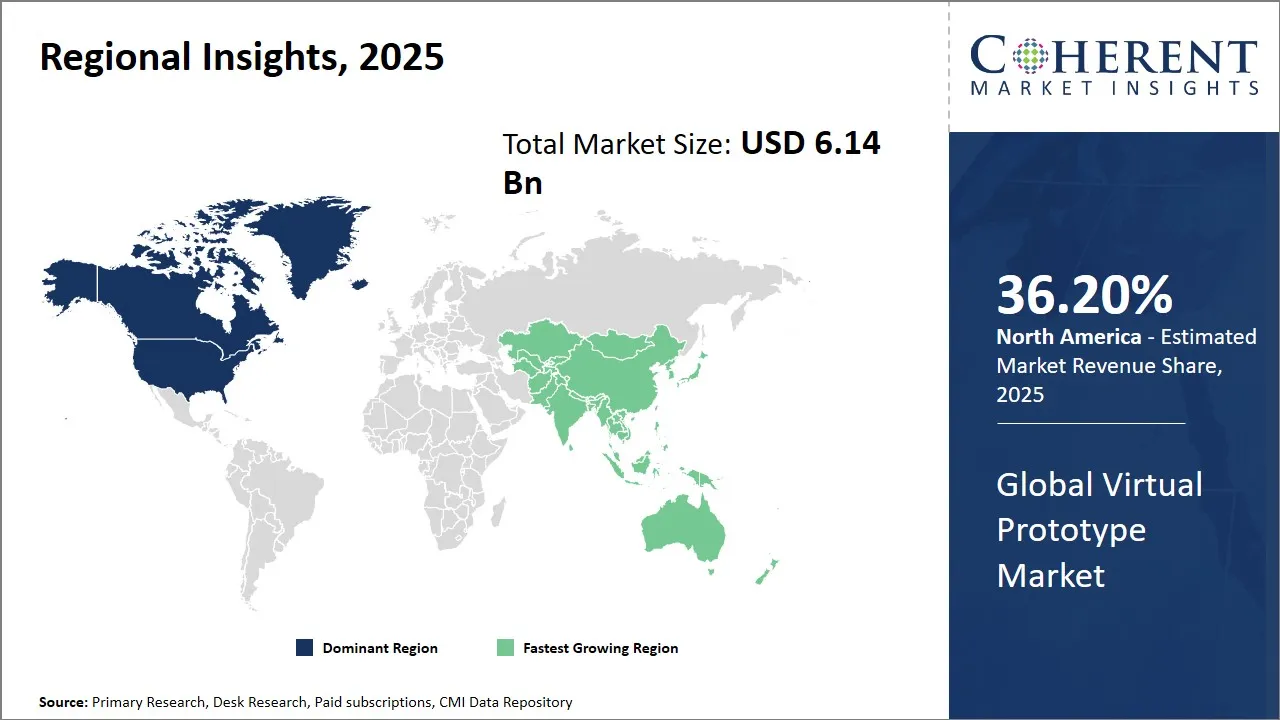
- North America is estimated to lead the market with a share of 36.2 % in 2026.
- Asia Pacific, holding a share of 30.1 % in 2026, is projected to be the fastest growing region.
Market Overview
A key trend in the virtual prototype market is the integration of advanced technologies such as artificial intelligence, machine learning, and augmented reality to enhance simulation accuracy and user experience. Additionally, the growing demand for digital twins and the shift towards Industry 4.0 initiatives are propelling market expansion. Increasing investments in R&D and the rising emphasis on sustainability are also encouraging companies to adopt virtual prototypes, enabling them to minimize physical prototyping and reduce material waste.
Current Events and Its Impact
Current Events | Description and its impact |
Geopolitical and Trade Developments |
|
Economic and Infrastructure Trends |
|
Segmental Insights
- Current Industry Events of 2026
- Market Size Estimation
- Regional Breakdown
- Competitive Landscape
- Customer Intelligence
- Segmental Analysis
- Pricing Analysis
- Key Market Drivers, Challenges & Future Trends
- Customized Insights Section
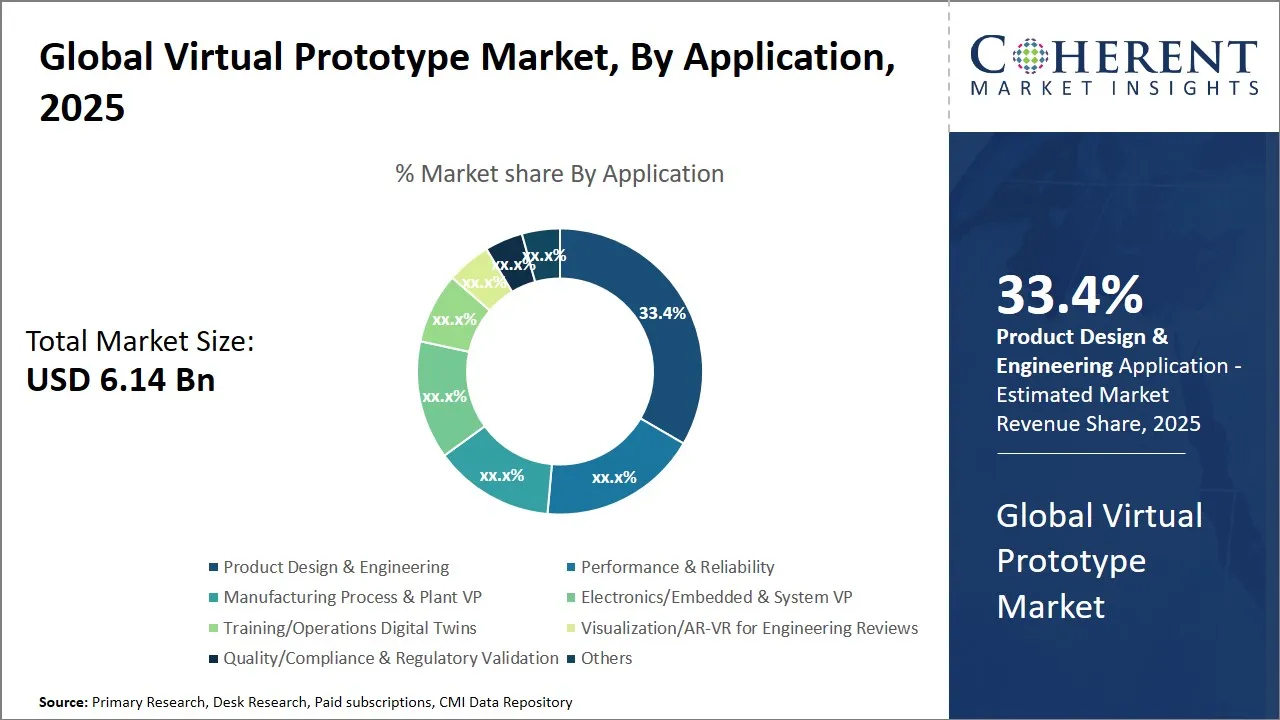
Global Virtual Prototype Market Insights, by Application – Innovation and Efficiency Propel the Product Design & Engineering Segment
Product design & engineering is expected to contribute the highest share of 34.4% in the market in 2026. Virtual prototyping enables designers and engineers to create and validate digital models of products before physical manufacturing, significantly reducing time-to-market and resource expenditure. The integration of advanced simulation tools within virtual prototypes allows for the early detection of design flaws and performance bottlenecks.
Furthermore, the push toward customization and complexity in modern products, particularly in the automotive, aerospace, and consumer electronics sectors, necessitates robust virtual prototyping solutions for managing intricate design parameters. Virtual prototypes facilitate collaboration among cross-functional teams by providing a shared digital workspace where modifications can be visualized and assessed in real time, improving communication and decision-making efficiency.
Add to this the rising adoption of digital transformation initiatives by enterprises seeking to enhance engineering workflows and reduce material waste, virtual prototyping emerges as a critical enabler of sustainable product development practices. Companies are increasingly recognizing the value of simulated testing in supporting regulatory compliance and quality assurance, especially in highly regulated industries.
Impact of AI on the Virtual Prototype Market
Artificial Intelligence (AI) is fundamentally reshaping the virtual prototyping (VP) landscape by enhancing model accuracy, automating simulation workflows, and reducing the time required to test complex product designs. Traditionally, creating high-fidelity prototypes required expert knowledge and significant manual setup. With AI-driven algorithms, tasks such as mesh generation, parameter optimization, and fault detection can now be automated, allowing engineers to focus more on design innovation rather than repetitive processes. AI integration also enables predictive analytics, where systems can learn from historical simulation data to forecast outcomes, thereby minimizing costly physical testing cycles and accelerating product launch timelines.
A notable instance of AI’s application is Ansys 2025 R2, which introduced AI-driven productivity enhancements that help engineers perform multiphysics simulations faster and with fewer errors. These AI-powered features significantly improve decision-making in industries like aerospace, automotive, and electronics, where design complexity is rapidly increasing.
Regional Insights
North America Virtual Prototype Market Analysis and Trends
North America, holding a share of 36.2% in 2026, is expected to dominate the global virtual prototype market, driven by a mature industrial ecosystem, advanced technological infrastructure, and strong investments in research and development. The presence of leading technology companies, such as Siemens Digital Industries Software, ANSYS, and Dassault Systèmes, has accelerated innovation and the adoption of virtual prototyping solutions.
Additionally, government initiatives promoting Industry 4.0 and digital manufacturing have fostered a favorable environment for market growth. The well-established automotive, aerospace, and electronics sectors in the U.S. and Canada heavily rely on virtual prototyping for product development efficiency and cost reduction. Furthermore, North America benefits from robust intellectual property protections and a collaborative industry-academia ecosystem, which propel continuous advancements and commercialization in this market.
Asia Pacific Virtual Prototype Market Analysis and Trends
The Asia Pacific, holding a share of 30.1% in 2026, is expected to exhibit the fastest growth in the global virtual prototype market, primarily attributed to rapid industrialization, increasing automation across manufacturing sectors, and expanding investments in digital technologies. Countries, such as China, Japan, South Korea, and India, are witnessing accelerated adoption of virtual prototyping driven by initiatives like "Made in China 2026" and India's Smart Manufacturing policies.
The region’s manufacturing hubs rely on virtual prototype technology to shorten design cycles, improve product quality, and reduce time-to-market amid intensifying global competition. Moreover, growing collaborations between regional startups and multinational corporations, along with expanding IT infrastructure, contribute to the dynamic growth. Notable regional players include Mitsubishi Electric, Hitachi, and local innovators focusing on customized virtual prototyping solutions to meet diverse industrial needs.
Global Virtual Prototype Market Outlook for Key Countries
U.S. Virtual Prototype Market Analysis and Trends
The U.S. continues to lead, supported by the dominance of major players such as PTC Inc., Siemens PLM Software, and ANSYS. These companies invest heavily in R&D to enhance capabilities like simulation fidelity and integration with IoT and AI technologies. The U.S. government’s emphasis on advanced manufacturing and digital innovation bolsters development, with sectors including aerospace, automotive, and consumer electronics driving demand. The presence of a well-established vendor ecosystem and service providers ensures streamlined deployment of virtual prototype technologies across enterprises, fostering innovation and efficiency in product design and validation processes.
Germany Virtual Prototype Market Analysis and Trends
Germany is characterized by a strong industrial base, particularly in automotive and mechanical engineering, which rely extensively on virtual prototyping. Key companies such as Siemens Digital Industries Software and Bosch leverage virtual prototype technologies to optimize production workflows and improve product reliability. Government programs supporting Industry 4.0 and digital transformation of the manufacturing sector further stimulate adoption. Germany’s advanced engineering education and research institutions also collaborate closely with industries, enabling continuous innovation in virtual prototyping methods tailored to complex manufacturing needs.
China Virtual Prototype Market Analysis and Trends
China is transforming into a significant player in the virtual prototype market, motivated by massive industrial expansion and government support through initiatives targeting smart manufacturing and digitalization. Key domestic firms like Huawei and Inspur are combining virtual prototype solutions with AI and cloud computing to meet localized requirements in automotive and electronics sectors. The large manufacturing output and growing need for rapid prototyping and testing solutions drive substantial market traction. Moreover, China benefits from an expanding startup ecosystem offering innovative virtual prototyping tools, which complements multinational corporations’ presence.
Japan Virtual Prototype Market Analysis and Trends
Japan continues to be a vital market with its emphasis on precision manufacturing, robotics, and automotive sectors. Corporations, such as Mitsubishi Electric, Hitachi, and FANUC, integrate virtual prototype technologies to enhance product accuracy and reduce costs. The government’s focus on Society 5.0—a vision combining cyber and physical systems—encourages advancements in digital manufacturing tools, including virtual prototyping. Additionally, Japanese companies emphasize long-term collaborations with technology providers to develop highly customized and efficient virtual prototype workflows, underpinning their competitive advantage in global markets.
India Virtual Prototype Market Analysis and Trends
India is rapidly evolving with increasing adoption of virtual prototyping facilitated by government initiatives like Make in India and the National Policy on Software Products. Local IT service providers and engineering startups are working alongside global firms, such as Dassault Systèmes and Siemens, to deliver cost-effective solutions tailored for the domestic manufacturing industry's diverse and growing segments. The demand is further propelled by automotive, aerospace, and electronics manufacturing hubs seeking to improve product development efficiency and reduce prototyping costs. Improving digital infrastructure and skilled workforce availability also support market expansion.
Market Players, Key Development, and Competitive Intelligence
Top Strategies Followed by Virtual Prototype Market Players
- Established players, typically large multinational corporations, heavily invest in research and development (R&D) to drive innovation and produce high-performance virtual prototype solutions that meet the evolving needs of diverse industries such as automotive, aerospace, and consumer electronics.
- Siemens Digital Industries Software continuously enhances its Simcenter platform with integrated AI-driven multiphysics capabilities.
- Mid-level players in the virtual prototype market adopt a more balanced approach, focusing on delivering cost-effective solutions that strike an optimal balance between quality and affordability.
- In February 2025, Altair launched HyperWorks 2025 with enhanced cloud-native VP workflows, enabling smaller and mid-sized manufacturers to access powerful simulation tools via subscription and pay-per-use models.
- Small-scale players in the virtual prototype market carve out their niches by focusing on specialized features or highly innovative solutions tailored to distinct industry needs or emerging technological trends.
- COMSOL has carved out a strong niche with its COMSOL Multiphysics platform, widely used in academic research, biomedical devices, and niche industrial physics modeling.
Key Developments
- In July 2025, Synopsys announced the completion of its acquisition of Ansys. The transaction combined leaders in silicon design, IP, and simulation and analysis to enable customers to rapidly innovate AI-powered products.
- In July 2025, Ansys announced 2025 R2, featuring new AI-powered capabilities across the portfolio that accelerate simulation and expand accessibility. R2 also delivers enhanced solvers, streamlined workflows, and improved engineering agility with expanded Python compatibility and on-demand cloud computing.
- In March 2025, Synopsys Inc. announced the availability of Synopsys Virtualizer Native Execution on Arm-based hardware, transforming software development for edge devices by substantially accelerating virtual prototype execution and deployment. This innovation delivers new, advanced capabilities that improve the productivity of engineering teams building software-defined products in the automotive, high-performance computing (HPC), and Internet of Things (IoT) industry segments.
- In February 2025, Altair, a global leader in computational intelligence, released Altair HyperWorks 2025, a best-in-class design and simulation platform for solving the complex engineering challenges
Market Report Scope
Virtual Prototype Market Report Coverage
| Report Coverage | Details | ||
|---|---|---|---|
| Base Year: | 2025 | Market Size in 2026: | USD 7.05 Bn |
| Historical Data for: | 2020 To 2024 | Forecast Period: | 2026 To 2033 |
| Forecast Period 2026 to 2033 CAGR: | 14.8% | 2033 Value Projection: | USD 18.52 Bn |
| Geographies covered: |
| ||
| Segments covered: |
| ||
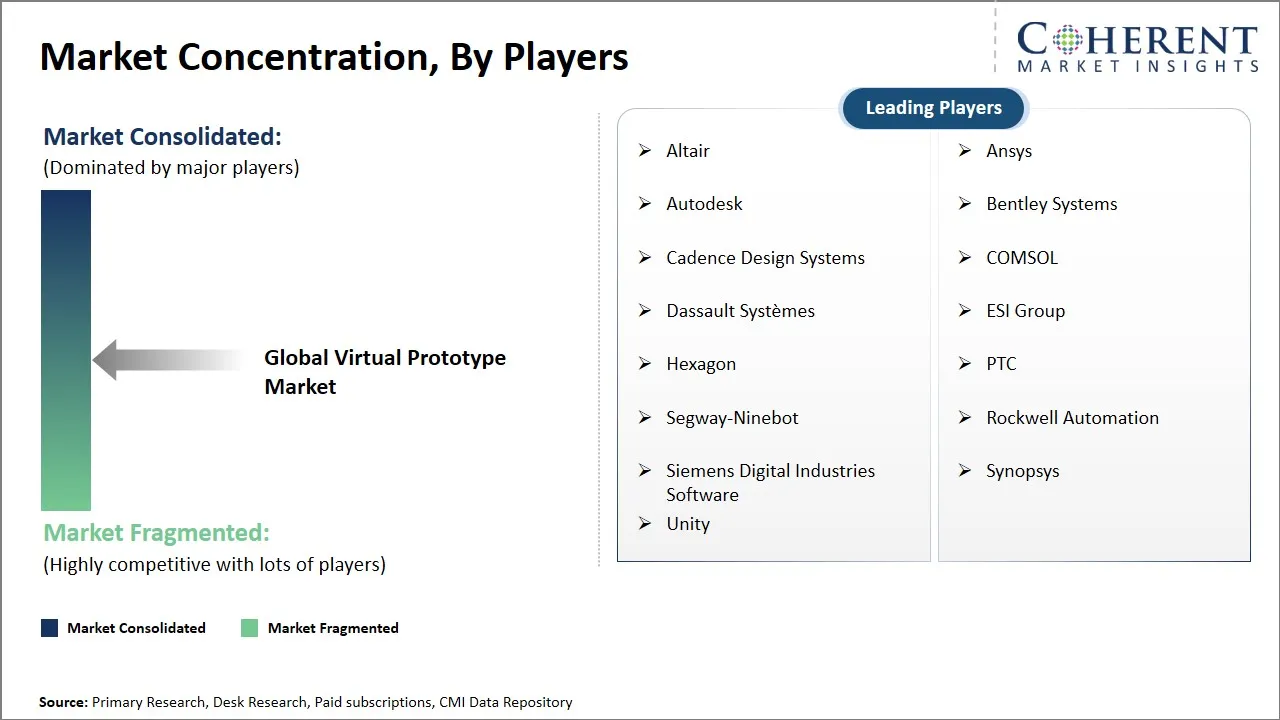
| Companies covered: | Altair, Ansys, Autodesk, Bentley Systems, Cadence Design Systems, COMSOL, Dassault Systèmes, ESI Group, Hexagon, PTC, Segway-Ninebot, Rockwell Automation, Siemens Digital Industries Software, Synopsys, and Unity | ||
| Growth Drivers: |
| ||
| Restraints & Challenges: |
| ||
Market Dynamics
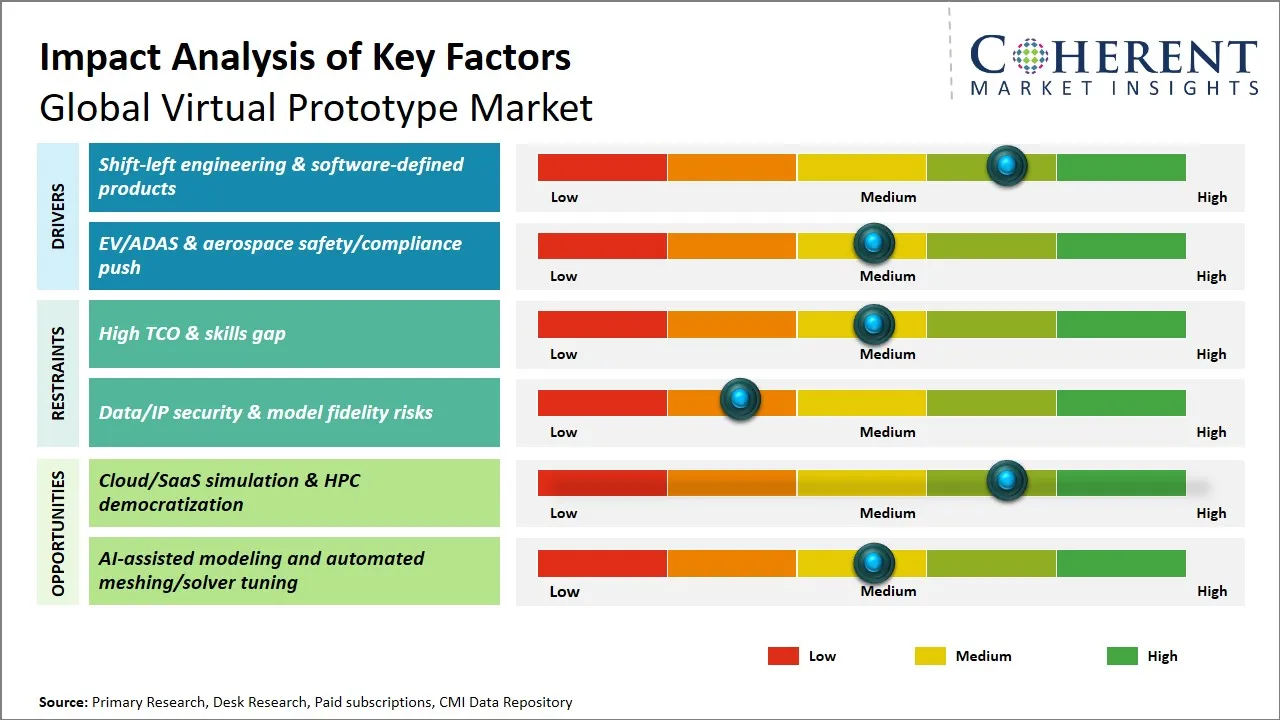
Global Virtual Prototype Market Driver – Shift-Left Engineering & Software-Defined Products
By integrating development and testing activities earlier in the product lifecycle, companies can identify and resolve design flaws well before physical production, significantly reducing time and cost overruns. Virtual prototypes enable engineers to simulate complex interactions and performance metrics in real-time, fostering more iterative and efficient design cycles. For instance, Synopsys’ Virtualizer Native Execution allows automotive and electronics companies to run complete software stacks on virtual prototypes earlier in the development cycle.
This approach aligns seamlessly with the growing trend toward software-defined products, where embedded software plays a critical role in product functionality and differentiation. As products become increasingly reliant on software, virtual prototypes offer a flexible platform to validate both hardware and software components simultaneously, streamlining collaboration between cross-functional teams.
Global Virtual Prototype Market Opportunity – Cloud/SaaS Simulation and HPC Democratization in the Global Virtual Prototype Market
The global virtual prototype market is witnessing a significant opportunity driven by the growing adoption of cloud-based simulation and Software-as-a-Service (SaaS) platforms, coupled with the democratization of High-Performance Computing (HPC). Traditionally, simulation and prototyping required extensive on-premises computational resources, limiting accessibility to large enterprises with significant capital expenditure budgets. However, the advent of cloud computing has transformed this landscape by offering scalable, flexible, and cost-effective access to advanced simulation tools and HPC capabilities. For instance, Altair HyperWorks 2025 offers cloud-native, pay-per-use simulation workflows, giving even small and mid-sized manufacturers access to high-performance virtual prototyping without investing in expensive in-house HPC clusters.
Cloud/SaaS solutions provide on-demand computing power and storage, facilitating real-time collaboration, faster iterations, and enhanced integration with product lifecycle management systems. Moreover, with democratized HPC, companies can accelerate complex simulations such as computational fluid dynamics, finite element analysis, and multi-physics modeling that were previously the domain of specialized research institutions.
Analyst Opinion (Expert Opinion)
- The integration of AI and machine learning into VP platforms is transforming how engineers interact with complex simulations. Automated meshing, predictive modeling, and design optimization are reducing engineering cycle times by up to 40%, enabling faster prototyping in industries like aerospace and EVs.
- Cloud/SaaS-based virtual prototyping solutions are lowering infrastructure barriers, making advanced simulation tools accessible to SMEs and startups. This trend is creating new adoption waves in cost-sensitive markets such as India and Southeast Asia, where pay-per-use HPC for VP is enabling innovation without prohibitive upfront costs.
- Beyond traditional design engineering, VP is now being integrated with AR/VR platforms and digital twins, particularly in training, maintenance, and regulatory compliance. For example, Dassault Systèmes’ collaboration with Apple Vision Pro is opening new immersive use-cases for design reviews, production planning, and operator training.
Speak to the analyst
Want personalized insights?
Take the findings above to one of our principal consultants, or have the report rebuilt around the segments, geographies and competitors you actually track.
Market Segmentation
- Application Insights (Revenue, USD Bn, 2021 - 2033)
- Product Design & Engineering
- Performance & Reliability
- Manufacturing Process & Plant VP
- Electronics/Embedded & System VP
- Training/Operations Digital Twins
- Visualization/AR-VR for Engineering Reviews
- Quality/Compliance & Regulatory Validation
- Others
- Regional Insights (Revenue, USD Bn, 2021 - 2033)
- North America
- U.S.
- Canada
- Latin America
- Brazil
- Argentina
- Mexico
- Rest of Latin America
- Europe
- Germany
- U.K.
- Spain
- France
- Italy
- Russia
- Rest of Europe
- Asia Pacific
- China
- India
- Japan
- Australia
- South Korea
- ASEAN
- Rest of Asia Pacific
- Middle East
- GCC Countries
- Israel
- Rest of Middle East
- Africa
- South Africa
- North Africa
- Central Africa
- North America
- Key Players Insights
- Altair
- Ansys
- Autodesk
- Bentley Systems
- Cadence Design Systems
- COMSOL
- Dassault Systèmes
- ESI Group
- Hexagon
- PTC
- Segway-Ninebot
- Rockwell Automation
- Siemens Digital Industries Software
- Synopsys
- Unity
Sources
Primary Research Interviews
Stakeholders
- Automotive & EV Manufacturers (e.g., Product Development Managers, Simulation Engineers)
- Aerospace & Defense OEMs (e.g., Design Validation Specialists, Systems Engineers)
- Semiconductor & Electronics Companies (e.g., Chip Designers, Embedded Systems Engineers)
- Industrial Machinery & Robotics Firms (e.g., Process Engineers, Plant Managers)
- Virtual Prototyping Software Vendors (e.g., Siemens, Dassault Systèmes, Altair, Synopsys/Ansys, Hexagon, COMSOL)
- Academic Researchers in Multiphysics Simulation and Digital Twins
- Cloud HPC Providers and SaaS Simulation Startups
Databases
- Eurostat
- U.S. Patent and Trademark Office (USPTO) – filings related to simulation & prototyping
- OECD
- World Intellectual Property Organization (WIPO)
- IndustryWeek Database
Magazines
- Engineering Simulation News
- Digital Engineering 24/7
- Manufacturing Technology Insights
- Electronics Weekly
- Automotive World
Journals
- Journal of Computational Science
- IEEE Transactions on Computer-Aided Design of Integrated Circuits and Systems
- International Journal for Numerical Methods in Engineering
- Simulation Modelling Practice and Theory
- Journal of Engineering Design
Newspapers
- The Economic Times (India)
- Nikkei Asia
- The Wall Street Journal (U.S.)
- The Guardian (UK)
- South China Morning Post
Associations
- NAFEMS (International Association for the Engineering Modelling, Analysis & Simulation Community)
- ASME (American Society of Mechanical Engineers)
- IEEE Computer Society
- Japan Society of Mechanical Engineers (JSME)
- Society of Automotive Engineers (SAE International)
Public Domain Sources
- U.S. Census Bureau
- EUROSTAT
- World Bank
- OECD
- ResearchGate
- United Nations Industrial Development Organization (UNIDO)
Proprietary Elements
- CMI Data Analytics Tool
- Proprietary CMI Existing Repository of information for last 8 years
Get access to 250+ pages report
Every segment, forecast, competitor profile and data table behind the analysis above — available for instant download.
- ESOMAR Member
- ISO 9001:2015 Certified
- D-U-N-S Registered
- GDPR & CCPA Compliant
Missing comfort of reading report in your local language? Find your preferred language:
Transform your Strategy with Exclusive Trending Reports
Frequently Asked Questions
The global virtual prototype market is estimated to be valued at USD 7.05 billion in 2026 and is expected to reach USD 18.52 billion by 2033.
The CAGR of global virtual prototype market is projected to be 14.8% from 2026 to 2033.
Shift-left engineering & software-defined products and EV/ADAS & aerospace safety/compliance push are the major factors driving the growth of the global virtual prototype market.
High TCO & skills gap and data/IP security & model fidelity risks are the major factora hampering the growth of the global virtual prototype market.
In terms of application, product design & engineering is estimated to dominate the market revenue share in 2026.
A digital simulation process is used to design, test, and validate products before physical prototyping.
AI automates meshing, optimizes simulations, and speeds up design iterations.