

Global Waterproofing Chemicals Market Size and Forecast – 2026- 2033
The global waterproofing chemicals market is estimated to be valued at USD 7.80 Bn in 2026 and is expected to reach USD 12.60 Bn by 2033, exhibiting a compound annual growth rate (CAGR) of 7.1% from 2026 to 2033.
Key Takeaways of the Waterproofing Chemicals Market
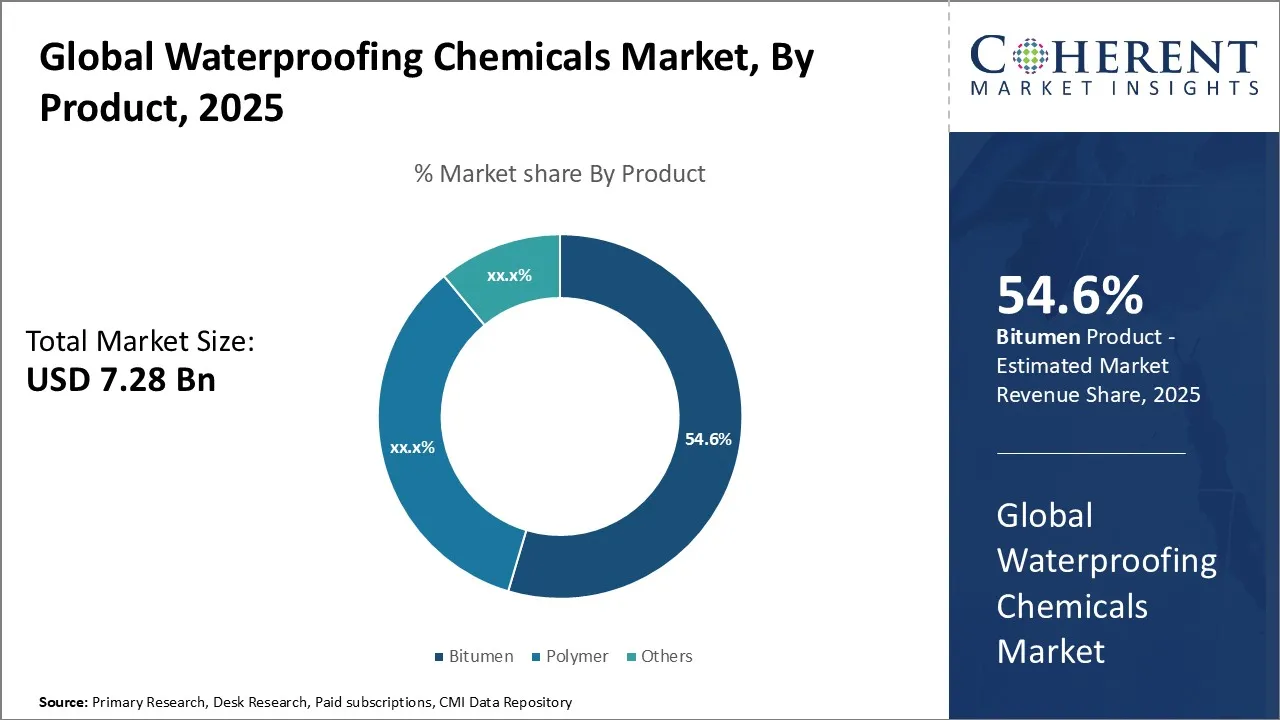
- The bitumen segment is projected to account for 55.6 % share in 2026.
- The roofing segment is expected to capture 39.5 % share in 2026.
- Asia Pacific is projected to lead the global waterproofing chemicals market in 2026 with a 48.9 % share. Europe, with an estimated share of 30.5% in 2026, is expected to be the fastest-growing region.
Market Overview
The waterproofing chemicals market is shifting towards sustainable solutions with bio-based and low-VOC products. Innovations in nanotechnology, polymer science, and the use of waterproofing admixtures are improving durability, while rising demand for waterproofing membranes highlights versatile applications across construction and infrastructure. Growing climate resilience awareness and smart technology integration are further driving high-performance product adoption.
Current Events and Its Impact
Current Events | Description and its Impact |
Tightening low-VOC & hazardous substance regulations across major regions |
|
Urban Flood-Resilience and Climate-Adaptation Programs |
|
Segmental Insights
- Current Industry Events of 2026
- Market Size Estimation
- Regional Breakdown
- Competitive Landscape
- Customer Intelligence
- Segmental Analysis
- Pricing Analysis
- Key Market Drivers, Challenges & Future Trends
- Customized Insights Section
Waterproofing Chemicals Market Insights, by Product – Bitumen Segment Dominates the Market Owing to its Superior Waterproofing Efficiency and Cost-Effectiveness
The bitumen segment is expected to hold 55.6% of the market share in 2026, driven by its proven performance in creating durable and efficient waterproofing layers. One of the critical factors behind bitumen’s market leadership is its inherent waterproofing properties, which provide exceptional resistance against water infiltration even under extreme environmental conditions. Its ability to form a seamless, flexible membrane makes it ideal for protecting structures against moisture-related damages, which is a critical requirement in both construction and infrastructure projects.
For example, in large-scale infrastructure projects such as highway pavements and bridges in India and the Middle East, bitumen-based waterproofing membranes have been extensively adopted due to their ability to withstand high temperature variations and heavy traffic loads, ensuring long-term durability and reduced maintenance costs.
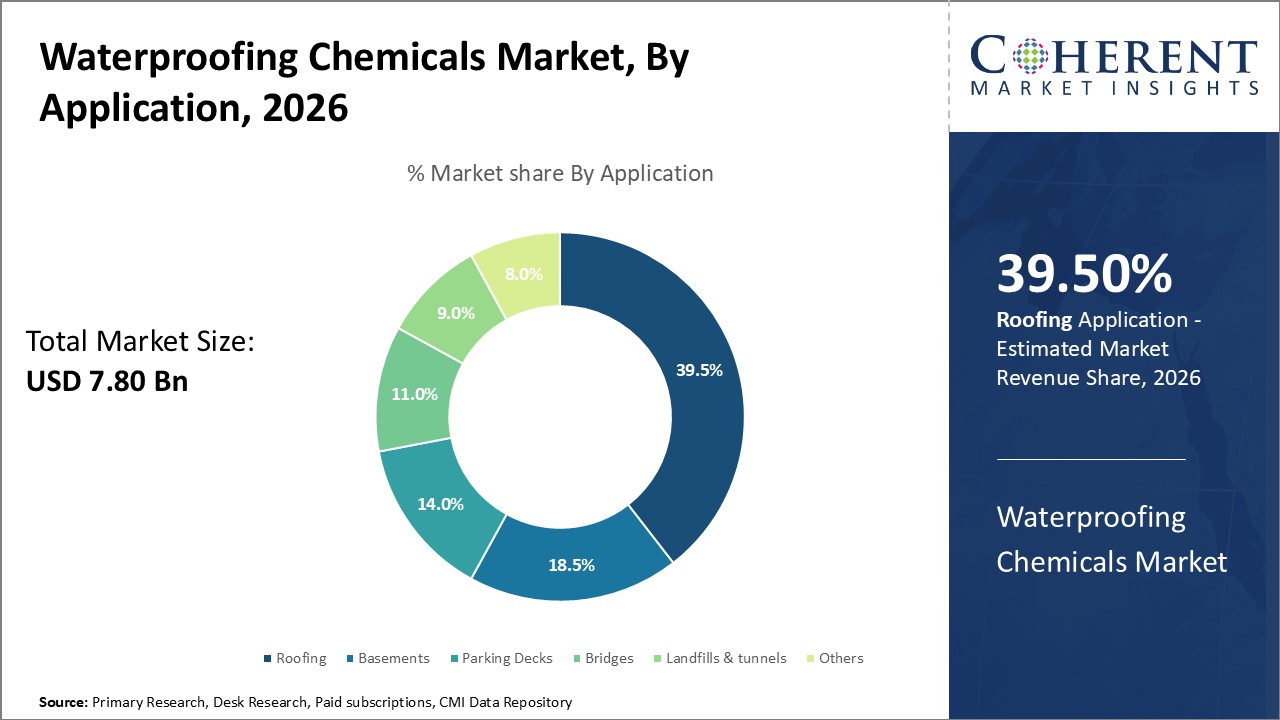
Waterproofing Chemicals Market Insights, by Application – Roofing Segment Dominates the Market Propelled by Increasing Urbanization and Stringent Building Regulations
The roofing segment is projected to account for 39.5% of the market share in 2026, driven by escalating urban development and the growing emphasis on protective building envelopes. Roofing structures are exposed continuously to a variety of environmental stresses including heavy rainfall, UV radiation, temperature fluctuations, and wind-driven water infiltration, which makes reliable waterproofing indispensable.
Urbanization and expansion of residential, commercial, and industrial infrastructure have intensified the demand for efficient roofing solutions. Modern architectural trends emphasize not only aesthetics but also functionality, with waterproofing playing a critical role in enhancing roof lifespan and occupant comfort. Waterproofing chemicals specifically formulated for roofing applications help in preventing water ingress that could otherwise cause structural deterioration, mold growth, and thermal inefficiency.
Regional Insights
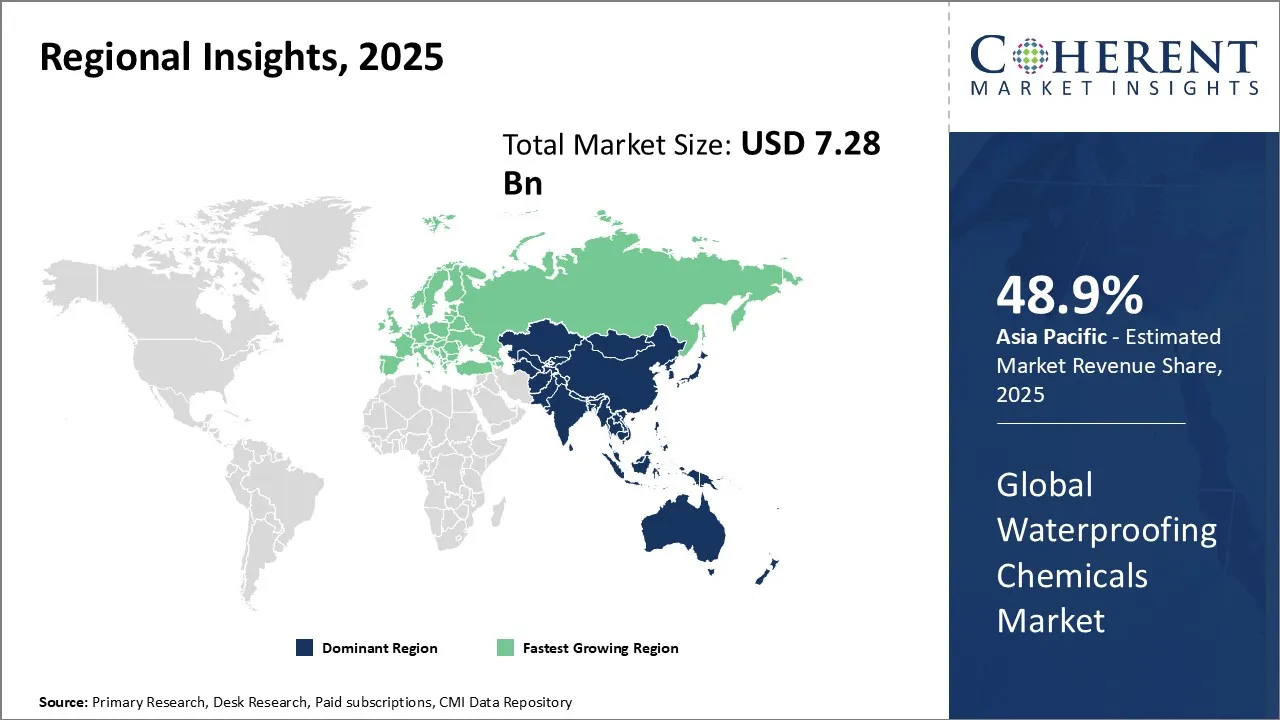
Asia Pacific Waterproofing Chemicals Market Analysis and Trends
The Asia Pacific region is projected to lead the market with a 48.9% share in 2026, driven by rapid urbanization, expansive construction activities, and strong industrial growth in countries like China, India, Japan, and South Korea. The dense market ecosystem features numerous manufacturers, research institutions, and a well-established supply chain that supports large-scale production and innovation.
Government initiatives focused on infrastructure development, sustainable building practices, and stricter regulations on waterproofing standards fuel the demand for advanced waterproofing solutions. Additionally, the presence of notable companies such as BASF, Sika AG, and Pidilite Industries propels innovation and market penetration. Strong export channels and a growing construction sector contribute to the region’s leadership in the market globally.
Europe Waterproofing Chemicals Market Analysis and Trends
The Europe region is expected to exhibit the fastest growth in the market contributing 30.5% share in 2026, supported by stringent building regulations, sustainability targets, and the region’s focus on energy-efficient construction. The European Union’s Green Deal and directives like Registration, Evaluation, Authorization and Restriction of Chemicals (REACH) are pushing manufacturers to innovate eco-friendly and high-performance waterproofing solutions. Countries such as Germany, France, and the U.K. are witnessing strong demand across residential, commercial, and infrastructure projects, driven by urban renewal programs and retrofitting of older buildings to meet modern safety and environmental standards.
The market ecosystem benefits from advanced R&D capabilities and the presence of leading global players such as Sika AG, BASF, and MAPEI S.p.A., who actively invest in sustainable technologies, bio-based formulations, and digitalized construction processes. Strategic collaborations, acquisitions, and investments in regional production facilities strengthen supply chain resilience and reduce reliance on imports. Additionally, cross-border trade within the EU, coupled with robust logistics networks, facilitates smooth distribution of raw materials and finished products, ensuring high market integration and competitiveness across the region.
Global Waterproofing Chemicals Market Outlook for Key Countries
China Waterproofing Chemicals Market Analysis and Trends
China waterproofing chemicals market flourishes against the backdrop of massive infrastructure expansion, including urban housing, industrial complexes, and public infrastructure. The government's emphasis on green building standards and water conservation drives the demand for eco-friendly waterproofing solutions. Companies like BASF and Sika AG have heavily invested in local R&D and manufacturing facilities to support product customization tailored to China’s climatic and construction needs, reinforcing domestic supply while catering to export demands.
India Waterproofing Chemicals Market Analysis and Trends
India waterproofing chemicals market is propelled by rising infrastructure development under government schemes such as Smart Cities and Housing for All initiatives. The country witness’s vibrant competition among regional players like Pidilite Industries and international companies such as MAPEI, fostering a diverse product range with technical advancements in polymer- and cementitious-based waterproofing chemicals. India's regulatory measures for construction safety and sustainability further boost adoption of high-performance waterproofing products.
U.S. Waterproofing Chemicals Market Analysis and Trends
The U.S. retains a strong market presence driven by advanced construction technologies and widespread renovation activities focused on climate resilience and energy efficiency. Domination by key players such as Dow Chemical and GCP Applied Technologies ensures continuous innovation in waterproofing materials with enhanced durability and environmental compliance. Government incentives promoting green building certification standards fuel the demand for next-generation waterproofing chemicals.
Germany Waterproofing Chemicals Market Analysis and Trends
Germany waterproofing chemicals market benefits from its mature construction industry and stringent regulations supporting sustainability and safety. The country’s focus on industrial and residential waterproofing aligns with broader European policies targeting energy-efficient buildings. Companies like Sika AG (headquartered in Switzerland but with significant operations in Germany) and Henkel AG & Co. KGaA drive the market through advanced product formulations and strong distribution networks, keeping pace with high market standards and customer demands.
U.A.E. Waterproofing Chemicals Market Analysis and Trends
The U.A.E.’s rapidly expanding urban landscape, characterized by mega-projects such as Expo developments and luxury real estate ventures, stimulates high demand for efficient waterproofing solutions. Government policies promoting sustainable construction and energy conservation reinforce the growth outlook. Global players like MAPEI and BASF collaborate with local distributors to deliver region-specific waterproofing chemicals capable of withstanding harsh desert conditions, thereby influencing the overall the market expansion.
Macro and Micro Economic Factors Impacting Waterproofing Chemicals Market Growth
Macro-Economic Factors
- Urbanization and Infrastructure Investment: Rapid urbanization, ongoing infrastructure renewal, and expansion—particularly in emerging economies like China, India, and Southeast Asia—fuel high demand for quality waterproofing solutions in large-scale roads, bridges, tunnels, and building constructions.
- Inflation and Trade Policies: Fluctuations in energy and raw material prices (especially petroleum-based), inflation rates, and tariffs can directly affect manufacturing costs and profitability. Trade tensions and supply chain constraints (like tariffs on chemical imports) impact the price and availability of crucial inputs.
- Climate Change and Regulatory Pressure: Increasing climate instability—frequent flooding, severe rain, and extreme weather—drives awareness around resilience and mandates waterproofing standards in construction codes. Stringent environmental and building safety regulations globally demand use of higher-performance and eco-friendly waterproofing chemicals.
Micro Economic Factors
- Technological Innovation: Advancements such as nanotechnology, polyurethane-based materials, and smart coatings increase product performance, durability, and cost-effectiveness, and support market differentiation for manufacturers.
- Product Development and Sustainability: Transition to solvent-free, bio-based, and low-VOC formulations due to green building incentives and customer preference for sustainable materials.
- Regulatory and Health Concerns: Exposure risks to volatile vapors (bitumen and other petroleum-based products) and disposal requirements shape product selection and restrict certain technologies, especially in regions with stricter regulatory environments
Market Players, Key Development, and Competitive Intelligence
Key Developments
- In February 2024, MAPEI S.p.A. announced the acquisition of Saudi Arabian waterproofing solutions provider, Bitumat, as part of its long-term strategy to strengthen its footprint in the Middle East. Bitumat operates a major production facility in the 2nd Industrial City of Dammam and an additional manufacturing plant in Bahrain. Its waterproofing solutions are widely utilized across building projects throughout the Middle East and Africa.
- In April 2023, Sika AG entered into a collaboration with the University of Cádiz (UCA) to advance innovative technologies aimed at protecting concrete structures from oil and water penetration. Developed by the UCA Nanomaterials research team, the surface-modifying technology is tailored for reinforced concrete. The new agreement seeks to expand the scope and functionality of this technology, further enhancing durability solutions for concrete infrastructure.
Top Strategies Followed by Global Waterproofing Chemicals Market Players
- Established players dominate the market by heavily investing in research and development (R&D) to innovate advanced, high-performance waterproofing solutions that cater to evolving industry requirements. Their R&D efforts focus on enhancing product durability, environmental friendliness, and application versatility, thereby setting quality benchmarks.
- For instance, BASF, developed advanced admixtures and waterproofing membranes that improve durability while meeting strict environmental standards under EU REACH.
- Mid-level players in the waterproofing chemicals market adopt a distinctly different yet complementary approach, focusing primarily on offering cost-effective waterproofing solutions that strike a balance between quality and affordability. Their target customer segments often include price-sensitive consumers, small and medium-scale construction firms, and regions where budget constraints influence purchasing decisions. By emphasizing value-for-money propositions, these mid-tier companies differentiate themselves while catering to an expanding market niche.
- For example, Pidilite, become a trusted brand in India and Southeast Asia by marketing cost-effective solutions such as acrylic-based waterproofing coatings that cater to small and medium-scale contractors. W.R. Meadows in North America provides elastomeric liquid waterproofing membranes designed for residential builders who seek budget-friendly but durable options.
- Small-scale players in the global waterproofing chemicals market typically operate with limited resources but exhibit agility through niche specialization and technology adoption. These companies often focus on developing waterproofing products with specialized features such as eco-friendly formulations, rapid curing times, or applications tailored to specific construction needs. Their innovation-driven approach enables them to carve out distinct market segments less accessible to larger competitors.
- For example, Kryton specializes in crystalline waterproofing admixtures that self-heal cracks in concrete, providing a unique advantage in high-rise construction and tunneling projects. Flexcrete gained recognition for waterborne, eco-friendly waterproofing systems with rapid curing times that suit refurbishment projects in the U.K.
Market Report Scope
Waterproofing Chemicals Market Report Coverage
| Report Coverage | Details | ||
|---|---|---|---|
| Base Year: | 2025 | Market Size in 2026: | USD 7.80 Bn |
| Historical Data for: | 2020 To 2024 | Forecast Period: | 2026 To 2033 |
| Forecast Period 2026 to 2033 CAGR: | 7.1% | 2033 Value Projection: | USD 12.60 Bn |
| Geographies covered: |
| ||
| Segments covered: |
| ||
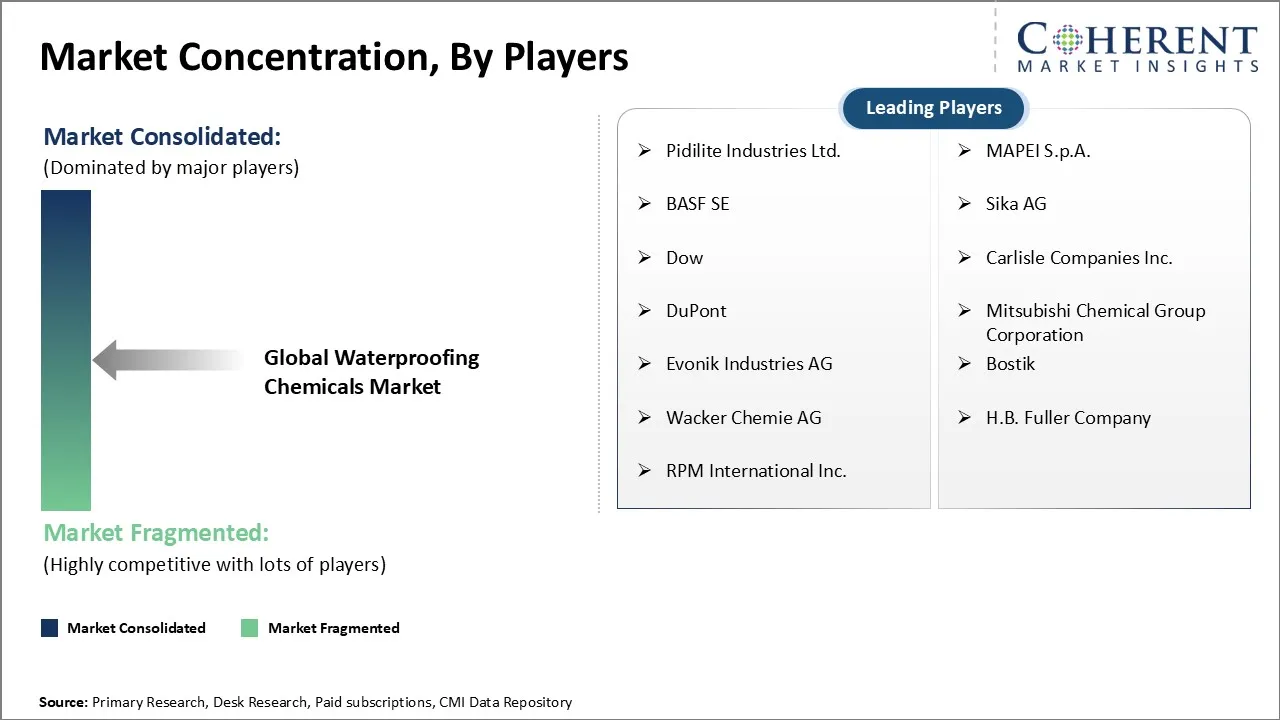
| Companies covered: | Pidilite Industries Ltd., MAPEI S.p.A., BASF SE, Sika AG, Dow, Carlisle Companies Inc., DuPont, Mitsubishi Chemical Group Corporation, Evonik Industries AG, Bostik, Wacker Chemie AG, H.B. Fuller Company, and RPM International Inc. | ||
| Growth Drivers: |
| ||
| Restraints & Challenges: |
| ||
Waterproofing Chemicals Market Dynamics
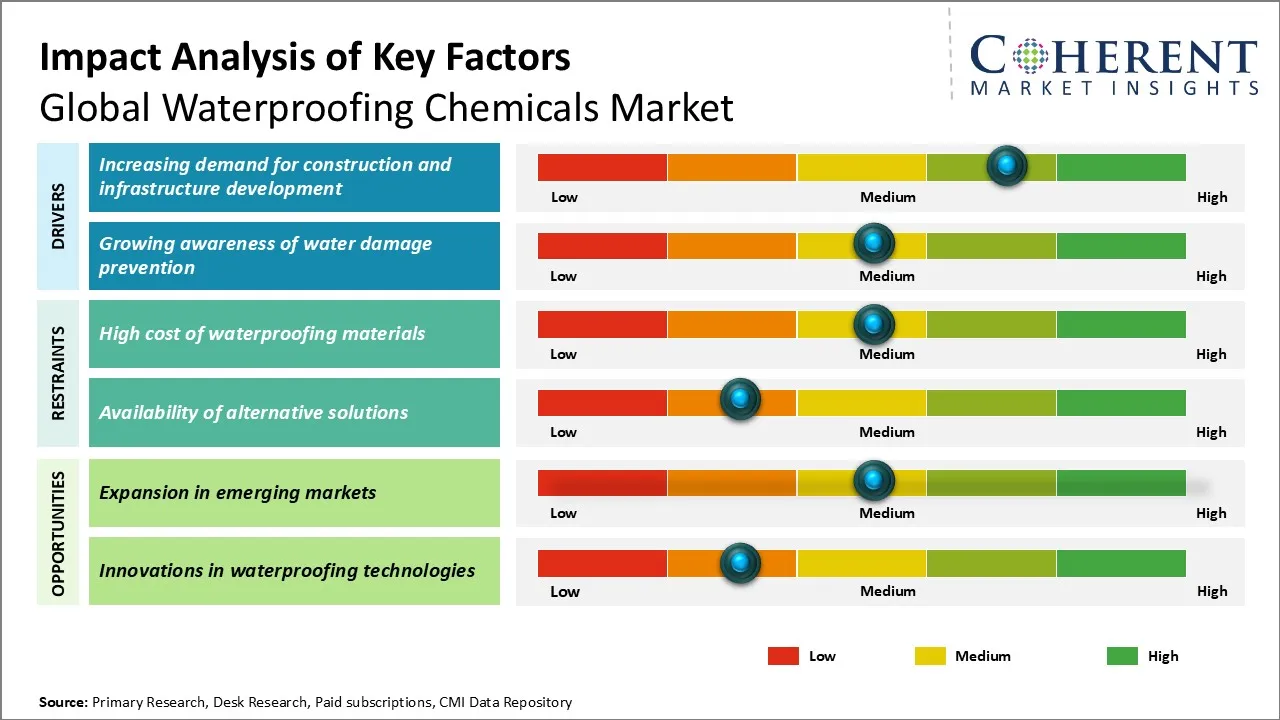
Waterproofing Chemicals Market Driver - Increasing Demand for Construction and Infrastructure Development
The accelerating pace of urbanization and industrialization across emerging and developed economies is significantly driving the demand for waterproofing chemicals. As governments and private sectors invest heavily in new infrastructure projects, including commercial buildings, residential complexes, bridges, tunnels, and transportation networks, the need for durable and long-lasting construction materials becomes critical. Waterproofing chemicals play a vital role in enhancing the structural integrity of these developments by preventing water ingress, which can cause corrosion, deterioration, and safety hazards. Moreover, stringent building codes and regulations aimed at improving sustainability and safety standards are pushing construction companies to adopt advanced waterproofing solutions.
For instance, in India, the government’s “Smart Cities Mission” and rapid metro expansion projects in Delhi, Mumbai, and Bengaluru are fueling the demand for waterproofing products in underground tunnels, bridges, and residential projects.
Waterproofing Chemicals Market Opportunity - Expansion in Emerging Markets
The global waterproofing chemicals market presents significant growth opportunities through expansion in emerging markets driven by rapid urbanization, increasing infrastructure development, and rising disposable incomes. Countries in Asia Pacific, Latin America, and Africa are witnessing accelerated construction activities, which are critical drivers for demand in waterproofing solutions. These regions often face climatic challenges such as heavy rainfall and humidity, intensifying the need for effective waterproofing chemicals to enhance the durability and longevity of buildings and infrastructure. Moreover, government initiatives focused on improving housing, commercial complexes, and transportation infrastructure further stimulate market potential.
For instance, Brazil’s preparations for large-scale sporting events and continuous investments in urban housing programs, coupled with Mexico’s expansion of commercial spaces in cities like Mexico City and Monterrey, are increasing waterproofing applications.
Analyst Opinion (Expert Opinion)
- The global waterproofing chemicals market is set for significant expansion, driven by increasing construction activities and a heightened focus on infrastructure resilience. Insights from the International Waterproofing Conference (2023) and the Global Construction Summit (2022) highlighted key innovations, with companies like BASF and Sika spearheading advancements in eco-friendly waterproofing solutions.
- BASF’s recent introduction of a bio-based waterproofing membrane exemplifies the industry's shift towards sustainable materials, responding to growing regulatory pressures and consumer demand for environmentally responsible options.
- Discussions at these conferences underscored the critical need for effective moisture management in both residential and commercial projects, particularly in regions prone to extreme weather. However, challenges such as fluctuating raw material prices and stringent compliance standards were noted as potential barriers to growth.
- Companies that prioritize R&D to enhance product performance and longevity will likely gain a competitive edge. Additionally, forming strategic partnerships with construction firms can facilitate broader market penetration. Ultimately, the waterproofing chemicals market's future will depend on its ability to innovate while addressing the evolving the demands of the construction industry and environmental sustainability.
Speak to the analyst
Want personalized insights?
Take the findings above to one of our principal consultants, or have the report rebuilt around the segments, geographies and competitors you actually track.
Market Segmentation
- Product Insights (Revenue, USD Bn, 2021 - 2033)
- Bitumen
- SBS
- APP
- Others
- Polymer
- PVC
- TPO
- EPDM
- Others
- Others
- Application Insights (Revenue, USD Bn, 2021 - 2033)
- Roofing
- Basements
- Parking Decks
- Bridges
- Landfills & tunnels
- Others
- Regional Insights (Revenue, USD Bn, 2021 - 2033)
- North America
- U.S.
- Canada
- Latin America
- Brazil
- Argentina
- Mexico
- Rest of Latin America
- Europe
- Germany
- U.K.
- Spain
- France
- Italy
- Russia
- Rest of Europe
- Asia Pacific
- China
- India
- Japan
- Australia
- South Korea
- ASEAN
- Rest of Asia Pacific
- Middle East
- GCC Countries
- Israel
- Rest of Middle East
- Africa
- South Africa
- North Africa
- Central Africa
- North America
- Key Players Insights
- Pidilite Industries Ltd.
- MAPEI S.p.A.
- BASF SE
- Sika AG
- Dow
- Carlisle Companies Inc.
- DuPont
- Mitsubishi Chemical Group Corporation
- Evonik Industries AG
- Bostik
- Wacker Chemie AG
- B. Fuller Company
- RPM International Inc.
Sources
Primary Research Interviews
- R&D Director – Leading Waterproofing Chemicals Manufacturer
- Procurement Manager – Global Construction & Infrastructure Firm
- Product Development Head – Building Materials Company
- Sustainability Manager – Green Building Certification Body (LEED/BREEAM)
Stakeholders
- Manufacturers
- End Use Sectors:
- Construction (Residential, Commercial, Industrial Buildings)
- Infrastructure (Roads, Bridges, Tunnels, Dams)
- Automotive & Transportation
- Packaging & Textiles (moisture resistance applications)
- Regulatory & Certification Bodies
- E-commerce Platforms and Retailers for DIY waterproofing products
- Technology Integration Players: Smart coatings & nanomaterials providers
Databases
- UN Comtrade Database
- India Import Export (EXIM) Database
- Eurostat – Construction & Chemicals Trade Data
- U.S. Geological Survey (USGS) – Chemicals & Materials Statistics
Magazines
- Construction Chemicals Magazine – Insights into waterproofing materials
- Coatings World – Updates on waterproofing and specialty coatings
- Chemical Weekly – Market developments in chemical products
- Global Construction Review – Waterproofing in infrastructure projects
- Building & Construction Technology Journal – Advanced waterproofing solutions
Journals
- Journal of Building Engineering – Waterproofing and durability studies
- Journal of Applied Polymer Science – Waterproofing chemical formulations
- Cement & Concrete Composites – Waterproofing admixtures in concrete
- Journal of Construction & Building Materials – Performance of waterproofing membranes
- Progress in Organic Coatings – Research on polymer-based waterproofing
Newspapers
- The Financial Times – Construction chemicals market growth
- The Economic Times – Infrastructure development & waterproofing demand in Asia
- Construction Europe News – Waterproofing trends in Europe
- Gulf News – Waterproofing in Middle East mega projects
- The New York Times – U.S. construction material demand shifts
Associations
- American Concrete Institute (ACI)
- Construction Chemicals Manufacturers Association (CCMA)
- European Federation for Construction Chemicals (EFCC)
- National Roofing Contractors Association (NRCA)
- World Green Building Council (WGBC)
Public Domain Sources
- U.S. Environmental Protection Agency (EPA) – Regulations on VOC emissions in waterproofing chemicals
- European Chemicals Agency (ECHA) – REACH Regulations on construction chemicals
- Bureau of Indian Standards (BIS) – Standards for waterproofing chemicals
- World Health Organization (WHO) – Safety aspects of chemical usage in building environments
Proprietary Elements
- CMI Data Analytics Tool, Proprietary CMI Existing Repository of information for last 8 years.
Get access to 250+ pages report
Every segment, forecast, competitor profile and data table behind the analysis above — available for instant download.
- ESOMAR Member
- ISO 9001:2015 Certified
- D-U-N-S Registered
- GDPR & CCPA Compliant
Missing comfort of reading report in your local language? Find your preferred language:
Transform your Strategy with Exclusive Trending Reports
Frequently Asked Questions
The global waterproofing chemicals market is estimated to be valued at USD 7.80 Bn in 2026 and is expected to reach USD 12.60 Bn by 2033.
The CAGR of the global waterproofing chemicals market is projected to be 7.1% from 2026 to 2033.
Increasing demand for construction and infrastructure development and growing awareness of water damage prevention are the major factors driving the growth of the global waterproofing chemicals market.
High cost of waterproofing materials and availability of alternative solutions are the major factors hampering the growth of the global waterproofing chemicals market.
In terms of product, the bitumen segment is estimated to dominate the market revenue share in 2026.
Pidilite Industries Ltd., MAPEI S.p.A., BASF SE, Sika AG, Dow, Carlisle Companies Inc., DuPont, Mitsubishi Chemical Group Corporation, Evonik Industries AG, Bostik, Wacker Chemie AG, H.B. Fuller Company, and RPM International Inc. are the major players.
Asia Pacific is expected to lead the global waterproofing chemicals market in 2026.