

Global Weather Strip Market Size and Forecast – 2026 To 2033
The Global Weather Strip Market is estimated to be valued at USD 12.91 Bn in 2026 and is expected to reach USD 20.33 Bn by 2033, exhibiting a compound annual growth rate (CAGR) of 6.7% from 2026 to 2033. The weather strip market growth is supported by increasing adoption of advanced weather strip and sealing solutions across automotive, construction, and industrial sectors where they are used to prevent air leakage, water ingress, dust entry, vibration, and noise transmission.
Automotive application is related to enhanced noise, vibration, and harshness and cabin comfort and long vehicle durability, while in buildings, weather strips are used for the sealing of doors, windows and the building envelope in an energy-efficient manner. Adhesive-backed sealing formats, and the increase of EPDM, PVC, silicone, TPE, and TPV formats is also enhancing the performance of the products and their installation. The U.S. Department of Energy points out that windows, doors, and skylights are typical areas of air leakage, and suggests increased use of weatherstripping as a way to increase building efficiency and lower heating and cooling costs.
Key Takeaways of the Global Weather Strip Market
- EPDM rubber is expected to dominate by material type with 38.6 % share in 2026, supported by its durability, compression recovery, and suitability for long-life automotive and building sealing profiles. In December 2025, Toyoda Gosei commercialized weatherstrips using higher recycled rubber content for Toyota’s new RAV4, reinforcing continued OEM focus on rubber-based sealing innovation.
- Door seals are expected to lead by product type with 34.7 % share in 2026, as vehicle doors, building entrances, and industrial access points require consistent air, water, dust, and noise protection. In July 2025, Cooper Standard showcased its FlexiCore thermoplastic body door seal and FlushSeal system on Renault Group’s Emblème demo car.
- Automotive is expected to remain the largest application with 42.8 % share in 2026, as weather strips are critical for cabin comfort, NVH control, waterproofing, and vehicle aerodynamics. In April 2026, International Organization of Motor Vehicle Manufacturers (OICA) reported that global vehicle production increased to 96.4 million units in 2025, keeping automotive platforms central to sealing demand.
- Asia Pacific is expected to dominate the market with 35.4 % share in 2026, supported by large-scale automotive production, expanding construction activity, and strong supplier ecosystems across China, India, Japan, and Southeast Asia. In April 2026, OICA stated that Asia Pacific produced around 59.2 million vehicles in 2025, accounting for more than 61% of the global output.
- North America is expected to be the fastest-growing region with 27.8 % share in 2026, backed by retrofit demand, energy-efficiency upgrades, and steady automotive replacement needs. In February 2026, Natural Resources Canada reported windows and doors, insulation, and air sealing among the top Greener Homes retrofit categories, supporting the demand for sealing products.
- Sustainable Sealing Materials: Weather strip suppliers are moving toward recyclable, lighter, and lower-emission sealing designs as OEMs and building product buyers increase scrutiny of material footprint. This trend is shifting competition from basic extrusion capacity toward formulation expertise, recyclability, and lifecycle performance, creating stronger opportunities for suppliers with advanced rubber, TPE, TPV, and hybrid material platforms.
- Performance-Led Product Differentiation: Weather strips are increasingly being treated as engineered performance components rather than commodity profiles. Demand is moving toward seals that improve acoustic comfort, reduce leakage, support thermal efficiency, enable smoother assembly, and integrate with modern vehicle and building designs. This favors manufacturers offering customized profiles, adhesive-backed systems, and application-specific sealing solutions.
Segmental Insights
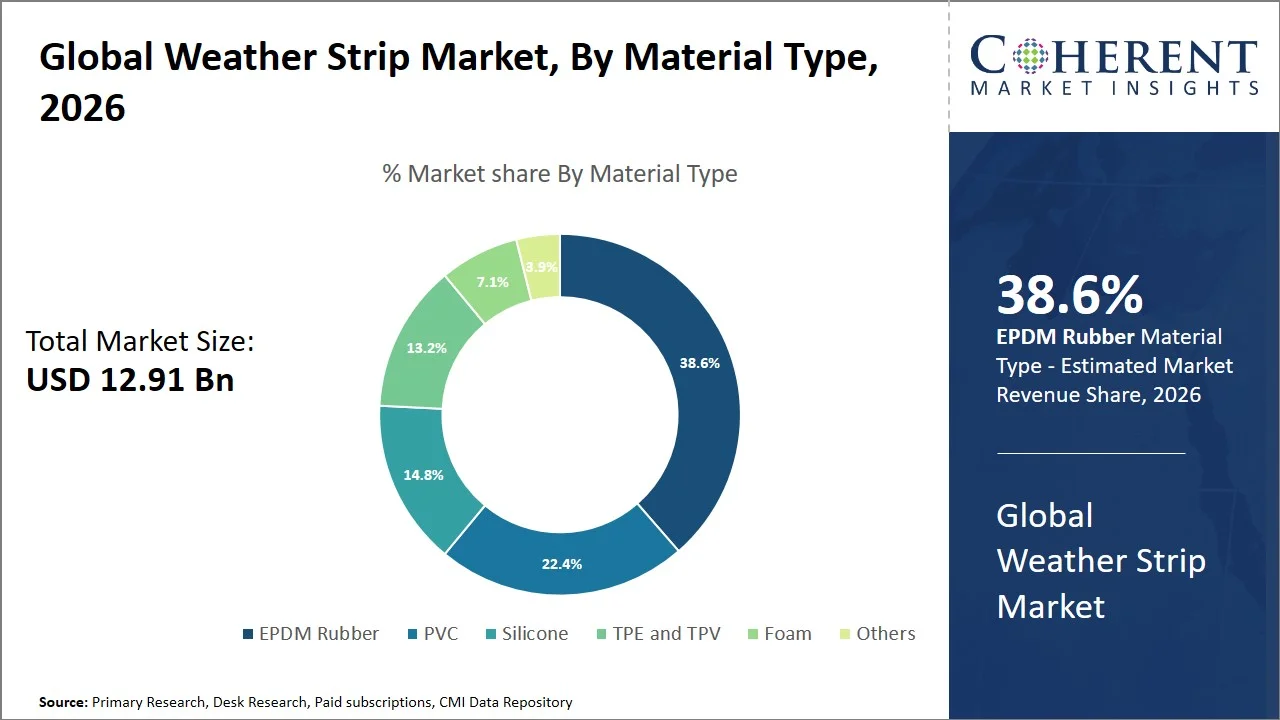
Why Does EPDM Rubber Dominate the Global Weather Strip Market?
EPDM rubber is expected to dominate the global weather strip market with 38.6% share in 2026, as it offers a strong balance of elasticity, weather resistance, compression recovery, and long-term sealing performance. Its leadership is reinforced by continuous use in automotive body sealing, building profiles, roofing membranes, and exterior sealing systems where exposure to heat, ozone, UV, rain, and repeated mechanical movement is high. Demand is supported by OEMs and construction suppliers seeking durable sealing materials that reduce warranty failures and maintain acoustic, thermal, and moisture protection over long service cycles.
- Current Industry Events of 2026
- Market Size Estimation
- Regional Breakdown
- Competitive Landscape
- Customer Intelligence
- Segmental Analysis
- Pricing Analysis
- Key Market Drivers, Challenges & Future Trends
- Customized Insights Section
Why Do Door Seals Represent the Largest Product Type in the Global Weather Strip Market?
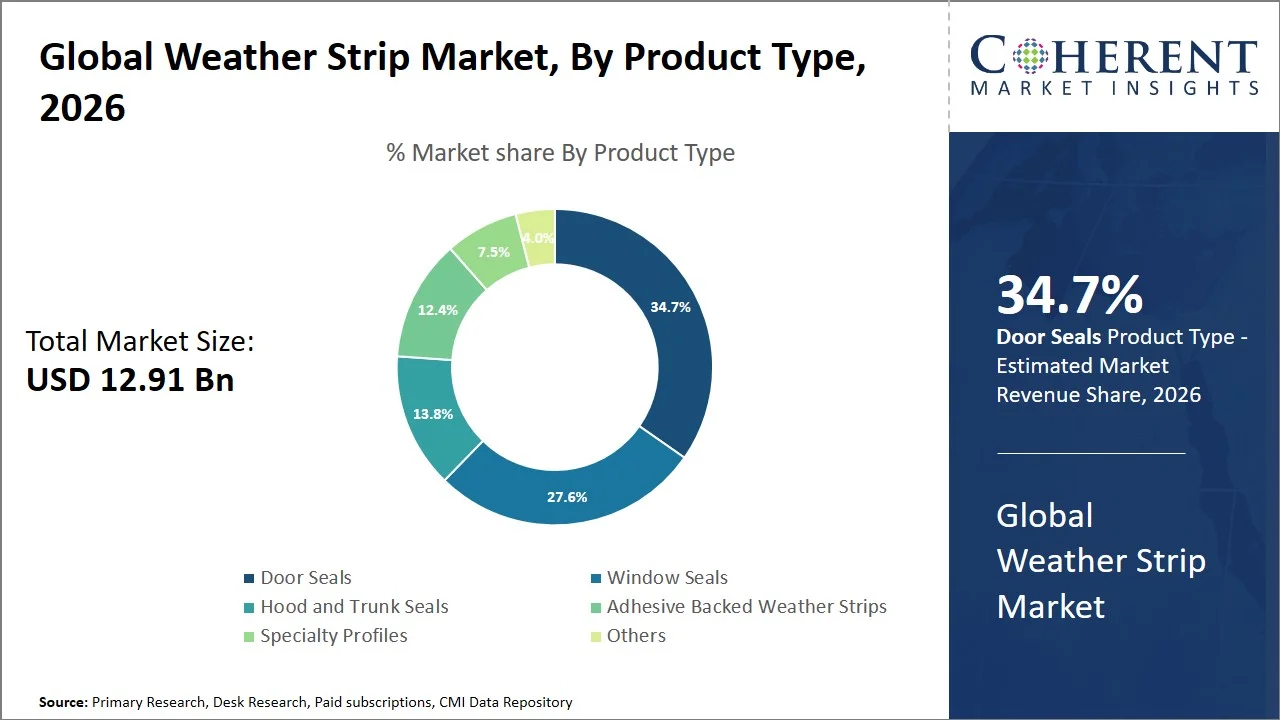
Door seals are expected to hold 34.7% of the market share in 2026, as doors remain the most frequent leakage, movement, and contact point across vehicles, homes, commercial buildings, and industrial enclosures. Their dominance is tied to repeated opening-and-closing cycles, exposure to air gaps, water ingress, dust entry, and noise transfer. Demand is strong because door sealing directly improves cabin refinement in vehicles and supports energy efficiency and comfort in buildings. Suppliers also benefit from broad product formats, including bulb seals, edge seals, compression seals, adhesive-backed strips, and co-extruded profiles tailored to metal, wood, glass, and composite door systems. In October 2024, the U.S. Department of Energy highlighted that reducing home air leaks can qualify for the Energy-Efficient Home Improvement Credit when compliant with 2021 IECC guidance.
Why Does Automotive Dominate the Global Weather Strip Market?
Automotive is expected to dominate the global weather strip market with 42.8% share in 2026, as each vehicle platform uses multiple sealing profiles across doors, windows, trunks, hoods, rooflines, glass runs, and body openings. The segment benefits from high value per unit, strict fitment requirements, and the need for consistent sealing performance over the vehicle lifecycle. Demand is increasingly shaped by premium cabin expectations, EV quietness requirements, aerodynamic optimization, and water/dust protection for electrical and interior systems. Supply-side leadership is supported by automated extrusion, flocking, surface coatings, and lightweight seal designs that allow OEMs to meet design, assembly, and durability targets. In May 2026, the International Energy Agency (IEA) reported that global electric car sales exceeded 20 million in 2025, making one in four new cars sold worldwide electric.
Global Weather Strip Market Dynamics
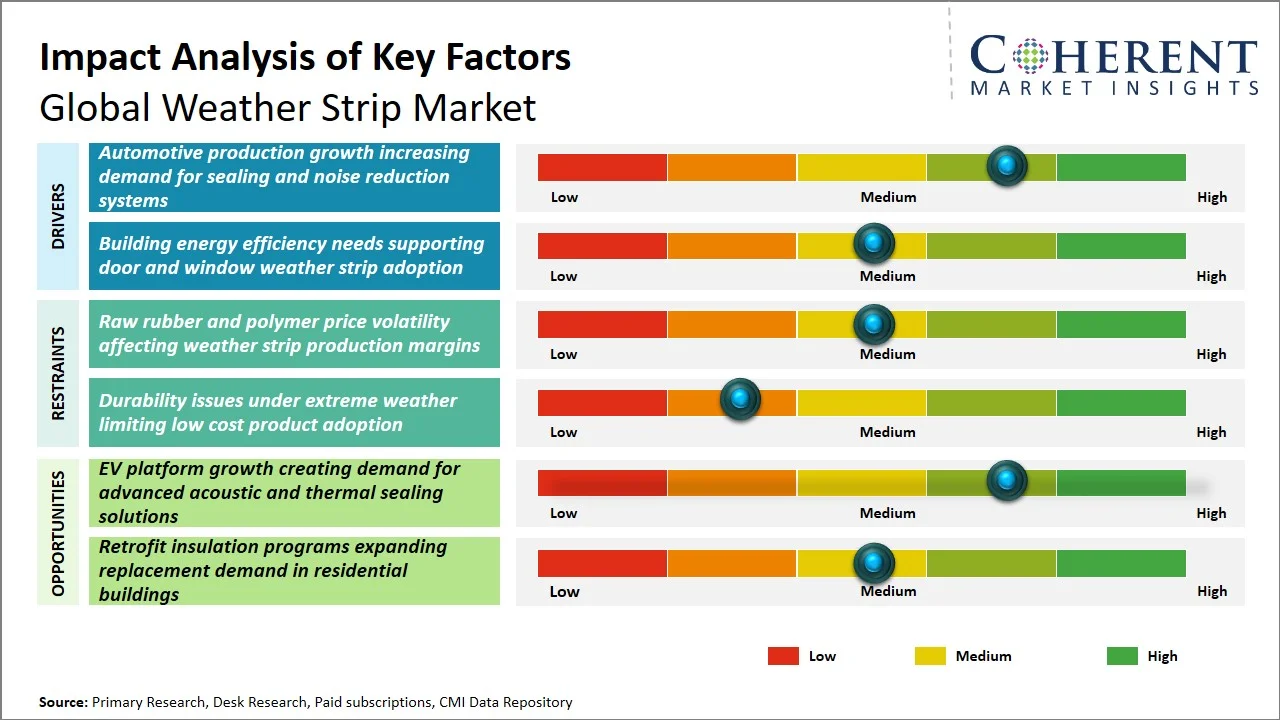
Key Market Drivers
- Automotive Platform Expansion Strengthening Demand for Body Sealing and NVH Control:
Automotive production growth is a major driver for the global weather strip market, as every passenger vehicle, SUV, pickup, commercial vehicle, and EV requires multiple sealing profiles across doors, windows, trunks, hoods, rooflines, and glass channels. Weather strips are critical for water management, wind-noise reduction, dust protection, cabin comfort, and long-term vehicle durability. As automakers expand localized production and add new assembly lines, demand increases for OEM-grade EPDM, TPV, flocked, coated, and co-extruded sealing systems. Suppliers benefit from recurring platform-level demand because weather strips are engineered to specific vehicle designs and remain required throughout model production cycles. In July 2026, Toyota Motor North America announced a USD 3.6 billion expansion of its San Antonio plant, adding a second vehicle assembly line to support Tacoma production. - Building Energy-Efficiency Upgrades Supporting Door and Window Weather Strip Adoption:
Building energy-efficiency needs are creating sustained demand for weather strips across residential, commercial, and institutional buildings. Door and window gaps are major leakage points, making weather strips, gaskets, caulking-compatible seals, compression profiles, and adhesive-backed strips important for reducing drafts, improving indoor comfort, and supporting lower heating and cooling losses. Demand is expanding through retrofit programs, home renovation channels, energy-code compliance, and facility maintenance budgets. The segment also benefits from easy installation and relatively low replacement cost, making weather strips attractive for homeowners, contractors, and building managers. Product suppliers are gaining opportunities through retail packs, professional-grade sealing systems, and energy-upgrade bundles.
Emerging Market Trends
- Shift Toward Multi-Material and Lightweight Sealing Architectures: Weather strip design is moving beyond conventional single-material rubber profiles toward multi-material architectures that combine EPDM, TPV, TPE, sponge rubber, flocked surfaces, low-friction coatings, and rigid carrier inserts. This trend is especially relevant in automotive and premium building applications, where sealing products must deliver flexibility, dimensional stability, low closing force, improved appearance, and long service life. Lightweight profiles are gaining attention because vehicle manufacturers and building system suppliers want to reduce material consumption without sacrificing durability. Multi-material designs also help suppliers differentiate through customized performance, including better acoustic control, smoother glass movement, tighter compression recovery, and improved resistance to heat, ozone, moisture, and repeated mechanical cycling.
- Growth of Application-Ready Retrofit and Aftermarket Weather Strip Formats: The market is increasingly moving toward application-ready weather strip formats that reduce installation time and simplify replacement for end users. Adhesive-backed strips, pre-cut door seals, garage door sealing kits, window sealing tapes, brush seals, and universal automotive replacement profiles are gaining relevance across retail, distributor, and online channels. This trend is reshaping demand from bulk industrial profiles toward packaged, easy-to-install products that serve homeowners, maintenance contractors, repair workshops, and facility managers. Suppliers that offer clear specifications, compatibility guidance, stronger adhesives, better packaging, and wider SKUs can capture recurring aftermarket demand. The trend also supports margin improvement because convenience, fit, and performance carry higher value than commodity extrusion alone.
Current Events and their Impact
Current Events | Description and its Impact |
January 2026 – California 2025 Building Energy Efficiency Standards Compliance Begins |
|
January 2026 – EU Construction Products Regulation 2024 Becomes Applicable |
|
2024 Onward – India ECSBC Formalizes Building Envelope Sealing Requirements |
|
Regional Insights
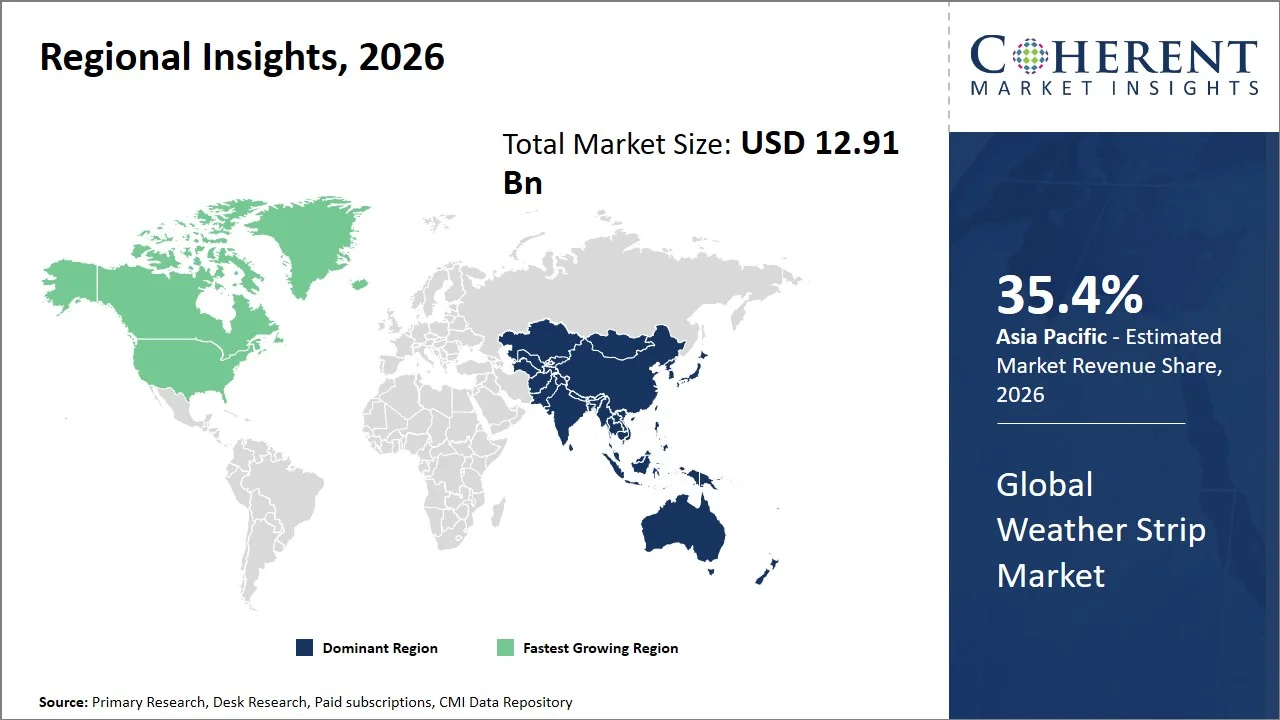
Why Does Asia Pacific Dominate the Global Weather Strip Market?
Asia Pacific is expected to dominate the global weather strip market with 35.4% share in 2026, supported by its large automotive manufacturing clusters, expanding residential construction, and strong local supplier base for rubber, TPV, PVC, and extruded sealing profiles. The region benefits from high-volume vehicle assembly in China, India, Japan, South Korea, and Southeast Asia, where door, window, hood, trunk, and glass-run seals are installed across passenger vehicles, commercial vehicles, and two-wheelers. Building-sector demand is also increasing as urban housing and commercial projects require air, dust, water, and noise sealing systems. In April 2026, SaarGummi expanded its manufacturing base in India through GoldSeal SaarGummi’s new Chennai facility to strengthen EPDM and TPV sealing systems capacity.
Why is North America Emerging as the Fastest-Growing Region in the Global Weather Strip Market?
North America is expected to emerge as the fastest-growing region with 27.8% share in 2026, supported by replacement demand in vehicles, building energy-efficiency upgrades, and higher adoption of engineered sealing products across residential, commercial, and industrial end uses. The region has a mature aftermarket channel for door seals, window seals, garage seals, foam tapes, and adhesive-backed weather strips, while OEM demand remains tied to light trucks, SUVs, EVs, and premium vehicles. Demand is also reinforced by stricter expectations around cabin quietness, water tightness, thermal insulation, and building air leakage control. In June 2026, the U.S. Federal Reserve’s G.17 data showed U.S. motor vehicle assemblies at a seasonally adjusted annual rate above 10 million units in May 2026, supporting continued sealing component consumption. (Source: U.S. Federal Reserve)
Global Weather Strip Market Outlook for Key Countries
Why is the U.S. a Key Market for the Global Weather Strip Market?
The U.S. is a key market for weather strips due to its large vehicle parc, strong renovation culture, advanced building materials retail network, and established automotive supplier ecosystem. Demand is broad-based across automotive OEMs, aftermarket replacement, residential door and window sealing, garage sealing, HVAC enclosures, and commercial building maintenance. Weather strips are widely used to reduce drafts, moisture ingress, dust entry, and exterior noise, making them relevant for both energy-efficient housing and vehicle comfort. The market also benefits from organized retail and e-commerce distribution, which supports frequent replacement of foam tapes, door sweeps, compression seals, and adhesive-backed strips. In July 2026, the U.S. Census Bureau reported May 2026 residential construction spending at a seasonally adjusted annual rate of USD 930.2 billion, supporting demand for building sealing products.
Why is China Important in the Global Weather Strip Market?
China is important in the global weather strip market because it combines large-scale vehicle production, dense component supplier clusters, and high domestic consumption of automotive and construction sealing products. Weather strips are used across China’s passenger cars, NEVs, commercial vehicles, residential buildings, factories, and logistics facilities. The country’s EV transition also raises demand for improved acoustic sealing, battery compartment protection, aerodynamic edge sealing, and tighter door and glass-run profiles, as quieter electric powertrains make wind and road noise more noticeable. China’s strong polymer processing and extrusion capabilities also support cost-efficient supply for domestic and export channels. In January 2026, China’s State Council reported that China’s auto output reached 34.531 million units in 2025, while NEV production totaled 16.626 million units.
Why is India Important in the Global Weather Strip Market?
India is important in the global weather strip market because it offers a fast-expanding automotive manufacturing base, rising vehicle ownership, and growing demand for cost-effective building sealing solutions. Weather strips are used in passenger vehicles, commercial vehicles, tractors, three-wheelers, two-wheelers, residential doors, window frames, industrial sheds, and transport equipment. Demand is supported by localized OEM sourcing, increasing use of EPDM and TPV profiles, and the need for durable seals that can withstand heat, dust, monsoon exposure, and frequent vehicle operation. India’s supplier ecosystem is also strengthening around automotive hubs in Tamil Nadu, Maharashtra, Gujarat, Haryana, and Karnataka. In June 2026, SIAM reported that India produced 29,27,711 passenger vehicles, three-wheelers, two-wheelers, and quadricycles in May 2026.
Why is Japan an Important Growth Market for the Global Weather Strip Market?
Japan remains an important growth market for weather strips due to its high-quality automotive manufacturing ecosystem, precision component suppliers, and strong focus on durability, NVH control, and lightweight sealing systems. Japanese automakers require weather strips that meet strict dimensional accuracy, long service life, and water-tightness expectations across compact cars, hybrid vehicles, kei cars, premium models, and export platforms. Demand also comes from replacement seals in Japan’s aging vehicle base and from building applications requiring reliable air and moisture protection. The country’s advanced rubber and resin processing capabilities support product innovation in glass-run channels, trunk seals, door seals, and specialized profiles. In September 2025, JAMA reported that Japan produced 8.23 million motor vehicles in 2024, including 7.14 million passenger cars.
Why is Germany a Strategic Country in the Global Weather Strip Market?
Germany is a strategic country for the global weather strip market because of its premium automotive base, engineering-led supplier network, and strong emphasis on quality, sustainability, and high-performance component standards. German vehicles require advanced sealing systems for acoustic insulation, water management, aerodynamic refinement, door-closing comfort, and EV platform protection. Weather strip demand is also supported by commercial buildings, industrial equipment, rail applications, and energy-efficient construction where precision rubber and polymer profiles are used to control leakage and improve operational performance. Germany’s shift toward electric vehicle production is especially relevant because EV cabins require stronger noise isolation and thermal sealing. In February 2026, VDA stated that electric passenger car production in Germany reached 1.22 million vehicles in 2025, up 15% year on year.
Technology Adoption Landscape in the Global Weather Strip Market
Technology | Adoption Level | Key Application Area | Business Impact |
EPDM and sponge rubber extrusion | High | Automotive door, trunk, hood, and building seals | Improves durability, compression recovery, and weather resistance in high-volume applications |
TPV/TPE co-extrusion | High | Lightweight automotive and architectural sealing profiles | Supports flexible design, recyclability potential, and reduced profile weight |
Flocked and low-friction coatings | Medium | Window channels, glass-run seals, sliding systems | Reduces friction, noise, and wear while improving operating comfort |
Pressure-sensitive adhesive backing | High | Residential, commercial, and aftermarket weather strips | Simplifies installation and increases adoption in DIY, retail, and retrofit channels |
CAD/CAE-based seal simulation | Medium | Automotive OEM sealing design and validation | Shortens development cycles and improves fit, compression, NVH, and leakage performance |
Recycled and bio-based elastomer formulations | Medium | Automotive and building sustainability-focused sealing products | Supports sustainability positioning and helps suppliers meet buyer material-footprint expectations |
How are Energy-Efficient Buildings and EV-Specific Sealing Needs Creating New Growth Opportunities in the Global Weather Strip Market?
Energy-efficient buildings and EV-specific sealing requirements are creating attractive growth opportunities for weather strip manufacturers. In buildings, the opportunity lies in supplying higher-performance door and window sealing products that support air-leakage control, thermal comfort, and retrofit-driven energy savings. These favors suppliers offering adhesive-backed strips, compression seals, gasketed profiles, and weather-resistant materials that can be installed easily across old and new structures. In automotive, EV platforms are creating demand for more precise acoustic sealing because the absence of engine noise makes wind, road, and panel noise more noticeable. EVs also require better sealing around battery compartments, charging areas, doors, glass systems, and lightweight body structures. Companies that combine material science, application engineering, and scalable extrusion capacity can move from commodity sealing products toward higher-value engineered profiles. The strongest opportunity is in customized, performance-certified, and sustainability-aligned sealing systems that support premiumization and long-term supplier relationships.
Market Players, Key Development, and Competitive Landscape
Key Developments
- In June 2026, Toyoda Gosei announced that its interior and exterior products were used on the new Lexus ES, including vibration-damping glass runs and weatherstrips designed to improve sound insulation. This is relevant to the weather strip market as quieter EV and hybrid platforms increase demand for sealing systems that reduce wind noise, road noise, and water intrusion.
- In June 2026, PPAP Automotive announced a partnership with Hutchinson to develop advanced body sealing systems for India’s passenger vehicle industry. The collaboration strengthens localization of automotive weather strip and sealing technologies, helping Indian OEMs access higher-performance body seals for doors, windows, trunks, and vehicle body structures.
- In March 2026, Minth Group announced investment in a new manufacturing facility in Gadsden, Alabama, expected to create more than 1,300 jobs. As Minth’s product portfolio includes dynamic and static automotive sealing systems, the expansion strengthens regional supply capability for global automakers and improves proximity to North American vehicle production hubs.
Competitive Landscape
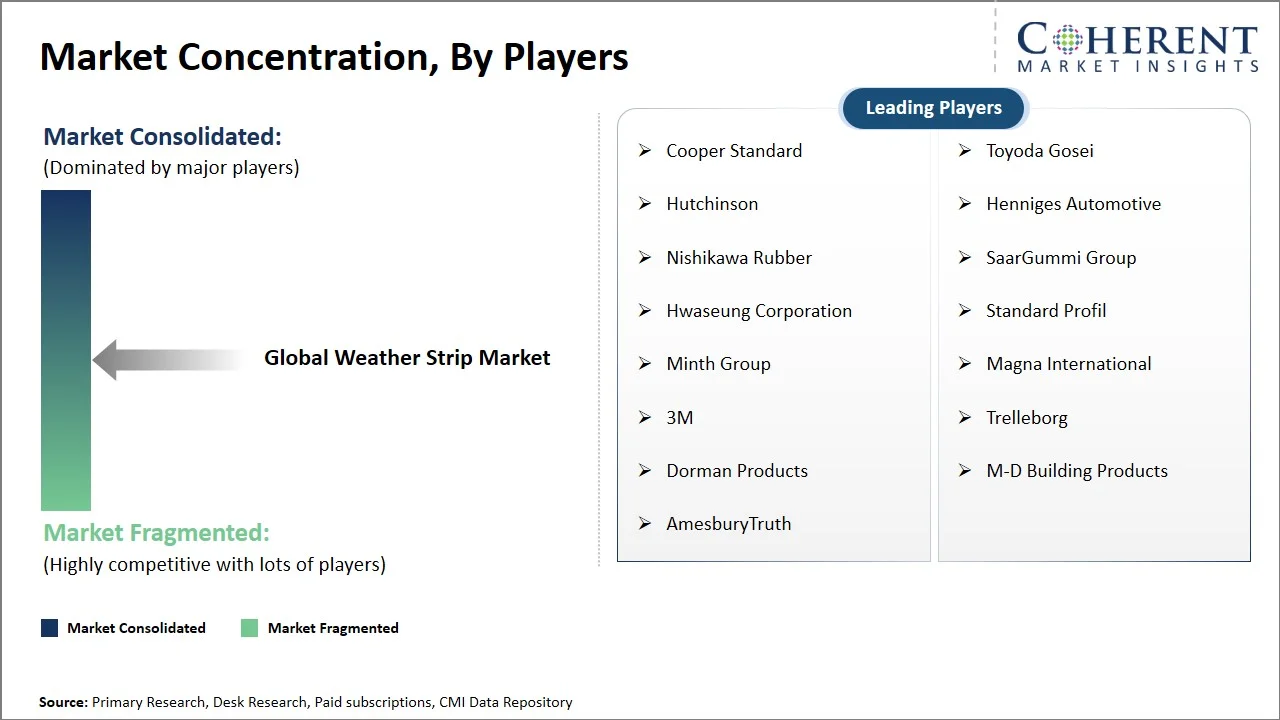
The global weather strip market is moderately fragmented, with competition across automotive OEM suppliers, building product manufacturers, rubber extruders, polymer processors, aftermarket brands, distributors, and private-label suppliers. Large players compete through engineering capability and OEM relationships, while smaller manufacturers compete through pricing, customization, regional distribution, and quick-turnaround production.
Key focus areas include
- Product quality, dimensional consistency, compression recovery, and long-life weather resistance remain key differentiators.
- Technology adoption is centered on co-extrusion, automated curing, adhesive lamination, surface coating, and precision profile design.
- Pricing competitiveness is important in construction, aftermarket, and distributor-led channels where products can be easily substituted.
- Capacity, delivery reliability, and local supply support are critical for automotive OEM and large construction-system customers.
- Certifications, testing, and quality control strengthen supplier credibility in regulated building and automotive applications.
- Distribution reach across OEM, industrial, retail, dealer, and online channels improves customer access and replacement demand capture.
- Product differentiation is visible through material grade, profile geometry, adhesive type, coating, color, and application-specific formats.
- Sustainability positioning is becoming more relevant through recycled content, lower-emission materials, and reduced-waste manufacturing.
Market Report Scope
Weather Strip Market Report Coverage
| Report Coverage | Details | ||
|---|---|---|---|
| Base Year: | 2025 | Market Size in 2026: | USD 12.91 Bn |
| Historical Data for: | 2020 To 2024 | Forecast Period: | 2026 To 2033 |
| Forecast Period 2026 to 2033 CAGR: | 6.7% | 2033 Value Projection: | USD 20.33 Bn |
| Geographies covered: |
| ||
| Segments covered: |
| ||
| Companies covered: | Cooper Standard, Toyoda Gosei, Hutchinson, Henniges Automotive, Nishikawa Rubber, SaarGummi Group, Hwaseung Corporation, Standard Profil, Minth Group, Magna International, 3M, Trelleborg, Dorman Products, M-D Building Products, and AmesburyTruth | ||
| Growth Drivers: |
| ||
| Restraints & Challenges: |
| ||
Analyst Opinion (Expert Opinion)
- The global weather strip market is likely to move from a volume-led sealing category to a performance-led engineered components market over the forecast period. Future growth will be shaped by stricter expectations around vehicle quietness, thermal control, leakage prevention, and building-envelope efficiency. Suppliers that can prove measurable performance in durability, compression recovery, acoustic insulation, and energy-loss reduction will be better positioned than basic profile manufacturers.
- Transformative market trends will come from EV-specific sealing, recyclable thermoplastic profiles, low-friction coated seals, and application-ready retrofit products. EV platforms will require advanced weather strips to manage wind noise, battery-area protection, and lightweight body architecture, while construction channels will shift toward easy-install sealing kits for renovation and energy-saving upgrades. These trends can create premium pricing opportunities for companies offering customized, sustainable, and installation-efficient products.
- Key restraints include raw material price volatility, margin pressure in commodity profiles, customer dependence in OEM supply contracts, and quality inconsistency among low-cost suppliers. Market players should focus on material innovation, OEM-grade engineering, application-specific product formats, channel diversification, and sustainability-led differentiation to improve competitive advantage.
Speak to the analyst
Want personalized insights?
Take the findings above to one of our principal consultants, or have the report rebuilt around the segments, geographies and competitors you actually track.
Market Segmentation
- Material Type Insights (Revenue, USD Bn, 2021 - 2033)
- EPDM Rubber
- PVC
- Silicone
- TPE and TPV
- Foam
- Others
- Product Type Insights (Revenue, USD Bn, 2021 - 2033)
- Door Seals
- Window Seals
- Hood and Trunk Seals
- Adhesive Backed Weather Strips
- Specialty Profiles
- Others
- Application Insights (Revenue, USD Bn, 2021 - 2033)
- Automotive
- Residential Buildings
- Commercial Buildings
- Industrial Enclosures
- Others
- Sales Channel Insights (Revenue, USD Bn, 2021 - 2033)
- OEM and Direct Sales
- Distributors and Dealers
- Retail Stores
- Online Sales
- Regional Insights (Revenue, USD Bn, 2021 - 2033)
- North America
- U.S.
- Canada
- Latin America
- Brazil
- Argentina
- Mexico
- Rest of Latin America
- Europe
- Germany
- U.K.
- Spain
- France
- Italy
- Russia
- Rest of Europe
- Asia Pacific
- China
- India
- Japan
- Australia
- South Korea
- ASEAN
- Rest of Asia Pacific
- Middle East
- GCC Countries
- Israel
- Rest of Middle East
- Africa
- South Africa
- North Africa
- Central Africa
- North America
- Key Players Insights
- Cooper Standard
- Toyoda Gosei
- Hutchinson
- Henniges Automotive
- Nishikawa Rubber
- SaarGummi Group
- Hwaseung Corporation
- Standard Profil
- Minth Group
- Magna International
- 3M
- Trelleborg
- Dorman Products
- M-D Building Products
- AmesburyTruth
Source
Primary Research Interviews
- Weather strip manufacturers producing EPDM, PVC, silicone, TPE, TPV, foam, adhesive-backed strips, and specialty sealing profiles
- Automotive sealing system suppliers covering door seals, window seals, hood seals, trunk seals, glass run channels, and body seals
- Building door, window, façade, garage, and glazing seal manufacturers
- Rubber extrusion, polymer profile, adhesive-lamination, flocking, coating, and testing equipment suppliers
- Automotive OEMs, Tier-1 suppliers, construction contractors, installers, distributors, dealers, retailers, and online sellers
- Raw material suppliers covering synthetic rubber, EPDM, PVC resins, thermoplastic elastomers, silicone, adhesives, coatings, and reinforcement materials
- Sustainability, building energy-efficiency, material compliance, and automotive quality consultants
Stakeholders
- Weather strip and sealing manufacturers: Cooper Standard, Toyoda Gosei, Hutchinson, Henniges Automotive, Nishikawa Rubber, SaarGummi Group, Hwaseung Corporation, Standard Profil, Minth Group, PPAP Automotive
- Automotive and industrial component suppliers: Magna International, Dorman Products, Trelleborg, Freudenberg Sealing Technologies, REHAU Automotive, Continental, Sumitomo Riko
- Building and architectural sealing companies: M-D Building Products, AmesburyTruth, Schlegel, Deventer Profile, Reddiplex, Raven Products, Q-Lon, Frost King
- Material, adhesive, and coating suppliers: Dow, ExxonMobil, SABIC, LyondellBasell, ARLANXEO, Lanxess, 3M, Henkel, H.B. Fuller, Sika, BASF
- End-use ecosystem: automotive OEMs, door and window manufacturers, building material retailers, contractors, aftermarket distributors, and industrial buyers
Databases
- OICA, SIAM, JAMA, VDA, ACEA – automotive production data
- U.S. Federal Reserve G.17, U.S. Census Bureau, Eurostat, EU PRODCOM – industrial, construction, and manufacturing data
- UN Comtrade, ITC Trade Map, USITC DataWeb – trade data for rubber, plastic profiles, and automotive components
- BLS, FRED, national energy agencies – pricing, construction cost, weatherization, and retrofit data
- Company annual reports, investor presentations, press releases, and technical product documents
Industry Publications and Journals
- Rubber News, European Rubber Journal, Rubber World, Plastics News, Sustainable Plastics
- Automotive News, Automotive World, SAE Media, WardsAuto
- Construction Dive, Building Design+Construction, Window + Door, Glass Magazine, Building Enclosure
- Rubber Chemistry and Technology, Polymer Testing, Journal of Applied Polymer Science, Construction and Building Materials, Energy and Buildings, Building and Environment, Applied Acoustics, Journal of Cleaner Production, Polymers
Associations
- OICA, SAE International, ASTM International, ISO, ACEA, VDA, JAMA, SIAM
- Automotive Component Manufacturers Association of India, European Tyre and Rubber Manufacturers’ Association, Association for Rubber Products Manufacturers
- Fenestration and Glazing Industry Alliance, National Fenestration Rating Council, National Association of Home Builders, Plastics Industry Association
Public Domain Sources:
- U.S. Department of Energy, U.S. EPA, U.S. Census Bureau, U.S. BLS, USITC
- European Commission, Eurostat, California Energy Commission, Natural Resources Canada
- India Bureau of Energy Efficiency, Ministry of Road Transport and Highways India, China State Council, Japan METI, Germany Federal Statistical Office
- ISO and ASTM standards databases
Proprietary Elements
- CMI Data Analytics Tool, Proprietary CMI Existing Repository of information for last 10 years.
Get access to 250+ pages report
Every segment, forecast, competitor profile and data table behind the analysis above — available for instant download.
- ESOMAR Member
- ISO 9001:2015 Certified
- D-U-N-S Registered
- GDPR & CCPA Compliant
Missing comfort of reading report in your local language? Find your preferred language:
Transform your Strategy with Exclusive Trending Reports
Frequently Asked Questions
The CAGR of the global weather strip market is projected to be 6.7% from 2026 to 2033.
The global weather strip market is estimated to be valued at USD 12.91 billion in 2026 and is expected to reach USD 20.33 billion by 2033.
Door seals are widely used, as they help prevent air leakage, water entry, dust intrusion, and noise transfer across vehicles, homes, commercial buildings, and industrial enclosures.
Electric vehicles are increasing the demand for advanced weather strips, as quieter cabins require better acoustic sealing, tighter door fitment, battery-area protection, and improved wind-noise control.
The aftermarket supports steady demand through replacement of worn door seals, window seals, garage seals, and adhesive-backed weather strips used in vehicles, homes, and commercial facilities.
In terms of material type, EPDM rubber is estimated to dominate the market revenue share in 2026.
Raw rubber and polymer price volatility affecting weather strip production margins and durability issues under extreme weather limiting low cost product adoption are the major factors hampering the growth of the global weather strip market.