

Global Whipped Cream Stabilizer Market Size and Forecast – 2026 To 2033
The Global Whipped Cream Stabilizer Market is estimated to be valued at USD 55.2 Mn in 2026 and is expected to reach USD 89.22 Mn by 2033, exhibiting a compound annual growth rate (CAGR) of 7.10% from 2026 to 2033. Market growth is supported by the increasing consumption of cakes, pastries, beverages, and refrigerated desserts requiring consistent whipping volume, smooth texture, reduced moisture separation, and longer shape retention.
Stabilizer systems are also becoming important in dairy, vegetable-fat, and hybrid cream formulations. In January 2025, Hydrosol introduced a new Stabimuls ICR functional system for mixed-fat cream, offering improved foam stability and suitability for foodservice cakes and desserts.
Key Takeaways of the Global Whipped Cream Stabilizer Market
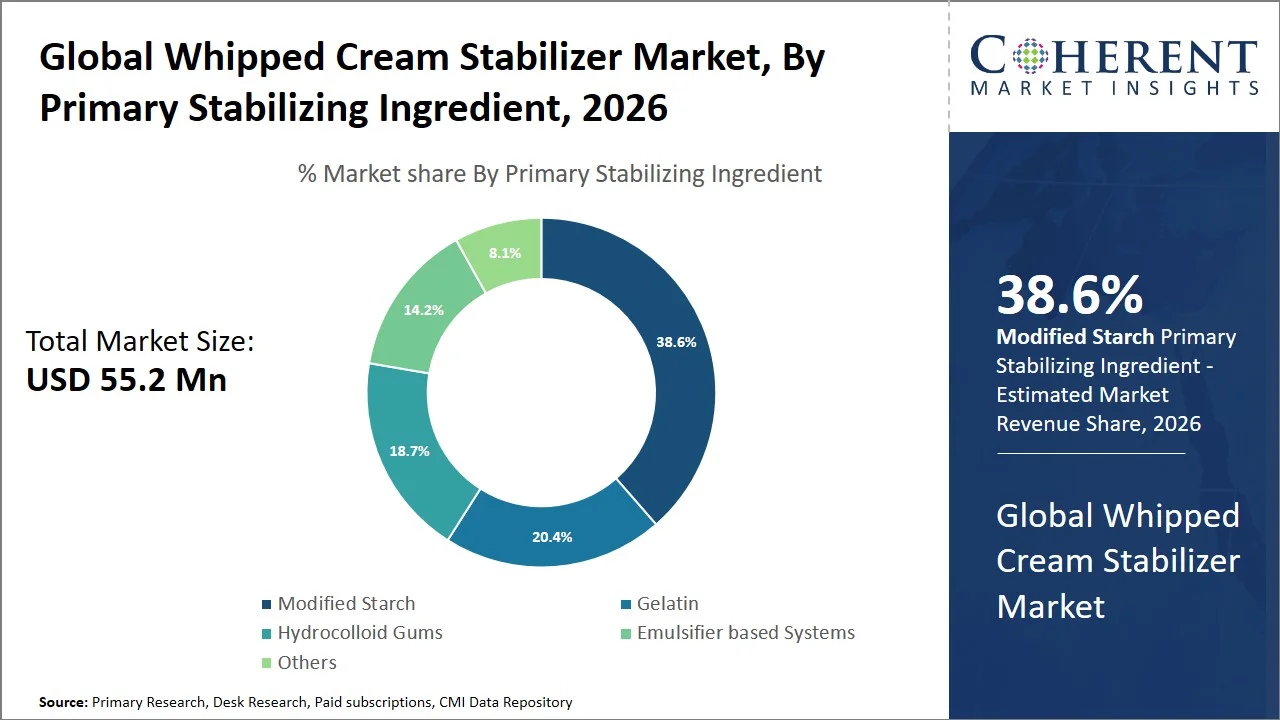
- Modified starch is expected to hold 38.6% of the global whipped cream stabilizer market in 2026 because it delivers reliable viscosity, air-cell support, freeze-thaw tolerance, neutral flavor, and economical dosage across bakery and foodservice formulations. In August 2024, Roquette launched CLEARAM TR modified tapioca starches for dairy desserts and bakery fillings, emphasizing viscosity, consistency, and elasticity.
- The powder segment is expected to account for 74.6% of the market share in 2026, reflecting the segment’s longer storage life, precise dosing, low handling complexity, and compatibility with dry bakery premixes. In October 2025, Palsgaard began the Brazilian production of Emulpals powdered whipping agents, citing improved supply security, inventory management, freight economics, aeration, and softness for bakery customers across the Americas.
- Conventional stabilizers are expected to capture 72.5% of the market share in 2026 because commercial users prioritize repeatable overrun, holding strength, process tolerance, regulatory familiarity, and cost control over reformulation complexity. In October 2024, Flavors & Fragrances Inc showcased a cost-efficient dairy concept combining specialty stabilizers and emulsifiers to preserve sensory quality and physical stability while reducing total formulation costs.
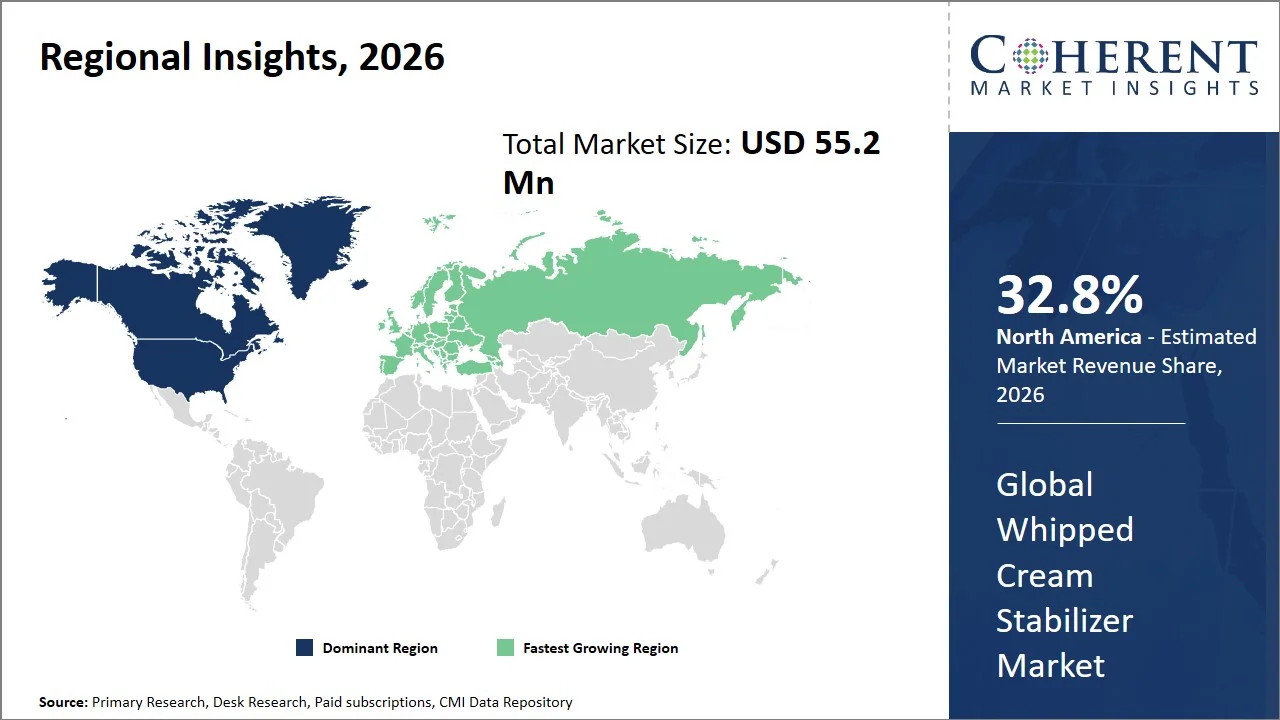
- North America is expected to represent 32.8% of the global market in 2026, supported by a mature commercial bakery sector, broad foodservice usage, advanced cold-chain distribution, and strong access to specialty ingredient formulation expertise. In July 2025, Tate & Lyle unveiled a new Mouthfeel Lab and expanded texturant portfolio at IFT FIRST in Chicago, strengthening regional customer-development capabilities.
- Europe is expected to hold 30.4% of the market share in 2026 while recording the fastest expansion, supported by premium patisserie demand, active clean-label reformulation, dense artisan bakery networks, and investment in localized technical support. In May 2024, Bakels opened a Polish headquarters incorporating an Innovation Centre and high-capacity warehouse for recipe development, customer training, and bakery-ingredient distribution.
- Clean-Label Reformulation with Natural Ingredient Systems: Buyers are increasingly evaluating stabilizers through ingredient-list simplicity as well as performance. Suppliers must therefore develop starch, gum, protein, and emulsifier combinations that maintain whipping speed, volume retention, smooth mouthfeel, and storage stability without creating unfamiliar label declarations. This shift raises formulation costs but creates premium positioning opportunities for companies with strong application testing, regulatory knowledge, and transparent sourcing capabilities.
- Application-Specific Premix Systems for Consistent Performance: Competition is moving from single-ingredient selling toward customized systems designed for particular cream fat levels, processing equipment, climates, desserts, and distribution conditions. Ready-to-dose blends can reduce operator variability, simplify purchasing, and shorten product-development cycles. This favors suppliers that combine ingredients with technical service, troubleshooting, pilot trials, and direct business-to-business support rather than competing mainly on commodity pricing.
Segmental Insights
Why Does Modified Starch Dominate the Global Whipped Cream Stabilizer Market?
Modified starch is expected to command 38.6% of the global whipped cream stabilizer market in 2026 because manufacturers can select cross-linked, substituted, or pregelatinized grades for specific shear, temperature, acidity, and storage conditions. In whipped cream, these starches bind free moisture, reinforce viscosity around entrained air, and reduce serum separation without imposing a strong flavor. Their broad raw-material base, scalable production, low use levels, and compatibility with existing dry-blending lines also support dependable procurement. Bakery and pastry shops favor the ingredient for piped decorations, layered cakes, chilled fillings, and desserts that must remain presentable during display or delivery. Suppliers can defend margins by offering application-specific grades rather than undifferentiated starch. In March 2025, Cargill showcased a dent-corn modified starch and starch-based functional systems for bakery, dairy, ice cream, and frozen desserts, emphasizing texture and stability performance.
- Current Industry Events of 2026
- Market Size Estimation
- Regional Breakdown
- Competitive Landscape
- Customer Intelligence
- Segmental Analysis
- Pricing Analysis
- Key Market Drivers, Challenges & Future Trends
- Customized Insights Section
Why Does Powder Represent the Largest Form in the Global Whipped Cream Stabilizer Market?
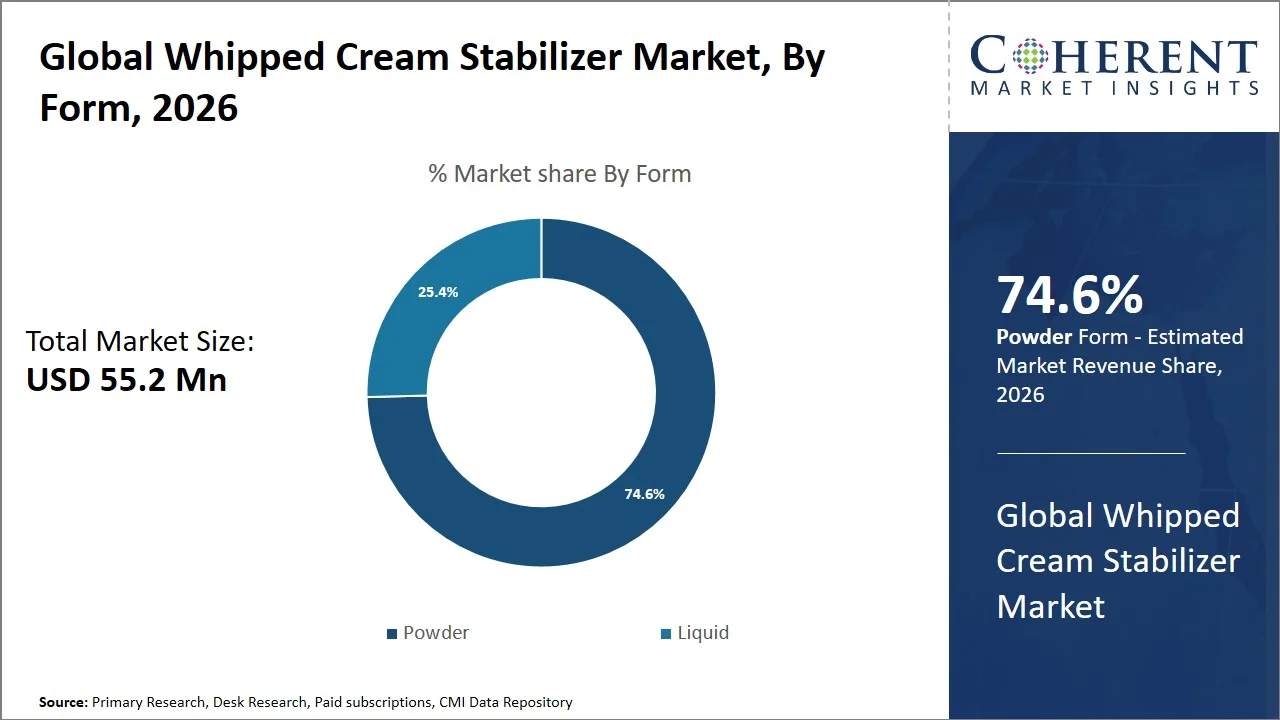
Powder is expected to represent 74.6% of the global whipped cream stabilizer market in 2026 because it fits the operating model of bakeries, cafés, dessert shops, distributors, and household users. Dry stabilizers can be weighed into standardized recipes, stored without dedicated liquid tanks, shipped economically, and packed in formats ranging from industrial sacks to portion-controlled sachets. Their ambient handling and longer usable life reduce spoilage exposure, while rapid dispersion supports batch production during peak service periods. Powder also allows manufacturers to combine starches, gums, emulsifiers, sugars, and proteins in one premix, lowering operator error and simplifying supplier qualification. Commercially, success depends on hydration speed, dust control, packaging integrity, and channel-specific pack sizes. In May 2024, Angel Yeast and BakeMark unveiled more than 40 bakery products at Bakery China, including mixes and decorative icings, demonstrating continued professional adoption of pre-blended dry systems.
Why Do Conventional Stabilizers Dominate the Product Positioning Category of the Global Whipped Cream Stabilizer Market?
Conventional stabilizers are expected to hold 72.5% of the global whipped cream stabilizer market in 2026 because most commercial buyers purchase against established recipes, approved additive lists, predictable processing tolerances, and fixed cost targets. These systems have extensive technical documentation, standardized specifications, and broad distributor availability, allowing multi-site bakeries and industrial dessert producers to reproduce overrun, firmness, piping definition, and refrigerated holding performance. Their dominance also reflects the expense and validation time involved in replacing proven formulations, particularly where allergen controls, shelf-life protocols, and customer sensory benchmarks are already embedded. Manufacturers therefore compete through optimized blends, technical service, and compliance-led reformulation rather than wholesale ingredient substitution. In June 2026, Corbion launched LUMI Set, a titanium-dioxide-free icing stabilizer designed to preserve texture, stability, and application performance while helping commercial bakers respond to changing ingredient restrictions.
Current Events and their Impact
Current Event | Description and Its Impact |
January 2024 – EU E471 contaminant specifications became fully applicable |
|
January 2025 – U.S. FDA revoked authorization for FD&C Red No. 3 |
|
July 2026 – European Commission updated EUDR scope and digital compliance tools |
|
Global Whipped Cream Stabilizer Market Dynamics
Key Market Drivers
Expansion of Decorated Bakery and Dessert Formats
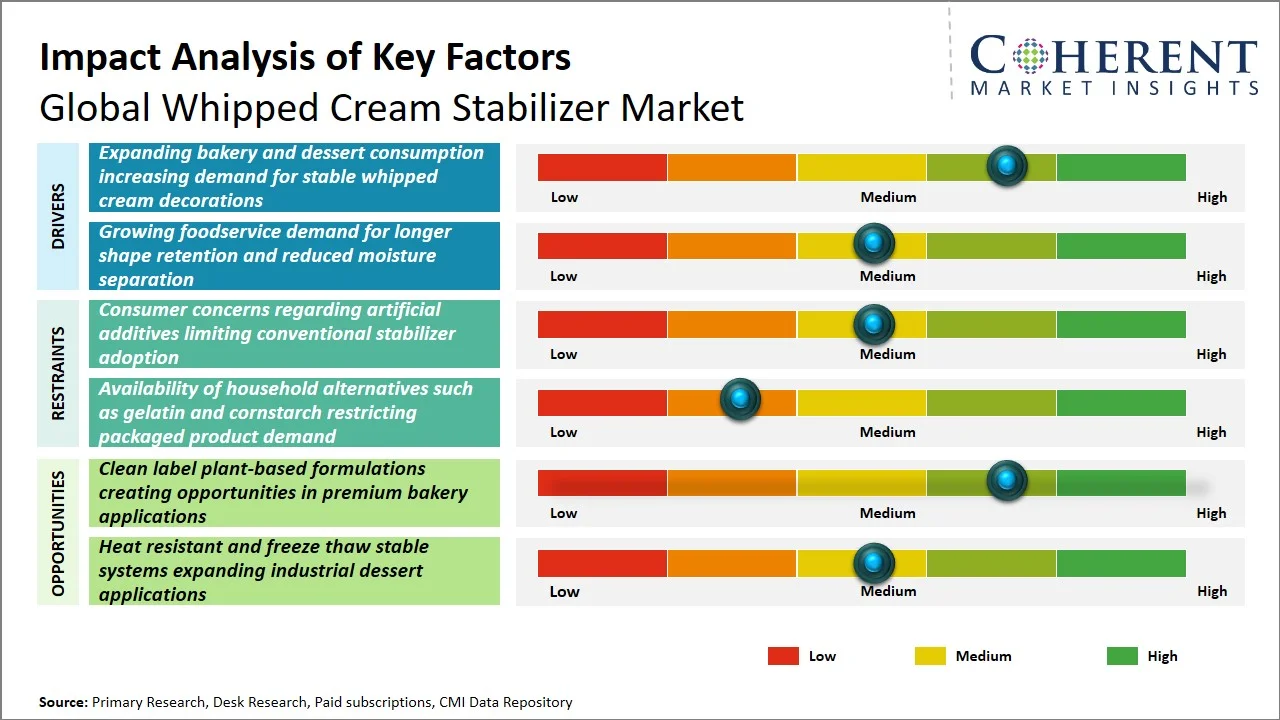
Growth in decorated cakes, pastries, chilled desserts, and seasonal bakery programs expands the number of products requiring cream that can be piped, layered, sliced, and displayed without losing definition. Stabilizers become commercially important because they reduce decoration failures, protect visual consistency across stores, and allow bakeries to prepare components before peak selling periods. This benefits starch and hydrocolloid suppliers, premix manufacturers, ingredient distributors, in-store bakeries, and industrial dessert producers. The strongest opportunity lies in systems calibrated for different cream-fat levels, mixing equipment, refrigeration cycles, and delivery times, because standardized dosage alone cannot guarantee identical results across applications. Suppliers that provide testing protocols and decorator-friendly instructions can gain preferred-vendor status. In April 2025, Rich Products and Funfetti expanded their partnership with a fully baked five-inch uniced cake layer for in-store bakeries, widening the platform for customized finishing, cream decoration, and seasonal merchandising.
Foodservice Prioritization of Extended Holding Performance
Foodservice operators increasingly require whipped cream to remain defined after preparation, withstand movement between central kitchens and outlets, and resist visible liquid release during refrigerated holding. This requirement converts foam stability from a sensory preference into an operating-cost issue: collapsed toppings create rework, inconsistent portions, slower service, and product waste. High-performance stabilizer systems help cafés, restaurant chains, commissaries, beverage outlets, and supermarket foodservice counters extend preparation windows while maintaining piping accuracy. Ingredient suppliers benefit when they can validate performance under real kitchen temperatures, bulk packaging formats, and repeated handling rather than relying only on laboratory viscosity data. The commercial advantage is especially strong for formulations used in multi-site chains, where consistency influences brand standards and purchasing contracts. In February 2025, Fonterra announced a further investment at its Waitoa UHT site to expand cream-processing capability and introduce larger packaging formats serving central kitchens, bakeries, and chain-store suppliers.
Emerging Market Trends
Cross-Platform Stabilizers for Dairy, Hybrid, and Plant-Based Creams
Formulators increasingly prefer stabilizer systems that can function across dairy, vegetable-fat, and hybrid cream bases. Modular combinations of gums, starches, proteins, and emulsifiers can reduce development time, simplify inventory, and support faster product customization. Suppliers with strong application-testing capabilities will gain an advantage, while single-ingredient manufacturers may face pressure unless they demonstrate compatibility across different fat structures, whipping temperatures, and storage conditions.
Texture Compensation in Reduced-Sugar and Reduced-Fat Cream Systems
Reduced-sugar and reduced-fat formulations require more sophisticated stabilization because lower sugar and fat levels weaken body, aeration, and moisture control. Suppliers are developing balanced systems using hydrocolloids, proteins, fibers, and emulsifiers to preserve smooth texture and shape retention without gumminess. This trend will increase demand for pilot-scale whipping trials and create premium opportunities for manufacturers that can maintain indulgent sensory performance in nutritionally reformulated desserts.
Regional Insights
Why Does North America Dominate the Global Whipped Cream Stabilizer Market?
North America is expected to lead the global whipped cream stabilizer market with a 32.8% share in 2026. The region combines a large commercial bakery and foodservice base with extensive supermarket in-store bakeries, refrigerated dessert production, and established use of whipped toppings in cakes, pastries, beverages, and seasonal products. Manufacturers benefit from reliable cold-chain logistics, specialist ingredient distributors, application laboratories, and customers requiring consistent overrun, piping definition, and display stability across multi-site operations. Demand also spans conventional dairy cream, non-dairy toppings, and clean-label formulations, encouraging suppliers to maintain broad texturizer portfolios. Product-development support is therefore an important competitive advantage. In February 2024, Ingredion launched NOVATION Indulge 2940 in North America, a functional native corn starch developed for gelling, co-texturizing, mouthfeel, and label-friendly dairy and alternative-dairy desserts.
Why is Europe Emerging as the Fastest-Growing Region in the Global Whipped Cream Stabilizer Market?
Europe is expected to account for 30.4% of the global whipped cream stabilizer market in 2026 and emerge as the fastest-growing region. Expansion is supported by Europe’s dense network of artisan patisseries, industrial bakeries, café chains, and premium dessert manufacturers, where whipped cream must retain fine aeration, clean flavor, and visual precision. Reformulation toward recognizable ingredients and plant-based offerings is widening demand for tailored starch, gum, protein, and emulsifier systems rather than standardized formulations. European suppliers also compete through customer co-development, pilot-scale testing, and application training, shortening commercialization cycles for pastries and chilled desserts. Sustainability requirements further favor concentrated systems that reduce processing waste. In March 2024, AAK announced the opening of a bakery-focused innovation center in Antwerp, Belgium, equipped for customer co-development, practical training, and testing of plant-based oil solutions.
Global Whipped Cream Stabilizer Market Outlook for Key Countries
Why is the U.S. a Key Market for the Global Whipped Cream Stabilizer Market?
The U.S. is a key market for whipped cream stabilizers because its bakery, foodservice, retail, and packaged-dessert channels operate at substantial scale and require repeatable product performance. Supermarket bakeries, restaurant chains, coffee shops, and independent decorators use stabilized cream for layer cakes, cupcakes, pies, beverages, and limited-time desserts that must withstand transport and refrigerated display. Purchasing decisions emphasize labor savings, dependable batch results, food-safety documentation, and compatibility with automated mixing or depositing equipment. The country’s broad distribution infrastructure also gives suppliers access to industrial users and small bakery customers through different pack sizes and service models. Seasonal merchandising creates frequent formulation opportunities for stabilizer and premix suppliers. In April 2025, Dawn Foods introduced a U.S. seasonal cake program comprising three cake mixes and two buttercreme-style icings, designed to help bakeries launch limited-time products without additional in-house formulation.
Why is Japan Important in the Global Whipped Cream Stabilizer Market?
Japan is important in the global whipped cream stabilizer market because its dessert sector places exceptional value on light mouthfeel, precise appearance, portion consistency, and refrigerated shelf quality. Convenience stores, specialist patisseries, cafés, hotels, and department-store food halls regularly sell cream-topped cakes, roll cakes, parfaits, pancakes, and chilled desserts, creating demand for systems that control syneresis and preserve delicate aeration. Suppliers must formulate for subtle sweetness, clean dairy flavor, compact portions, and production lines where accuracy and low wastage are essential. Japan’s mature processed-oil and dairy-ingredient industries also supports dairy and vegetable-fat whipping products. Cost management remains commercially important because formulations rely on oils, milk derivatives, packaging, and temperature-controlled distribution. In December 2024, Kaneka announced price revisions for whipping and whipped cream products from January 2025, citing higher ingredient, processing, labor, packaging, and logistics costs.
Why Does China Support Growth in the Global Whipped Cream Stabilizer Market?
China supports growth in the global whipped cream stabilizer market through the professionalization of bakery, café, tea-shop, and celebration-cake businesses across major and lower-tier cities. Whipped cream is extensively used in decorated cakes, fruit cakes, bakery fillings, cold beverages, and Western-style desserts, while operators increasingly seek longer holding time and reliable performance during delivery. The market accommodates dairy, vegetable-fat, and hybrid whipping creams, creating opportunities for stabilizer systems calibrated to different fat levels, processing temperatures, and price points. Local manufacturing and ultra-high-temperature processing capabilities improve availability beyond coastal cities, while digital ordering expands the need for creams that maintain structure during transport. In September 2025, Puratos announced a strategic joint venture with Guelph Foods, identified as a premium whipping-cream leader in China, combining local UHT production capacity with international bakery and patisserie research capabilities.
Why is Germany a Strategic Country in the Global Whipped Cream Stabilizer Market?
Germany is a strategic country in the global whipped cream stabilizer market because it combines an established cake and pastry culture with advanced food-ingredient engineering, processing equipment, and export-oriented manufacturing. Industrial bakeries and artisan confectioners require stabilizers that deliver controlled whipping volume, clean slicing, freeze-thaw tolerance, and dependable performance in tortes, cream cakes, and refrigerated desserts. German suppliers are particularly well positioned to develop integrated functional systems combining emulsification, water binding, and foam stabilization for dairy or vegetable-fat formulations. Strict quality management and detailed technical specifications also encourage buyers to work with suppliers offering application trials and production troubleshooting. Innovations developed in Germany can subsequently be commercialized across European and international markets. In September 2024, Hydrosol presented a Stabimuls ICR stabilizing system for vegetable-fat cream designed to provide high whipping volume, foam stability, and reliable performance under warm conditions.
Why is Brazil an Important Growth Market for the Global Whipped Cream Stabilizer Market?
Brazil is an important growth market for whipped cream stabilizers because a large bakery, confectionery, ice-cream, and foodservice ecosystem serves frequent celebration, snacking, and indulgence occasions. Local operating conditions create distinct formulation needs: creams may face warm ambient temperatures, long urban delivery routes, and uneven refrigeration, increasing the value of heat-tolerant foam stability and dependable piping performance. Cost-sensitive bakeries also require systems that work with vegetable-fat or blended whipping bases and can be sourced through broad distributor networks. Brazil’s domestic starch, sugar, oils, and food-ingredient industries provide a useful foundation for localized premix production and technical service. Product variety is expanding as suppliers target small entrepreneurs alongside industrial customers. In August 2025, Duas Rodas reported that its Mix, Selecta, and Specialitá brands would showcase more than 400 confectionery and foodservice products, including 60 recent launches, at Confeita Curitiba.
Market Players, Key Development, and Competitive Intelligence
Key Developments
- In July 2026, Nexira announced the acquisition of Keragum, a Morocco-based specialist in carob-derived ingredients and locust bean gum. This is important for the global whipped cream stabilizer market because vertical access to carob raw materials and processing capacity can strengthen the quality, traceability, and availability of a natural hydrocolloid used for thickening, stabilizing, and syneresis control in dairy and dessert formulations.
- In July 2025, Jungbunzlauer launched TayaGel LA, a low-acyl gellan gum designed to deliver suspension, gel formation, smooth mouthfeel, and visual clarity at low use levels. This is important for the global whipped cream stabilizer market because it expands the hydrocolloid toolkit available for dairy and plant-based aerated dessert systems, particularly where formulators require controlled structure without excessive viscosity or flavor interference.
- In July 2025, bene O joined a sustainable rice-farming project in Vietnam involving farmer training, digital monitoring, and the processing of certified rice into starch, flour, and protein ingredients. This is important for the global whipped cream stabilizer market because it supports a more traceable supply base for specialty rice starches that can be used in texture management, clean-label formulation, and moisture control.
Competitive Landscape
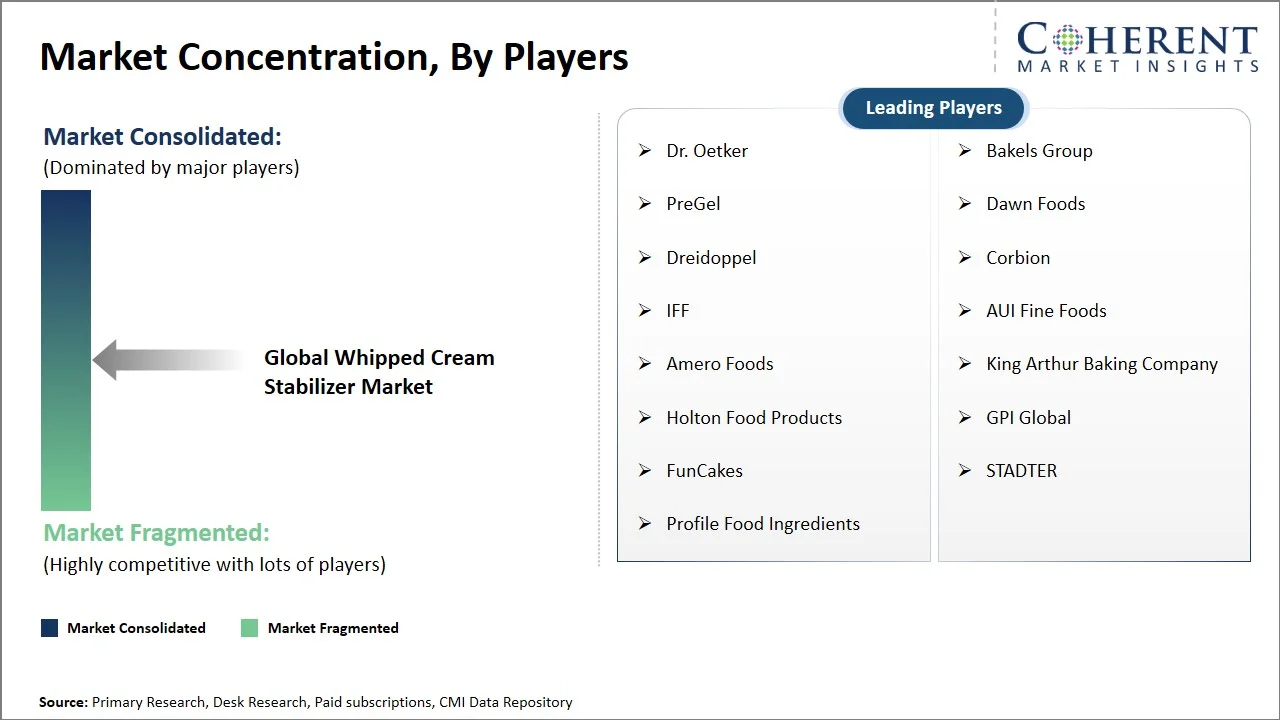
The global whipped cream stabilizer market is moderately fragmented, comprising multinational food-ingredient companies, starch and hydrocolloid manufacturers, emulsifier specialists, bakery premix producers, regional blenders, and consumer-facing stabilizer brands. Large participants benefit from broad ingredient portfolios and application laboratories, while regional companies compete through localized formulations, smaller order quantities, responsive service, and established bakery-distributor relationships. Competitive advantage depends less on ingredient ownership alone and more on the ability to provide validated, repeatable performance under customer-specific processing and storage conditions.
Key focus areas include
- Foam-performance differentiation: Suppliers compete on overrun, drainage control, piping sharpness, sliceability, and refrigerated holding.
- Formulation customization: Blends must accommodate dairy cream, vegetable-fat toppings, hybrid bases, and regional ingredient variations.
- Cost-in-use optimization: Customers assess dosage, batch yield, rejected-product reduction, and labor savings rather than purchase price alone.
- Supply continuity: Multiple sourcing options and regional inventories are important for starches, gums, gelatin, and emulsifier inputs.
- Quality assurance: Microbiological controls, contaminant testing, allergen management, and batch traceability influence supplier approval.
- Technical-service capability: Pilot trials, troubleshooting, operator training, and recipe adjustment strengthen customer retention.
- Channel flexibility: Industrial sacks, foodservice packs, retail containers, and online-ready formats address different purchasing models.
- Specialty positioning: Natural, vegan, halal, kosher, allergen-aware, and premium-performance systems provide margin differentiation.
Market Report Scope
Whipped Cream Stabilizer Market Report Coverage
| Report Coverage | Details | ||
|---|---|---|---|
| Base Year: | 2025 | Market Size in 2026: | USD 55.2 Mn |
| Historical Data for: | 2020 To 2024 | Forecast Period: | 2026 To 2033 |
| Forecast Period 2026 to 2033 CAGR: | 7.10% | 2033 Value Projection: | USD 89.22 Mn |
| Geographies covered: |
| ||
| Segments covered: |
| ||
| Companies covered: | Dr. Oetker, Bakels Group, PreGel, Dawn Foods, Dreidoppel, Corbion, IFF, AUI Fine Foods, Amero Foods, King Arthur Baking Company, Holton Food Products, GPI Global, FunCakes, STADTER, and Profile Food Ingredients | ||
| Growth Drivers: |
| ||
| Restraints & Challenges: |
| ||
Analyst Opinion (Expert Opinion)
- The global whipped cream stabilizer market leadership will increasingly shift from companies selling individual starches, gums, or emulsifiers toward suppliers managing complete foam-performance platforms. Buyers will expect formulation design, benchmark testing, dosage optimization, failure analysis, and operational guidance alongside the ingredient. This transition should increase customer retention and value capture for technically integrated suppliers while reducing the negotiating power of undifferentiated commodity sellers.
- Precision-fermented functional proteins could eventually alter the stabilizer architecture used in aerated cream products. Proteins designed for targeted interfacial activity may combine air incorporation, emulsification, and foam strengthening in ways that reduce the number of conventional additives required. Commercial success will depend on regulatory acceptance, production economics, flavor neutrality, and compatibility with existing whipping processes, favoring biotechnology participants that partner early with experienced dessert formulators.
- Participants should invest in cold-process dispersibility, temperature-abuse testing, rheology and foam-analysis capabilities, and regional application support. Dual sourcing is essential for agricultural hydrocolloids exposed to crop concentration and climate volatility. Suppliers should prioritize foodservice chains, industrial decorators, and emerging professional bakeries but avoid excessive investment in narrow formulations that function with only one cream base or processing condition. Regional blending partnerships can improve responsiveness without requiring full-scale manufacturing in every market.
Speak to the analyst
Want personalized insights?
Take the findings above to one of our principal consultants, or have the report rebuilt around the segments, geographies and competitors you actually track.
Market Segmentation
- Primary Stabilizing Ingredient Insights (Revenue, USD Mn, 2021 - 2033)
- Modified Starch
- Gelatin
- Hydrocolloid Gums
- Emulsifier based Systems
- Others
- Form Insights (Revenue, USD Mn, 2021 - 2033)
- Powder
- Liquid
- Product Positioning Insights (Revenue, USD Mn, 2021 - 2033)
- Conventional Stabilizers
- Clean label and Natural Stabilizers
- End User Insights (Revenue, USD Mn, 2021 - 2033)
- Bakery and Pastry Shops
- Restaurants Cafes and Dessert Shops
- Industrial Bakery and Dessert Manufacturers
- Household Consumers
- Others
- Distribution Channel Insights (Revenue, USD Mn, 2021 - 2033)
- Direct B2B Sales
- Food Ingredient Distributors
- Retail Stores
- Online Retail
- Others
- Regional Insights (Revenue, USD Mn, 2021 - 2033)
- North America
- U.S.
- Canada
- Latin America
- Brazil
- Argentina
- Mexico
- Rest of Latin America
- Europe
- Germany
- U.K.
- Spain
- France
- Italy
- Russia
- Rest of Europe
- Asia Pacific
- China
- India
- Japan
- Australia
- South Korea
- ASEAN
- Rest of Asia Pacific
- Middle East
- GCC Countries
- Israel
- Rest of Middle East
- Africa
- South Africa
- North Africa
- Central Africa
- North America
Sources
Primary Research Interviews
- Modified-starch, gelatin, hydrocolloid, emulsifier, dairy-ingredient, bakery-premix, whipped-topping, and food-additive manufacturers
- Distributors, contract blenders, private-label suppliers, commercial bakeries, cafés, dessert manufacturers, and foodservice operators
- R&D, formulation, procurement, production, quality, regulatory, sustainability, logistics, marketing, and sales executives
Stakeholders
- Dairy and non-dairy whipping-cream producers, bakery-ingredient companies, starch processors, gelatin and gum suppliers, and emulsifier specialists
- Bakeries, patisseries, restaurants, cafés, hotels, caterers, cloud kitchens, supermarket bakeries, and industrial dessert manufacturers
- Equipment suppliers, testing laboratories, packaging companies, cold-storage operators, importers, exporters, wholesalers, and B2B platforms
End-use Sectors
- Cakes, pastries, pies, cupcakes, cream rolls, bakery fillings, decorative toppings, mousses, parfaits, puddings, and frozen desserts
- Dairy creams, vegetable-fat toppings, hybrid creams, plant-based alternatives, reduced-fat products, reduced-sugar desserts, and clean-label formulations
- Bakery shops, foodservice outlets, industrial bakeries, packaged-dessert manufacturers, hospitality establishments, and household consumers
Regulatory and Government Bodies
- U.S. FDA, Health Canada, Canadian Food Inspection Agency, and relevant state food authorities
- European Commission, EFSA, UK Food Standards Agency, and national European food-control agencies
- China NHC, SAMR, and General Administration of Customs
- Japan MHLW, Consumer Affairs Agency, and Ministry of Agriculture
- Brazil ANVISA, Codex Alimentarius Commission, and JECFA
Databases
- UN Comtrade, ITC Trade Map, WTO Statistics, Eurostat, USITC DataWeb, World Bank, OECD, and FAOSTAT
- China Customs, Japan Trade Statistics, Brazil Comex Stat, Statistics Canada, Destatis, and U.S. Census databases
- FDA food-additive inventories, EU Food Additives Database, EFSA OpenFoodTox, JECFA, and Codex databases
- PubMed, ScienceDirect, Scopus, Web of Science, Espacenet, company filings, product catalogues, pricing records, and distributor databases
Magazines and Journals
- Baking & Snack, Food Business News, Dairy Foods, Food Ingredients First, FoodNavigator, BakeryAndSnacks, and DairyReporter
- Food Hydrocolloids, International Dairy Journal, Journal of Food Engineering, Food Chemistry, Carbohydrate Polymers, Foods, and Journal of Texture Studies
Associations
- Institute of Food Technologists
- American Bakers Association
- International Dairy Foods Association
- International Dairy Federation
- Fedima
- Starch Europe
- Gelatine Manufacturers of Europe
- International Food Additives Council
- National Restaurant Association
- Retail Bakers of America
Public Domain Sources
- Food-additive approvals, purity requirements, labeling rules, allergen standards, contaminant limits, and import regulations
- Government statistics covering bakery, dairy, foodservice, retail consumption, and international trade
- Scientific studies on foam stability, overrun, rheology, drainage, syneresis, emulsification, and refrigerated holding
- Annual reports, patents, technical data sheets, safety data sheets, product catalogues, press releases, distributor listings, and shipment records
Key Standards and Regulations
- U.S. FD&C Act, FDA food-additive and GRAS requirements, food labeling, allergen rules, GMP, and preventive controls
- EU food-additive regulations, authorized additive lists, food labeling, hygiene requirements, and contaminant limits
- UK food-safety, additive, allergen, and labeling regulations
- China food-safety standards for additives, dairy, bakery products, labeling, and microbiological quality
- Japan Food Sanitation Act and food-additive and labeling standards
- Brazil ANVISA requirements for additives, contaminants, allergens, labeling, and microbiological safety
- Codex General Standard for Food Additives, JECFA specifications, and relevant ISO food-safety, quality, traceability, and laboratory standards
Proprietary Elements
- CMI Data Analytics Tool
- Proprietary CMI Existing Repository of information for last 10 years.
Get access to 250+ pages report
Every segment, forecast, competitor profile and data table behind the analysis above — available for instant download.
- ESOMAR Member
- ISO 9001:2015 Certified
- D-U-N-S Registered
- GDPR & CCPA Compliant
Missing comfort of reading report in your local language? Find your preferred language:
Transform your Strategy with Exclusive Trending Reports
Frequently Asked Questions
The CAGR of the global whipped cream stabilizer market is projected to be 7.10% from 2026 to 2033.
The global whipped cream stabilizer market is estimated to be valued at USD 55.2 Mn in 2026 and is expected to reach USD 89.22 Mn by 2033
Powder is expected to remain the leading form due to its longer shelf life, convenient storage, precise dosing, and suitability for bakery premixes.
Bakery and pastry shops are expected to dominate due to the extensive use of stabilized whipped cream in cakes, pastries, fillings, and decorative toppings.
Clean-label reformulation and application-specific premix systems are shaping the market by encouraging natural ingredients, simplified labeling, and customized performance for dairy, hybrid, and plant-based creams.
Expanding bakery and dessert consumption increasing demand for stable whipped cream decorations and growing foodservice demand for longer shape retention and reduced moisture separation are the major factors driving the growth of the global whipped cream stabilizer market.
Consumer concerns regarding artificial additives limiting conventional stabilizer adoption and availability of household alternatives such as gelatin and cornstarch restricting packaged product demand are the major factors hampering the growth of the global whipped cream stabilizer market.