

Global Window Shade Market Size and Forecast – 2026 - 2033
The Global Window Shade Market is estimated to be valued at USD 5.01 Bn in 2026 and is expected to reach USD 8.48 Bn by 2033, exhibiting a compound annual growth rate (CAGR) of 7.8% from 2026 to 2033.
Key Takeaways of the Window Shade Market
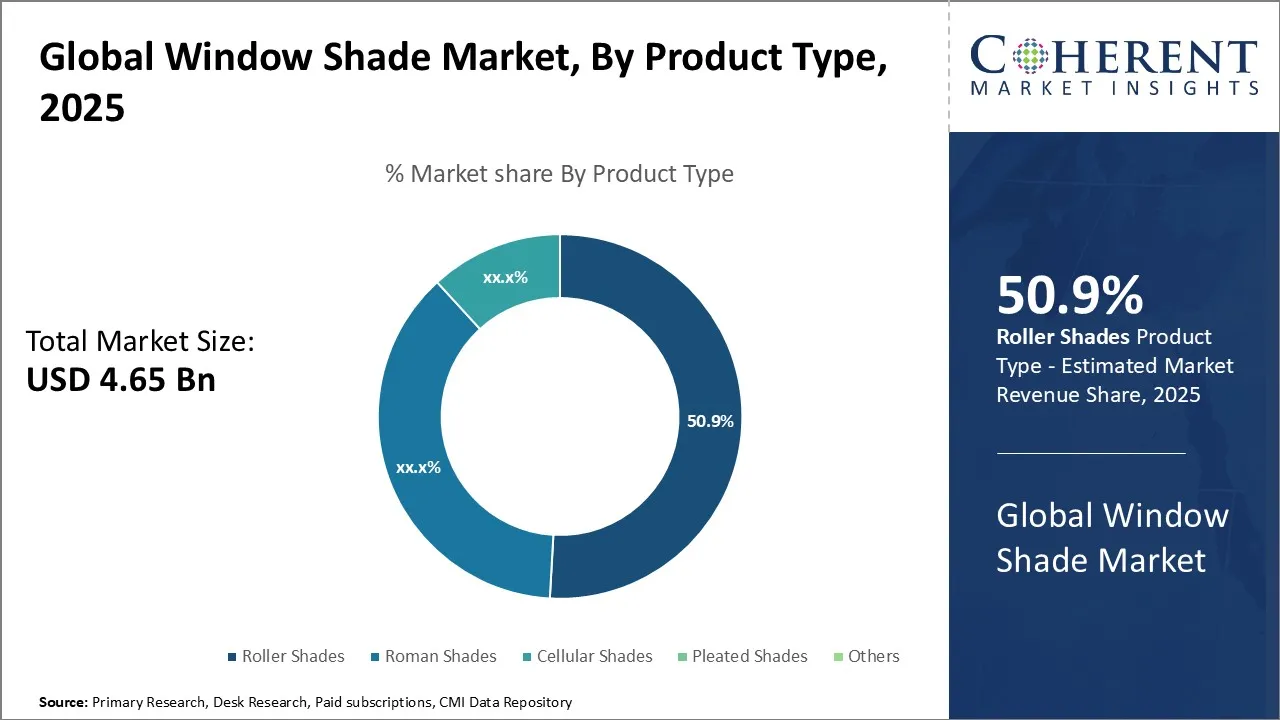
- The roller shades segment is set to lead the global window shade market in 2026, capturing a 51.9 % share.
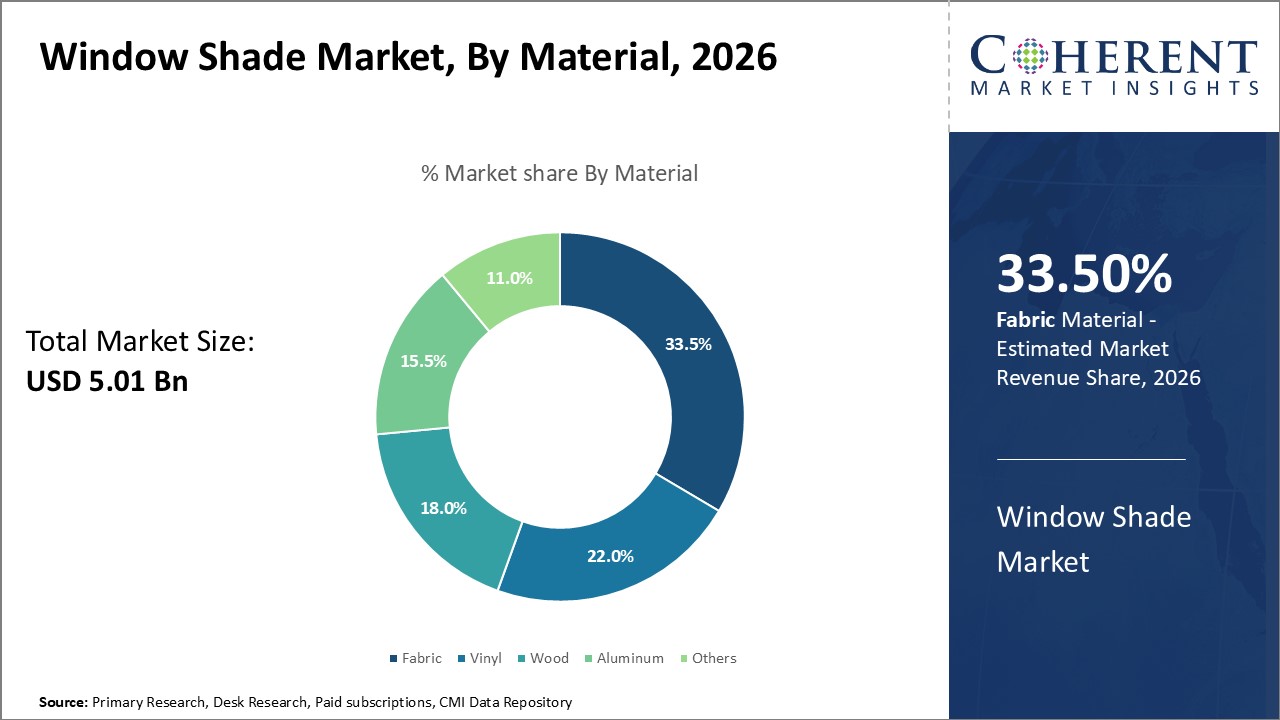
- The fabric segment is expected to account for a 33.5 % share of the window shade market in 2026.
- The residential segment is forecasted to lead the global window shade market in 2026, with a 46.6 % share.
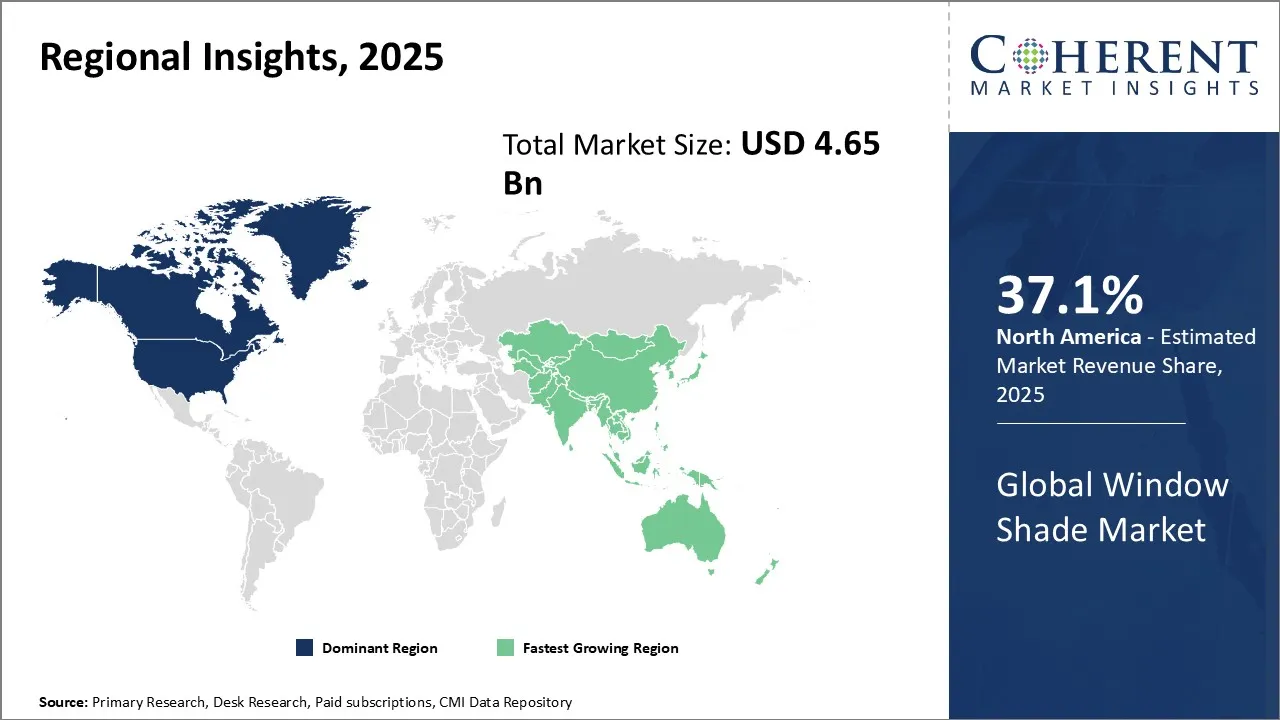
- North America is set to lead the global window shade market in 2026 with a 37.1 % share. Asia Pacific, with a 24.5% share in 2026, will be the fastest-growing region.
Market Overview
Current market trends highlight a growing adoption of automated and motorized window shades equipped with IoT integration, providing enhanced convenience and energy-saving benefits. Additionally, consumers are increasingly prioritizing sustainable and eco-friendly materials, which is boosting the development of innovative fabric blends and recyclable products. The rising preference for customized window treatments and the integration of smart home systems are further shaping the market dynamics, signaling a shift towards more technologically advanced and user-centric solutions in the window shade industry.
Current Events and Its Impact
Current Events | Description and its impact |
Surge in Smart Home Adoption |
|
Energy Efficiency Incentives and Regulations |
|
Segmental Insights
- Current Industry Events of 2026
- Market Size Estimation
- Regional Breakdown
- Competitive Landscape
- Customer Intelligence
- Segmental Analysis
- Pricing Analysis
- Key Market Drivers, Challenges & Future Trends
- Customized Insights Section
Window Shade Market Insights, By Product Type - Roller Shades Segment Lead the Market with Versatility and Functionality
Roller shades segment is expected to dominate the global window shade market with 51.9% share in 2026, primarily driven by their remarkable versatility and functional advantages. Roller shades’ popularity stems from their sleek, minimalistic design that seamlessly complements both modern and traditional interiors. Their streamlined silhouette makes them highly adaptable to various window sizes and shapes, offering a clean and contemporary look that appeals to a broad customer base.
One key driver behind the widespread adoption of roller shades is their ease of operation and maintenance. These shades use a straightforward rolling mechanism, allowing users to smoothly raise or lower the fabric to their desired height, enhancing convenience and user experience. This simplicity also translates to lower installation and repair costs compared to more complex shade types. Additionally, roller shades are widely available in various opacity levels—from sheer to blackout—catering to customers’ distinct needs for privacy, natural light management, and energy efficiency.
Window Shade Market Insights, By Material - Fabric Segment Dominates the Market due to Growing Demand for Versatile, Aesthetic, and Energy-Efficient Solutions in Residential and Commercial Spaces
The fabric segment is expected to hold 33.5% share in the window shade market in 2026, based on material, reflecting the material’s unmatched versatility and comfort attributes. Fabric window shades are favored for their wide range of textures, colors, and patterns, which allow consumers to customize the ambiance of any room extensively. Unlike harder materials such as vinyl or aluminum, fabric offers a soft, warm feel that enhances interior aesthetics, making spaces more inviting and cozier.
One of the major factors propelling fabric’s dominance is its superior light filtration capabilities. Fabrics provide a spectrum of opacity options—ranging from sheer to blackout—enabling precise control over sunlight penetration and glare reduction. This makes fabric shades ideal for residential settings, where comfort and mood setting are paramount, as well as for commercial spaces requiring controlled lighting environments, such as offices and conference rooms.
Window Shade Market Insights, By Application - Residential Applications Propel Market Growth through Comfort and Style
The residential segment is expected to dominate the global window shade market in 2026, capturing 46.6% of the share. Homeowners today prioritize window treatments that not only enhance décor but also improve comfort by managing natural light and thermal conditions. The demand in residential applications is intensified by lifestyle shifts such as increased remote work, which prompts individuals to create comfortable, multifunctional living spaces. Window shades help define room ambiance by regulating sunlight and glare, which is essential in-home offices and living areas.
Moreover, privacy concerns encourage the installation of shades, especially in densely populated urban settings where homes are close together. Advancements in smart home technology have notably influenced residential window shade trends. Motorized and app-controlled shades appeal to homeowners looking for convenience and seamless integration with their home automation systems. Such features allow users to program shades to open or close according to time of day or sunlight intensity, optimizing comfort while supporting energy savings.
Regional Insights
North America Window Shade Market Analysis and Trends
The North America region is projected to lead the market with a 37.1% share in 2026, driven by a mature market ecosystem characterized by advanced manufacturing capabilities, strong distribution networks, and high consumer awareness of energy-efficient and smart home products. The region benefits from stringent government regulations and incentives promoting energy conservation, which encourages the adoption of innovative window treatments.
The presence of major industry players such as Hunter Douglas, Springs Window Fashions, and Graber significantly contributes to ongoing product development such as Aura Illuminated Shades. These shades combine a textured front shade, a room-darkening liner, and built-in illumination, allowing users to adjust light levels and color temperatures for a customizable ambiance and market penetration. Additionally, well-established trade channels and a consumer base with a higher disposable income support the proliferation of premium and automated window shade solutions across residential and commercial sectors.
Asia Pacific Window Shade Market Analysis and Trends
The Asia Pacific region is expected to exhibit the fastest growth in the market contributing 24.5% share in 2026, fueled by rapid urbanization, increasing construction activities, and growing awareness about interior aesthetics and energy efficiency. Government policies in countries like China, India, and South Korea increasingly support smart building initiatives, indirectly boosting demand for advanced window treatments. This region's market is also shaped by a growing presence of both global players and dynamic local manufacturers, including companies such as NVC Lighting, LG Hausys, and MechoShade. The expanding middle-class consumer base, along with increasing exports to international markets, enhances the trade dynamics, making Asia Pacific a vibrant and competitive market for window shading solutions.
Global Window Shade Market Outlook for Key Countries
U.S. Window Shade Market Trends
The U.S. remains a lead market in North America, due to its mature housing and commercial infrastructure. Major players—including Hunter Douglas and Springs Window Fashions—have a stronghold with a focus on technologically advanced and energy-efficient window shades. Government programs encouraging green building standards (like LEED certification) and rising smart home trends support product innovation and integration with home automation systems. The competitive market encourages product diversification, including motorized and eco-friendly materials.
Germany Window Shade Market Trends
Germany’s window shade market benefits from the country’s strong commitment to energy efficiency and sustainable building practices. With government regulations emphasizing thermal insulation and reduced energy consumption, window shading solutions have become crucial in both residential and commercial constructions. Industry leaders like Warema and KADECO play a significant role, focusing on innovative shading fabrics and integration with smart home ecosystems. Germany also serves as a hub for exporting advanced shading technologies to other European countries, supported by its well-established manufacturing base.
China Window Shade Market Trends
China’s growing window shade market is propelled by booming construction activities, especially in urban centers, and increasing consumer focus on comfort and style. Local manufacturers such as NVC Lighting and increasingly global brands are expanding their footprint through collaborations and tailored product offerings. Policies advocating green buildings and smart cities further boost adoption rates, while rising consumer income levels encourage demand for premium automated window shades. Trade liberalization and investment in supply chain infrastructure support exports as well as domestic distribution.
India Window Shade Market Trends
India exhibits substantial growth potential due to rapid urbanization and a surging construction industry. The country’s government initiatives promoting energy-efficient buildings, such as the Energy Conservation Building Code (ECBC), drive demand for window shading as a low-cost method to regulate indoor temperatures. Domestic companies along with multinational corporations are investing in expanding product availability and awareness across Tier 1 and Tier 2 cities. Rising disposable incomes and changing lifestyle preferences contribute to increased adoption of customized and motorized shading options.
UAE Window Shade Market Trends
The UAE window shade market for window shades thrives on the backdrop of high construction rates, luxury real estate growth, and increasing integration of smart home technologies. Strong government initiatives supporting sustainability, including green building certifications like Estidama, push demand for energy-efficient window treatments. Regional players like Al-Futtaim and international firms such as Hunter Douglas cater to high-end commercial and residential projects. The country’s status as a commercial hub also facilitates trade and import of innovative shading solutions, supporting its market expansion.
Impact of Raw Material Pricing on the Window Shade Market
- The window shade market is significantly influenced by the pricing of key raw materials such as aluminum, PVC, wood, fabrics, and motors. Fluctuations in the prices of these inputs—driven by global economic factors, trade policies, seasonal demand, supply chain disruptions, and environmental regulations—directly affect manufacturing costs, profit margins, and ultimately, the retail price of window shades. Rising costs of premium inputs like cotton, silk, and high-quality metals prompt manufacturers to raise product prices to compensate, often restricting purchasing activity, especially among price-sensitive consumers.
- Volatility in raw material costs complicates long-term planning and contract negotiations, particularly in commercial projects, increasing business risks and causing delays. Smaller manufacturers face even more pressure, as they are less able to absorb cost changes or invest in substitutes like recycled materials or bio-based PVC, which, despite being environmentally favorable, come at a higher initial premium. Geopolitical events—such as the Russia-Ukraine conflict—have heightened cost instability and created shortages, leading to deferred installations and fulfillment challenges across supply chains.
Market Players, Key Development, and Competitive Intelligence
Key Developments
- In January 2025, the U.S. Consumer Product Safety Commission (CPSC) announced the recall of approximately 19,500 ChrisDowa Roller Window Shades sold exclusively on Amazon. The recall was issued due to the presence of long operating cords that pose a strangulation and entanglement hazard to children, violating federal safety regulations for window coverings.
Top Strategies Followed by Global Window Shade Market Players
- Established industry leaders in the window shade market, such as Hunter Douglas and Lutron Electronics, primarily invest heavily in research and development (R&D) to create high-performance, energy-efficient, and aesthetically appealing window coverings. These companies focus on innovation to cater to evolving consumer demands for smart integration and sustainable materials.
- For instance, Hunter Douglas has pioneered in developing energy-efficient window coverings with their Honeycomb Shades, which help with insulation by trapping air between layers, thereby enhancing energy savings.
- Mid-level competitors in the window shade market concentrate on delivering cost-effective solutions that strike a balance between quality and affordability. Targeting price-sensitive customers, these companies emphasize value-driven products that provide essential features without the premium pricing associated with high-end offerings. To bolster their market presence and operational efficiency, mid-level players frequently engage in partnerships or joint ventures with technology providers and manufacturing firms. These collaborations help them enhance production capabilities, reduce costs, and incorporate improved technology into their product lines.
- For example, Blinds.com offers a wide range of affordable yet quality blinds, such as their 2" Faux Wood Blinds, which are popular for their durability and price competitiveness. These mid-level players frequently engage in partnerships or joint ventures with technology providers and manufacturing firms to bolster their market presence. Budget Blinds, for instance, has partnered with Somfy, a leader in smart home technology, to offer motorized blinds at more accessible price points.
- Small-scale players in the global window shade industry distinguish themselves by carving out specialized niches through innovation and technology adoption. These firms often focus on unique product attributes such as custom designs, smart automation, or environmentally friendly materials to differentiate themselves from larger competitors. Embracing advanced manufacturing techniques, including digital printing and automation, small players enhance product customization and speed to market.
- For example, Companies like Blinds Galaxy and Shades IN Style focus on custom designs, smart automation, or environmentally friendly materials to differentiate themselves. Blinds Galaxy, for instance, specializes in eco-friendly products, offering bamboo and wood blinds, which are designed to appeal to environmentally conscious consumers.
Market Report Scope
Window Shade Market Report Coverage
| Report Coverage | Details | ||
|---|---|---|---|
| Base Year: | 2025 | Market Size in 2026: | USD 5.01 Bn |
| Historical Data for: | 2020 To 2024 | Forecast Period: | 2026 To 2033 |
| Forecast Period 2026 to 2033 CAGR: | 7.8% | 2033 Value Projection: | USD 8.48 Bn |
| Geographies covered: |
| ||
| Segments covered: |
| ||
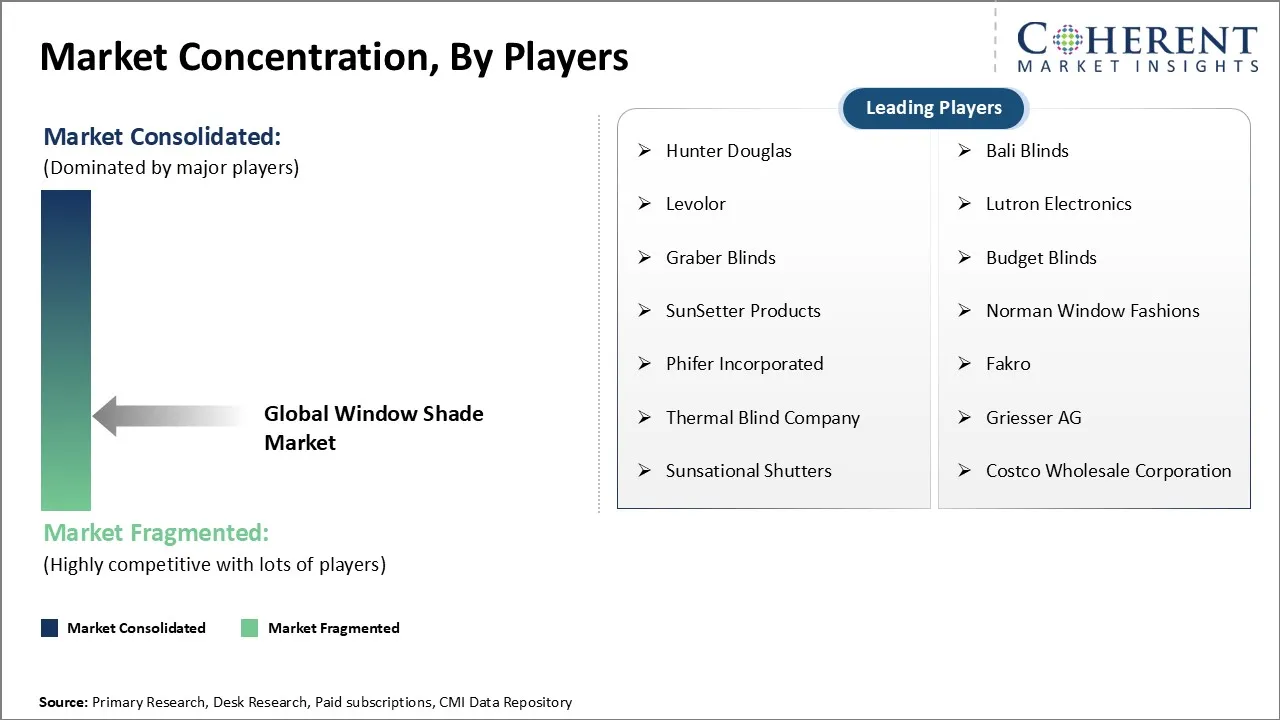
| Companies covered: | Hunter Douglas, Bali Blinds, Levolor, Lutron Electronics, Graber Blinds, Budget Blinds, SunSetter Products, Norman Window Fashions, Phifer Incorporated, Fakro, Thermal Blind Company, Griesser AG, Sunsational Shutters, and Costco Wholesale Corporation | ||
| Growth Drivers: |
| ||
| Restraints & Challenges: |
| ||
Window Shade Market Dynamics
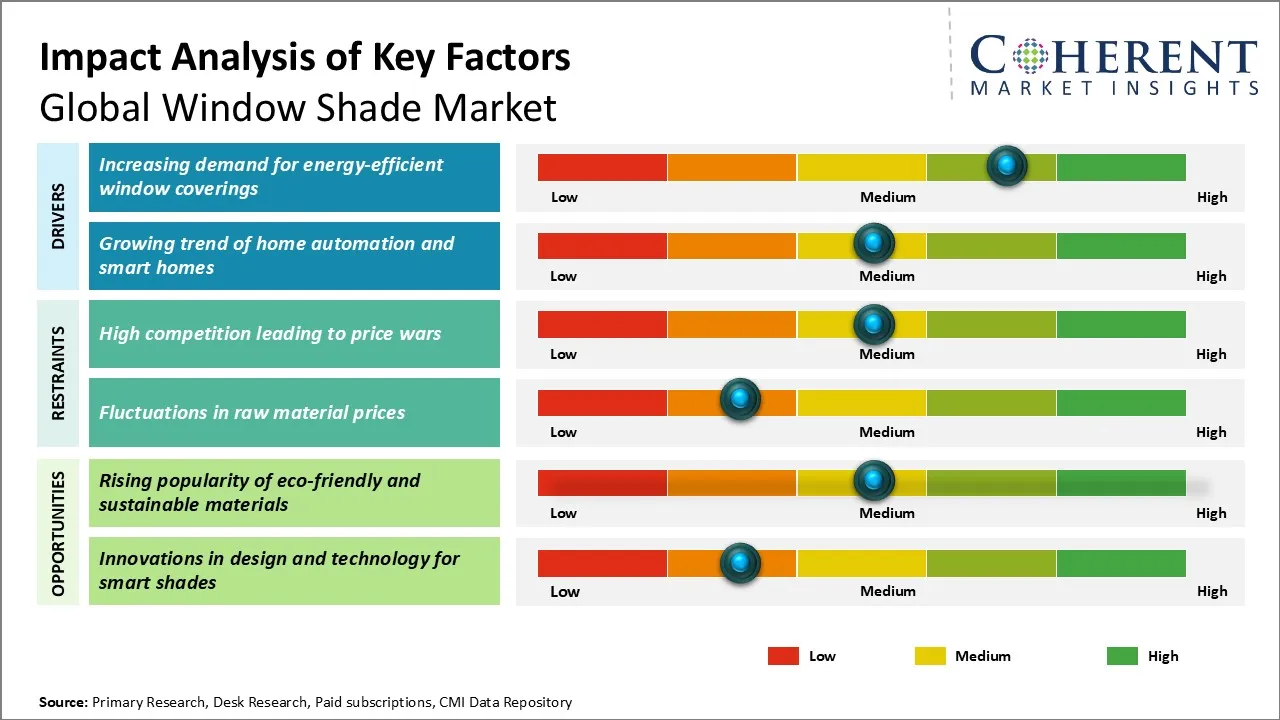
Window Shade Market Driver - Increasing Demand for Energy-Efficient Window Coverings
The escalating focus on energy conservation and sustainability has significantly fueled the demand for energy-efficient window coverings in residential and commercial buildings worldwide. As consumers and businesses become more conscious of reducing energy consumption and lowering utility expenses, window shades offering superior insulation properties have gained prominence. These window coverings help regulate indoor temperature by minimizing heat loss during winters and blocking excessive heat during summers, thereby reducing reliance on heating, ventilation, and air conditioning (HVAC) systems.
For instance, Hunter Douglas, a leading manufacturer of window shades, offers products like Honeycomb Shades, which are designed to provide superior insulation. These shades help reduce heating and cooling costs by up to 50%, making them a popular choice for both residential and commercial spaces looking to minimize their carbon footprint.
Window Shade Market Opportunity - Rising Popularity of Eco-Friendly and Sustainable Materials
The global window shade market is experiencing a significant opportunity driven by the rising popularity of eco-friendly and sustainable materials. Increasing environmental awareness among consumers and stricter government regulations on carbon footprint reduction are pushing manufacturers to innovate and incorporate sustainable materials such as bamboo, organic cotton, recycled polyester, polyester fiber, and other biodegradable fibers into their product offerings. This shift not only appeals to environmentally conscious customers but also aligns with growing trends in green building and sustainable interior design practices worldwide.
For example, Blinds.com have capitalized on the growing demand for sustainability by offering bamboo-based window coverings, which are renewable and biodegradable. Bamboo’s rapid growth cycle and minimal environmental impact make it an attractive alternative to synthetic materials, aligning with the eco-conscious consumer's values.
Analyst Opinion (Expert Opinion)
- The global window shade market is poised for substantial growth, driven by an increasing focus on energy efficiency and aesthetic enhancement in residential and commercial spaces. Companies like Hunter Douglas and Lutron are leading the charge with innovative products that integrate smart technology, allowing users to control light and temperature with ease.
- Recent events, such as the International Window Coverings Expo (2023) and the Home & Building Technology Conference (2022), have highlighted advancements in sustainable materials and design trends, showcasing how manufacturers are responding to consumer demand for environmentally friendly options. Presentations at these conferences emphasized the importance of customizability and integration with smart home systems, reflecting a shift towards personalized consumer experiences. Notably, case studies revealed significant energy savings achieved by businesses that have adopted advanced shading solutions.
- As urbanization and environmental concerns continue to rise, the window shade market is set to thrive. The combination of innovative design, smart technology adoption, and sustainability initiatives will be critical in shaping the future of this market, making window shades not just functional but also a key element of modern interior design.
Speak to the analyst
Want personalized insights?
Take the findings above to one of our principal consultants, or have the report rebuilt around the segments, geographies and competitors you actually track.
Market Segmentation
- Product Type Insights (Revenue, USD Bn, 2021 - 2033)
- Roller Shades
- Roman Shades
- Cellular Shades
- Pleated Shades
- Others
- Material Insights (Revenue, USD Bn, 2021 - 2033)
- Fabric
- Vinyl
- Wood
- Aluminum
- Others
- Application Insights (Revenue, USD Bn, 2021 - 2033)
- Residential
- Commercial
- Industrial
- Distribution Channel Insights (Revenue, USD Bn, 2021 - 2033)
- Online Retailers
- Offline Retailers
- Direct Sales
- Regional Insights (Revenue, USD Bn, 2021 - 2033)
- North America
- U.S.
- Canada
- Latin America
- Brazil
- Argentina
- Mexico
- Rest of Latin America
- Europe
- Germany
- U.K.
- Spain
- France
- Italy
- Russia
- Rest of Europe
- Asia Pacific
- China
- India
- Japan
- Australia
- South Korea
- ASEAN
- Rest of Asia Pacific
- Middle East
- GCC Countries
- Israel
- Rest of Middle East
- Africa
- South Africa
- North Africa
- Central Africa
- North America
- Key Players Insights
- Hunter Douglas
- Bali Blinds
- Levolor
- Lutron Electronics
- Graber Blinds
- Budget Blinds
- SunSetter Products
- Norman Window Fashions
- Phifer Incorporated
- Fakro
- Thermal Blind Company
- Griesser AG
- Sunsational Shutters
- Costco Wholesale Corporation
Sources
Primary Research Interviews
- Product Development Head – Leading Window Shade Manufacturer
- Procurement Manager – Major Home Improvement Retailer
- Marketing Manager – Window Treatment Company
- Sustainability Manager – Window Shade Certification Body
Stakeholders
- Manufacturers
- End-use Sectors:
- Residential (Home Decor and Interior Design)
- Commercial (Offices, Hotels, and Retail)
- Industrial (Automotive, Construction)
- Retailers and E-commerce Platforms
- Technology Integration Players: Smart window shade technology providers (IoT integration)
Databases
- UN Comtrade Database
- India Import Export (EXIM) Database
Magazines
- Window & Door Magazine – Trends in window coverings and home interior products
- Interior Design Magazine – Innovations in smart window treatments
- Home & Garden Magazine – Popular window shades in residential designs
- Building Products Magazine – Trends in commercial window coverings and energy efficiency
Journals
- Journal of Building Performance – Energy efficiency of window treatments
- Journal of Architectural and Planning Research – Impact of window treatments on building design
- International Journal of Energy and Environmental Engineering – Energy-saving window treatments and technologies
- Indoor and Built Environment Journal – Consumer preferences for smart window solutions
Newspapers
- The Wall Street Journal – Market growth and consumer trends in home improvement
- The New York Times – Innovations in window shade technologies and consumer preferences
- The Guardian – Sustainability trends in window coverings
- Financial Times – Market development in smart window shades and energy-efficient products
Associations
- Window Covering Manufacturers Association (WCMA)
- National Association of Home Builders (NAHB)
- Green Building Council
- International Interior Design Association (IIDA)
Public Domain Sources
- U.S. Department of Energy – Energy efficiency regulations for window treatments
- European Commission – Energy performance standards for window coverings
- World Green Building Council – Sustainability standards for window treatments
- OECD – Global market data on energy-efficient building solutions
Proprietary Elements
- CMI Data Analytics Tool, Proprietary CMI Existing Repository of information for last 8 years.
Get access to 250+ pages report
Every segment, forecast, competitor profile and data table behind the analysis above — available for instant download.
- ESOMAR Member
- ISO 9001:2015 Certified
- D-U-N-S Registered
- GDPR & CCPA Compliant
Missing comfort of reading report in your local language? Find your preferred language:
Transform your Strategy with Exclusive Trending Reports
Frequently Asked Questions
The global window shade market is estimated to be valued at USD 5.01 Bn in 2026 and is expected to reach USD 8.48 Bn by 2033.
Motorized window shades use an electric motor to raise, lower, or adjust the position of the shades, typically controlled by a remote, smartphone app, or home automation system.
Window shades made from materials like solar fabrics, blackout fabrics, and tinted or reflective films are designed to block UV rays, protecting interiors from sun damage.
The CAGR of global window shade market is projected to be 7.8% from 2026 to 2033.
Increasing demand for energy-efficient window coverings and the growing trend of home automation and smart homes are the major factors driving the growth of global window shade market.
High competition leading to price wars and fluctuations in raw material prices are the major factors hampering the growth of global window shade market.
In terms of Product Type, Roller Shades are estimated to dominate the market revenue share in 2026.