

Global Wireless Antenna Market Size and Forecast – 2026 To 2033
The global wireless antenna market is expected to grow from USD 5.10 Bn in 2026 to USD 8 Bn by 2033, registering a compound annual growth rate (CAGR) of 5.6% from 2026 to 2033. The global wireless antenna market is increasingly being pushed by the rapid rollout of 5G networks and development of 5G connectivity infrastructure.
On May 14, 2025, Vi (Vodafone Idea) announced the launch of 5G services in Delhi NCR in partnership with Ericsson. Vi has deployed Ericsson’s high-performing Massive MIMO radios to launch its 5G service. (Source: Ericsson)
Key Takeaways of the Global Wireless Antenna Market
- The Omni-Directional segment is expected to account for 44.0 % of the global wireless antenna market share in 2026. The demand for omni-directional antennas increases as telecom operators increasingly prioritize wide and uniform coverage in dense networks. On October 24, 2025, AT&T replaced 40% of Nokia radios with Ericsson, added midband spectrum to 15,000 sites and first open RAN call made on commercial network. (Source: AT&T)
- The Telecommunications segment is estimated to capture 28.0 % of the market share in 2026. The growing use of 5G radio antennas for security operations is a key factor driving the segment growth. On February 11, 2026, the European Commission proposed an EU-wide initiative to develop an AI-powered drone detection system using advanced 5G radio antennas, aimed at protecting airports, military facilities and other critical infrastructure. (Source: European Commission)
- North America is expected to dominate the wireless antenna market in 2026 with a market share of 32.0 %. The increasing use of MIMO antenna systems in the region is a major growth driver. On February 26, 2025, Verizon, working with Ericsson and Qualcomm, achieved a record 480 Mbps uplink speed using Massive MIMO antenna systems and C-band spectrum. (Source: Ericsson)
- Asia Pacific is expected to account for 27.0 % share in 2026 and is projected to record the fastest growth over the forecast period. The growing expansion of manufacturing facilities in the region is a major factor driving the regional market growth. Ericsson Antenna System (EAS) announced that it is expanding its local manufacturing footprint in India, positioning the country as a strategic innovation hub within Ericsson’s global network. (Source: Ericsson)
- Rapid shift toward Massive MIMO and beamforming antennas: State-of-the-art wireless networks are increasingly using Massive Multiple Input Multiple Output (Massive MIMO) and beamforming technologies, particularly in 5G infrastructure and future 6G networks. With these antennas, its easier focus energy towards a specific user rather than radiate in all directions. This yields better speed, capacity, and signal quality.
- Integration of AI and software-defined antenna systems: Wireless antennas are getting smarter and more software-driven. AI and machine learning are being deployed to optimize signal direction, minimize interference, and dynamically manage network traffic. The move to software defined radio (SDR) and cognitive antennas allows operators to change the network performance in real time to suit user demand, weather conditions and congestion levels, boosting overall efficiency.
Segmental Insights
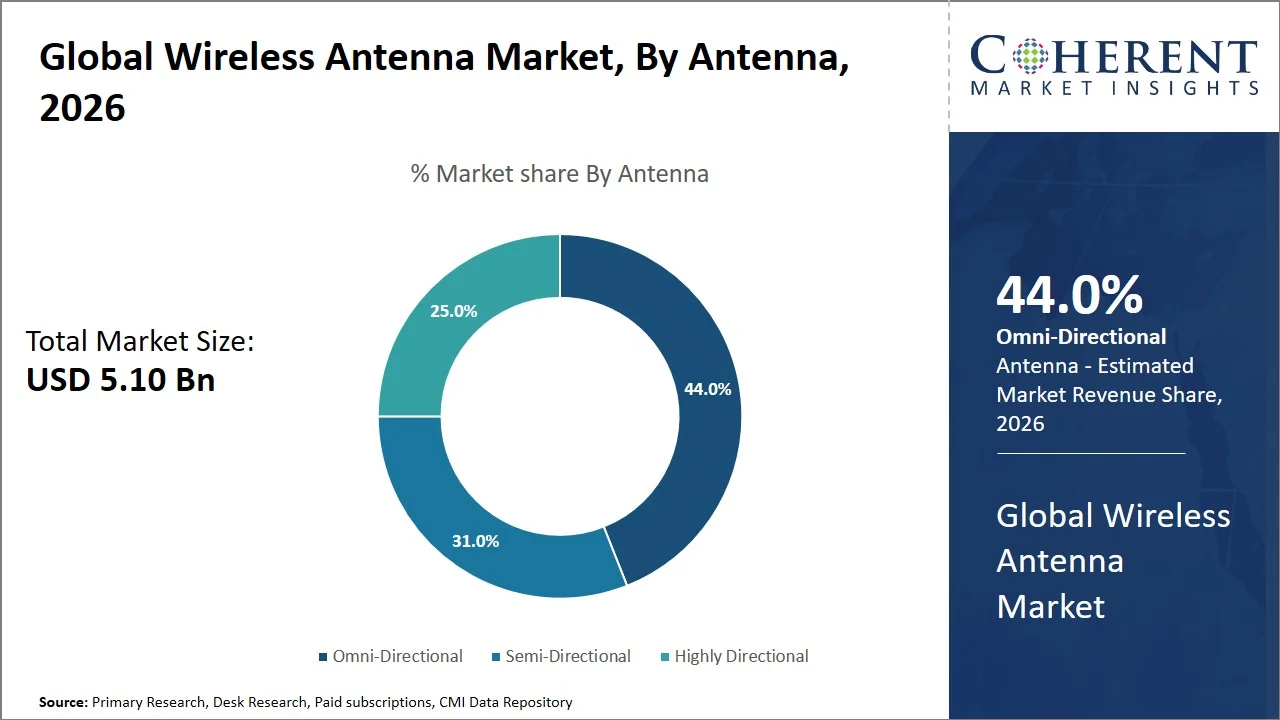
Why Does Omni-Directional Dominate the Global Wireless Antenna Market?
The Omni-Directional segment is expected to account for 44.0% of the global wireless antenna market share in 2026. Omni-directional antennas can radiate and receive signals in all directions equally making them very effective for vast area coverage without the need of perfect alignment. This makes them perfect for applications such as cellular base stations, Wi-Fi routers, and public communication networks where persistent connectivity and ease of deployment are more critical than directionality.
On December 4, 2024, Ericsson announced that it had won a multi-year, multi-billion USD extension deal from Bharti Airtel for 4G and 5G RAN products and solutions. As per the new contract, Ericsson will deploy centralized RAN and Open RAN-ready solutions for network transformation which will help customers with wider coverage and the enhanced capacity on the network. (Source: Ericsson)
- Current Industry Events of 2026
- Market Size Estimation
- Regional Breakdown
- Competitive Landscape
- Customer Intelligence
- Segmental Analysis
- Pricing Analysis
- Key Market Drivers, Challenges & Future Trends
- Customized Insights Section
Why are Telecommunications the Most Widespread Application?
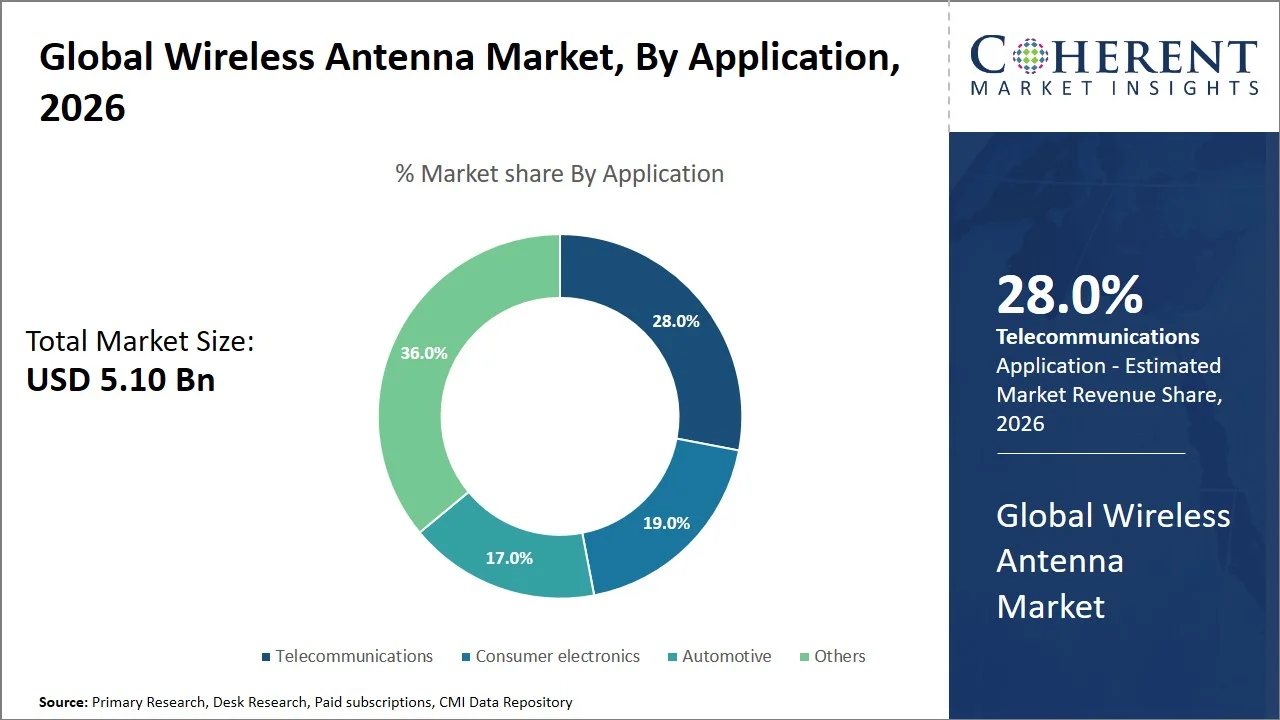
The Telecommunications segment is expected to account for 28.0% of the global wireless antenna market share in 2026. Wireless antennas are used in many different ways. The most common use is in the telecom industry. All day long, all over the place, phone, data, and internet services are being broadcast via mobile networks. Every single cell tower and base station needs antennas. The fast proliferation of smartphones and use of mobile internet exacerbates the demand on dense antenna infrastructure to deliver dependable coverage, high-speed connectivity, and low latency in both urban and rural areas.
On May 21, 2026, Bharti Airtel launched India's first commercial 5G network slicing. This innovation offers priority 5G data access to postpaid customers. The technology strengthens India's digital leadership. This move positions India among leading nations in leveraging 5G for differentiated services. Ericsson's core network technology supports this deployment. (Source: Economic Times)
Currents Events and their Impact
Current Events | Description and its Impact |
U.S. CHIPS and Science Act |
|
EU Radio Equipment Directive (RED) Updates |
|
(Source: Congress, European Commission)
Wireless Antenna Market Dynamics
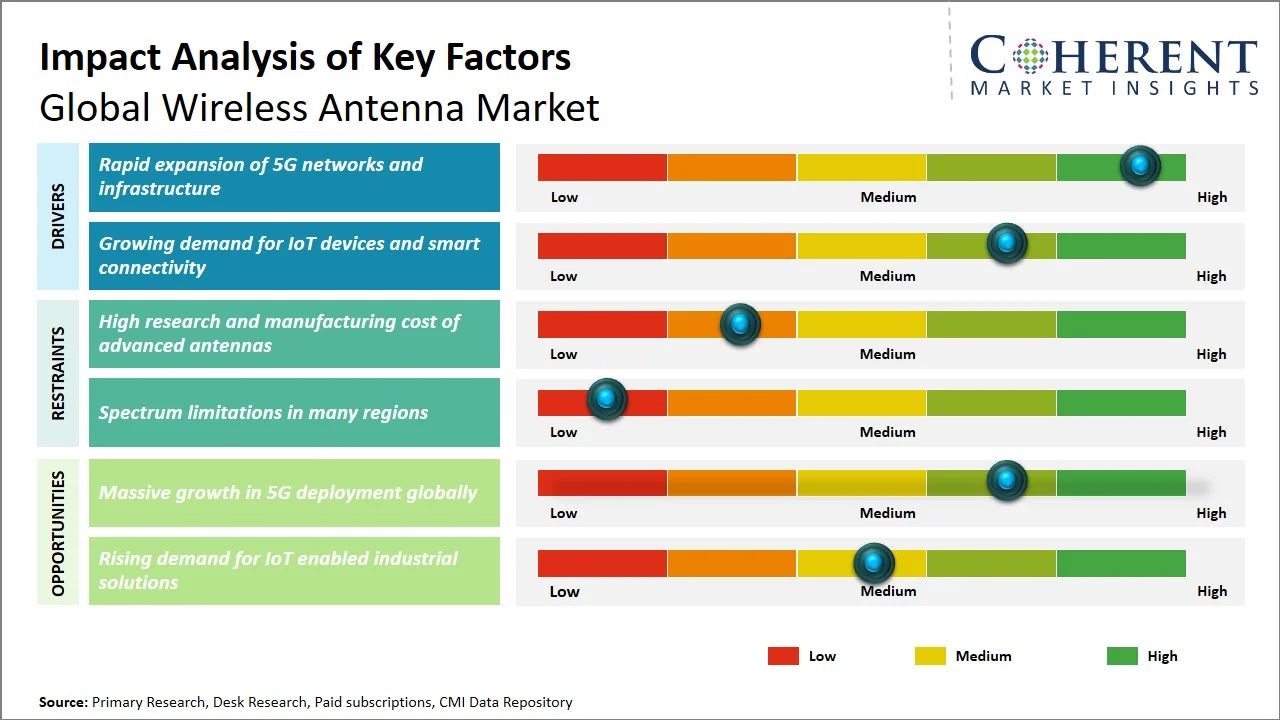
Market Drivers
Rapid expansion of 5G networks and infrastructure
The wireless antenna market is growing at a fast pace due to the rapid expansion of 5G networks and infrastructure. Telecom operators are deploying dense networks of advanced antennas to support higher data speeds, lower latency, and increased connectivity. This comprises the large-scale deployment of massive MIMO systems, tiny cells and antennas with beamforming capabilities to improve network coverage in urban and high traffic locations. Operators in regions such as North America, Europe, and Asia Pacific are advancing major 5G rollouts and are in great demand for high-performance multi-band antenna solutions that can efficiently address rising network complexity and data traffic.
On March 10, 2026, AT&T announced an investment and spend of more than USD 250 billion in the future of U.S. advanced connectivity, building the high-speed networks and resilience required for the next era of innovation and economic growth. (Source: AT&T)
Growing demand for IoT devices and smart connectivity
The wireless antenna market is experiencing a major boost due to the increasing demand for IoT devices and smart connectivity as billions of connected devices require reliable, low-power, and always-on communication capabilities. Every IoT application—from smart home systems and wearable devices to industrial sensors and linked vehicles—relies on tiny multi-band antennas to enable seamless data exchange and network integration. The fast-growing connected ecosystems are compelling manufacturers to produce highly efficient antenna solutions that can cover wide frequency ranges and sustain consistent performance in dense connection scenarios. On December 10, 2025, Vi Business expanded its IoT and Advanced Metering Infrastructure (AMI) solutions by launching Smart Gas Metering for city gas distributors. (Source: Vi)
Emerging Trends
- Growth of Small Cell and Dense Network Architectures: Growth telecom operators are deploying small cell deployments requiring small, low-power antennas to be deployed on street furniture, building facades and indoors to meet increased mobile data usage and 5G rollout.
- Advancement in Satellite and Non-Terrestrial Networks: The growth of satellite internet constellations and non-terrestrial networks is driving demand for advanced phased array and electronically steerable antennas that can maintain consistent high-speed connectivity.
Regional Insights
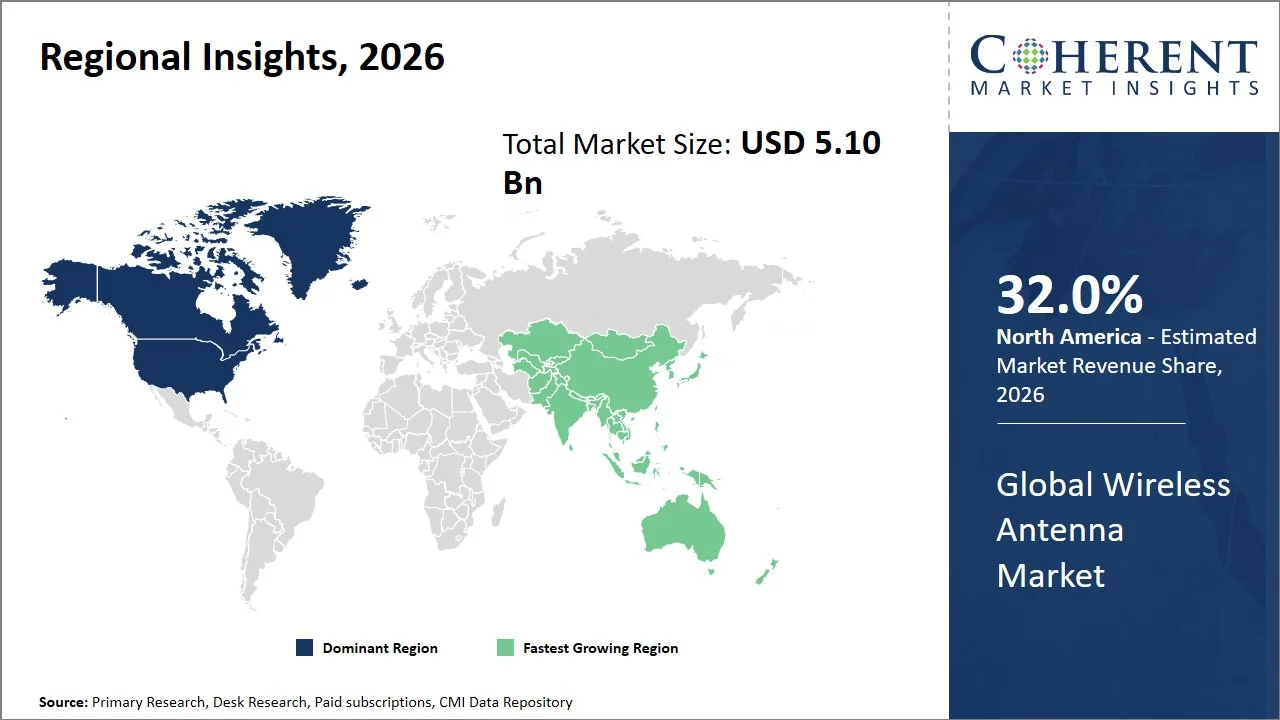
Why is North America a Strong Market for Wireless Antenna?
North America is expected to account for a market share of 32.0% in 2026. The North American wireless antenna industry is mostly driven by large-scale 5G infrastructure development by carriers such as Verizon, AT&T and T-Mobile, particularly through dense small-cell installations in urban hubs such as New York and San Francisco. The U.S. also employs CBRS (Citizens Broadband Radio Service) spectrum that has sped up private LTE and 5G antenna deployments in company campuses, logistical centers, and industrial zones. Qualcomm and CommScope, among others, are already actively supplying improved antenna systems to support huge MIMO and mmWave rollouts. On November 17, 2025, AT&T announced that it had hit the 5G accelerator and deployed mid-band (3.45 GHz) spectrum from EchoStar to nearly 23,000 cell sites in a matter of a few weeks. (Source: AT&T)
Why Does Asia Pacific Wireless Antenna Market Exhibit High Growth?
Asia Pacific is projected to account for 27.0% of the global wireless antenna market and expected to register the fastest growth. China Mobile and NTT Docomo are in the forefront of large-scale 5G base station installations and demand for antennas in Asia Pacific is the highest, propelled by big deployments in China, Japan, South Korea, and India. Huawei and ZTE’s large roll-out of antenna systems in China’s smart city projects and high-speed rail connectivity has greatly boosted high-frequency antenna adoption. South Korea's early 5G leadership, particularly in ultra-dense networks in Seoul, also has spurred the use of beamforming and small antenna arrays. (Source: Ericsson)
Global Wireless Antenna Market Outlook for Key Countries
Why is U.S. Emerging as a Major Hub in the Wireless Antenna Market?
In the U.S., the antenna business is being driven largely by 5G mid-band and mmWave expansion. Verizon’s “Ultra Wideband” network requires dense rooftop and street-level antenna installations in locations like Chicago and Los Angeles. AT&T’s deployment of C-band has further increased demand for enhanced macro-cell antennas in suburban and metro areas. In addition, the enterprise adoption of private 5G networks for manufacturing and defense use cases is boosting demand for customized high-performance antenna systems.
Is China the Next Growth Engine for the Wireless Antenna Market?
China is one of the most active antenna deployment marketplaces in the world and China Mobile, China Unicom, and China Telecom are building millions of 5G base station antennas supported by domestic manufacturers such as Huawei and ZTE. In Shenzhen and Shanghai, for example, the successful execution of large-scale smart city projects relies on Massive MIMO antenna arrays for real-time surveillance, traffic systems, and IoT connectivity. The rapid roll-out of the nation’s 5G standalone (SA) network has further fueled demand for high frequency and multi-band antenna systems.
Germany Wireless Antenna Market Analysis and Trends
Industrial use cases dominate Germany’s wireless antenna market, with Deutsche Telekom and Vodafone increasing 5G coverage, as well as private “5G campus networks” in factories run by corporations such as Siemens and BMW. These industrial deployments require specialized antennas tuned to low-latency automation and robotics, rather than consumer connectivity. The strict EU spectrum rules and the focus on Industry 4.0 applications fuel the demand for high-precision, interference-resistant antenna solutions.
India’s wireless antenna industry has had a significant growth post the country-wide 5G rollout spearheaded by Reliance Jio and Bharti Airtel, with dense antenna deployments centered in key cities such as Mumbai, Delhi and Bengaluru. The implementation has involved the large-scale installation of new base station antennas and enhancements to existing 4G infrastructure to accommodate 5G NSA and SA networks. Moreover, the growth of rural connection under the government’s digital programs is also driving a rise in demand for cost-effective and wide coverage antenna systems.
Global Wireless Antenna Market - Number of 4G/5G Base Stations Deployed Globally
Network Type | Number of Base Stations |
4G (LTE + LTE-Advanced) | ~841 LTE networks + millions of LTE sites |
China 5G | ~4.5–4.95 million 5G base stations |
India 5G | ~518,000+ 5G base stations |
USA 5G | ~150,000–200,000 base stations |
5G (all deployments) | ~360 commercial 5G networks globally |
How is Massive Growth in 5G Deployment Globally Creating New Growth Opportunities in the Wireless Antenna Market?
The large-scale global deployment of 5G networks is offering lucrative growth prospects for the wireless antenna market by escalating demand for the sophisticated antenna technologies such as massive MIMO, beamforming, and small cell antennas. 5G needs a denser network infrastructure with more capacity and quicker data transmission speeds. Telecom operators are therefore deploying a huge number of new antenna systems to boost coverage and performance, especially in metropolitan areas. The rapid growth also fuels ongoing innovation in compact, energy-efficient, high-frequency antenna designs, bringing up new revenue streams for manufacturers and solution providers across the wireless ecosystem.
On February 4, 2025, AT&T announced it is extending its voice core relationship with Nokia in a multi-year expansion deal that will support the U.S. operator in delivering on its vision of securely providing customer-focused networks and automation that drive new services, faster deployment times, and operational efficiencies. (Source: Nokia)
Global Wireless Antenna Market - Spectrum Allocation and Regulatory Change
Country/Region | Authority | Spectrum / Policy Change |
U.S. | FCC (Federal Communications Commission) | Approval of AT&T spectrum acquisition (UScellular deal) + continued C-band expansion |
FCC (Federal Communications Commission) | New upper C-band & 5G/6G auction planning with aviation interference safeguards | |
Europe | EU Spectrum Policy Group | Ongoing dispute over upper 6 GHz band allocation (Wi-Fi vs 5G/6G) |
China | MIIT / Operators (China Mobile, China Telecom) | Continued expansion of mid-band 5G spectrum usage (3.5 GHz, 2.6 GHz) |
India | TRAI (Telecom Regulator) | Proposal for satellite spectrum allocation (5-year licensing model) |
Department of Telecommunications (DoT) | National Frequency Allocation Plan (NFAP-2025) expands IMT bands incl. 6.425–7.125 GHz for 5G/6G |
Market Players, Key Development, and Competitive Intelligence
Key Developments
- On March 4, 2026, Huawei declared that its ultra-wideband (UWB) AAU series products had won the GSMA GLOMO Best Mobile Network Infrastructure award for their UWB, multi-antenna, and energy-saving innovations in all-band evolution toward 5G.
- On February 17, 2026, Ericsson announced it is introducing a new suite of radio, antenna, and AI RAN software solutions ahead of Mobile World Congress (MWC) 2026 in Barcelona, Spain. The new products will enable communications service providers (CSPs) to monetize AI devices with differentiated connectivity and launch new services.
Competitive Landscape
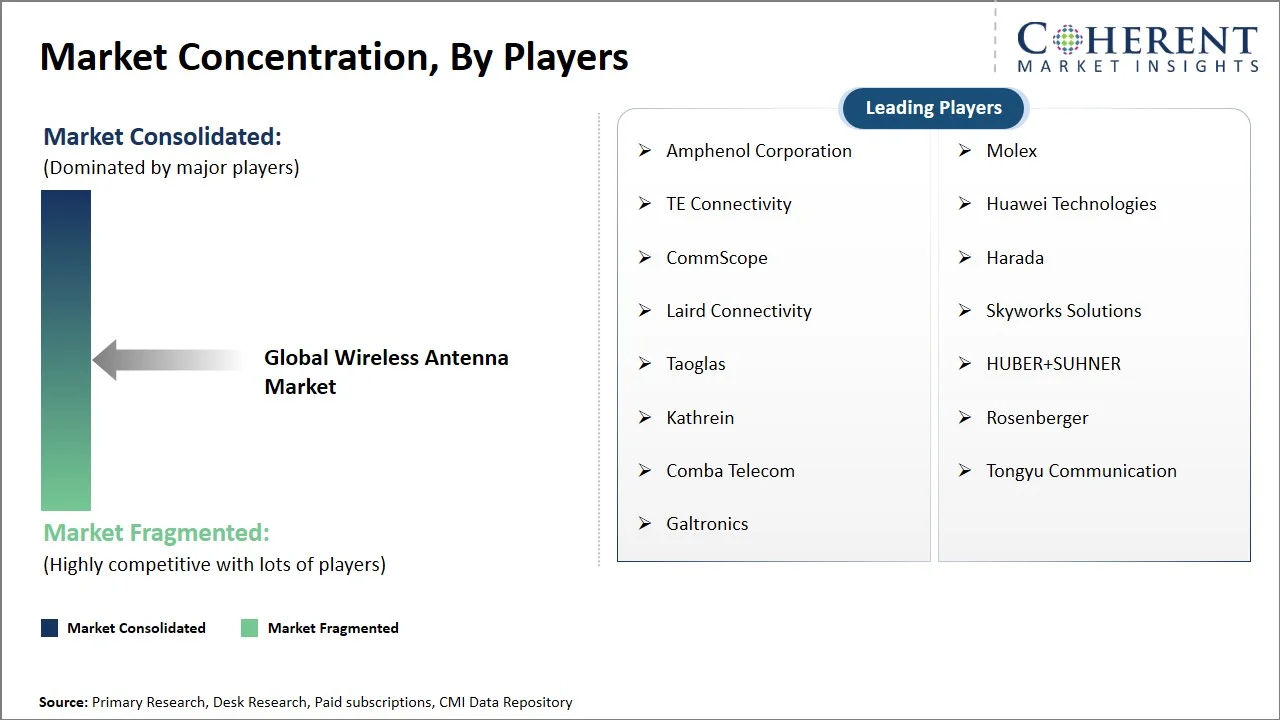
The global wireless antenna market is competitive and includes established multinational organizations and specialized technology companies, concentrating on continual innovation and product differentiation. The key competitors compete on parameters such as antenna performance, size reduction, integration capabilities and support for advanced technologies such as 5G, IoT and beamforming. Companies are investing more in R&D for high efficiency, multi-band and smart antenna solutions and growing through collaborations with telecom operators and infrastructure providers. Companies are often involved in strategic mergers, acquisitions, and collaborations with the purpose of expanding their worldwide reach and catering to the increasing demand from the telecoms, automobile, and industrial industries.
Market Report Scope
Wireless Antenna Market Report Coverage
| Report Coverage | Details | ||
|---|---|---|---|
| Base Year: | 2025 | Market Size in 2026: | USD 5.10 Bn |
| Historical Data for: | 2020 To 2024 | Forecast Period: | 2026 To 2033 |
| Forecast Period 2026 to 2033 CAGR: | 5.6% | 2033 Value Projection: | USD 8 Bn |
| Geographies covered: |
| ||
| Segments covered: |
| ||
| Companies covered: | Amphenol Corporation, Molex, TE Connectivity, Huawei Technologies, CommScope, Harada, Laird Connectivity, Skyworks Solutions, Taoglas, HUBER+SUHNER, Kathrein, Rosenberger, Comba Telecom, Tongyu Communication, and Galtronics | ||
| Growth Drivers: |
| ||
| Restraints & Challenges: |
| ||
Analyst Opinion (Expert Opinion)
- The global wireless antenna market is a high growth market with the increasing digital transformation and global connection expansion. 5G rollout, IoT expansion, and investments in smart infrastructure are important drivers of demand over the longer term. The market players need to tackle difficulties like as pricing pressure, complications in spectrum regulation, and rapid technical changes. Overall, further investment in sophisticated antenna technology will see significant growth potential from private 5G networks, satellite communications, and AI-driven network optimization.
- The future of the wireless antenna market is projected to be defined by next-generation communication technologies such as 6G research, satellite based broadband networks, and completely linked smart cities. With the exponential growth of data consumption, the demand for antennas that are ultra-low latency, large capacity, and energy efficient will keep going up. Performance and scalability will be further enhanced by advances in materials, software-defined antennas, and integrated communication systems. Furthermore, the availability of applications in driverless vehicles, industrial automation, and global IoT ecosystems will likely make wireless antennas an even further integrated part of the future digital infrastructure scenario.
Speak to the analyst
Want personalized insights?
Take the findings above to one of our principal consultants, or have the report rebuilt around the segments, geographies and competitors you actually track.
Market Segmentation
- Antenna Insights (Revenue, USD Billion, 2021 - 2033)
- Omni-Directional
- Semi-Directional
- Highly Directional
- Application Insights (Revenue, USD Billion, 2021 - 2033)
- Telecommunications
- Consumer electronics
- Automotive
- Others
- Regional Insights (Revenue, USD Billion, 2021 - 2033)
- North America
- U.S.
- Canada
- Latin America
- Brazil
- Argentina
- Mexico
- Rest of Latin America
- Europe
- Germany
- U.K.
- Spain
- France
- Italy
- Russia
- Rest of Europe
- Asia Pacific
- China
- India
- Japan
- Australia
- South Korea
- ASEAN
- Rest of Asia Pacific
- Middle East
- GCC Countries
- Israel
- Rest of Middle East
- Africa
- South Africa
- North Africa
- Central Africa
- North America
- Key Players Insights
- Amphenol Corporation
- Molex
- TE Connectivity
- Huawei Technologies
- CommScope
- Harada
- Laird Connectivity
- Skyworks Solutions
- Taoglas
- HUBER+SUHNER
- Kathrein
- Rosenberger
- Comba Telecom
- Tongyu Communication
- Galtronics
Sources
Primary Research Interviews
- Antenna manufacturers and OEMs
- Telecommunications equipment suppliers
- Network infrastructure providers
- Wireless technology integrators
Magazines
- Microwave Journal
- RF Globalnet Magazine
- Wireless Design & Development
- Electronic Design Magazine
Journals
- IEEE Transactions on Antennas and Propagation
- International Journal of Antennas and Propagation
- IEEE Antennas and Wireless Propagation Letters
Associations
- Antenna Measurement Techniques Association (AMTA)
- IEEE Antennas and Propagation Society
- Wireless Innovation Forum
- Global Mobile Suppliers Association (GSA)
Public Domain Sources
- Federal Communications Commission (FCC) reports
- International Telecommunication Union (ITU) publications
- World Trade Organization (WTO) trade statistics
- Government telecommunications regulatory reports
Proprietary Elements
- CMI Data Analytics Tool
- Proprietary CMI Existing Repository of information for last 10 years
Get access to 250+ pages report
Every segment, forecast, competitor profile and data table behind the analysis above — available for instant download.
- ESOMAR Member
- ISO 9001:2015 Certified
- D-U-N-S Registered
- GDPR & CCPA Compliant
Missing comfort of reading report in your local language? Find your preferred language:
Transform your Strategy with Exclusive Trending Reports
Frequently Asked Questions
The global wireless antenna market is expected to stand at USD 5.10 Bn in 2026 and is expected to reach USD 8 Bn by 2033.
The CAGR of the global wireless antenna market is projected to be 5.6% from 2026 to 2033.
Rapid expansion of 5G networks and infrastructure and growing demand for IoT devices and smart connectivity are the major factors driving the growth of the global wireless antenna market.
High research and manufacturing cost of advanced antennas and spectrum limitations in many regions are the major factors hampering the growth of the global wireless antenna market.
In terms of Antenna, Omni-Directional segment is estimated to dominate the market revenue share in 2026.
MIMO uses multiple antennas to improve data speed, capacity, and signal reliability.
Smart antennas dynamically adjust signal direction to improve performance and reduce interference.