Arthroscopy Devices Market Analysis & Forecast: 2026-2033

Arthroscopy devices market is estimated to be valued at USD 6,868.6 Mn in 2026 and is expected to reach USD 10,327.1 Mn in 2033, exhibiting a compound annual growth rate (CAGR) of 6% from 2026 to 2033.
A procedure for diagnosing and treating internal body parts is known as arthroscopy, and the devices used for examination are known as arthroscopy devices. Arthroscopy is a minimally invasive procedure and is performed by inserting a small probe through an incision. The primary application of arthroscopy is diagnosis of inner structure of the body. As the name suggests, surgical arthroscopy is the use of these devices during surgical procedures. Arthroscopy is widely used by orthopedic doctors to treat bone disorders and joint problems such as knee, shoulder and elbow related disorders.
Arthroscopy devices include mechanical instruments, motorized instruments, electrosurgical instruments, and special instruments such as probes, punches, shavers, electrocautery electrodes, laser, ACL sets, and meniscus repair sets. Arthroscopy procedures are minimally invasive which can prevent post-surgery complications, infections during surgery, and also help in reducing patient recovery time.
|
Current Event |
Description and its Impact |
|
Technological Innovation and Digital Integration |
|
|
Regulatory Environment Evolution |
|
Uncover macros and micros vetted on 75+ parameters: Get instant access to report
Artificial intelligence plays a transformative role in the Arthroscopy Devices Market by enhancing precision, efficiency, and outcomes in minimally invasive orthopedic procedures. AI-driven imaging improves visualization, enabling surgeons to detect subtle joint abnormalities more accurately. Robotics and AI-assisted navigation optimize instrument control, reducing surgical errors and recovery times. Smart implants integrated with AI provide real-time post-operative data, supporting personalized rehabilitation. Together, these innovations expand adoption, strengthen clinical confidence, and accelerate growth in the arthroscopy devices market globally.
For instance, in November 2025, KARL STORZ advanced AI-based quality analysis in minimally invasive surgery, applying deep learning to endoscopic video data. This innovation enhances efficiency, precision, and training in procedures like arthroscopy. Integrated into the OR1™ platform, it strengthens outcomes and supports digital transformation and global adoption.
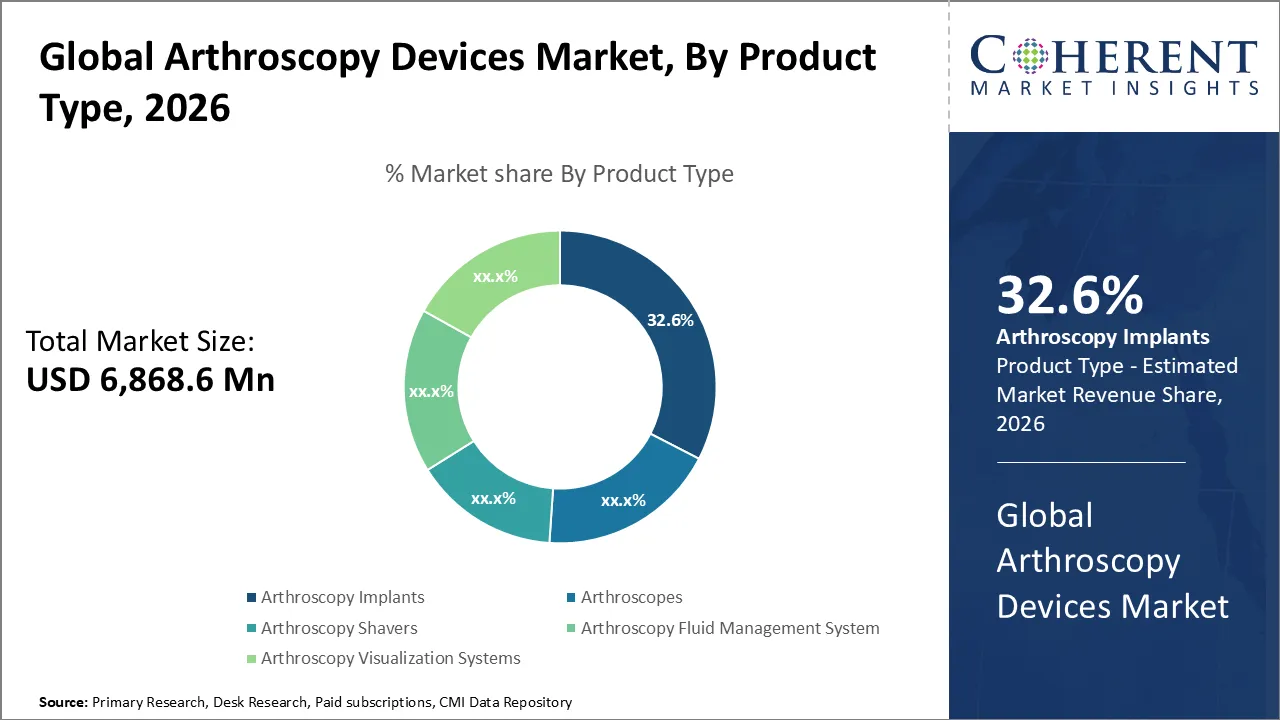
In terms of product type, the arthroscopy implants segment is expected to hold 32.6% share of the market in 2026, due to their vital role in ACL, rotator cuff, and meniscus repairs. Rising sports injuries and aging populations fuel demand. Their necessity for fixation and stabilization ensures the largest market share, making them indispensable in minimally invasive orthopedic procedures worldwide.
For instance, in June 2026, Smith+Nephew’s Wimbledon sponsorship highlights its leadership in sports medicine and advanced joint repair solutions. While the news focuses on athlete partnerships and brand visibility, it indirectly relates to arthroscopy implants, as the company’s portfolio includes ACL, meniscus, and shoulder repair devices widely used in minimally invasive orthopedic procedures worldwide.
In terms of application, the knee implant segment is expected to lead the market 29.8% share in 2026, driven by high prevalence of ACL injuries, meniscus tears, and osteoarthritis. Sports medicine and aging demographics make knee arthroscopy the most frequent procedure, securing the largest market share globally.
For instance, in January 2026, OrthoPreserve’s FDA Breakthrough Device designation and TAP enrollment for its meniscus implant mark a major advance in knee arthroscopy. Designed to revolutionize knee pain treatment, the implant targets meniscal damage common in sports injuries and aging patients, strengthening the knee implant segment within the global arthroscopy devices market.
To learn more about this report, Download Free Sample
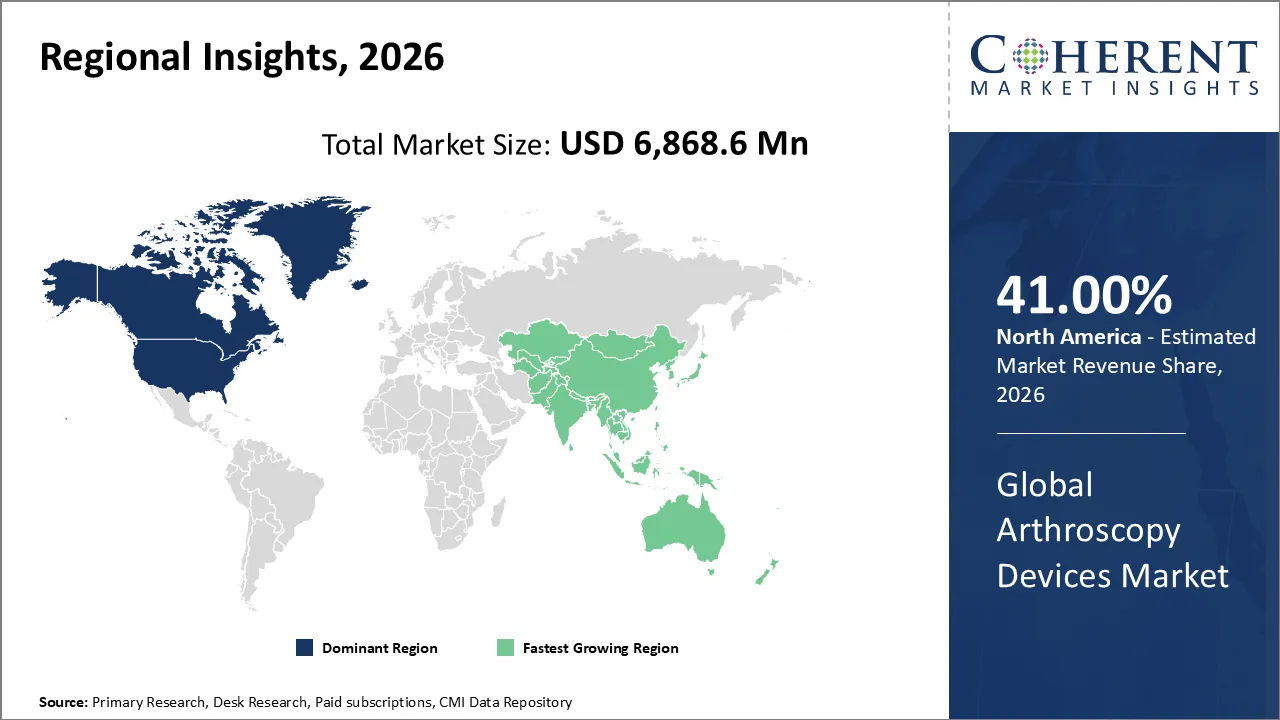
North America is expected to dominate the arthroscopy devices market with 41% share in 2026, due to rising sports injuries, an aging population with osteoarthritis, and strong adoption of minimally invasive surgeries. Advanced healthcare infrastructure, high per-capita spending, and the presence of leading manufacturers drive dominance, ensuring continued growth and innovation in joint repair solutions.
For instance, in June 2025, Arthrex’s launch of the Synergy Power™ System expands its arthroscopy devices portfolio. Designed for sports medicine, trauma, and arthroplasty, the powered instrument system enhances precision and efficiency in minimally invasive joint surgeries, reinforcing Arthrex’s leadership in innovative orthopedic solutions and advancing outcomes for patients worldwide.
Asia pacific is expected to exhibit the fastest growth, due to rising sports injuries, growing musculoskeletal disorders, and an aging population. Expanding healthcare infrastructure, increasing medical tourism, and greater awareness of minimally invasive surgeries drive adoption. Large patient bases in China and India fuel the region’s fastest growth globally.
For instance, in April 2025, Ganga Hospital in Coimbatore has been designated a Global Center of Excellence in trauma, joint replacement, and arthroscopy surgeries. This recognition highlights its advanced infrastructure, surgical expertise, and commitment to minimally invasive procedures. The designation underscores growing demand for arthroscopy devices in India, strengthening regional leadership in orthopedic care.
In 2026, the U.S. arthroscopy devices market is highly demanding due to rising sports injuries, an aging population with osteoarthritis, and strong adoption of minimally invasive surgeries. Advanced healthcare infrastructure, high per-capita spending, and leading manufacturers like Arthrex and Stryker drive innovation, reinforcing North America’s dominance in orthopedic care.
For instance, in September 2025, Arthrex achieved the first clinical case using its NanoNeedle™ Scope 2.0 in the United States. This advanced visualization system enhances minimally invasive arthroscopy by providing improved clarity and precision.
In 2026, India’s arthroscopy devices market is highly demanding due to rising sports injuries, growing musculoskeletal disorders, and an aging population. Expanding healthcare infrastructure, increasing medical tourism, and greater awareness of minimally invasive surgeries drive adoption. Affordable treatment options and a large patient base strengthen India’s role in Asia-Pacific growth.
For instance, in August 2025, Kauvery Hospital, Vadapalani in Chennai launched a Sports Medicine and Arthroscopy Center. The facility focuses on minimally invasive joint surgeries and advanced orthopedic care, addressing rising sports injuries and musculoskeletal disorders.
| Report Coverage | Details | ||
|---|---|---|---|
| Base Year: | 2025 | Market Size in 2026: | USD 6,868.6 Mn |
| Historical Data for: | 2020 To 2024 | Forecast Period: | 2026 To 2033 |
| Forecast Period 2026 to 2033 CAGR: | 6% | 2033 Value Projection: | USD 10,327 Mn |
| Geographies covered: |
|
||
| Segments covered: |
|
||
| Companies covered: |
Smith & Nephew Plc, Olympus Corporation, Johnson & Johnson (DePuy Synthes Inc.), Stryker Corporation, CONMED Corporation, Vimex Sp. z o.o., and Karl Storz SE & Co. KG. |
||
| Growth Drivers: |
|
||
| Restraints & Challenges: |
|
||
Uncover macros and micros vetted on 75+ parameters: Get instant access to report
The increasing incidence of ACL tears, meniscus injuries, and rotator cuff damage among athletes and active populations continues to drive the need for advanced surgical solutions. Simultaneously, the growing prevalence of osteoarthritis and rheumatoid arthritis in aging populations fuels demand for joint repair and replacement procedures. These factors significantly boost the arthroscopy devices market share, as hospitals and clinics adopt innovative devices to address both acute injuries and chronic orthopedic conditions across diverse patient demographics.
Arthroscopy has become the preferred surgical approach due to its smaller incisions, faster recovery times, and reduced hospital stays compared to traditional open surgeries. Patients and surgeons increasingly favor arthroscopy for knee, shoulder, hip, and wrist procedures, enhancing treatment outcomes and patient satisfaction. This trend directly accelerates arthroscopy devices market demand, as healthcare providers invest in advanced visualization systems, implants, and powered instruments to meet rising expectations for minimally invasive orthopedic care worldwide.
The integration of robotics, AI-driven imaging, and smart implants is opening new growth avenues in orthopedic care. Robotics improve surgical consistency, AI enhances diagnostic accuracy, and smart implants provide real-time data for post-surgical monitoring. Together, these technologies redefine patient care standards and expand treatment possibilities. Their adoption accelerates innovation cycles and attracts investment from healthcare providers worldwide. According to the arthroscopy devices market forecast, these advancements will be pivotal in shaping future demand, ensuring sustained growth and improved patient outcomes.
The arthroscopy devices market is characterized by expanding adoption of minimally invasive orthopedic procedures, rising incidence of joint injuries, and technological advancement across device categories. In 2024, the global market exceeded a valuation of several billion, supported by widespread use of arthroscopes, fluid-management systems, visualization equipment, and implant technologies designed for joint repair and diagnostic interventions. Knee arthroscopy remains the largest application segment, driven by the prevalence of meniscal tears, ligament injuries, and degenerative joint conditions. Visualization and implant systems are also key contributors to overall procedure volumes, reflecting a shift toward enhanced surgical precision and optimized patient outcomes.
Regional patterns show that North America holds a leading position in device utilization, supported by advanced healthcare infrastructure, high surgical volume, and widespread reimbursement frameworks that favor minimally invasive options. Europe follows, with strong demand for procedures addressing aging populations and sports-related injuries. Asia-Pacific is emerging as a rapidly growing market as healthcare investments increase and access to orthopedic care expands in countries such as China and India.
Innovation is a central theme, with companies introducing enhanced imaging systems, hybrid instruments combining suture and powered tools, and advanced fluid management platforms that improve surgical efficiency. Manufacturers are also focusing on portability and disposability to meet the needs of ambulatory surgical centers and specialty clinics, further broadening the addressable market.
Collectively, these dynamics underscore a robust landscape where clinical demand, procedural efficiency, and technological refinement interconnect to drive sustained growth in arthroscopy device adoption globally.
Share
Share
About Author
Komal Dighe is a Management Consultant with over 8 years of experience in market research and consulting. She excels in managing and delivering high-quality insights and solutions in Health-tech Consulting reports. Her expertise encompasses conducting both primary and secondary research, effectively addressing client requirements, and excelling in market estimation and forecast. Her comprehensive approach ensures that clients receive thorough and accurate analyses, enabling them to make informed decisions and capitalize on market opportunities.
Missing comfort of reading report in your local language? Find your preferred language :
Transform your Strategy with Exclusive Trending Reports :
Frequently Asked Questions
Joining thousands of companies around the world committed to making the Excellent Business Solutions.
View All Our Clients
 Schedule a meeting with report Author