

Custom Lasik Surgery Market Size and Forecast – 2026 to 2033
The Custom Lasik Surgery Market is estimated to be valued at USD 18.2 Bn in 2026 and is expected to reach USD 27.8 Bn by 2033, exhibiting a compound annual growth rate (CAGR) of 8.9% from 2026 to 2033.
Key Takeaways
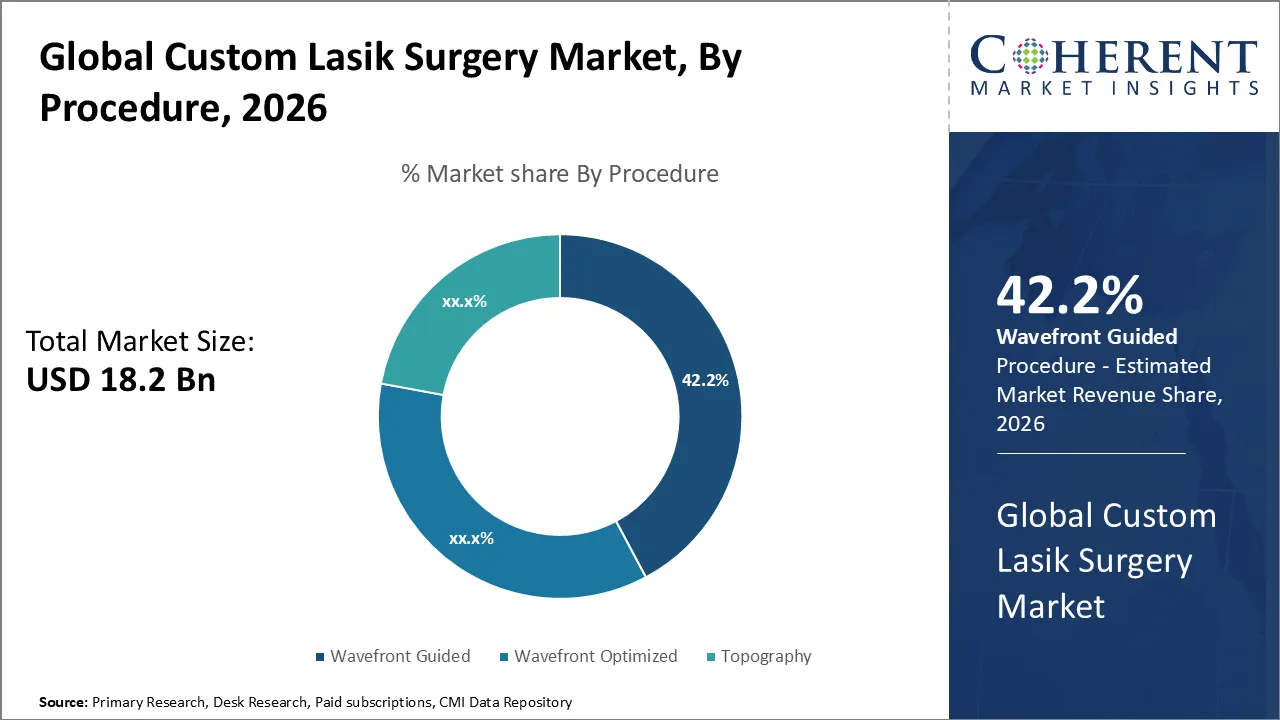
- By Procedure, Wavefront Guided hold the largest market share of 42.2% in 2026 owing to the rising prevalence of refractive errors.
- By Therapeutic Applications, Myopia expected to hold largest market share of 38.8% in 2026 owing to its surge in screen time & digital device usage.
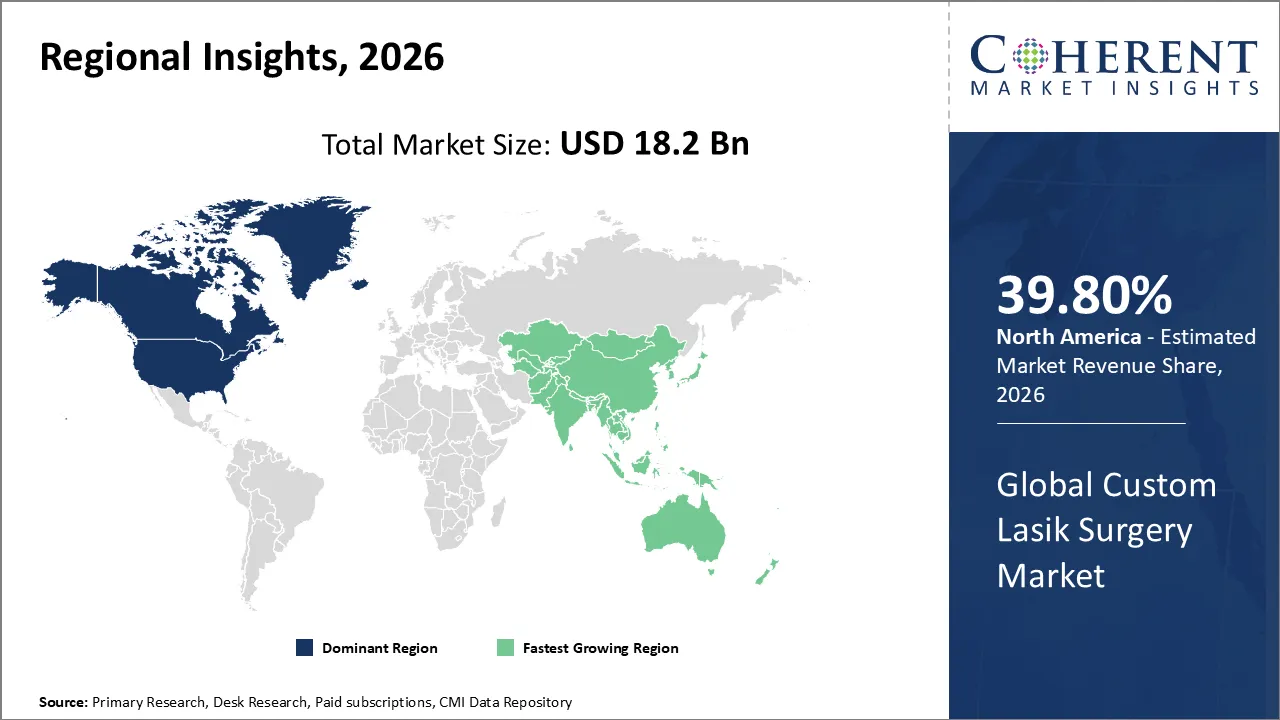
- By Region, North America dominates the overall market with an estimated share of 39.8% in 2026 owing to the early adoption of advanced technologies.
Market Overview
Rising cases of refractive errors such as myopia and astigmatism are driving the steady expansion of the custom LASIK surgery market, along with increasing demand for precise, personalized vision correction. Advanced technologies, including wavefront-guided systems and femtosecond lasers, enhance surgical outcomes and improve patient satisfaction. Growing awareness, higher disposable incomes, and a strong preference for minimally invasive procedures continue to boost adoption. Expanding ophthalmology clinics and increasing medical tourism in emerging economies further support market growth, positioning custom LASIK as a preferred alternative to glasses and contact lenses.
Current Events and their Impact on the Custom Lasik Surgery Market
Current Events | Description and its impact |
Technological Advancements in Ophthalmic Surgery |
|
Regulatory and Policy Changes |
|
Competitive and Market Dynamics |
|
Segmental Insights
- Current Industry Events of 2026
- Market Size Estimation
- Regional Breakdown
- Competitive Landscape
- Customer Intelligence
- Segmental Analysis
- Pricing Analysis
- Key Market Drivers, Challenges & Future Trends
- Customized Insights Section
Custom Lasik Surgery Market Insights, By Procedure: Wavefront Guided contribute the highest share of the market owing to its increasing preference for minimally invasive procedures.
Wavefront Guided hold the largest market share of 42.2% in 2026. Surgeons and patients are increasingly adopting wavefront-guided custom LASIK as they seek highly individualized and accurate vision correction. The technology provides detailed mapping of ocular imperfections, allowing clinicians to reduce visual disturbances such as glare and halos. Growing trust in advanced laser systems, rising cases of myopia and other refractive disorders, and higher expectations for superior visual outcomes continue to drive demand. Ongoing innovation, the presence of skilled ophthalmic professionals, and expanding access to premium eye care services further accelerate the adoption of wavefront-guided procedures. For instance, in September 2025, Alcon launched the first fully personalized LASIK treatment, Wavelight Plus, in the US and Canada. Using the Sightmap diagnostic device, it analyzes each patient’s eye shape and vision needs with over 100,000 data points to create a 3D “Digital Eye Twin” combining wavefront, biometry, and corneal tomography measurements.
Custom Lasik Surgery Market Insights, By Therapeutic Applications: Myopia contributes the highest share of the market owing to its rising education levels & academic pressure.
Myopia expected to hold largest market share of 38.8% in 2026. The increasing incidence of myopia is significantly driving demand in the custom LASIK surgery market. Greater screen exposure, intensive near-work activities, and reduced outdoor time accelerate vision deterioration, particularly among younger populations. Urban lifestyles and academic pressures contribute to the early onset and progression of myopia. As the condition worsens, individuals actively seek long-term corrective solutions, increasing interest in customized LASIK procedures. Advancements in diagnostic capabilities and rising awareness of surgical options further drive the conversion of myopic patients into LASIK candidates. For instance, Johnson & Johnson Vision has launched its next-generation personalized LASIK system, iDESIGN Refractive Studio, approved by the FDA in June. The system uses topography-integrated, wavefront-guided technology to precisely measure the eye and deliver customized LASIK for myopia, hyperopia, and mixed astigmatism.
Regional Insights
North America Custom Lasik Surgery Market Trends
North America dominates the overall market with an estimated share of 39.80% in 2026. The North America custom LASIK surgery market is advancing as clinics focus on precision and patient-centered care. Surgeons are increasingly using advanced technologies, such as wavefront-guided and femtosecond lasers, to improve accuracy and reduce complications. Outpatient and specialized centers are expanding to provide greater convenience and faster recovery. Educational campaigns and digital awareness initiatives actively promote elective procedures, while flexible financing and wider availability of premium eye care services enable more patients to access treatments, strengthening North America’s position in customized vision correction.
Asia Pacific Custom Lasik Surgery Market Trends
The Asia Pacific custom LASIK surgery market is growing rapidly as rising cases of myopia and other refractive errors, particularly among younger populations, increase demand. Clinics are adopting advanced technologies such as wavefront-guided and femtosecond lasers to provide precise, personalized vision correction. Expanding urban healthcare infrastructure, rising medical tourism, and growing awareness of elective eye surgeries are driving adoption. Higher disposable incomes and the increasing number of specialized eye care centers are also enabling more patients across the region to access custom LASIK procedures. For instance, in December 2025, Nethradhama Superspeciality Eye Hospital introduced the Ziemer Z8 Neo, a multi-purpose femtosecond laser system, delivering it across city centres via a custom mobile unit. This lets patients at all branches access bladeless, high-precision procedures without traveling to a central location.
United States Custom Lasik Surgery Market Trends
The United States custom LASIK surgery market is progressing as patients actively pursue precise, personalized vision correction. Clinics are adopting wavefront-guided and femtosecond laser technologies to increase surgical accuracy and minimize complications. Outpatient and specialized LASIK centers are expanding to offer greater convenience and faster recovery, while awareness campaigns and digital education actively promote elective procedures. Rising disposable incomes, flexible financing options, and a strong network of skilled ophthalmologists are enabling more patients to access treatments, boosting adoption and reinforcing the U.S. leadership in customized refractive surgery. For instance, in September 2025, Bausch + Lomb launched its ASANA GP lenses in the US, providing eye care providers a comprehensive, versatile portfolio that includes spherical, aspheric, toric, multifocal, reverse geometry, and keratoconic lenses.
China Custom Lasik Surgery Market Trends
The China custom LASIK surgery market is growing rapidly as more young individuals develop myopia and other refractive errors. Clinics are adopting advanced technologies, such as wavefront-guided and femtosecond lasers, to provide precise, personalized vision correction. Expanding urban healthcare infrastructure, rising awareness of elective eye procedures, and increasing medical tourism are driving patient demand. Higher disposable incomes and the growing number of specialized ophthalmic centers are enabling broader access, making custom LASIK increasingly popular across the country.
Custom Lasik Surgery Market Trend
Shift Toward Personalized Vision Correction
Patients increasingly demand procedures tailored to their unique ocular profiles, including wavefront-guided and topography-guided LASIK. Clinics are responding by mapping individual aberrations to minimize post-operative issues such as glare or halos. This trend emphasizes higher patient satisfaction, improved visual outcomes, and a growing preference for customized, premium LASIK procedures over traditional, one-size-fits-all approaches. Providers are investing in advanced diagnostic tools and software to deliver precise, individualized treatments, reinforcing personalization as a central market driver.
Adoption of Advanced Laser Technologies
The market is witnessing widespread integration of cutting-edge laser systems, including femtosecond and excimer lasers, which enhance surgical precision and safety. These technologies allow for bladeless procedures, reduced recovery times, and minimized complications. Clinics continuously upgrade their equipment to meet patient expectations for efficiency and accuracy. The trend reflects a focus on technological innovation, as providers aim to differentiate services and maintain competitive advantage while delivering high-quality vision correction solutions.
Custom Lasik Surgery Market Opportunity
Adoption of Next-Generation Laser Technologies
The development and integration of next-generation systems, including wavefront-optimized, topography-guided, and femtosecond lasers, offer opportunities for differentiation. Clinics can attract tech-savvy patients seeking safer, more precise, and minimally invasive procedures. Continuous technological upgrades improve outcomes, reduce complications, and enhance patient satisfaction. Providers investing in research and innovative treatment platforms can establish leadership in the market, catering to patients who prioritize advanced, customized vision correction solutions over traditional LASIK procedures.
Market Report Scope
Custom Lasik Surgery Market Report Coverage
| Report Coverage | Details | ||
|---|---|---|---|
| Base Year: | 2025 | Market Size in 2026: | USD 18.2 Bn |
| Historical Data for: | 2020 To 2024 | Forecast Period: | 2026 To 2033 |
| Forecast Period 2026 to 2033 CAGR: | 8.9% | 2033 Value Projection: | USD 27.8 Bn |
| Geographies covered: |
| ||
| Segments covered: |
| ||
| Companies covered: | Alcon Laboratories, Inc., Bausch & Lomb, Carl Zeiss, Inc., Abbott Medical Optics, Nidek, Inc., and Technolas Perfect Vision GmbH. | ||
| Growth Drivers: |
| ||
| Restraints & Challenges: |
| ||
Custom Lasik Surgery Market News
- In April 2025, Sankara Eye Hospital plans to screen all school students in Coimbatore district within a year under its Rainbow Programme, announced Dr. R.V. Ramani during the opening of the new LASIK Laser Centre at the Sivanandapuram campus.
Analyst Opinion (Expert Opinion)
- The evolution of the Custom LASIK Surgery market is best characterized as a transition from procedural novelty to outcome‑driven differentiation. Peer‑reviewed clinical data consistently demonstrate that customized ablation strategies achieve higher refractive accuracy; for example, wavefront‑guided treatments are correlated with a marked reduction in induced higher‑order aberrations compared with conventional LASIK, with large case series reporting post‑operative night vision disturbances in fewer than 5% of optimized cases. Such evidence has shifted clinical practice patterns toward pre‑operative aberrometry and individualized profiles as standard of care among leading refractive surgeons.
- The market exhibits a notable technology dichotomy: while advanced diagnostics and topography‑enhanced platforms have become commonplace in tier‑1 ophthalmic centers, a significant proportion of mid‑tier practices continue to rely on legacy excimer modalities with limited customization. Comparative outcomes research underscores this divide; patients treated in high‑volume, technology‑enabled settings report statistically superior contrast sensitivity and lower retreatment rates relative to those treated in conventional environments. This suggests that adoption barriers are less about overall demand and more about uneven access to precision tooling.
- Furthermore, patient expectations have evolved beyond simple improvement in sphere and cylinder correction to include qualitative visual metrics. Surveys conducted in clinical cohorts frequently show satisfaction rates exceeding 95% for visual acuity outcomes, yet up to 15% of patients still cite dissatisfaction related to visual phenomena such as halos under mesopic conditions. This persistent minority underscores an unresolved challenge and highlights the need for enhanced predictive modeling and individualized counseling. Thus, while the Custom LASIK segment has delivered on many of its technological promises, true market maturation will be defined by its ability to reconcile high‑end performance with consistently reproducible patient experiences across diverse clinical settings.
Speak to the analyst
Want personalized insights?
Take the findings above to one of our principal consultants, or have the report rebuilt around the segments, geographies and competitors you actually track.
Market Segmentation
- By Procedure
- Wavefront Guided
- Wavefront Optimized
- Topography
- By Therapeutic Applications
- Myopia
- Hyperopia
- Astigmatism
- Others
- By Regional Insights
- North America
- U.S.
- Canada
- Latin America
- Brazil
- Argentina
- Mexico
- Rest of Latin America
- Europe
- Germany
- U.K.
- Spain
- France
- Italy
- Russia
- Rest of Europe
- Asia Pacific
- China
- India
- Japan
- Australia
- South Korea
- ASEAN
- Rest of Asia Pacific
- Middle East
- GCC Countries
- Israel
- Rest of Middle East
- Africa
- South Africa
- North Africa
- Central Africa
- North America
- Key Players Insights
- Alcon Laboratories, Inc.
- Bausch & Lomb
- Carl Zeiss, Inc.
- Abbott Medical Optics
- Nidek, Inc.
- Technolas Perfect Vision GmbH.
Sources
Primary Research interviews
- Ophthalmologists and eye surgeons specializing in LASIK surgery
- Hospital administrators and clinic managers
- Optometrists and refractive surgery consultants
- Patients who have undergone custom LASIK procedures
- Medical device distributors and suppliers
Databases
- ClinicalTrials.gov
- PubMed
- World Health Organization Global Health Observatory
- FDA Medical Device Databases
Magazines
- Ophthalmology Times
- Eye World
- Vision Monday
- Review of Ophthalmology
Journals
- Journal of Refractive Surgery
- Journal of Cataract & Refractive Surgery
- Ophthalmology Retina
- American Journal of Ophthalmology
Newspapers
- The New York Times – Health Section
- The Guardian – Health & Science Section
- The Times of India – Health & Wellness Section
- The Washington Post – Health Section
Associations
- American Academy of Ophthalmology (AAO)
- International Society of Refractive Surgery (ISRS)
- European Society of Cataract and Refractive Surgeons (ESCRS)
- Asia-Pacific Association of Cataract & Refractive Surgeons (APACRS)
Public Domain sources
- National Eye Institute (NEI) reports and publications
- WHO Vision and Eye Health Fact Sheets
- Government health ministry reports on eye care and surgery trends
- FDA LASIK safety and efficacy reports
Proprietary Elements
- CMI Data Analytics Tool
- Proprietary CMI Existing Repository of information for last 8 years
Get access to 250+ pages report
Every segment, forecast, competitor profile and data table behind the analysis above — available for instant download.
- ESOMAR Member
- ISO 9001:2015 Certified
- D-U-N-S Registered
- GDPR & CCPA Compliant
Missing comfort of reading report in your local language? Find your preferred language:
Transform your Strategy with Exclusive Trending Reports
Frequently Asked Questions
The global custom LASIK surgery market is estimated to surpass USD 27.8 Bn by 2033.
Major players operating in the global custom LASIK surgery market include Alcon Laboratories, Inc., Bausch & Lomb, Carl Zeiss, Inc., Abbott Medical Optics, Nidek, Inc., and Technolas Perfect Vision GmbH.
Costly treatment procedures and technical complexity are some the major factors that are expected to hamper growth of the market over the forecast period.
Increasing incidence of refractive disorders, coupled with high demand for eye laser treatment are some the major factors that are expected to propel growth of the market over the forecast period.
The global custom LASIK surgery market is estimated to exhibit a CAGR of 8.9% over the forecast period.
Among regions, North America is expected to hold dominant position in the global custom LASIK surgery market over the forecast period.