

Spectrometry Market Size and Forecast
Spectrometry Market size is estimated to be valued at USD 29.33 Bn in 2026 and is expected to reach USD 50.59 Bn in 2033, exhibiting a compound annual growth rate (CAGR) of 8.1% from 2026 to 2033.
Key Takeaways
- Based on Product Type, the Mass Spectroscopy segment is expected to account for 49.5% of the global spectrometry market in 2026, owing to growing demand for tools that can provide quantitative, high-specificity results.
- Based on End User, the Biopharmaceutical industries segment is projected to hold the highest share of the global spectrometry market in 2026, due to increasing usage of spectrometry techniques in biopharmaceutical firms.
- Based on Region, North America is set to lead the global spectrometry market in 2026 with a 58.04% share, attributed to strong research and development and significant investments in the industries. While Asia Pacific is considered as the fastest growing region during the forecast period.
Market Overview
The global spectrometry market demand is extensively driven by the offered high level of precision, sensitivity, and expertise required for accurate analysis and data interpretation. Spectrometry is a technique used to study and measure the interaction of electromagnetic radiation with matter. It involves analyzing the spectrum of light or other radiation that is either absorbed, emitted, or reflected by a sample to gain information about its composition, structure, or properties. Scientists use inductively coupled plasma optical emission spectrometry, or ICP-OES to detect chemical elements, and is one of the most powerful and popular analytical tools for determining trace elements in numerous sample types. Spectrometry is used in a wide range of fields for chemical analysis, material characterization, and more.
Current Events and their Impact on the Spectrometry Market
Current Event | Description and its Impact |
Technological Innovations in Spectrometry Systems |
|
Regulatory & Funding Policy Shifts |
|
Role of Artificial Intelligence (AI) in Spectrometry
Artificial Intelligence (AI) is playing an increasingly important role in spectrometry by improving the accuracy, speed, and depth of data analysis. Spectrometry often involves interpreting complex and noisy signals, which can be time-consuming and challenging using traditional methods. AI helps by automating data processing, identifying patterns, and uncovering insights that may not be immediately visible through conventional analysis.
For example, at the 2023 ASMS conference in Houston, Texas, Expert Intelligence (EI) introduced its AI App Builder, a fully automated platform designed for Mass Spectrometry analysis. This tool allows scientists to build AI applications without requiring programming or AI expertise. The EI App Builder complements existing software by offering a visual, easy-to-use framework that enhances the interpretation of complex signal data. It enables researchers to analyze Mass Spec results more efficiently and accurately, demonstrating how AI can significantly advance spectrometric workflows.
- Current Industry Events of 2026
- Market Size Estimation
- Regional Breakdown
- Competitive Landscape
- Customer Intelligence
- Segmental Analysis
- Pricing Analysis
- Key Market Drivers, Challenges & Future Trends
- Customized Insights Section
Spectrometry in Water Safety
Spectrometry plays a vital role in ensuring water safety by enabling precise and continuous monitoring of water quality. It helps detect contaminants, chemical imbalances, and other harmful substances by analyzing how water samples interact with light or other forms of energy. This allows for real-time assessment of key water quality parameters such as turbidity, chemical concentrations, and biological content, ensuring safe and clean water for public use.
For instance, scan, has launched the next generation of spectrometers for online water quality monitoring. These advanced devices can measure important water quality parameters with high precision and speed. Key features include an onboard webserver, wireless communication, an optical information ring, rapid 10-second measurement intervals, large onboard memory, and groundbreaking accuracy. These innovations make spectrometry even more effective in safeguarding water quality through continuous, automated, and highly accurate analysis.
Segmental Insights
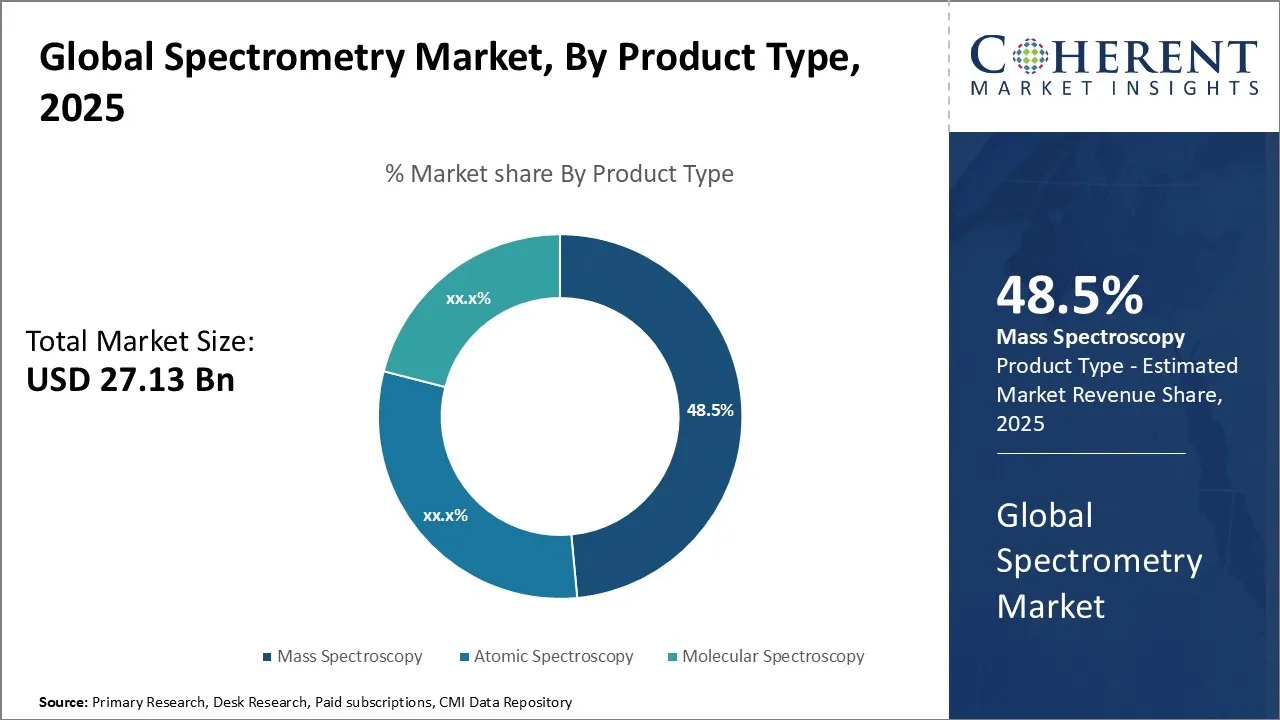
Spectrometry Market Insights, By Product Type
Mass Spectrometry Dominates the Overall Market on Account of Growing Demand for Quantitative and High-Specificity Results
In terms of product type, the mass spectrometry segment is expected to dominate the market with 49.5% share in 2026, due to growing demand for tools that provides quantitative, high-specificity results. Mass spectrometry (MS) is a powerful tool that identifies and quantifies components in complex samples with precision. From proteomics and metabolomics to imaging and glycolmics, MS drives innovation across industries such as food, pharmaceuticals, and environmental science. It offers a deeper understanding of biological processes, disease mechanisms, and biomarker discovery. Mass spectrometry is widely used in chemistry, biology, forensics and pharmaceuticals. Applications include identifying unknown substances, analyzing complex mixtures, studying proteins and detecting toxins or drugs.
In June 2025, Sciex unveiled its highly anticipated ZenoTOF 8600 mass spectrometry system at the American Society for Mass Spectrometry (ASMS) conference in Baltimore. The system features the new OptiFlow Pro source, enhanced ion guides (DJet and QJet), and an upgraded optical detector, delivering up to a tenfold increase in sensitivity over its predecessor. It also debuts ZT Scan DIA 2.0 for broader mass-range detection, improving quantitative analysis in proteomics, metabolomics, and genomics. This is further accelerating the spectrometry market growth.
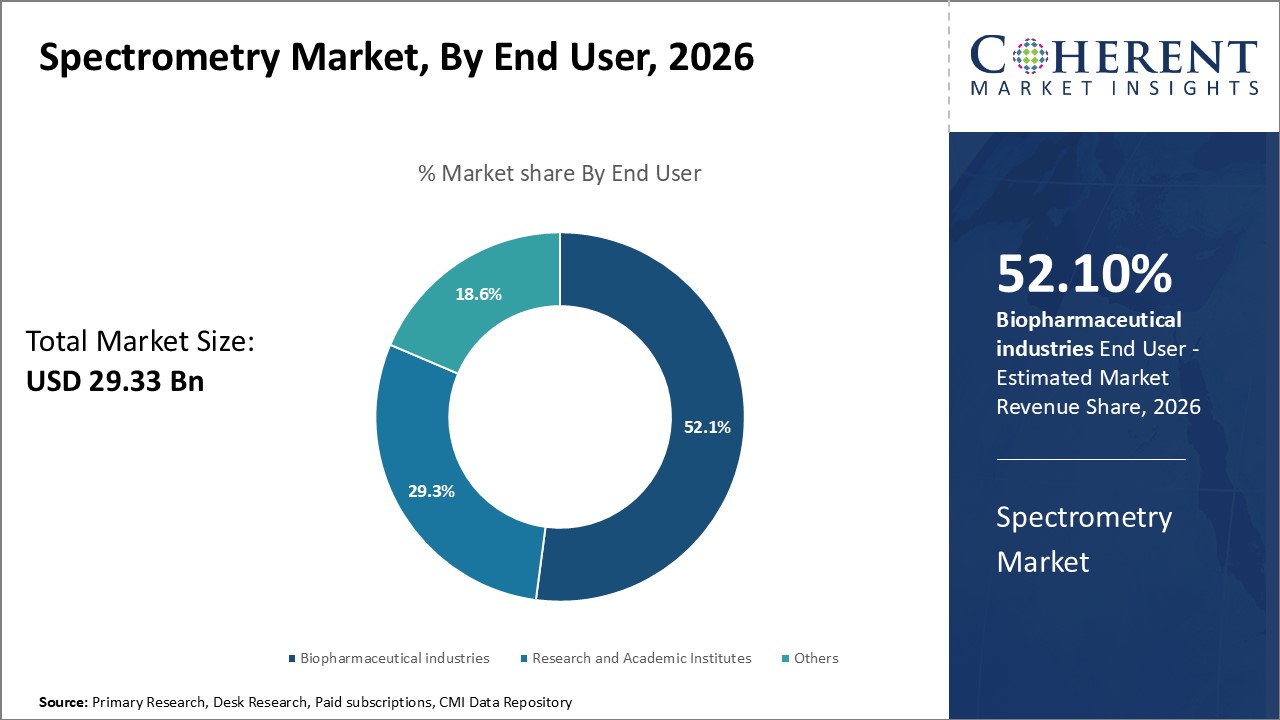
Spectrometry Market Insights, By End User
Biopharmaceutical Industries Dominates the Overall Market
In terms of end user, the biopharmaceutical industries segment is expected to dominate the market over the forecast period due to increasing usage of spectrometry techniques in biopharmaceutical firms. Spectrometry plays a critical role in biopharmaceutical drug discovery and development due to its unparalleled accuracy, sensitivity, and ability to analyze complex biological molecules. It is essential for characterizing large biologics such as monoclonal antibodies, helping researchers identify glycosylation patterns and determine drug-to-antibody ratios key quality attributes required for regulatory approval and therapeutic effectiveness. In pharmacokinetics and metabolism studies, MS enables precise quantification of drug levels and their metabolites in biological systems, offering higher specificity than traditional methods. Overall, spectrometry is a foundational tool to enhance the accuracy, efficiency and reliability of biopharmaceutical research and production.
In June 2025, Agilent Technologies unveiled its latest liquid chromatography advancements at the HPLC 2025 conference, featuring the Hybrid Multisampler and LC Single-Quadrupole Mass Spectrometers. the 1290 Infinity III Hybrid Multisampler, supports both traditional flow-through and Agilent’s Feed Injection Mode, minimizing sample prep while improving peak integrity. Additionally, Agilent introduced its Pro iQ LC-MS systems—integrating intelligent maintenance alerts and high sensitivity for oligonucleotides, peptides, and proteins—with eco-friendly designs, earning the MyGreenLab ACT EcoLabel 2.0 certification. These additions promise enhanced efficiency, reliability, and sustainability across biopharma, industrial, and academic lab settings.
Regional Insights
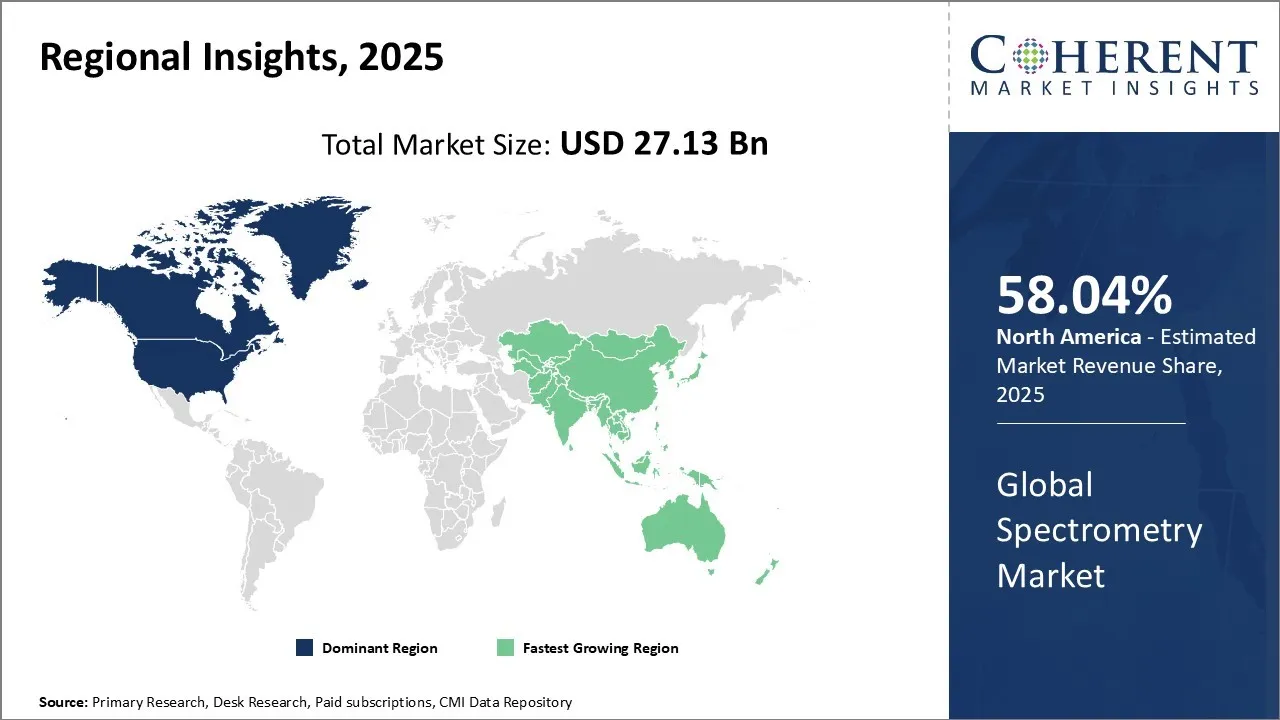
North America Spectrometry Market Analysis & Trends
The North America region is projected to lead the market with a 58.04% share in 2026. The region has a strong research and development platform and has made significant investments in the pharmaceutical and biotechnology industries. Along with that, it also has a large customer base. Recent spectrometry research and development in North America includes advancements in mass spectrometry technology, particularly in areas like proteomics and biopharma applications.
In September 2024, a Brown University team developed a method to transfer ions for mass spectrometry through a tiny capillary, minimizing sample loss. This method uses a tiny capillary, about 1000 times smaller than a human hair's width, to transfer ions into the mass spectrometer. This advancement aims to improve the efficiency and accuracy of analyzing minute samples, particularly in proteomics. In June 2024, BioPharmaSpec, a Contract Research Organization (CRO) for Discovery and Preclinical characterization of biopharmaceuticals, invested in state-of-the-art instrumentation, including top-of-the-range Mass Spectrometers, to support its clients in their product development goals, which is further contributing to the spectrometry market share.
Asia Pacific Spectrometry Market Analysis & Trends
The Asia Pacific region is set to grow rapidly in the spectrometry market during the forecast period. This is driven by growing pharmaceutical and biotechnology industries, increasing demand for food safety and environmental testing, and rising investments in healthcare infrastructure. For instance, researchers across Asia are leveraging portable near-infrared (NIR) and Raman spectroscopy to elevate on-site food safety and quality assessment.
Scientists at Singapore’s DiSTAP institute have deployed a leaf-clip Raman sensor capable of detecting plant metabolites like carotenoids and nitrates in real time enhancing agricultural quality monitoring before symptoms appear. Additionally, governments in countries like China, Japan, and India are investing heavily in modern lab equipment and automation to support early disease diagnosis and personalized medicine. As demand rises for high‑throughput, accurate analyses, hospitals and diagnostic centers are increasingly deploying spectrometry tools, enhancing care quality and enabling better patient outcomes across the region.
Spectrometry Market Outlook Country Wise
The United States Spectrometry Market Trends
The U.S. market for spectrometry is characterized by strong pharmaceutical and biotechnology industry, advanced healthcare infrastructure, and significant government funding for research. Some other factors that drive the demand for spectrometry is the stringent environmental regulations, and advancements in research and development. For instance, in January 2026, Roche Diagnostics unveiled its fully automated Cobas I 601 mass spectrometers in the U.S. The system enables streamlined testing for steroid hormones, vitamin D, immunosuppressants, and therapeutic drug monitoring, offering CLIA-compliant clinical workflows.
China Spectrometry Market Trends
China’s mass spectrometry market is positioning itself to disrupt global spectrometry dynamics by 2027. With heavy investment in domestic R&D and strategic partnerships, the country aims to localize up to 40% of high-end spectrometer production. This move could significantly undercut Western original equipment manufacturers (OEMs) by offering advanced instruments at lower prices. Domestic companies such as Tian Instruments and Skyray Instruments are scaling up, supported by government policies favoring indigenous tech development. The shift could reshape global pricing models and reduce China's reliance on expensive imports for pharmaceuticals, food safety, and environmental testing.
India Spectrometry Market Trends
India’s spectroscopy market is witnessing rapid growth, driven by increased adoption in agriculture and pharmaceutical sectors. In agriculture, these devices help analyze soil health, crop quality, and pesticide residues in real time, supporting precision farming. In pharmaceuticals, they ensure compliance with stringent quality control standards, enabling fast, non-destructive analysis of raw materials and formulations. The Indian government’s focus on digital agriculture and pharma innovation is further accelerating deployment, making portable spectroscopy a key enabler in quality and efficiency improvements.
For instance, in December 2024, Daksh Quality Systems unveiled a portable spectrometer, a German-manufactured product in India.
Market Report Scope
Spectrometry Market Report Coverage
| Report Coverage | Details | ||
|---|---|---|---|
| Base Year: | 2025 | Market Size in 2026: | USD 29.33 Bn |
| Historical Data for: | 2020 To 2024 | Forecast Period: | 2026 To 2033 |
| Forecast Period 2026 to 2033 CAGR: | 8.1% | 2033 Value Projection: | USD 50.59 Bn |
| Geographies covered: |
| ||
| Segments covered: |
| ||
| Companies covered: | ThermoFisher Scientific Inc, Adeptrix Corp, Analytik Jena AG, Bio-Rad Laboratories, Inc, Bruker Corporation, Danaher Corporation, PerkinElmer, Inc, Siemens Healthcare, Waters Corporation, Agilent Technologies, Inc., Shimadzu Corporation, and Advion, Inc. | ||
| Growth Drivers: |
| ||
| Restraints & Challenges: |
| ||
Global Spectrometry Market Key Trends
Introduction of newer instruments for efficient techniques
Introduction of newer and more efficient instruments to boost up techniques can drive the market growth. The spectrometry landscape in 2025 is undergoing a major transformation with the introduction of newer, more efficient instruments that are redefining analytical capabilities across industries. At the forefront, Thermo Fisher Scientific unveiled the Orbitrap Astral Zoom and Excedion Pro during the ASMS 2025 conference, offering up to 40% faster scan speeds and higher sensitivity, breakthroughs particularly vital for proteomics and biopharmaceutical research. Waters Corporation introduced the Xevo MRT, a benchtop multi-reflecting time-of-flight (TOF) spectrometer that delivers up to 100,000 resolutions at 100 Hz, while also focusing on reducing environmental impact.
Meanwhile, BrightSpec launched its novel Molecular Rotational Resonance (MRR) systems, spectraMRR™, isoMRR™, and nanoMRR™ which provide 3D molecular insights without the need for complex sample prep, advancing applications in drug development and compound verification. Agilent Technologies has also expanded its portfolio with the InfinityLab Pro iQ Series detectors, tailored for peptide and oligonucleotide analysis in regulated labs. These next-generation tools are collectively enabling faster, more precise, and sustainable spectrometry-based workflows.
Global Spectrometry Market Drivers
Increasing development activities in the market
Increasing development in the field of spectrometry is expected to drive the global spectrometry market growth over the forecast period. Spectrometry development activities are accelerating globally, driven by advancements in healthcare, agriculture, environmental science, and industrial automation. In 2024–2025, researchers at KAIST and MIT introduced a portable swept-source Raman spectrometer (SS-Raman), delivering lab-grade molecular diagnostics in field settings. Similarly, a deep learning-enabled optical convolutional spectrometer was developed using a chip-scale cavity array, offering high-resolution results at ultra-low costs, ideal for wearable or handheld diagnostics. In Europe, Fraunhofer IIS launched the nanoSPECTRAL chip, enabling real-time liquid and gas spectral analysis on a micro-scale platform. Meanwhile, Thermo Fisher Scientific unveiled its Stellar mass spectrometer at ASMS 2024, significantly improving sensitivity and throughput for biopharmaceutical analysis. These breakthroughs highlight the industry's shift toward miniaturized, AI-enhanced, and highly efficient spectrometry solutions, as indicated by ongoing spectrometry market research, positioning the technology as a key enabler in decentralized diagnostics, sustainable manufacturing, and next-gen drug development.
Global Spectrometry Market Opportunities
Toward Real-Time, Personalized, and Sustainable Applications
The future of spectrometry market lies in real-time, portable, and AI-integrated systems across multiple sectors. In healthcare, spectrometry is rapidly moving toward personalized diagnostics. For instance, miniature mass spectrometers are being developed for point-of-care testing, enabling instant detection of disease biomarkers in blood or breath samples. A recent example includes research into breath-based mass spectrometry for early cancer screening.
In agriculture, handheld spectrometers using near-infrared (NIR) technology are expected to monitor soil and crop health on-site, improving precision farming. For example, portable Raman devices are being tested for pesticide residue analysis in the field.
Moreover, sustainability is a growing focus. New spectrometers are being designed with eco-friendly materials and lower energy consumption. The launch of the Waters Xevo MRT with sustainable manufacturing credentials at ASMS 2024 is a leading example.
Key Developments
- In June 2025, Thermo Fisher Scientific launched two breakthrough instruments at the American Society for Mass Spectrometry (ASMS) conference: the Orbitrap Astral Zoom MS and the Orbitrap Excedion Pro MS. The Astral Zoom delivers a 35% faster scan speed, 40% higher throughput, and 50% enlarged multiplexing unlocking richer proteomics data for applications like early disease biomarker discovery.
- In May 2025, Bruker Corporation introduced the timsOmni™, a “Swiss-army knife” mass spectrometer that combines timsTOF technology with Omnitrap functionality for unmatched proteoform analysis, at the 73rd American Society for Mass Spectrometry conference.
- In January 2025, Almac Sciences, part of the global Almac Group, invested £500,000 (US$611,500) to upgrade its spectroscopy laboratories at its Craigavon headquarters. The investment included the acquisition of an Agilent 6545XT AdvanceBio Q‑TOF Mass Spectrometer and a Malvern Panalytical Empyrean X‑Ray Powder Diffractometer, enhancing capabilities for complex analytical tasks such as trace elemental analysis, impurity quantitation, polymorph screening, and structural elucidation.
- In June 2024, Waters Corporation unveiled the new Xevo MRT mass spectrometer at the ASMS 2024 conference, marking a milestone in high-resolution, high-speed analysis. The benchtop instrument delivers 100,000 FWHM resolution at 100 Hz and sub‑ppm mass accuracy, making it ideal for large-scale metabolomics and epidemiological research.
Analyst Opinion (Expert Opinion)
The spectrometry market, long considered a steady-growth segment within analytical instrumentation, is undergoing a structural transformation rather than a cyclical recovery. The primary drivers are rooted not in expanding budgets or broader instrumentation refresh cycles, but in irreversible shifts in end-user demands—particularly in biopharma, food safety, and environmental monitoring—where spectrometry is moving from a support function to a strategic enabler.
Mass spectrometry (MS) is becoming central to biologics development. According to data from BioPhorum, over 50% of biopharma R&D pipelines are now biologics-based, including monoclonal antibodies, ADCs, and mRNA therapies. Unlike traditional small molecules, these biologics demand far more rigorous and frequent structural characterization, which LC-MS technologies—particularly high-resolution Orbitrap and QTOF platforms—are uniquely positioned to provide.
Regulatory expectations are shifting toward continuous quality verification. Thermo Fisher’s integration of MS into PAT (Process Analytical Technology) workflows in late-phase clinical trials is a signal of where the market is heading: MS is no longer a post-process validation tool, but part of in-process decision-making. Vendors that cannot offer seamless, GMP-compliant integration will fall behind, regardless of technical specsmanship.
Environmental spectrometry—especially ICP-MS for trace metal detection and GC-MS for persistent organic pollutants—is no longer an academic concern but a political one. The EU’s Zero Pollution Action Plan and the U.S. EPA’s PFAS Strategic Roadmap are setting legally binding contaminant limits that are far below traditional detection capabilities. The requirement to detect PFAS compounds at sub-ng/L levels, for instance, has turned ultratrace MS from an optional luxury to a regulatory necessity.
Apart from this, Agilent's recent launch of the 8900 Triple Quadrupole ICP-MS explicitly calls out PFAS detection as a core use case, not an application note. Similarly, Shimadzu's investment in fully automated sample prep for GC-MS/MS reflects an understanding that throughput—not just sensitivity—is now a deal-breaker in high-volume testing labs.
There is a growing bifurcation between entry-level benchtop devices (used in academia and routine testing) and premium, application-specific platforms that integrate software, automation, and cloud-based compliance features. The “mid-tier” general-purpose spectrometer is increasingly irrelevant. Labs are either moving up—toward integrated, high-value systems with AI-assisted data interpretation—or down, toward cloud-based, low-cost services.
The success of startups like 908 Devices, which offers miniature MS units for field deployment, underlines this shift. Their customers are not traditional analytical chemists, but field operatives and process engineers who demand actionable data without laboratory infrastructure. This signals a longer-term trend: spectrometry’s core user base is expanding to non-traditional users, and vendors who cannot abstract complexity away from the user interface will be disrupted.
Speak to the analyst
Want personalized insights?
Take the findings above to one of our principal consultants, or have the report rebuilt around the segments, geographies and competitors you actually track.
Market Segmentation
- Global Spectrometry Market, By Product Type (Revenue, USD Bn, 2021 - 2033)
- Atomic Spectroscopy
- Atomic Absorption Spectroscopy
- X- Ray Diffraction
- Implantable
- X-Ray Fluorescence
- Inductively Coupled Plasma
- Ark Spark
- Elemental Analyzers
- ICP-MS
- Mass Spectroscopy
- TANDEM LC/MS
- Liquid Chromatography
- Gas Chromatography
- MALDI – TOF
- Fourier Transform
- Single Quadrupole
- Molecular Spectroscopy
- NMR
- UV Visualization
- Infrared
- Color Measurement
- Near Infrared
- Atomic Spectroscopy
- Global Spectrometry Market, By End User (Revenue, USD Bn, 2021 - 2033)
- Biopharmaceutical industries
- Research & Academic Institutes
- Others
- Global Spectrometry Market, By Region (Revenue, USD Bn, 2021 - 2033)
- North America
- U.S.
- Canada
- Latin America
- Brazil
- Mexico
- Argentina
- Rest of Latin America
- Europe
- Germany
- U.K.
- France
- Italy
- Spain
- Russia
- Rest of Europe
- Asia Pacific
- China
- India
- Japan
- Australia
- South Korea
- ASEAN
- Rest of Asia Pacific
- Middle East
- GCC
- Israel
- Rest of Middle East
- Africa
- South Africa
- Central Africa
- North Africa
- North America
- Key Players
- Thermo Fisher Scientific Inc.
- Adeptrix Corp
- Analytik Jena AG
- Bio-Rad Laboratories, Inc.
- Bruker Corporation
- Danaher Corporation
- PerkinElmer, Inc.
- Siemens Healthcare
- Waters Corporation
- Agilent Technologies, Inc.
- Shimadzu Corporation
- Advion, Inc.
Sources
Primary Research Interviews from the following stakeholders
Stakeholders
- Interviews with analytical instrument manufacturers, lab equipment distributors, lab managers, quality assurance heads, R&D scientists, academic researchers, and procurement managers across pharmaceutical, environmental, food, and industrial sectors.
Databases
- World Trade Organization (WTO) Trade Statistics
- UN Comtrade Database
- India’s Department of Science & Technology (DST) Publications
- U.S. Bureau of Economic Analysis (BEA)
- Eurostat – Science and Technology Section
- China Customs Statistics
- Korea Statistical Information Service (KOSIS)
- Japan External Trade Organization (JETRO)
- Directorate General of Commercial Intelligence and Statistics (DGCIS), India
Magazines
- Spectroscopy Magazine
- Lab Manager Magazine
- Analytical Scientist
- PharmaTech
- Food Quality & Safety
- Lab+Life Scientist
- Chemical & Engineering News (C&EN)
- Chromatography Today
- Instrument Business Outlook
Journals
- Journal of Analytical Atomic Spectrometry (Royal Society of Chemistry)
- Analytical Chemistry (ACS Publications)
- Journal of Mass Spectrometry
- Talanta (Elsevier)
- International Journal of Spectroscopy
- Journal of Food Composition and Analysis
- Spectrochimica Acta Part B: Atomic Spectroscopy
- Applied Spectroscopy
Newspapers
- The Economic Times – Science & Technology
- The Hindu – Sci-Tech Section
- Financial Times – Pharmaceuticals & Materials
- The Wall Street Journal – Industry & R&D Focus
- South China Morning Post – Science and Laboratory Infrastructure
- Business Standard – Chemicals and Pharma R&D
Associations
- International Union of Pure and Applied Chemistry (IUPAC)
- Federation of Analytical Chemistry and Spectroscopy Societies (FACSS)
- American Chemical Society (ACS) – Analytical Division
- European Chemical Society (EuChemS) – Division of Analytical Chemistry
- Indian Analytical Instruments Association (IAIA)
- Japan Analytical Instruments Manufacturers' Association (JAIMA)
- International Society for Optical Engineering (SPIE)
Public Domain Sources
- National Institute of Standards and Technology (NIST), U.S.
- Ministry of Science and Technology (India)
- U.S. Food and Drug Administration (FDA) – Analytical Method Validation Guidelines
- Ministry of Economy, Trade and Industry (METI), Japan
- European Commission – Research & Innovation Portal
- India Investment Grid – R&D and Instruments Sector
- Council of Scientific and Industrial Research (CSIR), India
- Central Drugs Standard Control Organization (CDSCO), India
Proprietary Elements
- CMI Data Analytics Tool, and Proprietary CMI Existing Repository of information for last 8 years
Get access to 250+ pages report
Every segment, forecast, competitor profile and data table behind the analysis above — available for instant download.
- ESOMAR Member
- ISO 9001:2015 Certified
- D-U-N-S Registered
- GDPR & CCPA Compliant
Missing comfort of reading report in your local language? Find your preferred language:
Transform your Strategy with Exclusive Trending Reports
Frequently Asked Questions
The Spectrometry Market is estimated to be valued at USD 29.33 Bn in 2026, and is expected to reach USD 50.59 Bn by 2033.
The CAGR of the Spectrometry Market is projected to be 8.1% from 2026 to 2033.
Increasing development activities in the market are expected to drive the market growth.
Based on Product type, Mass Spectrometry is the leading segment in the market.
Lack of lab safety and quality control is expected to hinder the market growth over the forecast period.
The major players operating in the market include ThermoFisher Scientific Inc, Adeptrix Corp, Analytik Jena AG, Bio-Rad Laboratories, Inc, Bruker Corporation, Danaher Corporation, PerkinElmer, Inc, Siemens Healthcare, Waters Corporation, Agilent Technologies, Inc., Shimadzu Corporation, and Advion, Inc.
Spectrometry detects contaminants, verifies composition, and ensures food meets regulatory standards for safety, authenticity, and nutritional labeling.