

The Surgical Retractors Market size is anticipated to grow at a CAGR of 6.6% with USD 2.45 Bn in 2026 and is expected to reach USD 3.83 Bn by 2033. The market growth is primarily driven by the increasing number of surgical procedures globally, rising prevalence of chronic diseases requiring surgical intervention, growing geriatric population, and increasing adoption of minimally invasive surgeries. According to the World Health Organization (WHO), countries in the Western Pacific Region are expanding access to safe and affordable surgical care for more than 2.2 billion people.
Key Takeaways
- The handheld retractors segment is likely to dominate the market with 63.5% in 2026. The segment’s growth is owing to its extensive use across general, orthopedic, cardiovascular, and neurosurgical procedures due to ease of handling, cost-effectiveness, and wide availability. According to Intuitive Surgical, 3.15 million procedures have been conducted worldwide using da Vinci surgical systems in 2025 because of the rising number of minimally invasive and complicated surgeries, which involve different types of handheld surgical instruments, including retractors.
- Abdominal retractors segment is set to lead with 26.8% in 2026. The segment’s growth is owing to the increasing number of abdominal, gastrointestinal, and colorectal procedures worldwide. Based on an analysis conducted in the year 2025 and published in the Journal of Surgical Research, the scientists examined 229,167 cases of colectomy operations in the National Surgical Quality Improvement Program data set, highlighting the large number of colorectal surgeries that are carried out.
- Orthopedic surgery segment is set to lead with 24.3% in 2026. The segment will grow owing to the increasing number of musculoskeletal disorders, traumas, and joint replacements. As per the data provided by WHO, about 1.71 billion people around the world have musculoskeletal disorders, which are among the main reasons of disabilities worldwide.
- Hospitals segment is likely to dominate the market with 68.7% in 2026. The segment’s growth is owing to high surgical volumes, availability of advanced operating rooms, and increasing adoption of specialized surgical devices. According to the World Health Organization (WHO), globally approximately 234 million major surgical procedures are performed every year, with hospitals serving as the primary setting for nearly all complex and inpatient surgeries due to required infrastructure, anesthesia support, and critical care facilities.
- North America is expected to dominate the market with 39% share in 2026. Regional prevalence is fueled by high incidence of surgeries, advanced hospital infrastructure, and extensive use of minimally invasive and robotic surgery procedures. North America benefits from high surgical volumes, advanced healthcare infrastructure, widespread adoption of robotic-assisted surgery, and strong presence of leading medical device manufacturers.
Segmental Insights
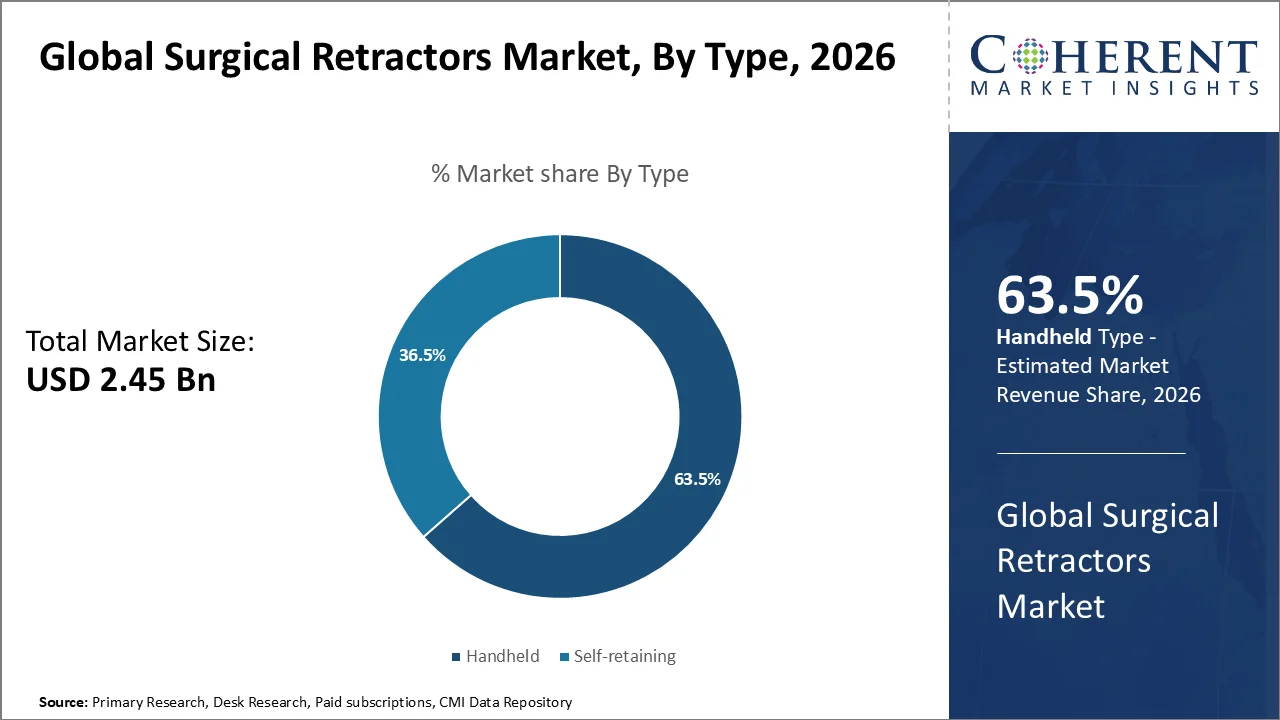
Why is Handheld Segment Dominating the Surgical Retractors Market?
On the basis of type, the handheld retractors segment is likely to dominate the market with 63.5% in 2026. The segment’s growth is owing to its extensive use across general, orthopedic, cardiovascular, and neurosurgical procedures due to ease of handling, cost-effectiveness, and wide availability.
According to Medtronic’s official surgical retractors portfolio, retractors are used across general surgery, gynecological, thoracic, colorectal, and abdominal procedures, where they play a critical role in providing manual tissue retraction and surgical field exposure during both open and minimally invasive surgeries. This confirms widespread reliance on handheld-style access instruments in routine and complex surgical workflows.
In February 2026, Medtronic received FDA clearance for the Stealth AXiS surgical system for spine procedures, integrating planning, navigation, and robotics into a single platform to improve precision during spinal surgeries.
- Current Industry Events of 2026
- Market Size Estimation
- Regional Breakdown
- Competitive Landscape
- Customer Intelligence
- Segmental Analysis
- Pricing Analysis
- Key Market Drivers, Challenges & Future Trends
- Customized Insights Section
Why is Abdominal Retractors Segment Leading the Market?
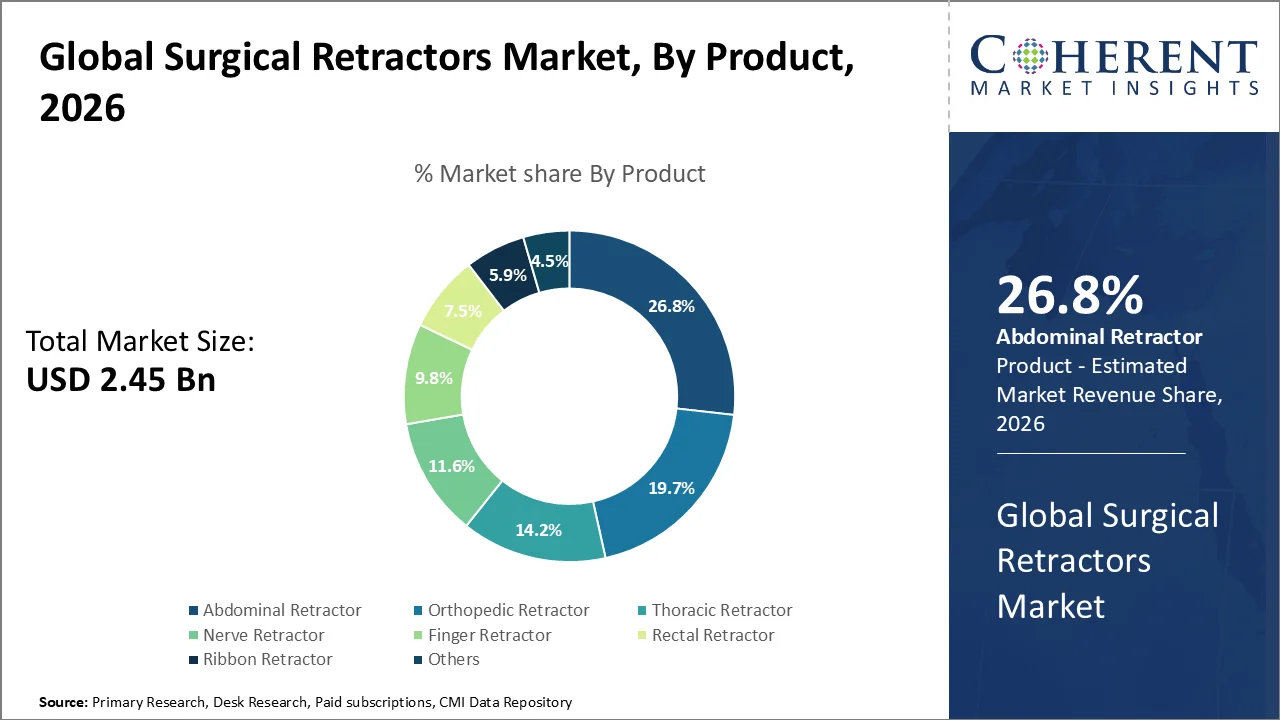
On the basis of product, the abdominal retractors segment is set to lead with 26.8% in 2026. The segment’s growth is owing to the increasing number of abdominal, gastrointestinal, and colorectal procedures worldwide.
According to the American Cancer Society (ACS, 2026 estimates), there will be approximately 108,860 new cases of colon cancer and 49,990 new cases of rectal cancer in the United States in 2026, making colorectal cancer one of the most common cancers requiring abdominal surgical intervention. These procedures frequently require abdominal retractors to maintain surgical exposure and visibility during surgery.
Orthopedic Surgery hold the Largest Market Share
On the basis of application, the orthopedic surgery segment is set to lead with 24.3% in 2026. The segment’s growth is owing to the rising prevalence of musculoskeletal disorders, trauma injuries, and joint replacement surgeries.
Additionally, OECD data shows that hip and knee replacement surgeries continue to rise annually across developed economies due to aging populations, further strengthening orthopedic surgical demand
Why are Hospitals Acquiring the Largest Share?
On the basis of end user, the hospitals segment is likely to dominate the market with 68.7% in 2026. The segment’s growth is owing to high surgical volumes, availability of advanced operating rooms, and increasing adoption of specialized surgical devices.
According to the American Hospital Association (AHA) Fast Facts (2026), the United States has approximately 6,100 hospitals, of which 5,121 are community hospitals, accounting for nearly 84% of total hospitals, thereby reflecting the dominance of large-scale hospital systems in healthcare delivery.
In June 2026, OrthAlign, Inc. announced FDA 510(k) clearance for its Lantern ASC system, a portable navigation tool used for orthopedic procedures that promises better accuracy in surgeries related to knee and hip bones without requiring bulky robotic devices.
Market Drivers
Rising Burden of Surgical Diseases is Driving the Surgical Retractors Market
The rising incidence of various chronic ailments such as heart diseases, cancer, gastrointestinal disorders, and musculoskeletal problems throughout the world is playing a major role in increasing the demand for surgeries and consequently in raising the requirement for surgical retractors.
According to the World Health Organization (WHO), 74% of all deaths in the world are caused by non-communicable diseases (NCDs), while cardiovascular diseases alone cause 17.9 million deaths per year. Rising disease prevalence is increasing surgical volumes worldwide, thereby sustaining demand for surgical retractors and related instruments.
Technological Advancements in Minimally Invasive and Robotic Surgery are Accelerating Adoption
The transition towards minimally invasive surgery (MIS), laparoscopy, and robotic surgery is causing an increasing demand for surgical retractors that offer improved visualization and precision without causing much trauma to the tissue.
According to Intuitive Surgical (2025 update), more than 3.1 million da Vinci robotic-assisted procedures were performed globally in 2025, reflecting the accelerating adoption of robotic surgery platforms that rely heavily on specialized retraction and access instruments.
Current Events and Their Impact
Current Event | Description and its Impact |
Implementation of EU Medical Device Regulation (MDR) Requirements for Reusable Surgical Instruments |
|
Expansion of Ambulatory Surgical Centers (ASCs) and Outpatient Surgery Reimbursement in the U.S. |
|
Surgical Retractors Market Trends
- Movement towards minimally invasive and laparoscopic surgeries is impacting the demands for product designs. The rise in the use of minimally invasive surgeries is demanding specialized retractors that facilitate small incisions, improved vision, and lesser damage to tissues. WHO stresses on the point that surgical systems around the world are increasingly turning towards more safe and less invasive procedures.
- Growth in robotic surgery is transforming the surgical instruments ecosystem. The acceptance and use of robotic surgery continue to rise around the world. Studies indicate increasing adoption of robotic-assisted surgery in orthopedic, gynecological, and abdominal procedures, where surgical access instruments such as retractors are necessary.
- Surgical innovation and operating theaters with AI integration are transforming surgical practices. The recent health care advances in 2026 illustrate the growing use of AI-integrated surgical operating theaters and robotic surgical techniques such as “pinhole” surgeries. For instance, the number of robotic surgeries in NHS England increased twofold from 35,000 (2022) to 70,000 (2024).
Regional Insights
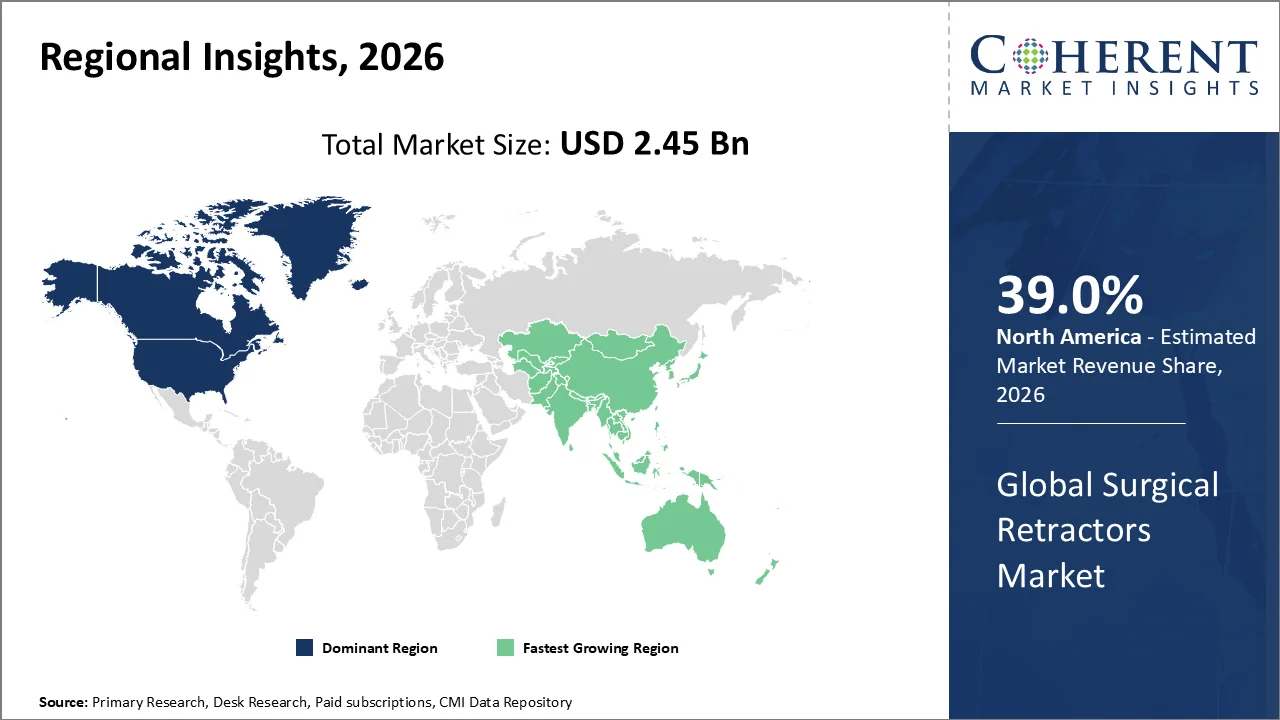
North America Leads the Surgical Retractors Market
On the basis of region, North America will lead the global market for surgical retractors, accounting for 39% market share in 2026, owing to high surgical volumes, sophisticated hospital infrastructure, and widespread use of minimally invasive and robotic surgery procedures.
According to the CDC of the United States, SSIs are responsible for up to 20% of the healthcare associated infections in the surgical population and hence form a clinical burden in the setting of surgical procedures.
In October 2024, TeDan Surgical Innovations (TSI) introduced the Phantom ML3 MIS Lumbar Surgical Access System, which was developed to provide assistance during minimally invasive transforaminal lumbar interbody fusion surgery (TLIF).
Asia-Pacific is the Fastest Growing Regional Market
On the basis of region, Asia-Pacific region is anticipated to witness robust growth for the surgical retractor market owing to improvements in healthcare infrastructure, increasing number of surgeries, and the growing trend of minimal invasive surgeries.
According to a peer-reviewed publication available at the U.S. National Library of Medicine (NCBI), Asia-Pacific nations including India, China, Indonesia, and Vietnam have shown fast progress in the provision of surgeries due to constant development and enhancement of their health systems.
Rising Surgical Burden and Advanced Healthcare Infrastructure are Accelerating the Surgical Retractors Market in the United States
The U.S. Surgical Retractors Market is witnessing steady growth, owing to a heavy load of surgical cases, sophisticated hospital infrastructure, and adoption of minimally invasive as well as robotic surgeries. The presence of a well-developed healthcare sector and high volume of procedures is expected to sustain the market for surgical devices like retractors within various fields of surgery, including general surgery, orthopedic surgery, and cardiovascular surgery.
Furthermore, the United States Centers for Disease Control and Prevention (CDC) states that 6 out of 10 Americans suffer from at least one chronic disease, which is a huge factor responsible for surgical operations in diseases of the heart, bones, and abdomen where surgical retractors are frequently employed.
In October 2025, Biedermann Motech announced the worldwide launch of its MOSS! MODULARITY system, which launched several new products, one of which is the DELTA XS 2.0 Retractor System for use in Transforaminal Lumbar Interbody Fusion (TLIF).
Healthcare Expansion and Rising Surgical Demand are Strengthening the Surgical Retractors Market in China
China’s Surgical Retractors Market is witnessing exponential growth owing to the massive healthcare infrastructure development along with an increase in hospital capacity and number of surgeries being performed in the country. Growth in healthcare infrastructure and improved access to surgical care are driving demand for surgical retractors in China.
In addition, China’s long-term healthcare strategy under the Healthy China 2030 program emphasizes the development of hospital facilities, increasing surgical capacity, and enhancing healthcare accessibility, thus contributing to the constant increase in surgery procedures that require retractors.
In June 2025, MicroPort MedBot announced that cumulative global orders for its robotic-assisted surgical systems had exceeded 130 units, highlighting accelerating adoption across endoscopic, orthopedic, and vascular specialties.
Who are the Major Companies in Surgical Retractors Industry
Some of the major key players in Surgical Retractors Market are Medtronic Plc, Becton, Dickinson and Company, Medical Devices Business Services, Inc., Teleflex Incorporated, Medline Industries, Inc., B. Braun Melsungen AG, Applied Medical Resources Corporation, Thompson Surgical, Innomed, Inc., LiNA Medical ApS, Vivo Surgical Private Limited, BVI, CooperSurgical Inc., Stryker Corporation, Mediflex Surgical Products, Applied Medical Technology, Inc., and Changzhou Haiers Medical Devices Co., Ltd.
Key News
- In December 2025, Medtronic announced that the U.S. FDA cleared the Hugo™ robotic-assisted surgery system for urologic surgical procedures, expanding robotic-assisted soft-tissue surgery capabilities and supporting increasing demand for surgical access instruments.
- In February 2025, Teleflex announced its acquisition of BIOTRONIK's Vascular Intervention business, strengthening its portfolio of interventional access technologies. The transaction expands Teleflex's position in procedural and surgical access solutions used across hospitals and operating rooms.
Market Report Scope
Surgical Retractors Market Report Coverage
| Report Coverage | Details | ||
|---|---|---|---|
| Base Year: | 2025 | Market Size in 2026: | USD 2.45 Bn |
| Historical Data for: | 2020 To 2024 | Forecast Period: | 2026 To 2033 |
| Forecast Period 2026 to 2033 CAGR: | 6.6% | 2033 Value Projection: | USD 3.83 Bn |
| Geographies covered: |
| ||
| Segments covered: |
| ||
| Companies covered: | Medtronic Plc, Becton, Dickinson and Company, Medical Devices Business Services, Inc., Teleflex Incorporated, Medline Industries, Inc., B. Braun Melsungen AG, Applied Medical Resources Corporation, Thompson Surgical, Innomed, Inc., LiNA Medical ApS, Vivo Surgical Private Limited, BVI, CooperSurgical Inc., Stryker Corporation, Mediflex Surgical Products, Applied Medical Technology, Inc., and Changzhou Haiers Medical Devices Co., Ltd. | ||
| Growth Drivers: |
| ||
| Restraints & Challenges: |
| ||
Analyst Opinion
- The Surgical Retractors Market is increasingly supported by the growing global need for safe surgical care. According to the World Health Organization (WHO), an estimated 143 million additional surgical procedures are needed each year in low- and middle-income countries to save lives and prevent disability, highlighting substantial unmet demand for surgical instruments and access devices, including retractors.
- Analysts expect rising cancer incidence to continue supporting demand for abdominal and thoracic retractors. According to the American Cancer Society, approximately 154,270 new cases of colorectal cancer are expected to be diagnosed in the U.S. in 2025, increasing the need for colorectal and gastrointestinal surgical procedures requiring surgical exposure devices.
- The increasing volume of musculoskeletal disorders is expected to strengthen demand for orthopedic surgery retractors. According to the World Health Organization (WHO), about 1.71 billion people worldwide are affected by musculoskeletal conditions, making them the leading contributor to disability globally. This is supporting growth in joint replacement and spine surgeries where specialized retractors are widely used.
- Analysts believe that the expansion of outpatient surgery settings will create new opportunities for compact and procedure-specific retractor systems. According to the Centers for Medicare & Medicaid Services (CMS), the list of procedures eligible for ambulatory surgical centers continues to expand, accelerating the shift of surgical volumes from inpatient hospitals to outpatient facilities.
Speak to the analyst
Want personalized insights?
Take the findings above to one of our principal consultants, or have the report rebuilt around the segments, geographies and competitors you actually track.
Market Segmentation
- By Type (Revenue, USD Bn, 2021-2033)
- Handheld
- Self-retaining
- By Product (Revenue, USD Bn, 2021-2033)
- Abdominal Retractor
- Finger Retractor
- Nerve Retractor
- Orthopedic Retractor
- Rectal Retractor
- Thoracic Retractor
- Ribbon Retractor
- Others
- By Application (Revenue, USD Bn, 2021-2033)
- Neurosurgery
- Wound Closure
- Reconstructive Surgery
- Cardiovascular
- Orthopedic
- Obstetrics and Gynecology (Ob/Gyn)
- Others
- By End User (Revenue, USD Bn, 2021-2033)
- Hospitals
- Ambulatory Surgical Centers
- Clinics
- Global Surgical Retractors Market , By Region (Revenue, USD Bn, 2021-2033)
- North America
- U.S.
- Canada
- Latin America
- Brazil
- Mexico
- Argentina
- Rest of Latin America
- Europe
- Germany
- U.K.
- France
- Italy
- Spain
- Russia
- Rest of Europe
- Asia Pacific
- China
- India
- Japan
- Australia
- South Korea
- ASEAN
- Rest of Asia Pacific
- Middle East
- GCC
- Israel
- Rest of Middle East
- Africa
- South Africa
- Central Africa
- North Africa
- North America
- Key Players
- Medtronic Plc
- Becton, Dickinson and Company
- Medical Devices Business Services, Inc.
- Teleflex Incorporated
- Medline Industries, Inc.
- Braun Melsungen AG
- Applied Medical Resources Corporation
- Thompson Surgical
- Innomed, Inc.
- LiNA Medical ApS
- Vivo Surgical Private Limited
- BVI
- CooperSurgical Inc.
- Stryker Corporation
- Mediflex Surgical Products
- Applied Medical Technology, Inc.
- Changzhou Haiers Medical Devices Co., Ltd.
Sources
Primary Research Interviews
- Surgical Retractor Manufacturers
- Medical Device Distributors & Suppliers
- Hospital Procurement Managers
- General Surgeons
- Orthopedic Surgeons
- Neurosurgeons
- Cardiothoracic Surgeons
- Plastic & Reconstructive Surgeons
- Ambulatory Surgical Center (ASC) Administrators
- Healthcare Industry Experts & Key Opinion Leaders (KOLs)
- Others
Databases
- Bloomberg Terminal
- Others
Magazines
- Medical Design & Outsourcing
- Medical Product Outsourcing (MPO)
- MD+DI (Medical Design & Development)
- Becker's Hospital Review
- OR Manager Magazine
- Healthcare Purchasing News
- Others
Journals
- Journal of Surgical Research
- Annals of Surgery
- The American Journal of Surger
- JAMA Surgery
- BMC Surgery
- International Journal of Surgery
- Others
Newspapers
- Reuters
- Bloomberg News
- Financial Times
- The Wall Street Journal
- The Economic Times
- Business Standard
- Others
Associations
- American College of Surgeons (ACS)
- Association of periOperative Registered Nurses (AORN)
- Association of Surgical Technologists (AST)
- European Association for Endoscopic Surgery (EAES)
- American Society for Surgery of the Hand (ASSH)
- World Federation of Societies of Anaesthesiologists (WFSA)
- Others
Public Domain Sources
- U.S. Food and Drug Administration (FDA)
- European Commission – Medical Devices
- World Health Organization (WHO)
- Organisation for Economic Co-operation and Development (OECD)
- Centers for Disease Control and Prevention (CDC)
- National Institutes of Health (NIH)
- Others
Proprietary Elements
- CMI Data Analytics Tool, Proprietary CMI Existing Repository of Information for the Last 10 Years
Get access to 250+ pages report
Every segment, forecast, competitor profile and data table behind the analysis above — available for instant download.
- ESOMAR Member
- ISO 9001:2015 Certified
- D-U-N-S Registered
- GDPR & CCPA Compliant
Missing comfort of reading report in your local language? Find your preferred language:
Transform your Strategy with Exclusive Trending Reports
Frequently Asked Questions
The Surgical Retractors Market is expected to reach USD 3.83 Billion by 2033, growing from USD 2.45 Billion in 2026.
The hospitals segment is expected to dominate the market owing to high surgical volumes, availability of advanced operating rooms, and increasing adoption of specialized surgical devices.
The high cost of advanced and specialized retractor systems, risk of tissue damage and surgical complications associated with improper use, stringent regulatory requirements, and increasing preference for minimally invasive procedures requiring smaller access devices are some of the key factors hampering market growth.
The increasing volume of surgical procedures worldwide, rising prevalence of musculoskeletal and chronic diseases, growing geriatric population, increasing adoption of minimally invasive surgeries, and technological advancements in robotic-assisted surgery are driving the demand for surgical retractors.
The Surgical Retractors Market is anticipated to grow at a CAGR of 6.6% between 2026 and 2033.
The market outlook remains positive due to the growing adoption of minimally invasive and robotic-assisted surgeries, rising orthopedic and gastrointestinal surgical volumes, expansion of ambulatory surgical centers, and continuous innovation in surgical access technologies.
The Surgical Retractors Market refers to the industry involved in the development, manufacturing, and commercialization of handheld and self-retaining surgical retractors used to provide tissue separation, access, and visualization during open, minimally invasive, and robotic-assisted surgical procedures across various specialties.