

Australia and New Zealand Cleanroom Gloves Market Size and Share Analysis: 2026 - 2033
The Australia and New Zealand cleanroom gloves market size is estimated to reach around USD 78 Mn in 2026 and is expected to grow at a CAGR of 5.6% during the forecast period (2026-2033), totaling USD 114.7 Mn by 2033.
Key Takeaways from the Australia and New Zealand Cleanroom Gloves Market Report
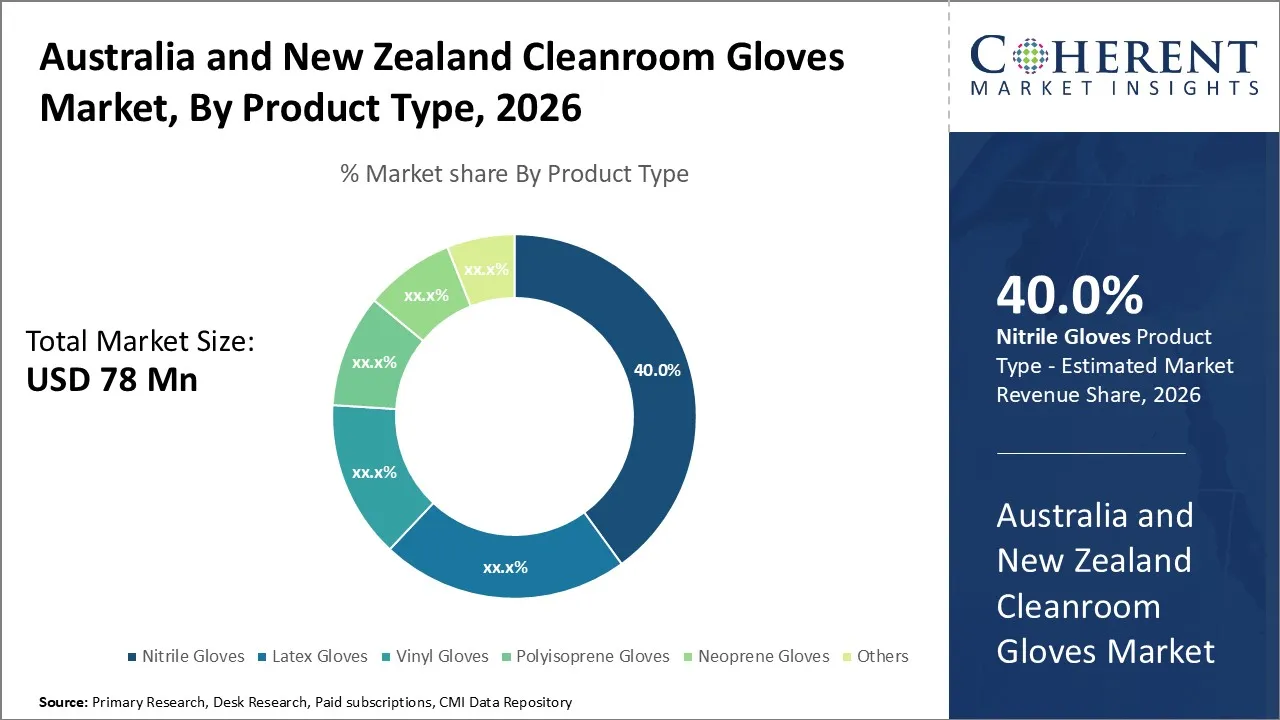
- Nitrile gloves remain the top-selling product type, accounting for more than 40% of market revenue share in 2026, owing to their chemical resistance, durability, and hypoallergenic properties.
- Sterile gloves segment is expected to dominate the market with a share of 60% in 2026 due to strict contamination control requirements in pharmaceutical, biotech, and clinical applications.
- Australia is anticipated to lead the cleanroom gloves market, accounting for a share of about 61% in 2026. This is mostly due to strong presence of pharmaceutical manufacturing hubs in cities like Sydney and Melbourne, increasing investments in biotechnology and medical research, and stringent regulatory standards enforced by the Therapeutic Goods Administration.
Australia and New Zealand Cleanroom Gloves Market Overview
The ANZ cleanroom gloves market is expected to register steady growth during the forecast period. This is primarily due to the rising adoption of cleanroom gloves in pharmaceutical, biotechnology, medical devices, and healthcare settings. In addition, increasing awareness regarding workplace safety and regulatory compliance is boosting sales of cleanroom gloves.
Cleanroom gloves are designed to protect products from contamination and to protect the wearer from exposure to chemicals. Cleanroom gloves, sterile gloves, and cleanroom hand protection products are used to protect hands while working in a controlled environment. Regular boxed gloves cannot be used in a cleanroom, especially those labeled with brand names or logos, as they may release particles or contaminants.
Longer length cleanroom gloves are becoming popular due to increased awareness and the growing need for extra personal and product protection. The traditional glove length used in a cleanroom is 300 mm (12 inches). However, for better protection while handling hazardous chemicals such as chemotherapy drugs, 400 mm (16 inches) gloves are recommended. These longer gloves cover the forearm and provide additional protection against exposure to harmful chemicals.
Rising emphasis on reducing hospital-acquired infections (HAIs) is encouraging the use of cleanroom gloves and other personal protective equipment in New Zealand and Australia. In New Zealand, a survey of 5,468 patients found that 6.6% had HAIs, with surgical site infections being the most common. In Australia, hospital-acquired infections are also a significant concern. This focus on preventing infections is supporting the adoption of cleanroom gloves.
Current Events and Their Impact on the Australia and New Zealand Cleanroom Gloves Market
Current Event | Description and its Impact |
Regulatory Environment Strengthening |
|
Technological Innovation in Materials Science |
|
Segmental Insights
- Current Industry Events of 2026
- Market Size Estimation
- Regional Breakdown
- Competitive Landscape
- Customer Intelligence
- Segmental Analysis
- Pricing Analysis
- Key Market Drivers, Challenges & Future Trends
- Customized Insights Section
Australia and New Zealand Cleanroom Gloves Market Insights, By Product Type- Nitrile Gloves Remain Highly Sought-After Product Type
Based on product type, nitrile gloves segment is forecast to dominate the market with a revenue share of over 40% in 2026. This is mostly due to their superior chemical resistance, puncture protection, and excellent durability compared to latex and vinyl alternatives. Nitrile gloves are widely preferred in pharmaceutical manufacturing, biotechnology laboratories, medical device production, and semiconductor facilities where stringent contamination control is critical.
Nitrile gloves minimize the risk of allergic reactions among workers. This is fueling their adoption across pharmaceutical manufacturing, biotechnology laboratories, and medical devices sectors in Australia and New Zealand. Their strong barrier protection against oils, solvents, and hazardous chemicals further strengthens their suitability for high-grade cleanroom environments.
Australia and New Zealand Cleanroom Gloves Market Insights, By Category - Sterile Gloves Dominate the Australia and New Zealand Market
Based on category, sterile gloves segment is expected to account for about 60% of the Australia and New Zealand cleanroom gloves market share in 2026. This is mainly due to the stringent hygiene and contamination control requirements in industries such as pharmaceuticals, biotechnology, and healthcare.
Growing adoption of Good Manufacturing Practices (GMP) and regulatory standards in these sectors is increasing the demand for sterile gloves. These gloves are critical in maintaining aseptic conditions as well as preventing microbial contamination. In addition, the increase in manufacturing of high-precision electronics and semiconductors in the region further boosts the use of sterile gloves, helping maintain product quality and follow cleanroom protocols.
Australia and New Zealand Cleanroom Gloves Industry News
- In January 2026, Ansell Limited launched TOUCHNTUFF 93‑800, a disposable glove engineered to provide at least 15 minutes of acetone resistance. This glove is a first in the market for disposable gloves with extended acetone protection.
- In September 2024, Mun Australia launched GloveOn COATS Biodegradable Nitrile Gloves. They use oatmeal-based COATS® technology to keep hands comfortable and are designed to break down faster in landfills.
Market Report Scope
Australia and New Zealand Cleanroom Gloves Market Report Coverage
| Report Coverage | Details | ||
|---|---|---|---|
| Base Year: | 2025 | Market Size in 2026: | USD 78 Mn |
| Historical Data for: | 2020 To 2024 | Forecast Period: | 2026 To 2033 |
| Forecast Period 2026 to 2033 CAGR: | 5.6% | 2033 Value Projection: | USD 114.7 Mn |
| Geographies covered: |
| ||
| Segments covered: |
| ||
| Companies covered: | Ansell Ltd., Kimberly-Clark Worldwide, Inc., Valutek Inc., Cardinal Health, Honeywell International Inc., Sabre Medical Pty Ltd., The Glove Company, and RS Components Pty Ltd. | ||
| Growth Drivers: |
| ||
| Restraints & Challenges: |
| ||
Australia and New Zealand Cleanroom Gloves Market Drivers
Growing Concerns Over Infection Control and Hygiene in Australia and New Zealand
There is a rising awareness about hygiene, infection control, and safety protocols, especially in diagnostic centers, hospitals, and clinnics. This is driving demand for cleanroom gloves in Australia and New Zealand. Cleanroom gloves provide effective barrier protection against chemicals, particles, and microbes, helping maintain sterile and contamination‑free environments. They also support overall workplace safety for personnel handling sensitive materials.
Multiple reports have shown that protective gloves worn by healthcare workers significantly reduce the risk of bacterial transfer to hands, reducing contamination by as much as 71% compared with no gloves. Thus, rising focus on reducing hospital‑acquired infections (HAIs) and cross-contamination in medical and laboratory settings is expected to fuel demand for cleanroom gloves in Australia and New Zealand during the forecast period.
Expansion of Pharmaceutical, Biotechnology, and Healthcare Sectors
Rapid growth in biopharmaceutical manufacturing in Australia and New Zealand is boosting the cleanroom gloves market. Pharmaceutical and biotechnology companies in these regions increasingly use contamination control supplies, such as cleanroom gloves, in sterile production and R&D environments. Rising healthcare standards and investments in advanced therapeutics and diagnostics further support cleanroom gloves demand.
Australia and New Zealand Cleanroom Gloves Market Trends
Cleanroom Glove Material Innovations
Growing interest in environmentally friendly and sustainable glove materials, such as biodegradable and recycled materials, is becoming a key trend in the cleanroom gloves market. In Australia and New Zealand, nitrile gloves lead the market because they resist chemicals and have a lower allergy risk compared with latex. Companies are starting to explore new options, including biodegradable cleanroom gloves, but these are still in the early stages of adoption.
Technological Advancements in Cleanroom Glove Production
Advancements in materials science and manufacturing processes are improving glove performance, durability, and comfort, which broadens application areas. Automated and smart production technologies are helping reduce costs and improve quality control. These innovations are expected to boost growth of the Australia and New Zealand cleanroom gloves market during the forecast period.
Australia and New Zealand Cleanroom Gloves Market Opportunities
Regulatory and Quality Compliance Requirements
Strict regulations in pharmaceuticals, medical devices, and research labs drive the use of certified cleanroom gloves to maintain product safety and cleanliness. In Australia and New Zealand, compliance with AS/NZS ISO cleanroom standards ensures the use of high-performance gloves that prevent contamination in controlled environments. As a result, lucrative growth opportunities are on the horizon for manufacturers of cleanroom gloves in these regions.
Analyst Opinion (Expert Opinion)
- Cleanroom gloves in ANZ have transitioned from commoditized PPE to contamination control levers in advanced manufacturing environments. Pharmaceutical, biotech, and semiconductor cleanrooms in Australia and New Zealand are increasingly specifying nitrile and low‑particulate glove formulations as part of core contamination control protocols rather than as ancillary protection. Across controlled environments, gloves now represent roughly a quarter of all consumable demand outperforming apparel and wiping products in unit share because operators empirically correlate glove particle generation with yield loss and environmental monitoring excursions. In regulated cleanrooms, operators will repeatedly mandate low particle shedding and validated endotoxin levels as part of supplier qualification checklists, rather than rely on generic examination gloves, effectively shifting procurement to performance metrics rather than price alone.
- Operational discipline in ANZ cleanrooms is evolving toward validated contamination metrics and gloves are core to this shift. Leading ANZ cleanroom facilities now integrate glove performance into environmental monitoring protocols, tracking glove change frequency against Class‑specific particulate action levels. Globally, over two‑thirds of cleanrooms mandate sterile glove usage to control particle and microbial contamination through critical process steps a trend mirrored in ANZ’s high‑precision sectors, where double‑gloving and frequent change‑outs are standard practice. Facilities that engineer processes around validated glove performance report noticeable reductions in particle excursions and audit failures, making cleanroom glove specification a determinant of operational compliance rather than a routine checkbox.
- Regulatory and contamination control scrutiny in ANZ has turned glove specification into a competitive moat for premium suppliers. Under TGA and AS/NZS ISO 14644 adherence regimes, cleanrooms in pharmaceutical and medical device manufacturing aren’t judged merely on documentation they’re evaluated on measurable contamination outcomes. As such, gloves tested for low ionic contamination, minimal extractables, and extended cuff coverage are increasingly required in qualification protocols. This rigour has weeded out lower‑quality supply sources and enabled distributors with documented performance data to secure multi‑year supply agreements with tier‑1 cleanroom operators. In effect, compliance precision has become as influential as supply reliability in contract awards.
Speak to the analyst
Want personalized insights?
Take the findings above to one of our principal consultants, or have the report rebuilt around the segments, geographies and competitors you actually track.
Australia and New Zealand Cleanroom Gloves Market Segmentation
- By Product Type Insights ( Revenue, USD Mn, 2020 - 2033)
- Nitrile Gloves
- Latex Gloves
- Vinyl Gloves
- Polyisoprene Gloves
- Neoprene Gloves
- Others
- By Category Insights ( Revenue, USD Mn, 2020 - 2033)
- Sterile
- Non-sterile
- By End Users Insights ( Revenue, USD Mn, 2020 - 2033)
- Pharmaceutical and Biotechnology Companies
- Medical Device Companies
- Hospitals and Clinics
- Diagnostic Laboratories
- By Region Insights ( Revenue, USD Mn, 2020 - 2033)
- Australia
- New Zealand
- Key Players
- Ansell Ltd.
- Kimberly-Clark Worldwide, Inc.
- Valutek Inc.
- Cardinal Health
- Honeywell International Inc.
- Sabre Medical Pty Ltd.
- The Glove Company
- RS Components Pty Ltd.
Sources
Primary Research interviews
- Interviews with cleanroom facility managers and procurement officers in pharmaceutical, biotech, and electronics manufacturing companies in Australia and New Zealand.
- Discussions with production supervisors and quality assurance personnel in cleanroom glove manufacturing units.
- Insights from distributors and suppliers of protective and sterile gloves in the region.
Databases
- Australian Bureau of Statistics (ABS)
- Stats NZ – Tatauranga Aotearoa
- World Health Organization (WHO) – medical and safety equipment statistics
- Food Standards Australia New Zealand (FSANZ) database
- Trade and import-export data from UN Comtrade
Magazines
- Cleanroom Technology
- Laboratory Equipment & Life Sciences
- Industrial Safety & Hygiene News
- Medical Device & Diagnostic Industry (MD+DI)
Journals
- Journal of Occupational and Environmental Hygiene
- International Journal of Pharmaceutical and Healthcare Research
- Journal of Pharmaceutical Innovation
- Biomedical Materials and Devices Journal
Newspapers
- The Australian
- The Sydney Morning Herald
- The New Zealand Herald
- Stuff.co.nz
Associations
- Australasian Society for Clean Technology (ASCT)
- Cleanroom Society of New Zealand (CSNZ)
- Australian Medical Association (AMA) – relevant safety equipment guidelines
- Safe Work Australia
Public Domain sources
- Government reports on occupational health and safety
- Public tenders for cleanroom supplies and PPE contracts
- ISO and ASTM standards for cleanroom gloves
- Trade publications and technical whitepapers freely available online
Proprietary Elements
- CMI Data Analytics Tool
- Proprietary CMI Existing Repository of information for last 8 years
Get access to 250+ pages report
Every segment, forecast, competitor profile and data table behind the analysis above — available for instant download.
- ESOMAR Member
- ISO 9001:2015 Certified
- D-U-N-S Registered
- GDPR & CCPA Compliant
Missing comfort of reading report in your local language? Find your preferred language:
Transform your Strategy with Exclusive Trending Reports
Frequently Asked Questions
The target market is estimated to be valued at USD 78 Mn in 2026.
The Australia and New Zealand Cleanroom Gloves Market value is expected to reach USD 114.7 Mn by 2033.
The ANZ cleanroom gloves market is poised to exhibit a CAGR of 5.6% from 2026 to 2033.
Major growth factors include increasing hospital admissions and rising number of surgical procedures.
Limitations of cleanroom gloves are restraining market growth.
Nitrile gloves segment, with about 40% market share in 2026, dominates the market.
Major players in the ANZ cleanroom gloves market include Ansell Ltd., Kimberly-Clark Worldwide, Inc., Valutek Inc., Cardinal Health, Honeywell International Inc., Sabre Medical Pty Ltd., The Glove Company, and RS Components Pty Ltd.