Geosteering Market Analysis & Forecast: 2026-2033

The Geosteering Market is estimated to be valued at USD 1,250 Mn in 2026 and is expected to reach USD 2,010 Mn by 2033, growing at a compound annual growth The rate (CAGR) of 7% from 2026 to 2033.
The Geosteering Market is advancing significantly driven by its expanding role in reservoir optimization, horizontal drilling efficiency, and the maximization of hydrocarbon recovery. The growing demand for energy as well as the increasing technical complexity of unconventional plays like shale and deepwater reservoirs are expected to drive market growth over the forecast period. Geosteering is a real-time well-placement technique that uses live subsurface measurements to guide drilling decisions and maintain the wellbore within targeted pay zones. Its ability to respond immediately to changing geological conditions substantially improves drilling efficiency and reduces costly deviations.
The geosteering industry is undergoing a transformative period bolstered by improvements in processing technologies and the use of modified workflows, including AI driven automation and cloud-based data integration. There is a high demand for specialized services in diverse settings, such as onshore shale basins and offshore exploration projects, for managing thin-layered reservoirs and complex geological structures. These developments have expanded the functional scope of drilling systems, thus improving their navigational accuracy, reservoir contact, and overall operational profitability. In addition, the integration of digital twin technology and advanced predictive analytics is allowing operators to model multiple drilling scenarios in real time, allowing potential geological risks to be identified and mitigated before they materialize. The shift toward autonomous, data-driven operations is transforming geosteering from a tactical optimization function into a strategic enabler of sustainable, cost-efficient energy production.
|
Current Event |
Description and the Impact |
|
Geopolitical Tensions in the Middle East
|
|
|
Technological Advancements in Real-Time Downhole Data Acquisition
|
|
|
Regional Shale and Unconventional Reservoir Development in North America and Asia-Pacific
|
|
Uncover macros and micros vetted on 75+ parameters: Get instant access to report
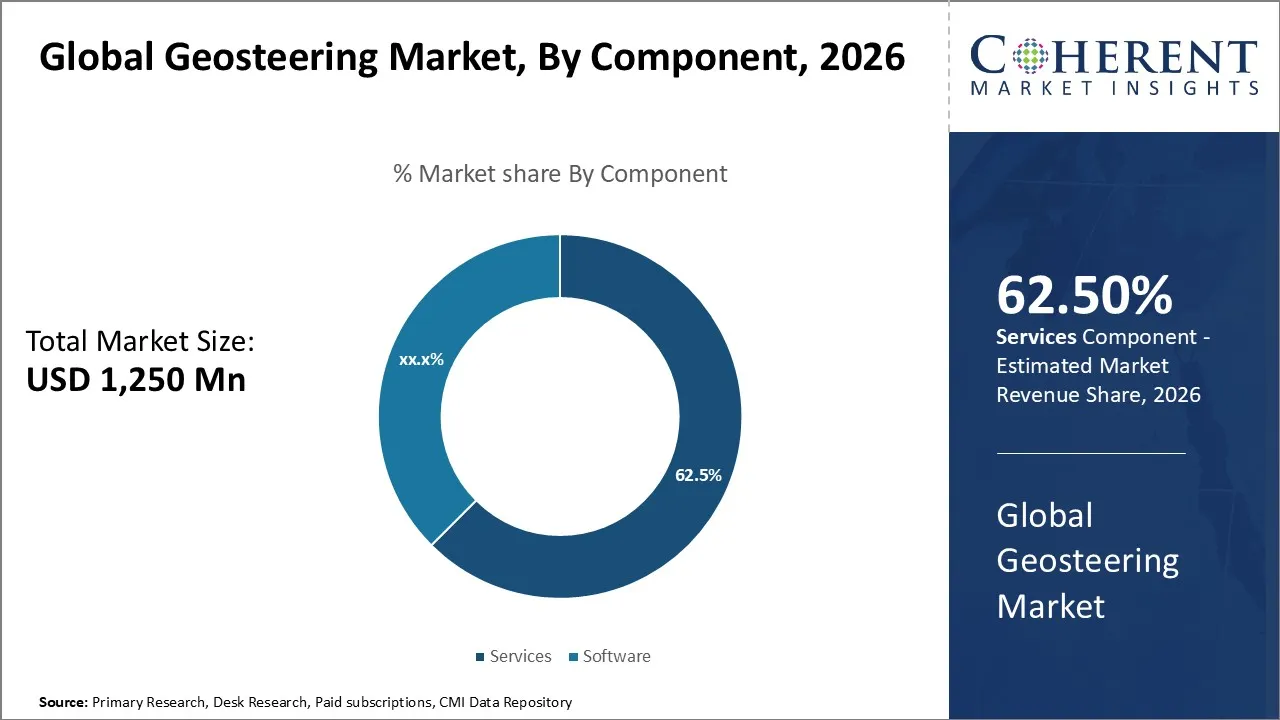
In terms of component, the services segment contributes the highest share of 62.50% in 2026 of the market. This is because it acts as the critical operational backbone that converts complex data into real-time drilling decisions. The modern oil and gas exploration has shifted toward thin, heterogeneous reservoirs like shale and unconventional plays that require constant, expert-led trajectory adjustments. Professional geosteering services provide the necessary petrotechnical expertise for real-time reservoir navigation, mitigating the high financial risks of deepwater projects by reducing non-productive time (NPT). This growth is also due to a global shortage of in-house specialists, prompting operators to rely on outsourced managed services to ensure data continuity from the drill bit to the surface. The segment is evolving via the integration of AI-assisted interpretation and cloud-based collaborative platforms, ensuring it remains the primary delivery mechanism for operational value.
In terms of tools, the MWD tools segment contributes the highest share of 34.80% in the market in 2026. The growth is attributed to its function as the main source of real-time directional data. The MWD tools provide immediate readings on inclination, azimuth, and toolface orientation. The tools allow operators to navigate complex trajectories without halting operations for traditional wireline surveys. This capability plays a crucial role in minimizing non-productive time (NPT) and improving the Rate of Penetration (ROP) in costly settings like offshore rigs and unconventional shale plays. The cutting edge MWD tools use sensors to monitor downhole dynamics like vibration and annular pressure, thereby safeguarding costly equipment from premature failure. These advancements, spearheaded by industry leaders like Schlumberger and Baker Hughes, are turning MWD into the high-speed data conduit necessary for the transition to autonomous drilling and AI-driven geosteering models.
To learn more about this report, Download Free Sample
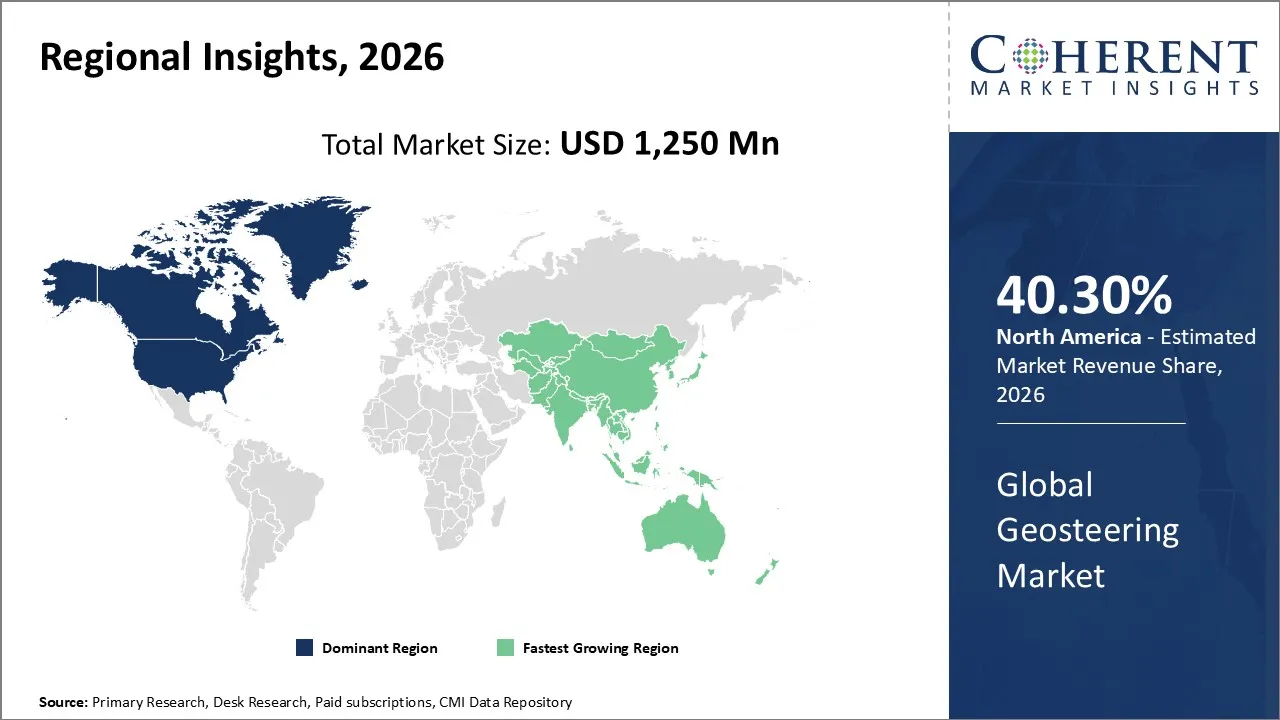
North America has remained the dominant region with 40.30% in 2026 of the global Geosteering Market over the past decade. The growth can be attributed to the region's abundant unconventional reserves, especially in the US and Canada. The shale gas and tight oil production from basins like the Permian, Eagle Ford, and Marcellus necessitate high-precision drilling to optimize hydrocarbon recovery. The market is shifting toward decision-grade intelligence, characterized by the deep integration of Artificial Intelligence (AI) and machine learning to automate well-path adjustments and provide predictive trajectory modeling. These technological progress like the widespread adoption of Rotary Steerable Systems (RSS) and advanced Logging-While-Drilling (LWD) sensors are enabling operators to unlock previously marginal acreage while significantly reducing operational costs and drilling risks.
For instance, in June 2025, Cactus Drilling, a privately owned land drilling business in the U.S., has announced a strategic collaboration agreement with SLB, a global energy technology firm. This partnership aims to enhance the adoption of automated and autonomous drilling technologies.
The Asia Pacific region has emerged as the fastest-growing market as nations across the region prioritize energy security and the exploitation of technically complex reserves. This growth is primarily driven by China, where state-owned companies such as Sinopec are investing in the massive shale gas plays of the Sichuan Basin. In addition, CNOOC is expanding its deepwater exploration efforts in the South China Sea. In India, the emphasis on the Krishna-Godavari (KG) Basin has made geosteering a crucial technique for navigating narrow, high-pressure reservoirs. The market is also being reshaped by the "digital oilfield" movement. There is a clear shift toward AI-driven automation and cloud-based geosteering software that allows for remote, real-time decision-making, reducing the need for on-site personnel in remote offshore locations. In addition, the emerging applications in the geothermal energy sectors of Indonesia and Japan are expanding the scope of the market. The businesses in the region like China Oilfield Services Limited (COSL) are increasing their market share by offering localized, cost-effective solutions that address the specific geological challenges in the Asia Pacific region.
The US is at the forefront of the market owing to the most mature and technologically advanced segment of the global industry. The intensive horizontal drilling necessary in major unconventional shale plays like the Permian, Bakken, and Eagle Ford basins, is contributing to industry growth. The sector has transitioned from traditional manual steering to decision-grade intelligence. This progress is mainly driven by the integration of Artificial Intelligence (AI) and machine learning, which allows for automated, real-time adjustments to wellbore trajectories. As a result, there is a substantial reduction in non-productive time and human error. In addition, this shift is bolstered by the widespread use of Rotary Steerable Systems (RSS) and advanced Logging-While-Drilling (LWD) tools that deliver high-resolution formation data directly from the bit. The U.S. operators are centralizing their expertise in Remote Operations Centers to address labor shortages and enhance efficiency. This approach allows expert geosteerers to oversee multiple rigs simultaneously via cloud-based monitoring platforms. The market continues to show resilience as companies focus on the efficiency gains provided by automated well planning and real-time analytics.
For instance, in February 2022, Schlumberger introduced the GeoSphere 360° 3D reservoir mapping-while-drilling service during the International Petroleum Technology Conference (IPTC).
The China market is characterized by rapid technological localization and aggressive expansion into unconventional and offshore reserves, fueled by a national mandate for energy self-sufficiency and strategic government emphasis on accelerating domestic natural gas output. The Sichuan Basin remains a key area of focus, where unconventional shale drilling requires careful navigation of intricate, thin reservoirs. The businesses in the country like PetroChina have created proprietary systems like the China Geosteering Drilling System (CGDS). This system integrates near-bit sensors with real-time surface interpretation, thereby providing precise guidance for the drill bit. There is a significant shift toward AI-driven automation and remote optimization drives targeting active wells across the country.
The South China Sea has become a vital offshore growth area, where deepwater geosteering plays a crucial role in optimizing recovery amid geologically unstable environments. The international service providers like Halliburton and SLB focus on specialized high-end projects. The domestic businesses like China Oilfield Services Limited (COSL) and Sinopec are increasingly dominating the market. These companies leverage localized research and benefit from strategic support from the government, which helps them maintain a competitive edge.
| Report Coverage | Details | ||
|---|---|---|---|
| Base Year: | 2025 | Market Size in 2026: | USD 1,250 Mn |
| Historical Data for: | 2020 To 2024 | Forecast Period: | 2025 To 2032 |
| Forecast Period 2026 to 2033 CAGR: | 7% | 2033 Value Projection: | USD 2,010 Mn |
| Geographies covered: |
|
||
| Segments covered: |
|
||
| Companies covered: |
Cougar Drilling Solutions, Emerson Paradigm Holding LLC, Schlumberger Limited, GeoSteering Technologies, Petrolink, Geo-Steering Solutions Inc., Halliburton, Exlog, Geotech Logging Services LLC, United Oil & Gas Consulting Ltd., HMG Software, Horizontal Solutions International, Maxwell Dynamics, Terracosm Software, LLC, LMKR, Rogii Inc., and Lloyd's Register Group Services Ltd. |
||
| Growth Drivers: |
|
||
| Restraints & Challenges: |
|
||
Uncover macros and micros vetted on 75+ parameters: Get instant access to report
The increase in exploration and production activities in unconventional reservoirs like shale gas and tight oil is the primary driver of growth in the global geosteering market. These formulations contain thin or heterogeneous sweet spots requiring extreme precision to navigate. Operators increasingly turn to complex horizontal drilling as easy way to reach reserves decline. Geosteering is essential here because it uses real-time data from logging and measurement while drilling tools to keep the drill within the most productive geological zones.
Steering increases the estimated ultimate recovery by maximizing reservoir contact and helps mitigate risks such as porpoising. This high-precision navigation capability identifies unexpected structural dips and faults in real time, thereby reducing nonproductive time and associated operational costs. The incorporation of artificial intelligence and 3D geomodeling in geosteering platforms allows for faster data-driven decision-making as well as improves the economic viability of marginal and unconventional resources. The dependence on cutting-edge digital and high-technology services continues to define the modern energy landscape, supporting the steady market expansion over the forecast period.
For instance, in December 2024, a leading energy technology business SLB has released Neuro™ automated geosteering, a system designed to dynamically adjust to subsurface complexities. This technology aims to drill more efficient and higher-performing wells. It also assist in minimizing the carbon footprint associated with drilling operations.
Definition: The geosteering market is a commercial ecosystem of tools and expertise used to navigate a drill bit through the earth’s most productive rock layers in real time. Instead of just following a precalculated map, operators in this market use a combination of high-tech sensors (like LWD and MWD) and specialized software to make split-second decisions based on the actual geology encountered underground. It is essentially the GPS for drilling, where the goal is not just to reach a destination but to stay within a very specific, often thin layer of oil-bearing rock. This market is vital today because as readily available oil runs out, companies must become more precise, making the data and software provided by geosteering firms the difference between achieving a million-dollar success and ending up with a dry hole.
Share
Share
About Author
Sakshi Suryawanshi is a Research Consultant with 6 years of extensive experience in market research and consulting. She is proficient in market estimation, competitive analysis, and patent analysis. Sakshi excels in identifying market trends and evaluating competitive landscapes to provide actionable insights that drive strategic decision-making. Her expertise helps businesses navigate complex market dynamics and achieve their objectives effectively.
Missing comfort of reading report in your local language? Find your preferred language :
Transform your Strategy with Exclusive Trending Reports :
Frequently Asked Questions
Joining thousands of companies around the world committed to making the Excellent Business Solutions.
View All Our Clients
 Schedule a meeting with report Author