Hydrate Inhibitors Market Analysis & Forecast: 2026-2033
Hydrate inhibitors market is estimated to be valued at USD 288.60 Mn in 2026 and is expected to reach USD 441.40 Mn in 2033, exhibiting a compound annual growth rate (CAGR) of 6.26% from 2026 to 2033.
Hydrate inhibitors are chemical substances or devices that are designed to control the formation of hydrates during the process of natural gas production. Natural gas hydrates are ice-like solids that form when natural gas and free water are combined at low temperatures and high pressure. It is formed at a gas or an oil condensate well.
Hydrate inhibitors aid in reducing hydrate plugs and line blockages, which occur due to hydrate formation. Hydrate inhibitors are used where mechanical methods such as insulated flow lines and active heating are not feasible.
|
Current Event |
Description and its Impact |
|
Technological Advancements in Chemical Solutions |
|
|
Environmental Regulations and Sustainability Initiatives |
|
Uncover macros and micros vetted on 75+ parameters: Get instant access to report
Low-Dosage Hydrate Inhibitors (LDHIs) are far more efficient than traditional Thermodynamic Hydrate Inhibitors (THIs) because they work effectively at very low concentrations, often in the parts-per-million range.
THIs such as methanol or MEG require massive volumes, sometimes hundreds of tons per month to prevent hydrate formation in subsea pipelines, which drives up logistics, storage, and regeneration costs.
By contrast, LDHIs can reduce chemical injection volumes by up to 90%, cutting down the need for transport and handling infrastructure offshore. This efficiency translates into significant financial savings, often amounting to tens of millions of dollars annually for deepwater projects, while also lowering environmental impact and simplifying operations.
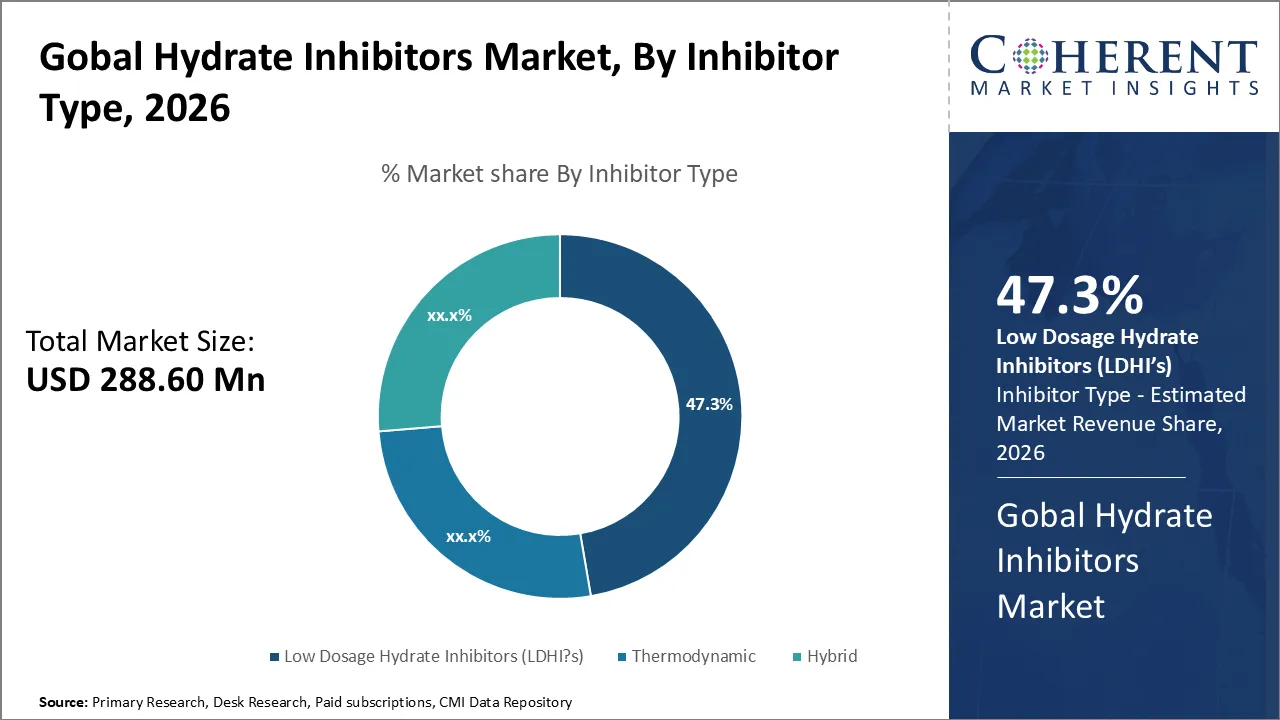
In terms of inhibitor type, the low dosage hydrate inhibitors (LDHIs) segment is expected to lead the market with 47.3% share in 2026, because they are affordable and work effectively for oil and gas operations. They work great at low concentrations, which means less need for chemicals, transportation, and harm to the environment. This makes them perfect for complicated deepwater and ultra-deepwater projects where the risk of hydrate formation is highest.
In March 2025, for example, Innospec's LaZuli™ line of products will help with deepwater subsea production. LaZuli HIW 6910 is one of these products. It is a low-dose hydrate inhibitor and anti-agglomerant. It is certified by API 17TR5 and 17TR6 and prevents gas hydrate blockages in flowlines that tie back to the seabed. It indicates that LDHIs are becoming increasingly utilized as hydrate inhibitors for offshore oil and gas operations because they are effective, affordable, and becoming more prevalent.
To learn more about this report, Download Free Sample
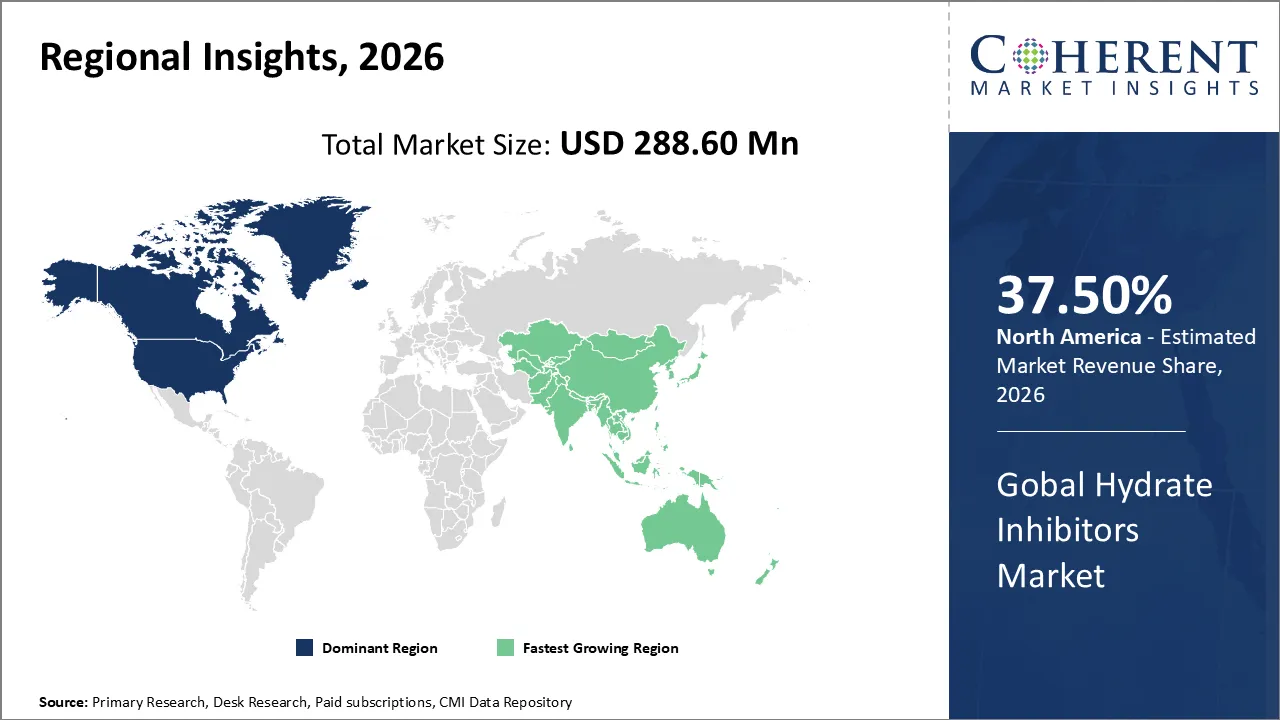
North America is expected to dominate the hydrate inhibitors market with 37.50% share in 2026, due to extensive offshore oil and gas exploration in the Gulf of Mexico, mature infrastructure, and stringent flow assurance regulations. Strong demand is driven by the growth of deepwater projects and the use of advanced low-dosage inhibitors, which help businesses run more smoothly and follow environmental rules.
For example, Baker Hughes added more natural gas fields in the U.S. to its AI-powered Leucipa™ chemical management platform in January 2025. The system optimizes the dosing of hydrate, scale, and corrosion inhibitors, which reduces on waste, improves flow assurance, and lowers emissions. This expansion helps natural gas production operations run more smoothly, last longer, and be more reliable.
Asia Pacific is expected to exhibit the fastest growth, driven by fast deepwater and ultra-deepwater oil and gas exploration, rising energy use in developing countries, and government spending on offshore infrastructure. The growth of subsea projects in China, India, and Southeast Asia is driving the use of efficient low-dosage hydrate inhibitors.
For instance, in September 2025, KBC, a Yokogawa company based in the UK and owned by Japan's Yokogawa Electric Corporation, has released its newest flow assurance modeling platform for upstream operations. The software improves the simulation of multiphase flow by dealing with problems like hydrates, wax, and scale. It also helps oil and gas companies around the world by giving them better predictive capabilities.
The Hydrate Inhibitors Market in India is growing in 2026 due to more offshore exploration in the Bay of Bengal and Arabian Sea, rising energy use, and government efforts to increase domestic oil and gas production. To ensure safe hydrocarbon transportation, strict pipeline integrity needs to be more widely adopted.
For instance, in August 2025, ONGC's Ahmedabad Asset is seeking proposals for new SRP flow assurance solutions and has asked for Expressions of Interest. The goal of the project is to make production more efficient and prevent blockages caused by wax, scale, asphaltenes, or hydrates. ONGC wants to improve mature field operations and make hydrocarbon flow management more reliable by encouraging technological innovation.
The Hydrate Inhibitors Market is growing in Australia in 2026 as more offshore oil and gas exploration projects are happening, especially in deepwater basins. The need for eco-friendly flow assurance solutions, rising energy use, and strict environmental rules all drive adoption. This leads to market growth and greater operational reliability across subsea pipelines.
For instance, in December 2025, TechnipFMC secured an important contract from Chevron for Gorgon Stage 3 in Western Australia. The deal brings in the first 7-inch Subsea 2.0 horizontal trees and advanced flexible jumpers to improve gas production and flow assurance. This award strengthens the 20-year partnership between TechnipFMC and Chevron on the Gorgon development.
| Report Coverage | Details | ||
|---|---|---|---|
| Base Year: | 2025 | Market Size in 2026: | USD 288.60 Mn |
| Historical Data for: | 2020 To 2024 | Forecast Period: | 2026 To 2033 |
| Forecast Period 2026 to 2033 CAGR: | 6.26% | 2033 Value Projection: | USD 441.40 Mn |
| Geographies covered: |
|
||
| Segments covered: |
|
||
| Companies covered: |
Halliburton, Ashland Global Specialty Chemicals Inc., Ecolab Inc., Baker Hughes Inc., Innospec Inc., JSC Gazprom Neftekhim Salavat, BASF SE, Evonik Industries AG, Clariant AG, GasHydrate LLC, and Schlumberger Limited. |
||
| Growth Drivers: |
|
||
| Restraints & Challenges: |
|
||
Uncover macros and micros vetted on 75+ parameters: Get instant access to report
The Hydrate Inhibitors Market is growing quickly as a variety of offshore drilling projects are starting in places like the Gulf of Mexico, Brazil, and West Africa. In these areas, subsea pipelines are at risk of forming hydrates because they are under extremely high pressure and very low temperatures. Hydrate inhibitors are vital for making sure that flow is safe and that operations are safe. As exploration picks up, the Hydrate Inhibitors Market share is expected to grow dramatically driven by new technologies and more investment being put into offshore projects.
Energy use around the world continues to rise, especially in the Asia-Pacific region, which is becoming the fastest-growing market for hydrate inhibitors. As the demand for oil and gas rises, hydrocarbons must be produced and transported without interruption, hydrate inhibitors are so important for keeping pipelines safe. They may prevent blockages, which makes energy supply chains more efficient and reliable. As cities grow and industries grow, the Hydrate Inhibitors market demand is expected to rise quickly, due to new, low-dose, and environmentally friendly solutions are being developed.
Eco-friendly hydrate inhibitors are made to be as gentle on the environment as possible while still being able to stop hydrates from forming. These biodegradable formulas lower the risk of pollution in marine ecosystems, making them especially good for use offshore. They not only help businesses follow the rules, but they also make their profiles for being environmentally friendly better. The Hydrate Inhibitors Market forecast shows that demand for green formulations will steadily rise, due to global energy companies are seeking to find a balance between safety and environmental responsibility.
The hydrate inhibitors market is a key part of the oil and gas chemical industry. The main goal is to stop gas hydrates from forming, which can block pipelines and stop production in cold, high-pressure places. The two most common types are thermodynamic hydrate inhibitors (THIs) and low-dosage hydrate inhibitors (LDHIs). As they work better and use less chemical volume in subsea tiebacks and complicated flow systems, LDHIs are becoming more popular. There has been a big increase in the number of projects that use them.
Several types of extraction, pipeline, and processing applications use hydrate inhibitors. Subsea infrastructure and long-distance transportation networks require constant chemical injection to keep the flow going. These systems use plenty of inhibitors around the world. New types of products, like polymer-based and hybrid products that combine kinetic and thermodynamic properties, are becoming increasingly common, especially in deepwater and ultra-deepwater settings where traditional methods are unsuccessful as well.
North America is the dominant market because it has a significant number of offshore and shale operations. Europe and Asia-Pacific follow because of North Sea projects and the growth of LNG export infrastructure. The Middle East and Africa region also makes a big difference because it has major gas fields and is still developing offshore.
One notable trend is the move toward environmentally friendly solutions and smart dosing technologies that cut down on the amount of chemicals used overall and allow for real-time monitoring. This helps with both regulatory compliance and operational efficiency.
Share
Share
About Author
Yash Doshi is a Senior Management Consultant. He has 12+ years of experience in conducting research and handling consulting projects across verticals in APAC, EMEA, and the Americas.
He brings strong acumen in helping chemical companies navigate complex challenges and identify growth opportunities. He has deep expertise across the chemicals value chain, including commodity, specialty and fine chemicals, plastics and polymers, and petrochemicals. Yash is a sought-after speaker at industry conferences and contributes to various publications on topics related commodity, specialty and fine chemicals, plastics and polymers, and petrochemicals.
Missing comfort of reading report in your local language? Find your preferred language :
Transform your Strategy with Exclusive Trending Reports :
Frequently Asked Questions
Joining thousands of companies around the world committed to making the Excellent Business Solutions.
View All Our Clients
 Schedule a meeting with report Author