

Adsorption Equipment Market Size and Forecast — 2026-2033
The Global Adsorption Equipment Market size is estimated to be valued at USD 3.00 billion in 2026 and is expected to reach USD 4.6 billion by 2033, exhibiting a compound annual growth rate (CAGR) of 7.3% from 2026 to 2033.
Overview
Adsorption equipment consists of systems—such as activated carbon units, zeolite beds, and polymeric adsorbent systems—designed to capture and remove volatile organic compounds (VOCs), odours, and industrial pollutants from gas or liquid streams. These units operate by binding contaminants onto porous media and are widely used in chemical processing, manufacturing, wastewater treatment, and air purification applications
Key Takeaways
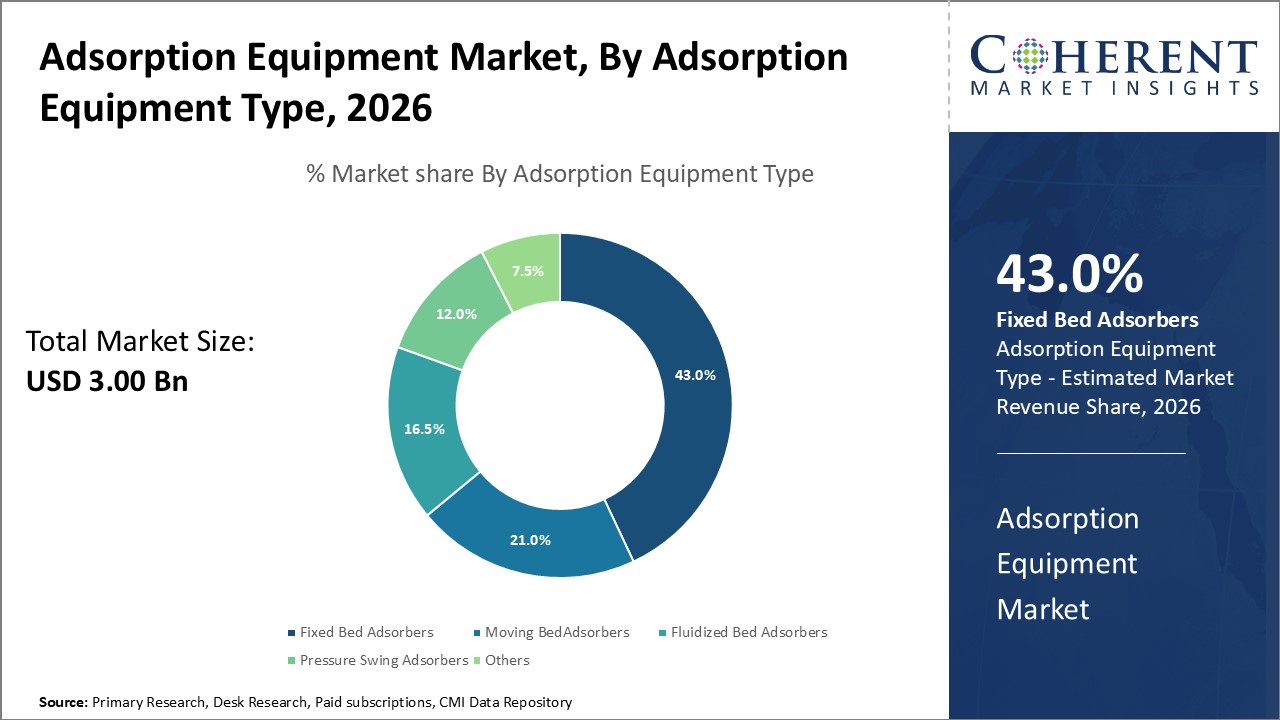
Fixed Bed Adsorbers continue to dominate the market share with over 43%, propelled by their reliability in chemical processing and water treatment sectors.
The Water Treatment application segment is projected to witness accelerated growth due to stringent environmental standards mandating advanced purification technologies.
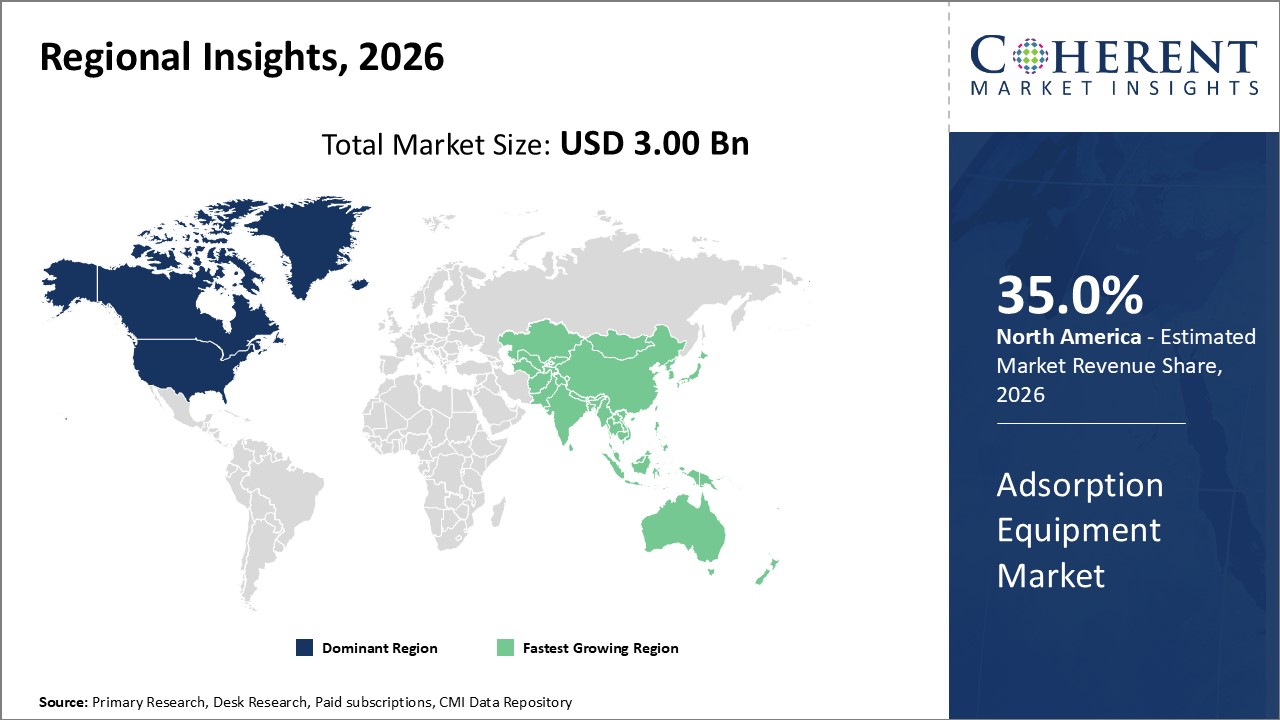
North America holds a dominant regional market share driven by the U.S.’s substantial demand for industrial gas separation and environmental-protection equipment.
Asia Pacific emerges as the fastest-growing region propelled by industrial expansion, government incentives, and technological adoption in countries like China and India.
Adsorption Equipment Market Segmentation Analysis
Adsorption Equipment Market Insights, By Adsorption Equipment
Fixed Bed Adsorbers dominate the market share with 43% due to their simplicity, reliability, and efficiency in handling large-scale operations, predominantly in water treatment and chemical processing industries. Their ability to offer continuous operation with minimal downtime makes them the preferred choice across various applications. Pressure Swing Adsorbers are the fastest-growing subsegment, benefiting from technological enhancements that promote energy efficiency and rapid cycle times. Their rising adoption in gas separation and purification, especially within petrochemical operations, fuels this growth. Moving Bed Adsorbers provide continuous adsorption with material movement, suited for specific industrial processes, while Fluidized Bed Adsorbers offer high mass transfer rates, albeit with operational complexity.
Adsorption Equipment Market Insights, By Application
Water Treatment holds the dominant position in the market, driven by escalating environmental standards requiring advanced treatment of wastewater and potable supplies. The adoption of adsorption equipment for removing organic contaminants and heavy metals has risen substantially, particularly in developed countries with strict discharge limits. Gas Separation is the fastest-growing application segment, propelled by industrial demands in LNG processing and air separation units where precision and energy efficiency are critical.
Adsorption Equipment Market Insights, By End-Use Industry
Petrochemicals dominate the market share attributable to the extensive use of adsorption equipment for processing hydrocarbons, gas purification, and catalyst regeneration, underpinning industry growth. The Environmental segment is rapidly growing, driven by global initiatives to reduce pollutants and ensure sustainable water and air quality management. Food & Beverage utilises adsorption to enhance preservation and quality control, gaining momentum as consumer safety concerns rise. Pharmaceuticals leverage adsorption technology to maintain stringent purity standards during drug manufacturing.
Adsorption Equipment Market Trends
The market is evolving with a clear orientation toward energy optimization and integration of smart technologies.
Notably, developments in pressure swing adsorption reflect a strategic push towards reducing operational costs while enhancing throughput, exemplified by Linde plc's 2025 facility upgrades in Europe, boosting performance metrics.
Modular adsorption units are increasingly prominent in emerging economies, addressing infrastructure challenges and enabling localized purification solutions.
Additionally, adoption of IoT-enabled process monitoring has gained traction in North America, enhancing equipment lifecycle management.
Adsorption Equipment Market Insights, By Geography
North America Adsorption Equipment Market Analysis and Trends
In North America, the dominance in the Adsorption Equipment market is attributable to strong industrial infrastructure coupled with rigorous regulatory frameworks promoting environmental compliance. The U.S. leads with significant capital investments in advanced gas separation and purification technologies, capturing nearly 35% market share regionally. Contributions from companies such as Honeywell and UOP LLC underscore the region’s leadership role.
Asia Pacific Adsorption Equipment Market Analysis and Trends
Meanwhile, Asia Pacific exhibits the fastest growth with a CAGR exceeding 8%, supported by rapid industrialization, government subsidies, and increasing environmental awareness in countries like China and India. Major players are expanding production capacity here to cater to the surging demand in petrochemical and water treatment applications.
Adsorption Equipment Market Outlook for Key Countries
USA Adsorption Equipment Market Analysis and Trends
The U.S. market benefits from stringent EPA regulations that have spurred intensive adoption of adsorption technologies for air purification and wastewater management. With government incentives promoting sustainability, companies like Honeywell and Calgon Carbon Corporation have introduced novel adsorbents that reduce energy consumption by 12%. The industrial gas separation segment has expanded by over 15% due to these factors, reinforcing the U.S. as a critical hub for market growth.
China Adsorption Equipment Market Analysis and Trends
China’s adsorption equipment market reflects rapid capacity additions linked to aggressive infrastructure projects and environmental initiatives targeting industrial emissions. Mitsubishi Chemical Corporation and BASF SE have expanded manufacturing plants in China since 2025 to meet growing domestic consumption. These expansions align with the country’s commitment to reducing pollution and increasing resource recovery, positioning it as the fastest-growing key country in this market
Analyst Opinion
The production capacity expansion in Asia-Pacific has been a significant driver, with China and India increasing manufacturing bases by over 15% annually in 2025, reflecting strong regional supply-side growth. Concurrently, global pricing trends have stabilized, with adsorption equipment pricing indices showing less than 3% volatility year-on-year, which supports predictable market revenue streams.
Import volumes of specialized adsorption materials for industrial applications surged by 18% in 2025 in North America, driven largely by increased demand for pollution control equipment in the United States. This import growth aligns with rising industrial deployment, particularly in refining and gas separation sectors, pointing to strong demand-side momentum.
Industrial use cases in wastewater treatment have amplified with deployment rates exceeding 12,000 units globally in 2025 alone, fueled by stricter discharge norms, leading to adsorption equipment becoming a pivotal technology for sustainable water management. Multi-sector adoption including pharmaceuticals and food processing further augment demand profiles.
Micro-indicators such as equipment miniaturization and modular adsorption units showed a 21% uptick in adoption across emerging markets in 2026, demonstrating a trend toward flexible, on-site applications. This supports diversified market dynamics, enabling quicker turnaround times and lower capital expenditure for end-users, thereby accelerating business growth.
- Current Industry Events of 2026
- Market Size Estimation
- Regional Breakdown
- Competitive Landscape
- Customer Intelligence
- Segmental Analysis
- Pricing Analysis
- Key Market Drivers, Challenges & Future Trends
- Customized Insights Section
Market Scope
| Report Coverage | Details | ||
|---|---|---|---|
| Base Year: | 2025 | Market Size in 2026: | USD 3.00 billion |
| Historical Data for: | 2020 To 2024 | Forecast Period: | 2026 To 2033 |
| Forecast Period 2026 to 2033 CAGR: | 7.3% | 2033 Value Projection: | USD 4.6 billion |
| Geographies covered: |
| ||
| Segments covered: |
| ||
| Companies covered: | UOP LLC, Linde plc, Honeywell International Inc., Parker Hannifin Corporation, Mitsubishi Chemical Corporation, BASF SE, Evoqua Water Technologies, Calgon Carbon Corporation, 3M Company, Kuraray Co., Ltd. | ||
| Growth Drivers: |
| ||
Adsorption Equipment Market Growth Factors
The surge in environmental regulations globally, especially relating to air and water pollution control, has notably escalated the demand for advanced adsorption equipment, with regulatory-driven installations increasing over 20% in 2025. Rapid industrialization in developing regions has stimulated demand in sectors such as petrochemicals and pharmaceuticals, accounting for nearly 35% of new adsorption equipment investments worldwide. Technological advancements, including the incorporation of nanomaterials into adsorbents, have enhanced equipment efficiency by up to 15%, propelling market growth. Additionally, increased government subsidies and incentives for sustainable industrial processes in key markets like the U.S. and China have bolstered adoption rates, further magnifying market revenue potential.
Adsorption Equipment Market Development
In 2026, Dürr Aktiengesellschaft expanded its product portfolio by integrating advanced adsorption technologies designed for next-generation industrial air purification applications. The upgrade focused on improving volatile organic compound (VOC) capture efficiency, reducing emission levels, and supporting stricter global environmental compliance standards. By combining digital monitoring, modular system design, and energy-optimised regeneration processes, the company aimed to deliver more flexible and cost-efficient pollution-control solutions for diverse manufacturing environments. This strategic expansion strengthened Dürr’s role as a comprehensive clean-air technology provider and aligned with increasing industrial demand for sustainable emission-reduction systems.
In 2025, Environmental C&C Inc. introduced a new line of high-efficiency adsorption systems tailored specifically for chemical and petrochemical processing facilities. The product range emphasized enhanced contaminant removal capacity, longer media life, and improved operational reliability under high-temperature and corrosive conditions typical of refinery settings. Engineered for ease of integration into existing plant infrastructures, these systems aimed to support customers in meeting evolving environmental regulations and internal sustainability targets.
Key Players
Leading Companies of the Market
UOP LLC
Linde plc
Honeywell International Inc.
Parker Hannifin Corporation
Mitsubishi Chemical Corporation
BASF SE
Evoqua Water Technologies
Calgon Carbon Corporation
3M Company
Kuraray Co., Ltd.
Other strategic collaborations, such as Honeywell’s partnership with a major Asian manufacturer in 2025 resulted in a 13% increase in regional market penetration through jointly developed low-energy adsorption systems. Similarly, BASF’s 2026 launch of next-gen activated carbon technology enhanced its market share by catering to stringent environmental regulations in Europe. Continuous product innovation and capacity expansion remain central to market players’ growth strategies, evidenced by Linde plc’s investment exceeding USD 250 million in adsorption facility upgrades in 2025, augmenting operational efficiency and output.
Adsorption Equipment Market Future Outlook
In the coming years, the adsorption equipment market is expected to shift toward more energy-efficient, recyclable, and selective adsorbent solutions driven by decarbonization efforts, ESG reporting mandates, and sustainability-focused manufacturing practices. Growing investments in semiconductor, chemical, and pharmaceutical production will increase demand for high-performance adsorption systems capable of removing trace contaminants. Digital monitoring, IoT integration, and predictive maintenance platforms are likely to become standard features, enabling better lifecycle optimisation. Additionally, government initiatives promoting industrial pollution control in Asia-Pacific and Latin America are projected to unlock significant new revenue streams.
Adsorption Equipment Market Historical Analysis
The adsorption equipment market has historically grown alongside tightening industrial emission regulations and rising awareness of VOC mitigation across manufacturing, petrochemical, and wastewater treatment sectors. From the early 2000s onward, activated carbon filtration systems dominated adoption due to affordability and proven sorbent efficiency, while regulatory agencies in North America, Europe, and Japan established stringent air-quality limits that encouraged compliance-driven purchasing. The market later expanded into emerging economies as rapid industrialisation increased the need for air purification and odor control systems. Over time, technological improvements—such as modular adsorption units and automated regeneration systems—helped increase operational reliability and broaden application diversity.
Sources
Primary Research Interviews:
Environmental Engineers
Industrial Emissions Supervisors,
Wastewater Treatment Managers
Air Quality Compliance Officers
Databases:
EPA Emissions Inventory
GlobalData Environmental Technology Reports
Statista Industrial Pollution Data
EEA Air Quality Database
Magazines:
Pollution Engineering,
Industrial Air Solutions Magazine
Environmental Protection
Chemical Engineering
Journals:
Journal of Environmental Chemical Engineering
Environmental Science & Technology
Separation and Purification Technology
Clean Technologies and Environmental Policy
Newspapers:
The Guardian (Environment)
The Washington Post (Climate & Industry)
The Economic Times (Energy)
Financial Times (Sustainability)
Associations:
Air & Waste Management Association (A&WMA)
U.S. Environmental Protection Agency (EPA)
European Environment Agency (EEA)
ISO Environmental Standards Committee
Get access to 250+ pages report
Every segment, forecast, competitor profile and data table behind the analysis above — available for instant download.
- ESOMAR Member
- ISO 9001:2015 Certified
- D-U-N-S Registered
- GDPR & CCPA Compliant
Missing comfort of reading report in your local language? Find your preferred language:
Transform your Strategy with Exclusive Trending Reports
Frequently Asked Questions
The dominant companies include UOP LLC, Honeywell International Inc., BASF SE, Linde plc, and Mitsubishi Chemical Corporation, owing to their technological innovations and capacity expansions.
The market size is projected to reach USD 4.6 billion by 2033, with a CAGR of 7.3% from 2026 to 2033, reflecting robust growth prospects.
Petrochemical stands out with rapid growth opportunities.
Energy-efficient technologies, modular adsorption units, and AI-integrated systems are expected to redefine efficiency and operational capabilities in the market.
The market landscape is intensely competitive, with a focus on innovation and regional expansion; key challenges include raw material volatility and stringent environmental compliance demands.
Strategies such as partnerships, product innovation, regional capacity expansion, and targeting niche applications are widespread among leading market players.