

Africa Power Tools Market Size and Share Analysis: 2026-2033
The Africa Power Tools Market is anticipated to grow at a CAGR of 7.5% with USD 1.94 Bn share in 2026 and is expected to reach USD 3.21 Bn in 2033. This growth in the market is driven by rapid urbanization, infrastructure development and rising demand from construction and DIY sectors across emerging African economies.
Key Takeaways
- The power tools held the largest market share of 65% in 2026, demand for powered hand tools has already been observed through trade data from across Africa. In terms of the importation of pneumatic tools, a total of USD 77,860 was imported by Botswana in 2023, while Zambia procured USD 94,600 worth of pneumatic tools from South African suppliers.
- The electric mode of operation is the dominant segment in 2026 with an estimated 55% of the total Africa power tool market revenue. The segment has seen an annual average growth of approximately 4% from 2024 through 2026. Electricity access in 2023 was measured at 53.3% in the sub-Saharan Africa area and 87.7% in South Africa, which increased the use of corded and battery-powered electric power tools across industries such as construction, workshops, and maintenance.
- In 2026, the industrial sector represented an estimated 60% of total market share as a result of ongoing investments in the energy sector and heavy industries. Based on the International Energy Agency, Africa had capital investment in energy sectors in 2024 estimated to be approximately USD 110 billion for energy project development. This amount consists of funds for fossil fuels and electric power that had approximately $70 billion by 2024.
- In 2026, Africa maintained 65% of the total report scope. In 2024, investment in clean energy in Africa was over $40 billion, this was almost twice the investment of clean energy in 2020. With the anticipated growth in demand for electricity increasing at approximately 4% per year through 2026, this data provides evidence that there is an expected increase in demand for power tools related to a variety of industries that encompass infrastructure, utilities, and manufacturing in Africa. (IEA)
Segmental Insights
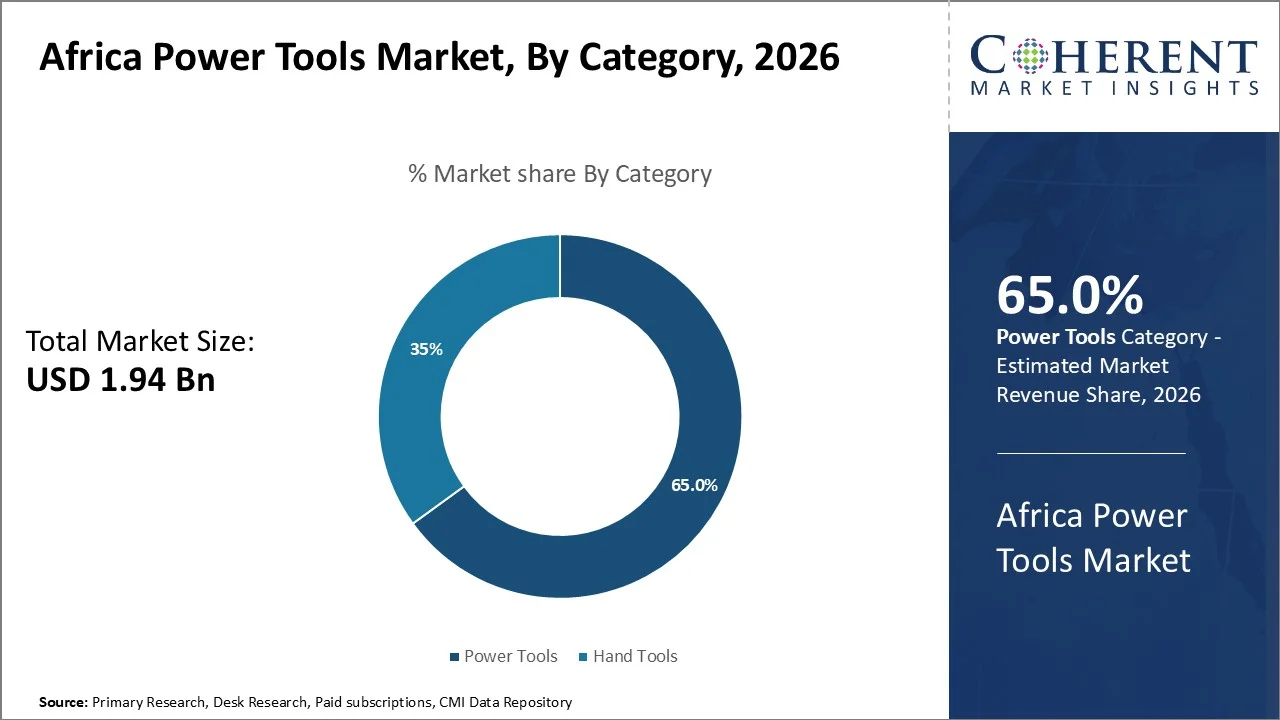
By Category, the power tools segment dominates with 65% of market share in 2026
In 2026, power tools held the largest share of 65% of the Africa Power Tools Market because most people prefer to use powered drilling, cutting, grinding, and fastening tools for construction, industrial maintenance, and manufacturing. This also due to improved electrification and depth of electrical distribution.
Powered tools have taken over from manual hand tools among contractors and industries due to their increased productivity and efficiency, as well as the ability for consistent output when performing repetitive tasks such as drilling, cutting, or fastening. With the increased availability of cordless platforms, batteries and chargers, accessories, and after-sales service in African markets, workshops, electricians, fabricators, and maintenance teams are better able to adopt powered tools as part of their daily operations.
- Current Industry Events of 2026
- Market Size Estimation
- Regional Breakdown
- Competitive Landscape
- Customer Intelligence
- Segmental Analysis
- Pricing Analysis
- Key Market Drivers, Challenges & Future Trends
- Customized Insights Section
By Mode of Operation, the electric segment dominates with 55% of market share in 2026
By 2026, approximately 55% of Africa’s power tool market is expected to be attributed to electric tools (both corded and battery-operated). Compared to pneumatic and hydraulic tools for example, both types of electric tools are typically viewed as better options for drilling, fastening, cutting and repairing tasks. As reported by the International Energy Agency (IEA), Africa's electricity consumption will grow by an average of four percent annually from 2024 through 2026. According to the World Bank, in 2023, 53.3% of Sub-Saharan African residents and 87.7% of South African residents had access to electricity.
The growth of this industry is being fueled by two key factors. First, with faster drilling, cutting and fastening of materials, electric tools are helping to increase productivity on job sites and require less physical effort and provide improved consistency. Secondly, the increased availability of compatible chargers and support from lithium-ion cordless tool manufacturers is making it more practical for contractors, maintenance teams, electricians and fabrication shops throughout Africa to utilize this type of tool.
An example of an electric tool launched in Africa was the cordless Bosch Go, which was designed by Bosch Power Tools Ghana specifically for African professional users. The Bosch Go has six different torque settings, can operate at speeds of up to 360 rpm and weighs only 280 grams which assists artisans in making the transition from reliance on manual effort to using power assisted methods of working.
By End-use sector, the Industrial segment dominates with 60% of market share in 2026
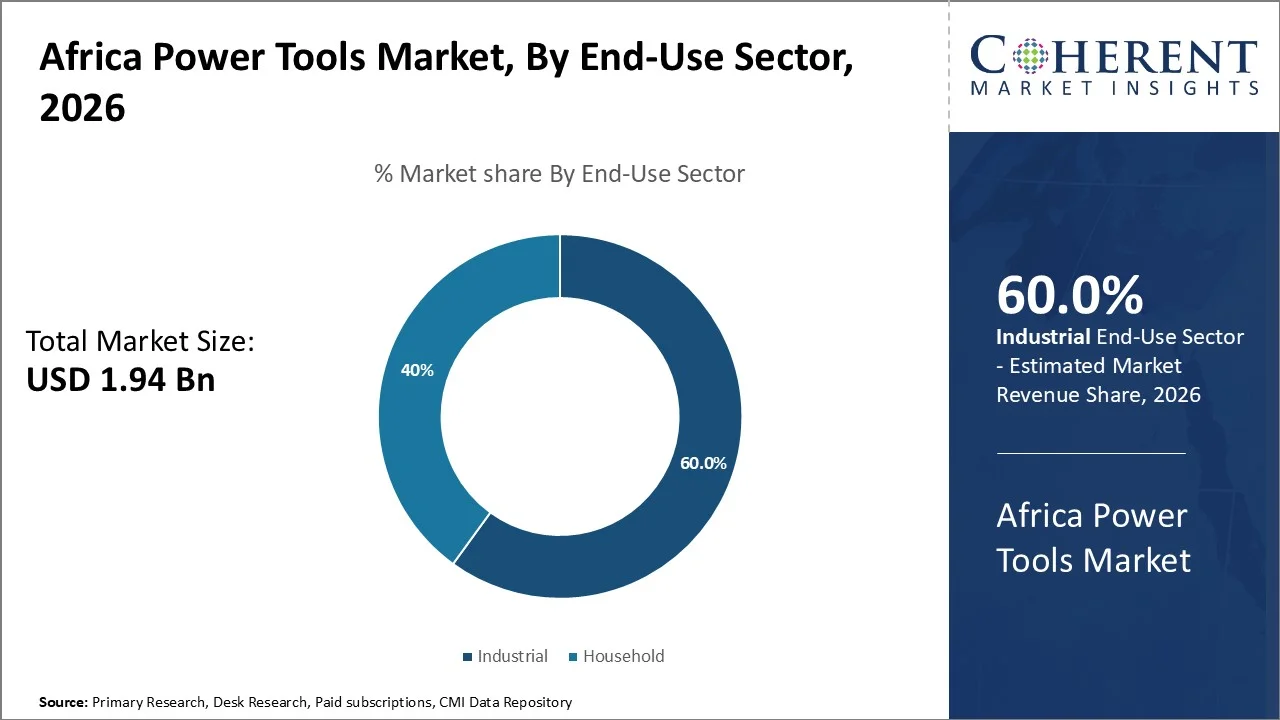
In 2026, the industrial sector dominates the Africa Power Tools Market with approximately 60% of the market due to the high reliance of mining, manufacturing, fabrication, utility, and plant maintenance activity on using high quality power tools for drilling, grinding, cutting and fastening. The industrial sector's leadership position will likewise benefit from a strong overall industrial economy as the World Bank has projected that Sub-Saharan Africa will experience a 4.3% growth rate in 2026 and the UNIDO reported that African manufacturing employment increased by 5.2% in 2022 and that manufacturing output grew by 0.6% during the third quarter of 2024. (UNIDO)
The growth of this segment is being driven by two main factors. First, industrial users need high duty-cycle power tools for continuous maintenance, repair, shutdown and fabrication work, therefore creating a steady demand for replacement and upgrades. Second, there is an increase in the number of energy, mining, metals and engineering projects throughout Africa, providing further support for the increased need for durable, accurate, and service provided power tools that perform well within harsh industrial applications.
Electra Mining Africa 2026 is one of the main industrial shows supporting this segment. It will take place from 7 to 11 September 2026 in Johannesburg. The official organizer reports that the 2024 event attracted more than 39,885 visitors, over 950 exhibitors, 58 countries and that 72% of attendees influence purchasing decisions, highlighting how commercially important this segment is to its supplier of industrial tools.
Regional Insights
Africa Power Tools Market Dominance Driven by Electrification, Mining Activity, and Industrial Expansion
According to estimates, by the end of 2026, Africa will still account for approximately 65% of the total share of power tool purchases within Africa through stronger industrial purchases of power tools, through equipment required for mining operations; and through an increase in electrical access. The IEA has predicted that the annual growth in electricity consumption in Africa will be approximately 4% for 2024 through 2026. Additionally, Electra Mining Africa's most recent event had a record number of attendees (39,855) and exhibitors (950+) which is a clear sign of the growing number of industrial and professional power tool users within the region.
Country Analysis
GCC Growth Supported by Construction Expansion, Industrial Maintenance, and Economic Diversification
The GCC power tools market is driven by rapid infrastructure development and large-scale construction projects across countries like the UAE and Saudi Arabia, which increase demand for heavy-duty and portable tools. For instance, Saudi Arabia alone has over $1 trillion worth of planned and ongoing construction projects, significantly boosting equipment demand (source: MEED Projects). Industrial expansion, particularly in oil & gas, manufacturing, and automotive sectors, further boosts tool consumption.
Africa Power Tools Market Trends
- The trend of moving to electric and cordless tools is growing rapidly in Africa. African markets have a large and expanding power generation system, which supports this trend. According to the International Energy Agency (IEA), electricity demand in Africa is projected to grow by 4% annually from 2024-2026. Bosch describes professional-use cordless tools as being built to last, and their 18V AMP platform will enable suppliers to offer a shared battery platform for multiple brands, further supporting the electric ecosystem.
- Professional buyer behavior is increasingly based upon demonstration and event-driven experiences. An example of this is the official 2024 Electra Mining Africa report, which indicates that there were 950 exhibitors and approximately 39,900 attendees from 58 countries, all of whom were interested in purchasing industrial and mining equipment and tools. In fact, according to the same event organizers, 72% of attendees either made or influenced purchasing decisions; 45% of attendees attended the show for the purpose of shopping for new products and services, both of which demonstrate that live product evaluation is critical to successfully bringing new tools and equipment into the marketplace.
Current Events and Their Impact on Africa Power Tools Market
Current Event | Description and its Impact |
AfDB approves Mission 300 technical assistance program |
|
ARE Energy Access Investment Forum 2026 focuses on renewable electrification
|
|
Market Report Scope
Africa Power Tools Market Report Coverage
| Report Coverage | Details | ||
|---|---|---|---|
| Base Year: | 2025 | Market Size in 2026: | USD 1.94 Bn |
| Historical Data for: | 2020 To 2024 | Forecast Period: | 2026 To 2033 |
| Forecast Period 2026 to 2033 CAGR: | 7.5% | 2033 Value Projection: | USD 3.21 Bn |
| Geographies covered: | Africa, GCC | ||
| Segments covered: |
| ||
| Companies covered: | Stanley Black & Decker, Inc., SKF, Atlas Copco AB, Hitachi Koki Co. Ltd, Robert Bosch GmbH, Snap-on Incorporated, Techtronic Industries Company Limited, Makita Corporation, Danaher Corporation | ||
Who are the Major Companies in Africa Power Tools Market?
Major companies are Stanley Black & Decker, Inc., SKF, Atlas Copco AB, Hitachi Koki Co. Ltd, Robert Bosch GmbH, Snap-on Incorporated, Techtronic Industries Company Limited, Makita Corporation, Danaher Corporation
Key News
- Milwaukee has introduced its patented REDLINK PLUS Intelligence electronic system for its range of handheld power tools.
Analysts Opinion
- The Africa Power Tools industry is now moving towards more electric tool usage due to the practical effects of electrification in many different uses of these products. The IEA is predicting a 4% increase in electricity consumption in Africa from 2024-2026, where 53.3% of Sub-Saharan Africa and 87.7% of South Africa have access to electricity as of 2023; plus, the AfDB (by way of its $3.9 Million USD dollar Mission 300 program) is providing coverage for 13 countries over 24 months. As a result, we should see faster penetration of electric tools and also battery powered cordless power tools; increased access for distributors, and a growing number of installers, power utility employees and maintenance contractors purchasing new electric and battery-powered corded tools.
Market Segmentation
- Africa Power Tools Market, By Category
- Power Tools
- Hand Tools
- Africa Power Tools Market, By Mode of Operation
- Electric
- Pneumatic
- Others
- Africa Power Tools Market, By End-Use Sector
- Industrial
- Household
- Africa Power Tools Market, By Region
- Africa
- GCC
Sources
Primary Research interviews
- Power tool manufacturers and regional brand managers
- Authorized distributors, importers, and wholesalers of power tools and accessories
- Construction contractors and EPC companies
- Industrial maintenance heads from mining, utilities, metals, and manufacturing plants
- Hardware retailers, tool rental companies, and workshop owners
- Procurement managers from infrastructure, industrial, and engineering projects
Databases
- UN Comtrade Database
- World Integrated Trade Solution (WITS)
- World Bank DataBank / World Development Indicators
- International Energy Agency (IEA) Data and Statistics
- UNIDO Statistics Data Portal
- African Development Bank (AfDB) Data Portal / Africa Information Highway
- National statistics offices, customs data portals, and trade departments across African countries
Magazines
- African Review of Business and Technology
- Technical Review Middle East
- African Business
- African Mining
- Sparks Electrical News
Journals
- International Journal of Machine Tools and Manufacture
- Journal of Manufacturing Systems
- Journal of Manufacturing Science and Engineering
- Journal of Intelligent Manufacturing
- The International Journal of Advanced Manufacturing Technology
Newspapers
- Reuters Africa
- Business Day
- Daily Maverick
- Engineering News
- Mining Weekly
Associations
- African Federation of Construction Contractors’ Associations (AFCCA)
- Master Builders South Africa (MBSA)
- Steel and Engineering Industries Federation of Southern Africa (SEIFSA)
- South African Institute of Mechanical Engineering (SAIMechE)
- South African Institute of Electrical Engineers (SAIEE)
- Southern African Institute of Mining and Metallurgy (SAIMM)
- Electrical and Electronics Association of Egypt (EEAIA)
Public Domain sources
- Official company annual reports, sustainability reports, and investor presentations of power tool manufacturers
- Official product catalogs, distributor listings, and regional brand websites
- Ministry of Industry, Ministry of Energy, customs authorities, and national statistical agency publications across African countries
- International Energy Agency (IEA), World Bank, UNIDO, AfDB, and UN Comtrade publications
- Electra Mining Africa official event reports and exhibitor/visitor statistics
- Bosch Africa official corporate and regional presence information
Proprietary Elements
- CMI Data Analytics Tool
- Proprietary CMI Existing Repository of information for last 8 years
Get access to 250+ pages report
Every segment, forecast, competitor profile and data table behind the analysis above — available for instant download.
- ESOMAR Member
- ISO 9001:2015 Certified
- D-U-N-S Registered
- GDPR & CCPA Compliant
Missing comfort of reading report in your local language? Find your preferred language:
Transform your Strategy with Exclusive Trending Reports
Frequently Asked Questions
The Africa Power Tools Market is worth USD 1.94 Bn in 2026 and is expected to grow at a rate of 7.5% per year to USD 3.21 Bn by 2033.
Rapid urbanization, infrastructure development, rising industrial activity, and increasing demand from construction and DIY applications in emerging African economies are the main factors driving market growth. More investments in electrification and energy are also making it easier for people to use electric and cordless tools.
The power tools segment holds the largest share, accounting for 65% of the market in 2026. Growing demand for powered tools for drilling, cutting, grinding, and fastening in construction, industrial maintenance, and manufacturing is helping it stay on top.
The electric segment is the most popular way to do business, bringing in 55% of all market revenue in 2026. This dominance is helped by better access to electricity, more use of battery-powered tools, and a growing need for efficient tools in workshops, construction sites, and maintenance work.
The industrial sector is the biggest end-use segment, making up 60% of the market in 2026. High-duty power tools are still in high demand because of mining, fabrication, manufacturing, plant maintenance, and utility operations.
Some important trends are the move toward electric and cordless tools, the growing importance of shared battery platforms, and the increasing use of live product demos and trade shows to convert buyers. More and more, industrial buyers want tools that are backed by service and that are productive and long-lasting.