

All-Terrain Vehicle (ATV) Lighting Systems Market Size and Share Analysis: (2026 - 2033)
The All-Terrain Vehicle (ATV) lighting systems market is anticipated to grow at a CAGR of 3.7% with USD 128.6 Mn share in 2026 and is expected to reach USD 163.7 Mn in 2033. The All-Terrain Vehicle (ATV) Lighting Systems Market is gaining traction as riders demand safer night riding, farm utility, trail visibility, and durable off-road accessories. Government safety data strengthens the need for better illumination: the U.S. CPSC’s 2024 OHV annual report, published in 2025, recorded 2,577 OHV-related deaths during 2019–2021, including 1,728 linked to All-Terrain Vehicle (ATV) lighting systems s, while its All-Terrain Vehicle (ATV) lighting systems Safety Center notes over 100,000 emergency-department-treated OHV injuries annually. In 2026, OEM adoption also supports demand; Polaris’ official 2026 Sportsman 570 page highlights available LED lighting for improved cornering visibility, and Yamaha’s 2026 Grizzly features LED headlights and taillight with lower power use and brighter illumination.
Source: Cpsc.gov; cpsc.gov; Polaris Inc.; yamahamotorsport.com
Key Takeaways
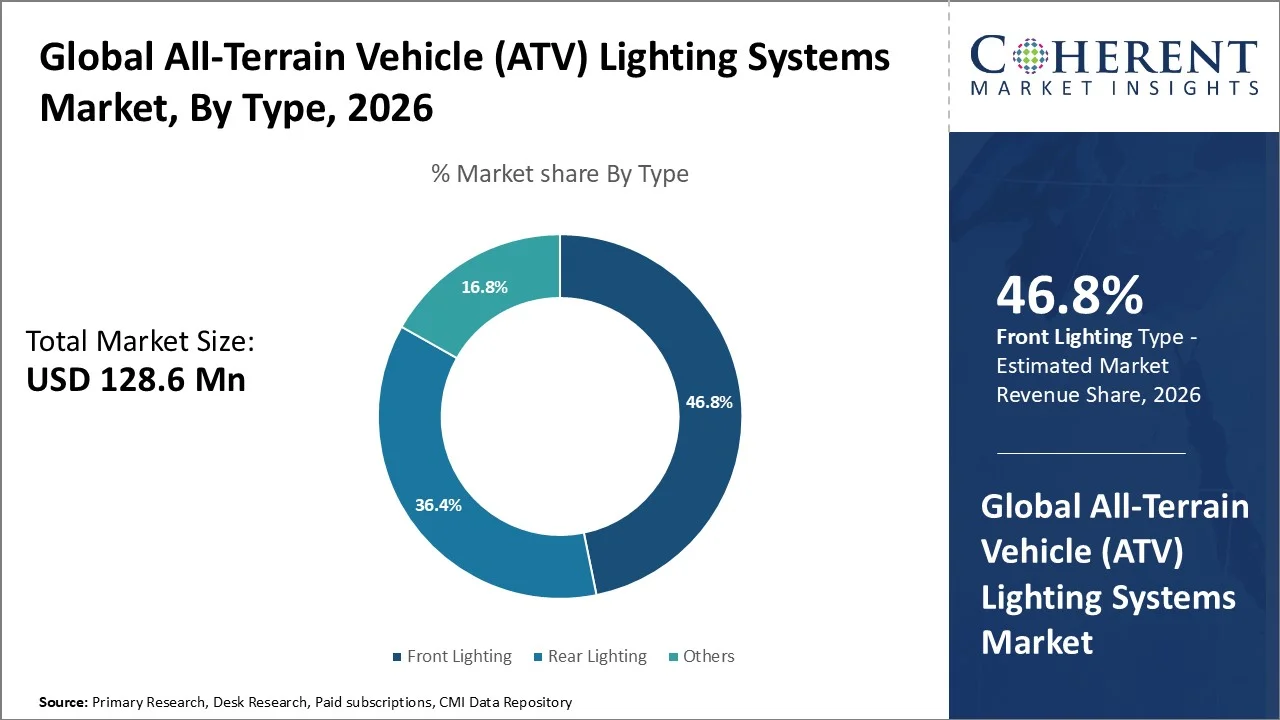
- Front Lighting is expected to account the largest share of 46.8% in 2026, because it directly improves rider visibility and collision avoidance in low‑light or rugged terrain, addressing key safety concerns highlighted by federal data. The U.S. Consumer Product Safety Commission (CPSC) reports off‑highway vehicles, including All-Terrain Vehicle (ATV) lighting systems, accounted for 2,448 deaths from 2018–2020, with All-Terrain Vehicle (ATV) lighting systems responsible for more than two‑thirds of these fatalities, underscoring the need for effective forward illumination (CPSC safety data published in 2025). Front headlights and spotlights significantly enhance contrast and obstacle recognition versus rear or auxiliary lights, making them essential equipment. OEMs increasingly equip 2026 All-Terrain Vehicle (ATV) lighting systems s with high‑output LEDs to meet these safety priorities.
Source: United States - Consumer Product Safety Commission
- OEM will dominate with 72.5% in 2026, because lighting is increasingly specified at the vehicle-design stage for safety compliance, wiring compatibility, warranty support, and dealer serviceability. CPSC’s 2026 warning stated that OHVs, including All-Terrain Vehicle (ATV) lighting systems s, are linked with an annual average of more than 800 deaths and about 100,000 emergency-department-treated injuries, keeping visibility and compliant stop/tail lighting a core OEM requirement. The CPSC final rule, published in 2018, requires stop lamps/reflectors on applicable All-Terrain Vehicle (ATV) lighting systems s. As a 2026 instance, Polaris’ 2025 manufacturer release noted new LED highlights on 2026 Sportsman 570 EPS for low-light path visibility.
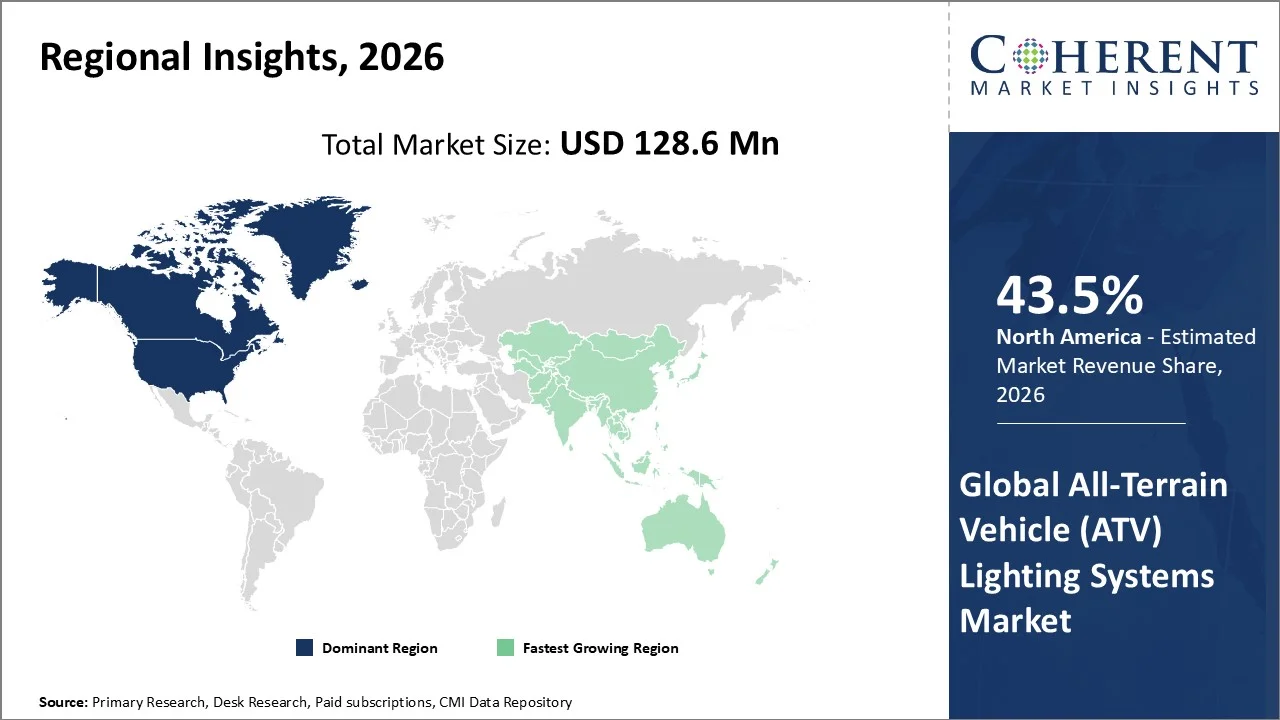
- North America is expected to acquire the dominant share of 43.5% in 2026, due to strong off-road recreation culture, high All-Terrain Vehicle (ATV) lighting systems utility use, and early adoption of LED safety features. The U.S. BEA’s 2026-published outdoor recreation data show outdoor recreation contributed 2.4% of U.S. GDP and supported over 5.2 million jobs, indicating a large All-Terrain Vehicle (ATV) lighting systems user base. Safety needs also support lighting upgrades, as the U.S. CPSC’s 2025 report noted about 100,000 emergency-treated OHV injuries annually. In 2026, Polaris highlighted LED lighting on its Sportsman 570 All-Terrain Vehicle (ATV) lighting systems for better night visibility, supporting OEM-led adoption.
Source: Bureau of Economic Analysis; United States - Consumer Product Safety Commission
Market Driver
Increasing demand for All-Terrain Vehicles (ATV) from the Recreational Segment
Increasing demand for All‑Terrain Vehicles (ATV) from the recreational segment is a major driver of the global All-terrain vehicle (ATV) lighting systems market growth because leisure riding and adventure tourism encourage consumer purchases beyond utility or work‑focused use. The growing demand for All-Terrain Vehicles (ATV) in the recreational segment is a significant driver of market growth, particularly as consumers increasingly seek off-road experiences. According to the U.S. Bureau of Labor Statistics (BLS), the Producer Price Index for electric lighting equipment has seen steady growth, supporting advancements in All-Terrain Vehicle (ATV) lighting systems lighting systems for safety and visibility. Additionally, the U.S. Consumer Product Safety Commission (CPSC) reported an increase in recreational off-highway vehicle injuries and fatalities, underscoring the importance of improved safety standards, including lighting (published in 2026). To enhance safety and visibility, Polaris and other All-Terrain Vehicle (ATV) lighting systems manufacturers have integrated advanced lighting technologies that meet NHTSA's FMVSS No. 108 standards, which are key regulations for vehicle lighting in the U.S.
The U.S. Forest Service and Bureau of Land Management (BLM) data show that off-highway vehicle usage is increasing as recreational enthusiasts gain better access to public lands, driving higher All-Terrain Vehicle (ATV) lighting systems adoption for off-road leisure. Additionally, eCFR 49 CFR §571.108 sets the standards for lights and reflectors, which are critical for meeting the safety needs of recreational All-Terrain Vehicle (ATV) lighting systems riders. This growing participation in All-Terrain Vehicle (ATV) lighting systems recreational activities directly influences the expansion of both the consumer market and associated lighting systems.
Growing awareness about safety while riding All-Terrain Vehicles (All-Terrain Vehicle (ATV) lighting systems s)
Growing awareness about safety while riding All-Terrain Vehicles (ATV) is significantly driving the growth of the All-Terrain Vehicle (ATV) lighting systems market. For instance, in 2026, the U.S. Consumer Product Safety Commission (CPSC) reported that All-Terrain Vehicle (ATV) lighting systems -related injuries and fatalities often result from inadequate visibility, leading to a push for improved lighting systems. Regulatory standards, such as FMVSS No. 108 and 49 CFR §571.108, enforced by the National Highway Traffic Safety Administration (NHTSA), mandate high-quality lighting solutions for vehicles, promoting safety while riding. The U.S. Federal Register continues to update regulations, encouraging the use of adaptive lighting systems. With increasing focus on rider safety and regulatory support, the demand for advanced lighting systems that enhance visibility and reduce risks continues to rise.
Smart Lighting, Enhanced Visibility, and Off-Road Safety Innovations Are Driving the Global All-Terrain Vehicle (ATV) lighting systems Industry
Smart lighting innovations, enhanced visibility features, and off‑road safety technologies are key drivers for the global All-Terrain Vehicle (ATV) lighting systems market growth by improving performance and rider confidence in challenging terrains. Smart and adaptive lighting technologies significantly enhance visibility and rider safety in challenging off‑road environments, directly addressing documented safety concerns associated with All-Terrain Vehicle (ATV) lighting systems. U.S. Consumer Product Safety Commission (CPSC) data show that off‑highway vehicles including All-Terrain Vehicle (ATV) lighting systems s are linked to more than 800 deaths and an estimated 100,000 emergency department‑treated injuries annually (CPSC safety warning, January 22, 2026), underscoring the need for better visibility.
For instance, January 2026, according to the data published by the CPSC enforcement actions have also highlighted how missing safety reflectors and lights reduce detectability, increasing collision risk. U.S. regulations and standards like ANSI/SVIA’s lighting and reflector requirements backed by CPSC analysis finding over 30 % of fatal All-Terrain Vehicle (ATV) lighting systems collisions occur at night or low light reinforce the safety value of enhanced lighting. Meanwhile, industry adoption of durable LED systems with high IP ratings and extended lifespan (over 30,000 h) has exceeded 90 % market share in off‑road lighting products (LED technology trend, 2026 off‑road lighting industry sources), driving consumer preference and market growth focused on performance and safety.
Smart and adaptive lighting technologies are accelerating growth in the global All-Terrain Vehicle (ATV) lighting systems industry by directly improving rider visibility and safety in rugged, low‑light conditions. U.S. automotive lighting performance standards such as FMVSS No. 108 codified in 49 CFR §571.108 define rigorous requirements for lamps, reflective devices, and photometric performance to ensure proper illumination and visibility across conditions (current regulatory text, 2026). These technical standards, administered by NHTSA, push manufacturers to develop advanced LED, adaptive beam, and signal lighting systems that meet or exceed government safety criteria, reinforcing market demand for higher‑performing products.
Source: United States - Consumer Product Safety Commission; Federal Register; CHIMING-AUTO; NHSTA; ECFR.gov
- Current Industry Events of 2026
- Market Size Estimation
- Regional Breakdown
- Competitive Landscape
- Customer Intelligence
- Segmental Analysis
- Pricing Analysis
- Key Market Drivers, Challenges & Future Trends
- Customized Insights Section
Current Events and Their Impact on the All-Terrain Vehicle (ATV) lighting systems market
Current Event | Description and its Impact |
Consumer Product Safety Commission (CPSC) All-Terrain Vehicle (ATV) lighting systems Safety Enforcement and Recalls – 2026 |
|
NHTSA Regulatory Modernization and Lighting Standards Dialogue – 2026 |
|
Safe Streets and Roads for All (SS4A) Grant Program – FY 2026 |
|
UN Road Safety Financing Project in India – 2026 Initiative |
|
Off‑Highway Vehicle Safety Enforcement and Local Funding – Minnesota 2026–27 |
|
Global Road Safety Grants Programme – 2026 Funding Support |
|
Segmental Insights
Why is Front Lighting Acquiring the Largest Market Share?
Front Lighting is projected to account for the largest share of cognitive systems spending in 2026, representing approximately 46.8% of the total volume. Front lighting is acquiring the largest share in the All-Terrain Vehicle (ATV) Lighting Systems Market because it is the most safety-critical lighting position on an All-Terrain Vehicle (ATV) lighting system. It directly supports forward visibility during trail riding, farm work, snow plowing, forestry, and low-light off-road use. CPSC’s 2026 All-Terrain Vehicle (ATV) lighting systems /OHV safety page states that OHVs, including All-Terrain Vehicle (ATV) lighting systems, are linked to an annual average of 800+ deaths and around 100,000 emergency-department-treated injuries, which increases the need for better visibility equipment. Manufacturers are also prioritizing front LED systems: Polaris’ 2026 Sportsman 570 highlights LED lighting for improved cornering visibility and sunset riding, while Honda’s 2026 FourTrax Foreman 4x4 includes a 50-watt assist headlight to light the rider’s path.
OEM holds the Largest Market Share
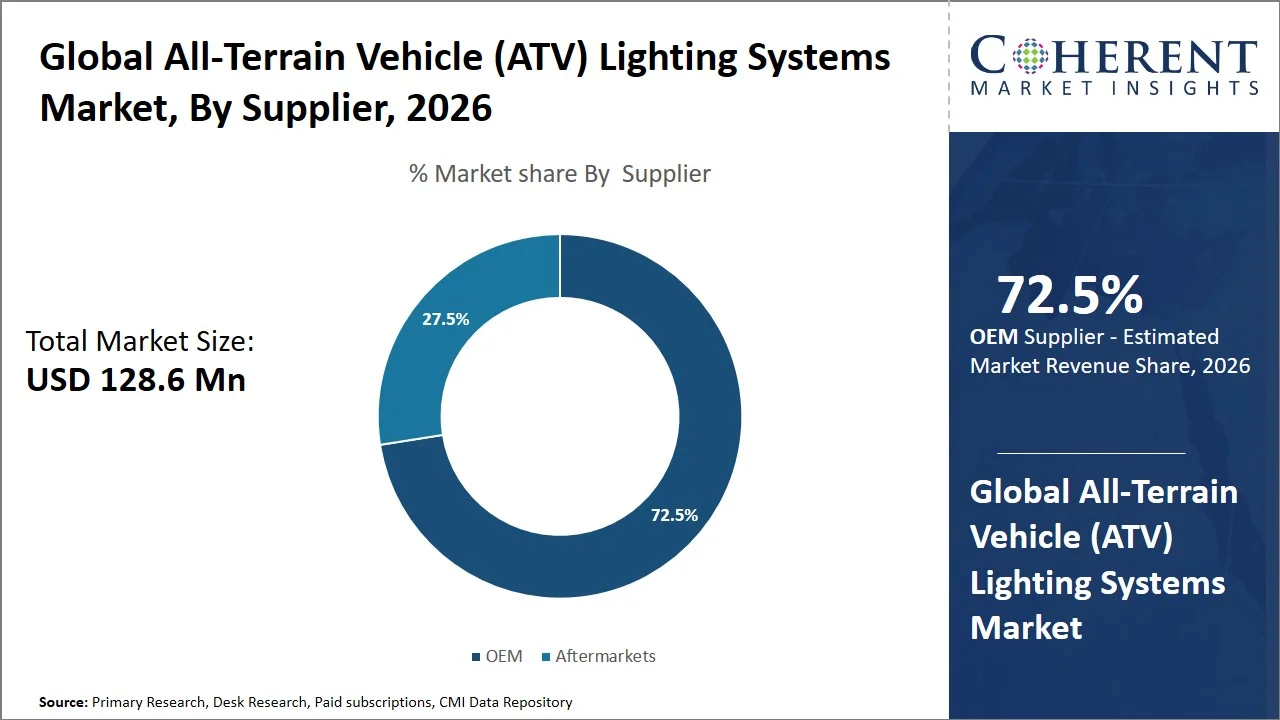
Based on supplier, OEM dominate the market, accounting for a significant 72.5% share in 2026, because factory-fitted lighting is preferred for safety, durability, warranty support, and regulatory alignment. For instance, the CPSC’s 2024-published OHV injury report estimated 509,900 emergency-treated OHV injuries during 2019–2023, creating pressure for safer built-in lighting systems. In 2026, CPSC warned that some youth All-Terrain Vehicle (ATV) lighting systems s were missing required safety reflectors, reducing vehicle visibility, which strengthens demand for OEM-installed compliant lighting. Further, eCFR 49 CFR §571.108, under FMVSS No. 108, specifies requirements for original and replacement lamps, reflectors, and related equipment. Polaris’s 2026 Sportsman 570 also offers LED lighting for improved visibility, showing how OEMs are integrating lighting as a core safety feature.
Source: CPSC; (FMVSS 108 / eCFR); Federal Register; Polaris Inc.
All-Terrain Vehicle (ATV) Lighting Systems Market Trends
Smart, Adaptive Lighting Technologies
Manufacturers are integrating advanced LED and adaptive beam technologies with sensor‑driven illumination to enhance visibility in off‑road conditions. This trend responds to safety data by the U.S. Consumer Product Safety Commission (CPSC), which continues to report high numbers of All-Terrain Vehicle (ATV) lighting systems injuries and fatalities linked to low visibility and deficient lighting (CPSC All-Terrain Vehicle (ATV) lighting systems Injury & Recall Data, 2026). Improved lighting systems significantly reduce crash risks in low‑light and rugged terrain conditions.
Source: U.S. CPSC All-Terrain Vehicle (ATV) lighting systems Safety Data
Regulatory Harmonization & Higher Lighting Standards
To address safety risks, relevant U.S. agencies enforce and update vehicle lighting safety requirements. Federal Motor Vehicle Safety Standard (FMVSS) No. 108 and 49 CFR § 571.108 set stringent performance criteria for lamps and reflective devices (eCFR, 2026). These evolving standards push OEMs toward more robust, compliant lighting solutions that improve conspicuity and durability under off‑road use.
Source: eCFR
Safety‑Driven Product Innovation
In 2026 Federal Register notices, the NHTSA emphasized modernization of lighting requirements, particularly focusing on lighting performance and effectiveness (Federal Register, Apr 2026). This trend is prompting suppliers to innovate adaptive and programmable lighting modules that improve illumination angles and responsiveness.
Consumer Preference for Energy ‑ Efficient LEDs
Energy efficiency remains a key trend, with rapid replacement of traditional halogen lamps by high‑efficiency LED systems that offer longer lifespan, lower power draw, and better resistance to vibration critical for rugged All-Terrain Vehicle (ATV) lighting systems terrain use. Government energy efficiency policy priorities for vehicles indirectly influence consumer and OEM shifts toward LED‑centric lighting.
Installation Standards and Visibility requirements Updating
UNECE’s UN Regulation No. 48 governing installation and visibility of vehicle lighting is periodically amended (latest consolidated version in force as of late 2024/early 2026) and emphasizes correct light placement and conspicuity (UNECE R48 revised text, 2026 context). This drives manufacturers to integrate lighting that meets both performance and installation norms for global compliance.
Source: TRALERT
Regional Insights
North America dominates owing to High All-Terrain Vehicle (ATV) lighting systems Adoption
North America account 43.5% market share in 2026, supported by because All-Terrain Vehicle (ATV) lighting systems use is strongly linked with recreation, farming, snow removal, hunting, and public-trail riding, creating steady demand for headlights, LED bars, work lights, and auxiliary lamps. For instance, in 2025, the U.S. CPSC OHV Annual Report, recorded 2,577 OHV-related deaths during 2019–2021, including 1,728 All-Terrain Vehicle (ATV) lighting systems -related deaths, increasing the safety focus on better forward visibility and night-riding support. The U.S. Forest Service, updated in 2026, reported nearly 2,200 miles of OHV trails and roads in Inyo National Forest, showing the scale of off-road use. Canada also supports demand, as Statistics Canada, published in 2021, reported about 100 All-Terrain Vehicle (ATV) lighting systems fatalities annually during 2013–2019. OEM adoption strengthens the region, with 2026 Polaris Sportsman 570 offering LED lighting and 2026 Yamaha Grizzly EPS highlighting brighter LED headlights.
Source: U.S. Consumer Product Safety Commission; Government of Canada; US Forest Service
Asia Pacific All-Terrain Vehicle (ATV) Lighting Systems Market Trends
The Asia-Pacific region is poised to be as the fastest-growing region through 2026-2033, owing to a convergence of economic, demographic and usage factors. In 2026, Asia‑Pacific off‑road vehicles including All-Terrain Vehicle (ATV) lighting systems s and UTVs are widely adopted for agriculture, rural mobility and tourism, with China and India leading in volume as reported on Asia‑Pacific off‑road vehicle market trends published recently. Government and industry data indicate that rising disposable incomes, expanding middle‑class leisure spending and expanding off‑road tourism and farm mechanization fuel demand for lighting systems that enhance safety and performance. Additionally, manufacturers are increasingly introducing region‑specific high‑intensity LED and auxiliary lighting designed for rugged use to meet this demand, supported by local production in countries such as India, Japan and China in 2026. These factors collectively make Asia‑Pacific the fastest growing region for All-Terrain Vehicle (ATV) lighting systems lighting systems.
The Asia‑Pacific region is the fastest‑growing in the all‑terrain vehicle lighting systems market because expanding agricultural mechanization and recovery in tourism activity are boosting off‑road vehicle use directly increasing demand for dependable lighting systems. Government‑backed mechanization programs in China and Southeast Asia are integrating modern farming machinery into rural operations, encouraging greater All-Terrain Vehicle (ATV) lighting systems adoption for utility work (reported in a World Bank‑linked official mechanization strategy report). Meanwhile, as of March 31, 2026, the Asia‑Pacific Tourism Outlook shows visitor arrivals projected to surpass pre‑pandemic levels by 2026, stimulating outdoor recreation and adventure tourism sectors where All-Terrain Vehicle (ATV) lighting systems s and associated lighting systems are widely used.
Pacific Asia Travel Association; World Bank
Growing OEM Adoption of LED Lighting and Safety and Fatality Concerns is Accelerating the All-Terrain Vehicle lighting systems market Demand in United States
The United States leads the North America All‑Terrain Vehicle (ATV) Lighting Systems Market due to its extensive ATV ownership base, high safety focus, and strong OEM innovation. Federal safety data show significant risks: the U.S. Consumer Product Safety Commission’s 2024 OHV annual report, published in 2025, recorded 2,577 off‑highway vehicle (OHV) fatalities (2019–2021), many linked to ATVs, driving demand for improved lighting and visibility solutions. OEMs are responding with advanced lighting: the 2026 Polaris Sportsman 570 ATV offers LED pod and bumper lights as standard lighting upgrades, boosting visibility for night and trail riding. U.S. manufacturers’ strong R&D and large consumer market reinforce the country’s dominance in this segment.
Source: U.S. CPSC
China All-Terrain Vehicle (ATV) lighting systems market Trends
China remains a dominant country in the All-Terrain Vehicle (ATV) lighting systems market due to its strong vehicle manufacturing base, export-oriented component ecosystem, and presence of major Chinese ATV/OHV OEMs. For instance, in January 2026, China’s State Council reported that China’s NEV production and sales exceeded 16 million units in 2025, supporting a deep electrical, battery, LED, and vehicle-component supply chain that benefits ATV lighting production. Official data published in December 2025 also showed China produced over 31.23 million vehicles and exported 6.343 million vehicles during January–November 2025, strengthening demand for lighting assemblies and signaling equipment. Chinese OEM CFMOTO further supports dominance; its 2026 CFORCE ATV launch highlighted new off-road models, while the company stated that it remains the No. 1 best-selling ORV brand in Europe. Segway Powersports’ ATV line also promotes high-brightness LED headlights rated at 30,000 cd and 60% brighter than normal lights, reinforcing China’s leadership in advanced ATV visibility systems.
Source: www.gov.cn; Segway Technology Co., Ltd; CFMOTO
Who are the Major Companies in All-Terrain Vehicle (ATV) lighting systems market
Some of the major key players in All-Terrain Vehicle (ATV) lighting systems market are Baja Designs, Lazer Star Lights, Nextech Industries, Oracle Lighting, Piaa Corporation, Plasmaglow, Polaris Industries, Vision X USA, Warn Industries, and Xprite.
Key News
- In 2026, UTV Products introduced the UTV3022-1 as a new LED work light designed for evolving utility-vehicle lighting needs. The product includes white DRL, amber DRL, and strobe functions, supporting visibility, safety, warning, and day-to-day operation. The launch reflects a wider industry shift toward multifunction LED lighting units that combine illumination, signaling, and safety functions in one compact product. Such lights are relevant for utility ATVs, UTVs, farm vehicles, forestry vehicles, and other off-road machines operating in low-light or harsh working environments.
- In April 2026, Rigid Industries introduced its all‑new Phoenix Series modular lighting system, a next‑generation platform for off‑road, overland, and ATV/UTV applications. The Phoenix Series offers five selectable color modes (from cool white to amber) that riders can toggle from inside the cab, along with three adjustable power settings. The system is modular, with 5‑inch and 7‑inch pods and pre‑wired 30", 40", and 50" configurations, combining spot and drive beams to deliver up to ~14,200 lumens for enhanced visibility in diverse terrain and weather conditions.
Source: RIGID Industries
- In July 2025, Vision X Off-Road introduced the DURA PRO driving light update with a dual-circuit Daytime Running Light “Glow Mode.” The company positioned DURA PRO as a more versatile off-road lighting solution available in 2-LED, 4-LED, 6-LED, and 9-LED configurations, with white and selective-yellow options. Its dual-circuit design allows the light to operate as both a high-output driving beam and an SAE-approved DRL at reduced output. This supports ATV/UTV aftermarket demand for lights that combine trail illumination, daytime visibility, legal road-use compliance, and lower-power utility lighting for campsites or staging areas.
Source: Vision X Off-Road
Market Report Scope
All-Terrain Vehicle (ATV) lighting systems Market Report Coverage
| Report Coverage | Details | ||
|---|---|---|---|
| Base Year: | 2025 | Market Size in 2026: | USD 128.6 Mn |
| Historical Data for: | 2020 To 2024 | Forecast Period: | 2026 To 2033 |
| Forecast Period 2026 to 2033 CAGR: | 3.7% | 2033 Value Projection: | USD 163.7 Mn |
| Geographies covered: |
| ||
| Segments covered: |
| ||
| Companies covered: | Baja Designs, Lazer Star Lights, Nextech Industries, Oracle Lighting, Piaa Corporation, Plasmaglow, Polaris Industries, Vision X USA, Warn Industries, and Xprite. | ||
Analyst Opinion
- The All-Terrain Vehicle (ATV) Lighting Systems market is witnessing accelerated growth due to increasing consumer focus on safety and night-riding visibility. The demand for brighter, more durable lighting systems, particularly LEDs, is being driven by both safety regulations and OEM innovation. The U.S. Consumer Product Safety Commission (CPSC) reported a substantial number of ATV-related fatalities in its 2024 OHV annual report, highlighting the urgent need for better lighting solutions. With significant investments from manufacturers like Polaris and Yamaha in advanced lighting technology, the market is expected to continue expanding, especially as U.S. riders seek enhanced safety on public and private trails.
Source: U.S. Consumer Product Safety Commission (CPSC)
- As the North American market remains the largest, the U.S. continues to lead in ATV adoption and lighting innovation. Manufacturers are increasingly integrating advanced lighting into their models, reflecting growing consumer demand for improved trail visibility and compliance with safety standards. The 2026 Polaris Sportsman 570 is one such example, featuring LED headlights and auxiliary lighting systems to improve off-road performance.
- The increasing emphasis on night safety and visibility in off-road environments is driving significant investments in ATV lighting technology. As demand for brighter, energy-efficient, and long-lasting lighting systems grows, industry leaders are focused on integrating advanced LED and adaptive lighting solutions into their 2026 models. In addition to the safety aspect, these lights offer higher durability, low energy consumption, and extended operational life, making them ideal for rugged and extreme riding conditions. As a result, the global ATV lighting market is expected to see continued growth with technological advancements aimed at improving visibility and rider safety.
- The U.S. government’s increasing focus on reducing off-road vehicle fatalities and injuries has led to stricter lighting regulations for ATV manufacturers. Government reports from the U.S. Consumer Product Safety Commission (CPSC) indicate that ATV-related fatalities remain a major concern, with over 2,000 deaths reported annually. In response to these statistics, manufacturers are prioritizing enhanced lighting systems to improve visibility and decrease accident rates, especially for off-road and nighttime riding. This regulatory pressure is expected to propel the adoption of more advanced lighting technologies in the U.S. ATV market.
- Rising ATV usage for both recreational and professional purposes is expanding the market for high-quality lighting systems. According to The U.S. Forest Service, off-road trails and ATV parks are expected to grow by 5–10% by 2026, pushing the demand for innovative lighting solutions. As off-road activities increase in popularity across regions like California, Colorado, and Nevada, the need for robust, reliable lighting systems that can withstand challenging environmental conditions is expected to surge, particularly in the public trail and recreational ATV market.
- Consumer preference for high-performance aftermarket lighting systems is increasing. As more riders retrofit their vehicles with advanced lighting options, there is a noticeable trend toward plug-and-play LED lighting kits and light bars that can be easily installed without professional help. The growing DIY trend in ATV modifications is contributing to this shift, with aftermarket suppliers capitalizing on this demand by offering customizable, versatile lighting solutions that cater to various consumer needs, from trail lighting to work lights.
Speak to the analyst
Want personalized insights?
Take the findings above to one of our principal consultants, or have the report rebuilt around the segments, geographies and competitors you actually track.
Market Segmentation
- By Type (Revenue, USD Mn, 2021-2033)
- Rear Lighting
- Front Lighting
- Others
- By Supplier (Revenue, USD Mn, 2021-2033)
- OEM
- Aftermarkets
- By Region (Revenue, USD Mn, 2021-2033)
- North America
- U.S.
- Canada
- Latin America
- Brazil
- Mexico
- Argentina
- Rest of Latin America
- Europe
- Germany
- U.K.
- France
- Italy
- Spain
- Russia
- Rest of Europe
- Asia Pacific
- China
- India
- Japan
- Australia
- South Korea
- ASEAN
- Rest of Asia Pacific
- Middle East
- GCC
- Israel
- Rest of Middle East
- Africa
- South Africa
- Central Africa
- North Africa
- North America
- Competitive Landscape
- Baja Designs
- Lazer Star Lights
- Nextech Industries
- Oracle Lighting
- Piaa Corporation
- Plasmaglow
- Polaris Industries
- Vision X USA
- Warn Industries
- Xprite
Sources
Primary Research Interviews
- Interviews with ATV OEMs to understand lighting integration, safety needs, cost barriers, and performance requirements.
- Discussions with LED lighting manufacturers and component suppliers to assess technology trends, durability, waterproofing, and energy efficiency.
- Insights from dealers, distributors, and aftermarket suppliers to evaluate demand for LED kits, light bars, and replacement lighting products.
- Conversations with industry consultants and safety experts to understand regulations, rider behavior, and market adoption trends.
Databases
- U.S. Bureau of Labor Statistics (BLS) U.S. Consumer Product Safety Commission (CPSC)
- U.S. Consumer Product Safety Commission (CPSC)
- National Highway Traffic Safety Administration (NHTSA) Database
- Electronic Code of Federal Regulations (eCFR)
- U.S. Federal Register
- U.S. International Trade Commission (USITC) DataWeb
- UN Comtrade Database – Global import-export data for vehicle lighting and signalling equipment
- Eurostat / Comext Database
- U.S. Bureau of Labor Statistics (BLS)
- U.S. Census Bureau
Magazines
- SAE Automotive Engineering Magazine
- LEDs Magazine
- Powersports Business
- ATV Illustrated
- Vehicle Lighting Technology International
Journals
- SAE International Journal of Transportation Safety
- Lighting Research & Technology
- LEUKOS – Journal of the Illuminating Engineering Society
- IEEE Transactions on Intelligent Transportation Systems
- Accident Analysis & Prevention
Newspapers
- Reuters – Automotive News
- Bloomberg – Automotive News
- The Wall Street Journal – Automotive Section
- Financial Times – Automotive Section
- Automotive News
Associations
- SAE International
- Specialty Equipment Market Association (SEMA)
- Motorcycle Industry Council (MIC)
- Specialty Vehicle Institute of America (SVIA)
- Illuminating Engineering Society (IES)
Public Domain Sources:
- U.S. Consumer Product Safety Commission (CPSC)
- National Highway Traffic Safety Administration (NHTSA)
- Electronic Code of Federal Regulations (eCFR)
- U.S. Federal Register
- U.S. Forest Service
- Bureau of Land Management (BLM)
- U.S. International Trade Commission (USITC)
- UN Comtrade
- UNECE Vehicle Regulations
- Transport Canada
Proprietary Elements
- CMI Data Analytics Tool
- Proprietary CMI Existing Repository of information for last 10 years
Get access to 250+ pages report
Every segment, forecast, competitor profile and data table behind the analysis above — available for instant download.
- ESOMAR Member
- ISO 9001:2015 Certified
- D-U-N-S Registered
- GDPR & CCPA Compliant
Missing comfort of reading report in your local language? Find your preferred language:
Transform your Strategy with Exclusive Trending Reports
Frequently Asked Questions
The All-Terrain Vehicle (ATV) lighting systems market is expected to reach USD 163.7 Million in 2033.
Major players operating in the global All-Terrain Vehicle (ATV) lighting systems market include Baja Designs, Lazer Star Lights, Nextech Industries, Oracle Lighting, Piaa Corporation, Plasmaglow, Polaris Industries, Vision X USA, Warn Industries, and Xprite.
Strict regulatory and safety compliance and harsh operating conditions the major factors hampering the growth of the All-Terrain Vehicle (ATV) lighting systems market.
Increasing demand for All-Terrain Vehicles (ATV) from the Recreational Segment and growing awareness about safety while riding All-Terrain Vehicles (ATV) are the main driving the growth of the market.
The All-Terrain Vehicle (ATV) lighting systems market is anticipated to grow at a CAGR of 3.7% between 2026 and 2033.
Among regions, North America is expected to account for a largest market share in the global All-Terrain Vehicle (ATV) lighting systems market over the forecast period.