

Animal Model Market Size and Trends: 2026-2033
Animal model market is estimated to be valued at USD 2,110.6 Mn in 2026 and is expected to reach USD 3,173.5 Mn by 2033, exhibiting a compound annual growth rate (CAGR) of 6% from 2026 to 2033.
Key Takeaways
- Based on Animal Type, the Mice segment is expected to lead the market with 52% share in 2026, due to its wide use in drug discovery and basic research.
- Based on Application, the Drug Discovery & Development segment is expected to lead with 38% share in 2026, driven by rising demand for preclinical testing.
- Based on End User, the Pharma & Biotech Companies segment is expected to lead with 42% share in 2026, owing to increased R&D investment.
- Based on Region, North America is set to lead the animal model market with 49% share in 2026. While, Asia Pacific is anticipated to be the fastest growing region.
Market Overview
The growing need for preclinical research in drug discovery and development is propelling the market for animal models worldwide. The use of a variety of animal models, including mice, rats, rabbits, and guinea pigs, is being fueled by an increase in R&D expenditures by pharmaceutical and biotechnology companies as well as an expansion of academic research initiatives. Animal models that are genetically altered and disease-specific are becoming more and more popular because they can yield more accurate results for translational research.
Current Events and Its Impacts on the Animal Model Market
Current Events | and its impact |
Regulatory Changes in Animal Testing and Alternative Methods |
|
Geopolitical Trade Tensions and Supply Chain Disruptions |
|
How is product innovation driving the growth in the animal model market?
- Genetically Modified Models: Use of transgenic and knockout mice/rats to more accurately model human disease and make drug discovery more efficient.
- Disease-Specific Models: Developing animal models that are relevant to specific human conditions, including cancer, cardiovascular disease, neurological disorders, and infectious diseases.
- 3D Organ & Humanized Models: The addition of humanized or organ-on-chip models to improve the translational outcome of existing animal studies.
- High-Throughput Testing Platforms: Highly automated mechanisms and robot technologies that will help in increasing efficiency and reducing manpower.
- Current Industry Events of 2026
- Market Size Estimation
- Regional Breakdown
- Competitive Landscape
- Customer Intelligence
- Segmental Analysis
- Pricing Analysis
- Key Market Drivers, Challenges & Future Trends
- Customized Insights Section
Segmental Insights
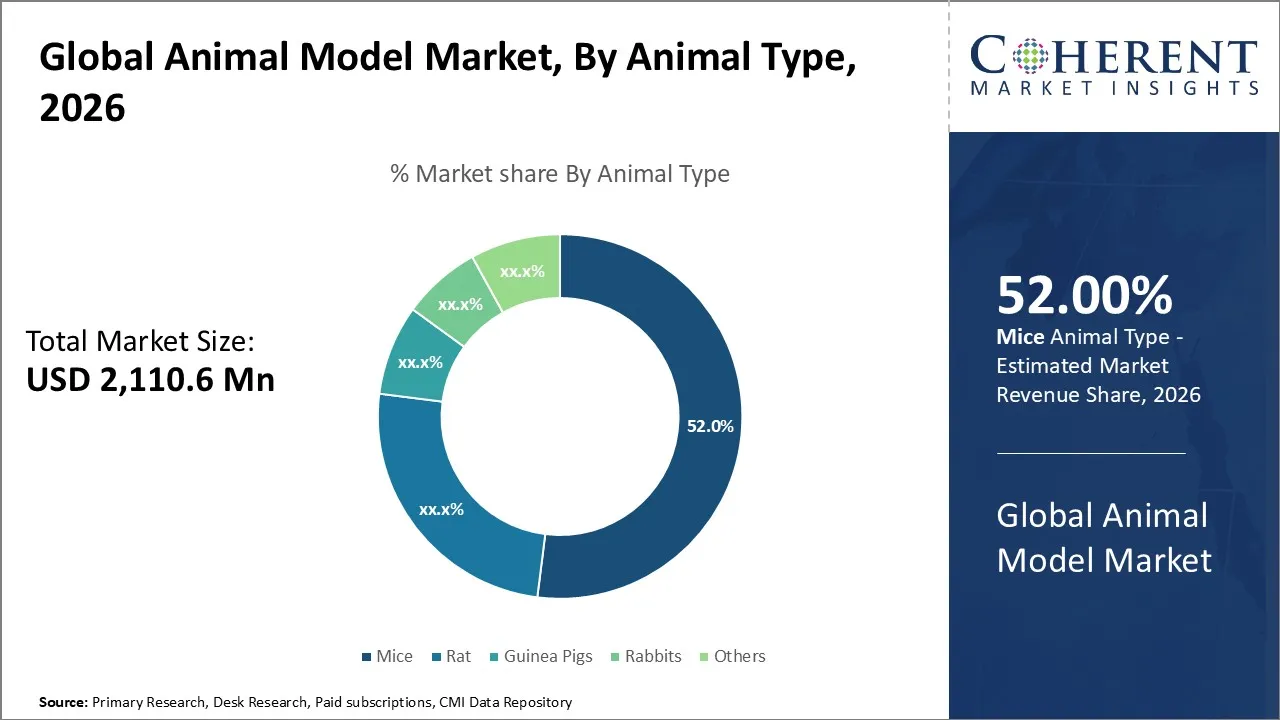
Animal Model Market Insights, By Animal Type – Mice dominate due to extensive use in research
By animal type, the mice segment is projected to contribute 52% of the highest market share in 2026, considering their extensive applications in drug discovery and basic research. This is because mice are conveniently preferred due to their genetic similarity to humans, efficient or short reproductive cycles, and availability of well-established diseased models.
For instance, in March 2025, Alamar Biosciences introduced the NULISAseq Mouse Panel 120, which is an advanced biomarker profiling technology that facilitates extensive protein expression analysis for mouse models of inflammation, neurodegeneration, and immuno-oncology research disciplines.
Animal Model Market Insights, By Application – Drug Discovery & Development leads with rising preclinical demand
Based on application, the drug discovery & development segment is expected to show the highest market share of 38% in 2026. This is due to the increased demand for carrying out drug testing in this phase. The drug industry is investing greatly in drug testing, especially in the preclinical stage, in which animal models are needed to check efficacy and safety before moving to the clinical stage.
For instance, in April 2025, the U.S. Food and Drug Administration (FDA) announced a groundbreaking plan to abolish the mandatory animal testing of monoclonal antibodies and other drugs by promoting the use of more human-relevant methods, such as AI-based computer models and lab-based systems.
Animal Model Market Insights, By End User – Pharma & Biotech Companies lead with increased R&D investment
Based on end user, the pharma & biotech companies’ segment is estimated to hold the highest market share of 42% in 2026 due to high investments in R&D. These companies hold the highest share of the preclinical research segment and are the largest consumers of various animal models ranging from mice/rats to rabbits.
For instance, in July 2025, Altasciences announced a strategic partnership with VoxCell BioInnovation, bringing 3D bioprinted human like tissue models into play in early-stage drug development, thus speeding up its research processes.
Regional Insights
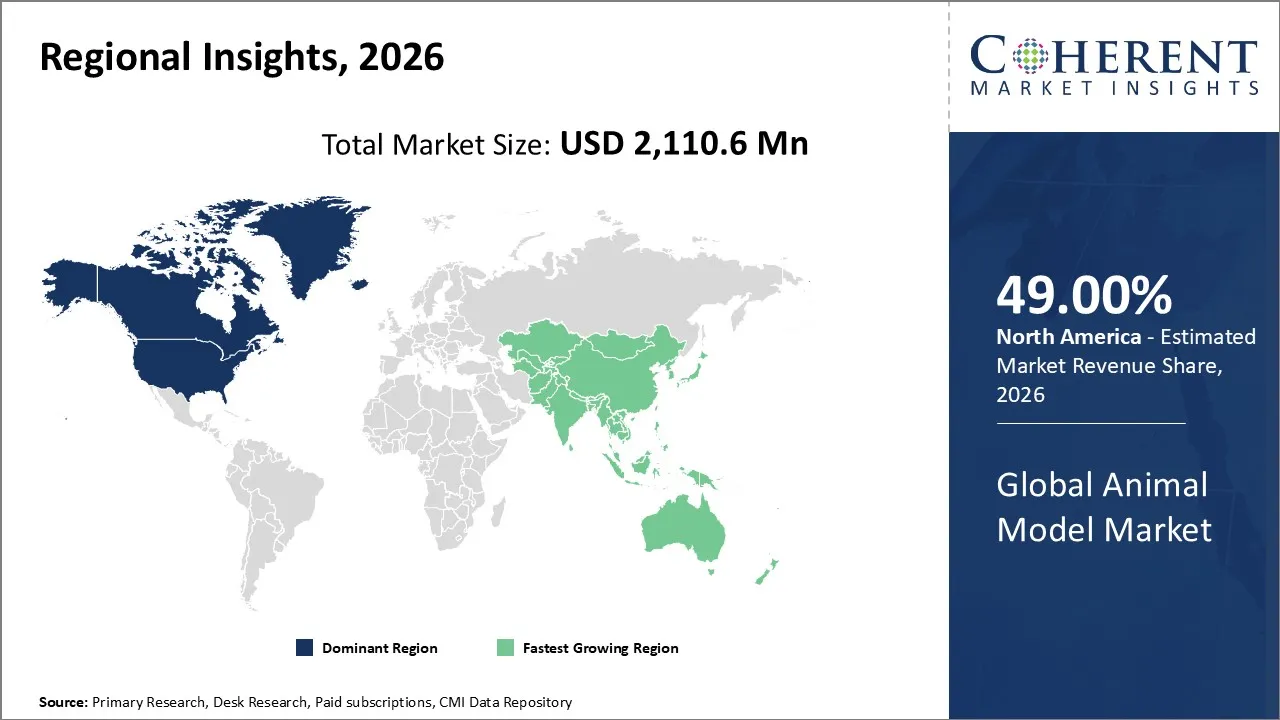
North America Animal Model Market Analysis & Trends
North America is expected to dominate the animal model market in 2026, accounting for a market share of 49%. The factors responsible for the growth of the animal model market in North America include well-established pharmaceutical R&D capabilities, widespread adoption of animal testing technology, well-established laboratory facilities, and support for research. These factors have enabled North America to maintain its leadership role in the global animal model market.
For instance, in September 2025, Crown Bioscience expanded its presence in the U.S. by opening a new Model Development Center in Kannapolis, North Carolina, enhancing its portfolio of advanced oncology and transgenic models to support preclinical studies for pharma and biotech companies.
Asia Pacific Animal Model Market Analysis & Trends
The Asia Pacific region is expected to witness the highest growth rate in the animal models market. This is due to an increase in pharmaceutical and biotechnology industry R&D investments in the region, in addition to the rising demand for preclinical services and increased collaboration with global CROs. Expansion of the total research infrastructure in countries like China, India, and Japan, and the rise of several domestic service companies employing sophisticated animal models for the same purpose.
For instance, in July 2025, Biocytogen Pharmaceuticals expanded its preclinical service platform in Asia to include a broader range of humanized and transgenic models, as well as biomarker and toxicity testing services.
Animal Model Market Outlook for Key Countries
Is the U.S. animal model market leading due to pharma and biotech R&D dominance?
The U.S. animal model market is driven by high investment in pharmaceutical and biotechnology research and supported by advanced preclinical research infrastructure. There is good regulatory support, and there are collaborations between CRO and pharma companies. In addition, advanced transgenic and humanized models are also available.
For instance, in April 2025, The U.S. FDA announced the plan to phase out animal testing requirements for monoclonal antibody drugs and promote the integration of New Approach Methodologies (NAMs) in the form of AI models and cell/organoid systems.
Is China’s investment in biotech accelerating animal model market growth?
China's emphasis on life sciences research, pharma/biotech R&D investments, and its growing collaboration with global CROs are positively impacting the animal model’s market. China’s government strategies towards improvement of research infrastructure and the incentives for preclinical research are fueling the use of technically advanced models like transgenic mice and disease models.
For instance, in March 2025, Alamar Biosciences launched the NULISAseq Mouse Panel 120 in China, offering comprehensive biomarker profiling of mice models that support research in inflammation, neurodegeneration, and immuno-oncology pathways.
Market Report Scope
Animal Model Market Report Coverage
| Report Coverage | Details | ||
|---|---|---|---|
| Base Year: | 2025 | Market Size in 2026: | USD 2,110.6 Mn |
| Historical Data for: | 2020 To 2024 | Forecast Period: | 2026 To 2033 |
| Forecast Period 2026 to 2033 CAGR: | 6% | 2033 Value Projection: | USD 3,173.5 Mn |
| Geographies covered: |
| ||
| Segments covered: |
| ||
| Companies covered: | Charles River Laboratories International, Inc., The Jackson Laboratory, Taconic Biosciences, JSR Corporation (Crown Bioscience Inc.), Genoway S.A, Eurofins Scientific SE, Envigo, Perkinelmer, Inc. (Horizon Discovery Group), Ozgene Pty Ltd., and Hera Biolabs (Transposagen Biopharmaceuticals), among others. | ||
| Growth Drivers: |
| ||
| Restraints & Challenges: |
| ||
Animal Model Market Driver
Rising demand for preclinical testing and drug discovery
The increasing focus on pharmaceutical and biotechnology R&D is driving the animal model market. With the expanding drug discovery, basic research, and translational studies, there is great demand for reliable animal models, especially mice and humanized models, to assess the efficacy, safety, and toxicity of new therapeutic candidates. Preclinical testing requirements from regulatory authorities further boost market growth, and the rise of personalized medicine.
Animal Model Market Opportunity
Adoption of advanced genetic, humanized, and alternative models
The market offers a great opportunity for growth through the use of genetically engineered, humanized, and disease-specific animal models. New technologies like CRISPR, organoid integration, and AI-assisted platforms can provide expansion opportunities to bypass the traditional use of animal models. The market can grow by offering specialized preclinical research services such as oncology, immunology, and neurodegenerative research to a wider customer base of pharma and biotech companies.
Analyst Opinion (Expert Opinion)
- The animal model market is witnessing significant transformation as more advanced models are incorporated within preclinical research, becoming more sophisticated and disease-specific. The emphasis is moving from conventional rodent models to more advanced and sophisticated models, including genetically engineered, humanized, and disease-specific models, which help predict more about human biology and diseases.
- North America is still leading with its established infrastructure of biotech industries, regulatory maturity, and close association between pharmaceutical companies, CROs, and research institutes. Asia Pacific is also emerging fast with local investments in preclinical facilities, association with CROs, and adoption of new models to drive research into oncology, immunology, and neurodegenerative studies.
- The market is characterized by specialization. The successful providers are the ones who are able to offer customized models for complex disease pathways, along with biomarker profiling and integrated preclinical platforms. The companies that are unable to upgrade to these highly developed platforms risk becoming irrelevant as the need continues to emphasize precision in predictions, reproducibility, and timely research.
Speak to the analyst
Want personalized insights?
Take the findings above to one of our principal consultants, or have the report rebuilt around the segments, geographies and competitors you actually track.
Top Strategies Followed by Animal Model Market Players
- Established players focus on advanced research and model development. Leading companies like Charles River, Envigo, and Taconic Biosciences invest heavily in developing genetically engineered, humanized, and disease-specific models. These firms continuously refine breeding techniques, improve reproducibility, and enhance model relevance for oncology, immunology, and neurodegenerative studies.
- Mid-level players compete on service breadth and efficiency. These companies leverage partnerships with global suppliers and CROs to provide comprehensive preclinical testing services, maintaining quality while controlling costs. Streamlined operations and flexible project management allow them to serve small and mid-size biotech firms effectively.
- Small-scale providers specialize in niche preclinical services. By focusing on specific disease models, rare conditions, or custom animal models, these players gain visibility among targeted clients. Many adopt digital tools for project tracking, data analysis, or model customization. Local collaborations with universities and research institutes enhance access to experimental models and specialized expertise.
Emerging Startups in the Animal Model Market
- Innovative technology integration is a key focus. Startups like InVivo Biosystems and XenoBio are developing advanced platforms that integrate organoids, humanized models, or AI-assisted analytics to improve predictive accuracy and accelerate drug discovery.
- Sustainability and ethical research practices are rising priorities. Some emerging companies are developing alternatives that reduce reliance on traditional animal testing, such as organ-on-chip systems, in silico modeling, and advanced tissue platforms, supporting regulatory and ethical compliance while improving translational research.
- Niche specialization fills market gaps. Startups target underserved areas such as rare disease modeling, immuno-oncology, or complex transgenic systems. Partnerships with academic labs and biotech companies help these startups gain early adoption and expand preclinical service offerings.
Animal Model Industry News
- In January 2026, Taconic Biosciences announced the acquisition of TransCure bioServices, which will expand global humanized mouse translational research platforms by combining Taconic’s models with TransCure’s preclinical expertise.
- In July 2025, Eurofins announced record half‑year revenues and ongoing investments in digitalization and laboratory expansions, including enhancements to its BioPharma and genomics services that support preclinical and discovery testing workflows used alongside animal models.
Market Segmentation
- Animal Type Insights (Revenue, USD Mn, 2026 - 2033)
- Rat
- Mice
- Guinea Pigs
- Rabbits
- Others
- Application Insights (Revenue, USD Mn, 2026 - 2033)
- Drug Discovery & Development
- Basic Research and Others
- End User Insights (Revenue, USD Mn, 2026 - 2033)
- Pharma & Biotech Companies
- Academic Research Institutes
- Regional Insights (Revenue, USD Mn, 2026 - 2033)
- North America
- U.S.
- Canada
- Latin America
- Brazil
- Argentina
- Mexico
- Rest of Latin America
- Europe
- Germany
- U.K.
- Spain
- France
- Italy
- Russia
- Rest of Europe
- Asia Pacific
- China
- India
- Japan
- Australia
- South Korea
- ASEAN
- Rest of Asia Pacific
- Middle East
- GCC Countries
- Israel
- Rest of Middle East
- Africa
- South Africa
- North Africa
- Central Africa
- North America
- Key Players Insights
- Charles River Laboratories International, Inc.
- The Jackson Laboratory
- Taconic Biosciences
- JSR Corporation (Crown Bioscience Inc.)
- Genoway S.A
- Eurofins Scientific SE
- Envigo
- Perkinelmer, Inc. (Horizon Discovery Group)
- Ozgene Pty Ltd.
- Hera Biolabs (Transposagen Biopharmaceuticals)
- Others
Sources
Primary Research Interviews
- Animal Model Manufacturers & Lab Managers
- Preclinical & Translational Research Scientists
- CROs (Contract Research Organizations) & Lab Service Providers
- Pharma & Biotech R&D Heads
- Academic & University Research Labs
- Regulatory Affairs & Compliance Experts
- Others
Databases
- PubMed
- ClinicalTrials.gov
- Scopus
- Web of Science
- ResearchGate
- Others
Magazines
- Laboratory Animal Magazine
- Lab Animal Life
- Genetic Engineering & Biotechnology News (GEN)
- Laboratory Equipment & Biotechnology Reports
- Others
Journals
- Journal of Laboratory Animal Science
- ILAR Journal (Institute for Laboratory Animal Research)
- Laboratory Animals
- Transgenic Research
- Others
Newspapers
- The Wall Street Journal (Health & Biotech Section)
- Financial Times (Healthcare & Life Sciences Section)
- Nature News
- Science Daily
- Others
Associations
- American Association for Laboratory Animal Science (AALAS)
- European Federation of Laboratory Animal Science Associations (FELASA)
- International Council for Laboratory Animal Science (ICLAS)
- National Centre for the Replacement, Refinement & Reduction of Animals in Research (NC3Rs)
- Others
Public Domain Sources
- U.S. National Institutes of Health (NIH) Reports & Publications
- U.S. Food & Drug Administration (FDA) Preclinical Guidance Documents
- European Medicines Agency (EMA) Reports
- World Health Organization (WHO) Preclinical Research Reports
- Others
Proprietary Elements
- CMI Data Analytics Tool
- Proprietary CMI Existing Repository of Information for the Last 8 Years
Get access to 250+ pages report
Every segment, forecast, competitor profile and data table behind the analysis above — available for instant download.
- ESOMAR Member
- ISO 9001:2015 Certified
- D-U-N-S Registered
- GDPR & CCPA Compliant
Missing comfort of reading report in your local language? Find your preferred language:
Transform your Strategy with Exclusive Trending Reports
Frequently Asked Questions
The animal model market is estimated to be valued at USD 2,110.6 Mn in 2026, and is expected to reach USD 3,173.5 Mn by 2033.
The CAGR of the animal model market is projected to be 6% from 2026 to 2033.
Key factors driving growth include increasing R&D investment in pharma and biotech, rising demand for disease-specific and humanized animal models, and expansion of preclinical research in emerging markets.
Challenges include ethical concerns and regulatory restrictions, high costs associated with genetically engineered and humanized models, and the gradual adoption of alternative in vitro and computational models.
Mice are estimated to dominate the market due to their widespread use in drug discovery, immunology, and basic research.
North America is anticipated to lead the market due to well-established biotech infrastructure, regulatory maturity, and high adoption of advanced animal models.
Charles River Laboratories International, Inc., The Jackson Laboratory, Taconic Biosciences, JSR Corporation (Crown Bioscience Inc.), Genoway S.A, Eurofins Scientific SE, Envigo, PerkinElmer, Inc. (Horizon Discovery Group), Ozgene Pty Ltd., and Hera Biolabs (Transposagen Biopharmaceuticals) are key market players.