

Animal Vaccines Market Analysis & Forecast 2026-2033
The animal vaccines market is estimated to be valued at USD 9,815.7 Mn in 2026 and expected to reach USD 15,275.6 Mn by 2033, witnessing a CAGR of 6.6% over the forecast period (2026-2033).
Key Takeaways
- Based on Product Type, the inactivated vaccines segment is expected to hold 37.8% share of the market in 2026.
- Based on Application, the livestock animal segment is expected to lead the market with 47.2% share in 2026.
- Based on Distribution Channel, the veterinary clinics segment is projected to account for 42.3% share of the market in 2026.
- Based on Region, North America is set to lead the animal vaccines market with 29% share in 2026. While, Asia Pacific is anticipated to be the fastest growing region.
Market Overview
Vaccination enhances health of animals, thus improving their life expectancies. Veterinary vaccines are available for diseases such as rabies, E. coli, distemper, hepatitis rotavirus, parvovirus, brucellosis, and pinkeye. Various diseases such as foot-and-mouth disease and influenza adversely affect livestock across the globe. Economic losses due to death of livestock is significant, as it impacts the supply of dairy products, meat, and other poultry products.
Vaccines are broadly classified as inactivated vaccines, toxoid vaccines, live attenuated vaccines, conjugated vaccines, and subunit and DNA vaccines. Veterinary vaccines impact animal health and production quality and also ensure good health of general human population through consumption of various food procured from animals.
Current Event and their Impacts on the Animal Vaccines Market
Current Event | Description and its Impact |
Avian Influenza (H5N1) Global Outbreak |
|
African Swine Fever (ASF) Containment Efforts |
|
How have oral rabies vaccination programs reduced wildlife rabies cases across regions?
Region | Wildlife Target | Method | Reduction in Rabies Cases | Notes |
Western Europe (Germany, France, Switzerland) | Foxes | Oral vaccine baits | >90% reduction | Rabies nearly eliminated in fox populations by 2010. |
Eastern Europe (Poland, Hungary, Baltic states) | Foxes, raccoon dogs | Oral vaccine baits | ~85–90% reduction | Large-scale EU-supported vaccination campaigns. |
United States (Northeast & Midwest) | Raccoons, coyotes | Oral vaccine baits | >90% reduction | Rabies incidence in raccoons dropped dramatically since 1990s. |
Canada (Ontario, Quebec) | Foxes, raccoons | Oral vaccine baits | ~95% reduction | Rabies eradicated in red foxes by early 2000s. |
- Current Industry Events of 2026
- Market Size Estimation
- Regional Breakdown
- Competitive Landscape
- Customer Intelligence
- Segmental Analysis
- Pricing Analysis
- Key Market Drivers, Challenges & Future Trends
- Customized Insights Section
Segmental Insights
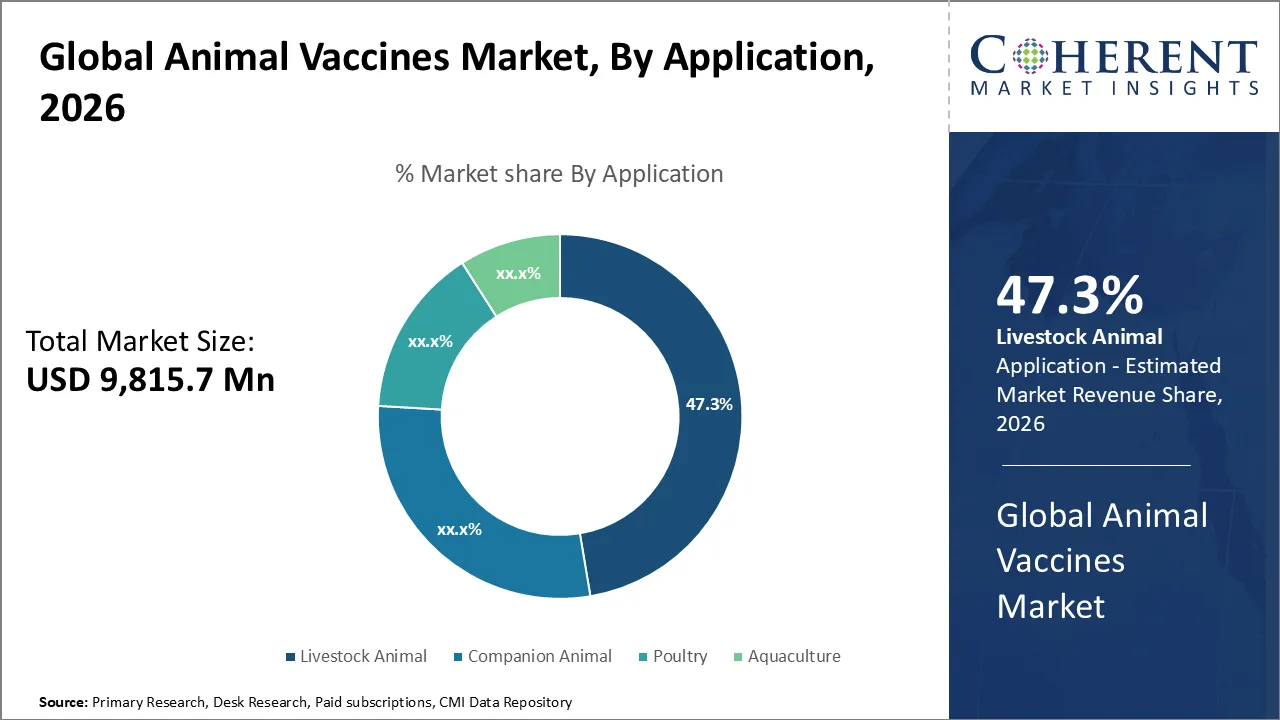
Animal Vaccines Market Insights, By Application: Livestock animals lead through global demand for meat and dairy security
In terms of application, the livestock animal segment is expected to lead the market with 47.2% share in 2026, due to individuals all over the world care about preserving cattle, pigs, and chickens healthy and safe from disease. Vaccination programs are needed because people consume more meat and dairy, and government programs help make sure that everyone gets vaccinated. This segment's size and economic significance render it the most impactful application domain in 2026.
For instance, in March 2026, a vaccination campaign for cattle started in Nawabpet, Telangana, with the goal of improving the health of livestock and the quality of life in rural areas. The minister stressed the importance of proactive animal healthcare programs in making Nawabpet a model village. This campaign stresses how important it is for farmers to vaccinate their livestock to protect their livelihoods and boost the state's agricultural economy.
Animal Vaccines Market Insights, By Product Type: Inactivated vaccines dominate with trusted safety and broad livestock use
In terms of product type, the inactivated vaccines segment is expected to hold 37.8% share of the market in 2026, because they are safe, stable, and accepted by regulators. They revert to being virulent like live vaccines can, so they're great for use on a large scale with livestock and poultry. Their widespread use across regions guarantees steady demand, making them the most popular product category on the market.
For instance, in April 2025, HIPRA released ICHTIOVAC ERM, an inactive vaccine for salmon that protects them from Enteric Redmouth Disease. This is the company's first step into the European aquaculture market, which goes beyond raising animals on land. The vaccine makes it harder for diseases to spread in salmon farming. This shows that there is a growing need for safe and effective aquaculture immunization solutions in Europe's animal health industry.
Animal Vaccines Market Insights, By Distribution Channel: Veterinary clinics dominate distribution with accessible, widespread vaccination services
In terms of distribution channel, the veterinary clinics segment is projected to account for 42.3% share of the market in 2026, as they are accessible and affordable for farmers and pet owners. They are found in both rural and urban areas, which means high coverage. Clinics are the main place for point of care, so they will be the most important place for administrating vaccines and getting into the market in 2026.
For instance, in March 2025, GALVmed announced a new program to help with low vaccination rates in ruminants across Africa. The goal of the program is to make it easier for farmers to get livestock vaccines, make delivery systems stronger, and help farmers. The program's goal is to protect animal health, boost productivity, and protect the livelihoods of rural people who depend on livestock by filling in gaps in immunization.
Regional Insights
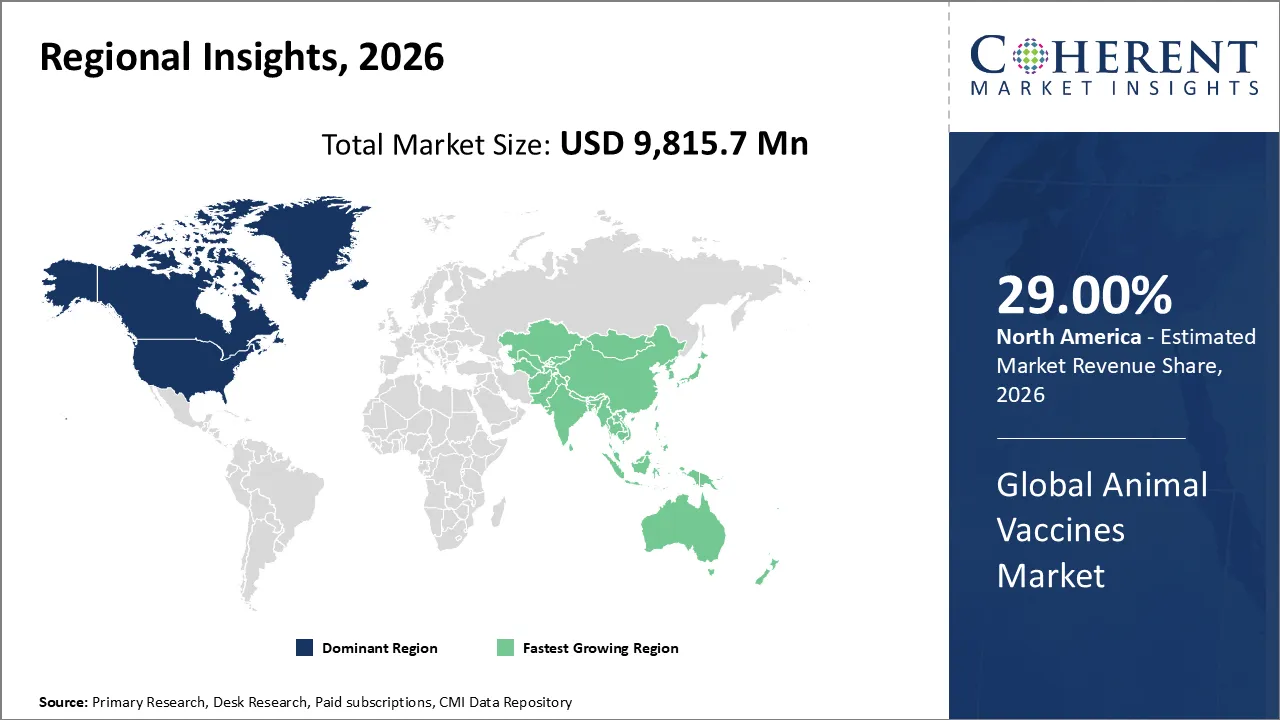
North America Animal Vaccines Market Analysis & Trends
North America is expected to dominate the animal vaccines market with 29% share in 2026, owing to greater numbers of individuals are getting pets, advanced veterinary care, and rising awareness about zoonotic disease. Strong investments in research and development and regular product launches help adoption even more, making the region the biggest source of revenue in the world.
For instance, in March 2026, Biovaxys and Adiverna, two companies from Canada and the United States, are working together to make mRNA vaccines for pets. This North American partnership uses AI-guided immunotherapy to improve pet health care. The goal of the initiative is to improve disease prevention and increase options for animal health around the world by promoting new ideas in veterinary medicine.
Asia Pacific Animal Vaccines Market Analysis & Trends
Asia Pacific is expected to exhibit the fastest growth, because livestock is growing quickly, people are consuming more meat and dairy, and the government is supporting vaccination programs. As people learn more about zoonotic diseases and veterinary care gets better in places like India and China, adoption speeds up even more, making the region the fastest-growing in the world.
For instance, in November 2025, Ceva started a program in Singapore to work together to get prepared for avian influenza. The project is mostly about studying wildlife, surveillance, and preventive vaccination strategies. The goal of the effort is to protect animal populations, public health, and the region's ability to deal with possible outbreaks by improving monitoring and readiness.
Animal Vaccines Market Outlook Country-Wise
The U.S. Animal Vaccines Market Trends
The Animal Vaccines Market is strong in the U.S. in 2026 because more than 65% of households own pets, people are extremely aware of how to prevent zoonotic diseases, and the veterinary infrastructure is incredibly good. The U.S. is a major contributor to global adoption due to ongoing research and development investments and frequent product launches.
India Animal Vaccines Market Trends
Since India has a significant number of livestock, people are eating more meat and dairy, and the government is supporting vaccination programs to improve food security, the Animal Vaccines Market is going to be active in 2026. India is a major growth driver as more people are learning about zoonotic diseases and the veterinary infrastructure is getting better.
For instance, in February 2026, A Pune institute in Maharashtra will make a vaccine for lumpy skin disease to keep cattle safe. This program improves India's livestock health infrastructure, which means farmers can get vaccines faster. Local vaccine production is meant to lower economic losses, improve animal welfare, and support sustainable farming.
Market Report Scope
Animal Vaccines Market Report Coverage
| Report Coverage | Details | ||
|---|---|---|---|
| Base Year: | 2025 | Market Size in 2026: | USD 9,815.7 Mn |
| Historical Data for: | 2020 To 2024 | Forecast Period: | 2026 To 2033 |
| Forecast Period 2026 to 2033 CAGR: | 6.6% | 2033 Value Projection: | USD 15,275.6 Mn |
| Geographies covered: |
| ||
| Segments covered: |
| ||
| Companies covered: | Merck & Co., Inc., Boehringer Ingelheim International GmbH., Zoetis Inc., Elanco Animal Health Incorporated, Ceva, HIPRA, Romvac Company Sa, Biovac, Vaxxinova International BV, and Biogénesis Bagó | ||
| Growth Drivers: |
| ||
| Restraints & Challenges: |
| ||
Animal Vaccines Market Driver
Increasing number of R&D initiatives
The Animal Vaccines Market growth is observed because there are increasing numbers of research and development projects going on around the world. Companies are heavily investing into cutting-edge technologies to make vaccines for pets and livestock that work better, are safer, and are more innovative. These research and development projects are focused on fighting new diseases, making it easier to get vaccines to people, and boosting immune responses. New pathogens threaten animal health; continuous innovation ensures better disease prevention. This will make food more secure and help veterinary healthcare systems around the world.
For instance, in March 2026, Researchers at Purdue University made a vaccine that lowers fertility in animals to help with the problem of overpopulation animals in the wild. The project is based in Indiana, USA, and it offers a more humane way to cull animals that helps balance ecosystems and lower conflicts between people and animals. It shows that a growing amount of research and development is going into new ways to improve animal health.
Increasing product launches
Animal Vaccines market demand is growing due to the launch’s new products, by making more solutions available for different types of animals. Top companies are making new vaccines that target certain diseases, which fills a gap in veterinary medicine. These new products not only help farmers manage diseases better, but they also make them more confident in preventive healthcare. As people learn more about zoonotic diseases and how they affect livestock productivity, the steady introduction of new vaccines makes sure that more people use them, speeds up market penetration, and supports long-term growth in both developed and developing areas.
For instance, in October 2025, The European Medicines Agency (EMA) provided Eco Animal Health a good review for ECOVAXXIN® MS, a poultry vaccine that targets Mycoplasma synoviae. This important step makes it possible for the EU to give its approval and for the product to be launched in 2026. The vaccine's goal is to help animal health and boost the poultry industry's efforts to stop diseases by lowering the number of chickens that get sick.
Animal Vaccines Market Opportunity
DNA and Recombinant Vaccines
DNA and recombinant vaccines are changing the Animal Vaccines Market forecast by providing safer, more accurate, and more specific protection against infectious diseases. These new formulations have fewer side effects and stronger immune responses than traditional vaccines, making them great for both livestock and pets. Their ability to adapt quickly helps them fight new pathogens, which makes global veterinary healthcare more resilient. As adoption increases, companies leveraging these technologies can secure competitive advantages and tap into new growth segments within the expanding market.
Analyst Opinion (Expert Opinion)
- The World Health Organization claims that more than 60% of new infectious diseases come from animals, which is driving up global demand for animal vaccines. This trend shows how important it is to have vaccination programs that maintain both livestock healthy and the public health.
- Vaccination of companion animals is growing quickly, due to data from the American Pet Products Association that shows more than 65% of U.S. households own a pet. These numbers highlight the growing emphasis on preventive healthcare for pets, which is why a increasing number of individuals are getting their pets vaccinated with new vaccines.
Speak to the analyst
Want personalized insights?
Take the findings above to one of our principal consultants, or have the report rebuilt around the segments, geographies and competitors you actually track.
Recent Developments
- In March 2026, The Bhubaneswar Municipal Corporation will vaccinate to 52,000 dogs as part of a big anti-rabies campaign. The goal of the campaign is to stop rabies, make people safer, and make animals healthier. The program improves veterinary care and helps the community by preventing diseases in both stray and pet dogs.
- In February 2026, Telangana stated it would build a BSL-3 animal vaccine factory in Hyderabad, along with projects for the GCC and an innovation hub. The goal of the initiative, which was announced at BioAsia 2026, is to boost biotechnology, create jobs, and improve the infrastructure for vaccine research. It shows that the state is serious about improving animal health and life sciences research.
Market Segmentation
- By Product Type
- Attenuated Live Vaccines
- Conjugate Vaccines
- Inactivated Vaccines
- Subunit Vaccines
- Toxoid Vaccines
- DNA Vaccines
- Recombinant Vaccines
- By Application
- Companion Animal
- Livestock Animal
- Poultry
- Aquaculture
- By Distribution Channel
- Veterinary Clinics
- Veterinary Hospitals
- Veterinary Research Institutes
- Others
- By Region
- North America
- U.S.
- Canada
- Latin America
- Brazil
- Argentina
- Mexico
- Rest of Latin America
- Europe
- Germany
- U.K.
- Spain
- France
- Italy
- Russia
- Rest of Europe
- Asia Pacific
- China
- India
- Japan
- Australia
- South Korea
- ASEAN
- Rest of Asia Pacific
- Middle East & Africa
- GCC Countries
- Israel
- Rest of Middle East & Africa
- North America
- Key Players
- Merck & Co., Inc.
- Boehringer Ingelheim International GmbH.
- Zoetis Inc.
- Elanco Animal Health Incorporated
- Ceva
- HIPRA
- Romvac Company Sa
- Biovac
- Vaxxinova International BV
- Biogenesis Bago
Sources
Primary Research Interviews
- Animal Vaccine Manufacturers
- Veterinary Biologics Producers
- Livestock Health Product Manufacturers
- Companion Animal Vaccine Developers
- Veterinary Pharmaceutical Distributors
- Veterinary Doctors & Animal Health Consultants
- Poultry, Swine, Cattle, and Aquaculture Farm Operators
- Regulatory Affairs Specialists in Veterinary Biologics
- Others
Databases
- Bloomberg Terminal
- Thomson Reuters Eikon
- Others
Magazines
- Animal Pharm
- Poultry World
- Pig Progress
- Dairy Global
- Veterinary Practice News
- Animal Health International Magazine
- Others
Journals
- Vaccine
- Veterinary Microbiology
- Preventive Veterinary Medicine
- Journal of Veterinary Pharmacology and Therapeutics
- Frontiers in Veterinary Science
- Research in Veterinary Science
- Others
Newspapers
- Financial Times
- The Wall Street Journal
- Reuters
- Bloomberg News
- The Economic Times
- Others
Associations
- World Organisation for Animal Health (WOAH)
- Animal Health Institute (AHI)
- HealthforAnimals
- American Veterinary Medical Association (AVMA)
- Federation of Veterinarians of Europe (FVE)
- Others
Public Domain Sources
- U.S. Department of Agriculture (USDA)
- European Medicines Agency (EMA)
- U.S. Food and Drug Administration (FDA) Center for Veterinary Medicine
- World Organisation for Animal Health (WOAH)
- Food and Agriculture Organization (FAO)
- World Health Organization (WHO)
- Government Veterinary and Livestock Departments
- Others
Proprietary Elements
- CMI Data Analytics Tool
- Proprietary CMI Existing Repository of Information for the Last 8 Years
Get access to 250+ pages report
Every segment, forecast, competitor profile and data table behind the analysis above — available for instant download.
- ESOMAR Member
- ISO 9001:2015 Certified
- D-U-N-S Registered
- GDPR & CCPA Compliant
Missing comfort of reading report in your local language? Find your preferred language:
Transform your Strategy with Exclusive Trending Reports
Frequently Asked Questions
The global Animal Vaccines Market size was valued at USD 9,815.7 Mn in 2026 and is expected to reach USD 15,275.6 Mn in 2033.
The global animal vaccines market is expected to exhibit a CAGR of 6.6% during the forecast period (2026-2033).
The market is estimated to be valued at USD 9,815.7 Mn in 2026.
Merck & Co., Inc., Boehringer Ingelheim International GmbH., Zoetis Inc., Elanco Animal Health Incorporated, Ceva, HIPRA, Romvac Company Sa, Biovac, Vaxxinova International BV, and Biogénesis Bagó are some of the prominent players operating in the market.
The market is expected to be valued at USD 15,275.6 Mn in 2033.
North America is the prominent region in the market.
Increasing number of R&D initiatives and increasing product launches, are expected to drive growth of the market.