

Anti Fungal Drugs Market Size and Forecast – 2026 to 2033
Anti Fungal Drugs Market is estimated to be valued at USD 15.56 Bn in 2026 and is expected to reach USD 20.06 Bn in 2033, exhibiting a compound annual growth rate (CAGR) of 3.7% from 2026 to 2033.
Key Takeaways
- By Drug Type, Azoles acquired the prominent share of 30% in 2026 as broad-spectrum efficacy.
- By Indication, Aspergillosis hold the largest market share in 2026 owing to the rising incidence of immune compromised populations.
- By Dosage Form, Tablets acquired the prominent market share in 2026 on account of the rising incidence of fungal infections.
- By Distribution Channel, Hospital Pharmacies dominates the overall market with an estimated share in 2026 owing to the management of severe and systemic infections.
- By Region, North America dominates the overall market with an estimated share of 33.5% in 2026 owing to the high prevalence of fungal infections.
Market Overview
The increasing prevalence of fungal infections, particularly among immune compromised patients, is rapidly expanding the antifungal drugs market. Improved drug formulations and diagnostic technologies are enhancing treatment effectiveness and patient outcomes. Growing awareness and better access through hospital pharmacies and retail channels are driving the antifungal drugs market demand. Researchers and governments actively support innovation, while the rise of resistant fungal strains emphasizes the urgent need for new therapies.
Current Events and their Impact on the Anti Fungal Drugs Market
Current Events | Description and its impact |
Geopolitical and Regulatory Developments |
|
Economic and Healthcare Infrastructure Trends |
|
Epidemiological and Public Health Factors |
|
End-user Feedback and Unmet Needs in the Anti Fungal Drugs Market
- Need for Faster-Acting Treatments: Patients and healthcare providers express demand for antifungal drugs that deliver quicker symptom relief and infection clearance. Delayed response times in some current therapies cause prolonged discomfort and increased risk of complications, highlighting the need for more rapid-acting antifungal options.
- Improved Safety and Reduced Side Effects: Users often report adverse effects associated with antifungal medications, such as liver toxicity or drug interactions. There is a strong need for safer formulations that minimize side effects, especially for long-term treatments or vulnerable populations like the elderly and immunocompromised.
- Better Formulation Convenience: End-users seek antifungal drugs in more convenient forms, such as oral tablets or topical creams with easy application and dosing schedules. Improved formulations can enhance patient adherence and treatment effectiveness, particularly for outpatient and self-administered therapies.
- Current Industry Events of 2026
- Market Size Estimation
- Regional Breakdown
- Competitive Landscape
- Customer Intelligence
- Segmental Analysis
- Pricing Analysis
- Key Market Drivers, Challenges & Future Trends
- Customized Insights Section
Pricing Analysis of Anti Fungal Drugs
Common antifungals like Fluconazole, Itraconazole, and Clotrimazole are available in both branded and generic forms. Fluconazole 150 mg may cost between $0.06 to $0.60 per tablet, while Itraconazole 200 mg ranges from $0.25 to $1.20 per capsule. Topical antifungals like Clotrimazole creams cost about $0.40 to $1.50 per tube. In contrast, systemic and advanced antifungals like Voriconazole and Caspofungin are significantly pricier, with injections costing anywhere between $25 to $120 per vial. The price variation can exceed 1,000% between brands.
Segmental Insights
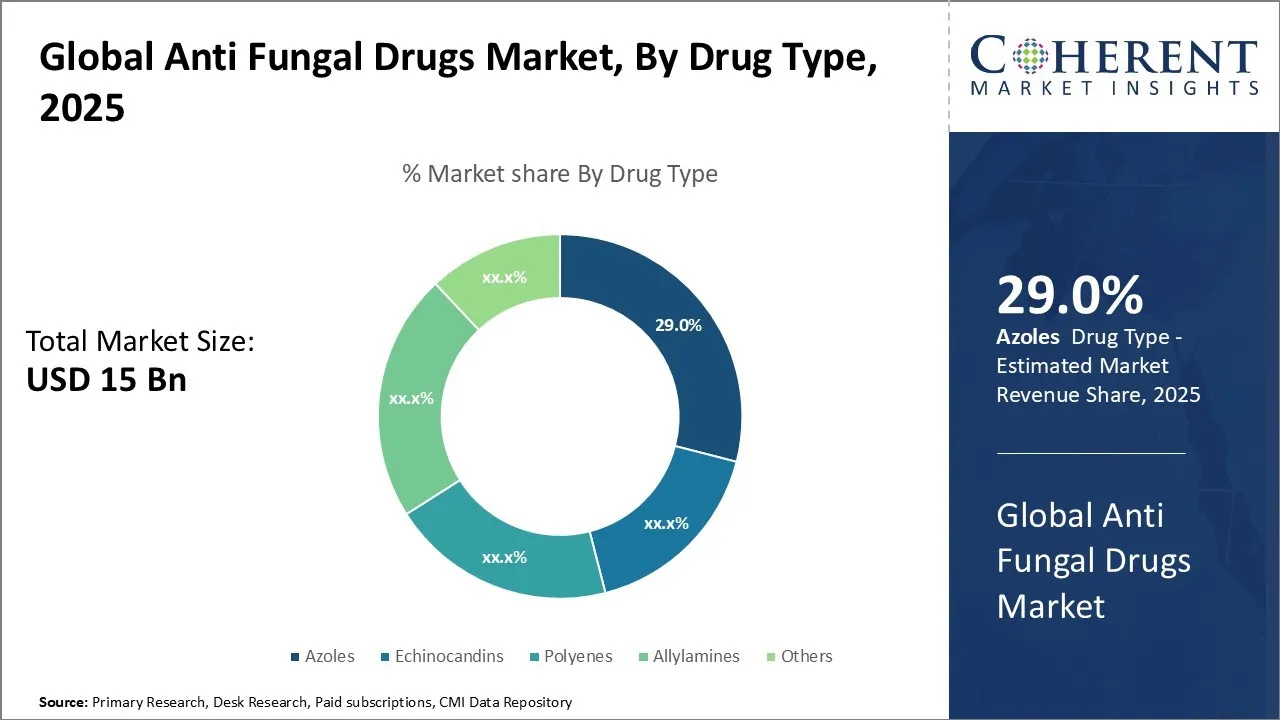
Anti Fungal Drugs Market Insights, By Drug Type - Azoles contribute the highest share of the market owing to its improved safety and pharmacokinetics
Azoles acquired the prominent share of 30.0% in 2026. Azoles drive growth in the antifungal drugs market through their broad-spectrum activity and proven effectiveness against various fungal infections. Clinicians widely prefer them for treating conditions such as candidiasis and aspergillosis. Pharmaceutical companies continue to develop newer-generation azoles with better safety and resistance profiles, encouraging broader adoption. Their availability in both oral and intravenous forms increases patient access and improves treatment adherence. These factors firmly establish azoles as a vital component of antifungal therapy across healthcare settings. For instance, the FDA approved Luzu Cream for the topical treatment of athlete’s foot, jock itch, and ringworm caused by the organisms Trichophyton rubrum and Epidermophyton floccosum in patients over 18 years old. Luzu Cream is currently the only topical azole antifungal that treats interdigital tinea pedis with once-daily dosing for two weeks.
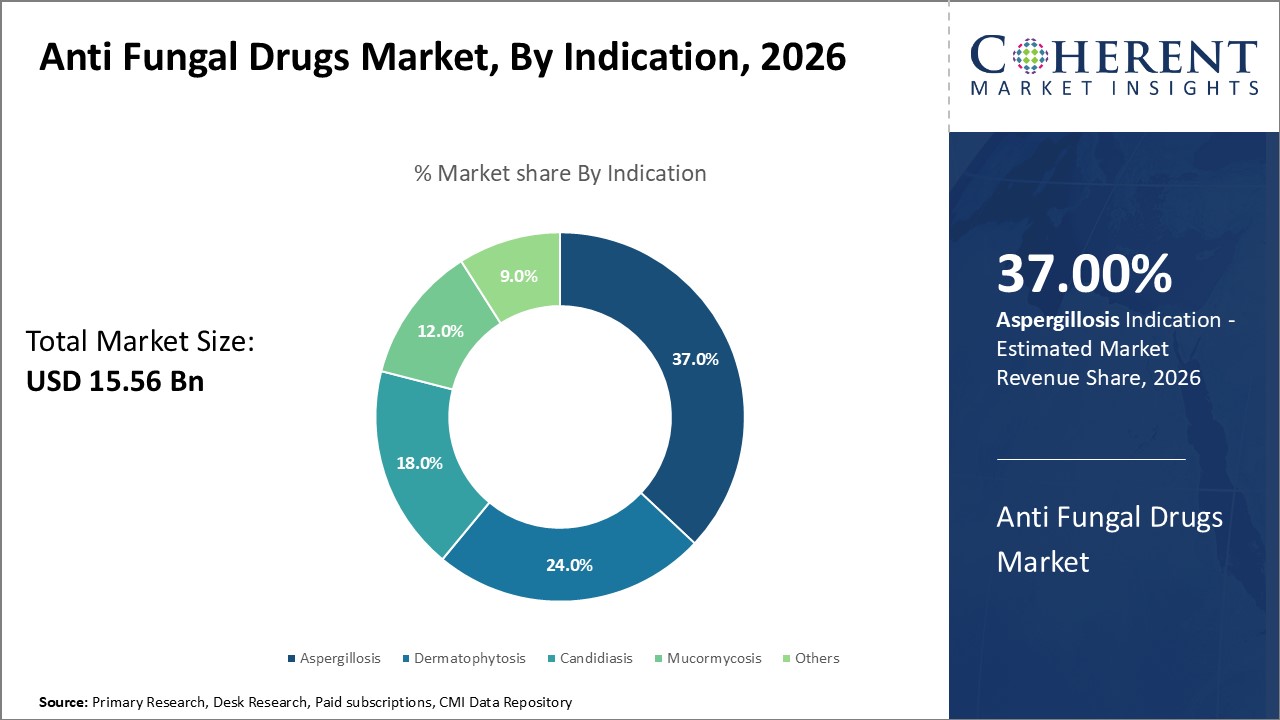
Anti Fungal Drugs Market Insights, By Indication - Aspergillosis contribute the highest share of the market owing to its advancements in antifungal drug development
The rising incidence of aspergillosis among immunocompromised individuals, such as cancer patients, transplant recipients, and those with chronic lung diseases, drives strong demand in the antifungal drugs market. Healthcare providers are detecting and treating infections earlier thanks to improved diagnostics and growing awareness of invasive fungal diseases. Pharmaceutical companies continue to develop targeted antifungal therapies that enhance treatment outcomes. Ongoing research and increasing healthcare investments further strengthen efforts to manage aspergillosis, firmly establishing its influence on market growth.
For instance, BDR Pharmaceutical introduced Zisavel Capsules, the first-of-its-kind generic drug for treating invasive aspergillosis and mucormycosis. Zisavel belongs to the isavuconazole family, a class of medications known as azole antifungals.
Anti Fungal Drugs Market Insights, By Dosage Form - Tablets contribute the highest share of the market owing to its improved diagnostic capabilities
Tablets contribute significantly to the growth of the antifungal drugs market as patients and healthcare providers favor them for their convenience, easy administration, and high compliance, particularly in outpatient settings. Manufacturers have improved oral formulations to boost absorption and minimize side effects. Patients use tablets widely to treat common infections like athlete’s foot and oral thrush due to their accessibility and non-invasive form. Expanding retail and online channels continue to increase their availability, reinforcing tablets as a central option in antifungal treatment. For instance, Cadila Pharmaceuticals launched Posaconazole tablets, a new triazole antifungal drug that effectively treats a wide range of invasive fungal diseases.
Anti Fungal Drugs Market Insights, By Distribution Channel - Hospital Pharmacies contribute the highest share of the market owing to its integration with antimicrobial stewardship programs
Hospital pharmacies drive the antifungal drugs market by managing severe and systemic fungal infections that demand urgent and specialized treatment. They provide prompt access to advanced antifungal therapies; especially intravenous formulations used in critical care. Pharmacists ensure precise dosing, monitor for drug interactions, and improve overall treatment safety. They also support antimicrobial stewardship programs to encourage responsible medication use. As hospitalization rates rise and patient cases become more complex, hospital pharmacies continue to play a vital role in delivering effective antifungal care.
Regional Insights
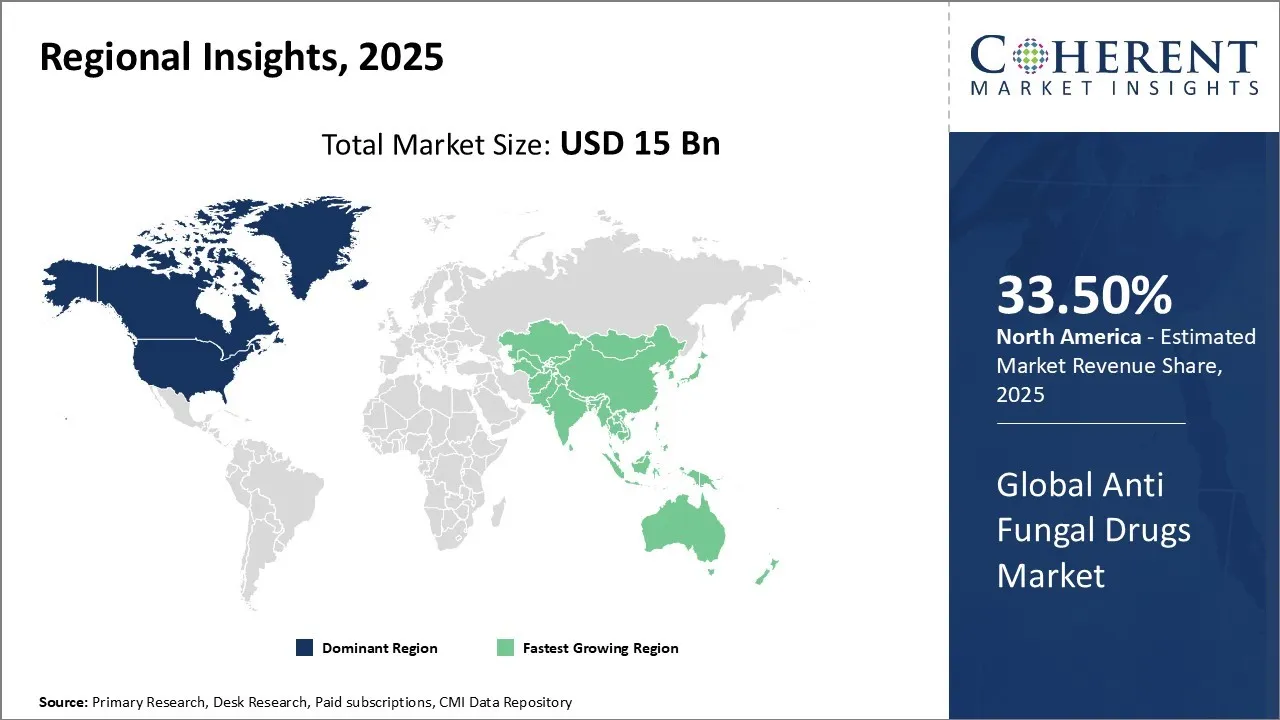
North America Anti Fungal Drugs Market Trends
North America dominates the overall market with an estimated share of 33.50% in 2026. A high burden of fungal infections and a strong healthcare infrastructure drive growth trend in the North America antifungal drugs market. Healthcare providers increasingly diagnose infections early and offer advanced treatment options, boosting demand. Pharmaceutical companies actively invest in developing new antifungal therapies, while regulatory bodies support innovation through streamlined approvals. Key industry players continue to strengthen the market with ongoing research and partnerships. Hospitals and retail pharmacies expand the use of antifungal medications, further accelerating market development across the region. For instance, in January 2024, Vanda Pharmaceuticals Inc. announced that the U.S. Food and Drug Administration (FDA) has approved its Investigational New Drug (IND) application to evaluate VTR-297 for treating onychomycosis.
Asia Pacific Anti Fungal Drugs Market Trends
Rising cases of fungal infections, greater awareness of early diagnosis, and better access to healthcare are driving steady growth in the Asia Pacific antifungal drugs market. Countries such as India, China, and Japan are fueling demand by expanding their healthcare infrastructure and strengthening their pharmaceutical industries. Pharmaceutical companies are offering a wide range of branded and generic antifungal medications, improving treatment accessibility. Ongoing research and development efforts, along with strategic partnerships, are actively supporting the market’s continued expansion across the region. For instance, Sato Pharmaceutical Co., Ltd. and Eisai Co., Ltd. unveiled NAILIN® Capsules 100mg, an oral antifungal agent, in Japan.
United States Anti Fungal Drugs Market Trends
Hospitals and retail pharmacies across the U.S. actively expand the distribution of antifungal drugs. They increase patient convenience and adherence by providing oral and topical formulations through multiple channels, which broadens market reach and fuels growth. U.S. regulatory agencies expedite approval of new antifungal medications via priority reviews. Government programs fund research and public health efforts, driving innovation and enhancing treatment access. Advanced healthcare infrastructure enables early detection and effective management of fungal infections, supporting the widespread use of antifungal therapies. For instance, in U.S., Fresenius Kabi has introduced Posaconazole Injection, a generic substitute for Noxafil®, for use in treating or preventing serious fungal infections in adults and children who have an increased chance of getting these infections due to a weakened immune system.
India Anti Fungal Drugs Market Trends
India is rapidly expanding its healthcare infrastructure, including hospitals and clinics, to improve access to advanced diagnostics and antifungal treatments. This growth enables better management of fungal infections and fuels market development. India’s robust generic pharmaceutical industry produces affordable antifungal drugs, increasing accessibility. The widespread availability of cost-effective generics encourages use in both public and private healthcare. Government policies actively promote pharmaceutical research and public health awareness, further driving steady market expansion. For instance, in Ahmedabad, Intas Pharmaceuticals Limited announced the launch of an innovative antifungal drug, Super Bioavailable Itraconazole-SB 100mg, under the brand name Itaspor-SB Forte/Subawin. The company expects the drug to significantly lower the cost of fungal infection treatment, improve patient compliance, and reduce the time doctors need for patient counselling.
Market Report Scope
Anti Fungal Drugs Market Report Coverage
| Report Coverage | Details | ||
|---|---|---|---|
| Base Year: | 2025 | Market Size in 2026: | USD 15.55 Bn |
| Historical Data for: | 2020 To 2024 | Forecast Period: | 2026 To 2033 |
| Forecast Period 2026 to 2033 CAGR: | 3.7% | 2033 Value Projection: | USD 20.06 Bn |
| Geographies covered: |
| ||
| Segments covered: |
| ||
| Companies covered: | GlaxoSmithKline Plc, Bayer AG, Abbott Laboratories, Merck & Co., Inc, Glenmark Pharmaceuticals Limited, Enzon Pharmaceuticals, Inc., Pfizer Inc., Gilead Sciences, Inc., Sanofi S.A., and Astellas Pharma, Inc., Alembic Pharmaceuticals Limited, and SCYNEXIS, Inc. | ||
| Growth Drivers: |
| ||
| Restraints & Challenges: |
| ||
Anti Fungal Drugs Market Trend
- Rising Prevalence of Fungal Infections
The increasing incidence of fungal infections globally, particularly among immunocompromised patients such as those with cancer, HIV, or undergoing organ transplants, drives the antifungal drugs market. According to the U.S. Centers For Disease Control and Prevention, each year, fungal diseases lead to over 75,000 hospitalizations and close to 9 million outpatient visits. Factors like diabetes, widespread antibiotic use, and invasive medical procedures contribute to vulnerability. This growing patient pool creates high demand for effective antifungal therapies, pushing healthcare providers and pharmaceutical companies to focus on innovative treatment solutions and broader access to antifungal medications.
Anti Fungal Drugs Market Opportunity
- Development of Novel Drug Formulations
Innovating new drug formulations presents opportunities to enhance patient compliance and treatment outcomes. Extended-release, combination therapies, and targeted delivery systems can improve efficacy and reduce side effects. Developing oral, topical, and inhaled formulations for difficult-to-treat fungal infections opens new therapeutic avenues. These advancements can cater to diverse patient needs, expanding the range of treatment options available and differentiating products in a competitive market.
Anti Fungal Drugs Market News
- In May 2025, researchers at Brown University developed a new nanotechnology-based method that may enhance the treatment of fungal infections, especially those caused by drug-resistant Candida species.
- In January 2025, the University of Exeter launched a new funding call to support global innovations addressing antifungal drug resistance in humans, plants, and animals. The initiative aims to combat the growing threat of treatment-resistant fungal infections worldwide.
Analyst Opinion (Expert Opinion)
- The antifungal drugs market is poised at a critical inflection point driven primarily by the alarming rise in invasive fungal infections, which now represent a significant threat to immunocompromised patients worldwide. Recent data from the Centers for Disease Control and Prevention (CDC) highlights that approximately 75% of invasive fungal infections occur in hospitalized patients with weakened immune systems, such as those undergoing chemotherapy or organ transplants. This has pushed clinicians to increasingly rely on broad-spectrum azoles like voriconazole, whose sales surged by over 15% in key markets last year alone, reflecting its clinical preference.
- However, the escalating issue of antifungal resistance, notably in Candida auris—a pathogen responsible for outbreaks in over 30 countries—cannot be overstated. Resistance rates to first-line azoles in C. auris have exceeded 90% in some hospital settings, underscoring an urgent need for novel agents with new mechanisms of action. Recent FDA approvals, such as ibrexafungerp, mark a turning point by offering alternative treatments that circumvent existing resistance pathways.
- Moreover, the increasing integration of rapid diagnostic tools like MALDI-TOF mass spectrometry and PCR assays in hospital settings is transforming antifungal stewardship. Facilities employing these diagnostics have reported a 20-30% improvement in targeted therapy initiation, reducing unnecessary broad-spectrum antifungal use and slowing resistance emergence.
Speak to the analyst
Want personalized insights?
Take the findings above to one of our principal consultants, or have the report rebuilt around the segments, geographies and competitors you actually track.
Market Segmentation
- By Drug Type (Revenue, USD Bn, 2021 - 2033)
- Echinocandins
- Polyenes
- Allylamines
- Azoles
- Others
- By Application (Revenue, USD Bn, 2021 - 2033)
- Neurosurgery
- Plastic Surgery
- Cardiovascular Surgery
- Obstetrics & Gynecology
- Others
- By Indication (Revenue, USD Bn, 2021 - 2033)
- Aspergillosis
- Dermatophytosis
- Candidiasis
- Mucormycosis
- Others
- By Dosage Form (Revenue, USD Bn, 2021 - 2033)
- Powders
- Ointments
- Injections
- Tablets
- Others
- By Distribution Channel (Revenue, USD Bn, 2021 - 2033)
- Hospital Pharmacies
- Online Pharmacies
- Retail Pharmacies
- By Region (Revenue, USD Bn, 2021 - 2033)
- North America
- U.S.
- Canada
- Latin America
- Brazil
- Argentina
- Mexico
- Rest of Latin America
- Europe
- Germany
- U.K.
- Spain
- France
- Italy
- Russia
- Rest of Europe
- Asia Pacific
- China
- India
- Japan
- Australia
- South Korea
- ASEAN
- Rest of Asia Pacific
- Middle East
- GCC Countries
- Israel
- Rest of Middle East
- Africa
- South Africa
- North Africa
- Central Africa
- North America
- Key Players Insights
- GlaxoSmithKline Plc
- Bayer AG
- Abbott Laboratories
- Merck & Co., Inc.
- Glenmark Pharmaceuticals Limited
- Enzon Pharmaceuticals, Inc.
- Pfizer Inc.
- Gilead Sciences, Inc.
- Sanofi S.A.
- Astellas Pharma, Inc.
- Alembic Pharmaceuticals Limited
- SCYNEXIS, Inc.
Sources
Primary Research Interviews
- Discussions with infectious disease specialists and clinical microbiologists from major hospitals
- Interviews with procurement managers in hospital pharmacies and retail chains
- Conversations with regulatory experts from pharmaceutical manufacturing firms
- Feedback from R&D heads and formulation scientists in antifungal drug development
Databases
- World Health Organization (WHO) Global Health Observatory
- Centers for Disease Control and Prevention (CDC) Antifungal Resistance Database
- U.S. Food and Drug Administration (FDA) Drug Approval and Safety Database
- European Centre for Disease Prevention and Control (ECDC) Surveillance Atlas
- ClinicalTrials.gov (U.S. National Library of Medicine)
Magazines
- Pharmaceutical Executive
- Infectious Disease Special Edition (IDSE)
- PharmaTimes
- The Pharma Letter
Journals
- Journal of Antimicrobial Chemotherapy
- Clinical Infectious Diseases (CID)
- Medical Mycology
- Antimicrobial Agents and Chemotherapy (AAC)
- The Lancet Infectious Diseases
Newspapers
- The New York Times – Health Section
- The Guardian – Global Health Coverage
- The Hindu – Science and Health Segment
- The Economic Times (India) – Pharma and Healthcare News
- Financial Times – Global Pharmaceutical Updates
Associations
- Infectious Diseases Society of America (IDSA)
- International Society for Human and Animal Mycology (ISHAM)
- Indian Medical Association (IMA)
- European Society of Clinical Microbiology and Infectious Diseases (ESCMID)
- Global Action Fund for Fungal Infections (GAFFI)
Public Domain Sources
- World Bank Healthcare Indicators
- Ministry of Health and Family Welfare (India)
- U.S. Department of Health and Human Services (HHS)
- National Health Service (NHS) UK Reports
- European Medicines Agency (EMA) Public Reports
Proprietary Elements
- CMI Data Analytics Tool, and Proprietary CMI Existing Repository of information for last 8 years
Get access to 250+ pages report
Every segment, forecast, competitor profile and data table behind the analysis above — available for instant download.
- ESOMAR Member
- ISO 9001:2015 Certified
- D-U-N-S Registered
- GDPR & CCPA Compliant
Missing comfort of reading report in your local language? Find your preferred language:
Transform your Strategy with Exclusive Trending Reports
Frequently Asked Questions
The Anti Fungal Drugs Market is estimated to be valued at USD 15.55 Bn in 2026, and is expected to reach USD 20.06 Bn by 2033.
The CAGR of the Anti Fungal Drugs Market is projected to be 3.7% from 2026 to 2033.
Increasing product approvals by the regulatory bodies and increasing adoption of inorganic growth strategies, such as agreements, is expected to drive the market growth.
Azoles is the leading drug type segment in the market.
Increasing product recalls are expected to hinder the market over the forecast period.
The major players operating in the market are GlaxoSmithKline Plc, Bayer AG, Abbott Laboratories, Merck & Co., Inc, Glenmark Pharmaceuticals Limited, Enzon Pharmaceuticals, Inc., Pfizer Inc., Gilead Sciences, Inc., Sanofi S.A., and Astellas Pharma, Inc., Alembic Pharmaceuticals Limited, and SCYNEXIS, Inc.