

Antifreeze Proteins Market Size and Share Analysis- Growth Trends and Forecasts (2026-2033)
The Antifreeze Proteins Market size is anticipated to grow at a CAGR of 34.8% with USD 24.03 Mn in 2026 and is expected to reach USD 194.39 Mn by 2033. The growth of the market is attributed to the increasing use of antifreeze proteins in cryopreservation, growing demand for frozen food products with improved quality and shelf life, rising applications in the medical and biotechnology industries, and increasing research activities in protein engineering. Antifreeze substances, such as antifreeze proteins (AFPs), can inhibit the formation and recrystallization of ice crystals, and have attracted great attention and are widely applied in frozen food preservation, cryopreservation, and biomedicine.
Key Takeaways
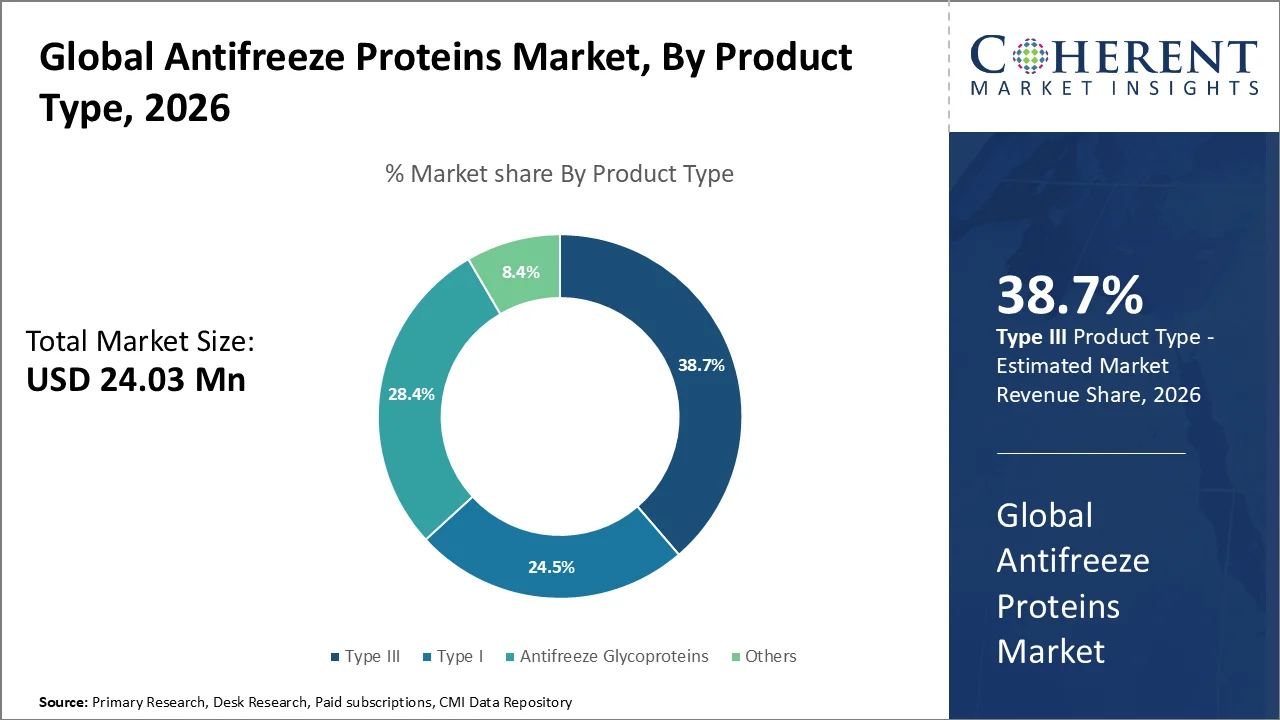
- Type III segment is projected to lead the market with 38.7% in 2026. The segment is expected to expand because of its superior thermal hysteresis activity and ice recrystallization inhibition qualities. It is widely utilized in cryopreservation, regenerative medicine, organ transplantation and frozen food preservation. Active Type III antifreeze proteins were found to significantly better preserve intact ovarian follicles and DNA double-strand break damage than inactive Type III isoforms, with implications for superior cryoprotective performance for biomedical applications, a study published in the Computational and Structural Biotechnology Journal (Elsevier) reported.
- Solid category is expected to lead the market with 66.4% in 2026. The reason for the dominance of this market is its longer shelf life, improved stability during storage and transit, ease of handling in laboratory and pharmaceutical settings, and compatibility with freeze-dried formulations used in biotechnology and medical research. Lyophilization (freeze-drying) is a commonly employed method to enhance the stability and shelf life of protein-based biopharmaceuticals and allow for long-term storage with the retention of biological activity as per the International Council for Harmonisation (ICH) Q5C Stability Guideline.
- Fish segment is predicted to have the greatest market share of 52.8% in 2026. Growth of this category is driven by the commercial availability of fish-derived antifreeze proteins, which are widely available, and their proven efficacy in cryobiology and food preservation. Global output of aquatic animals reached a record 223.2 Mn tonnes, including 185.4 Mn tonnes of fisheries and aquaculture products, in the latest 2024 State of World Fisheries and Aquaculture (SOFIA) report by the Food and Agriculture Organization of the United Nations.
- The Medical Industry category is estimated to dominate the market with 47.6% in 2026. The segment’s rise is due to increasing usage of antifreeze proteins in cryopreservation of cells, tissues, embryos and organs, combined with rising investments in regenerative medicine and biobanking. According to the 2025 study from the International Society for Cell & Gene Therapy (ISCT), the growing development of cell and gene therapy pipelines around the globe is driving the need for enhanced cryopreservation methods to sustain cell viability during manufacture and clinical use.
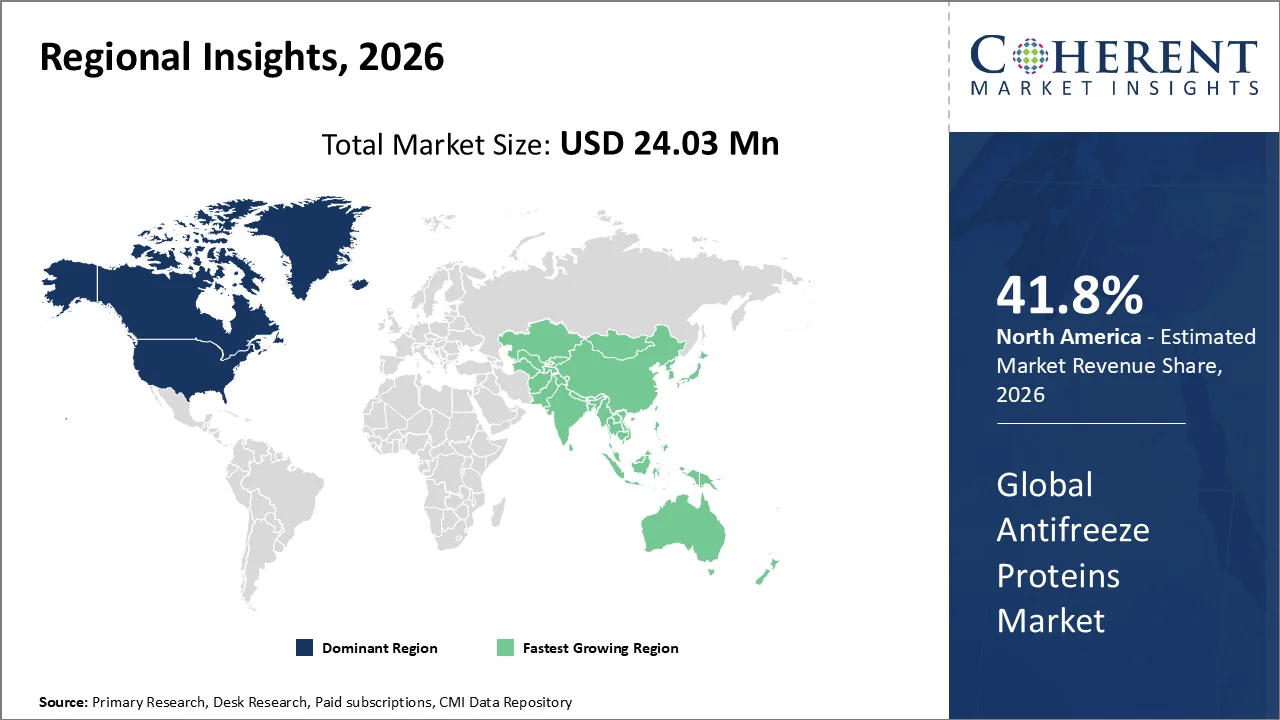
- North America is projected to dominate the worldwide antifreeze proteins market with a market share of 41.8% in 2026. The leadership in the area is powered by huge investments in biotechnology and life science studies along with increasing applications of cryogenic techniques. According to the Alliance for Regenerative Medicine Annual Report 2025, the industry of regenerative medicines was able to attract approximately USD 15.2 billion in investment worldwide in 2024. North America dominated the field of cell and gene therapies.
Segmental Insights
Why is Type III Holding the Largest Share?
Based on product type, the Type III segment is expected to hold the largest share of 38.7% for the Antifreeze Proteins Market in 2026. This is due to the high performance of the segment in terms of thermal hysteresis activity and ice recrystallization inhibition property, which enables its wide range of applications.
Based on the National Center for Biotechnology Information, research carried out in 2024 and published in Cryobiology showed that the use of type III antifreeze proteins significantly improved cell survival rate upon thawing as well as minimized cryoinjury as compared to other methods of cryopreservation.
In March 2025, Alpha Teknova and Pluristyx unveiled PluriFreeze Cryopreservation System, a proprietary cryopreservation platform developed for allogeneic cell therapy manufacturing.
- Current Industry Events of 2026
- Market Size Estimation
- Regional Breakdown
- Competitive Landscape
- Customer Intelligence
- Segmental Analysis
- Pricing Analysis
- Key Market Drivers, Challenges & Future Trends
- Customized Insights Section
Solid Form Holds the Largest Market Share
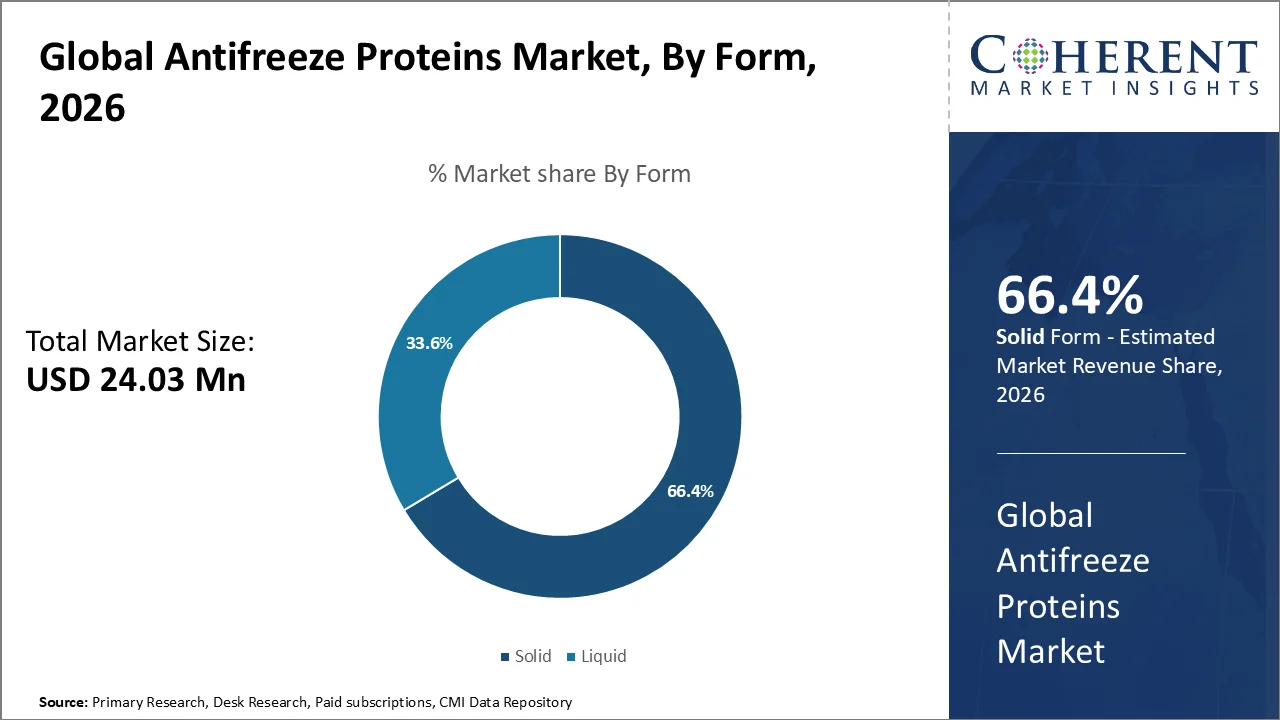
On the basis of form, the Solid segment is estimated to hold the largest market share of 66.4% in 2026, owing to its greater storage stability, longer shelf life, easier transportability, and suitability for lyophilized drug and biotech applications.
As per research conducted by scientists from the US Food and Drug Administration in 2025, there was a continuing high prevalence of the use of freeze-dried drug formulations within the pharmaceuticals industry. This is based on the analysis of 162 FDA applications regarding lyophilized drug products, which include 24 NDAs, 118 ANDAs and 20 BLAs.
In October 2024, the Parenteral Drug Association hosted the PDA Aseptic Processing of Biopharmaceuticals Conference 2024 in Incheon, South Korea (October 29–30, 2024). The meeting was focused on Annex 1 implementation, aseptic processing, contamination control methods (CCS) and quality management for lyophilized biologics.
Why is Fish the Leading Source?
Based on source, Fish segment is estimated to contribute the greatest share of 52.8% in 2026. The segment is driven by the high commercial availability of fish-derived antifreeze proteins and their efficiency in cryobiology, food preservation, and biomedical research.
According to the Copernicus Marine Service, the ocean constitutes over 90% of the inhabitable space on Earth and hosts around 250,000 known marine species, with many more remaining to be discovered.
In April 2025, The BioLife Solutions announced the acquisition of PanTHERA CryoSolutions, a developer of proprietary Ice Recrystallization Inhibitor (IRI) technology for use in biopreservation and cryogenic storage applications.
Why is the Medical Industry Holding the Largest Share?
Based on end user, the Medical Industry sector is anticipated to be the leading segment in the Antifreeze Proteins Market, with a share of 47.6% in 2026. The expansion of the segment is driven by expanding applications in cryopreservation of stem cells, embryos, tissues and organs, and increased investments in regenerative medicine and biobanking.
According to the peer-reviewed article in Biotechnology Advances (2025) published by Elsevier, there is an increase in cryopreservation requirements due to the rapid growth in cell therapy, assisted reproduction, and regenerative medicine, which are all dependent on successful preservation of the cells after thawing.
Market Growth Drivers
Rising Growth in Organ Transplantation and Tissue Preservation is Driving the Antifreeze Proteins Market
The increasing cases of organ transplantations worldwide are contributing to the need for improved cryopreservation methods, which include the antifreeze proteins. Antifreeze proteins help reduce injury from the ice crystals and improve organ, tissue, and cellular preservation during transportation. Increased use of antifreeze proteins in transplantation therapy is expected to rise with the increased focus on increasing organ viability.
According to Global Observatory on Donation and Transplantation (GODT), a total of 173,727 organ transplants has been done in 2024 which is a 2% rise as compared to 2023. The rising incidence of organ transplants necessitates the need for development of new organ preservation and cryopreservation techniques that encourage the use of antifreeze proteins in transplantation.
Current Events and Their Impact on the Antifreeze Proteins Market
Current Event | Description and its Impact |
WHO Supports Global Expansion of Cell and Gene Therapy to Strengthen Advanced Healthcare |
|
FDA Continues to Advance Regulatory Support for Human Cell and Gene Therapy Products |
|
Antifreeze Proteins Market Trends
- Increased Demand for Cryopreservation with the Increase in Production of Cell Therapies Increased demand for cell and gene therapy, which includes the application of antifreeze protein technology to increase cell viability post-thawing, is leading to the increased need for cryopreservation technologies. According to ARM 2025 report, there are more than 2,000 active clinical trials of regenerative medicine being conducted around the world.
- Increasing Number of IVF and Assisted Reproductive Technology (ART) Procedures Resulting in AFP Application. There is an increasing trend of freezing embryos and eggs. There are more than 1.1 million IVF procedures performed annually just in Europe alone, indicating that there is high cryopreservation dependence in the field of reproductive medicine, as per the European Society of Human Reproduction and Embryology (ESHRE).
- Expanding biobank infrastructure on a global scale helps increase the demand for AFP. Biobanks are expanding rapidly to help advance regenerative medicine and tailor treatments. The National Cancer Institute (NCI, NIH) reports that there are more than 350 active biobanks and biospecimen banks in the US alone, storing millions of biological specimens under cryogenic conditions.
Regional Insights
North America Dominates the Antifreeze Proteins Market
North America is projected to lead the worldwide antifreeze proteins market by holding 41.8% of the market in 2026. The region’s leadership is fueled by robust investments in biotechnology, regenerative medicine and life sciences R&D, and the growing adoption of advanced cryopreservation technologies across cell therapy, stem cell banking and biopharmaceutical manufacturing. In May 2026, the American Biotech Innovation Alliance (ABIA) launched to unite U.S. biotechnology leaders in advancing a national strategy to strengthen the country's leadership in biotech innovation.
Asia Pacific Emerges as the Fastest-Growing Region
The Asia Pacific is expected to be the fastest expanding antifreeze proteins market, owing to the rapid growth of biotechnology, increasing number of IVF procedures and heavy expenditures in regenerative medicine infrastructure in China, Japan, South Korea and India.
According to the International Society for Stem Cell Research (ISSCR) clearly states that the domain of stem cell and regenerative medicine is witnessing rapid expansion on an international scale, with significant work being done in the Asia-Pacific region.
In October 2025, Cryoport expanded its global supply chain network by opening a new biopharma logistics center in Europe to support temperature-controlled transport of cell and gene therapies.
Adoption of Advanced Biotechnology Infrastructure and Expanding Cryopreservation Ecosystem are Accelerating the Antifreeze Proteins Market in the U.S.
The U.S. is a prominent consumer of antifreeze proteins because of its advanced biotechnology infrastructure, extensive development pipeline for cellular and gene therapy, and wide usage of cryopreservation techniques in regenerative medicine and biobanking. Expansion of the country’s clinical and research environment is creating high demand for ice recrystallization inhibition and cryoprotective compounds.
According to the U.S. Food and Drug Administration (FDA, 2025), the U.S. has a fast-growing collection of cellular and gene therapy products in terms of development and regulation, such as CAR-T products, stem cell products, and gene-edited cells products, all of which need long-term cryopreservation and transportation
China Biotechnology Expansion and Government-Led Cryogenic Research Programs are Accelerating the Antifreeze Proteins Market
China is becoming one of the high-potential countries for antifreeze proteins because of the huge investments made by its government into the fields of biotechnology, synthetic biology, and regenerative medicine. China is fast developing sophisticated cryogenic facilities to undertake biomedical studies and applications.
According to the Chinese Academy of Sciences (CAS, 2025), China is stepping up research in protein engineering, synthetic biology, and regenerative medicine platforms that are the enabling technologies for cryopreservation and antifreeze proteins.
Who are the Major Companies in Antifreeze Proteins Industry
Some of the major key players in Antifreeze Proteins Market are Kaneka Corporation, Rishon Biochem Co., Ltd, Aqua Bounty Technologies, Inc., Sirona Biochem Corp., Unilever Plc., Nichirei Corporation, A/F Protein Inc., Kodera Herb Garden Co., ProtoKinetix, Inc., Shanghai Yu Tao Industrial Co., Ltd., and MyBiosource, Inc.
Key News
- In May 2025, Kaneka announced the elucidation of the crystal structure of PHA synthase, a development supporting its biotechnology and biomaterials research capabilities.
- In June 2026, X-Therma launched its XT-NoVo and TimeSeal platform, enabling sub-zero, non-freezing preservation and transport of sensitive biologics using a non-toxic antifreeze molecule.
Market Report Scope
Antifreeze Proteins Market Report Coverage
| Report Coverage | Details | ||
|---|---|---|---|
| Base Year: | 2025 | Market Size in 2026: | USD 24.03 Mn |
| Historical Data for: | 2020 To 2024 | Forecast Period: | 2026 To 2033 |
| Forecast Period 2026 to 2033 CAGR: | 34.8% | 2033 Value Projection: | USD 194.39 Mn |
| Geographies covered: |
| ||
| Segments covered: |
| ||
| Companies covered: | Kaneka Corporation, Rishon Biochem Co., Ltd, Aqua Bounty Technologies, Inc., Sirona Biochem Corp., Unilever Plc., Nichirei Corporation, A/F Protein Inc., Kodera Herb Garden Co., ProtoKinetix, Inc., Shanghai Yu Tao Industrial Co., Ltd., and MyBiosource, Inc. | ||
| Growth Drivers: |
| ||
| Restraints & Challenges: |
| ||
Analyst Opinion
- Antifreeze Proteins Market is experiencing significant growth due to their wide usage in cryopreservation, regenerative medicines, and cell therapies. It has been found from recent studies conducted in the field of science that traditional cryoprotectants like DMSO (Dimethyl Sulfoxide) and glycerol face certain challenges in cytotoxicity. This is leading to a search for antifreeze proteins and peptides.
- Antifreeze proteins have become an important business avenue as far as food preservation is concerned. This was pointed out by the Foods Review in 2025 which states that antifreeze proteins, antifreeze peptides, polysaccharides, and analogs are being investigated to inhibit ice recrystallization, prevent food texture loss, protein breakdown, and preserve frozen foods.
- The constant development in recombinant protein engineering is bound to speed up the process of commercialization. The study in 2025 revealed that the recombinant snow flea antifreeze protein showed a 67.6% recovery rate after thawing and was efficient at inhibiting ice recrystallization, thus illustrating the promise of antifreeze proteins as future cryoprotectants.
Speak to the analyst
Want personalized insights?
Take the findings above to one of our principal consultants, or have the report rebuilt around the segments, geographies and competitors you actually track.
Market Segmentation
- By Product Type (Revenue, USD Mn, 2021-2033)
- Type I
- Type III
- Antifreeze Glycoproteins
- Others
- By Form (Revenue, USD Mn, 2021-2033)
- Solid
- Liquid
- By Source (Revenue, USD Mn, 2021-2033)
- Fish
- Recombinant
- Bacteria
- Fungi
- Plant
- Animals
- By End User (Revenue, USD Mn, 2021-2033)
- Medical Industry
- Food & Beverages Industry
- Cosmetics Industry
- Others
- By Region (Revenue, USD Mn, 2021-2033)
- North America
- U.S.
- Canada
- Latin America
- Brazil
- Mexico
- Argentina
- Rest of Latin America
- Europe
- Germany
- U.K.
- France
- Italy
- Spain
- Russia
- Rest of Europe
- Asia Pacific
- China
- India
- Japan
- Australia
- South Korea
- ASEAN
- Rest of Asia Pacific
- Middle East
- GCC
- Israel
- Rest of Middle East
- Africa
- South Africa
- Central Africa
- North Africa
- North America
Sources
Primary Research Interviews
- Biotechnology Companies
- Antifreeze Protein Manufacturers
- Cryopreservation Solution Providers
- Cell & Gene Therapy Companies
- Biopharmaceutical Manufacturers
- Biobank and Biorepository Managers
- Regenerative Medicine Researchers
- Academic and Research Institutes
- Food & Beverage Manufacturers
- Cryobiology Experts
- Pharmaceutical Industry Executives
- Others
Databases
- Bloomberg Terminal
- Thomson Reuters Eikon
- Crunchbase
- PitchBook
- Others
Magazines
- Genetic Engineering & Biotechnology News (GEN)
- BioPharma Dive
- Nature Biotechnology
- Pharmaceutical Technology
- Bioprocess International
- Drug Discovery World
- Others
Journals
- Cryobiology
- Biotechnology Advances
- Foods
- International Journal of Biological Macromolecules
- Journal of Controlled Release
- Computational and Structural Biotechnology Journal
- Journal of Biotechnology
- Nature Biotechnology
- Others
Newspapers
- Reuters
- Bloomberg News
- Financial Times
- The Wall Street Journal
- Nikkei Asia
- The Economic Times
- Business Standard
- Others
Associations
- International Society for Cell & Gene Therapy (ISCT)
- International Society for Stem Cell Research (ISSCR)
- Society for Cryobiology
- International Society for Biological and Environmental Repositories (ISBER)
- Alliance for Regenerative Medicine (ARM)
- Parenteral Drug Association (PDA)
- Others
Public Domain Sources
- U.S. Food and Drug Administration (FDA)
- National Institutes of Health (NIH)
- National Cancer Institute (NCI)
- World Health Organization (WHO)
- Food and Agriculture Organization of the United Nations (FAO)
- Global Observatory on Donation and Transplantation (GODT)
- International Council for Harmonisation (ICH)
- Chinese Academy of Sciences (CAS)
- Copernicus Marine Service
- European Society of Human Reproduction and Embryology (ESHRE)
- Others
Proprietary Elements
- CMI Data Analytics Tool
- Proprietary CMI Existing Repository of Information for the Last 10 Years
Get access to 250+ pages report
Every segment, forecast, competitor profile and data table behind the analysis above — available for instant download.
- ESOMAR Member
- ISO 9001:2015 Certified
- D-U-N-S Registered
- GDPR & CCPA Compliant
Missing comfort of reading report in your local language? Find your preferred language:
Transform your Strategy with Exclusive Trending Reports
Frequently Asked Questions
The Antifreeze Proteins Market is expected to reach USD 194.39 Mn by 2033.
Major players operating in the global Antifreeze Proteins Market include Kaneka Corporation, Rishon Biochem Co., Ltd, Aqua Bounty Technologies, Inc., Sirona Biochem Corp., Unilever Plc., Nichirei Corporation, A/F Protein Inc., Kodera Herb Garden Co., ProtoKinetix, Inc., Shanghai Yu Tao Industrial Co., Ltd., and MyBiosource, Inc.
The high production and purification costs of antifreeze proteins, limited large-scale commercial manufacturing capacity, stringent regulatory requirements for medical applications, and complex extraction and recombinant production processes are the key factors hampering market growth.
The increasing adoption of cryopreservation technologies, growing demand for regenerative medicine and cell therapies, rising applications in frozen food preservation, expanding organ transplantation and biobanking activities, and advancements in recombinant protein engineering are driving the growth of the Antifreeze Proteins Market.
The Antifreeze Proteins Market is anticipated to grow at a CAGR of 34.8% between 2026 and 2033.
North America is expected to account for the largest share of the global Antifreeze Proteins Market during the forecast period, owing to strong biotechnology infrastructure, increasing regenerative medicine research, and widespread adoption of cryopreservation technologies.
The medical industry is the largest end user due to the increasing use of antifreeze proteins in cryopreservation of stem cells, embryos, tissues, and organs, along with growing investments in regenerative medicine, cell therapy, and biobanking.