

Aroma Chemicals Market Size and Forecast – 2026 to 2033
The global aroma chemicals market is estimated to be valued at USD 7.44 Bn in 2026 and is expected to exhibit a compound annual growth rate (CAGR) of 6.6% during the forecast period, reaching USD 11.60 Bn in 2033.
Key Takeaways from the Aroma Chemicals Market Report
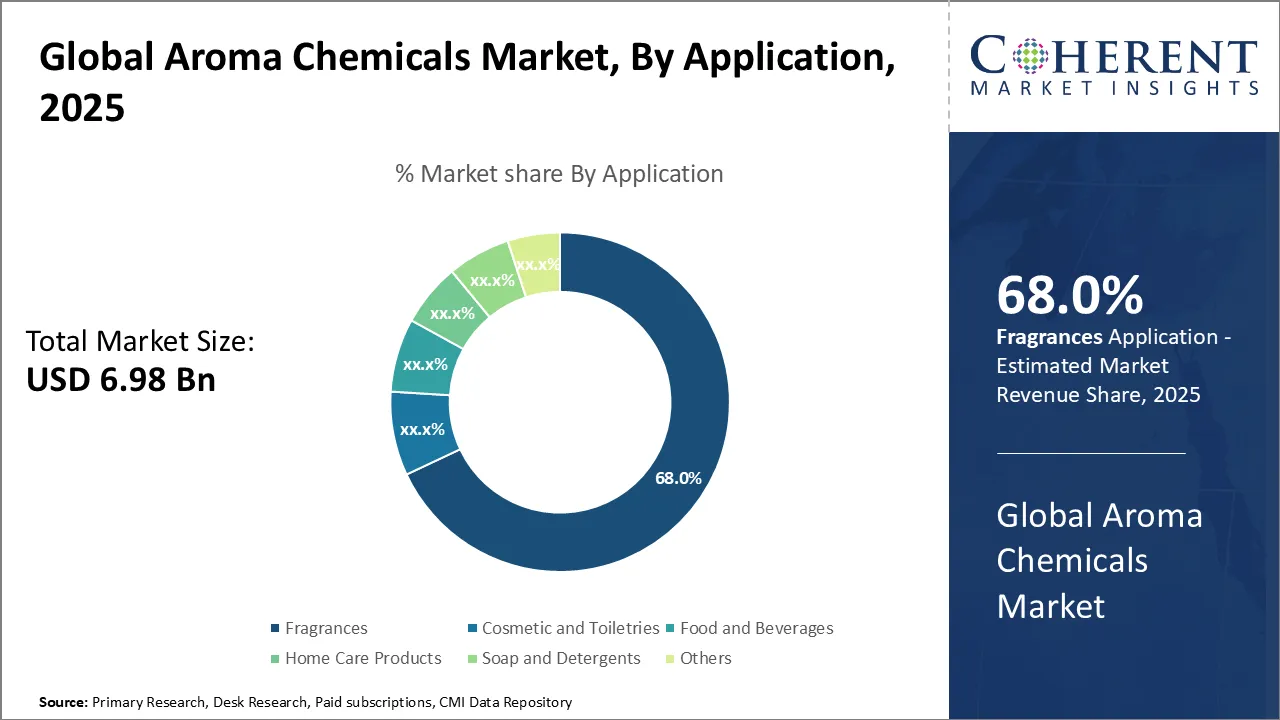
- Fragrances remain the most lucrative application of aroma chemicals, accounting for a market share of around 69% in 2026.
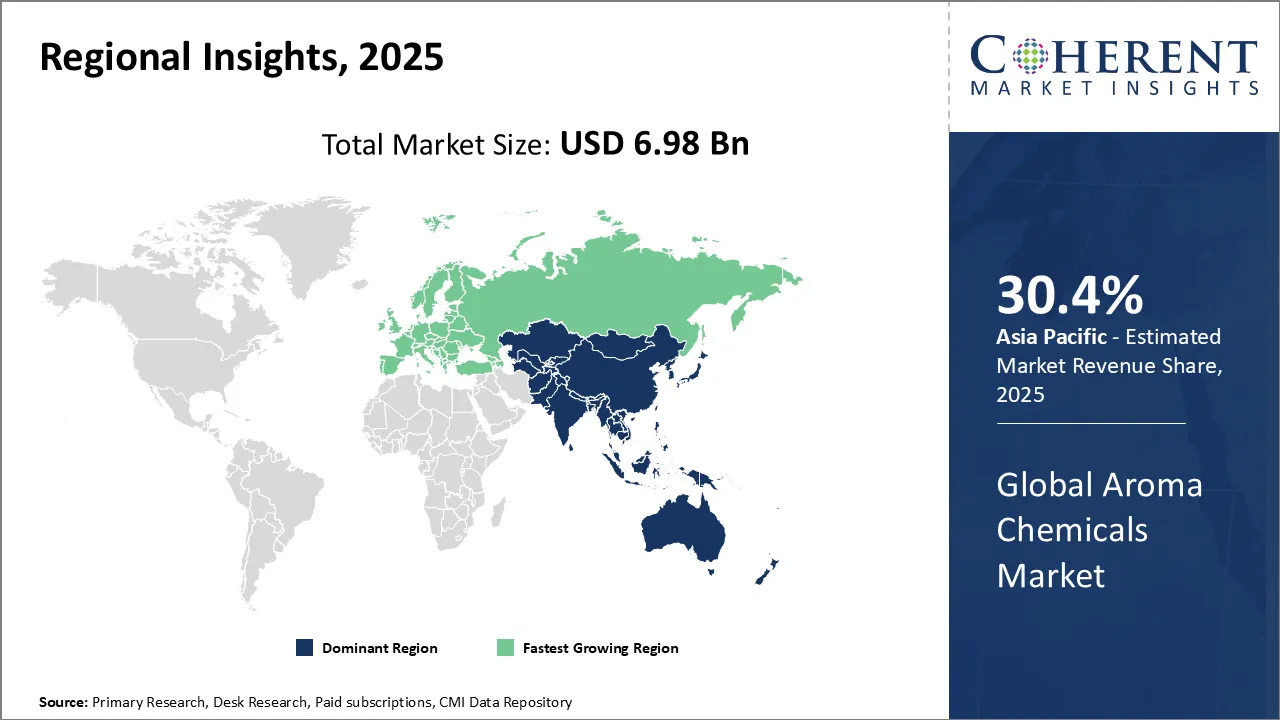
- Asia Pacific remains the leading region in aroma chemical consumption, accounting for 30.4% of the market revenue share by 2026.
- Europe remains the second-largest market for aroma chemicals, capturing a market share of 27.6% in 2026.
Aroma Chemicals Market Overview
The global aroma chemicals market is expected to grow steadily during the forecast period. This can be attributed to increasing consumption of fragrances across cosmetics and toiletries, soaps and detergents, and food and beverage industries.
Aromatic chemicals are being increasingly used in industries such as dairy products, cosmetics and toiletries, soaps, detergents, ready meals, bakery and confectionery foods. Thus, expansion of these industries is expected to uplift aroma chemical demand during the forecast period.
The fragrance industry is growing rapidly due to increasing investments from leading players. For instance, in May 2026, Unilever announced an £80 million investment to build in-house fragrance capabilities in the UK. These developments will likely create growth prospects for aroma chemical manufacturers.
Current Events and Their Impact on the Aroma Chemicals Market
Current Event | Description and its Impact |
Rising Consumer Demand for Natural and Sustainable Products |
|
Technological Advancements in Biotechnology and Green Chemistry |
|
Segmental Insights
- Current Industry Events of 2026
- Market Size Estimation
- Regional Breakdown
- Competitive Landscape
- Customer Intelligence
- Segmental Analysis
- Pricing Analysis
- Key Market Drivers, Challenges & Future Trends
- Customized Insights Section
Aroma Chemicals Market Insights, By Application: Fragrance Industry Holds the Lion’s Share in the Aroma Chemicals Market
The fragrance industry is expected to lead the aroma chemicals industry, accounting for a market share of around 69% in 2026. This can be attributed to rising usage of aroma chemicals in perfumes, deodorants, colognes, and personal care products.
Aroma chemicals serve as the core building blocks in fragrance formulation. They allow manufacturers to create consistent, long-lasting, and unique scents that define brand identity. Growing worldwide demand for personal care products, combined with more luxury and high-end fragrances being launched, is increasing the use of aroma chemicals.
Major fragrance producers are investing in innovative as well as sustainable aroma chemical solutions derived from bio-based and renewable sources to cater to environmentally conscious consumers. This ongoing innovation and the central role of scent in consumer purchasing behavior ensure that the fragrance industry will continue to command the largest share of the aroma chemicals sector.
Regional Insights
Asia Pacific Remains the Most Lucrative Market for Aroma Chemicals
Asia Pacific dominates the global aroma chemicals market with a share of 30.4% in 2026. This is mostly due to increasing demand for various flavors and fragrances in countries such as China, Japan, and India.
Rapid urbanization and increasing disposable incomes are leading to higher consumption of personal care, household, and food products in Asia Pacific countries. This, in turn, is expected to boost demand for fragrances and flavors made from aroma chemicals during the forthcoming period.
A key trend in the region is the increasing preference for natural and sustainable aroma ingredients. Local manufacturers are investing in bio-based aroma chemicals to cater to eco-conscious consumers.
For instance, in May 2026, Aromsyn launched new eco-friendly aromatic compounds to meet rising global demand for green chemicals. Such development will likely boost growth of aroma chemicals market in the region. In addition, the expansion of the perfume and processed food industries in India and China is expected to further uplift aroma chemical demand in the region.
Europe Remains an Attractive Market for Aroma Chemical Manufacturers
As per the Coherent Market Insights’ latest aroma chemicals market analysis, Europe is expected to account for 27.6% of the global market share in 2026. European market is constantly growing due to rising use of air fresheners, cosmetics, and personal care products, especially in countries such as Germany, France, and the U.K.
Consumers’ strong inclination toward premium and long-lasting fragrances is encouraging companies to use high-quality synthetic and natural aroma compounds. As a result, aroma chemicals market demand in Europe is increasing steadily.
A major trend shaping the European market is the shift toward clean-label and eco-friendly fragrances. Manufacturers are focusing on biotechnology and green chemistry to produce safer, sustainable aroma chemicals.
Aroma Chemicals Market Outlook – Country-wise
China Aroma Chemicals Market Trends
When it comes to aroma chemical consumption, China leads from the forefront. It is expected to account for a prominent share in the global aroma chemical market, courtesy of its massive manufacturing base for personal care, cosmetics, and household products.
China’s expanding middle-class population and rising disposable incomes are boosting demand for fragrances, detergents, and food flavors. This, in turn, is creating a fertile ground for the aroma chemicals market growth. Additionally, strong presence of local and international fragrance producers supports large-scale production and consumption of aroma chemicals.
China is also home to some of the leading aroma chemical manufacturers, who are growing by launching new products as well as expanding their factories. For example, Wanhua Chemical recently opened the world’s largest citral production plant in China.
United States Aroma Chemicals Market Forecast
The United States is poised to offer lucrative growth opportunities to manufacturers of aroma chemicals during the forecast period. This is attributable to rising use of premium fragrances and personal care products.
Increasing consumer spending on wellness-oriented and natural-scented items is encouraging manufacturers to invest in innovative, sustainable aroma ingredients. The nation also benefits from a strong R&D ecosystem and advanced production technologies that enable the development of high-quality synthetic and bio-based aroma chemicals.
Companies such as Natara Global are expanding in North America through partnerships. For instance, in January 2026, Natara partnered with Vigon International to distribute its specialty aroma chemicals as well as botanical extracts in the U.S. and Canada.
Clean-label and plant-derived fragrance trends are driving a major shift in the U.S. market. Growing awareness about ingredient transparency and health-conscious purchasing behaviors are pushing brands to adopt safer, eco-friendly formulations.
Market Concentration and Competitive Landscape
Innovation is becoming a key tool for aroma chemicals to stay competitive as well as meet the growing demand for fragrances and flavors. Leading companies are rigorously investing in research and development (R&D) to create new, sustainable, and natural aroma ingredients that appeal to consumers who prefer eco-friendly products. They also work on improving the quality and stability of synthetic aroma chemicals to enhance their performance in perfumes, cosmetics, and food applications.
Aroma chemical manufacturers are also using strategies like partnerships and mergers. They often team up with perfume brands, cosmetic companies, and food makers to create products made just for them. Some companies are also growing in new markets by building factories or setting up distribution networks. Big players are using digital tools and machines in production to work faster and spend less money.
Intraocular Lens Industry News
- In October 2025, BASF Aroma Ingredients launched Isobionics® Natural alpha-Farnesene 95, a high-purity natural lime flavor ingredient produced using advanced fermentation technology. It is designed for lime applications in beverages, sweets, and other citrus flavor formulations.
- In August 2024, Wanhua Chemical successfully launched its 48,000 ton-per-year citral production facility in Yantai, China. This new plant will help the company meet growing aroma chemical demand.
- In January 2024, Kao Corporation launched bio gallic acid, an aromatic compound produced through fermentation. The company successfully manufactured gallic acid from glucose using microorganisms.
Market Report Scope
Aroma Chemicals Market Report Coverage
| Report Coverage | Details | ||
|---|---|---|---|
| Base Year: | 2025 | Market Size in 2026: | USD 7.44 Bn |
| Historical Data for: | 2020 To 2024 | Forecast Period: | 2026 To 2033 |
| Forecast Period 2026 to 2033 CAGR: | 6.6% | 2033 Value Projection: | USD 11.60 Bn |
| Geographies covered: |
| ||
| Segments covered: |
| ||
| Companies covered: | Agilex flavors and fragrances INC, BASF, Aromatech flavorings INC, Bell Flavors & Fragrances Company, Flavorchem Corporation, and Vigon International INC | ||
| Growth Drivers: |
| ||
| Restraints & Challenges: |
| ||
Aroma Chemicals Market Drivers
Growing Demand for Food and Beverages
Rising demand for diverse and flavorful food and beverage products is driving growth of the aroma chemicals market. Consumers are increasingly seeking enhanced taste, aroma, and overall sensory experiences, prompting manufacturers to incorporate a wide range of natural and synthetic aroma compounds.
This trend is especially evident in packaged foods, beverages, confectioneries, and dairy products, where unique and appealing flavors play a crucial role in consumer preference. As a result, the need for high-quality aroma chemicals is expanding rapidly, fueling market growth globally.
Cosmetic and Personal Care Industry Penetration
Consumption of cosmetic products is increasing due to growing consumer awareness about personal care. Factors such as growth in per capita income, changing lifestyles, and a stronger focus on self-care have boosted the demand for cosmetics. This, in turn, is fueling sales of aroma chemicals as they are widely used in cosmetic and personal care products.
Increased Consumption of Toiletries
Consumers' growing awareness of maintaining hygiene is driving demand for toiletries such as soaps, detergents, disinfectants, and toilet cleaners. The use of fragrances in many of these products is expected to support growth in the aroma chemicals market.
Aroma Chemicals Market Challenges
Health Concerns Over Synthetic Aroma Chemicals
Around 95% of synthetic chemicals used in fragrances are derived from petroleum-based compounds, including benzene derivatives, phthalates, and aldehydes, many of which are harmful to human health. Exposure to these chemicals has been linked to defects, cancer, allergies, asthma, and nervous system disorders in both adults and children.
In addition, several of these synthetic fragrance chemicals are classified as hazardous by the U.S. Environmental Protection Agency (EPA). Their presence in products raises concerns about long-term health risks and environmental impact.
According to the Environmental Working Group (EWG) researchers, about 75% of the fragrance products contain phthalates, which have resulted in breast cancer, diabetes, reduction in sperm count, reproductive malformation, and disruptive hormonal activities. These factors may hamper the overall aroma chemicals market growth.
Analyst Opinion (Expert Opinion)
- The aroma chemicals industry is undergoing a structural shift as global fragrance and flavor manufacturers move away from synthetic, petrochemical-derived ingredients. Roughly 40% of global consumers now prefer products labeled “natural” or “eco-friendly” (NielsenIQ, 2024). This has pushed companies like Symrise AG and Givaudan SA to expand their natural aroma portfolios. For example, Givaudan’s acquisition of Naturex allowed it to strengthen its plant-based aroma ingredients offering, a strategic move that set the tone for the rest of the market.
- Traditional synthesis methods are being replaced by biotechnological production routes. Firms such as BASF and DSM-Firmenich are leveraging fermentation and enzymatic synthesis to produce aroma molecules like vanillin and patchoulol sustainably. BASF’s bio-based citral plant in Malaysia exemplifies how manufacturers are reducing carbon footprints while securing long-term feedstock stability. This isn’t a short-term trend but a fundamental R&D direction defining the next decade of aroma innovation.
- While aroma chemicals are used in both flavors and fragrances, the fragrance sector stays dominant because it offers higher profits and more chances for innovation. With over 2,000 new perfumes launched worldwide each year (Mintel, 2024), the demand for complex aroma molecules like esters, terpenes, and musk derivatives is growing fast. Top perfumers now want customized aroma bases, pushing suppliers to provide not just standard chemicals but also custom-made solutions and collaborative creation models.
Speak to the analyst
Want personalized insights?
Take the findings above to one of our principal consultants, or have the report rebuilt around the segments, geographies and competitors you actually track.
Market Segmentation
- Composition Insights (Revenue, USD Bn, 2021 - 2033)
- Esters
- Geranyl Acetate
- Methyl Acetate
- Methyl Formate
- Methyl Propionate
- Others
- Amines
- Trimethylamine
- Cadadverine
- Pyridine
- Others
- Linear Terpenes
- Geraniol
- Myrcene
- Citronellol
- Others
- Cyclic Terpenes
- Camphor
- Menthol
- Eucalyptol
- Others
- Aromatic
- Eugenol
- Vanillin
- Anisole
- Benzaldehyde
- Others
- Esters
- Application Insights (Revenue, USD Bn, 2021 - 2033)
- Cosmetic and Toiletries
- Food and Beverages Products
- Home Care Products
- Fragrances
- Soap and Detergents
- Others
- Regional Insights (Revenue, USD Bn, 2021 - 2033)
- North America
- U.S.
- Canada
- Latin America
- Brazil
- Argentina
- Mexico
- Rest of Latin America
- Europe
- Germany
- U.K.
- Spain
- France
- Italy
- Russia
- Rest of Europe
- Asia Pacific
- China
- India
- Japan
- Australia
- South Korea
- ASEAN
- Rest of Asia Pacific
- Middle East
- GCC Countries
- Israel
- Rest of Middle East
- Africa
- South Africa
- North Africa
- Central Africa
- North America
- Key Players Insights
- Agilex Flavors and Fragrances INC
- BASF
- Aromatech Flavorings INC
- Bell Flavors & Fragrances Company
- Flavorchem Corporation
- Vigon International INC.
Sources
Primary Research Interviews
- Industry experts, aroma chemical manufacturers, fragrance formulators, raw material suppliers, distributors, cosmetic and personal care product developers, food and beverage flavor houses, and senior executives from end-use industries.
Databases
- PubChem
- Scopus
- ScienceDirect
- World Bank Data
- UN Comtrade Database
- Chemical Abstracts Service (CAS).
Magazines
- Perfumer & Flavorist
- Chemical & Engineering News
- Cosmetics & Toiletries
- Global Cosmetic Industry (GCI) Magazine
- Happi Magazine.
Journals
- Journal of Agricultural and Food Chemistry
- Flavour and Fragrance Journal
- Industrial Crops and Products
- Journal of Essential Oil Research
- International Journal of Cosmetic Science.
Newspapers
- The Economic Times
- Business Standard
- Financial Times
- The Guardian
Associations
- International Fragrance Association (IFRA)
- Research Institute for Fragrance Materials (RIFM)
- Flavor and Extract Manufacturers Association (FEMA)
- American Chemical Society (ACS)
- International Organization of the Flavor Industry (IOFI).
Public Domain Sources
- World Health Organization (WHO)
- United Nations Environment Programme (UNEP)
- U.S. Food and Drug Administration (FDA)
- European Chemicals Agency (ECHA), and European Commission (EC).
Proprietary Elements
- CMI Data Analytics Tool
- Proprietary CMI Existing Repository of information for last 8 years.
Get access to 250+ pages report
Every segment, forecast, competitor profile and data table behind the analysis above — available for instant download.
- ESOMAR Member
- ISO 9001:2015 Certified
- D-U-N-S Registered
- GDPR & CCPA Compliant
Missing comfort of reading report in your local language? Find your preferred language:
Transform your Strategy with Exclusive Trending Reports
Frequently Asked Questions
The Aroma Chemicals Market is estimated to be valued at USD 7.44 Bn in 2026, and is expected to reach USD 11.60 Bn by 2033.
Major players operating in the market include Agilex flavors and fragrances INC, BASF, Aromatech flavorings INC, Bell Flavors & Fragrances Company, Flavorchem Corporation, and Vigon International INC
Among applications, cosmetics and toiletries segment held a dominant position in the market in 2026 and is expected to retain its dominance throughout the forecast period.
Growing demand for cosmetics, healthcare products, food, personal care, and household products globally is one of the major factors that is expected to propel the market over the forecast period (2026-2033).
The CAGR of the Aroma Chemicals Market is projected to be 6.6% from 2026 to 2033.
Among regions, Asia Pacific is estimated to hold a dominant position in the market during the forecast period.