

Negative Pressure Wound Therapy (NPWT) Devices Market Analysis & Forecast: 2026-2033
Negative Pressure Wound Therapy (NPWT) Devices Market is estimated to be valued at USD 2,949.0 Mn in 2026 and is expected to reach USD 4,643.2 Mn in 2033, exhibiting a compound annual growth rate (CAGR) of 6.7% from 2026 to 2033.
Key Takeaways
- By Product Type, Conventional NPWT Devices are anticipated to capture the largest market share of 68.1% in the global NPWT devices market in 2026. This dominance is driven by their established clinical efficacy, widespread hospital usage, and compatibility with a wide range of wound types.
- By Region Insights: North America is expected to dominate the global NPWT devices market with a projected share of 34.8% in 2026. This regional leadership is attributed to advanced healthcare infrastructure, high awareness of wound care technologies, and favourable reimbursement policies in the U.S. and Canada.
Market Overview
The global Negative Pressure Wound Therapy (NPWT) Devices Market is witnessing steady growth, driven by rising prevalence of chronic wounds, surgical site infections, and diabetic ulcers. Key product segments include conventional, single-use, and portable NPWT devices, with conventional systems holding the largest share due to hospital preference and proven clinical efficacy. Technological advancements and increased home healthcare adoption are enhancing market dynamics.
Current Events and its Impact on the Negative Pressure Wound Therapy (NPWT) Devices Market
Current Event | Description and its impact |
Recent Innovations and Market Influence |
|
Business Alliances and Infrastructure Enhancements |
|
Regulatory Trends and Industry Response |
|
Pipeline Analysis: Negative Pressure Wound Therapy (NPWT) Devices Market
The pipeline for Negative Pressure Wound Therapy (NPWT) devices is steadily evolving, driven by rising demand for advanced wound care technologies, particularly in home healthcare and outpatient settings. Key players such as 3M, Smith+Nephew, and Mölnlycke are actively developing next-generation NPWT systems with integrated digital monitoring, enhanced exudate management, and compact, user-friendly designs. A strong focus is being placed on single-use, portable NPWT devices that cater to ambulatory care and improve patient mobility.
In addition to chronic and post-surgical wounds, the development pipeline is increasingly addressing the needs of Negative Pressure Wound Therapy (NPWT) devices by traumatic injuries, as these wounds require rapid, efficient, and contamination-free healing solutions. This includes battlefield wounds, motor vehicle accident injuries, and emergency trauma cases, where NPWT can significantly reduce infection risk and support faster tissue regeneration.
Several clinical trials are underway to validate the efficacy of NPWT systems in managing complex wounds, including infected surgical sites, diabetic foot ulcers, and acute traumatic injuries. Innovations in dressing materials, such as antimicrobial-infused foams and pressure-distribution interfaces, are also part of the development pipeline.
As healthcare systems emphasize cost-effective, outcomes-based care, companies are exploring connected devices with telehealth integration to enhance compliance and remote monitoring. These pipeline developments are expected to reshape the competitive landscape by 2026.
- Current Industry Events of 2026
- Market Size Estimation
- Regional Breakdown
- Competitive Landscape
- Customer Intelligence
- Segmental Analysis
- Pricing Analysis
- Key Market Drivers, Challenges & Future Trends
- Customized Insights Section
Patent Landscape: Negative Pressure Wound Therapy (NPWT) Devices Market
The patent landscape of the Negative Pressure Wound Therapy (NPWT) devices market reflects a competitive and innovation-driven environment, with a surge in filings related to device efficiency, portability, and digital integration. Leading market players such as 3M, Smith+Nephew, and KCI (Acelity) hold a significant number of active patents, particularly focused on automated pressure control, antimicrobial dressing compositions, fluid canister designs, and wearable NPWT systems.
Recent patent activity highlights trends in single-use NPWT technologies and smart wound care systems equipped with sensors for remote monitoring and therapy optimization. Start-ups and mid-sized firms are also entering the IP space with patents covering biodegradable dressings and noise-reduction mechanisms for discreet use in outpatient settings.
The growing emphasis on home healthcare and personalized wound management is pushing innovation toward compact, user-friendly, and data-enabled devices. This dynamic patent ecosystem is expected to strengthen intellectual property barriers and shape the next wave of market advancements.
Reimbursement Scenario: Negative Pressure Wound Therapy (NPWT) Devices Market
Reimbursement plays a pivotal role in shaping NPWT market access and adoption. In the United States, Medicare provides coverage for NPWT devices under the Home Health Benefit. Since 2017, disposable NPWT devices have been reimbursed, with Medicare paying roughly $735,000 for nearly 4,000 devices between January 2017 and June 2018. Patients are responsible for a 20 % coinsurance, averaging around $47 per device. Private insurers often align with Medicare standards but may offer limited home-use coverage or impose stricter authorization requirements.
In Europe, reimbursement is fragmented Germany, Sweden, Switzerland, the Netherlands, and Slovakia offer dedicated inpatient NPWT coverage, while outpatient coverage remains rare or case‑by‑case. England reimburses dressings but not devices, and in Austria and Switzerland outpatient mechanisms exist only in select settings.
In Asia‑Pacific, markets like Australia have conditional public reimbursement subject to cost-effectiveness assessment by bodies like MSAC. In emerging countries, inconsistent coverage and high out-of-pocket costs significantly restrict NPWT device adoption.
Prescribers’ Preference: Negative Pressure Wound Therapy (NPWT) Devices Market
Prescribers, including wound care specialists, surgeons, and general practitioners, show a strong preference for conventional NPWT devices due to their proven clinical effectiveness, especially in treating complex wounds such as diabetic foot ulcers, pressure sores, and surgical site infections.
These systems offer reliable vacuum control, customizable settings, and consistent exudate management, making them ideal for inpatient care. However, there is a growing shift toward single-use and portable NPWT systems, particularly for outpatient and home healthcare settings, driven by convenience, reduced infection risks, and increased patient mobility.
Clinician’s value ease of use, automated pressure regulation, and integrated digital monitoring features, which enhance treatment compliance and enable remote wound assessment. Preference is also influenced by hospital protocols, training availability, and reimbursement support. As the healthcare industry moves toward personalized and cost-effective wound care solutions, prescribers are increasingly favouring compact, connected, and patient-friendly NPWT systems that deliver reliable clinical outcomes outside traditional care environments.
Negative Pressure Wound Therapy (NPWT) Devices Market Trends
- Rising Chronic Wound and Diabetes Prevalence Fuels NPWT Devices Market Growth
Increasing prevalence of chronic wounds and ulcers among the global population is expected to drive the growth of the global negative pressure wound therapy (NPWT) devices market during the forecast period.
For instance, according to an article published in the National Library of Medicine, on October 5, 2020, titled “The Incidence of Pressure Ulcers and its Associations in Different Wards of the Hospital: A Systematic Review and Meta-Analysis,” it is estimated that about 2.5 million hospitalizations annually in the U.S. are due to pressure ulcers. Moreover, in the U. S., about US$ 11 billion is spent annually by the healthcare system for the prevention and treatment of pressure ulcers.
- Increasing prevalence of diabetes
For instance, according to the World Health Organization (WHO), as of September 16, 2022, 422 million people globally have diabetes, and the prevalence has been rising more rapidly in low- and middle-income countries than in high-income countries. In 2019, diabetes and kidney disease due to diabetes caused an estimated 2 million deaths, globally.
In February 2024, The Times of India reported that AIIMS Delhi, in collaboration with its School of International Biodesign, developed a cost-effective NPWT device combined with oxygen therapy. Tested on over 100 trauma patients, the device significantly reduced healing time (down to 7–10 days), improved wound vascularity, and lowered infection risk all at reduced cost compared to traditional NPWT systems.
Segmental Insights
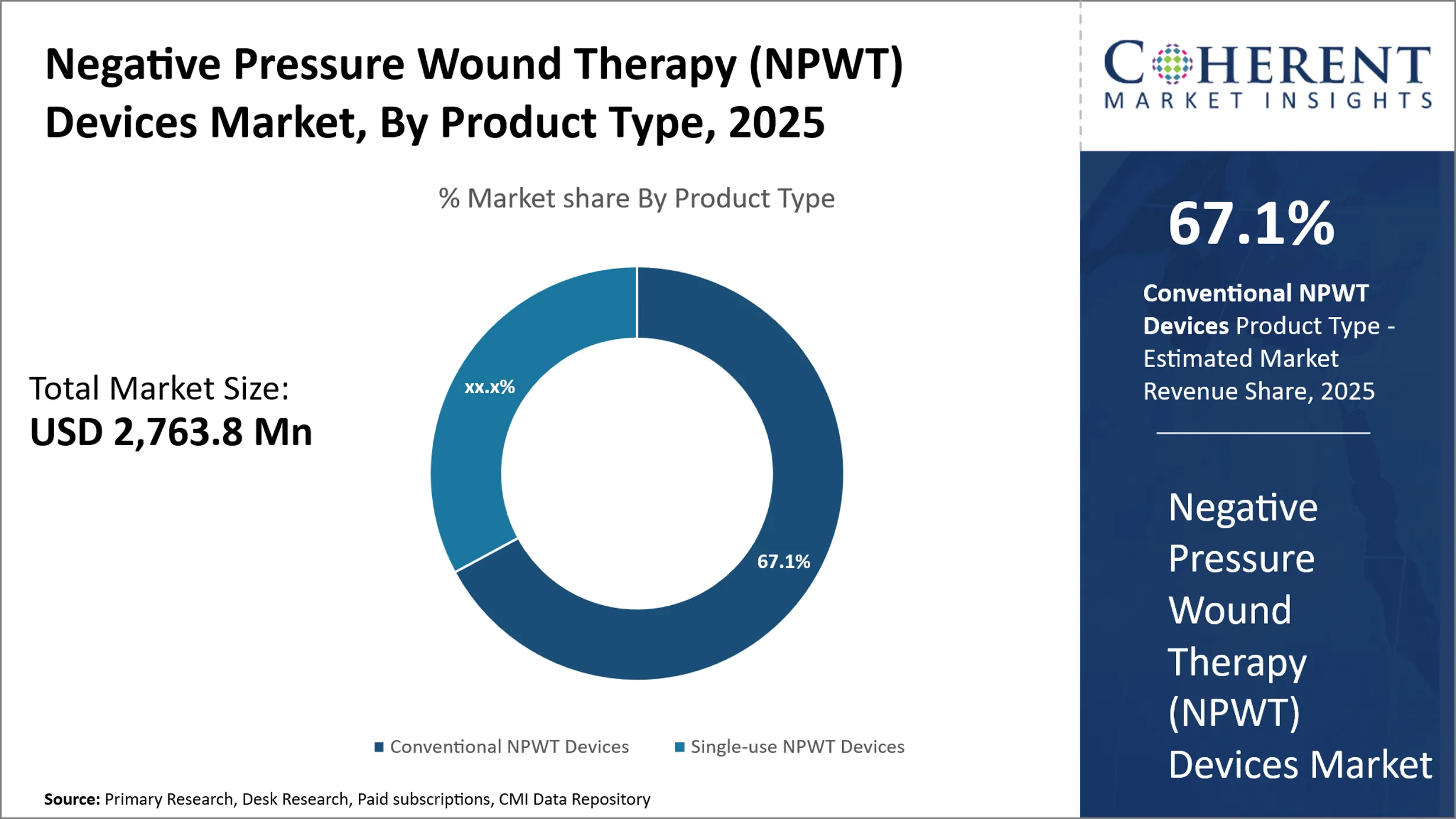
Global Negative Pressure Wound Therapy Market Insights, By Product Type
Conventional NPWT Devices are projected to dominate the global NPWT devices market, capturing approximately 68.1% of the total market share in 2026. This stronghold is attributed to their proven clinical effectiveness, robust vacuum capabilities, and adaptability to various wound types, including chronic, post-operative, and acute wounds. These systems are widely used in inpatient settings due to features such as continuous pressure monitoring, customizable dressing kits, and enhanced exudate management.
Despite increasing demand for single-use and portable systems, particularly in outpatient and home healthcare settings, conventional NPWT devices remain the preferred choice in hospitals and surgical centres. Their ability to support high-risk wound healing, reduce infection rates, and provide real-time therapy adjustments reinforces their clinical importance. Moreover, innovations in dressing materials and user-friendly interfaces continue to strengthen the value proposition of conventional systems, particularly in developed healthcare markets.
While the trend toward mobility and home-based treatment is expected to drive adoption of lightweight, disposable NPWT systems, the conventional segment is anticipated to retain dominance due to its high reliability, treatment precision, and compatibility with complex wound care protocols.
Negative Pressure Wound Therapy (NPWT) Devices Market – Regional Insights
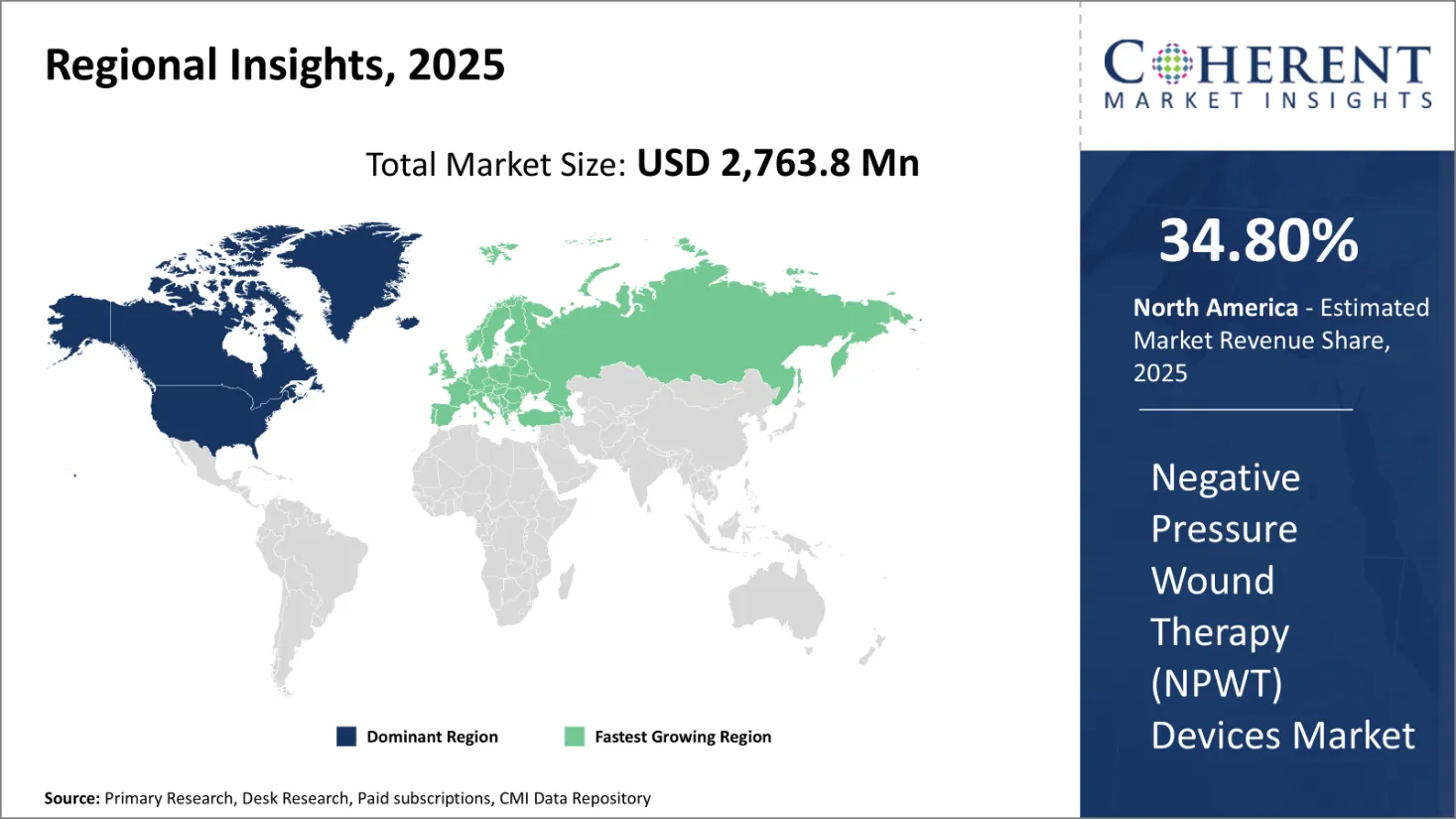
North America NPWT Devices Market Trends and Analysis
North America is projected to lead the global Negative Pressure Wound Therapy (NPWT) devices market with an estimated 34.80% share in 2026, reaffirming its status as the most mature and innovation-driven regional market. This dominance is underpinned by a robust healthcare infrastructure, heightened awareness of advanced wound care technologies, and well-established reimbursement frameworks across the U.S. and Canada.
The region faces a high burden of chronic wounds, including diabetic foot ulcers, pressure sores, and post-surgical infections conditions that demand reliable and efficient NPWT solutions. In particular, the growing use of Negative Pressure Wound Therapy (NPWT) devices with surgical incisions is gaining momentum, as clinicians increasingly adopt these systems to enhance healing outcomes, minimize surgical site infections, and reduce hospital readmissions.
A growing geriatric population and rising prevalence of lifestyle-related conditions such as diabetes further fuel product demand across inpatient and outpatient care settings. Key industry players are headquartered or have major operations in North America, contributing to consistent product development, FDA approvals, and the integration of digital health features into NPWT systems. Continuous investment in telemedicine, home healthcare, and remote patient monitoring solutions also supports the expansion of portable and single-use NPWT devices.
With a strong focus on clinical efficacy, patient outcomes, and healthcare cost reduction, North America remains the global epicenter for NPWT innovation and adoption—especially in the rapidly expanding segment of NPWT devices used in conjunction with surgical incisions.
Negative Pressure Wound Therapy (NPWT) Devices Market Dominating Countries
United States
The United States leads the global Negative Pressure Wound Therapy (NPWT) devices market, accounting for the largest share within the North American region, which is projected to capture 34.8% of the global market in 2026. The country’s dominance stems from its advanced healthcare infrastructure, widespread adoption of wound care technologies, and strong reimbursement support from Medicare and private insurers.
A high prevalence of chronic wounds, driven by diabetes, obesity, and an aging population, has increased demand for NPWT devices in both hospital and home care settings. The U.S. is also home to several key industry players, including 3M Health Care and Smith+Nephew, who continuously invest in research, FDA-approved innovations, and connected care solutions. The country’s early adoption of telehealth and digital wound monitoring technologies positions it as a global innovation hub for NPWT systems.
Furthermore, ongoing clinical trials, robust healthcare spending, and initiatives to reduce hospital readmissions through advanced wound management practices continue to reinforce the United States' leadership in the NPWT devices market.
Canada
Canada plays a crucial role in the North American NPWT devices market, supported by a universal healthcare system and increasing awareness of advanced wound care solutions. Canadian healthcare providers are rapidly adopting NPWT for the treatment of diabetic ulcers, pressure sores, and post-operative wounds across both urban and remote areas.
Favorable government policies and health insurance programs cover a wide range of wound care technologies, making NPWT more accessible to the population. Additionally, Canada’s regulatory environment promotes patient safety and encourages adoption of devices that meet rigorous health standards. The presence of regional distributors and expanding telemedicine infrastructure further facilitate the use of NPWT in home settings, particularly in managing chronic wounds in elderly patients.
Canada’s proactive stance on improving wound care outcomes and promoting innovation through partnerships and clinical research solidifies its growing influence in the global NPWT landscape.
Market Report Scope
Negative Pressure Wound Therapy (NPWT) Devices Market Report Coverage
| Report Coverage | Details | ||
|---|---|---|---|
| Base Year: | 2025 | Market Size in 2026: | USD 2,949.0 Mn |
| Historical Data for: | 2020 To 2024 | Forecast Period: | 2026 To 2033 |
| Forecast Period 2026 to 2033 CAGR: | 6.7% | 2033 Value Projection: | USD 4,643.2 Mn |
| Geographies covered: |
| ||
| Segments covered: |
| ||
| Companies covered: | 3M, Cardinal Health, Smith+Nephew, Genadyne, DeRoyal Industries, Inc., Medela AG, Convatec Inc., Mölnlycke Health Care AB, PAUL HARTMANN AG, ATMOS MedizinTechnik GmbH & Co. KG, Talley Group Ltd, Cork Medical, LLC, and Devon Medical Products | ||
| Growth Drivers: |
| ||
| Restraints & Challenges: |
| ||
Analyst Viewpoint – Negative Pressure Wound Therapy (NPWT) Devices Market
- The global NPWT devices market growth is driven by the rising burden of chronic wounds, expanding geriatric population, and growing preference for advanced wound care Analysts emphasize the increasing adoption of portable and single-use NPWT systems, particularly in home healthcare and ambulatory settings, as a key growth enabler amid shifting care delivery models.
- Technological innovations such as digital monitoring, pressure feedback systems, and antimicrobial dressings are transforming NPWT devices into smart, patient-centric tools. Integration of telehealth features and wearable form factors is improving treatment compliance and enabling remote wound management. Analysts note that manufacturers investing in connected, data-driven solutions are well-positioned to lead the market.
- Despite regulatory complexities and varying reimbursement frameworks across regions, the market outlook remains optimistic. Collaborations between device makers, healthcare providers, and digital health platforms, along with rising investments in clinical research and remote care infrastructure, are expected to accelerate market penetration and long-term value creation.
Negative Pressure Wound Therapy (NPWT) Devices Market: Key Development
- In May 2025, Smith+Nephew was awarded a 10-year, up to $75 million contract by the U.S. Department of Defense to supply its RENASYS™ TOUCH NPWT systems. The portable and intuitive device will support wound care in combat, aeromedical transport, and military medical facilities, enhancing field-level care delivery.
- In January 2025, Medtronic rolled out a new NPWT system featuring real-time wound assessment and AI-driven care guidance. The system helps clinicians customize treatment plans more efficiently, optimizing outcomes in both inpatient and outpatient settings.
- In April 2025, A novel pressure-sensing wound dressing capable of monitoring negative pressure fluctuations in real time was demonstrated in preclinical studies. This smart dressing enhances therapy precision and supports next-gen NPWT solutions.
- In August 2024, Guard Medical secured FDA 510(k) approval for larger sizes (up to 25 cm) of its NPseal surgical NPWT dressing. The expanded size portfolio enables broader use in orthopedic, cesarean, and cardiothoracic procedures, enhancing device flexibility for closed-incision therapy.
- In July 2024, AOTI’s NEXA™ NPWT System, already approved internationally, received U.S. FDA clearance for use in home care. As the only multi-week disposable NPWT that delivers conventional system performance at lower cost, it facilitates safer and more accessible wound care outside hospital settings.
Market Segmentation
- Global Negative Pressure Wound Therapy (NPWT) Devices Market, By Product Type (Revenue, USD Mn, 2021 - 2033)
- Single-use NPWT Devices
- Conventional NPWT Devices
- Global Negative Pressure Wound Therapy (NPWT) Devices Market, By Application (Revenue, USD Mn, 2021 - 2033)
- Diabetic Foot Ulcers
- Pressure Ulcers
- Venous Leg Ulcers
- Burn Wounds
- Others (Surgical Wounds, Traumatic Wounds, etc.)
- Global Negative Pressure Wound Therapy (NPWT) Devices Market, By End User (Revenue, USD Mn, 2021 - 2033)
- Hospitals
- Home Care Settings
- Others (Ambulatory Surgery Centers (ASCs), Specialty Clinics, etc.)
- Global Negative Pressure Wound Therapy (NPWT) Devices Market, By Region (Revenue, USD Mn, 2021 - 2033)
- North America
- U.S.
- Canada
- Latin America
- Brazil
- Argentina
- Mexico
- Rest of Latin America
- Europe
- Germany
- U.K.
- Spain
- France
- Italy
- Russia
- Rest of Europe
- Asia Pacific
- China
- India
- Japan
- Australia
- South Korea
- ASEAN
- Rest of Asia Pacific
- Middle East
- GCC Countries
- Israel
- Rest of Middle East
- Africa
- South Africa
- North Africa
- Central Africa
- North America
- Key Players Insights
- 3M
- Cardinal Health
- Smith+Nephew
- Genadyne
- DeRoyal Industries, Inc.
- Medela AG.
- Convatec Inc.
- Mölnlycke Health Care AB
- PAUL HARTMANN AG
- ATMOS MedizinTechnik GmbH & Co. KG
- Talley Group Ltd.
- Cork Medical, LLC
- Devon Medical Products
Sources
The Stakeholders Consulted
- Wound care specialists and hospital clinicians
- Procurement managers in hospitals and ambulatory surgical centers
- Manufacturers and suppliers of NPWT devices and accessories
- Biomedical engineers and home healthcare providers
- Regulatory compliance officers and reimbursement consultants
- Researchers in chronic wound management and advanced wound healing
- Government public health departments and veterans’ healthcare administrators
- End-users across segments such as hospitals, trauma centers, home care, and military field care units
Databases Opened
- U.S. Food and Drug Administration (FDA) – Medical Device Recalls and Approvals
- Centers for Medicare & Medicaid Services (CMS) – NPWT Reimbursement Database
- World Health Organization (WHO) – Global Wound Care Burden Statistics
- National Institutes of Health (NIH) – Clinical Trials Database for Wound Healing
Magazines & Trade Publications
- Medical Device and Diagnostics Industry (MD+DI)
- Wound Management & Prevention Magazine
- MedTech Insight
- Today’s Wound Clinic
- Healthcare Purchasing News – Wound Care Section
Scientific and Industry Journals
- International Wound Journal
- Advances in Skin & Wound Care
- Journal of Wound, Ostomy and Continence Nursing (JWOCN)
- Journal of Biomedical Materials Research
- Journal of Tissue Viability
Newspapers & Media Outlets
- The Wall Street Journal – Healthcare Innovation
- Bloomberg – Medical Technology & Devices
- Reuters – Global Health and Medical Devices
- The Economic Times – HealthTech and MedTech
- Business Standard – Indian Medical Devices Industry
Associations and Regulatory Bodies
- U.S. Food and Drug Administration (FDA)
- Centers for Medicare & Medicaid Services (CMS)
- European Medicines Agency (EMA)
- Indian Council of Medical Research (ICMR)
- Association for the Advancement of Wound Care (AAWC)
- European Wound Management Association (EWMA)
- Medical Device Innovation Consortium (MDIC)
Public Domain Sources
- World Health Organization (WHO) – Non-Communicable Disease & Ulcer Prevalence
- U.S. Centers for Disease Control and Prevention (CDC) – Chronic Wound and Infection Data
- Government of Canada – Device Recalls and Health Advisories
- European Commission – Medical Device Directives and MDR Updates
- ClinicalTrials.gov – Ongoing NPWT Clinical Trials
Proprietary Research Elements
- CMI Data Analytics Tool
- Proprietary CMI Repository of Wound Care Market Data (covering past 8 years)
- CMI Expert Interviews and Transcripts (focused on wound care physicians, procurement managers, and regulatory experts in NPWT technologies)
Get access to 250+ pages report
Every segment, forecast, competitor profile and data table behind the analysis above — available for instant download.
- ESOMAR Member
- ISO 9001:2015 Certified
- D-U-N-S Registered
- GDPR & CCPA Compliant
Missing comfort of reading report in your local language? Find your preferred language:
Transform your Strategy with Exclusive Trending Reports
Frequently Asked Questions
The Negative Pressure Wound Therapy (NPWT) Devices Market size is estimated to be valued at USD 2,949.0 Mn in 2026, and is expected to reach USD 4,643.2 Mn by 2033.
The CAGR of the Negative Pressure Wound Therapy (NPWT) Devices industry is projected to be 6.7% from 2026 to 2033.
Factors such as increase in the prevalence of chronic wounds and ulcer and rise in the global burden of diabetes are expected to drive the market.
Conventional NPWT devices is the leading product type segment in the market.
The major factors hampering growth of the market include product recall and complications associated with negative pressure wound therapy (NPWT) devices.
Major players operating in the market include 3M, Cardinal Health, Smith+Nephew, Genadyne, DeRoyal Industries, Inc., Medela AG, Convatec Inc., Mölnlycke Health Care AB, PAUL HARTMANN AG, ATMOS MedizinTechnik GmbH & Co. KG, Talley Group Ltd, Cork Medical, LLC, and Devon Medical Products.