

Ophthalmic Lasers Market Size and Share Analysis - 2026 To 2033
The global ophthalmic lasers market size is estimated to reach USD 2.01 Bn in 2026 and is projected to grow at a CAGR of 5.8% during the forecast period (2026–2033), surpassing USD 2.98 Bn by 2033. This is attributable to rising prevalence of cataracts, glaucoma, diabetic retinopathy, and age-related macular degeneration, increasing preference for minimally invasive laser-based eye surgeries, and continuous advancements in ophthalmic laser technologies. As of 2026, cataracts account for approximately 45% of global blindness, affecting an estimated 15.2 million people worldwide.
Key Takeaways from the Ophthalmic Lasers Market Report
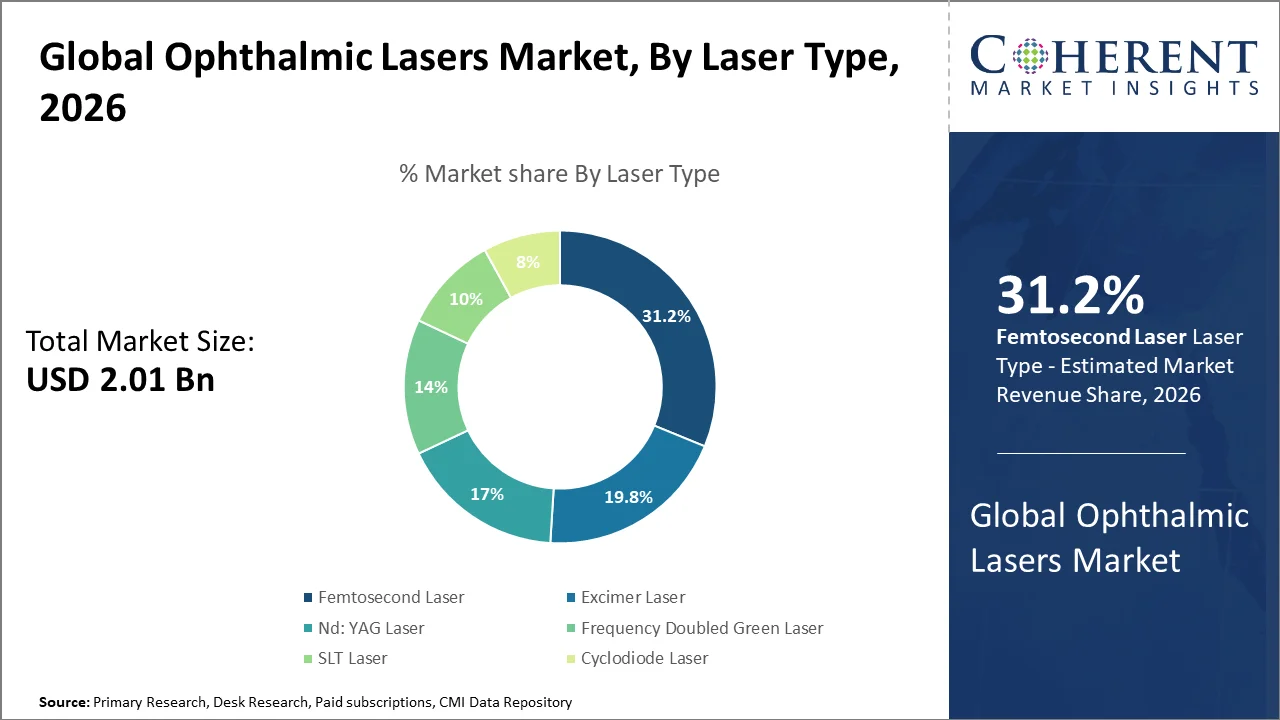
- Femtosecond laser is expected to lead the market with a share of 31.2% in 2026 due to its increasing use in cataract and refractive surgeries. For example, a 2025 Scientific Reports meta-analysis of 46 randomized controlled trials found that femtosecond laser-assisted cataract surgery provides high surgical precision, supporting its increasing adoption.
- Refractive corrections are projected to account for the largest revenue share of 23% in 2026 due to growing number of LASIK and SMILE procedures. For example, by 2025, more than 10 million eyes had been treated with ZEISS SMILE and SMILE pro worldwide, reflecting the growing adoption of laser vision correction procedures.
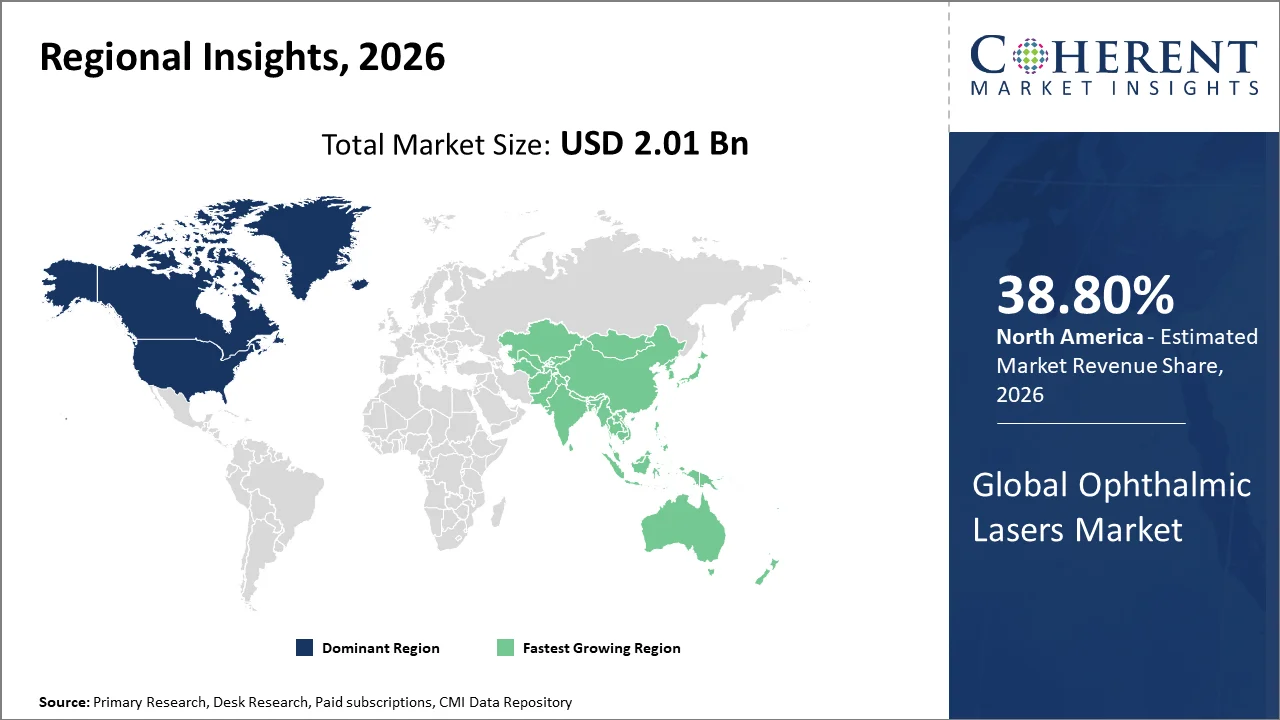
- North America is anticipated to dominate the global ophthalmic lasers industry with a share of 38.80% in 2026, owing to advanced healthcare infrastructure, high adoption of laser technologies, and a large number of eye surgeries. For example, the American Academy of Ophthalmology estimates that annual cataract surgeries in the U.S. will reach nearly 5.1 million by 2025, driving demand for ophthalmic lasers.
- Asia Pacific, recording a CAGR of 6.0%, is poised to emerge as the fastest-growing market for ophthalmic lasers during the forecast period, thanks to improving healthcare infrastructure, rising eye disease cases, and growing access to advanced eye care. For example, over 150 million people in the Western Pacific Region have vision impairment, driving demand for ophthalmic laser equipment.
Ophthalmic Lasers Market Overview
The global ophthalmic lasers market is poised to exhibit steady growth during the forecast period. This growth is primarily driven by rising prevalence of eye diseases and vision disorders, increasing demand for minimally invasive ophthalmic procedures, continuous advancements in laser technologies, growing adoption of femtosecond and excimer lasers, and an expanding aging population requiring vision correction and eye disease treatment.
Ophthalmic lasers are widely used for the treatment of various eye disorders, including glaucoma, retinal diseases, and refractive errors. Increasing adoption of minimally invasive procedures, improved treatment accuracy, enhanced safety as well as advancements in ophthalmic laser technologies are increasing demand for these systems. Patients prefer laser-based eye treatments due to reduced discomfort, shorter recovery time, and the convenience of outpatient procedures.
An ophthalmic laser system primarily consists of a laser console, foot pedal, and laser delivery system. The delivery system transfers laser energy to the patient’s eye through devices such as fiber optic cables, operating microscopes, slit lamps, or indirect ophthalmoscopes. Continuous research and technological advancements are expanding the applications of ophthalmic lasers in areas such as glaucoma treatment, cataract management, and retinal imaging.
According to a study published in the This rising number of glaucoma patients is expected to increase the demand for ophthalmic laser procedures used in glaucoma treatment during the forthcoming period.
Advancements in ophthalmic laser solutions are supporting market expansion. Top ophthalmic laser manufacturers are introducing innovative laser technologies to meet the evolving needs of ophthalmologists as well as improve eye care outcomes.
For example, in January 2024, The systems offer multiple treatment modes, including Continuous Wave and patented MicroPulse® Technology, for ophthalmic laser procedures. Such innovations are expected to boost growth of the global ophthalmic lasers market during the forecast period.
Segmental Insights
Which Laser Type Dominates the Global Ophthalmic Lasers Market?
Femtosecond Laser to Account for Nearly One-Third of the Market in 2026
According to Coherent Market Insights’ Ophthalmic Lasers Market analysis, femtosecond laser is set to lead the market, accounting for a share of 31.2% in 2026. This dominance can be attributed to growing adoption of femtosecond lasers in cataract surgery, LASIK, and corneal transplantation procedures.
Femtosecond lasers deliver highly precise, bladeless incisions with minimal damage to surrounding tissues, resulting in improved surgical accuracy, faster patient recovery as well as better visual outcomes. Rising demand for minimally invasive ophthalmic procedures, increasing prevalence of cataracts and refractive errors, and continuous technological advancements in laser-assisted eye surgery are also supporting growth of femtosecond laser segment.
Leading manufacturers of ophthalmic lasers are constantly upgrading their portfolios as well as expanding their regional presence to capitalize on emerging opportunities. For example, in February 2025, ZEISS VISUMAX 800 with SMILE pro software received approval in China. This updated ZEISS femtosecond laser will provide refractive surgeons in China with faster treatment, greater flexibility, and significant workflow enhancements.
- Current Industry Events of 2026
- Market Size Estimation
- Regional Breakdown
- Competitive Landscape
- Customer Intelligence
- Segmental Analysis
- Pricing Analysis
- Key Market Drivers, Challenges & Future Trends
- Customized Insights Section
Which Application Generates Highest Revenue in the Global Ophthalmic Lasers Market?
Refractive Corrections to Generate Nearly One-Fourth of Global Market Revenue in 2026
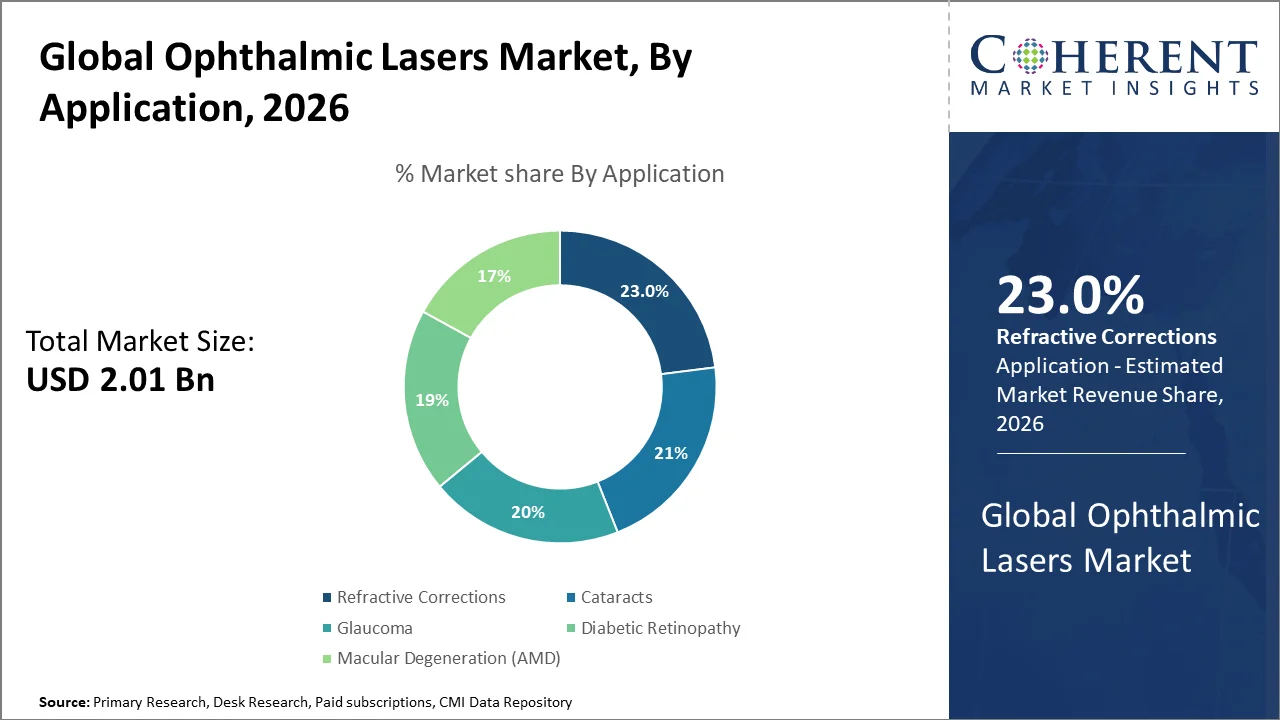
By application, refractive corrections segment is anticipated to account for the largest revenue share of 23% in 2026. This is primarily attributed to rising prevalence of refractive errors such as myopia, hyperopia, and astigmatism, increasing demand for minimally invasive vision correction procedures as well as growing adoption of laser-assisted surgeries such as LASIK and SMILE.
For example, according to the This, in turn, is set to increase demand for refractive correction solutions such as laser-assisted vision correction procedures. Similarly, continuous advancements in ophthalmic laser technologies that improve precision, safety, and patient outcomes are expected to support segment growth.
Ophthalmic Lasers Market Growth Drivers
Rising Prevalence of Eye Disorders
Increasing incidence of eye disorders is providing a strong impetus for the growth of ophthalmic lasers market. There is a rise in cases of refractive errors, cataracts, glaucoma, and diabetic eye diseases. For instance, according to the This rising eye disease burden is boosting demand for laser-based treatments as well as boosting sales of ophthalmic lasers.
Ophthalmic Lasers Market Opportunities
Advancements in Laser Technology
Continuous advancements in laser technology are creating new growth opportunities for the ophthalmic lasers market. Innovations such as femtosecond lasers, advanced imaging systems, and minimally invasive laser procedures are improving treatment precision, safety, and recovery outcomes, encouraging wider adoption of laser-based eye surgeries.
For example, in 2025, the U.S. FDA approved updates for the VISUMAX 800 Femtosecond Laser system by Carl Zeiss Meditec, including post-approval study data and system enhancements. This highlights continued innovation in laser-based refractive correction technologies. Such advancements are expected to create new growth avenues for ophthalmic laser companies during the forecast period.
Ophthalmic Lasers Market Trends
Growing Adoption of LASIK and Other Refractive Procedures
Increasing adoption of advanced laser-based minimally invasive eye surgeries is a key growth-shaping trend in the ophthalmic lasers market. There is a significant rise in advanced vision correction procedures such as LASIK, PRK, SMILE, and laser cataract surgeries. This is driving demand for femtosecond lasers, excimer lasers, and other advanced ophthalmic laser technologies. These technologies offer higher precision, faster recovery, reduced surgical complications, and improved patient outcomes, increasing their adoption among ophthalmologists and patients.
Current Events and Their Impact on the Ophthalmic Lasers Market
Current Event | Description and its Impact |
2026 U.S. Reimbursement Updates for Ophthalmology Procedures |
|
Current Events and Their Impact |
|
Regional Insights
North America to Retain its Dominance Over Ophthalmic Lasers Market
North America is expected to dominate the global ophthalmic lasers market, accounting for a share of 38.80% in 2026. This is attributable to high adoption of advanced eye care technologies, increasing prevalence of age-related eye disorders, rising demand for refractive correction procedures, and strong healthcare infrastructure.
Rising burden of vision disorders is playing a key role in boosting North America ophthalmic lasers market. According to the U.S. Centers for Disease Control and Prevention (CDC), around 20.5 million Americans aged 40 years and older have cataracts, while refractive errors remain among the most common eye problems in the country. This increasing patient base is driving demand for laser-assisted procedures and advanced ophthalmic treatments.
Growing preference for minimally invasive laser-based treatments for conditions such as cataract, glaucoma, and refractive errors is also encouraging hospitals and eye clinics to adopt advanced ophthalmic laser systems. This, in turn, is expected to fuel ophthalmic laser sales in the region during the forecast period.
Asia Pacific Emerges as the Fastest-Growing Ophthalmic Lasers Market
Asia Pacific ophthalmic lasers market is projected to register a CAGR of 6.0% during the forecast period. This steady growth is mostly due to rising prevalence of vision disorders, improving access to eye care services, increasing healthcare investments, growing awareness about vision correction procedures, and expanding adoption of advanced surgical technologies in countries such as China and India. An estimated 30 million people in India live with moderate to severe visual impairment. Increasing number of ophthalmic clinics and hospitals equipped with modern laser systems is also supporting market expansion across the region.
Growing need for vision care services is a key factor fueling ophthalmic laser adoption in Asia Pacific. According to the World Health Organization (WHO), at least 2.2 billion people globally live with vision impairment or blindness, with major causes including unaddressed refractive errors and cataracts. The high burden of avoidable vision impairment is encouraging governments and healthcare providers to expand eye care access and adopt advanced treatment technologies, including laser-based procedures.
Ophthalmic Lasers Market Outlook – Country-wise
U.S. Ophthalmic Lasers Market Trends
The United States is projected to remain a prominent market for ophthalmic lasers during the assessment period. This is mainly due to high adoption of advanced laser-based vision correction procedures, increasing prevalence of age-related eye disorders, strong presence of leading ophthalmic laser device manufacturers, and growing demand for minimally invasive eye surgeries. In the United States, approximately 12 million people aged 40 years and older have vision impairment, including about 1 million who are blind. Availability of advanced healthcare infrastructure and a large number of specialized eye care centers also supports adoption of femtosecond and excimer laser technologies across the country.
China Ophthalmic Lasers Market Forecast
China’s ophthalmic lasers market is anticipated to grow steadily during the assessment period. This is attributable to rising cases of refractive errors and cataracts, expanding ophthalmic healthcare infrastructure, increasing government focus on improving eye care services, and growing adoption of modern surgical technologies in major hospitals. In China, the 14th Five-Year Plan for National Eye Health projected that the cataract surgery rate reached 3,500 by the end of 2025. In addition, increasing number of vision correction procedures among younger populations and improvements in medical equipment accessibility are expected to support market growth in the country.
Who are the Major Companies in the Ophthalmic Lasers Market?
Some of the major players in ophthalmic lasers market are IMRA America, Inc., Newport Corporation, Abbott Medical Optics, Alcon, Bausch & Lomb, Carl Zeiss Meditec, Ziemer Ophthalmic Systems, Optotek, Nidek, Schwind, and Lumenis.
Key Strategies Adopted by Industry Players
Leading manufacturers of ophthalmic lasers are adopting various organic and inorganic strategies to boost their revenue as well as gain a competitive edge in the industry. These include new product launches and approvals, increasing investments in R&D, acquisitions, partnerships, collaborations, mergers, and distribution agreements. Companies are also focusing on technological innovations and advancements to improve the precision, safety, and efficiency of ophthalmic laser systems.
- In February 2025, Alcon launched Voyager DSLT in the U.S., the first and only Direct Selective Laser Trabeculoplasty (DSLT) device. The device provides an automated laser treatment option for patients with glaucoma and ocular hypertension.
- In January 2025, Norlase launched LYNX, the world’s first pattern laser indirect ophthalmoscope in Europe and the U.S. The device combines laser treatment and indirect ophthalmoscopy in a compact system for retinal procedures.
- In April 2025, BVI Medical received FDA 510(k) clearance for Leos (Laser Endoscopy Ophthalmic System), a laser-based glaucoma surgery system. The system is designed to support minimally invasive glaucoma procedures using laser technology and endoscopic visualization.
- In January 2024, Bausch + Lomb received FDA approval for the TENEO Excimer Laser Platform for LASIK vision correction in patients with myopia and myopic astigmatism. The platform uses advanced laser technology to improve precision and efficiency in refractive eye surgery.
Market Report Scope
Ophthalmic Lasers Market Report Coverage
| Report Coverage | Details | ||
|---|---|---|---|
| Base Year: | 2025 | Market Size in 2026: | USD 2.01 Bn |
| Historical Data for: | 2020 To 2024 | Forecast Period: | 2026 To 2033 |
| Forecast Period 2026 to 2033 CAGR: | 5.8% | 2033 Value Projection: | USD 2.98 Bn |
| Geographies covered: |
| ||
| Segments covered: |
| ||
| Companies covered: | IMRA America, Inc., Newport Corporation, Abbott Medical Optics, Alcon, Bausch & Lomb, Carl Zeiss Meditec, Ziemer Ophthalmic Systems, Optotek, Nidek, Schwind, and Lumenis. | ||
| Growth Drivers: |
| ||
| Restraints & Challenges: |
| ||
Analyst Opinion (Expert Opinion)
- Ophthalmic lasers are benefiting from the rising number of cataract surgeries worldwide. Cataract is the leading cause of blindness globally, driving steady demand for laser-assisted cataract surgery and advanced ophthalmic laser systems.
- Laser vision correction surgery is becoming increasingly popular owing to excellent clinical results. According to clinical trials, more than 90% of patients who have undergone LASIK procedure attain 20/20 vision or even better, which motivates more patients and surgeons to opt for laser techniques.
- Consequent innovations contribute to the development of ophthalmic laser devices. The advancement of laser platforms with advanced imaging, high precision, and workflow increases the accuracy of surgery.
- The trend towards minimal invasive eye surgery procedures promotes further market development. Improved recovery time, increased accuracy of the surgery and higher level of patient comfort promote the use of ophthalmic laser devices.
Speak to the analyst
Want personalized insights?
Take the findings above to one of our principal consultants, or have the report rebuilt around the segments, geographies and competitors you actually track.
Market Segmentation
- By Laser Type (Revenue, USD Bn, 2021 - 2033)
- Nd: YAG Laser
- Frequency Doubled Green Laser
- SLT Laser
- Excimer Laser
- Femtosecond Laser
- Cyclodiode Laser
- By Application (Revenue, USD Bn, 2021 - 2033)
- Cataracts
- Glaucoma
- Diabetic Retinopathy
- Macular Degeneration (AMD)
- Refractive Corrections
- By End User (Revenue, USD Bn, 2021 - 2033)
- Hospitals
- Eye Clinics
- Ambulatory Surgical Centers
- Others
- By Region Insights (Revenue, USD Bn, 2021 - 2033)
- North America
- U.S.
- Canada
- Latin America
- Brazil
- Argentina
- Mexico
- Rest of Latin America
- Europe
- Germany
- U.K.
- Spain
- France
- Italy
- Russia
- Rest of Europe
- Asia Pacific
- China
- India
- Japan
- Australia
- South Korea
- ASEAN
- Rest of Asia Pacific
- Middle East
- GCC Countries
- Israel
- Rest of Middle East
- Africa
- South Africa
- North Africa
- Central Africa
Sources
Primary Research Interviews
- Ophthalmologists
- Refractive Surgeons
- Cataract Surgeons
- Vitreoretinal Specialists
- Hospital Procurement Managers
- Ambulatory Surgery Center (ASC) Administrators
- Ophthalmic Laser Manufacturers
- Medical Device Distributors
- Industry Experts and Key Opinion Leaders (KOLs)
Databases
- PubMed
- MEDLINE
- Scopus
- Embase
- ClinicalTrials.gov
- World Bank Open Data
- OECD Data
- UN Comtrade Database
Magazines
- Ophthalmology Management
- Review of Ophthalmology
- Ophthalmology Times
- Cataract & Refractive Surgery Today (CRST)
- Retina Today
Journals
- Ophthalmology
- JAMA Ophthalmology
- American Journal of Ophthalmology
- British Journal of Ophthalmology
- Journal of Cataract & Refractive Surgery
- Graefe's Archive for Clinical and Experimental Ophthalmology
Newspapers
- The Wall Street Journal
- Financial Times
- The New York Times
- The Economic Times
- Business Standard
Associations
- American Academy of Ophthalmology (AAO)
- American Society of Cataract and Refractive Surgery (ASCRS)
- European Society of Cataract and Refractive Surgeons (ESCRS)
- International Council of Ophthalmology (ICO)
- Asia-Pacific Academy of Ophthalmology (APAO)
- World Glaucoma Association (WGA)
Public Domain Sources
- World Health Organization (WHO)
- U.S. Food and Drug Administration (FDA)
- European Medicines Agency (EMA)
- U.S. National Institutes of Health (NIH)
- Centers for Disease Control and Prevention (CDC)
- National Eye Institute (NEI)
- Eurostat
- World Bank
- Organisation for Economic Co-operation and Development (OECD)
Proprietary Elements
- CMI Data Analytics Tool
- Proprietary CMI Existing Repository of information for last 10 years
Get access to 250+ pages report
Every segment, forecast, competitor profile and data table behind the analysis above — available for instant download.
- ESOMAR Member
- ISO 9001:2015 Certified
- D-U-N-S Registered
- GDPR & CCPA Compliant
Missing comfort of reading report in your local language? Find your preferred language:
Transform your Strategy with Exclusive Trending Reports
Frequently Asked Questions
The ophthalmic lasers market refers to the global industry involved in the development, manufacturing, and use of laser-based devices for eye care procedures such as vision correction, glaucoma treatment, cataract surgery, and retinal disorders.
Ophthalmic lasers are used for procedures including LASIK vision correction, glaucoma management, retinal photocoagulation, posterior capsulotomy, and treatment of other eye conditions. They help improve surgical precision and patient outcomes.
The global market is estimated to be valued at USD 2.01 Bn in 2026.
The global Ophthalmic Lasers Market value is expected to reach USD 2.98 Bn by 2033.
The global market is poised to exhibit a CAGR of 5.8% from 2026 to 2033.
Major growth factors include rising prevalence of eye diseases, increasing preference for minimally invasive laser procedures, continuous technological advancements in ophthalmic laser systems, and growing aging population.
Femtosecond laser is expected to lead the market with a share of 31.2% in 2026.