

Automated Liquid Handling Systems Market Size Analysis- 2026 To 2033
The Automated Liquid Handling Systems Market size is anticipated to grow at a CAGR of 6.8%, with USD 3.5 Bn in 2026, and is expected to reach approximately USD 5.56 Bn in 2033. The primary growth drivers are largely defined by the rising adoption of laboratory automation, increasing demand for high-throughput screening and sample preparation, growing use of automated workflows in pharmaceutical and biotechnology research, and increasing emphasis on accuracy, reproducibility, and reduced manual handling in diagnostic and research laboratories. According to a 2025 study published by the Royal Society of Chemistry, optimization of robotic liquid-handling operations using an 8-channel pipetting system achieved up to a 37% reduction in execution time compared with the baseline method.
Key Takeaways
- The automated liquid handling workstation segment is likely to dominate the market with 47.5% in 2026. The segment’s growth is owing to the increasing demand for high-throughput sample processing, improved pipetting accuracy, workflow standardization, reduced manual intervention, and integration of robotic platforms across drug discovery, genomics, and diagnostic laboratories. A 2026 study published in SLAS Technology evaluated the Agilent Bravo automated liquid handling platform equipped with a 96-barrel head and reported excellent agreement with calibrated manual pipetting (r² = 0.998).
- The biotechnological & pharmaceutical companies’ segment is set to lead with 44.2% in 2026. The segment’s growth is owing to the increasing adoption of laboratory automation in drug discovery and development, high-throughput screening, assay development, compound preparation, and molecular biology workflows. According to the U.S. National Science Foundation, U.S. businesses invested approximately USD 136 Bn in biotechnology R&D in 2023.
- North America is expected to acquire the prominent share of 39.6% in 2026. The region’s growth is owing to the strong presence of pharmaceutical and biotechnology companies, well-established research laboratories, early adoption of laboratory automation, substantial research and development expenditure, and the presence of major automated liquid handling system manufacturers. According to the U.S. National Science Foundation, federal research and experimental development obligations reached USD 194.2 Bn in fiscal year 2024, increasing 4.4% from USD 186.1 Bn in fiscal year 2023. Separately, the country’s 41 federally funded research and development centers spent USD 31.8 Bn on research and development in fiscal year 2025, supporting a large research infrastructure that facilitates adoption of laboratory automation technologies.
Market Drivers
Growing Adoption of Laboratory Automation in Pharmaceutical and Biotechnology R&D is Driving the Automated Liquid Handling Systems Market
The Automated Liquid Handling Systems Market is gaining momentum owing to the increasing use of laboratory automation across pharmaceutical and biotechnology research. Automated liquid handlers are increasingly being integrated into drug discovery, assay development, sample preparation, compound screening and analytical workflows to minimize repetitive manual pipetting, increase reproducibility and increase laboratory throughput.
A peer-reviewed study by F. Hoffmann-La Roche and Genentech in 2024 said: “Laboratory automation is increasingly being adopted by the pharmaceutical industry to increase experimental efficiency and operational resilience, especially with the adoption of automated liquid handlers.
Increasing Demand for High-Throughput Sample Preparation and Improved Reproducibility
The increasing volume and complexity of biological and pharmaceutical samples in laboratories is driving automation of sample preparation. Manual liquid handling can be tedious and error-prone especially when large numbers of samples, microplates and low volume dispensing steps are involved. These limitations are overcome by automated liquid handling systems, which standardize repetitive tasks, improve precision, and enable laboratories to process much larger sample volumes.
A recent automated robotic platform with liquid handling performed 96 measurements in 16 hours and 40 minutes, or about 10 minutes per sample, with relative standard deviations of approximately 2%. These results demonstrate the potential of automated liquid handling for achieving high throughput and high reproducibility.
Current Events and Their Impact on the Automated Liquid Handling Systems Market
Current Event | Description and its Impact |
U.S. FDA Quality Management System Regulation (QMSR) Becomes Effective (2026) |
|
FDA Reverses 2024 Laboratory Developed Test Rule Following Federal Court Decision (2025) |
|
- Current Industry Events of 2026
- Market Size Estimation
- Regional Breakdown
- Competitive Landscape
- Customer Intelligence
- Segmental Analysis
- Pricing Analysis
- Key Market Drivers, Challenges & Future Trends
- Customized Insights Section
Segmental Insights
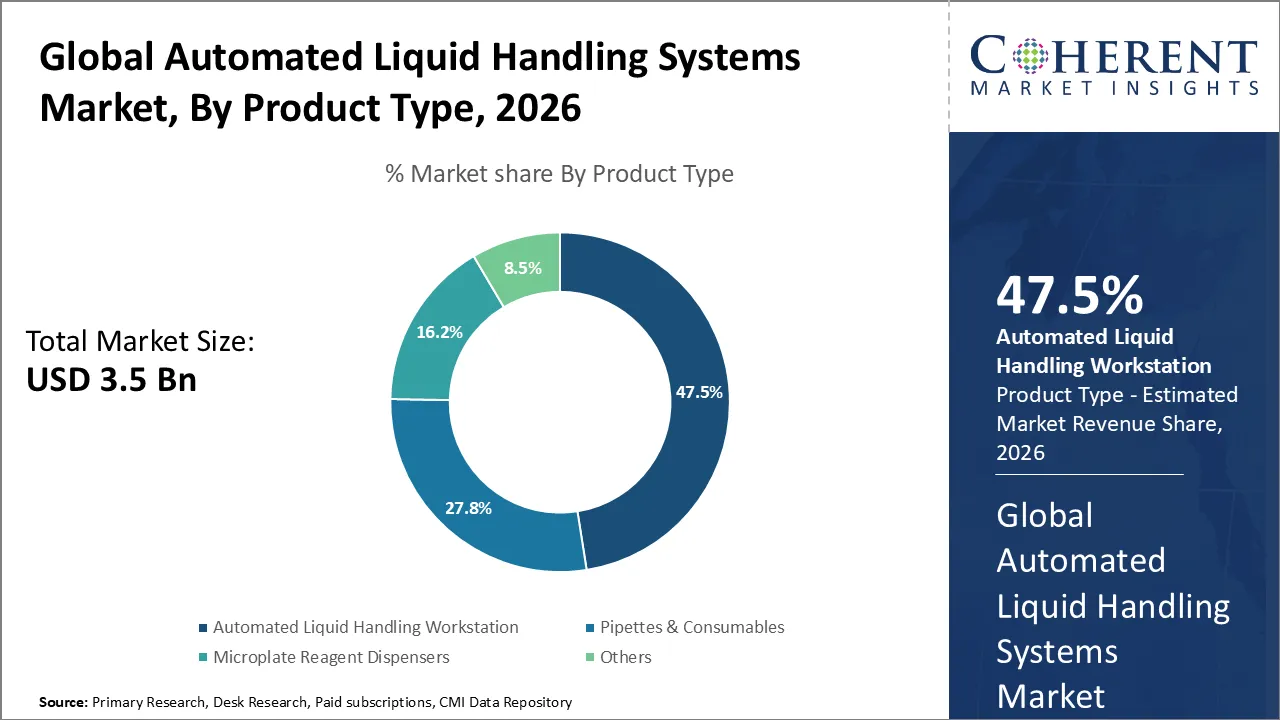
Why is the Automated Liquid Handling Workstation Segment Acquiring the Largest Share?
On the basis of product type, the automated liquid handling workstation segment is projected to account for the largest Automated Liquid Handling Systems Market share of 47.5% in 2026. The segment’s growth is owing to its ability to integrate pipetting, plate handling, sample preparation, reagent dispensing, mixing, and workflow control within a single automated platform. These capabilities make workstations particularly suitable for high-throughput genomics, proteomics, drug discovery, and clinical research applications.
A fully automated chromatin-profiling workflow was developed in a 2025 peer-reviewed study using a liquid-handling workstation capable of processing 8 to 96 ChIP-seq reactions simultaneously. The automated workflow significantly reduced pipetting and handling errors and minimized experimental variability in larger scale studies.
In December 2025, Danaher company Beckman Colter Life Sciences added the Biomek i3 Benchtop Liquid Handler to its portfolio of automated workstations. The system is designed for low- to medium-throughput workflows and includes 15 standard and 5 flex deck positions, supporting genomics, synthetic biology, sequencing, high-throughput screening, and drug discovery applications.
Why are Biotechnological & Pharmaceutical Companies Holding the Largest Market Share?
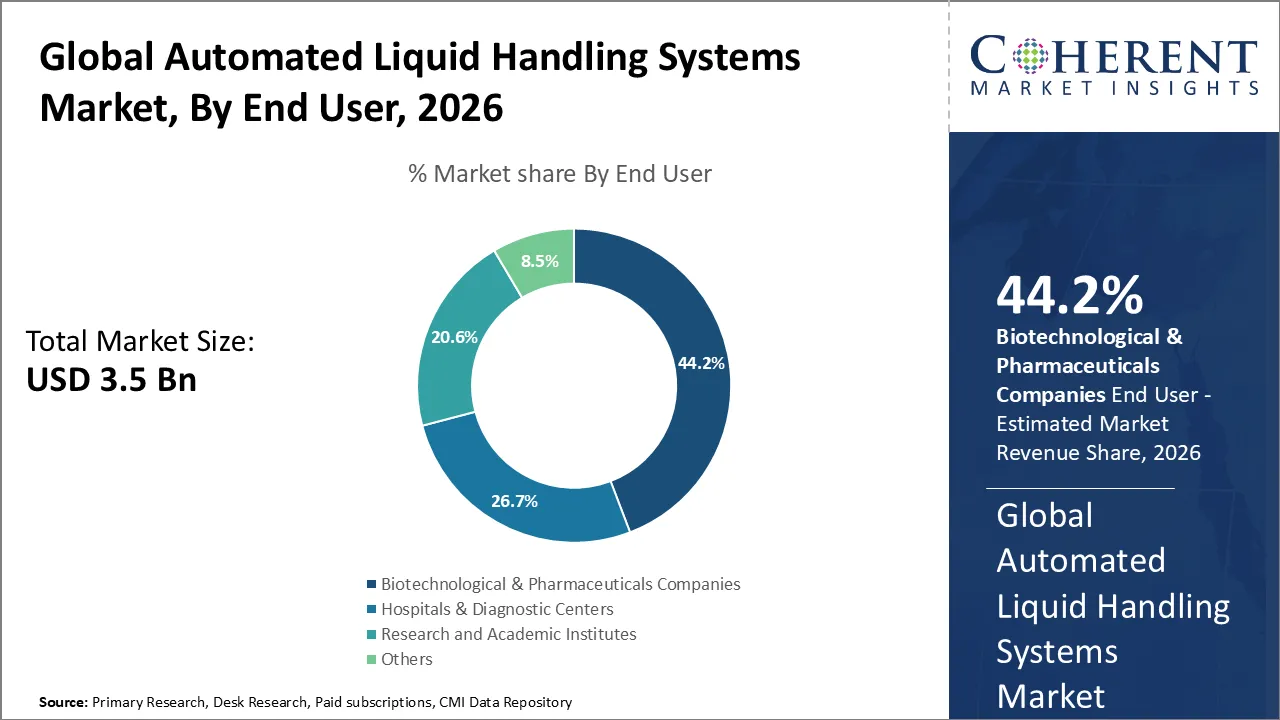
On the basis of end user, the biotechnological & pharmaceutical companies’ segment is set to lead the Automated Liquid Handling Systems Market with a 44.2% share in 2026. The segment’s growth is owing to the extensive use of automated liquid handling systems in compound screening, assay development, molecular biology, protein purification, drug discovery, biologics development, and quality-control workflows. Pharmaceutical and biotechnology companies increasingly require scalable and reproducible automation as drug pipelines expand and laboratory workflows become more complex.
According to the U.S. Food and Drug Administration’s Center for Drug Evaluation and Research approved 46 first-of-a-kind drugs in 2025, including 34 new molecular entities and 12 biologics. In total, the agency approved 123 drug products during 2025, highlighting the continued scale of pharmaceutical development and analytical activity that drives demand for automated laboratory technologies.
In January 2026, Beckman Colter Life Sciences and Automata announced a strategic partnership that combines Beckman Coulter’s liquid handling, genomic and cell-analysis technologies with Automata’s AI-ready laboratory automation platform.
Automated Liquid Handling Systems Market Trends
- Automated liquid handling systems are developing from task-specific instruments to interconnected experimental platforms with the increasing integration of artificial intelligence, robotics and self-driving laboratory platforms. A 2026 review in Nature Reviews Chemistry noted that self-driving laboratories are evolving to multi-purpose systems where algorithms can propose, execute and interpret experiments with minimal human intervention.
- Growing adoption of automated liquid handling in next-generation sequencing workflows is fueling demand in molecular diagnostics and genomics labs. In August 2026, Pillar Biosciences and Hamilton announced the commercial launch of an automated library-preparation workflow for the oncoReveal Nexus 21 Gene Panel on the Hamilton Microlab STAR and STARlet systems. This workflow targets to improve efficiency and reproducibility of the laboratory for cancer research.
- The increasing use of automated liquid handlers in proteomics and high-throughput sample preparation is broadening their applications beyond traditional pipetting. A peer-reviewed 2025 paper used the Beckman Colter Biomek i5 to establish an automated 18-plex TMT-Pro proteomics workflow in a 96-well format, dramatically reducing hands-on time and sample handling errors, and enabling rapid scaling of the number of reactions.
Regional Insights
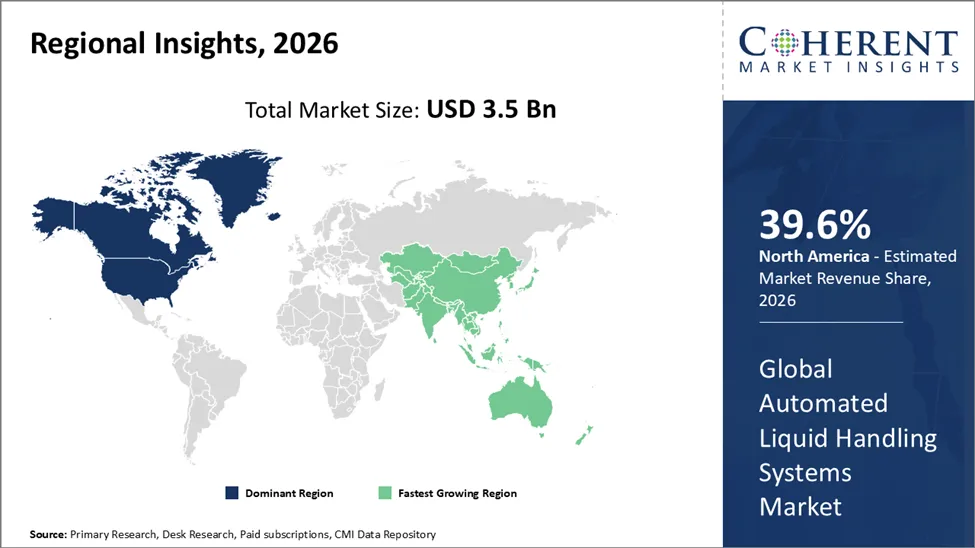
North America Dominates Owing to Strong Laboratory Automation Infrastructure and Public Research Investment
North America is expected to account for a prominent 39.6% share of the Automated Liquid Handling Systems Market in 2026. The region’s growth is owing to the strong presence of pharmaceutical and biotechnology companies, extensive adoption of high-throughput screening, advanced genomics and proteomics research, and increasing investment in AI-enabled laboratory automation.
The U.S. National Institutes of Health’s National Center for Advancing Translational Sciences also operates a highly automated primary screening system capable of storing more than 3 million compound wells and over 1.5 million assay wells, while running multiple assays in parallel.
In July 2026, the U.S. National Science Foundation announced an inaugural USD 380 million investment across 20 teams to establish a nationwide network of AI-enabled programmable cloud laboratories. The initiative is intended to test and scale automated science platforms and expand access to laboratory automation technologies across the U.S.
Asia Pacific Automated Liquid Handling Systems Market Trends
Asia Pacific is expected to be the fastest-growing region in the Automated Liquid Handling Systems Market during the forecast period. The region’s growth is being supported by expanding biotechnology infrastructure, new biofoundries, increasing adoption of synthetic biology and genomics, and government-backed investment in laboratory automation across countries such as China, India, Japan, Singapore, and South Korea.
In April 2026, the Government of India reported that its BioE3 Policy is supporting the development of Bio-AI hubs, biofoundries, and biomanufacturing hubs. The newly established DBT-ICGEB Biofoundry in New Delhi uses integrated high-throughput workflows that replace slow manual processes with bio-automation and artificial intelligence, directly strengthening demand for automated liquid handling and related laboratory systems.
Strong Biopharmaceutical R&D and Expansion of Automated Laboratory Workflows are Accelerating the Automated Liquid Handling Systems Market in the United States
The U.S. Automated Liquid Handling Systems Market is witnessing strong growth owing to the country’s large pharmaceutical and biotechnology research base, increasing adoption of high-throughput workflows, and continued integration of robotics into drug discovery, genomics, and assay development.
In July 2025, MilliporeSigma launched the AAW Automated Assay Workstation in the U.S. with Opentrons technology. The platform automates routine laboratory experiments that were previously carried out manually, and aims to improve reproducibility and reduce hands-on time in pharmaceutical, biotechnology and academic laboratories.
The expansion of pharmaceutical R&D infrastructure is also strengthening the addressable base for laboratory automation. In July 2025, AstraZeneca announced plans to invest USD 50 billion in U.S. manufacturing and R&D over five years, including new and expanded research facilities. The company stated that its planned Virginia manufacturing facility will employ AI, automation, and data analytics to optimize operations.
China Automated Liquid Handling Systems Market Trends
China is expected to witness strong growth in the Automated Liquid Handling Systems Market over the forecast period. The growth is owing to the expansion of synthetic biology and biopharmaceutical research, development of automated biofoundries, increasing adoption of AI-enabled drug discovery, and localization of advanced laboratory automation equipment.
In May 2026, the Chinese Academy of Sciences also highlighted a 10-year Asian synthetic-cell roadmap centered on the establishment of an artificial-intelligence-driven biofoundry. Such biofoundries integrate robotics, automated experimentation, and high-throughput biological workflows, creating additional opportunities for automated liquid handling platforms in synthetic biology and biomanufacturing research.
Who are the Major Companies in Automated Liquid Handling Systems Industry
Some of the major key players in Automated Liquid Handling Systems Market are Aurora Biomed, Inc., Hamilton Company, Tecan Group Ltd, Eppendorf AG, Qiagen N.V., Mettler-Toledo International Inc., Corning, Inc., Bio-Rad Laboratories Inc., PerkinElmer, Inc., Agilent Technologies, Inc., Danaher Corporation, and Thermo Fisher Scientific Inc.
Key News
- In September 2026, QIAGEN N.V. launched QIAmini, a compact automated sample-preparation platform designed for small-batch workflows. The system expands QIAGEN’s automation portfolio toward lower-throughput laboratories seeking walkaway nucleic-acid sample preparation.
- In July 2026, Revvity developed T-SPOT A201, a next-generation high-throughput automated platform building on its Auto-Pure 2400 liquid handler. The system is designed to process up to 384 samples during an 8-hour shift, with approximately 45 seconds of hands-on time per sample, demonstrating continued expansion of high-throughput liquid-handling automation into clinical laboratory workflows.
Market Report Scope
Automated Liquid Handling Systems Market Report Coverage
Report Coverage | Details | ||
Base Year: | 2025 | Market Size in 2026: | USD 3.5 Bn |
Historical Data for: | 2020 to 2024 | Forecast Period: | 2026 to 2033 |
CAGR: | 6.8% | 2033 Value Projection: | USD 5.56 Bn |
Geographies covered: |
| ||
Segments covered: |
| ||
Companies covered: | Aurora Biomed, Inc., Hamilton Company, Tecan Group Ltd, Eppendorf AG, Qiagen N.V., Mettler-Toledo International Inc., Corning, Inc., Bio-Rad Laboratories Inc., PerkinElmer, Inc., Agilent Technologies, Inc., Danaher Corporation, and Thermo Fisher Scientific Inc. | ||
Growth Drivers: |
| ||
Restraints & Challenges: |
| ||
Analyst Opinion
- The Automated Liquid Handling Systems Market is expected to benefit from the transition toward self-driving and AI-enabled laboratories, where liquid handlers increasingly operate as part of integrated robotic experimentation platforms rather than standalone pipetting systems. A 2026 Nature Reviews Chemistry article notes that self-driving laboratories are evolving from specialized automation tools into multipurpose platforms capable of proposing, executing, and interpreting experiments with limited human intervention.
- High-throughput drug discovery and screening will remain an important structural demand driver. The U.S. National Institutes of Health’s NCATS primary screening system can store more than 3 million compound wells and over 1.5 million assay wells and run multiple assays in parallel, while its Tox21 platform can screen a library of approximately 10,000 compounds across 15 concentrations. Such large-scale automated research infrastructure demonstrates the importance of liquid handling, dispensing, and robotic plate processing in modern discovery workflows.
- Automated liquid handling is also moving deeper into regulated pharmaceutical analytical workflows, where reproducibility and reduced operator variability are critical. A 2025 Merck & Co. study reported that a robotic liquid-handling workflow for residual DNA quantitation achieved reproducibility equivalent to or better than manual workflows, while increasing throughput, reducing human-error risk, and eliminating several manual pipetting and plate-preparation steps.
Speak to the analyst
Want personalized insights?
Take the findings above to one of our principal consultants, or have the report rebuilt around the segments, geographies and competitors you actually track.
Market Segmentation
- By Product Type (Revenue, USD Bn, 2021-2033)
- Automated Liquid Handling Workstation
- Pipettes & Consumables
- Microplate Reagent Dispensers
- Others
- By End User (Revenue, USD Bn, 2021-2033)
- Hospitals & Diagnostic Centers
- Biotechnological & Pharmaceuticals Companies
- Research and Academic Institutes
- Others
- By Region (Revenue, USD Bn, 2021-2033)
- North America
- U.S.
- Canada
- Latin America
- Brazil
- Mexico
- Argentina
- Rest of Latin America
- Europe
- Germany
- U.K.
- France
- Italy
- Spain
- Russia
- Rest of Europe
- Asia Pacific
- China
- India
- Japan
- Australia
- South Korea
- ASEAN
- Rest of Asia Pacific
- Middle East
- GCC
- Israel
- Rest of Middle East
- Africa
- South Africa
- Central Africa
- North Africa
- North America
Sources
Primary Research Interviews
- Laboratory automation specialists
- Automated liquid handling system manufacturers
- Pharmaceutical and biotechnology R&D professionals
- Clinical laboratory managers and laboratory directors
- Genomics, proteomics, and molecular diagnostics researchers
- High-throughput screening and drug discovery scientist
- Procurement managers from pharmaceutical, biotechnology, diagnostic, and research laboratories
- Key opinion leaders (KOLs) in laboratory automation and life sciences
Databases
- U.S. National Science Foundation (NSF)
- National Institutes of Health (NIH)
- U.S. Food and Drug Administration (FDA)
- Organisation for Economic Co-operation and Development (OECD)
- World Bank
- European Commission – Research and Innovation Database
- ClinicalTrials.gov
- PubMed / National Library of Medicine
Magazines
- Laboratory Automation & Screening
- Genetic Engineering & Biotechnology News (GEN)
- Lab Manager
- Drug Discovery & Development
- BioPharma Dive
- Pharmaceutical Technology
Journals
- SLAS Technology
- SLAS Discovery
- Journal of Laboratory Automation
- Nature Biotechnology
- Nature Methods
- Journal of Proteome Research
- Analytical Chemistry
- Journal of Pharmaceutical and Biomedical Analysis
Newspapers
- The Wall Street Journal
- Financial Times
- Reuters
- The New York Times
- The Economic Times
- Nikkei Asia
Associations
- Society for Laboratory Automation and Screening (SLAS)
- Association for Diagnostics & Laboratory Medicine (ADLM)
- American Society for Clinical Laboratory Science (ASCLS)
- International Society for Biological and Environmental Repositories (ISBER)
- Biotechnology Innovation Organization (BIO)
- Pharmaceutical Research and Manufacturers of America (PhRMA)
Public Domain Sources
- Company Annual Reports and Investor Presentations
- Company Product Portfolios, Technical Datasheets, and Application Notes
- FDA Regulatory and Quality System Publications
- NIH and Government-Funded Laboratory Automation Publications
- University and Academic Research Publications
- Clinical and High-Throughput Screening Research Studies
- Patent Databases such as WIPO, USPTO, and Google Patents
- Publicly Available Genomics, Proteomics, and Drug Discovery Project Reports
Proprietary Elements
- CMI Data Analytics Tool
- Proprietary CMI Existing Repository of Information for the Last 10 Years
Get access to 250+ pages report
Every segment, forecast, competitor profile and data table behind the analysis above — available for instant download.
- ESOMAR Member
- ISO 9001:2015 Certified
- D-U-N-S Registered
- GDPR & CCPA Compliant
Missing comfort of reading report in your local language? Find your preferred language:
Transform your Strategy with Exclusive Trending Reports
Frequently Asked Questions
The Automated Liquid Handling Systems Market is expected to reach USD 5.56 Bn in 2033.
Major players operating in the global Automated Liquid Handling Systems Market include Aurora Biomed, Inc., Hamilton Company, Tecan Group Ltd, Eppendorf AG, Qiagen N.V., Mettler-Toledo International Inc., Corning, Inc., Bio-Rad Laboratories Inc., PerkinElmer, Inc., Agilent Technologies, Inc., Danaher Corporation, and Thermo Fisher Scientific Inc.
The high investment cost, complex system integration, workflow setup requirements, and need for technical expertise are the key factors hampering growth of the market.
The rising demand for high-throughput screening and sample preparation, growing use of automated workflows in genomics and proteomics, increasing adoption of laboratory automation, and rising focus on accuracy and reproducibility are boosting demand for automated liquid handling systems.
The Automated Liquid Handling Systems Market is anticipated to grow at a CAGR of 6.8% between 2026 and 2033.
Among regions, North America is expected to account for the largest market share in the global Automated Liquid Handling Systems Market over the forecast period, with a 39.6% share in 2026.
An automated liquid handling system is a laboratory automation platform designed to perform tasks such as pipetting, reagent dispensing, sample preparation, mixing, and plate handling with reduced manual intervention and improved workflow consistency.