

Automated Patch Clamp System Market Size and Share Analysis: 2026-2033
The global automated patch clamp system market size is estimated to reach USD 614.7 Mn in 2026 and is expected to grow at a compound annual growth rate (CAGR) of 6.9% during the forecast period (2026–2033), reaching approximately USD 981.6 Mn by 2033. This growth is primarily driven by increasing demand for high-throughput screening in drug discovery, rising focus on ion channel research, and growing adoption of laboratory automation technologies.
Key Takeaways from the Automated Patch Clamp System Market Report
- Micro-fabricated planar electrode-based patch clamp is anticipated to be the leading market segment with a market share of 60% in 2026. This is attributed to the high-throughput nature of this patch clamp system, along with its ability to integrate with automated drug discovery processes.
- The 384-channel amplifier systems are estimated to have the largest market share of 38% by 2026 due to rising demand for increased throughput for pharmaceutical research. The U.S. FDA states that high-throughput screening increases the safety and effectiveness of drugs, leading to their faster adoption in drug development processes.
- The biopharmaceuticals segment will continue to be the major end-user, contributing to 48% of the overall market share in 2026, owing to growing research & development activities and rising adoption of ion channel screens in drug discovery. The European Federation of Pharmaceutical Industries and Associations reported that the pharmaceutical R&D investment in Europe was about €50 billion in 2023 and rose up to about €55 billion in 2024.
- North America is forecasted to have the biggest share of the global automated patch clamp system market by 2026, accounting for an expected market share of 42%. This is primarily due to the continent’s numerous pharmaceutical and biotechnology companies, advanced laboratories, and large R&D budget. According to the National Institutes of Health, the government spending on biomedical research in FY 2025 was estimated to be around $48.5 billion.
Segmental Insights
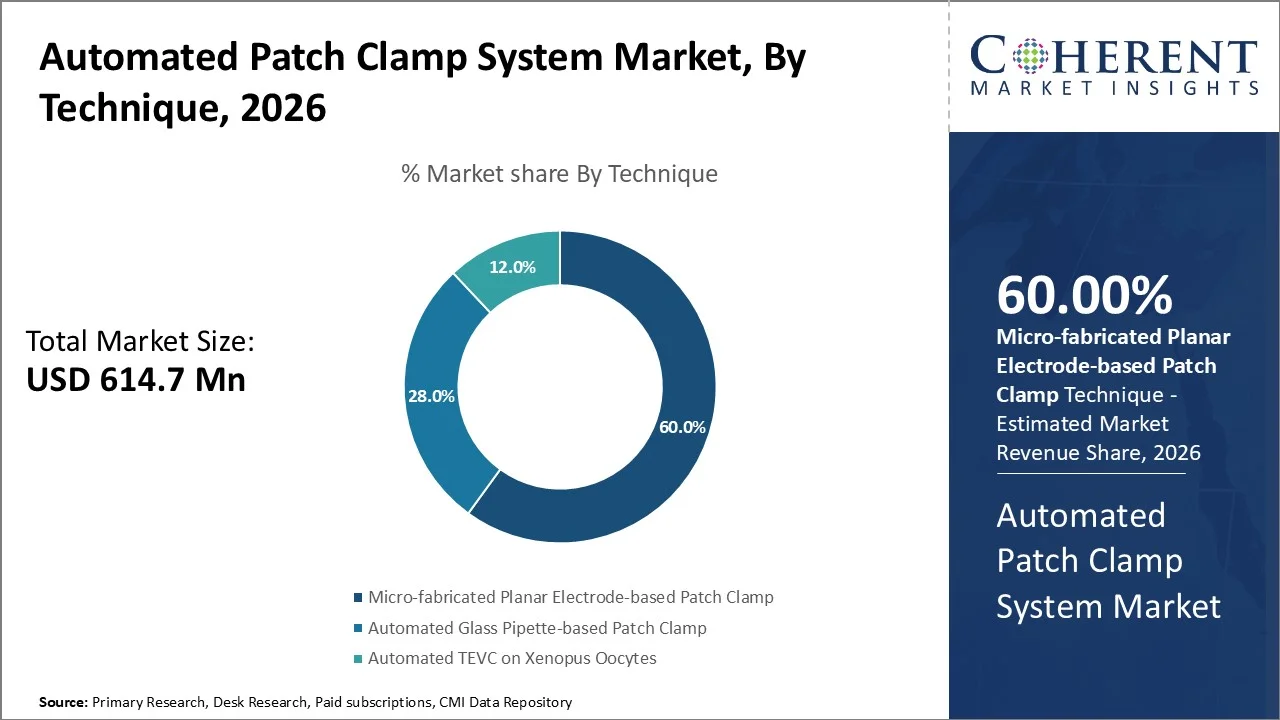
Why is the Micro-fabricated Planar Electrode-based Segment Acquiring the Largest Market Share?
The micro-fabricated planar electrode-based patch clamp segment is expected to hold the highest revenue share in the automated patch clamp system market, contributing about 60% of the market. The increasing demand for high-throughput, automation-compatible ion channel testing is driving adoption of this technology.
As per the report by the National Institutes of Health, about a majority of present-day drugs act upon ion channels, especially neurological and cardiovascular diseases, which makes high throughput electrophysiology technology crucial for successful drug discovery.
In February 2025, Sophion Bioscience A/S introduced the Qube 384 Dynamic Platform, a next-generation automated patch clamp system designed to enhance high-throughput ion channel screening with 384-well parallel recording capability and improved assay flexibility.
- Current Industry Events of 2026
- Market Size Estimation
- Regional Breakdown
- Competitive Landscape
- Customer Intelligence
- Segmental Analysis
- Pricing Analysis
- Key Market Drivers, Challenges & Future Trends
- Customized Insights Section
Which Amplifier Segment Dominates the Market?
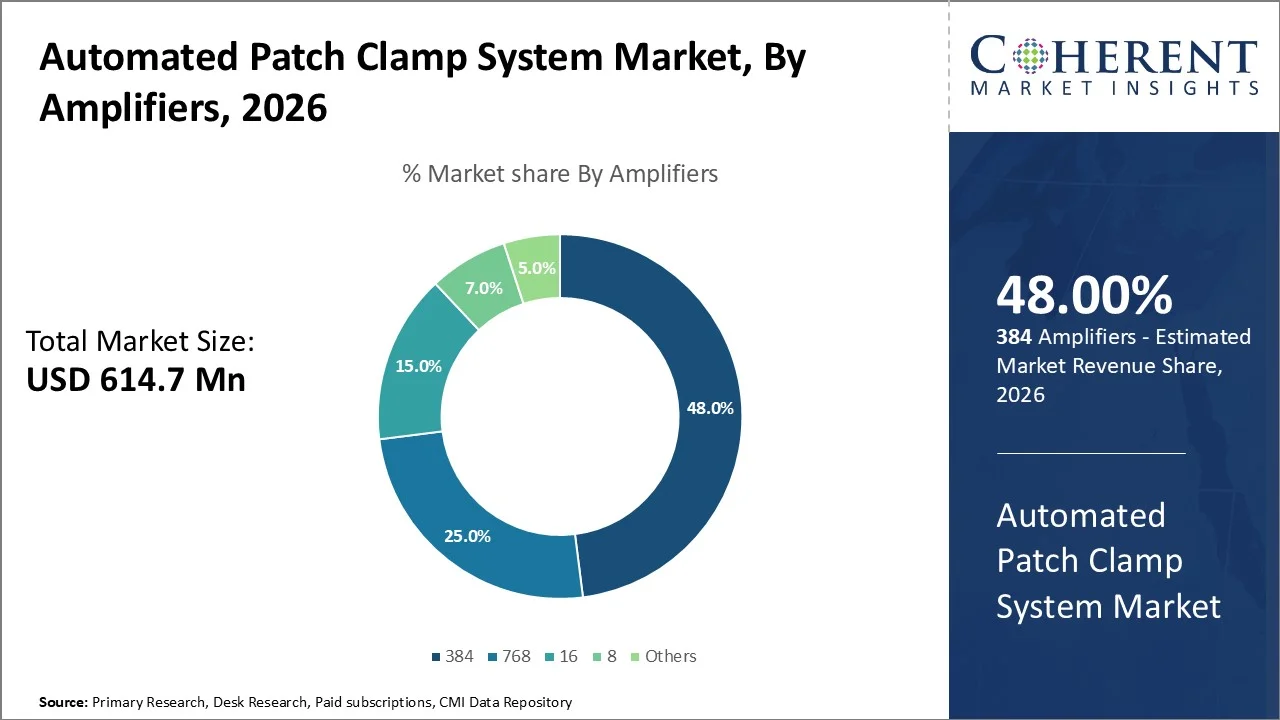
The 384-channel amplifier systems segment is projected to dominate the automated patch clamp system market, accounting for a share of 38% in 2026, owing to the rising need for high throughput screening and large-scale compound screening in the pharmaceutical industry.
This approach is widely adopted due to its ability to enable simultaneous data acquisition and rapid ion channel screening. As stated by the U.S. Food and Drug Administration, the application of new in vitro approaches, including high-throughput electrophysiology, is essential in enhancing safety testing of newly developed drugs.
Why Do Biopharmaceutical Companies Dominate the Market?
The biopharmaceutical companies' segment is predicted to remain the dominant one within the end-users in the global automated patch clamp system market with 48% market share in 2026 due to increasing research and development, ion channels, and pharmacological drug discovery.
The biopharmaceutical industry is investing heavily in HTS technologies and automated electrophysiology systems to enhance preclinical testing efficiency and accelerate drug candidate selection.
In March 2025, Molecular Devices announced expanded availability of its IonWorks and high-throughput electrophysiology platforms, designed specifically to support biopharmaceutical and CRO workflows for large-scale ion channel screening and drug safety assessment.
Current Events and Their Impact on the Automated Patch Clamp System Market
Current Event | Description and its Impact |
Expansion of FDA Support for Alternative Non-Animal Drug Testing Methods (U.S. FDA, 2025 Policy Shift) |
|
Increase in NIH Funding for Neuroscience and Ion Channel Research |
|
Automated Patch Clamp System Market Trends
- The increasing demands for HTS and ion channels’ studies drive the adoption of automated patch clamps. Ion channels are identified by the National Institutes of Health as critical drug targets, thus the current relevance of electrophysiology studies.
- Growing adoption of 384-channel and planar electrode-based systems is boosting high-throughput screening capacity, enabling thousands of compound tests per day in pharma labs.
- The growing trend of automation and incorporation of AI technologies into electrophysiology systems is contributing positively to the efficiency, precision, and repeatability of drug discovery experiments. U.S. Food and Drug Administration support advanced in vitro testing methods to enhance drug safety evaluation.
Regional Insights
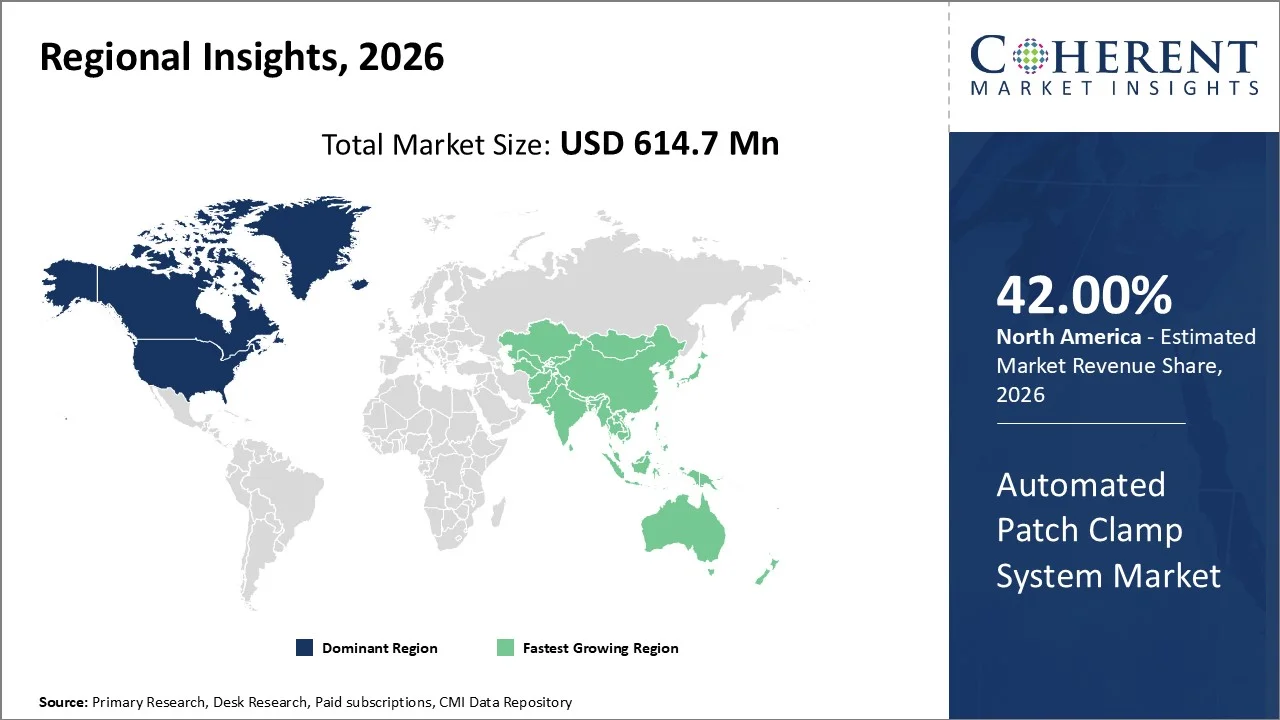
North America dominates owing to strong adoption of advanced electrophysiology and drug discovery technologies
North America is expected to dominate the market with a 42% market share in 2026 due to the substantial contribution of pharmaceutical companies and biotech organizations, along with strong research facilities and high spending on research and development.
In October 2025, Sophion Bioscience announced continued expansion of its Qube 384 automated patch clamp platform adoption across North American pharmaceutical and biotech companies, highlighting its growing use for high-throughput ion channel screening and safety pharmacology applications.
Asia Pacific Automated Patch Clamp System Market Trends
Asia Pacific would emerge as the fastest-growing region up to 2026-2033, supported by extensive development in pharmaceuticals R&D, higher investment in biotechnology, and advanced technology in high-throughput screening methods. Nations like China, India, and Japan have seen rapid development in drug discovery and electrophysiology technology.
India conducts extensive research in pharmacological and biomedical fields, whereas China has been making rapid progress in the life sciences industry due to the implementation of innovation and localization policies backed by the government. According to the World Health Organization, many nations in the Asia-Pacific region are investing heavily in healthcare research and development.
Growing Geriatric Population is Accelerating the Automated Patch Clamp System Market Demand in United States
The United States automated patch clamp system market is witnessing strong expansion, driven by a highly advanced pharmaceutical and biotechnology ecosystem, increasing investment in neuroscience research, and rising demand for high-throughput ion channel screening technologies. The presence of a large geriatric population and high burden of neurological and cardiovascular diseases is further increasing the need for efficient drug discovery tools.
In July 2025, Sophion Bioscience highlighted increased adoption of its Qube 384 automated patch clamp platform among U.S. pharmaceutical and biotechnology companies.
China Automated Patch Clamp System Market Trends
The China automated patch clamp system market is currently experiencing robust growth owing to the fast-growing pharma and biotech industries in China, increasing funding by the government on life sciences, and rising demand for drug discovery solutions. The focus of research in China towards neurology and cardiology, combined with an increased prevalence of chronic conditions, is boosting the market for high-throughput electrophysiology techniques.
In April 2024, Sophion Bioscience A/S announced a strategic collaboration with Scope Research Institute of Electrophysiology (China-linked CRO serving APAC, including Indian research networks) to expand ion channel research and automated patch clamp validation studies across Asia-Pacific, including India.
Who are the Major Companies in Automated Patch Clamp System Industry
Some of the major key players in Automated Patch Clamp System are Sophion Bioscience A/S, Nanion Technologies GmbH, NeoBiosystems, Inc., Multi-Channel Systems MCS GmbH, Fluxion Biosciences, Molecular Devices, LLC, Scitech Korea Inc., and HEKA Elektronik GmbH.
Market Developments
- In April 2025, Sophion Bioscience highlighted expanded application of its Qube 384 automated patch clamp platform for ion channel screening and cardiac safety testing in pharmaceutical and biotech companies.
- In January 2026, Fluxion Biosciences announced the launch of ScorpION AI-based automated patch clamp QC and analytics platform, designed to improve data processing, quality control, and ion channel assay standardization in drug discovery workflows.
- In February 2025, Nanion Technologies expanded the use of its SynchroPatch 384 automated patch clamp platform, focusing on high-throughput ion channel screening, drug discovery, and safety pharmacology applications.
Market Report Scope
Automated Patch Clamp System Market Report Coverage
| Report Coverage | Details | ||
|---|---|---|---|
| Base Year: | 2025 | Market Size in 2026: | USD 614.7 Mn |
| Historical Data for: | 2020 To 2024 | Forecast Period: | 2026 To 2033 |
| Forecast Period 2026 to 2033 CAGR: | 6.9% | 2033 Value Projection: | USD 981.6 Mn |
| Geographies covered: |
| ||
| Segments covered: |
| ||
| Companies covered: | Sophion Bioscience A/S, Nanion Technologies GmbH, NeoBiosystems, Inc., Multi-Channel Systems MCS GmbH, Fluxion Biosciences, Molecular Devices, LLC, Scitech Korea Inc., and HEKA Elektronik GmbH | ||
| Growth Drivers: |
| ||
| Restraints & Challenges: |
| ||
Analyst Opinion
- The automated patch clamp system market is driven by strong scientific need in drug discovery, as ion channels remain key targets in cardiovascular, neurological, and metabolic diseases. Demand is structural rather than cyclical, ensuring long-term market growth.
- High-throughput screening requirements in pharmaceutical R&D are growing rapidly, with modern drug discovery pipelines requiring faster and more reliable electrophysiology data to reduce development time and cost.
- The adoption of automated electrophysiology systems is increasing due to their efficiency advantages. In particular, 384-channel technologies enable large-scale compound screening.
- Strong growth in biopharmaceutical R&D investment and increasing focus on safety pharmacology and cardiac toxicity testing are further reinforcing the shift toward automated patch clamp technologies across global drug development workflows.
Speak to the analyst
Want personalized insights?
Take the findings above to one of our principal consultants, or have the report rebuilt around the segments, geographies and competitors you actually track.
Automated Patch Clamp System Market Segmentation
- By Technique
- Automated Glass Pipette-based Patch Clamp
- Micro-fabricated Planar Electrode-based Patch Clamp
- Automated TEVC On Xenopus Oocytes
- By Amplifiers
- 8
- 16
- 384
- 768
- Others
- By End User
- Contract Research Organization
- Biopharmaceuticals
- Academic & Research Institutes
- Global Automated Patch Clamp System Market, By Region: (Revenue, USD Mn, 2021-2033)
- North America
- U.S.
- Canada
- Latin America
- Brazil
- Mexico
- Argentina
- Rest of Latin America
- Europe
- Germany
- U.K.
- France
- Italy
- Spain
- Russia
- Rest of Europe
- Asia Pacific
- China
- India
- Japan
- Australia
- South Korea
- ASEAN
- Rest of Asia Pacific
- Middle East
- GCC
- Israel
- Rest of Middle East
- Africa
- South Africa
- Central Africa
- North Africa
- North America
Sources
Primary Research Interviews
- Pharmaceutical & biotechnology R&D scientists
- Electrophysiology and ion channel researchers
- CRO (Contract Research Organization) managers
- Laboratory automation specialists
- Medical device manufacturers and distributors
- Key opinion leaders (KOLs) in drug discovery and electrophysiology
Databases
- National Institutes of Health (NIH)
- U.S. Food and Drug Administration (FDA)
- European Federation of Pharmaceutical Industries and Associations (EFPIA)
- World Health Organization (WHO)
- Organisation for Economic Co-operation and Development (OECD)
- PubMed / NCBI Biomedical Literature Database
Magazines
- Drug Discovery & Development
- Nature Biotechnology
- Genetic Engineering & Biotechnology News (GEN)
- Lab Manager Magazine
- Fierce Biotech
Journals
- Journal of Pharmacological and Toxicological Methods
- Nature Methods
- Journal of General Physiology
- Frontiers in Pharmacology
- Journal of Biomolecular Screening
Newspapers / Business Publications
- The Wall Street Journal
- Financial Times
- Reuters Health News
- Bloomberg Biotechnology Coverage
- The Economic Times (India – Life Sciences Section)
Associations
- Society for Laboratory Automation and Screening (SLAS)
- American Society for Pharmacology and Experimental Therapeutics (ASPET
- International Society for Ion Channel Research (ISICR)
- European Association for the Study of the Liver (EASL – drug discovery collaborations
- Federation of European Neuroscience Societies (FENS)
Public Domain Sources
- Company Annual Reports and Investor Presentations (e.g., Sophion Bioscience, Nanion Technologies, Molecular Devices)
- Government biomedical research funding reports (NIH, EU Horizon programs)
- Clinical trial registries such as ClinicalTrials.gov
- FDA guidance documents on in vitro safety pharmacology
- WHO global health and biomedical research reports
Proprietary Elements
- CMI Data Analytics Tool
- Proprietary Coherent Market Insights (CMI) historical database (last 10+ years of market intelligence)
Get access to 250+ pages report
Every segment, forecast, competitor profile and data table behind the analysis above — available for instant download.
- ESOMAR Member
- ISO 9001:2015 Certified
- D-U-N-S Registered
- GDPR & CCPA Compliant
Missing comfort of reading report in your local language? Find your preferred language:
Transform your Strategy with Exclusive Trending Reports
Frequently Asked Questions
The Automated Patch Clamp System Market is expected to reach USD 981.6 Mn in 2033, growing from USD 614.7 Mn in 2026 at a CAGR of 6.9% (2026–2033).
Major players operating in the global automated patch clamp system market include Sophion Bioscience A/S, Nanion Technologies GmbH, NeoBiosystems, Inc., Multi-Channel Systems MCS GmbH, Fluxion Biosciences, Molecular Devices, LLC, Scitech Korea Inc., and HEKA Elektronik GmbH.
High equipment cost, complex operation requiring skilled expertise, and limited adoption in small laboratories are some of the key factors restraining market growth.
Rising demand for high-throughput ion channel screening, increasing pharmaceutical and biotechnology R&D investment, and growing adoption of automated electrophysiology platforms are key growth drivers.
Among regions, North America is expected to account for the largest market share, driven by strong pharma presence, advanced research infrastructure, and high R&D investment.