

Automotive Powertrain Dynamometers Market Size & Forecast 2026-2033
Automotive Powertrain Dynamometers is estimated to be valued at USD 336.6 Mn in 2026 and is expected to reach USD 461.1 Mn in 2033, exhibiting a compound annual growth rate (CAGR) of 4.6% from 2026 to 2033.
Key Takeaways
- Based on Type, the ICE Powertrain segment is projected to account for 81.2% of the global automotive powertrain dynamometers market in 2026, owing to global vehicle production, particularly in developing regions.
- Based on Application, the Passenger Vehicle segment is expected to capture the largest share of the global automotive powertrain dynamometers market in 2026, due to rising Requirement for Extensive Testing of Engine, Transmission and Drivetrains.
- Based on Region, Asia Pacific is expected to lead the global automotive powertrain dynamometers market in 2026 with a 36.9% share. While, North America, with a 29.5% share, will be the fastest growing region.
Market Overview
The automotive powertrain dynamometers market is experiencing steady growth, driven by advancements in automotive technologies, stringent emission regulations, and the increasing demand for electric and hybrid vehicles. These dynamometers are essential tools for testing and analyzing the performance, efficiency, and durability of various powertrain components, including engines, transmissions, and drivetrains. They play a crucial role in the development and optimization of vehicle powertrains, ensuring compliance with regulatory standards and meeting consumer expectations for performance and fuel efficiency. The rising need for precise testing solutions and enhanced vehicle performance is significantly boosting automotive powertrain dynamometers market demand, as manufacturers and research institutions increasingly invest in these advanced diagnostics and testing systems.
Current Events and their Impact on the Automotive Powertrain Dynamometers Market
Current Event | Description and its Impact |
Electric Vehicle Market Acceleration and Advanced Testing Requirements |
|
Stricter Global Emission Regulations Implementation |
|
Statistical Data on the Automotive Powertrain Dynamometers Market
Industry-Specific Data for Automotive Powertrain Dynamometers
- Thermal Testing Capability: Nearly 55% of advanced dynamometers are equipped with environmental chambers, simulating temperatures from –40°C to +60°C for durability tests.
- Fuel Efficiency & Emission Measurement: Over 60% of installations are paired with exhaust gas analyzers to support Euro 6/7 and EPA compliance testing.
- High-Speed Applications: State-of-the-art systems can achieve test speeds of up to 20,000 rpm, meeting requirements for next-generation turbocharged engines and e-axles.
- Energy Recovery Systems: Around 40% of new dynamometers integrate regenerative braking technology, enabling recovered energy to be fed back into the grid.
- Testing Automation: Nearly 50% of OEM facilities now use automated test cycles with robotic shift actuators for transmission and hybrid powertrain evaluation.
- Commercial Vehicle Focus: Approximately 30% of dynamometer installations are designed specifically for heavy-duty trucks, buses, and off-highway vehicles.
- EV Battery-Coupled Testing: About 25% of new setups combine powertrain dynamometers with battery simulators to test charging, discharging, and load dynamics under real driving conditions.
- Noise & Vibration Analysis: More than 45% of test labs integrate NVH measurement modules to assess drivetrain refinement.
- Remote Monitoring: Over 50% of new test cells are IoT-enabled, allowing real-time cloud monitoring and predictive maintenance.
- Life-Cycle Testing: Advanced facilities simulate up to 200,000 km of vehicle operation within controlled dynamometer environments for accelerated validation.
- Current Industry Events of 2026
- Market Size Estimation
- Regional Breakdown
- Competitive Landscape
- Customer Intelligence
- Segmental Analysis
- Pricing Analysis
- Key Market Drivers, Challenges & Future Trends
- Customized Insights Section
Segmental Insights
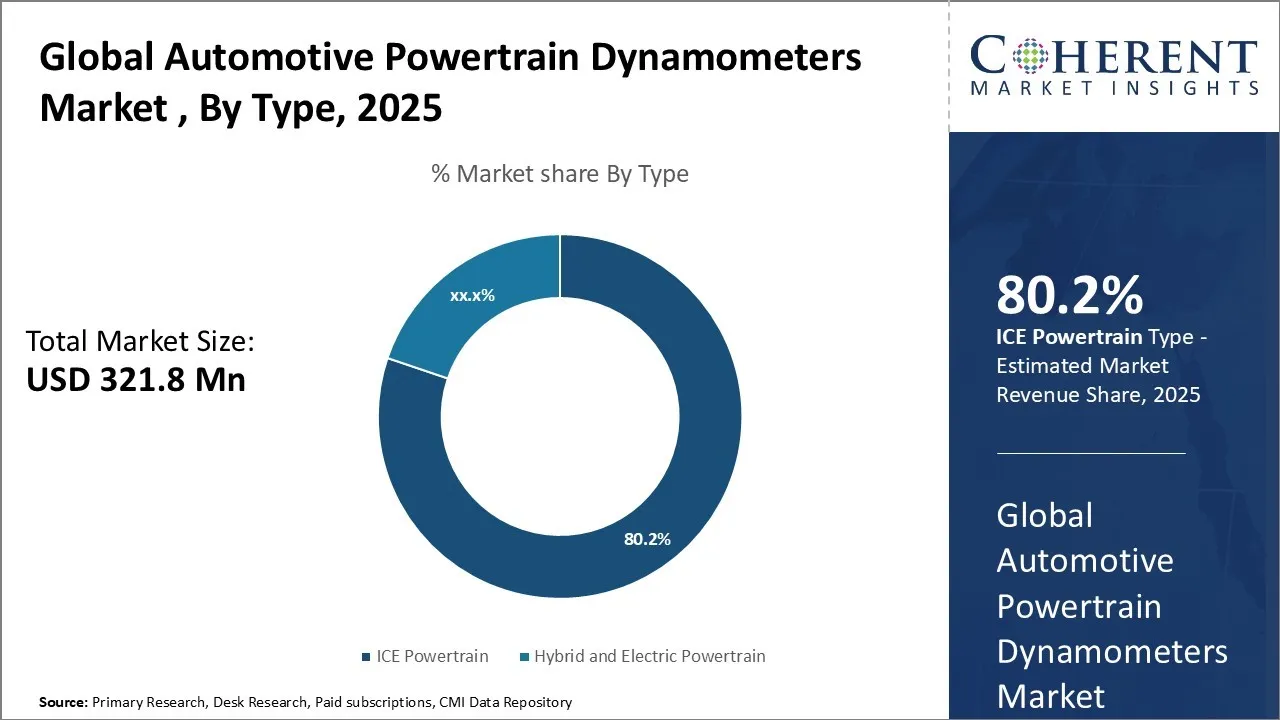
Automotive Powertrain Dynamometers Market Insights, By Type: ICE Powertrain Dominates Owing to Global Vehicle Production
In terms of type, the ICE powertrain segment is expected to hold 81.2% share of the global automotive powertrain dynamometers market in 2026, owing to global vehicle production, particularly in developing regions. Automakers require dynamometers to test and optimize ICE powertrains for performance, fuel efficiency, emissions compliance, and durability. Additionally, stringent government regulations on emission standards and fuel consumption necessitate extensive testing of ICE engines under various operating conditions. The need to enhance engine performance, reduce environmental impact, and meet consumer expectations for reliability and efficiency is driving significant demand for dynamometers in ICE powertrain development.
For instance, in April 2025, Cummins Inc. unveiled the industry's first hydrogen internal combustion engine (H2-ICE) turbochargers tailored for heavy-duty on-highway applications in Europe. This innovation marks a significant advancement in hydrogen combustion technology, supporting the transition to low-emission transportation.
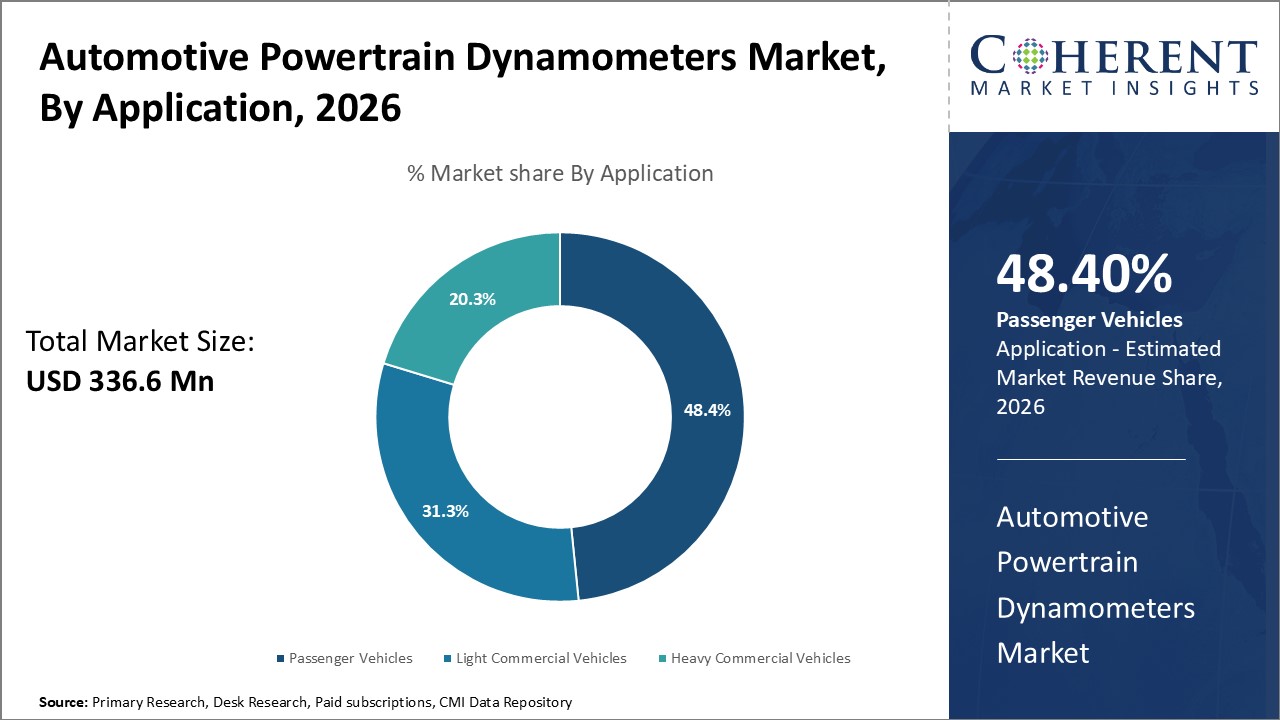
Automotive Powertrain Dynamometers Market Insights, By Application: Passenger Vehicle Led by Rising Requirement for Extensive Testing of Engine, Transmission and Drivetrains
In terms of application, the passenger vehicle segment is expected to hold the largest share of the global automotive powertrain dynamometers market in 2026, due to the global production of passenger cars is substantial, requiring extensive testing of engines, transmissions, and drivetrains to ensure reliability, performance, and fuel efficiency. Moreover, the growing adoption of electric and hybrid passenger vehicles necessitates specialized dynamometers capable of evaluating battery-powered and hybrid powertrains. Third, stringent emission and safety regulations in regions like North America, Europe, and Asia-Pacific compel manufacturers to rigorously test vehicles to comply with standards. Lastly, increasing consumer expectations for performance, comfort, and efficiency drive automakers to optimize powertrain systems, further boosting the demand for dynamometers in passenger vehicle applications.
For instance, in February 2025, Eaton's Mobility Group launched a state-of-the-art testing hub in Tczew, Poland, enhancing its European capabilities for both internal combustion engine (ICE) and electrified vehicle (EV) powertrain technologies. The facility features advanced equipment, including two newly installed powertrain dynamometers: a heavy-duty transient dynamometer for eTransmission development and a medium-duty dynamometer for passenger and light to medium-duty truck powertrains.
Regional Insights
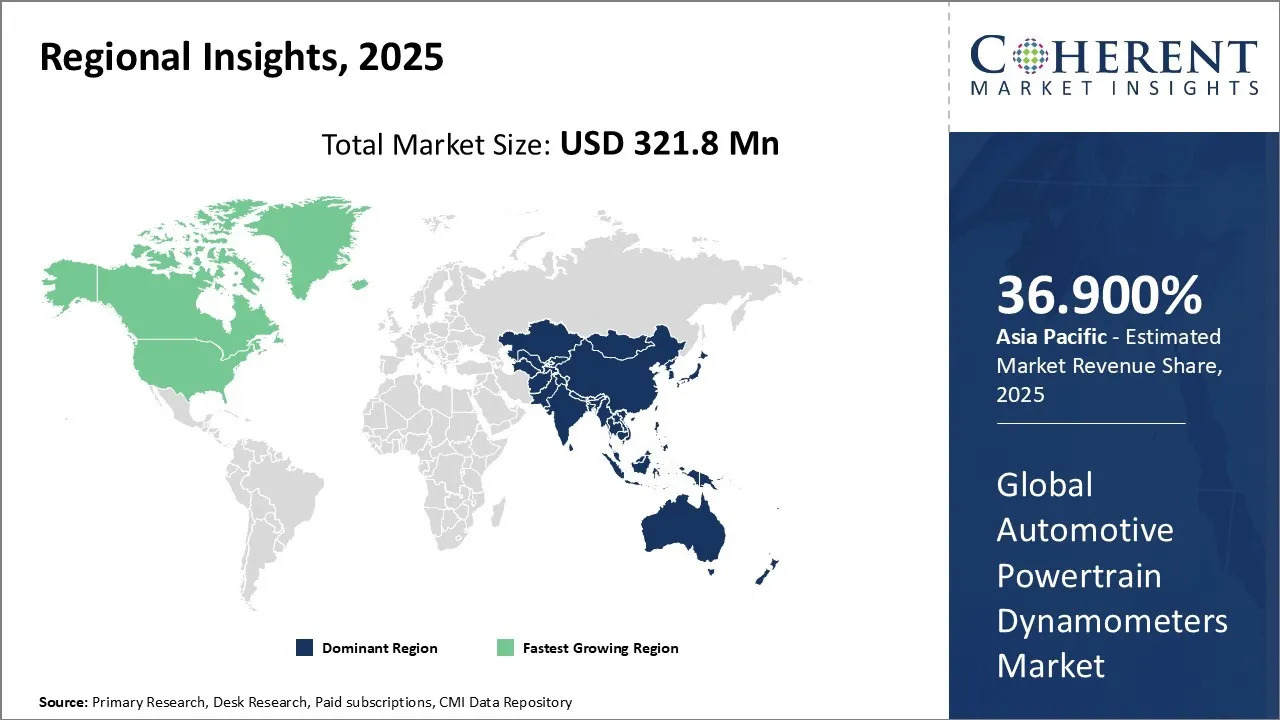
Asia Pacific Automotive Powertrain Dynamometers Market Analysis & Trends
The Asia Pacific region is projected to lead the market with a 36.9% share in 2026, due to rapid automotive production in countries like China, India, Japan, and South Korea has created a significant need for dynamometers to efficiently test and optimize engines, transmissions, and drivetrains. Additionally, the growing adoption of electric and hybrid vehicles in the region is driving demand, as these advanced powertrains require precise testing to ensure performance, efficiency, and regulatory compliance.
Government initiatives and stringent emission standards further encourage automakers to invest in powertrain testing equipment. Moreover, the expansion of automotive R&D facilities by leading manufacturers and research institutions has increased the utilization of dynamometers for vehicle development, quality assurance, and innovation, collectively boosting the automotive powertrain dynamometers market demand in Asia Pacific.
Toyota Motor Corporation is setting up its first research and development centre in India via its local unit, signaling the country’s rising strategic importance. The Bengaluru-based facility, located near Toyota Kirloskar Motor’s Bidadi factory, will kick off with about 200 staff and scale up to around 1,000 engineers by 2027. The move follows Toyota’s decision last year to reconfigure India as a regional hub overseeing operations across the Middle East, East Asia, and Oceania. This is further propelling the powertrain dynamometers market share.
North America Automotive Powertrain Dynamometers Market Analysis & Trends
The North America region is expected to exhibit the fastest growth in the market contributing 29.5% share in 2026. The region is home to leading automotive OEMs and testing equipment manufacturers that heavily invest in advanced R&D for vehicle performance optimization. Stringent emission and fuel efficiency regulations enforced by agencies such as the EPA (Environmental Protection Agency) and CARB (California Air Resources Board) drive the need for precise powertrain testing solutions.
Additionally, the rising adoption of electric and hybrid vehicles in the U.S. and Canada increases demand for dynamometers to evaluate battery performance, electric drivetrains, and regenerative braking systems. The presence of established automotive testing infrastructure and continuous innovation in automotive technologies further strengthens the market growth in this region.
For instance, in March 2024, the Environmental Protection Agency has finalized federal greenhouse gas emission standards for passenger cars and light trucks covering model years 2023 through 2026. These strengthened standards, aim to harness advanced clean-car technology, delivering health and climate benefits while lowering fuel and maintenance costs for drivers, further driving the adoption of these dynamometers.
Automotive Powertrain Dynamometers Market Outlook Country-Wise
The U.S. Automotive Powertrain Dynamometers Market Trends
The U.S. holds the highest share at 24.6%, driven by a strong automotive R&D ecosystem, stringent EPA emission regulations, and the rapid shift toward EVs and hybrid vehicles. Automakers and testing facilities increasingly depend on advanced powertrain dynamometers to ensure compliance and optimize performance.
For instance, in March 2026, Hyundai Motor Group unveiled a landmark USD 21 billion investment in the United States, slated from 2026 to 2028. The plan allocates USD 9 billion to expand U.S. vehicle production capacity to 1.2 million units annually. Another USD 6 billion will boost parts localization, logistics and steel production, including a low-carbon steel mill in Louisiana. The remaining USD 6 billion targets future industries, autonomous driving, robotics, AI, advanced air mobility and energy infrastructure, featuring partnerships in EV charging and emerging technologies. This initiative is further expected to propel the automotive powertrain dynamometers market revenue.
The U.K. Automotive Powertrain Dynamometers Market Trends
With 4.6% share, the U.K. market is supported by zero-emission mobility goals, growing EV infrastructure, and investments in automotive testing centers. Adoption of powertrain dynamometers is fueled by strict EU and national emission standards and accelerated EV development.
For instance, in July 2026, The UK government unveiled a £63 million boost to expand electric vehicle charging infrastructure in a move tied to its “Plan for Change.” Key allocations include £25 million helping councils install innovative cross-pavement chargers for homes without driveways, and £8 million accelerating electrification across more than 200 NHS sites, into saving fuel and maintenance costs while improving air quality.
China Automotive Powertrain Dynamometers Market Trends
China accounts for 9.5% of the market, reflecting its position as the world’s largest automotive producer. Strong government incentives for New Energy Vehicles (NEVs) and rapid EV penetration are fueling demand for dynamometers in both domestic production and export-focused facilities. China has more than 100 factories with a combined capacity to build close to 40 million internal combustion engine cars a year. According to the General Administration of Customs China, the China’s exports in H1 2026 exceeded 13 trillion yuan (approx. 180.95 billion USD), a 7.2% year-on-year increase, with the automotive sector leading the growth.
GCC Countries Automotive Powertrain Dynamometers Market Trends
At 1.2%, GCC countries represent a growing but smaller share, with demand supported by diversification into automotive testing, early-stage EV adoption, and government initiatives to develop regional automotive capabilities. The popularity of luxury and high-performance vehicles further drives testing needs.
For instance, in May 2026, Lucid Group and King Abdullah University of Science and Technology (KAUST) have entered a strategic partnership to propel electric vehicle (EV) innovation and autonomous driving capabilities. The collaboration grants Lucid access to KAUST’s supercomputing resources, enabling advanced simulations in fluid dynamics, crash safety, structural optimization, AI, and digital twin development.
Brazil Automotive Powertrain Dynamometers Market Trends
Holding 1.4%, Brazil’s market is shaped by its expanding automotive manufacturing base, rising adoption of flex-fuel and hybrid vehicles, and compliance with PROCONVE emission regulations. These factors push automakers to adopt dynamometers for fuel efficiency and regulatory testing.
For instance, in August 2026, Chinese automaker Great Wall Motor (GWM) opened its first full manufacturing facility in Brazil. Located in Iracemápolis, São Paulo, the factory launches with assembly lines for the Haval H6, with plans for Haval H9 SUVs and Poer pickup trucks to follow. Initial capacity is projected at 30,000 vehicles annually beginning in 2026, ramping up to 50,000 by 2028.
Market Report Scope
Automotive Powertrain Dynamometers Market Report Coverage
| Report Coverage | Details | ||
|---|---|---|---|
| Base Year: | 2025 | Market Size in 2026: | USD 336.6 Mn |
| Historical Data for: | 2020 To 2024 | Forecast Period: | 2026 To 2033 |
| Forecast Period 2026 to 2033 CAGR: | 4.6% | 2033 Value Projection: | USD 461.1 Mn |
| Geographies covered: |
| ||
| Segments covered: |
| ||
| Companies covered: | Horiba, Ltd., Ricardo, Rototest, Intertek Group PLC, AVL | ||
| Growth Drivers: |
| ||
| Restraints & Challenges: |
| ||
Automotive Powertrain Dynamometers Market Driver
Increasing production of automobiles
The increasing production of automobiles is a major factor driving the growth of the automotive powertrain dynamometers market share. For instance, in 2025, global automobile production is projected to be around 91.6 million vehicles, with a daily output of approximately 250,959 vehicles, and 89.6 million vehicle sales worldwide.
As global automotive manufacturing expands to meet rising consumer demand, automakers are under pressure to test and validate engines, transmissions, and drivetrains with greater accuracy and efficiency. Powertrain dynamometers are extensively used to ensure optimal performance, fuel efficiency, and compliance with stringent emission norms during the vehicle development cycle. With the surge in production of electric and hybrid vehicles, the need for advanced dynamometers capable of testing high-voltage batteries and electric drivetrains has further intensified. This direct correlation between rising vehicle output and demand for testing solutions is expected to strengthen the market share of powertrain dynamometers worldwide.
Analyst Opinion (Expert Opinion)
The Automotive Powertrain Dynamometers market value is poised at a critical juncture where technological sophistication and regulatory pressures are reshaping testing paradigms. The increasing penetration of electric and hybrid vehicles is compelling OEMs and Tier-1 suppliers to adopt more versatile and precise dynamometer systems capable of evaluating both conventional internal combustion engines (ICE) and advanced electric drivetrains. Evidence from leading automakers indicates that test cycles for EV powertrains now demand measurement resolutions exceeding 0.01% torque fluctuation to ensure battery and motor longevity under variable load conditions.
Furthermore, the heightened emphasis on real-world emission testing is driving a shift from conventional bench dynamometers to multi-axis, road-simulation setups. European OEMs, for instance, are increasingly deploying chassis dynamometers integrated with environmental control chambers to replicate temperature and humidity variations—parameters historically overlooked but now critical for stringent WLTP compliance. In North America, the trend toward powertrain optimization for fuel economy is resulting in the incorporation of high-fidelity, software-driven control systems in dynamometers, enabling simultaneous analysis of torque, vibration, and NVH (noise, vibration, harshness) characteristics in real time.
A notable market signal is the strategic investment by manufacturers such as Horiba and AVL in modular dynamometer platforms. These systems not only accommodate ICE, hybrid, and electric powertrains but also support rapid adaptation for hydrogen fuel cell testing, underscoring the anticipated diversification of automotive propulsion technologies. Additionally, data analytics integration has emerged as a differentiator; dynamometers capable of streaming high-resolution powertrain data into cloud-based platforms are increasingly favored by OEMs seeking predictive maintenance insights and accelerated R&D cycles.
Speak to the analyst
Want personalized insights?
Take the findings above to one of our principal consultants, or have the report rebuilt around the segments, geographies and competitors you actually track.
Recent Developments
- In August 2025, German mobility technology supplier ZF Group secured three major, multi-million-euro contracts to supply powertrain and tyre testing systems across India – marking its debut in the nation’s vehicle validation and test infrastructure sector. This includes India’s first 440 kW direct-drive powertrain test bench with a flexible, gear-free 3E dynamometer, as well as multiple tyre R&D benches and automated end-of-line tyre test systems for passenger and two-wheeler manufacturers.
- In June 2025, Cummins inaugurated a groundbreaking fuel-agnostic Powertrain Test Facility at its Darlington campus, investing over $16.65 million in the 738 sqm, two-storey site. The facility, believed to be the first of its type for Cummins and unique in Europe, expands testing to full drivetrains powered by hydrogen, renewable natural gas, advanced diesel, or battery-electric systems.
- In January 2025, RWTH Aachen’s eTestHiL research initiative launched a cutting-edge 1 MW tension test bench to rigorously validate electric heavy-duty drivetrains. Featuring bidirectional battery emulation and high-torque, high-speed capabilities, the system enables comprehensive testing of the full electromechanical powertrain under realistic load conditions.
- In August 2023, PALFINGER MARINE introduced the Go Power D100LE, a state-of-the-art lifeboat engine dynamometer that dramatically improves maritime safety. Designed to test lifeboat engines without launching, the innovative “Dyno” replicates real-world conditions using a robust water-brake system, regardless of weather or sea state.
Market Segmentation
- By Type (Revenue, USD Mn, 2021 - 2033)
- ICE Powertrain
- Hybrid and Electric Powertrain
- By Application (Revenue, USD Mn, 2021 - 2033)
- Passenger Vehicles
- Light Commercial Vehicles
- Heavy Commercial Vehicles
- By Region (Revenue, USD Mn, 2021 - 2033)
- North America
- U.S.
- Canada
- Latin America
- Brazil
- Argentina
- Mexico
- Rest of Latin America
- Europe
- Germany
- U.K.
- Spain
- France
- Italy
- Russia
- Rest of Europe
- Asia Pacific
- China
- India
- Japan
- Australia
- South Korea
- ASEAN
- Rest of Asia Pacific
- Middle East
- GCC Countries
- Israel
- Rest of Middle East
- Africa
- South Africa
- North Africa
- Central Africa
- North America
- Automotive Powertrain Dynamometers Market Companies
- Horiba, Ltd.
- Ricardo
- Rototest
- Intertek Group PLC
- AVL
Sources
Primary Research Interviews from the following stakeholders
Stakeholders
- Interviews with automotive OEMs, powertrain R&D heads, test lab engineers, fleet managers, and procurement heads across leading global markets.
Specific Stakeholders
- Powertrain test engineers at automotive OEMs (e.g., Ford, Toyota, Hyundai)
- R&D leads at EV and hybrid vehicle divisions
- Facility and operations managers at independent automotive test labs and dynamometer testing centers
- Procurement heads at commercial vehicle manufacturers and Tier-1 suppliers
- Product managers and design engineers at dynamometer OEMs and component suppliers (e.g., motors, sensors, control systems)
- Fleet managers conducting in-house powertrain testing and benchmarking
Databases
- U.S. Department of Energy (DOE) Vehicle Technologies Office Data
- International Energy Agency (IEA) Transport Statistics
- Eurostat – Transport Equipment and Vehicle Statistics
- China Automotive Technology & Research Center (CATARC) Data Portal
- Japan External Trade Organization (JETRO) Automotive Statistics
- Korea Customs Service Data Portal
- Directorate General of Commercial Intelligence and Statistics (DGCIS), India
- National Highway Traffic Safety Administration (NHTSA) Vehicle Data
Magazines
- Automotive Testing Technology International
- Engine Technology International
- Automotive Engineering Magazine
- SAE International – Automotive Testing Section
- Automotive World – Powertrain & EV Section
- Motor Vehicle Testing & Evaluation
Journals
- SAE International Journal of Engines
- International Journal of Automotive Technology
- Vehicle System Dynamics
- Journal of Automobile Engineering (Institution of Mechanical Engineers)
- IEEE Transactions on Vehicular Technology
- Journal of Power Sources
Newspapers
- Automotive News
- The Wall Street Journal – Automotive & Tech
- Financial Times – Automotive & Engineering
- The Economic Times – Auto & Engineering Sector
- Nikkei Asia – Automotive and EV Technology
Associations
- Society of Automotive Engineers (SAE)
- International Council on Combustion Engines (CIMAC)
- European Automobile Manufacturers Association (ACEA)
- Automotive Testing Technology International Association (ATTA)
- Society of Vehicle Dynamics Engineers (SVDE)
Public Domain Sources
- U.S. Department of Energy – Vehicle Technologies Reports
- National Institute of Standards and Technology (NIST), U.S.
- Ministry of Economy, Trade and Industry (METI), Japan
- U.S. International Trade Commission (USITC)
- NITI Aayog – Automotive & EV Reports
- India Investment Grid – Automotive Sector
- EU Single Market Observatory – Automotive & Mobility Reports
- Bureau of Energy Efficiency (BEE), India – Automotive Sector
Proprietary Elements
- CMI Data Analytics Tool, and Proprietary CMI Existing Repository of information for last 8 years
Get access to 250+ pages report
Every segment, forecast, competitor profile and data table behind the analysis above — available for instant download.
- ESOMAR Member
- ISO 9001:2015 Certified
- D-U-N-S Registered
- GDPR & CCPA Compliant
Missing comfort of reading report in your local language? Find your preferred language:
Transform your Strategy with Exclusive Trending Reports
Frequently Asked Questions
The global Automotive Powertrain Dynamometers Market size was valued at USD 336.6 Mn in 2026 and is expected to reach USD 461.1 Mn in 2033.
The global automotive powertrain dynamometers market is expected to reach USD 461.1 Mn by 2033.
The market is expected to witness a CAGR of 4.6% during the forecast period (2026-2033).
Increasing production of automobiles is the primary factor driving the market growth.
Asia Pacific held the largest share in the market in 2026, accounting for 36.9% share, in terms of value.
Key players operating in the market include Horiba, Ltd., Ricardo, Rototest, Intertek Group PLC, AVL.
High initial investment costs and the need for skilled technicians hinder market expansion.