

Automotive Steering Wheel Market Size and Forecast — 2026 - 2033
The Global Automotive Steering Wheel Market size is estimated to be valued at USD 6.8 billion in 2026 and is projected to reach USD 11.2 billion by 2033, registering a compound annual growth rate (CAGR) of 7.6% during the forecast period from 2026 to 2033.
Overview
The Automotive Steering Wheel market offers a diverse range of products designed to enhance vehicle control, safety, and driver comfort. Key offerings include conventional mechanical steering wheels, power-assisted steering wheels, and advanced electronic or steer-by-wire systems. Premium variants often feature integrated controls for infotainment, cruise control, and driver-assistance systems, reflecting growing demand for convenience and connectivity. Materials range from standard plastics and polyurethane to luxury leather and carbon fiber finishes. Additionally, adjustable and multifunctional designs are gaining popularity to improve ergonomics. Overall, the market caters to both passenger and commercial vehicles, combining technological innovation with safety and aesthetic appeal.
Key Takeaways
The passenger cars segment dominates the automotive steering wheel market, capturing approximately 54% of total revenue due to increased focus on safety and ergonomic design.
Multifunction steering wheels are the fastest-growing subsegment, driven by integration of interface controls in modern vehicles, with nearly 22% year-over-year growth.
Conventional steering wheels still hold a major share by volume but are gradually being replaced by electronic and advanced alternatives.
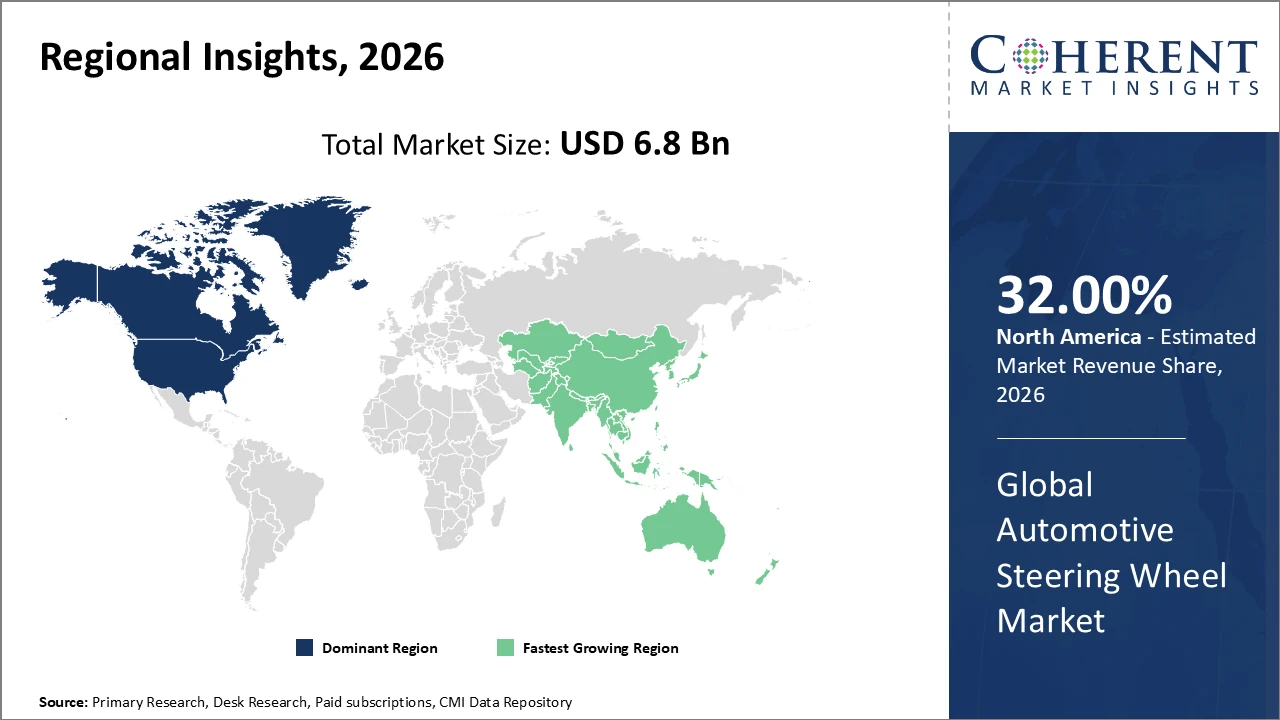
North America leads regionally with nearly 32% market share, supported by advanced automotive manufacturing and strong demand for technologically advanced vehicles.
Asia Pacific is the fastest-growing region, with a CAGR exceeding 9%, driven by rapid automotive production and rising electric vehicle adoption in China and India.
Europe experiences steady growth due to strict safety regulations and innovation from established automotive manufacturers.
Automotive Steering Wheel Market Segmentation Analysis
Automotive Steering Wheel Market Insights, By Component Type
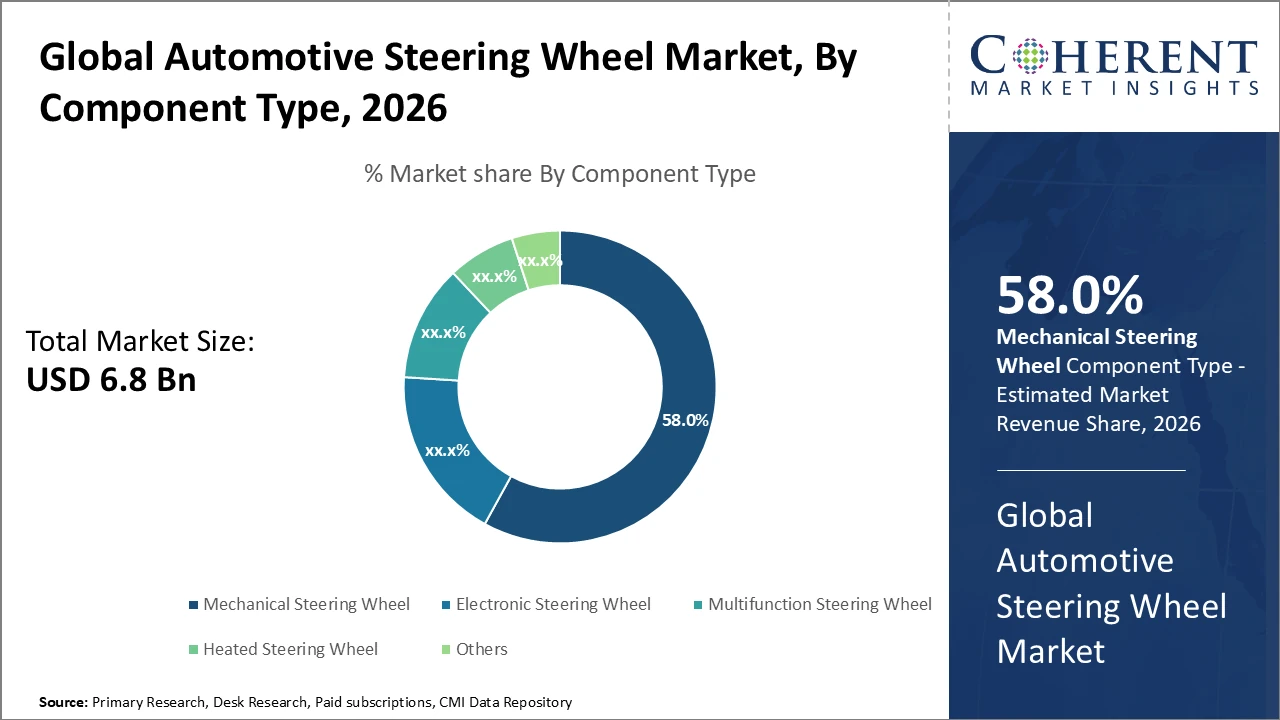
Mechanical steering wheels dominate the market with a 58% share, favored for their reliability and cost-effectiveness across passenger and commercial vehicles. The fastest-growing subsegment is multifunction steering wheels, driven by rising consumer demand for integrated controls such as audio, cruise, and telematics, with annual growth exceeding 20%. Electronic steering wheels are gaining traction, particularly with the adoption of steer-by-wire systems, offering enhanced control, though they currently hold a smaller market share. Heated steering wheels primarily serve premium vehicles and colder regions, experiencing moderate growth. The “others” category includes specialized materials and custom designs for niche automotive applications.
Automotive Steering Wheel Market Insights, By Vehicle Type
Passenger cars dominate the automotive steering wheel market, driven by the global fleet’s demand for enhanced safety and comfort features. The fastest-growing segment is electric vehicles, experiencing annual sales growth exceeding 20% in regions like Asia Pacific and Europe. EVs often require advanced and electronic steering wheel designs, accelerating innovation in the sector. Commercial vehicles hold a significant share but grow more slowly, focusing on durable, functional steering wheels suited for heavy-duty and utility applications. The “others” segment serves specialty vehicles, including construction and agricultural machinery, representing smaller yet steady market niches that contribute to overall industry diversification.
Automotive Steering Wheel Market Insights, By Technology
Conventional steering wheels currently dominate the market due to their established technology and widespread use across most vehicle types. The fastest-growing segment is steer-by-wire systems, gaining momentum as automakers integrate autonomous driving features and enhance vehicle safety. In 2025, steer-by-wire adoption experienced double-digit growth, driven by OEMs piloting autonomous vehicle fleets. Retractable steering wheels, mainly used in concept and luxury vehicles, remain niche but demonstrate potential for improved cabin ergonomics and space optimization. The “others” category includes emerging technologies such as variable stiffness steering wheels, which adapt to different driving conditions, reflecting ongoing innovation in steering system design.
Automotive Steering Wheel Market Trends
The automotive steering wheel market is rapidly adopting steer-by-wire technology, eliminating the mechanical link between the steering wheel and road wheels for enhanced precision and safety.
In 2025, Tesla and Toyota expanded steer-by-wire usage across multiple models, with Tesla reporting a 20% increase in customer satisfaction due to improved handling.
Integration of biometric sensors in steering wheels is growing, monitoring driver vitals to enhance safety and personalize the driving experience; several OEMs implemented this technology by 2026.
Sustainable materials, including carbon fiber composites and bio-based plastics, are being used to reduce vehicle weight and environmental impact, offering 15% cost savings and better durability.
Infotainment systems and haptic feedback integrated into steering wheels have become standard in premium vehicles, enhancing driver interaction and experience.
Automotive Steering Wheel Market Insights, By Geography
North America Automotive Steering Wheel Market Analysis and Trends
In North America, the automotive steering wheel market is dominated by a strong automotive manufacturing base, advanced research ecosystems, and stringent safety regulations that drive innovation. The region accounts for approximately 32% of the market share, supported by policies incentivizing the adoption of electronic and safety-enhancing steering technologies. Leading companies, including ZF Friedrichshafen AG and Magna International, have established flagship production and R&D facilities, fostering the development of multifunctional, steer-by-wire, and electronically controlled steering systems. High consumer demand for technologically advanced and safe vehicles further reinforces North America’s position as a key market for steering wheel innovation and growth.
Asia Pacific Automotive Steering Wheel Market Analysis and Trends
Asia Pacific is the fastest-growing automotive steering wheel market, with a CAGR exceeding 9%, driven by expanding vehicle production, rapid adoption of electric vehicles in China and India, and supportive government initiatives promoting automotive technology advancements. The region benefits from a strong local supplier base and rising demand from domestic markets, fueling revenue growth. Automotive manufacturers focusing on cost-effective multifunction steering wheels have secured significant contracts, particularly in China’s growing EV sector. Investments in innovation, such as steer-by-wire systems and integrated infotainment controls, further strengthen market expansion, positioning Asia Pacific as a key hub for steering wheel technology and automotive growth.
Automotive Steering Wheel Market Outlook for Key Countries
USA Automotive Steering Wheel Market Analysis and Trends
The U.S. automotive steering wheel market is driven by substantial investments in ADAS and autonomous driving technologies. Leading OEMs, including General Motors and Ford, are adopting steer-by-wire systems to comply with evolving safety regulations. Safety mandates introduced by the U.S. Department of Transportation in 2026 have accelerated the use of multifunctional steering wheels featuring integrated controls and touch-sensitive interfaces. Key suppliers such as ZF Friedrichshafen AG and Magna International hold significant market shares, providing OEMs with advanced steering modules. These innovations support continuous business growth, enhance vehicle safety and ergonomics, and strengthen competitive positioning in the U.S. automotive market.
Germany Automotive Steering Wheel Market Analysis and Trends
The Germany automotive steering wheel market is witnessing steady growth, driven by strong automotive manufacturing, technological innovation, and rising demand for advanced vehicle safety features. Key trends include the adoption of steer-by-wire systems, multifunctional steering wheels with integrated controls, and premium materials such as leather and carbon fiber for enhanced ergonomics and aesthetics. Electric and autonomous vehicle development is further accelerating demand for digitally controlled steering solutions. German automakers and suppliers are investing heavily in research and development to integrate haptic feedback, touch-sensitive interfaces, and driver-assistance technologies. Overall, the market reflects a focus on innovation, safety, and enhanced driver experience.
Analyst Opinion
The growing integration of electronic controls in steering wheels is a key supply-side driver, with global production of electronic and multifunction steering wheels increasing by 15% in 2025 due to OEM focus on in-cabin user interfaces.
Rising electronics pricing associated with advanced features resulted in a 10% price premium over conventional steering wheels in 2024, boosting revenue generation.
Demand-side trends highlight expanding adoption in electric and autonomous vehicles, where steering wheel design affects human-machine interaction; in 2026, EV sales rose 22% globally, with over 70% using steer-by-wire technology.
Micro-level indicators show rising imports of steering wheel components in Southeast Asia, with Malaysia and Indonesia reporting a 12% increase in 2025.
Nano-level dynamics reflect a shift from traditional plastics to sustainable composites, with bio-based material adoption reducing production costs by 9% by 2026, promoting cost efficiency and environmental sustainability.
- Current Industry Events of 2026
- Market Size Estimation
- Regional Breakdown
- Competitive Landscape
- Customer Intelligence
- Segmental Analysis
- Pricing Analysis
- Key Market Drivers, Challenges & Future Trends
- Customized Insights Section
Market Scope
| Report Coverage | Details | ||
|---|---|---|---|
| Base Year: | 2025 | Market Size in 2026: | USD 6.8 billion |
| Historical Data for: | 2020 To 2024 | Forecast Period: | 2026 To 2033 |
| Forecast Period 2026 to 2033 CAGR: | 7.6% | 2033 Value Projection: | USD 11.2 billion |
| Geographies covered: |
| ||
| Segments covered: |
| ||
| Companies covered: | NSK Ltd., JTEKT Corporation, Denso Corporation, Robert Bosch GmbH, Magna International Inc., Nissin Kogyo Co. Ltd., Mando Corporation, Hyundai Mobis | ||
| Growth Drivers: |
| ||
Automotive Steering Wheel Market Growth Factors
The growth of the automotive steering wheel market is driven by increasing production of electric and autonomous vehicles. Stricter safety regulations mandating advanced steering controls further support market expansion. Rising consumer demand for multifunctional and customizable steering wheels, including touch-sensitive interfaces and haptic feedback, is particularly strong in premium vehicles. Innovations in steer-by-wire technology reduce mechanical complexity and enhance vehicle control, prompting significant OEM investment. In early 2026, new European safety mandates led to a 13% increase in electronically controlled steering wheel adoption. Additionally, the proliferation of connected cars encourages sensor-embedded steering designs, fueling revenue growth through 2033.
Automotive Steering Wheel Market Development
In January 2026, Autoliv, Inc., have co-developed the world’s first foldable steering wheel for the Tensor Robocar. It can also be utilized in a traditional manual control mode, or retracted for autonomous operation. This technology drives adaptive safety and flexible design in the changing world of automated mobility.
Key Players
Leading Companies of the Market
NSK Ltd.
Denso Corporation
JTEKT Corporation
Robert Bosch GmbH
Magna International Inc.
Nissin Kogyo Co. Ltd.
Mando Corporation
Hyundai Mobis
Competitive strategies in the automotive steering wheel market focus on strategic partnerships, robust R&D investment, and technology licensing. For example, in 2025, ZF Friedrichshafen AG collaborated with leading EV manufacturers to accelerate the adoption of steer-by-wire steering wheels, achieving a 20% increase in market share within the electronic steering segment. Similarly, JTEKT Corporation has prioritized the development of lightweight composite materials since 2024, reducing product weight by 15% and securing significant contracts across Europe and Asia Pacific. These approaches highlight how innovation, collaboration, and material advancements are central to maintaining a competitive edge in the market.
Automotive Steering Wheel Market Future Outlook
The future of the automotive steering wheel market is set to be shaped by rapid technological advancements and evolving vehicle designs. Steer-by-wire systems and fully digital steering solutions are expected to gain widespread adoption, particularly in electric and autonomous vehicles. Integration of multifunctional controls, haptic feedback, and touch-sensitive interfaces will enhance driver convenience and safety. Sustainable and lightweight materials, including recycled composites and carbon fiber, will drive demand in premium and eco-friendly vehicles. Additionally, growing emphasis on connected car technologies and advanced driver-assistance systems will create opportunities for innovation, positioning the market for steady growth and transformation over the coming decade.
Automotive Steering Wheel Market Historical Analysis
The automotive steering wheel market has evolved significantly over the past decade, transitioning from basic mechanical systems to advanced, technology-integrated designs. Initially dominated by conventional steering wheels with manual or hydraulic power assistance, the market gradually shifted toward power-assisted and electronically controlled systems. Growing consumer demand for safety, comfort, and convenience led to the introduction of multifunctional steering wheels with integrated controls for audio, navigation, and driver-assistance features. Premium materials such as leather and wood gained popularity in luxury segments. The rise of electric and autonomous vehicles further accelerated innovation, laying the groundwork for steer-by-wire technology and digitally enhanced steering solutions in today’s market.
Sources
Primary Research Interviews:
Automotive engineers and designers directly involved in steering system development.
Vehicle manufacturers’ product managers, procurement specialists, and R&D heads responsible for steering wheel components.
Suppliers and technology providers developing advanced steering systems, including steer-by-wire, multifunctional, and electronically controlled steering solutions.
Magazines:
Automotive News – Updates on vehicle innovations, market trends, and steering system developments.
Motor Trend – Insights into automotive design, technology integration, and consumer preferences.
Car and Driver – Coverage of automotive interior advancements, steering ergonomics, and new model releases.
Journals:
SAE International Journal of Passenger Cars – Research on steering systems, vehicle dynamics, and driver-assistance technologies.
Journal of Automobile Engineering – Studies on steering wheel design, materials, and safety innovations.
International Journal of Automotive Technology – Investigations on electronic steering, haptic feedback, and multifunctional steering applications.
Newspapers:
The Financial Times – Global automotive industry trends, investments, and technology developments.
Reuters – Updates on vehicle innovations, regulatory changes, and automotive supplier strategies.
Bloomberg – Market performance, corporate strategies, and developments in the automotive components sector.
Associations:
Society of Automotive Engineers (SAE) – Standards, research, and technical guidelines for steering systems.
European Automobile Manufacturers Association (ACEA) – Policy, safety regulations, and market data.
International Organization of Motor Vehicle Manufacturers (OICA) – Global automotive industry standards, production statistics, and technological trends.
Get access to 250+ pages report
Every segment, forecast, competitor profile and data table behind the analysis above — available for instant download.
- ESOMAR Member
- ISO 9001:2015 Certified
- D-U-N-S Registered
- GDPR & CCPA Compliant
Missing comfort of reading report in your local language? Find your preferred language:
Transform your Strategy with Exclusive Trending Reports
Frequently Asked Questions
Leading companies include Hyundai Mobis, JTEKT Corporation, and NSK Ltd., which maintain significant market share through advanced technology integration, strategic partnerships, and continuous innovation.
The market is expected to grow from USD 6.8 billion in 2026 to USD 11.2 billion by 2033, achieving a CAGR of 7.6%, driven by increased adoption of multifunctional, electronic, and steer-by-wire steering systems across passenger and electric vehicles.
Passenger cars offer the largest growth potential, especially electric and autonomous vehicles that require advanced multifunctional steering wheels with integrated controls and safety features.
Steer-by-wire technology, biometric sensor integration, lightweight and sustainable materials, and infotainment-enhanced steering wheels will drive product innovation and revenue growth in the coming years.
The market is highly competitive, with companies competing through innovation, partnerships, and technology licensing. Key challenges include high R&D expenditures, raw material availability, and cost pressures from advanced component adoption.
Common strategies include joint ventures with automakers, technology licensing agreements, regional production facility expansion, and collaborations with EV and autonomous vehicle manufacturers to enhance market reach and drive innovation.