

Basal Cell Carcinoma Market Size and Share Analysis- Growth Trends and Forecasts (2026-2033)
The Basal Cell Carcinoma Market size is anticipated to grow at a CAGR of 9.8% with USD 4.2 Bn in 2026 and is expected to reach USD 8.15 Bn in 2033. The primary drivers are largely defined by the burden of non-melanoma skin cancer, rising UV exposure, aging population, wider use of Mohs surgery, and growing adoption of topical and light-based treatments in dermatology settings. Basal cell carcinoma is the most common form of skin cancer, and the American Cancer Society lists surgery, curettage and electrodesiccation, cryotherapy, radiation therapy, topical chemotherapy, targeted drugs, and photodynamic therapy as treatment options. Globally, IARC estimates more than 1.5 million skin cancer cases in 2022, thereby supporting the sustained demand for diagnosis and treatment.
Key Takeaways
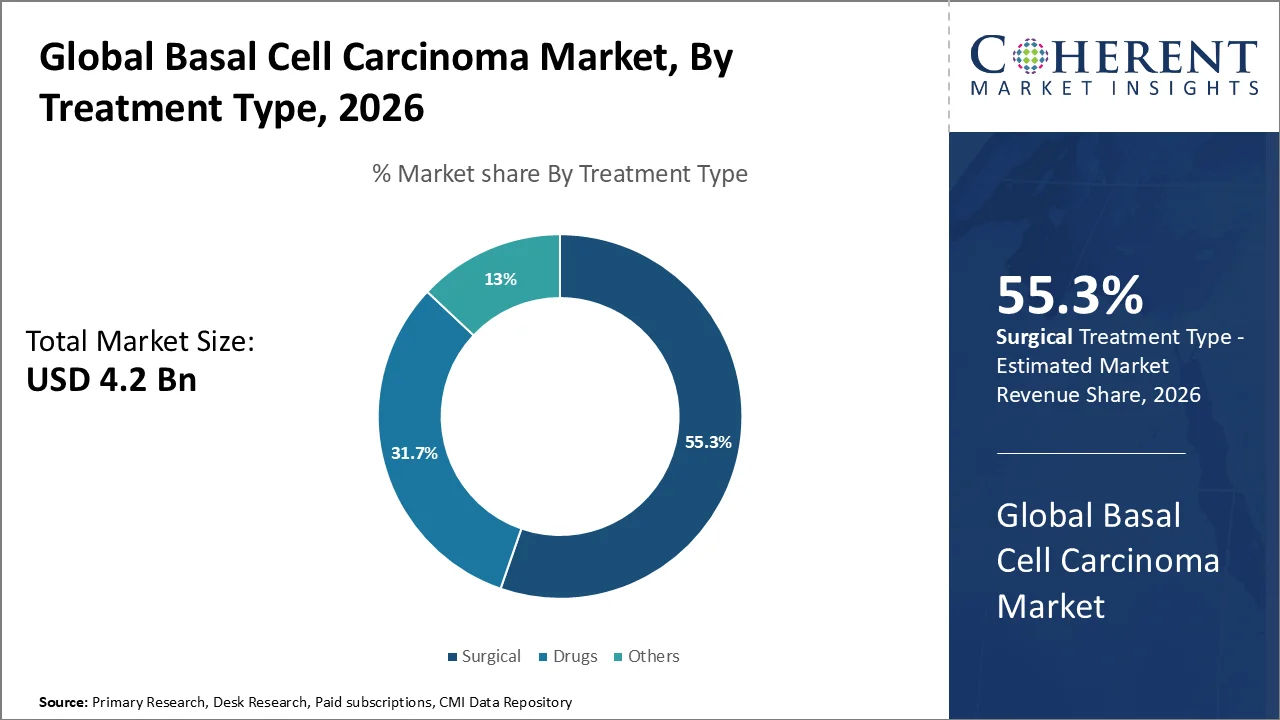
- Surgical segment is likely to dominate the market with 55.3% in 2026. The segment’s growth is owing to its high cure rates, precision-based tumor removal (including Mohs surgery), margin control benefits, and strong clinical preference in non-melanoma skin cancer management where complete excision ensures minimal recurrence. The CDC data showing over 6.1 million annual U.S. treatments for basal and squamous cell carcinomas, thereby highlighting the large patient pool propelling the demand for surgical interventions.
- Hospitals segment is set to lead with 47.5% in 2026. The segment’s growth is owing to the diagnosis-led treatment pathways, biopsy confirmation before therapy, dermatologist-driven referrals, procedural availability (surgery, cryotherapy, photodynamic therapy), and structured post-treatment monitoring for recurrence management and complication control. CDC estimates of USD 8.9 billion annual skin cancer treatment costs in the U.S. reflect the heavy institutional care burden supporting hospital dominance.
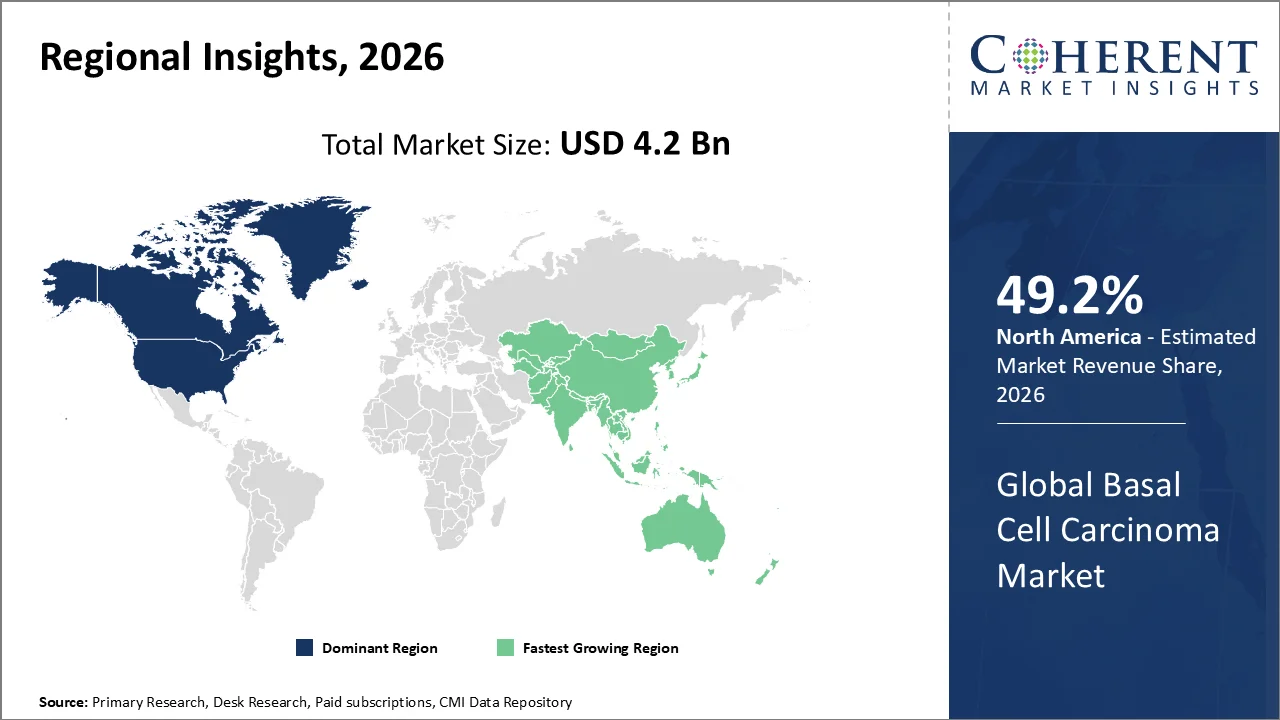
- North America is expected to acquire the prominent share of 49.2% in 2026. The region’s growth is owing to the high incidence of non-melanoma skin cancers, advanced dermatology infrastructure, strong reimbursement systems, and widespread access to surgical and topical therapies, supported by high UV exposure-related disease burden. AIM at Melanoma Foundation reports over 234,000 annual melanoma cases in the U.S., indicating a strong overall skin cancer burden supporting regional dominance.
Segmental Insights
Why is Surgical Acquiring the Largest Share?
On the basis of treatment type, the surgical segment is projected to account for the largest Basal Cell Carcinoma Market share of 55.3% in 2026. The segment’s growth is owing to the high cure expectations in localized disease, availability across dermatology and surgical practices, suitability for most operable lesions, and the ability to confirm complete removal through margin assessment.
The American Academy of Dermatology states that surgical treatment modalities remain the cornerstone of BCC treatment, while nonsurgical approaches such as topical therapy, radiation therapy, and photodynamic therapy have lower cure rates and should mainly be considered for low-risk BCC or when surgery is contraindicated.
Surgery also remains critical because untreated BCC can cause local tissue destruction, disfigurement, and recurrence, even though metastatic spread is rare. AAD states that basal cell and squamous cell carcinomas are highly treatable when detected early and treated properly. This supports strong demand for excision, Mohs micrographic surgery, curettage, electrodessication, and reconstructive procedures.
- Current Industry Events of 2026
- Market Size Estimation
- Regional Breakdown
- Competitive Landscape
- Customer Intelligence
- Segmental Analysis
- Pricing Analysis
- Key Market Drivers, Challenges & Future Trends
- Customized Insights Section
Hospitals hold the Largest Market Share
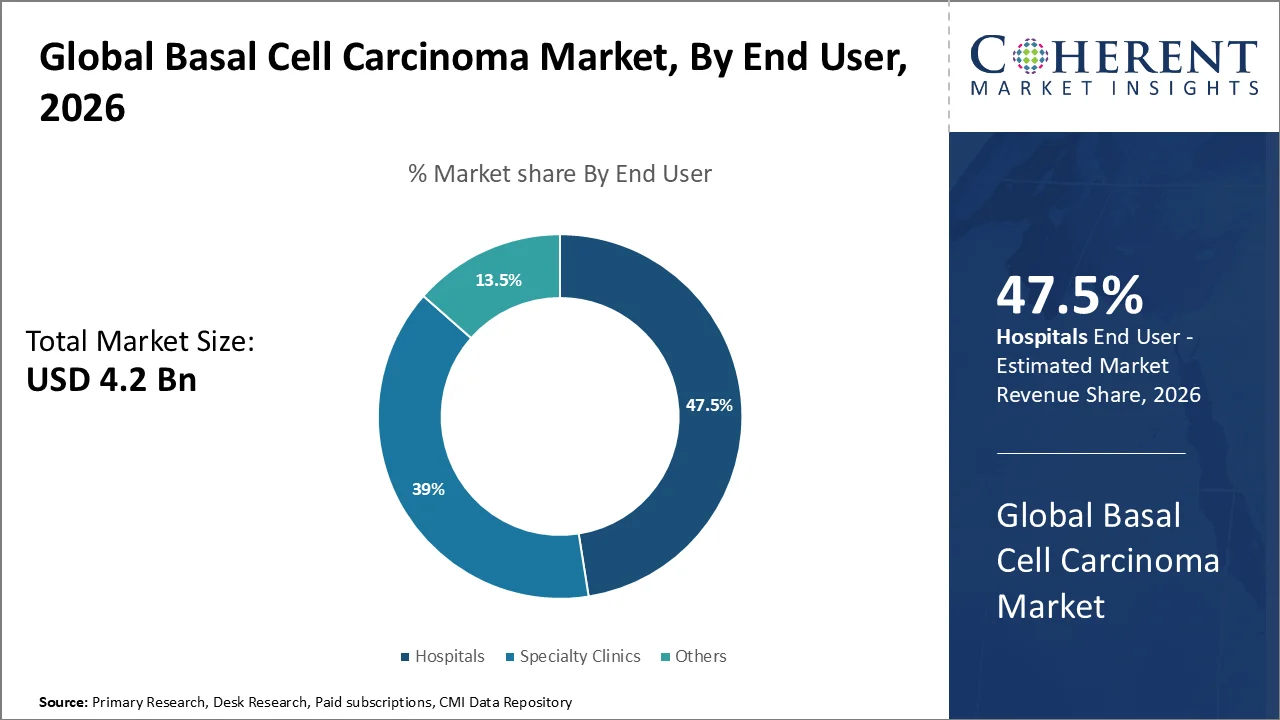
On the basis of end user, the hospitals segment lead with a major 47.5% share in 2026. The segment’s growth is owing to their comprehensive diagnostic and treatment infrastructure, ability to manage both early-stage and advanced BCC cases, and availability of multidisciplinary oncology and dermatology expertise.
Hospitals are equipped to perform biopsy confirmation, Mohs micrographic surgery, complex excisions, reconstructive procedures, and systemic therapy administration for locally advanced or metastatic cases, making them central to the BCC care continuum. According to the American Academy of Dermatology (AAD), skin cancer remains the most common cancer in the United States, with an estimated 9,500 new cases diagnosed daily. This is substantially increasing the hospital-based dermatology and surgical workload.
Hospitals also benefit from structured referral pathways from primary care and dermatology clinics, thus ensuring a steady inflow of patients requiring advanced intervention or recurrence management. In addition, the increasing integration of oncology departments with dermatology units has strengthened the hospital-based care models for complex BCC cases.
Market Drivers
Rising Innovations in Photodynamic Therapy are Transforming the Basal Cell Carcinoma Market in the US
The U.S. is witnessing stronger innovation in superficial basal cell carcinoma management as companies work to expand non-invasive treatment options beyond surgery, curettage, topical agents, and destructive procedures. Photodynamic therapy is gaining attention because it combines a photosensitizing agent with a light source to selectively destroy abnormal cells while preserving surrounding healthy tissue.
In December 2025, Biofrontera submitted a supplemental New Drug Application to the U.S. FDA for Ameluz-PDT for the treatment of superficial basal cell carcinoma. The firm stated that the application included Phase 3 treatment data, one-year follow-up, and integrated safety data from the US and European BCC studies.
In February 2026, the FDA accepted the filing, reported no filing deficiencies, and set a PDUFA target action date of September 28, 2026. If approved, Ameluz-PDT would become the first U.S.-indicated PDT photosensitizer specifically for superficial BCC, which could expand the non-invasive treatment adoption in dermatology practices.
AI-Enabled Skin Cancer Detection: A Major Breakthrough in Basal Cell Carcinoma Market
AI-enabled skin cancer detection is emerging as a major breakthrough in the Basal Cell Carcinoma Market. The BCC diagnosis depends extensively on timely lesion recognition, dermoscopic evaluation, biopsy selection, and specialist referral. The AI-supported tools can help primary care physicians and dermatologists evaluate suspicious lesions more consistently, particularly in settings with limited dermatology access.
In January 2024, DermaSensor announced FDA clearance for its AI-powered medical device to detect the three most common skin cancers including melanoma, basal cell carcinoma, and squamous cell carcinoma. The device uses elastic scattering spectroscopy and AI to evaluate lesions non-invasively at the point of care. A 2024 Nature Digital Medicine article described DermaSensor as the first AI-enabled medical device authorized by the FDA for skin cancer detection in the primary care setting.
Current Events and Their Impact
Current Event | Description and its Impact |
CMS Establishes New Superficial Radiotherapy (SRT) Codes for Non-Melanoma Skin Cancer (2026)
|
|
Expansion of Teledermatology, AI-Based Skin Cancer Detection, and SaMD Regulation in the U.S. |
|
Basal Cell Carcinoma Market Trends
- Rising demand for early diagnosis, biopsy confirmation, and dermoscopy-based screening is improving the treatment timing and minimizing the disease progression risks.
- The adoption of localized and non-invasive therapies including topical drugs, photodynamic therapy, and microneedle delivery is expanding the options for low-risk lesions.
- AI-enabled dermatology devices and computer-aided imaging systems are improving lesion detection accuracy through dermoscopic image analysis and deep learning models.
- The WHO states that the global population aged 60 years and older will rise from 1.0 billion in 2020 to 1.4 billion by 2030 and 2.1 billion by 2050. As older adults represent a high-risk group for keratinocyte cancers, this demographic shift is expected to increase dermatology visits, lesion monitoring, and treatment demand.
- The AAD recommends BCC stratification according to NCCN risk criteria, optimal biopsy techniques, surgical management, and annual follow-up. This supports the standardized treatment pathways, clearer patient selection for surgery versus non-surgical options, and improved clinical decision-making across dermatology clinics and hospitals.
Regional Insights
North America Dominates Owing to the High Disease Burden and Advanced Treatment Access
The North America region accounts for 49.2% of the market share in 2026. The region’s growth is owing to the high skin cancer incidence, broad dermatology infrastructure, strong procedural treatment volumes, FDA-approved advanced therapies, and growing use of digital diagnostic tools. AAD states that skin cancer is the most common cancer in the U.S. and estimates that one in five Americans will develop skin cancer in their lifetime.
The region also leads in innovation and regulatory approvals, thereby strengthening its prominence. The FDA has approved few of the crucial targeted therapies like hedgehog pathway inhibitors (vismodegib, sonidegib) and immunotherapy agents like cemiplimab for advanced basal cell carcinoma management, thereby expanding treatment options beyond surgery.
In May 2026, Medicus Pharma reported expanded Phase 2 SKNJCT-003 results for its Doxorubicin Microneedle Array in nodular basal cell carcinoma, thus showing a positive dose-response. The 200µg cohort achieved 55% complete response at Day 57, thereby supporting the strong registrational potential.
Asia Pacific Basal Cell Carcinoma Market Trends
Asia Pacific is expected to witness strong growth in Basal Cell Carcinoma Market over the forecast period. The region’s growth is owing to the expanding dermatology access, rising skin cancer awareness, improving diagnostic infrastructure, and high ultraviolet exposure in countries such as Australia. The region is also benefiting from a growing elderly population, as age remains a major risk factor for basal cell carcinoma.
India represents an emerging opportunity, driven by population aging and gradual expansion of specialist dermatology care. According to PIB data published in October 2025, India’s senior citizen population is projected to reach around 230 million by 2036, accounting for nearly 15% of the total population.
Technological advancement is also strengthening the early detection in the region. In June 2024, South Korea approved its first AI-driven skin cancer detection solution named canofyMD SCAI. It was developed by LifeSemantics, which uses smartphone images to identify conditions including basal cell carcinoma. The tool demonstrated around 80.9% diagnostic accuracy in clinical trials and is planned for commercial launch and further the global regulatory expansion.
High Disease Prevalence and Expanding Dermatology Access is Accelerating the Basal Cell Carcinoma Market in United States
The U.S. Basal Cell Carcinoma market is witnessing strong structural growth. This is owing to the exceptionally high disease prevalence, advanced dermatology infrastructure, and rapid adoption of innovative treatment modalities. Basal cell carcinoma remains the most common cancer in the United States, with an estimated 3.6 million cases diagnosed annually. This highlights the sustained clinical and procedural demand for dermatology as well as oncology services.
In May 2025, NYC Health + Hospitals launched the dermatology services in New York City to improve access to screening, early detection, and treatment of skin conditions like basal cell carcinoma. This is strengthening the equitable care and expanding preventive dermatologic services in the underserved communities.
Australia Basal Cell Carcinoma Market Trends
Australia is a major country-level market due to high UV exposure, fair-skinned population risk, strong public awareness campaigns, and large keratinocyte cancer treatment volumes. Cancer Council Australia states that more than two in three Australians will be diagnosed with skin cancer in their lifetime, making skin cancer one of the country’s most important public health and dermatology burdens.
In April 2026, Regeneron Pharmaceuticals and Telix Pharmaceuticals announced a collaboration worth up to USD 4.3 billion to develop radiopharmaceutical therapies and companion diagnostics across multiple cancer types, including basal cell carcinoma.
Who are the Major Companies in Basal Cell Carcinoma Industry
Some of the major key players in Basal Cell Carcinoma Market are Merck & Co., Inc., Sun Pharmaceutical Industries Ltd., Novartis AG., Bausch & Lomb Incorporated., Allergan, Perrigo Company plc, Taro Pharmaceutical Industries Ltd., Provectus Biopharmaceuticals, Inc., F. Hoffmann-La Roche Ltd, Sanofi, and Mylan N.V.
Key News
- In June 2026, Cape Fear Valley Health opened a new dermatology clinic in Fayetteville to expand access to skin care, including screening, diagnosis, and treatment of conditions such as basal cell carcinoma. The clinic also offers Mohs surgery to enable precise, high-cure-rate skin cancer removal locally.
- In April 2025, SKNV launched Kefunova, a prescription-only topical cream combining fluorouracil and calcipotriene to support dermatology providers treating superficial basal cell carcinoma. The ready-to-use formulation offers accessible in-office dispensing and e-prescribing options for patients needing convenient lesion-focused care nationwide.
Market Report Scope
Basal Cell Carcinoma Market Report Coverage
| Report Coverage | Details | ||
|---|---|---|---|
| Base Year: | 2025 | Market Size in 2026: | USD 4.2 Bn |
| Historical Data for: | 2020 To 2024 | Forecast Period: | 2026 To 2033 |
| Forecast Period 2026 to 2033 CAGR: | 9.8% | 2033 Value Projection: | USD 8.15 Bn |
| Geographies covered: |
| ||
| Segments covered: |
| ||
| Companies covered: | Merck & Co., Inc., Sun Pharmaceutical Industries Ltd., Novartis AG., Bausch & Lomb Incorporated., Allergan, Perrigo Company plc, Taro Pharmaceutical Industries Ltd., Provectus Biopharmaceuticals, Inc., F. Hoffmann-La Roche Ltd, Sanofi, and Mylan N.V. | ||
| Growth Drivers: |
| ||
| Restraints & Challenges: |
| ||
Analyst Opinion
- The basal cell carcinoma market is driven by strong clinical necessity. Non-melanoma skin cancers (NMSC), including squamous cell carcinoma, basal cell carcinoma, and Merkel cell carcinoma, account for approximately 1.2 million cases and 63,731 deaths globally, highlighting the persistent and clinically significant disease burden.
- The market is shifting from procedure-only management toward a broader treatment ecosystem. The AAD still identifies surgery as the cornerstone of BCC treatment but the FDA-approved systemic therapies like hedgehog inhibitors and cemiplimab have expanded options for more advanced disease. This matters because locally advanced and metastatic BCC patients often need alternatives when surgery or radiation is unsuitable.
- The advanced procedures like Mohs surgery are gaining strong preference, especially for facial and recurrent BCC cases. The clinical data shows Mohs surgery delivers cure rates of up to 99% for new basal cell carcinoma cases and around 94% for recurrent cases, thereby supporting the wider adoption of precision-based dermatology treatments.
Speak to the analyst
Want personalized insights?
Take the findings above to one of our principal consultants, or have the report rebuilt around the segments, geographies and competitors you actually track.
Market Segmentation
- By Treatment Type (Revenue, USD Bn, 2021-2033)
- Surgical
- Surgical Excision
- Electrodessication & Cutterage ED&C
- Moh's Surgery
- Cryosurgery
- Drugs
- Topical Treatment
- Advanced Medication
- Other
- Others
- Radiation Therapy
- Photodynamic Therapy PDT
- Laser Therapy
- Surgical
- By End User (Revenue, USD Bn, 2021-2033)
- Hospitals
- Specialty Clinics
- Others
- Global Basal Cell Carcinoma Market, By Region (Revenue, USD Bn, 2021-2033)
- North America
- U.S.
- Canada
- Latin America
- Brazil
- Mexico
- Argentina
- Rest of Latin America
- Europe
- Germany
- U.K.
- France
- Italy
- Spain
- Russia
- Rest of Europe
- Asia Pacific
- China
- India
- Japan
- Australia
- South Korea
- ASEAN
- Rest of Asia Pacific
- Middle East
- GCC
- Israel
- Rest of Middle East
- Africa
- South Africa
- Central Africa
- North Africa
- North America
- Key Players
- Merck & Co., Inc.
- Sun Pharmaceutical Industries Ltd.
- Novartis AG.
- Bausch & Lomb Incorporated.
- Allergan
- Perrigo Company plc
- Taro Pharmaceutical Industries Ltd.
- Provectus Biopharmaceuticals, Inc.
- Hoffmann-La Roche Ltd
- Sanofi
- Mylan N.V.
Sources
Primary Research Interviews
- Dermatologists & Dermato-oncologists
- Mohs Surgery Specialists
- Oncology Drug Manufacturers
- Topical & Photodynamic Therapy Providers
- Hospital & Dermatology Clinic Procurement Managers
- Skin Cancer Treatment Consultants
- Others
Databases
- World Health Organization (WHO)
- International Agency for Research on Cancer (IARC)
- Centers for Disease Control and Prevention (CDC)
- National Institutes of Health (NIH)
- National Cancer Institute (NCI)
- Surveillance, Epidemiology, and End Results Program (SEER)
- Organisation for Economic Co-operation and Development (OECD)
Magazines
- Dermatology Times
- Practical Dermatology
- Oncology Times
- The Dermatologist
- Modern Aesthetics
- Others
Journals
- Journal of the American Academy of Dermatology
- JAMA Dermatology
- British Journal of Dermatology
- Dermatologic Surgery Journal
- The Lancet Oncology
- Journal of Clinical Oncology
- Others
Newspapers
- Financial Times
- The Wall Street Journal
- Reuters
- Bloomberg News
- The New York Times
- Others
Associations
- American Academy of Dermatology Association (AAD)
- American Society for Dermatologic Surgery (ASDS)
- Skin Cancer Foundation
- European Association of Dermato-Oncology (EADO)
- American Society of Clinical Oncology (ASCO)
- European Society for Medical Oncology (ESMO)
- Others
Public Domain Sources
- U.S. Food and Drug Administration (FDA)
- National Cancer Institute (NCI) – SEER Program
- ClinicalTrials.gov
- PubMed / NCBI
- European Medicines Agency (EMA)
- Others
Proprietary Elements
- CMI Data Analytics Tool, Proprietary CMI Existing Repository of Information for the Last 10 Years
Get access to 250+ pages report
Every segment, forecast, competitor profile and data table behind the analysis above — available for instant download.
- ESOMAR Member
- ISO 9001:2015 Certified
- D-U-N-S Registered
- GDPR & CCPA Compliant
Missing comfort of reading report in your local language? Find your preferred language:
Transform your Strategy with Exclusive Trending Reports
Frequently Asked Questions
The Basal Cell Carcinoma Market is expected to reach USD 8.15 Billion in 2033.
The high cost of advanced targeted therapies, delays in diagnosis, and a shortage of trained dermatologists are the key factors hampering growth of the market.
The Basal Cell Carcinoma Market includes products, procedures, diagnostics, drugs, devices, and services used to diagnose, treat, and monitor basal cell carcinoma. It covers surgical treatment, topical therapies, photodynamic therapy, radiation therapy, hedgehog inhibitors, immunotherapy, AI-enabled detection, and dermatology care services.
Major opportunities include improved topical therapies, wider teledermatology adoption, stronger skin cancer screening programs, and increasing access to advanced treatment in emerging economies.
The market is expected to grow steadily as early diagnosis improves and demand rises for non-invasive, patient-friendly, and cosmetically acceptable treatment approaches.
The rising skin cancer prevalence, an aging global population with higher cumulative sun exposure, and technological advancements in targeted therapies is boosting the demand for Basal Cell Carcinoma.
The Basal Cell Carcinoma Market is anticipated to grow at a CAGR of 9.8% between 2026 and 2033.