

Bio Decontamination Market Size and Forecast – 2026 to 2033
Bio Decontamination Market is estimated to be valued at USD 322.3 Mn in 2026 and is expected to reach USD 616.2 Mn in 2033, exhibiting a compound annual growth rate (CAGR) of 9.7% from 2026 to 2033.
Key Takeaways
- By Product Type, Equipment holds the largest market share in 2026 owing to its rising healthcare-associated infections (HAIS).
- By Agent Type, Hydrogen Peroxide dominates the overall market share in 2026 owing to the exceptional antimicrobial efficacy & fast cycles.
- By Type of Decontamination, Chamber Decontamination dominates the overall market with an estimated share of 61% in 2026 owing to the rising regulatory and safety standards.
- By End-User, Hospitals & Healthcare Facilities acquired the prominent share in 2026 owing to the growing technological advancements in decontamination methods.
- By Region, North America acquired the prominent share of 40.5% in 2026 on account of the robust healthcare infrastructure and high surgical volumes.
Market Overview
Bio decontamination is the process of eliminating microscopic organisms and pathogens using technologies such as hydrogen peroxide vapor, chlorine dioxide, peracetic acid, etc. It is used to disinfect tools, spaces, and equipment in pharmaceutical, biotechnology, and healthcare facilities. The key factors driving the bio decontamination market demand are a rise in the incidence of hospital-acquired infections, increasing focus on food decontamination, and the growing pharmaceutical and biotechnology industries.
Current Events and their Impact on the Bio Decontamination Market
Current Events | Description and its impact |
Geopolitical Tensions and Biosecurity Concerns |
|
Technological Advancement in Decontamination Methods |
|
Emerging Infectious Disease Outbreaks and Antimicrobial Resistance |
|
End-user Feedback and Unmet Needs in the Bio Decontamination Market
- Demand for Faster Decontamination Cycles: End-users seek technologies that reduce sterilization time without compromising effectiveness. Faster cycles improve operational efficiency in healthcare and pharmaceutical settings, allowing quicker turnover of rooms and equipment, but many existing systems still require lengthy processes that limit productivity.
- Need for User-Friendly Systems: Healthcare professionals and lab staff prefer bio-decontamination equipment that is easy to operate and requires minimal training. Complex systems can lead to errors or underutilization, so intuitive interfaces and automated functions are highly requested to enhance adoption and consistent use.
- Desire for Residue-Free Solutions: Users emphasize the importance of decontamination methods that leave no harmful residues on surfaces or equipment. This is critical for sensitive medical devices and pharmaceutical environments where contamination could affect product integrity or patient safety.
- Current Industry Events of 2026
- Market Size Estimation
- Regional Breakdown
- Competitive Landscape
- Customer Intelligence
- Segmental Analysis
- Pricing Analysis
- Key Market Drivers, Challenges & Future Trends
- Customized Insights Section
Segmental Insights
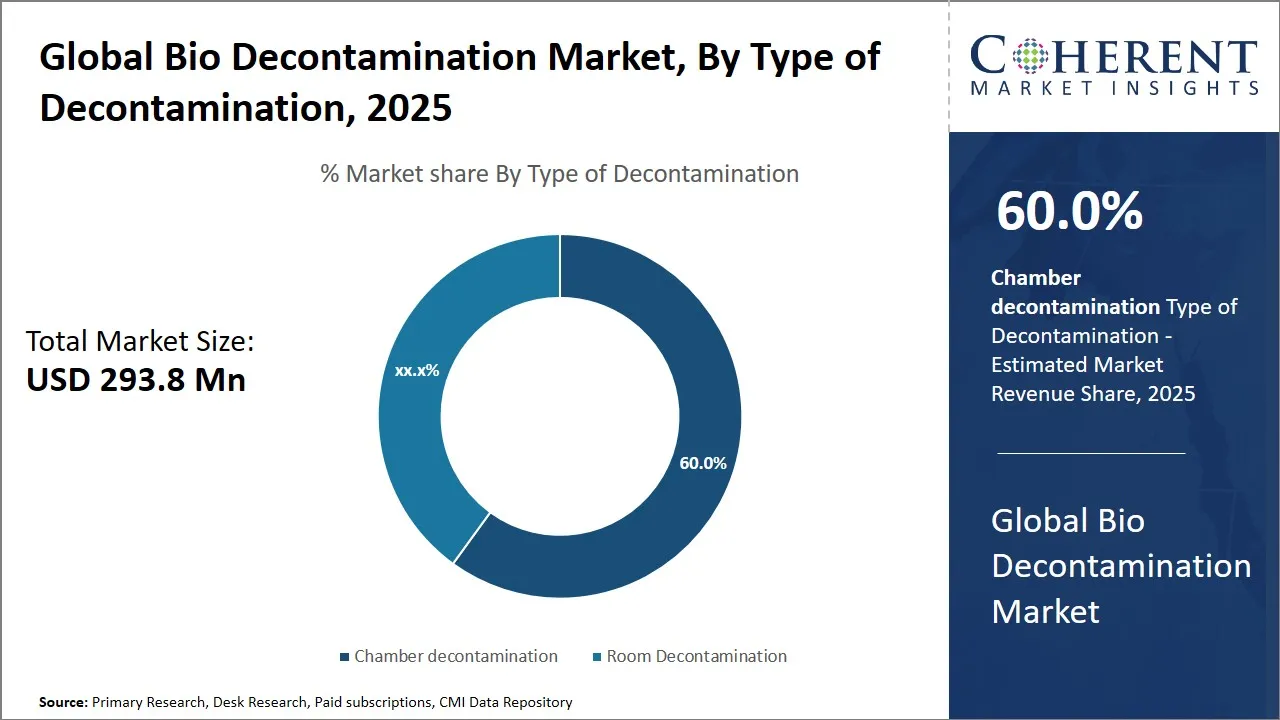
Bio Decontamination Market Insights, By Type of Decontamination - Chamber Decontamination contribute the highest share of the market owing to its customization, scalability & portability
Chamber Decontamination dominates the overall market with an estimated share of 61.0% in 2026. Chamber decontamination is gaining traction in the bio-decontamination market due to its ability to provide controlled, consistent sterilization in enclosed spaces. Healthcare and pharmaceutical industries prefer chambers for their effectiveness in disinfecting sensitive equipment and materials. Technological advancements, including automated vaporized hydrogen peroxide and UV-C systems, enhance decontamination precision and reduce human error. Regulatory pressure for validated, reproducible sterilization processes also support adoption. Additionally, the demand for portable and scalable solutions drives the use of chambers in diverse facility sizes and settings. For instance, Initial Hygiene, the hygiene division of Rentokil Initial, has launched its VIRUSKILLER™ clean air technology in Singapore. The VIRUSKILLER™ air purifiers use a three-layer filtration system and a patented UV-C Reactor Chamber to deactivate viruses in real time.
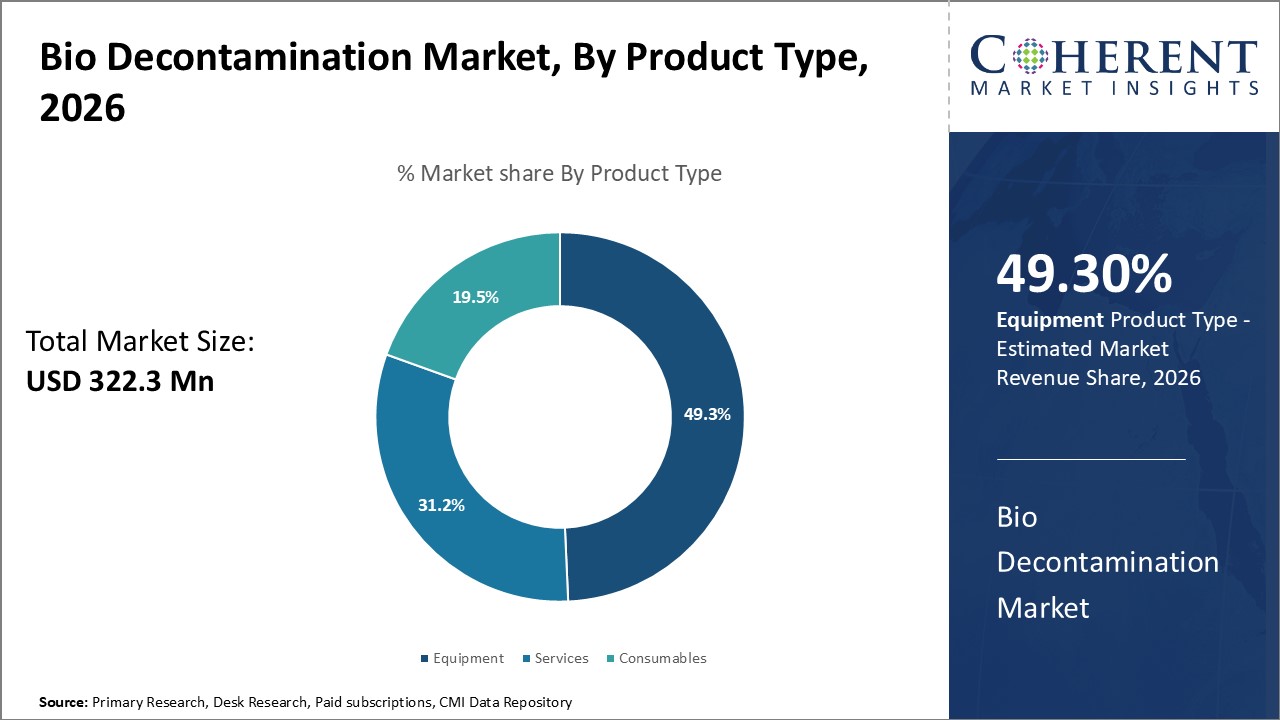
Bio Decontamination Market Insights, By Product Type - Equipment contributes the highest share of the market owing to its growth in emerging markets & healthcare infrastructure
Growing awareness of infection control, particularly in healthcare and pharmaceutical settings, drives the demand for bio-decontamination equipment. The rise in hospital-acquired infections pushes facilities to adopt reliable sterilization tools. Manufacturers continue to develop advanced technologies like vaporized hydrogen peroxide and UV-C systems to enhance efficiency and safety. Regulatory bodies enforce strict hygiene standards, encouraging the use of compliant equipment. Additionally, users increasingly prefer automated, residue-free, and eco-friendly solutions, which further accelerates the adoption of modern decontamination equipment. For instance, STERIS has introduced its next-generation integrated Vaporized Hydrogen Peroxide (VHP) bio decontamination systems to help customers achieve up to a six-log bioburden reduction in GMP pharmaceutical, medical device, and research settings.
Bio Decontamination Market Insights, By Agent Type - Hydrogen Peroxide contribute the highest share of the market owing to its preference for chamber & room decontamination
The bio-decontamination market increasingly relies on hydrogen peroxide for its powerful antimicrobial action, which effectively eliminates bacteria, viruses, and spores. Its ability to break down into water and oxygen makes it a safe and environmentally friendly option. Regulatory bodies encourage its use, while rising demand for non-toxic and efficient sterilization methods drives further adoption. Healthcare and pharmaceutical sectors favor hydrogen peroxide for its compatibility with advanced vaporized systems, allowing them to achieve thorough decontamination of equipment, rooms, and critical environments with minimal interruption.
For instance, in March 2025, Nouryon, a global specialty chemicals provider, launched Eka HP Puroxide, a new low-carbon hydrogen peroxide product. With this solution, Nouryon helps customers in the pulp and paper, mining, and water treatment industries significantly lower their Scope 3 greenhouse gas emissions.
Bio Decontamination Market Insights, By End User - Hospital & Healthcare Facilities contribute the highest share of the market owing to its outsourcing of bio-decontamination services
Hospitals and healthcare facilities actively drive demand in the bio-decontamination market as they work to control hospital-acquired infections and uphold strict hygiene standards. They rely on effective sterilization to safeguard patients and staff, particularly in surgical units and intensive care areas. The increasing awareness of infection control also motivates continued investment in bio-decontamination solutions. For instance, Viscogliosi Brothers, LLC, in partnership with Enviro-Mist Inc., has launched VB Enviro Care to deliver top-tier disinfecting products. These clinically proven technologies effectively disinfect air and surfaces in workplaces, manufacturing facilities, healthcare settings, and homes. They also offer contract services that support industries needing sterile environments or enhanced bio-decontamination.
Regional Insights
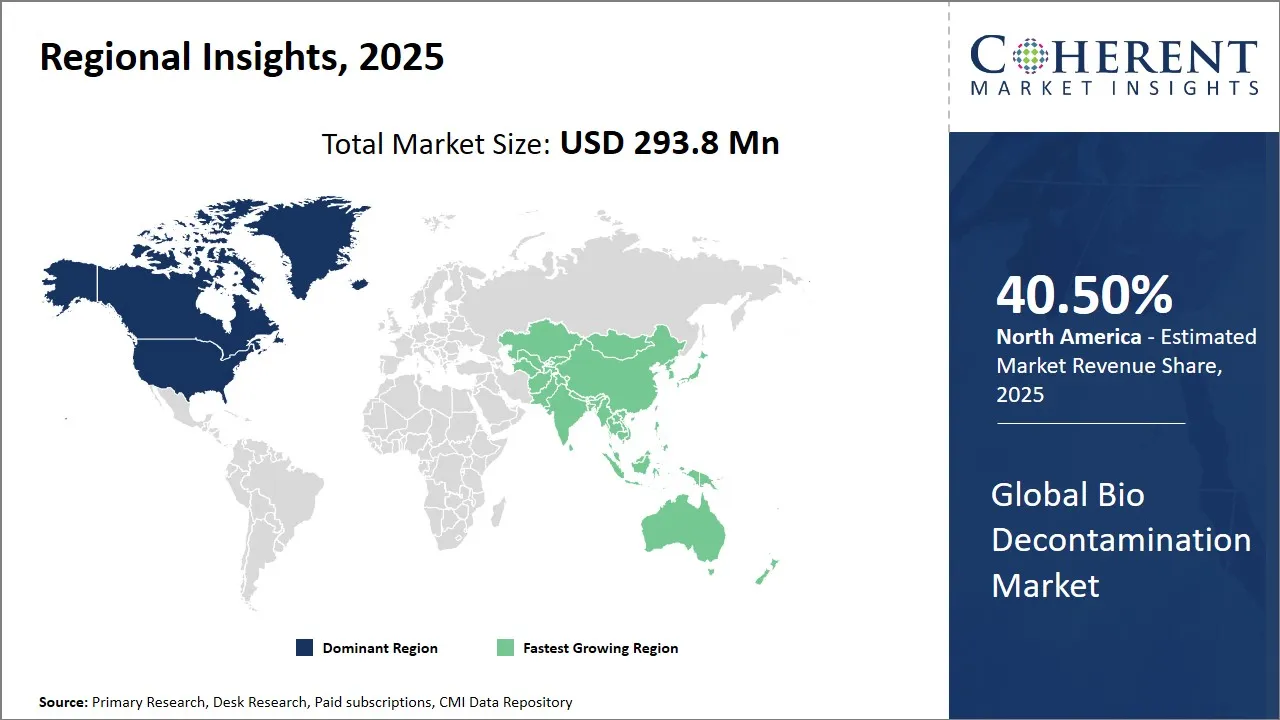
North America Bio Decontamination Market Trends
North America acquires the largest share of 40.50%. Advanced healthcare infrastructure, high surgical volumes, and strict regulatory standards drive strong growth in the North America bio-decontamination market. Hospitals, pharmaceutical firms, and research laboratories across the region actively adopt modern sterilization technologies to meet safety and compliance needs. Organizations increasingly outsource decontamination services to specialized providers, seeking efficiency and expertise. Technological innovation and a heightened focus on infection control continue to support the region’s widespread use of advanced bio-decontamination solutions across both medical and industrial environments.
Asia Pacific Bio Decontamination Market Trends
Asia Pacific countries are rapidly expanding healthcare infrastructure by building new hospitals, laboratories, and cleanrooms. This expansion drives demand for effective decontamination systems to maintain sterility, especially in densely populated nations like China and India. Healthcare modernization efforts prioritize reducing infection risks, prompting hospitals and clinics to adopt reliable, automated decontamination systems that enhance patient safety and ensure compliance with regulations.
For example, the Asia Pacific Society of Infection Control has released an updated version of its Guidelines for the Disinfection and Sterilization of Instruments in Healthcare Facilities.
United States Bio Decontamination Market Trends
Highly developed healthcare facilities in the U.S. demand rigorous decontamination to prevent infections. Continuous hospital and lab upgrades drive the need for sophisticated bio-decontamination technologies that ensure sterile environments, enhance patient safety, and meet regulatory requirements in surgical and critical care areas. U.S. companies actively develop advanced technologies like vaporized hydrogen peroxide and UV-C systems, offering improved efficacy, faster cycle times, and environmental safety across applications ranging from hospitals to pharmaceutical manufacturing.
For instance, Steris has introduced its next-generation vaporized hydrogen peroxide (VHP) biodecontamination systems, designed to deliver a 6-log reduction in bioburden for pharmaceutical, medical device, and research settings that follow good manufacturing practices (GMP).
India Bio Decontamination Market Trends
India is rapidly expanding its healthcare infrastructure by building new hospitals, clinics, and diagnostic labs to meet rising healthcare demands. This growth drives the need for effective bio-decontamination solutions to maintain sterile environments and minimize infection risks, especially in busy urban centers. Manufacturers actively adopt bio-decontamination technologies to ensure sterile production, enhance product safety, and comply with global regulations. Increasing awareness motivates hospitals and clinics to invest in automated, reliable systems that enhance patient safety and meet healthcare standards. For instance, Biomoneta Research, a spinout from antibiotics discovery startup Bugworks, aims to lower the risk of airborne infections with its patent-pending indoor air decontamination device, ZeBox, which actively traps and destroys viruses, bacteria, fungi, and spores.
Market Report Scope
Bio Decontamination Market Report Coverage
| Report Coverage | Details | ||
|---|---|---|---|
| Base Year: | 2025 | Market Size in 2026: | USD 322.3 Mn |
| Historical Data for: | 2020 To 2024 | Forecast Period: | 2026 To 2033 |
| Forecast Period 2026 to 2033 CAGR: | 9.7% | 2033 Value Projection: | USD 616.2 Mn |
| Geographies covered: |
| ||
| Segments covered: |
| ||
| Companies covered: | STERIS Corporation, Ecolab, Inc., TOMI Environmental Solutions, Inc. , JCE Biotechnology, Fedegari Autoclavi SpA, Howorth Air Technology Ltd., Noxilizer, Inc., ClorDiSys Solutions, Inc., Wales Group, and Wenzhou Weike Biological Laboratory Equipment Co., Ltd. | ||
| Growth Drivers: |
| ||
| Restraints & Challenges: |
| ||
Bio Decontamination Market Trend
- Rising Demand for Automated Decontamination Systems
The market is witnessing growing adoption of automated bio-decontamination technologies that minimize human intervention and reduce errors. These systems offer consistent sterilization, improve safety, and optimize workflow efficiency in hospitals, pharmaceutical manufacturing, and research labs. Automated solutions like vaporized hydrogen peroxide and UV-C light systems are preferred for their reliability and ability to maintain stringent hygiene standards with minimal downtime, driving their widespread use across healthcare and industrial sectors.
Bio Decontamination Market Opportunity
- Rising Outsourcing Demand for Decontamination Services
Healthcare and pharmaceutical companies are increasingly outsourcing bio-decontamination services to reduce operational costs and ensure consistent compliance with regulatory standards. This creates a strong opportunity for service providers offering specialized, mobile, and contract-based decontamination solutions. As facilities aim to minimize capital expenditure and focus on core competencies, demand for third-party decontamination providers is set to grow, particularly in regions lacking in-house capabilities or resources for advanced sterilization technologies.
Bio Decontamination Market News
- In July 2025, Inivos launched the ProXcide Mini, a compact and portable bio-decontamination device specifically designed to disinfect small, enclosed spaces like biosafety cabinets, incubators, pass-through hatches, and isolators.
- In October 2024, Belgium-based cleanroom maintenance company EAZER Maintenance partnered with pre-engineered cleanroom expert ABN Cleanroom Technology and Hasselt University to develop a prototype of CleanAR, a digital solution for bio-decontamination cleaning.
Analyst Opinion (Expert Opinion)
- Regulatory enforcement is the most immediate driver of purchasing behavior in the bio decontamination market. Between 2022 and 2024, the U.S. FDA issued more than 1,100 Form 483 observations specifically related to environmental monitoring and sterilization lapses. Facilities are no longer buying equipment—they’re buying audit readiness. If your system can’t produce electronic batch records and 21 CFR Part 11-compliant logs, you’re already off the vendor list.
- Cycle time is now a procurement differentiator, not a technical detail. At least three major CDMOs in Europe—reported by internal audits in 2023—have rejected high-end VHP systems due to 4+ hour cycle durations. When manufacturing slots are worth tens of thousands of dollars per hour, a sterilization process that delays cleanroom turnover is no longer viable, regardless of how effective it is on paper.
- Outsourcing is becoming the standard operating model for small and mid-sized facilities. Bioquell’s service division reported a 27% YoY increase in global decontamination contracts between 2022 and 2023. Hospitals and contract manufacturers are moving away from capital equipment purchases, opting instead for subscription-based services that include technicians, consumables, and cycle validation. Vendors focused solely on equipment sales are on borrowed time.
- Hospitals are transitioning from basic surface cleaning to controlled decontamination in high-risk zones like ICUs and oncology wards. CDC data from 2023 linked 9.4% of HAIs directly to contaminated surfaces, even in rooms recently cleaned by standard protocols. This is pushing infection control teams to deploy automated, validated systems that leave no chemical residues and require no manual labor—especially during off-hours.
- Pharmaceutical manufacturers are no longer tolerating downtime caused by decontamination failure. A 2023 shutdown of a major biologics line at a U.S. CDMO due to incomplete hydrogen peroxide breakdown cost the client $1.6 million in lost batches and compliance resets. As a result, manufacturers now demand real-time monitoring of sterilant levels, airflow, and surface kill rates—capabilities missing from many legacy systems still in operation today.
Speak to the analyst
Want personalized insights?
Take the findings above to one of our principal consultants, or have the report rebuilt around the segments, geographies and competitors you actually track.
Market Segmentation
- By Product Type (Revenue, USD Mn, 2021 - 2033)
- Equipment
- Chamber Decontamination
- Room Decontamination
- Services
- Consumables
- Chemical Indicators
- Biological Indicators
- Others
- By Agent Type (Revenue, USD Mn, 2021 - 2033)
- Hydrogen Peroxide
- Chlorine Dioxide
- Nitrogen Dioxide
- Peracetic Acid
- Others
- By Decontamination (Revenue, USD Mn, 2021 - 2033)
- Chamber Decontamination
- Room Decontamination
- By End User (Revenue, USD Mn, 2021 - 2033)
- Pharmaceutical & Medical Device Manufacturing Companies
- Life Sciences & Biotechnology Research Organizations
- Hospitals &Healthcare Facilities
- By Region (Revenue, USD Mn, 2021 - 2033)
- North America
- U.S.
- Canada
- Latin America
- Brazil
- Argentina
- Mexico
- Rest of Latin America
- Europe
- Germany
- U.K.
- Spain
- France
- Italy
- Russia
- Rest of Europe
- Asia Pacific
- China
- India
- Japan
- Australia
- South Korea
- ASEAN
- Rest of Asia Pacific
- Middle East
- GCC Countries
- Israel
- Rest of Middle East
- Africa
- South Africa
- North Africa
- Central Africa
- North America
- Key Players Insights
- STERIS Corporation
- Ecolab, Inc.
- TOMI Environmental Solutions, Inc.
- JCE Biotechnology
- Fedegari Autoclavi SpA
- Howorth Air Technology Ltd.
- Noxilizer, Inc.
- ClorDiSys Solutions, Inc.
- Wales Group
- Wenzhou Weike Biological Laboratory Equipment Co., Ltd.
Sources
Primary Research Interviews
- Industry experts
- hospital infection control specialists
- pharmaceutical manufacturing leaders
- decontamination equipment manufacturers
- service providers.
Databases
- PubMed
- ClinicalTrials.gov
- U.S. FDA Database
- World Health Organization Global Health Observatory
- Environmental Protection Agency Chemical Data.
Magazines
- Infection Control Today
- Pharmaceutical Technology
- BioPharm International
- Cleanroom Technology Magazine.
Journals’
- Journal of Hospital Infection
- Applied and Environmental Microbiology
- Journal of Clinical Microbiology
- International Journal of Hygiene
- Environmental Health.
Newspapers
- The Wall Street Journal (Healthcare section)
- The New York Times (Science & Health)
- The Guardian (Health)
- Financial Times (Healthcare).
Associations
- Association for Professionals in Infection Control and Epidemiology (APIC)
- Parenteral Drug Association (PDA)
- International Federation of Pharmaceutical Manufacturers & Associations (IFPMA)
- American Society for Microbiology (ASM).
Public Domain Sources
- Centers for Disease Control and Prevention (CDC)
- National Institutes of Health (NIH)
- World Health Organization (WHO)
- U.S. Environmental Protection Agency (EPA).
Proprietary Elements
- CMI Data Analytics Tool, and Proprietary CMI Existing Repository of information for last 8 years.
Get access to 250+ pages report
Every segment, forecast, competitor profile and data table behind the analysis above — available for instant download.
- ESOMAR Member
- ISO 9001:2015 Certified
- D-U-N-S Registered
- GDPR & CCPA Compliant
Missing comfort of reading report in your local language? Find your preferred language:
Transform your Strategy with Exclusive Trending Reports
Frequently Asked Questions
The Bio Decontamination Market is estimated to be valued at USD 322.3 Mn in 2026, and is expected to reach USD 616.2 Mn by 2033.
The CAGR of the Bio Decontamination Market is projected to be 9.7% from 2026 to 2033.
The major factors driving the growth of the market are the rising incidence of hospital-acquired infections, increasing focus on food decontamination, growth of pharmaceutical and biotechnology industries, technological advancements in decontamination methods, increasing life sciences R&D, and growing applications in the food industry.
The equipment segment accounts for the leading share in the market owing to the growing adoption of technologies such as hydrogen peroxide vapor bio-decontamination systems.
The major players operating in the market are STERIS Corporation, Ecolab, Inc., TOMI Environmental Solutions, Inc., JCE Biotechnology, Fedegari Autoclavi SpA, Howorth Air Technology Ltd., Noxilizer, Inc., ClorDiSys Solutions, Inc., Wales Group, and Wenzhou Weike Biological Laboratory Equipment Co., Ltd.
North America is expected to continue leading the market during the forecast period.