

Blister Packaging Market Size and Forecast – 2026 to 2033
The blister packaging market is estimated to be valued at USD 36.79 Bn in 2026 and is expected to reach USD 61.43 Bn by 2033, growing at a compound annual growth rate (CAGR) of 7.6% from 2026 to 2033.
Key Takeaways
- By Product Type, Blister Cards hold the largest market share of 38.6% in 2026 owing to the surge in pharmaceutical demand.
- By Technology, Thermoforming expected to hold largest market share of 43.1% in 2026 owing to its enhanced automation and production efficiency.
- By Material Type, Plastic acquired the prominent market share of 42.7% in 2026 owing to the superior barrier properties.
- By Application, Pharmaceuticals dominates the overall market share in 2026 owing to the enhanced patient compliance and safety.
- By Region, North America dominates the overall market with an estimated share of 41.7% in 2026 owing to the regulatory compliance and safety standards.
Market Overview
The blister packaging market is expanding quickly as pharmaceuticals, consumer goods, and food industries increasingly demand it. Manufacturers provide secure, tamper-evident, and convenient packaging solutions that improve product protection and ensure consumer safety. Innovations in smart packaging and the use of sustainable materials drive higher adoption rates. Advances in manufacturing technologies like thermoforming support the needs of e-commerce and retail sectors. Stricter regulatory requirements and growing consumer preference for eco-friendly packaging also actively contribute to the market’s growth.
Current Events and their Impact on the Blister Packaging Market
Current Events | Description and its impact |
Global Supply Chain Disruptions Due to Ongoing Geopolitical Tensions |
|
Rising Environmental Regulations and Sustainability Initiatives |
|
Regional Economic Fluctuations and Market Dynamics |
|
Eco-friendly Blister Packaging Industry
The eco-friendly blister packaging industry is transforming traditional pharmaceutical and consumer goods packaging by introducing sustainable alternatives to conventional plastic-aluminum combinations. Traditionally difficult to recycle, blister packs are now being reengineered using recyclable materials like polyethylene terephthalate (PET), which significantly reduce environmental impact. These innovations aim to lower carbon footprints, eliminate harmful materials like polyvinyl chloride (PVC), and improve recyclability.
In October 2024, Bayer, in collaboration with Liveo Research, introduced the healthcare industry's first polyethylene terephthalate (PET) blister packaging for its Aleve brand. This innovation eliminates polyvinyl chloride (PVC) and cuts the packaging’s carbon footprint by 38%. Blister packs, commonly used in over-the-counter products, are typically hard to recycle due to their mixed materials. Launching initially in the Netherlands, Bayer plans to expand this sustainable packaging across its entire product line in the coming years.
- Current Industry Events of 2026
- Market Size Estimation
- Regional Breakdown
- Competitive Landscape
- Customer Intelligence
- Segmental Analysis
- Pricing Analysis
- Key Market Drivers, Challenges & Future Trends
- Customized Insights Section
Segmental Insights

Blister Packaging Market Insights, by Product Type: Blister Cards contribute the highest share of the market owing to its e-commerce growth and retail visibility.
Blister Cards hold the largest market share of 38.6% in 2026. Blister cards are rigid, environmentally friendly plastic containers that are thermoformed around a product or portions of a product. Products are shielded from damage during storage and transportation by the stiff blister section, while the paper backing offers stability and openability. Blister cards offer a strong defense against oxygen, moisture, and other environmental contaminants, extending the shelf life of medications, medical supplies, and small gadgets. Furthermore, their own chambers are designed to avoid the friction and damage that unsecured products can experience during shipping.
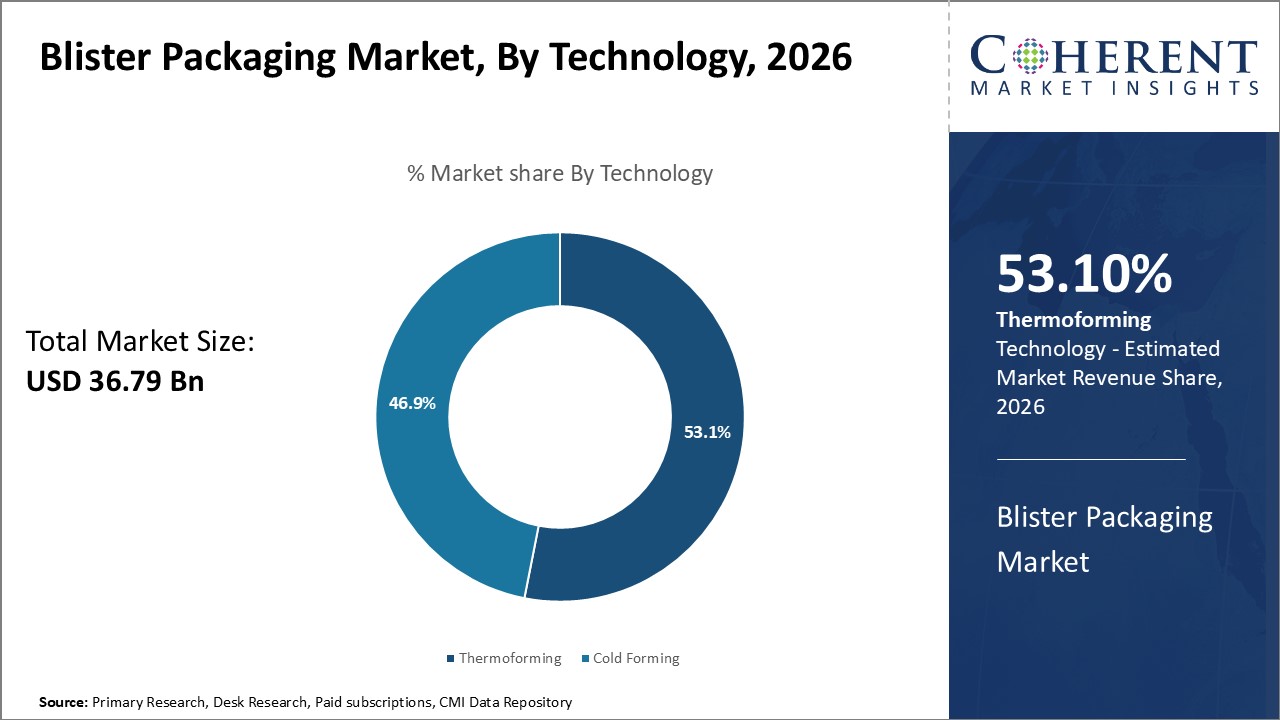
Blister Packaging Market Insights, by Technology: Thermoforming contributes the highest share of the market owing to its superior product protection.
Thermoforming expected to hold the largest blister packaging market share of 43.1% in 2026. Pressure and heat are used to thermoform plastic sheets into precisely shaped cavities that fit objects. It may produce intricate blister forms around irregularly shaped items, including pharmaceutical capsules, without compromising product safety, unlike cold forming. This prevents damage to delicate items during storage and distribution. Thermoforming significantly cuts waste throughout the production process when compared to other manufacturing methods, which further lowers the quantity of plastic utilized. Blister manufacturers also find the automation benefits of thermoforming technology appealing. On an assembly line, thermoforming allows for the rapid and continuous production of several identical blister packs with minimal human intervention.
For instance, in October 2024, ExxonMobil has launched its Signature Polymers portfolio to enhance service and partnerships in the polymers industry, and, with key partners, developed a fully recyclable thermoformed packaging with 95% polyethylene content.
Blister Packaging Market Insights, by Material Type: Plastic contributes the highest share of the market owing to its customization and design flexibility.
Plastic acquired the prominent market share of 42.7% in 2026. PVC, PVDC, and PET are among the plastics that exhibit exceptional stability and resilience to distribution circumstances. They provide a barrier around products to protect them from external elements like humidity, extending their shelf life. Furthermore, food and drugs are shielded from deterioration caused by oxygen and carbon dioxide penetration by plastic blister packaging. The impermeable quality of polymers such as polyvinyl chloride (PVC) and polyethylene terephthalate (PET) is a crucial component in prolonging the shelf life of products. They function as effective barriers against the moisture and gases that lead to reactions that compromise the quality of medicinal and food compositions.
For instance, in November 2024, Switzerland-based Bayer has launched PET blister packaging for its Aleve brand, calling it a healthcare industry first and a sustainable alternative to traditional plastic-aluminum blister packs.
Blister Packaging Market Insights, by Application: Pharmaceuticals contribute the highest share of the market owing to its rise in chronic diseases and aging population.
The pharmaceutical industry's blister packaging market is driven by the requirement for patient-friendly, tamper-evident, and safe packaging that ensures drug safety and accurate dose. Blister packs help patients comply with regulations by providing convenient unit-dose formats and protecting sensitive drugs from environmental damage. Regulations that enforce traceability and safety promote greater use. The demand for effective drug delivery is increased by an aging population and an increase in chronic illnesses, while advancements in smart packaging improve supply chain efficiency and product authentication.
For instance, in May 2025, Aptar CSP Technologies expanded its services by launching a cGMP-compliant manufacturing facility in New Jersey to support clinical packaging for OSD and capsule-based DPI drugs using its Activ-Polymer and Activ-Blister solutions
Regional Insights
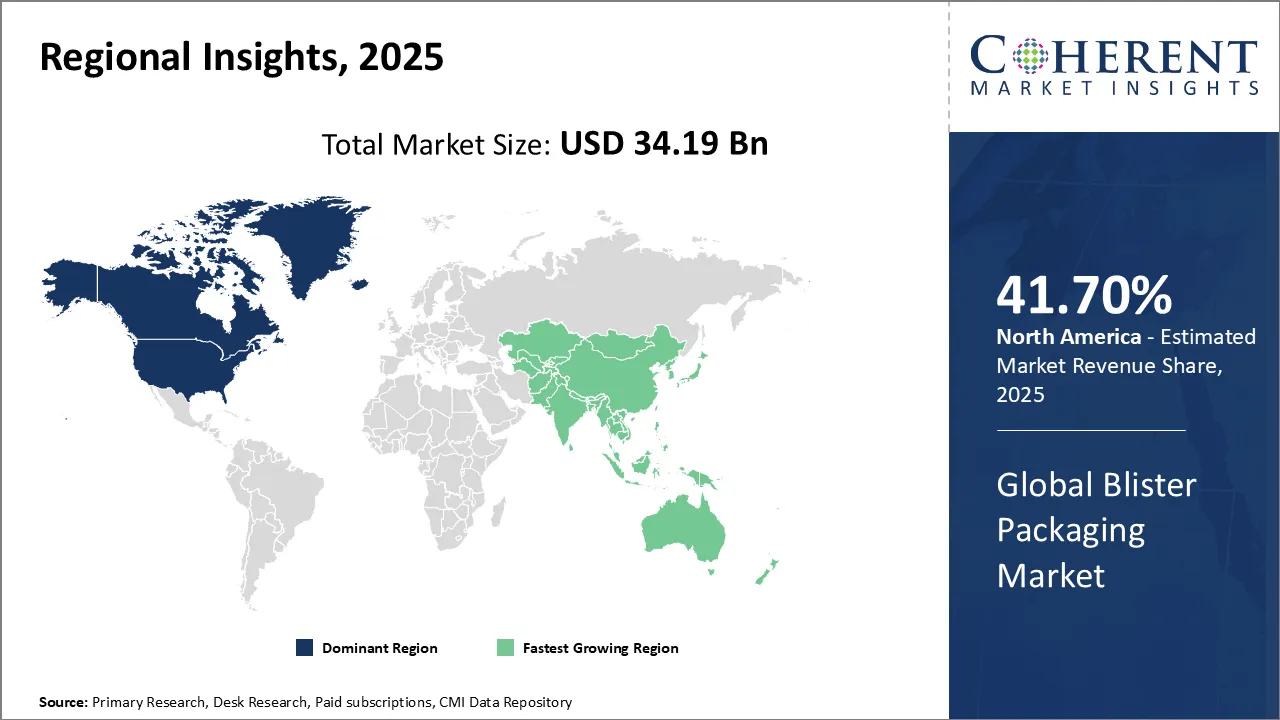
North America Blister Packaging Market Trends
North America dominates the overall market with an estimated share of 41.7% in 2026. The need for safe, tamper-evident, and patient-friendly packaging that guarantees medication safety and precise dosage is what propels the blister packaging market in the pharmaceutical sector. By offering simple unit-dose formats and shielding delicate medications from environmental harm, blister packs assist patients in adhering to laws. More use is encouraged by laws that enforce safety and traceability. An aging population and a rise in chronic illnesses raise the need for efficient drug delivery, while developments in smart packaging enhance product identification and supply chain efficiency.
For instance, in January 2024, TekniPlex Healthcare, based in Wayne, Pennsylvania, partnered with Alpek Polyester to launch a pharmaceutical-grade PET blister film containing 30% post-consumer recycled (PCR) monomers.
Asia Pacific Blister Packaging Market Trends
The growth of the pharmaceutical business and increased awareness of healthcare issues are driving the blister packaging industry's rapid expansion in the Asia Pacific region. Manufacturers focus on offering cost-effective packaging solutions that ensure product safety and extend shelf life. They are investing more in automation and advanced manufacturing technology to boost production efficiency. The growing need for tamper-evident and easy packaging in emerging economies has an impact on market trends. Environmental concerns also motivate companies to employ sustainable materials in compliance with regional regulations and consumer preferences.
For instance, Catalent has expanded its primary packaging capabilities at its Shiga, Japan, clinical supply facility by adding a high-speed blister packaging line to complement its existing automated bottling line.
United States Blister Packaging Market Trends
US companies are advancing the blister packaging sector by combining state-of-the-art technology with strict regulatory compliance. They prioritize tamper-evident and kid-resistant features in order to meet safety laws and protect consumers. The growing focus on sustainable packaging encourages the use of recyclable and eco-friendly materials. The rise of tailored medicine is also driving the need for customizable blister packs. Furthermore, robust, lightweight packaging that attracts customers and preserves product integrity throughout shipping is essential in the expanding e-commerce sector.
For instance, in February 2024, ViiV Healthcare, a global HIV-focused company, has announced the launch of Dovato in a new blister pack format in the US. This is further accelerating the blister packaging market revenue.
China Blister Packaging Market Trends
China's blister packaging market is expanding rapidly as a result of the nation's thriving pharmaceutical and consumer products sectors. Manufacturers focus on offering high-quality, cost-effective packaging that protects products and extends shelf life. They are investing in automation and advanced production technology to boost output and efficiency. Growing health concerns and stricter regulations are driving up demand for safe, tamper-evident packaging. At the same time, as consumer preferences shift toward greener products, companies are being compelled by national rules to employ sustainable materials.
End-user Feedback and Unmet Needs in the Blister Packaging Market
- Durability Concerns: End users often report blister packs that fail to protect fragile contents adequately, leading to damage during transit. There is a demand for stronger, more impact-resistant materials that maintain product integrity without increasing weight or cost.
- Ease of Opening: Consumers frequently expsress frustration with blister packs that are difficult to open, especially for elderly or disabled individuals. There is an unmet need for ergonomic designs that ensure easy access while maintaining child-resistant features.
- Sustainability Expectations: End users increasingly seek eco-friendly packaging solutions. Many feel current blister packs generate excessive plastic waste and want recyclable or biodegradable alternatives that do not compromise product safety or shelf life.
Blister Packaging Market Trend
Shift Towards Smart Packaging
The blister packaging market is evolving with smart packaging technologies integrating QR codes, NFC tags, and sensors. These innovations enhance product traceability, combat counterfeiting, and provide real-time information to consumers. Brands are leveraging this trend to improve consumer engagement and build transparency across the supply chain, transforming traditional packaging into interactive platforms.
Focus on Sustainable Materials
Eco-consciousness is reshaping blister packaging choices, with a growing emphasis on biodegradable films, recycled plastics, and compostable laminates. Manufacturers are innovating to balance environmental impact and product protection. This trend reflects both regulatory pressures and consumer demand for greener packaging solutions that reduce landfill waste without compromising safety or shelf life.
Blister Packaging Market Opportunity
Growth in Over-the-Counter (OTC) Product Packaging
The surge in self-medication and OTC drug consumption presents an opportunity for blister packaging innovations. Consumers prefer easy-to-carry, single-dose formats that enhance convenience and compliance. Packaging designs that combine safety with portability and clear dosage instructions appeal strongly to this segment, driving demand for versatile blister solutions tailored to OTC products.
Market Report Scope
Blister Packaging Market Report Coverage
| Report Coverage | Details | ||
|---|---|---|---|
| Base Year: | 2025 | Market Size in 2026: | USD 36.79 Bn |
| Historical Data for: | 2020 To 2024 | Forecast Period: | 2026 To 2033 |
| Forecast Period 2026 to 2033 CAGR: | 7.6% | 2033 Value Projection: | USD 61.43 Bn |
| Geographies covered: |
| ||
| Segments covered: |
| ||
| Companies covered: | Amcor PLC, Blisters Inc., Honeywell International Inc., Blisterpak Inc., VisiPak, Sonoco Products Company, Powerpak Industries L.L.C., Clearwater Packaging Inc., Constantia Flexibles GmbH, Westrock Company, Algus Packaging Inc., Abhinav Enterprises, Uno Plast, Nithiya Enterprises, Thermopack, VisiPak, Sudham Packaging Industries, Entek Corporation, Grotal, and Nirmala Industries | ||
| Growth Drivers: |
| ||
| Restraints & Challenges: |
| ||
Blister Packaging Market News
- In May 2025, Nailsea Town Council has launched a recycling scheme for empty medicine blister packs, which standard kerbside services do not accept due to their mixed plastic and foil composition.
- In July 2025, Haleon, maker of Panadol, has partnered with Pharmacycle to launch a national recycling program in which consumers can order a satchel, fill it with used blister packs, and return it via Australia Post using a pre-paid label.
Analyst Opinion (Expert Opinion)
- The blister packaging market is undergoing a pivotal transformation, driven less by volume growth and more by qualitative shifts in technology adoption and consumer expectations. From an expert standpoint, the key inflection point lies in how manufacturers address the growing friction between sustainability imperatives and functional packaging demands.
- Moreover, the integration of smart packaging elements such as RFID and NFC chips, as exemplified by pharmaceutical leaders like Pfizer and Novartis, is not just a value addition but rapidly becoming a necessity to counter counterfeit risks. Studies show that counterfeit drugs account for nearly 10% of the global pharmaceutical market, and blister packs embedded with serialized tracking technologies have proven instrumental in curbing this. The pressure on manufacturers to adopt these technologies will intensify, but adoption remains uneven, hindered by legacy equipment and cost concerns.
- Finally, blister packaging’s durability and convenience are no longer negotiable but a baseline expectation. Feedback from end-users, particularly elderly patients, exposes significant flaws in current designs. For example, a survey conducted by the National Council on Aging showed that 65% of seniors struggle with opening traditional blister packs, risking non-compliance. Innovators focusing on ergonomic designs, such as peelable and resealable blisters, are gaining competitive advantage.
- In conclusion, blister packaging firms that strategically invest in sustainable materials, smart anti-counterfeit technologies, and user-centric design will dominate. Those that rest on legacy strengths risk obsolescence in a market demanding agility and innovation.
Speak to the analyst
Want personalized insights?
Take the findings above to one of our principal consultants, or have the report rebuilt around the segments, geographies and competitors you actually track.
Market Segmentation
- Product Type Insights (Revenue, USD Bn, 2021 - 2033)
- Clamshells
- Trapped Blisters
- Face Seal Blisters
- Blister Cards
- Technology Insights (Revenue, USD Bn, 2021 - 2033)
- Thermoforming
- Cold Forming
- Material Type Insights (Revenue, USD Bn, 2021 - 2033)
- Plastic
- Paper & Paperboard
- Aluminum
- Application Insights (Revenue, USD Bn, 2021 - 2033)
- Consumer Goods
- Pharmaceuticals
- Electronics & Semiconductors
- Others
- Regional Insights (Revenue, USD Bn, 2021 - 2033)
- North America
- U.S.
- Canada
- Latin America
- Brazil
- Argentina
- Mexico
- Rest of Latin America
- Europe
- Germany
- U.K.
- Spain
- France
- Italy
- Russia
- Rest of Europe
- Asia Pacific
- China
- India
- Japan
- Australia
- South Korea
- ASEAN
- Rest of Asia Pacific
- Middle East & Africa
- GCC Countries
- Israel
- Rest of Middle East & Africa
- Key Players Insights
- Amcor PLC
- Blisters Inc.
- Honeywell International Inc.
- Blisterpak Inc.
- VisiPak
- Sonoco Products Company
- Powerpak Industries L.L.C.
- Clearwater Packaging Inc.
- Constantia Flexibles GmbH
- Westrock Company
- Algus Packaging Inc.
- Abhinav Enterprises
- Uno Plast
- Nithiya Enterprises
- Thermopack
- VisiPak
- Sudham Packaging Industries
- Entek Corporation
- Grotal
- Nirmala Industries
Sources
Primary Research interviews
- Interviews with packaging material suppliers
- Discussions with pharmaceutical and consumer goods manufacturers
- Feedback from packaging machinery providers
- Insights from logistics and distribution channel partners
- Conversations with quality control and regulatory professionals in the packaging industry
Databases
- Statista
- World Bank Data
- United Nations Comtrade Database
- Eurostat
- U.S. Census Bureau – International Trade Data
Magazines
- Packaging World
- Pharmaceutical Technology
- Packaging Digest
- Healthcare Packaging
- Flexible Packaging Magazine
Journals
- Journal of Packaging Technology and Research
- International Journal of Pharmaceutics
- Packaging Technology and Science
- Journal of Pharmaceutical Sciences
- Materials Today
Newspapers
- The Wall Street Journal
- Financial Times
- The Economic Times
- The Guardian (Business Section)
- Business Standard
Associations
- World Packaging Organisation (WPO)
- Flexible Packaging Association (FPA)
- Institute of Packaging Professionals (IoPP)
- European Bioplastics
- International Pharmaceutical Federation (FIP)
Public Domain sources
- U.S. Food and Drug Administration (FDA)
- European Medicines Agency (EMA)
- World Health Organization (WHO)
- U.S. Environmental Protection Agency (EPA)
- Indian Ministry of Commerce and Industry
Proprietary Elements
- CMI Data Analytics Tool, and Proprietary CMI Existing Repository of information for last 8 years
Get access to 250+ pages report
Every segment, forecast, competitor profile and data table behind the analysis above — available for instant download.
- ESOMAR Member
- ISO 9001:2015 Certified
- D-U-N-S Registered
- GDPR & CCPA Compliant
Missing comfort of reading report in your local language? Find your preferred language:
Transform your Strategy with Exclusive Trending Reports
Frequently Asked Questions
The Blister Packaging Market is estimated to be valued at USD 36.79 Bn in 2026, and is expected to reach USD 61.43 Bn by 2033.
The CAGR of the Blister Packaging Market is projected to be 7.6% from 2026 to 2033.
Growing demand from pharmaceutical industry and preference towards innovative convenience packaging are the major factors driving the growth of the global blister packaging market.
Fluctuations in raw material costs and complex design requirements are the major factors hampering the growth of the global blister packaging market.
In terms of product type, blister cards is estimated to dominate the market revenue share in 2026.
Amcor PLC, Blisters Inc., Honeywell International Inc., Blisterpak Inc., VisiPak, Sonoco Products Company, Powerpak Industries L.L.C., Clearwater Packaging Inc., Constantia Flexibles GmbH, Westrock Company, Algus Packaging Inc., Abhinav Enterprises, Uno Plast, Nithiya Enterprises, Thermopack, VisiPak, Sudham Packaging Industries, Entek Corporation, Grotal, and Nirmala Industries are the major players.
North America is expected to lead the global blister packaging market.