

Brain Hemorrhage Market Size and Share Analysis- 2026 To 2033
The Brain Hemorrhage Market size is anticipated to grow at a CAGR of 6.0% with USD 240.6 Mn in 2026 and is expected to reach USD 361.8 Mn by 2033. The market growth is primarily driven by the increasing prevalence of intracerebral and subarachnoid hemorrhage, rising incidence of hypertension and traumatic brain injuries, growing geriatric population, and increasing demand for advanced diagnostic and treatment modalities. According to the World Stroke Organization (WSO) Global Intracerebral Hemorrhage Factsheet 2025, more than 3.4 Mn new cases of intracerebral hemorrhage occur worldwide each year, and intracerebral hemorrhage accounts for 28.8% of all incident strokes worldwide.
Key Takeaways
- Anti-hypertensive drugs segment will command the market share of 41.8% by 2026. Growth in the anti-hypertensive drugs segment can be attributed to the frequent use of blood pressure lowering drugs in acute and chronic treatment of brain hemorrhage due to the fact that hypertension is the highest modifiable cause of brain hemorrhage. As per 2026 review published in Stroke, most patients suffering from intracerebral hemorrhage have hypertension. Further, StatPearls suggests that over 60% of cases of primary intracerebral hemorrhage are related to hypertension.
- Hospital pharmacies segment is likely to dominate with 67.3% in 2026. The sector growth is credited to the fact that brain hemorrhage is a medical emergency that needs prompt hospitalization, rigorous monitoring and administration of drugs under expert care. Intracerebral hemorrhage is an acute life-threatening condition with a 30-day mortality rate of 30% that requires rapid inpatient management, thus strengthening the role of hospital pharmacies, according to the European Stroke Organisation (ESO) and European Academy of Neurology guidelines as summarized in the Stroke Manual (2026).
- North America is estimated to hold the largest share of 39.4% of the brain hemorrhage market in 2026. The increase in the region is attributable to high burden of stroke, good reimbursement scenario, extensive availability of advanced neuroimaging technology, strong presence of prominent pharmaceutical and medical device businesses and increasing use of minimally invasive neurosurgery operations. About 795,000 Americans have a stroke each year, and hemorrhagic strokes make up roughly 13% of all stroke cases, according to the American Stroke Association’s 2025 heart disease and Stroke Statistics Update.
Market Drivers
Increasing Traumatic Brain Injuries and Road Traffic Accidents are Fueling the Brain Hemorrhage Market
Increasing prevalence of traumatic brain injuries (TBI) and road traffic accidents is highly supporting the growth of the brain hemorrhage market. Intracerebral, subdural, and epidural hemorrhages are common sequelae of severe head trauma, and require rapid identification and intervention. The need for neurocritical care and emergency interventions is further augmented by expanding urbanization, increased vehicular density, sports injuries and falls in elderly.
According to the World Health Organization (WHO) estimates that road traffic injuries kill over 1.19 million people each year, while tens of millions more people receive non-fatal injuries, many of which include traumatic brain injury and associated cerebral bleeding.
Rising Healthcare Expenditure and Expansion of Stroke Care Infrastructure are Accelerating the Brain Hemorrhage Market
The market is expanding due to rising healthcare expenditure in specialized stroke facilities, which are enhancing accessibility to sophisticated diagnostics, neurocritical care units, and surgical procedures. Governments and healthcare facilities are developing their stroke network and emergency service systems in an effort to minimize mortality rates and enhance results; this will increase demand for brain hemorrhage treatments and technologies.
In addition, in 2025, the Radiological Society of North America (RSNA) disclosed that the use of AI greatly reduces time-to-diagnosis in cases of stroke and cerebral hemorrhage, increasing emergency treatment efficiency.
In February 2025, the European Stroke Organisation (ESO) revised its recommendations for stroke centers, stressing the need for comprehensive stroke centers with neuroimaging and neurosurgical capabilities to optimize outcomes for patients with hemorrhagic stroke.
Current Events and Their Impact on the Brain Hemorrhage Market
Current Event | Description and its Impact |
Updated AHA/ASA Guidelines Promote Minimally Invasive Treatment for Intracerebral Hemorrhage |
|
FDA Expansion of AI-Enabled Medical Devices Enhances Brain Hemorrhage Diagnosis |
|
- Current Industry Events of 2026
- Market Size Estimation
- Regional Breakdown
- Competitive Landscape
- Customer Intelligence
- Segmental Analysis
- Pricing Analysis
- Key Market Drivers, Challenges & Future Trends
- Customized Insights Section
Segmental Insights
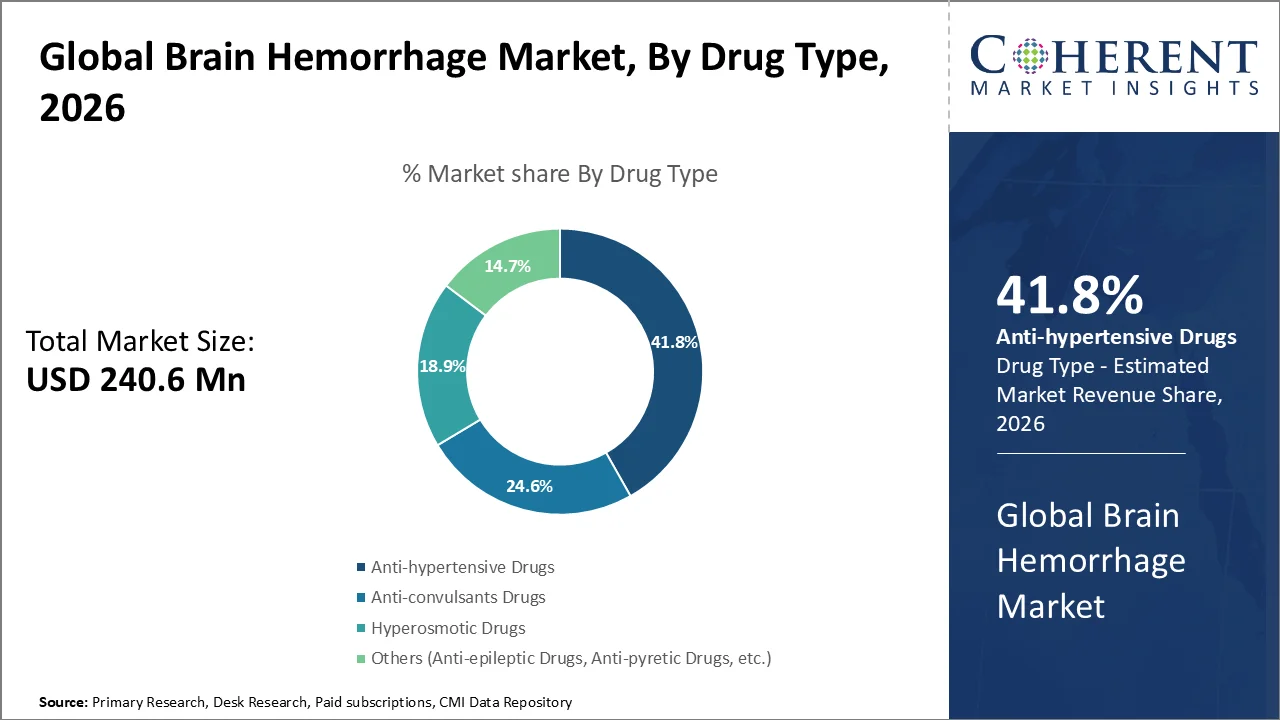
Why are Anti-hypertensive Drugs Acquiring the Largest Share?
By Drug Type, the Brain Hemorrhage market is segmented into Anti-hypertensive medications, Thrombolytic drugs, Coagulants, and Others. The Anti-hypertensive drugs segment is expected to hold the biggest share of 41.8% by 2026. The expansion of the segment is explained by the widespread use of blood pressure lowering medications both in the setting of acute and secondary prophylaxis, as hypertension is the most major modifiable risk factor for intracerebral hemorrhage.
Furthermore, the American Heart Association’s 2025 heart disease and Stroke Statistics Update indicated that almost 47% of U.S. adults have hypertension, indicating the large patient population requiring antihypertensive medication.
In April 2026, NeurologyLive published data from the Phase III TRIDENT study showing that GMRx2, a fixed-dose triple antihypertensive tablet including telmisartan, amlodipine, and indapamide, reduced the incidence of recurrent stroke by 39% in patients with a history of intracerebral hemorrhage.
Hospital Pharmacies Hold the Largest Market Share
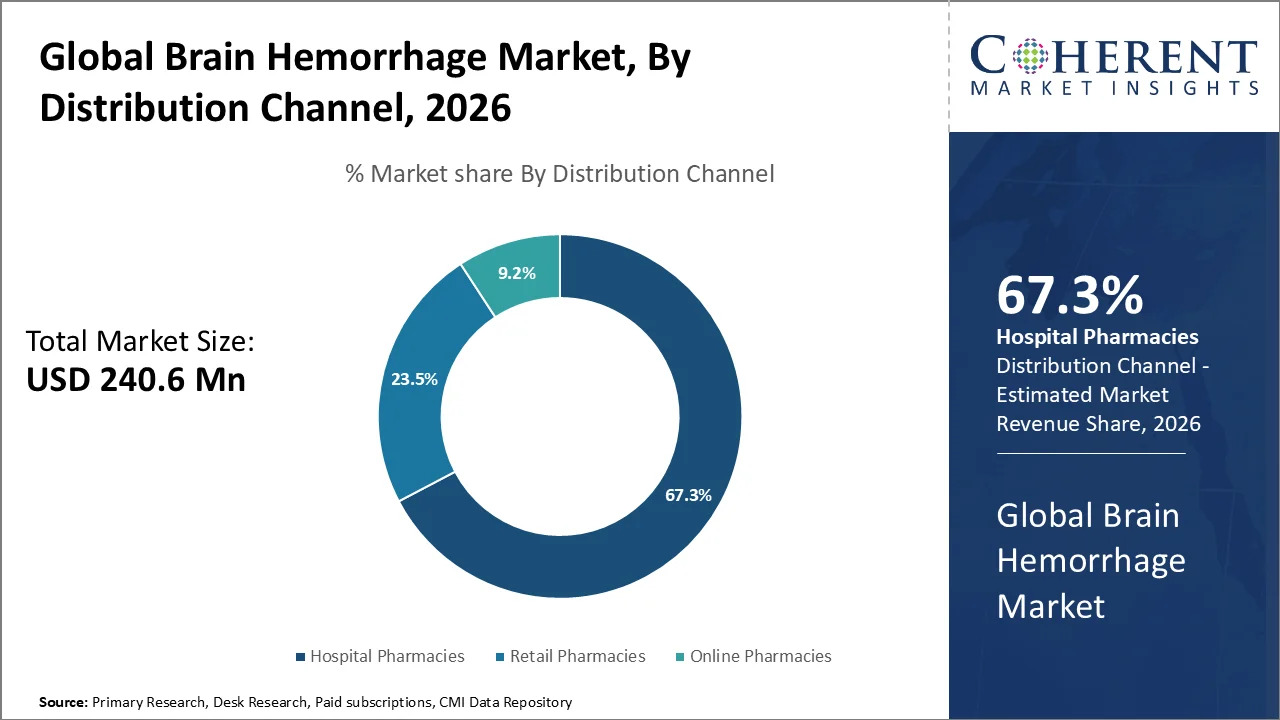
On the basis of distribution channel, the hospital pharmacies category is expected to lead with a healthy 67.3% share in 2026. The increase is due to the fact that brain hemorrhage is a life-threatening neurological emergency that requires rapid hospitalization, rigorous monitoring and drug delivery under specialized supervision. Medication delivery mainly happens in hospital settings due to the necessity for quick blood pressure management, reversal of anticoagulation, seizure prevention, and neurocritical care.
According to the American Hospital Association (AHA), U.S. hospitals reported around 33.7 million admissions in 2024, which indicates a huge patient base managed through hospital pharmacies.
In April 2026, Grace Therapeutics reported that the U.S. FDA issued a Complete Response Letter for GTx-104, an IV formulation of nimodipine being developed for aneurysmal subarachnoid hemorrhage (aSAH).
Brain Hemorrhage Market Trends
- Minimally invasive surgical methods are increasingly used and are improving results and reducing hospitalization time for patients with intracerebral hemorrhage. There is positive clinical evidence that it reduces mortality and disability and techniques such as minimally invasive catheter evacuation and image-guided surgery are becoming more popular.
- Intensive blood pressure control is becoming a strong trend in secondary hemorrhagic stroke prevention. The global TRIDENT study involving 1,670 patients showed that the use of the low-dose triple therapy antihypertensive drug GMRx2 lowered the risk of recurrence of stroke by nearly 40%, highlighting the increased focus on rigorous management of hypertension in 2025.
- Increased access to specialized treatment due to the growth of comprehensive stroke centers and neurocritical care facilities. It has been reported by the World Stroke Organization (WSO) Global Stroke Fact Sheet 2025 that there are about 12.2 million cases of new strokes and 101 million stroke survivors around the world.
Regional Insights
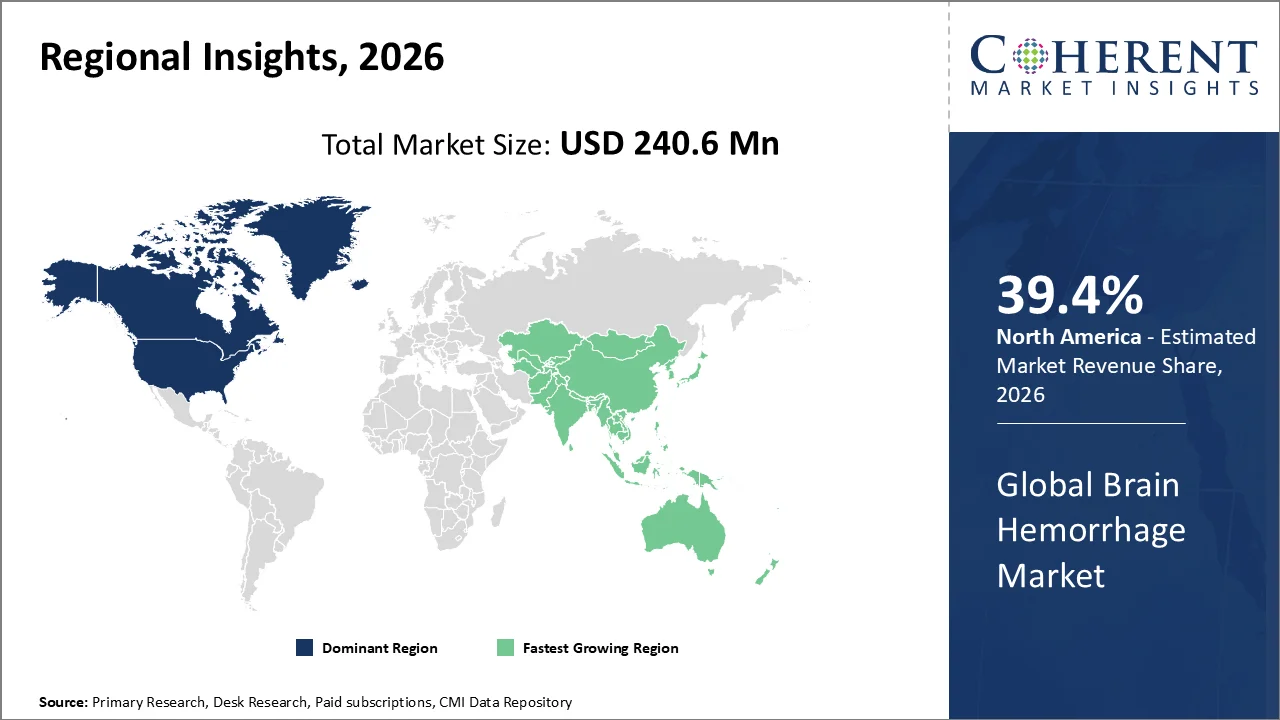
North America Dominates Owing to Advanced Stroke Care Infrastructure and High Disease Burden
North America Brain Hemorrhage Market share accounted for 39.4 % in 2026. The expansion of the region is due to availability of modern neurocritical care units, wide availability of CT and MRI imaging, favourable reimbursement systems, and rising use of minimally invasive neurosurgery operations. Presence of specialized stroke centers and top pharmaceutical and medical devices businesses aids the market expansion.
According to the American Hospital Association (AHA) Fast Facts on U.S. Hospitals, 2026, there are 6,100 hospitals in the U.S., including 5,121 community hospitals, with an estimated 35.7 million total hospital admissions each year and more than 907,000 staffed beds. This demonstrates the significant healthcare infrastructure that is available for acute neurological emergencies and the capacity to provide prompt diagnosis and treatment for patients with brain hemorrhage.
In February 2025, Stryker Corporation announced the growth of its neurovascular portfolio and stroke care solutions through intensified commercialization activities across North America, in response to the growing demand for innovative hemorrhagic stroke management technology.
Asia Pacific Brain Hemorrhage Market Trends
Asia Pacific is expected to witness the fastest growth in the Brain Hemorrhage Market during the forecast period. The growth in the region is attributed to the increasing incidence of hypertension, rapid aging population, growing healthcare spending, and rising access to stroke treatment facilities across China, Japan, India, and South Korea. Governments are investing more and more in the care of neurological diseases and the development of emergency stroke networks, which is propelling market growth.
Based on the World Stroke Organization Worldwide Stroke Fact Sheet 2025, an estimated 86% of deaths resulting from stroke occur in low- and middle-income countries. Asia represents a substantial proportion of the global burden of stroke.
In March 2026, MicroPort NeuroTech announced that its neurovascular range had been expanded to 27 NMPA-approved products, while six other products were recognized as Innovative Medical Devices under the “Green Path” program in China.
Advanced Stroke Infrastructure and Growing AI Adoption are Accelerating the Market in the U.S.
The U.S. Brain Hemorrhage Market growth is driven by the presence of advanced stroke management systems, growing adoption of imaging modalities based on artificial intelligence, and rising expenditure on health care. The U.S. has an extensive network of stroke centers and neurological critical care centers, which help detect intracranial hemorrhages at an early stage.
According to CDC’s NCHS, stroke was the fourth leading cause of deaths in the U.S. in 2024 with a mortality rate of 166,852 deaths, indicating the immense burden on neurological health care system as well as the demand for advanced hemorrhagic stroke treatment.
In April 2025, Bioxodes announced positive Phase IIa interim data for its first-in-class candidate BIOX-101 in patients with intracerebral hemorrhagic stroke.
Aging Population and Government-Led Stroke Care Improvements are Supporting Market Growth in Japan
Japan’s Brain Hemorrhage Market is rising because to the fast-aging population, high prevalence of hypertension, and ongoing investments in stroke detection and treatment infrastructure in the country. The market expansion is further supported by increasing adoption of less invasive neurovascular operations and advanced imaging technology.
According to the Statistics Bureau of Japan reported in 2025 that 29.3% of Japan’s population was aged 65 or older, which makes Japan one of the oldest societies in the world and increases the risk of hemorrhagic stroke.
In July 2025, Terumo Corporation announced progress in strengthening its neurovascular solutions business in Japan and globally through its Terumo Neuro division.
Who are the Major Companies in Brain Hemorrhage Industry
Some of the major key players in Brain Hemorrhage Market are Baxter, Oxurion NV, Pfizer, Inc., F. Hoffmann-La Roche Ltd., Boehringer Ingelheim, Novartis AG, Bayer AG, Abbott, Bristol-Myers Squibb, Johnson and Johnson, Neurotech Pharmaceuticals, Inc., Siemens Healthcare GmbH, Novo Nordisk A/S, H. Lundbeck A/S, and Ligand Pharmaceuticals Incorporated.
Key News
- In March 2026, Roche Diagnostics hosted the NeuRo Symposium 2026 in Barcelona, bringing together global experts to discuss advances in neurological diagnostics, including blood-based biomarkers for traumatic brain injury and neurodegenerative diseases.
- In December 2025, Abbott announced that the U.S. FDA approved its Volt Pulsed Field Ablation (PFA) System for the treatment of atrial fibrillation. The approval was based on results from the VOLT-AF IDE study involving 392 patients.
Market Report Scope
Brain Hemorrhage Market Report Coverage
| Report Coverage | Details | ||
|---|---|---|---|
| Base Year: | 2025 | Market Size in 2026: | USD 240.6 Mn |
| Historical Data for: | 2020 To 2024 | Forecast Period: | 2026 To 2033 |
| Forecast Period 2026 to 2033 CAGR: | 6.0% | 2033 Value Projection: | USD 361.8 Mn |
| Geographies covered: |
| ||
| Segments covered: |
| ||
| Companies covered: | Baxter, Oxurion NV, Pfizer, Inc., F. Hoffmann-La Roche Ltd., Boehringer Ingelheim, Novartis AG, Bayer AG, Abbott, Bristol-Myers Squibb, Johnson and Johnson, Neurotech Pharmaceuticals, Inc., Siemens Healthcare GmbH, Novo Nordisk A/S, H. Lundbeck A/S, and Ligand Pharmaceuticals Incorporated | ||
| Growth Drivers: |
| ||
| Restraints & Challenges: |
| ||
Analyst Opinion
- The market is gradually moving towards prevention and adopting strategies for risk reduction. Out of total number of adult populations worldwide, around 1.28 billion people suffer from hypertension, while 21% of these patients have controlled blood pressure.
- Specialized stroke networks and hospital infrastructure are being expanded, which is improving market accessibility. More than 2,800 institutions participate in the American Heart Association’s Get With The Guidelines-Stroke program, an indicator of broad adoption of standardized stroke care pathways and supporting demand for bleeding diagnostics, therapies and neurocritical care services.
- Analysts expect to see increased investment in minimally invasive neurosurgery, blood-based biomarkers, and precision medicine. The number of people aged 65 years and older worldwide will reach 1.6 billion by 2050, which is likely to significantly increase the incidence of intracerebral hemorrhage and open up opportunities for next-generation diagnosis and therapy technologies.
Speak to the analyst
Want personalized insights?
Take the findings above to one of our principal consultants, or have the report rebuilt around the segments, geographies and competitors you actually track.
Market Segmentation
- By Drug Type (Revenue, USD Mn, 2021-2033)
- Anti-hypertensive Drugs
- Anti-convulsants Drugs
- Hyperosmotic Drugs
- Others (others include Anti-epileptic Drugs, Anti-pyretic Drugs, etc.)
- By Distribution Channel (Revenue, USD Mn, 2021-2033)
- Hospital Pharmacies
- Retail Pharmacies
- Online Pharmacies
- By Region (Revenue, USD Mn, 2021-2033)
- North America
- U.S.
- Canada
- Latin America
- Brazil
- Mexico
- Argentina
- Rest of Latin America
- Europe
- Germany
- U.K.
- France
- Italy
- Spain
- Russia
- Rest of Europe
- Asia Pacific
- China
- India
- Japan
- Australia
- South Korea
- ASEAN
- Rest of Asia Pacific
- Middle East
- GCC
- Israel
- Rest of Middle East
- Africa
- South Africa
- Central Africa
- North Africa
- North America
Sources
Primary Research Interviews
- Neurologists and Neurosurgeons
- Neurocritical Care Specialists
- Stroke Center Directors
- Hospital Pharmacists
- Emergency Medicine Physicians
- Pharmaceutical Manufacturers
- Neurovascular Device Manufacturers
- Diagnostic Imaging Providers
- Healthcare Distributors and Suppliers
- Others
Databases
- Bloomberg Terminal
- Thomson Reuters Eikon
- S&P Global Market Intelligence
- Factiva
- D&B Hoovers
- PitchBook
- GlobalData
- Others
Magazines
- Stroke & Vascular Neurology Magazine
- Neurology Today
- MedTech Dive
- Medical Device Network
- Fierce Biotech
- Pharmaceutical Technology
- Others
Journals
- Stroke
- The Lancet Neurology
- Journal of Neurosurgery
- Neurology
- JAMA Neurology
- Neurosurgery
- Nature Reviews Neurology
- Others
Newspapers
- The Wall Street Journal
- Financial Times
- Reuters
- Bloomberg News
- The Economic Times
- Business Standard
- Nikkei Asia
- Others
Associations
- American Heart Association (AHA)
- American Stroke Association (ASA)
- World Stroke Organization (WSO)
- European Stroke Organisation (ESO)
- Society of NeuroInterventional Surgery (SNIS)
- American Association of Neurological Surgeons (AANS)
- Congress of Neurological Surgeons (CNS)
- World Federation of Neurosurgical Societies (WFNS)
- Others
Public Domain Sources
- World Health Organization (WHO)
- Centers for Disease Control and Prevention (CDC)
- National Institutes of Health (NIH)
- U.S. Food and Drug Administration (FDA)
- American Hospital Association (AHA)
- Statistics Bureau of Japan
- Ministry of Health, Labour and Welfare (Japan)
- National Medical Products Administration (NMPA), China
- Radiological Society of North America (RSNA)
- United Nations World Population Prospects
- World Bank Open Data
- Organisation for Economic Co-operation and Development (OECD)
- Others
Proprietary Elements
- CMI Data Analytics Tool
- Proprietary CMI Existing Repository of Information for the Last 8 Years
- CMI Market Modeling and Forecasting Framework
- CMI Industry Expert Network
- Proprietary Epidemiology and Healthcare Infrastructure Database
- Internal Competitive Intelligence Repository
Get access to 250+ pages report
Every segment, forecast, competitor profile and data table behind the analysis above — available for instant download.
- ESOMAR Member
- ISO 9001:2015 Certified
- D-U-N-S Registered
- GDPR & CCPA Compliant
Missing comfort of reading report in your local language? Find your preferred language:
Transform your Strategy with Exclusive Trending Reports
Frequently Asked Questions
The Brain Hemorrhage Market is expected to reach USD 361.8 Mn in 2033.
Major players operating in the global Brain Hemorrhage Market include Baxter, Oxurion NV, Pfizer, Inc., F. Hoffmann-La Roche Ltd., Boehringer Ingelheim, Novartis AG, Bayer AG, Abbott, Bristol-Myers Squibb, Johnson and Johnson, Neurotech Pharmaceuticals, Inc., Siemens Healthcare GmbH, Novo Nordisk A/S, H. Lundbeck A/S, and Ligand Pharmaceuticals Incorporated
High treatment and hospitalization costs, limited availability of specialized stroke centers in developing regions, delayed diagnosis, shortage of neurocritical care specialists, and lack of approved targeted therapies for intracerebral hemorrhage are the key factors hampering market growth.
The increasing prevalence of hypertension and hemorrhagic stroke, growing geriatric population, rising incidence of traumatic brain injuries, advancements in neuroimaging technologies, expansion of stroke care infrastructure, and increasing demand for minimally invasive treatments are driving the market growth.
The Brain Hemorrhage Market is anticipated to grow at a CAGR of 6.0% between 2026 and 2033.
Among regions, North America is expected to account for the largest share of the global Brain Hemorrhage Market over the forecast period, owing to advanced stroke care infrastructure, widespread access to neuroimaging technologies, and favorable reimbursement systems.
Anti-hypertensive drugs dominate the market because hypertension is the leading modifiable risk factor for intracerebral hemorrhage. Effective blood pressure management helps prevent hematoma expansion and reduces the risk of recurrent hemorrhagic stroke, resulting in strong demand for these therapies.