all report title image

B2B Telecommunication Market Analysis & Forecast: 2026-2033

B2B Telecommunication Market, By Solution (Unified Communication and Collaboration, VoIP, WAN , Cloud Services, and M2M Communication), By End-user (Small & Medium Enterprise and Large Enterprise), By Vertical (BFSI, Healthcare, Media and Entertainment, Government, Energy and Utility, Retail, Transportation and Logistics, and Others), By Geography (North America, Europe, Asia Pacific, and Latin America, Middle East & Africa)

  • Historical Range : 2020 - 2024
  • Forecast Period : 2026 - 2033

B2B Telecommunication Market Analysis & Forecast: 2026-2033

B2B telecommunication market is estimated to be valued at USD 99.94 Bn in 2026 and is expected to reach USD 270.73 Bn in 2033, exhibiting a compound annual growth rate (CAGR) of 15.3% from 2026 to 2033.

Key Takeaways

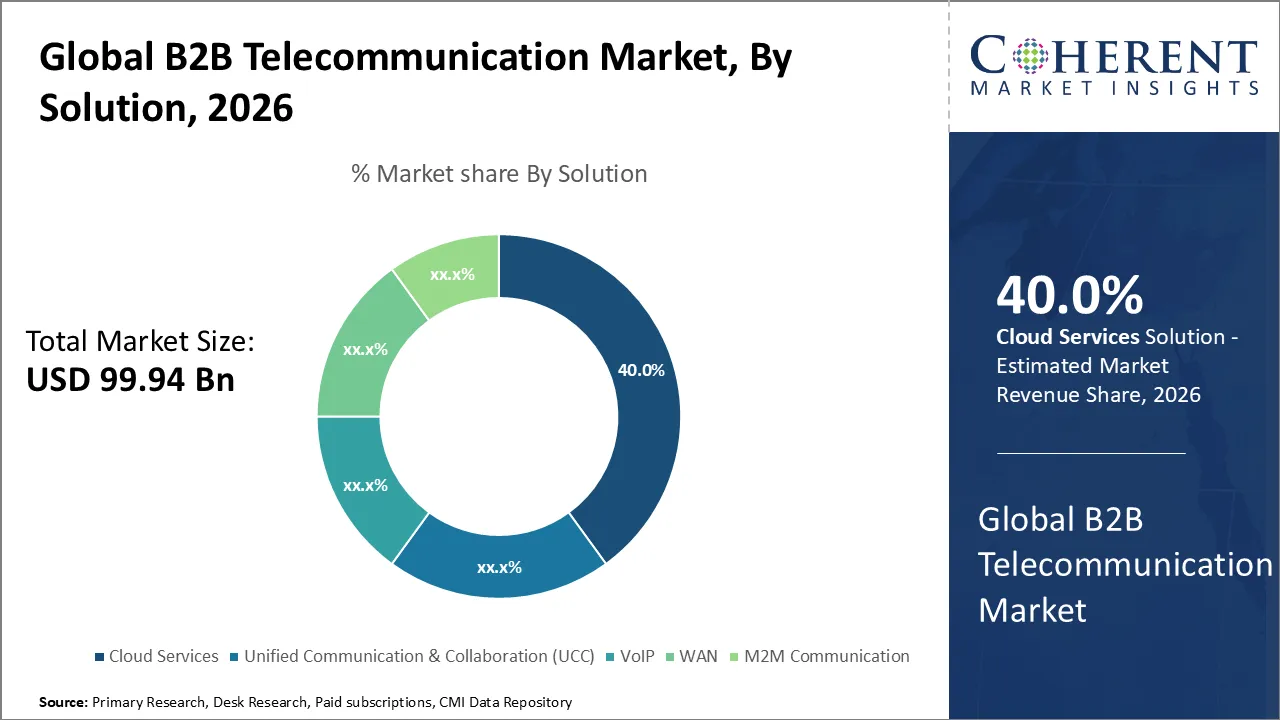
  • Based on Solution, the Cloud Services segment is expected to hold 40% share of the market in 2026.
  • Based on End User, the Largest Enterprise segment is expected to lead the market with 70% share of the market in 2026.
  • Based on Vertical, the BFSI segment is projected to account for 28% share in 2026.
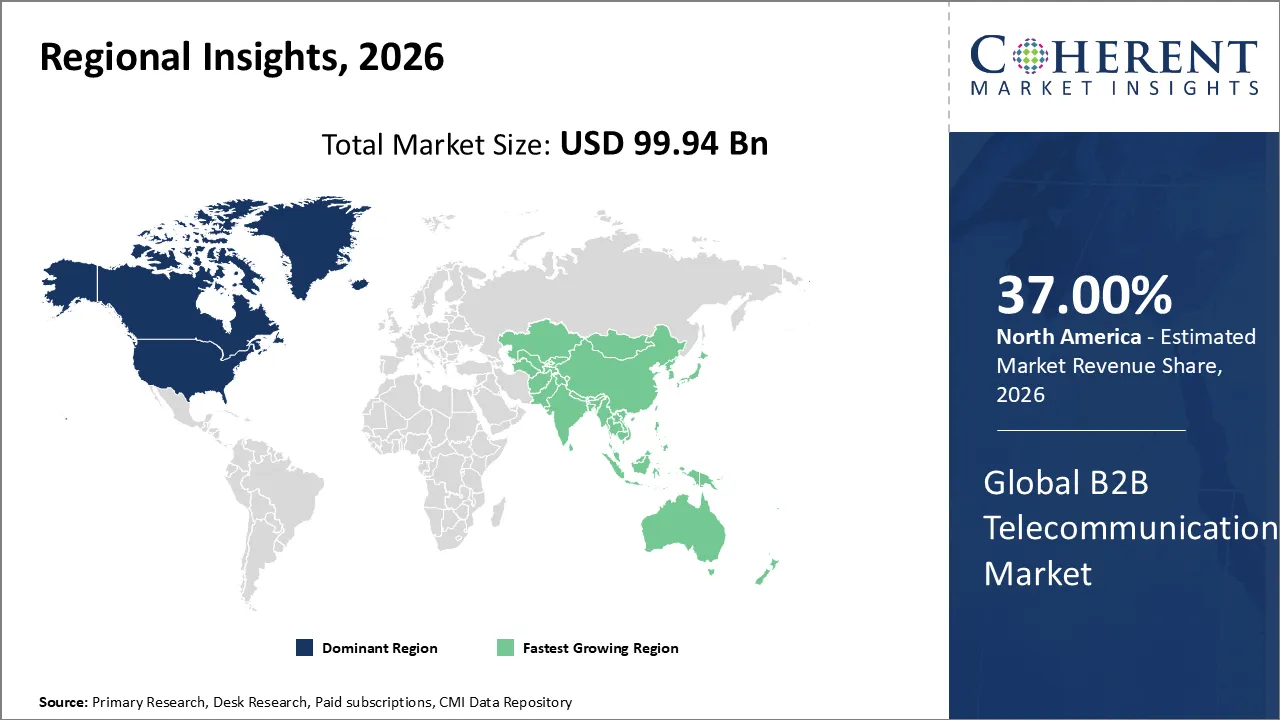
  • Based on Region, North America is set to lead the B2B telecommunication market with 37% share in 2026. While, Asia Pacific is anticipated to be the fastest growing region.

Market Overview

A B2B communication refers to any communications between businesses as opposed to between businesses and clients or clients and clients. B2B communications can take place in any form with telecommunications providers maintaining systems that transfer data, sound, text, voice, and video. This telecommunication platform is typically used by marketers to boost the company’s presence within the industry and ascertain networking opportunities. A B2B telecommunication platform offers a robust view where the data and statistics related to financial information, cases, and orders is offered to customers. Thus, this enables easy management of most complex hierarchies that represent structure of an organization. Moreover, it provides access to a detailed reporting and set-up a real-time control over service usage.

Current Events and Its Impact on the B2B Telecommunication Market

Current Event

Description and its Impact

5G Network Infrastructure Deployment and Standards Competition

  • Description: European 5G security regulations and vendor restrictions
  • Impact: Limits market access for certain vendors while creating opportunities for approved suppliers.
  • Description: Open RAN adoption acceleration
  • Impact: Enables smaller vendors to compete with traditional telecom giants in B2B markets.
  • Description: Private 5G network demand surge
  • Impact: Drives new revenue streams for B2B telecom providers serving manufacturing and logistics sectors.

Cybersecurity Threats and Regulatory Response

  • Description: Ransomware attacks on critical infrastructure
  • Impact: Increases demand for secure B2B telecom solutions and managed security services.
  • Description: Zero Trust architecture mandates
  • Impact: Drives enterprise spending on advanced B2B networking and security solutions.
  • Description: Data localization requirements
  • Impact: Forces B2B telecom providers to restructure services and infrastructure deployment strategies.

Uncover macros and micros vetted on 75+ parameters: Get instant access to report

Will Private 5G Networks Become the Backbone of Enterprise Connectivity by 2026?

Adoption Trends

  • By 2026, nearly 40% of large enterprises will deploy private 5G networks, driven by the need for secure, low-latency, and high-bandwidth communication.
  • Smart factories are leading the charge, with over 60% planning integration, enabling real-time monitoring, robotics, and predictive maintenance.
  • Logistics and supply chains are adopting private 5G to support autonomous vehicles, drones, and IoT sensors for real-time tracking and efficiency.

Industry Applications

  • Manufacturing: Enables Industry 4.0 with connected machines, AR-assisted maintenance, and digital twins.
  • Logistics: Improves fleet management, warehouse automation, and predictive delivery scheduling.
  • Healthcare: Supports remote surgery, IoT-enabled patient monitoring, and secure data transfer.
  • Energy & Utilities: Enhances smart grids, predictive equipment monitoring, and field workforce connectivity.

Business Case

  • Latency: Private 5G reduces latency to, critical for automation and robotics.
  • Security: Enterprises gain dedicated, isolated networks, reducing cyber risks compared to public 5G.
  • Efficiency: Studies show 20–30% productivity gains in factories using private 5G-enabled automation.
  • ROI: Enterprises adopting private 5G report up to 25% cost savings in operational efficiency within 2–3 years.

Segmental Insights

B2B Telecommunication Market By Solution

To learn more about this report, Download Free Sample

B2B Telecommunication Market Insights, By Solution - Cloud services lead by enabling scalable, secure, and cost‑efficient enterprise communication

In terms of solution, the cloud services segment is expected to hold 40% share of the market in 2026, driven by enterprise digital transformation, IoT integration, and widespread 5G adoption. Businesses increasingly migrate to cloud platforms for scalability, cost efficiency, and secure communication. This segment benefits from demand for hybrid work solutions, data storage, and advanced collaboration tools.

For instance, in January 2026, Rubrik unveiled its Sovereign Cloud Security Solution, designed to help enterprises ensure data sovereignty, compliance, and protection against cyber threats. The offering provides immutable data safeguards and sovereign-compatible threat detection, supporting global businesses in regulated sectors.

B2B Telecommunication Market Insights, By End User - Large enterprises dominate with higher budgets and complex global telecommunication needs

In terms of end user, the large enterprise segment is expected to lead the market with 70% share of the market in 2026. Their complex infrastructure, global operations, and higher budgets fuel demand for advanced telecommunication solutions. Investments in secure WAN, SD-WAN, and unified communication platforms make them the primary drivers of growth compared to smaller enterprises.

For instance, in December 2025, Tata’s Nelco begun LEO satellite internet trials in India, marking a major step in next-generation connectivity. The initiative aims to deliver high-speed, low-latency internet to remote regions, supporting enterprises in sectors like mining, oil, and logistics. This move strengthens India’s B2B telecom landscape with advanced satellite solutions.

B2B Telecommunication Market Insights, By Vertical - BFSI drives growth through secure, compliant, and real‑time communication for digital banking and finance

In terms of vertical, the BFSI segment is projected to account for 28% share in 2026, requiring secure, compliant, and reliable communication networks. Digital banking, fintech expansion, and regulatory demands push adoption of cloud, VoIP, and WAN solutions. BFSI’s reliance on real-time data exchange and customer engagement ensures it remains the largest vertical in B2B telecommunication markets.

For instance, in October 2025, Tata Communications launched an AI-led voice solution for BFSI enterprises, enhancing customer engagement and secure communication. The offering leverages advanced telecom infrastructure and artificial intelligence to improve call center efficiency, fraud prevention, and compliance. This marks a significant step in B2B telecommunication tailored for financial institutions.
Regional Insights

B2B Telecommunication Market By Regional Insights

To learn more about this report, Download Free Sample

North America B2B Telecommunication Market Analysis & Trends

North America is expected to dominate the B2B telecommunication market with 37% share in 2026, driven by digital transformation, 5G adoption, IoT expansion, and cloud-based services. Enterprises in BFSI, healthcare, and manufacturing demand secure, high-speed connectivity and unified communication solutions, fueling growth amid remote work trends and rising need for advanced enterprise infrastructure.

For instance, in September 2025, SGGS expanded its connectivity presence in North America, strengthening enterprise-grade telecom services. The move enhances secure, scalable communication infrastructure, supporting digital transformation for businesses. This development highlights SGGS’s role in advancing B2B telecommunication, delivering robust connectivity solutions tailored to enterprise needs across industries in the region.

Asia Pacific B2B Telecommunication Market Analysis & Trends

Asia Pacific is expected to exhibit the fastest growth, driven by rapid digitalization, 5G rollout, IoT adoption, and cloud migration. Enterprises across BFSI, manufacturing, and healthcare demand secure, scalable connectivity for remote monitoring, automation, and cross-border operations, fueling strong growth in enterprise telecom infrastructure and services.

For instance, in November 2025, Asia’s telecom operators are investing heavily in mobile finance and cybersecurity to drive future growth, according to TM Forum research. By expanding secure digital services, telcos aim to capture BFSI opportunities, strengthen enterprise trust, and position themselves as key players in Asia’s evolving B2B telecommunication and financial technology landscape.

B2B Telecommunication Market Outlook Country-Wise

The U.S. B2B Telecommunication Market Trends

The U.S. B2B telecommunication market in 2026 is driven by 5G expansion, AI integration, IoT adoption, and cloud migration. Enterprises in BFSI, healthcare, and manufacturing demand secure, high-speed connectivity and advanced cybersecurity. Remote work trends and digital transformation further fuel growth in enterprise-grade telecom infrastructure and services nationwide.

For instance, in October 2025, Nokia and NVIDIA have partnered to pioneer an AI-powered 6G platform, aiming to restore America’s leadership in telecommunications. The collaboration integrates advanced AI with next-generation networks, enhancing automation, connectivity, and enterprise solutions. This initiative positions the U.S. at the forefront of global B2B telecommunication innovation and infrastructure development.

China B2B Telecommunication Market Trends

China’s B2B telecommunication market in 2026 is driven by rapid 5G deployment, enterprise cloud adoption, IoT expansion, and digital transformation initiatives. Industries like manufacturing, BFSI, and government demand secure, scalable connectivity and unified communication solutions, fueling growth in enterprise telecom infrastructure and services across the nation.

For instance, in November 2025, China launched a two-year commercial trial of satellite IoT services to expand nationwide connectivity. The initiative aims to support industries such as logistics, agriculture, and energy with secure, wide-area coverage. This development highlights China’s push in B2B telecommunication, enabling enterprises to leverage IoT for digital transformation and efficiency.

Market Report Scope

B2B Telecommunication Market Report Coverage

Report Coverage Details
Base Year: 2025 Market Size in 2026: USD 99.94 Bn
Historical Data for: 2020 To 2024 Forecast Period: 2026 To 2033
Forecast Period 2026 to 2033 CAGR: 15.3% 2033 Value Projection: USD 270.73 Bn
Geographies covered:
  • North America: U.S. and Canada
  • Latin America: Brazil, Argentina, Mexico, and Rest of Latin America
  • Europe: Germany, U.K., Spain, France, Italy, Russia, and Rest of Europe
  • Asia Pacific: China, India, Japan, Australia, South Korea, ASEAN, and Rest of Asia Pacific
  • Middle East: GCC Countries, Israel, and Rest of Middle East
  • Africa: South Africa, North Africa, and Central Africa
Segments covered:
  • By Solution: Unified Communication and Collaboration, VoIP, WAN, Cloud Services, and M2M Communication
  • By End-user: Small and Medium Enterprises and Large Enterprises
  • By Vertical: BFSI, Healthcare, Media and Entertainment, Government, Energy and Utility, Retail, Transportation, and Others
Companies covered:

Telstra Corporation Limited, Verizon Communications, Inc., Telefonica, S.A., Deutsche Telekom AG, Sprint Corporation (SoftBank Group Corporation), AT&T Inc., Vodafone Group PLC, NTT Communications Corporation, and Orange S.A.

Growth Drivers:
  • Cloud-Based Communication Solutions
  • 5G Network Deployment
Restraints & Challenges:
  • High Infrastructure & Deployment Costs

Uncover macros and micros vetted on 75+ parameters: Get instant access to report

B2B Telecommunication Market Driver

Cloud-Based Communication Solutions

Enterprises are increasingly adopting cloud-based telecommunication platforms to achieve scalability, cost efficiency, and operational flexibility. These solutions empower businesses to support remote workforces, enable seamless global collaboration, and facilitate real-time data sharing across geographies. By reducing dependency on physical infrastructure, cloud services enhance agility and resilience in modern B2B operations. As organizations continue to digitize, the B2B telecommunication market share is expanding significantly, driven by the rising preference for cloud-first strategies and unified communication platforms.

5G Network Deployment

The rollout of 5G networks is transforming enterprise connectivity with ultra-low latency and unprecedented bandwidth. This advancement supports critical applications such as IoT ecosystems, AI-driven analytics, and real-time video conferencing, making telecom indispensable for industries like healthcare, manufacturing, and logistics. 5G enables smart factories, connected healthcare, and intelligent supply chains, fueling innovation across sectors. With enterprises demanding faster, more reliable communication infrastructure, B2B telecommunication market demand is surging, positioning 5G as a cornerstone of next-generation business communication.

B2B Telecommunication Market Opportunity

Integrated Platforms (Voice, Video, Messaging, Conferencing)

Enterprises are increasingly adopting Unified Communication & Collaboration (UCC) platforms that seamlessly combine voice, video, messaging, and conferencing into a single solution. This integration eliminates the inefficiencies of managing multiple tools, enabling smoother workflows and faster decision-making. By offering a unified experience, businesses can enhance collaboration across departments and geographies. As adoption accelerates, the B2B telecommunication market forecast highlights UCC as a critical driver of growth, reshaping enterprise communication strategies worldwide.

Analyst Opinion (Expert Opinion)

  • The B2B telecommunication market continues to expand as enterprises increasingly prioritize integrated, secure, and scalable communication infrastructure. Business communication services encompass a broad range of solutions including unified communications, managed connectivity, cloud‑based platforms, and IoT networking, all of which are central to digital business operations. Data services remain a dominant segment, reflecting the critical role of high‑capacity data transmission for enterprise systems, while cloud‑based communication deployments have become prevalent as organizations shift away from traditional on‑premises architecture toward more flexible and scalable models.
  • Enterprise adoption patterns reveal a clear preference for digital and cloud‑enabled solutions. A significant portion of businesses now rely on unified communications platforms that integrate messaging, video conferencing, and voice integration to enhance collaboration across distributed teams. Managed network services and Software‑Defined Wide Area Networks (SD‑WAN) are also gaining traction, especially among multinational firms seeking to optimize connectivity across global operations.
  • Regional demand signals show North America and Europe as established markets with high penetration of advanced telecom services, while Asia‑Pacific is emerging rapidly due to expanding enterprise digitization and connectivity requirements. Small and medium enterprises are increasingly adopting cost‑effective cloud telecom solutions, narrowing the gap with larger corporations.
  • Technological drivers such as 5G deployment, edge computing integration, and AI‑enhanced network management are reshaping service capabilities. These innovations support low‑latency operations and real‑time data processing critical for industrial IoT, smart infrastructure, and digital supply chain applications, reinforcing the strategic importance of B2B telecommunication services in enabling modern enterprise ecosystems.

Recent Developments

  • In September 2025, Bharti Airtel’s B2B unit has partnered with Swift Navigation to launch a spatial precision solution. Combining telecom infrastructure with advanced navigation technology, the initiative delivers accurate location services for industries like logistics, automotive, and smart cities. This collaboration strengthens Airtel’s role in the B2B telecommunication market with innovative enterprise solutions.
  • In August 2025, Airtel’s digital arm Xtelify launched pioneering digital capabilities to accelerate business transformations. By integrating telecom infrastructure with advanced digital solutions, Xtelify empowers enterprises with secure connectivity, automation, and innovation. This initiative strengthens Airtel’s presence in the B2B telecommunication market, driving enterprise efficiency and supporting digital growth across industries.

Market Segmentation

  • By Solution
    • Unified Communication and Collaboration
    • VoIP
    • WAN
    • Cloud Services
    • M2M Communication
  • By End-user
    • Small and Medium Enterprises
    • Large Enterprises
  • By Vertical
    • BFSI
    • Healthcare
    • Media and Entertainment
    • Government
    • Energy and Utility
    • Retail
    • Transportation
    • Others
  • By Region
    • North America
      • U.S.
      • Canada
    • Latin America
      • Brazil
      • Argentina
      • Mexico
      • Rest of Latin America
    • Europe
      • Germany
      • U.K.
      • Spain
      • France
      • Italy
      • Russia
      • Rest of Europe
    • Asia Pacific
      • China
      • India
      • Japan
      • Australia
      • South Korea
      • ASEAN
      • Rest of Asia Pacific
    • Middle East & Africa
      • GCC Countries
      • Israel
      • Rest of Middle East & Africa
  • Competitive Section
    • Telstra Corporation Limited
    • Verizon Communications, Inc.
    • Telefonica, S.A.
    • Deutsche Telekom AG
    • Sprint Corporation (SoftBank Group Corporation)
    • AT&T Inc.
    • Vodafone Group PLC
    • NTT Communications Corporation
    • Orange S.A.

Sources

Primary Research Interviews

  • Telecommunication Network Operators (Enterprise & Wholesale)
  • B2B Connectivity & Managed Service Providers
  • Network Infrastructure & Equipment Manufacturers
  • Cloud & Data Center Service Providers
  • IoT, 5G & Private Network Solution Providers
  • Telecom System Integrators & Technology Consultants
  • Others

Databases

  • Bloomberg Terminal
  • Thomson Reuters Eikon
  • Others

Magazines

  • Telecoms.com
  • Light Reading
  • Fierce Telecom
  • Network World
  • Communications Today
  • Others

Journals

  • IEEE Communications Magazine
  • IEEE Journal on Selected Areas in Communications
  • Telecommunications Policy Journal
  • Computer Networks Journal
  • International Journal of Communication Systems
  • Others

Newspapers

  • Financial Times
  • The Wall Street Journal
  • Reuters
  • Bloomberg News
  • The Economic Times (Telecom Section)
  • Others

Associations

  • GSMA (Groupe Spéciale Mobile Association)
  • International Telecommunication Union (ITU)
  • Telecom Regulatory Authority of India (TRAI)
  • European Telecommunications Standards Institute (ETSI)
  • 3rd Generation Partnership Project (3GPP)
  • Others

Public Domain Sources

  • International Telecommunication Union (ITU)
  • Federal Communications Commission (FCC)
  • Telecom Regulatory Authority of India (TRAI)
  • European Commission – Digital Economy & Society
  • World Bank – Digital Development Data
  • OECD – Telecommunications Outlook
  • Others

Proprietary Elements

  • CMI Data Analytics Tool
  • Proprietary CMI Existing Repository of Information for the Last 8 Years

Share

Share

About Author

Suraj Bhanudas Jagtap is a seasoned Senior Management Consultant with over 7 years of experience. He has served Fortune 500 companies and startups, helping clients with cross broader expansion and market entry access strategies. He has played significant role in offering strategic viewpoints and actionable insights for various client’s projects including demand analysis, and competitive analysis, identifying right channel partner among others.

Missing comfort of reading report in your local language? Find your preferred language :

Frequently Asked Questions

The B2B telecommunication market is estimated to be valued at USD 99.94 Bn in 2026, and is expected to reach USD 270.73 Bn by 2033.

Major players operating in the global B2B telecommunication market include Telstra Corporation Limited, Verizon Communications, Inc., Telefonica, S.A., Deutsche Telekom AG, Sprint Corporation (SoftBank Group Corporation), AT&T Inc., Vodafone Group PLC, NTT Communications Corporation, and Orange S.A.

High infrastructure & deployment costs is expected to hamper growth of the market over the forecast period.

Cloud-Based Communication Solutions and 5G Network Deployment are expected to propel growth of the market over the forecast period.

The global B2B telecommunication market is estimated to exhibit a CAGR of 15.3% over the forecast period.

Among regions, North America is estimated to hold dominant position in the market over the forecast period.

Select a License Type

EXISTING CLIENTELE

Joining thousands of companies around the world committed to making the Excellent Business Solutions.

View All Our Clients
trusted clients logo
© 2026 Coherent Market Insights Pvt Ltd. All Rights Reserved.