

Self-Storage Market Size and Trends - 2026 to 2033
Global self storage market is estimated to be valued at USD 64.54 Bn in 2026 and is expected to reach USD 95.77 Bn by 2033, exhibiting a compound annual growth rate (CAGR) of 5.8% from 2026 to 2033.
Key Takeaways
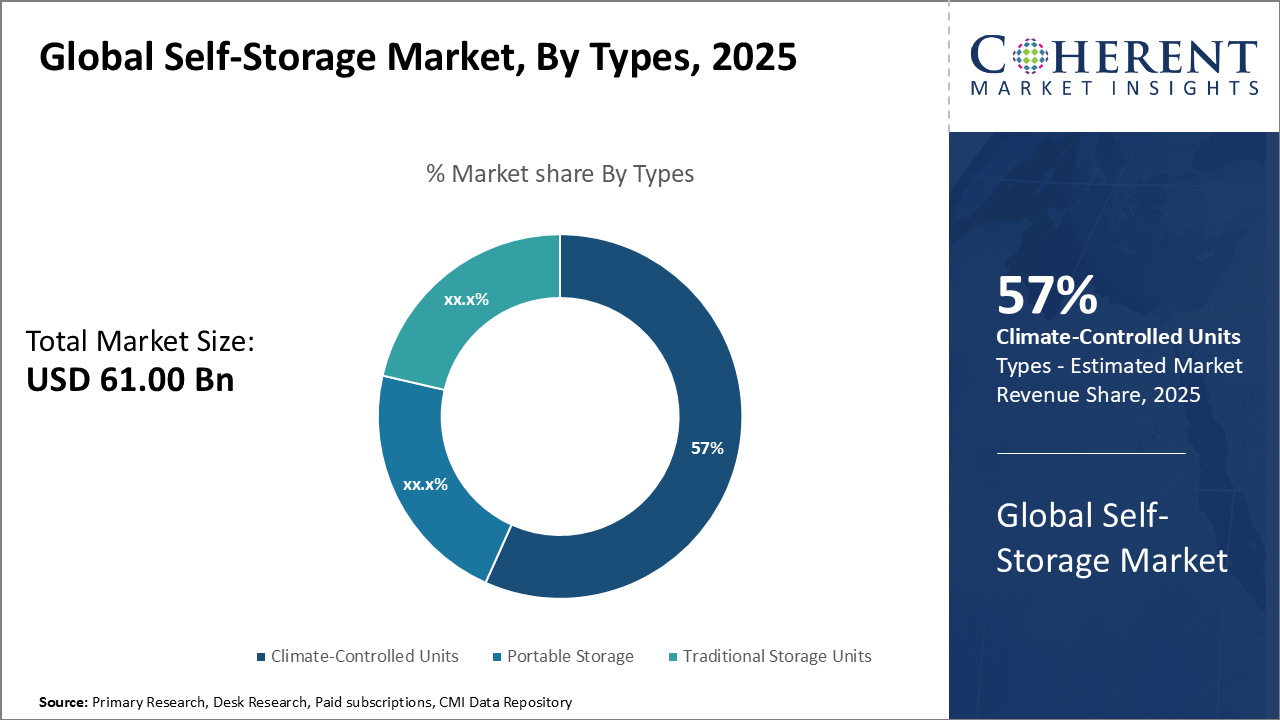
- Based on Types, the Climate-controlled units segment is expected to lead the market with 58% share in 2026, as customers prioritize protection for sensitive valuables.
- Based on End Users, the Residential segment is expected hold 68% share of the market in 2026, as urban households seek extra space for belongings.
- Based on Region, North America is set to lead the self-storage market with 48.8% share in 2026. While, Asia Pacific is anticipated to be the fastest growing region.
Market Overview
Rising urbanization and population mobility have increased demand for flexible storage space. Changes in demographics, such as people getting married later and having smaller families, have made consumers need more non-traditional storage options. As more people enter the market, competition is getting tougher. Companies that offer personalized storage units and extra services like equipment rentals and insurance are in a good position to gain market share in the near future.
Current Events and their Impacts on the Self-Storage Market
Current Event | Description and its Impact |
Rising Interest Rates and Monetary Policy Tightening |
|
Urbanization and Housing Market Volatility |
|
Segmental Insights
- Current Industry Events of 2026
- Market Size Estimation
- Regional Breakdown
- Competitive Landscape
- Customer Intelligence
- Segmental Analysis
- Pricing Analysis
- Key Market Drivers, Challenges & Future Trends
- Customized Insights Section
Self-Storage Market Insights, By Types: Climate-Controlled Units Dominate as Customers Prioritize Protection for Sensitive Valuables
By types, Climate-controlled units segment is estimated to contribute the largest share of 58% in 2026 the self storage market due to rising consumer awareness about protecting valuable and sensitive items. These units keep the temperature and humidity stable, which protects electronics, papers, antiques, and furniture from damage. Urbanization and smaller living spaces make people rely more on storage, and extreme weather makes the need for climate protection even stronger.
Businesses also like climate-controlled spaces for storing inventory and records, which makes them more popular. Customers see them as a high-quality, dependable solution, even though they cost more than regular units. In 2025, they are expected to be the most popular self-storage option as they are safe, easy to use, and affordable.
For instance, in June 2025, Strategic Storage Trust VI, Inc. announced the opening of a new self-storage facility in Toronto, Ontario. The modern property offers a range of unit sizes, including climate-controlled options, designed to protect sensitive belongings. This expansion strengthens the company’s presence in Canada and meets growing demand for secure, premium storage solutions.
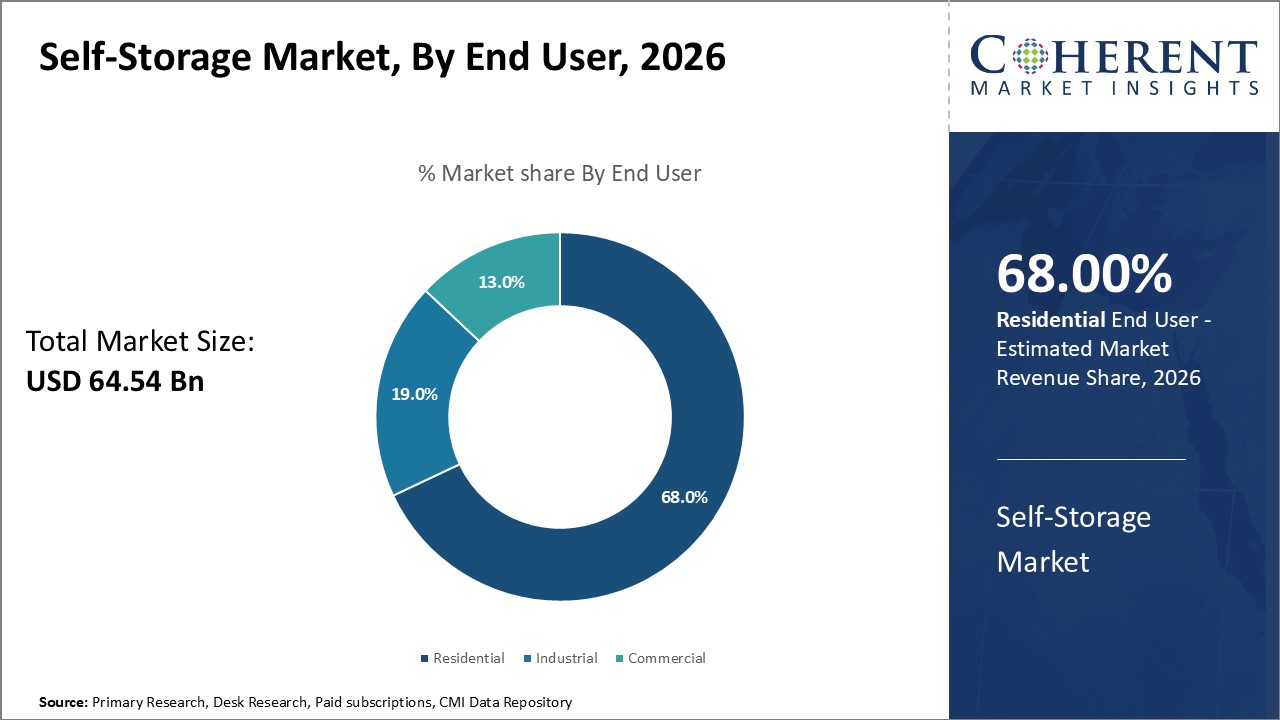
Self-Storage Market Insights, By End User: Residential Leads as Urban Households Seek Extra Space for Belongings
By End User, the residential segment is estimated to contribute the greatest share of 68% in 2026 the overall self storage market due to rapid urbanization, smaller living spaces, and lifestyle changes that create a need for extra storage. Rising consumer mobility, frequent relocations, and seasonal storage requirements for household goods, sports equipment, and personal belongings further fuel demand.
Increased adoption of e-commerce also contributes, as individuals store bulk purchases or delivery overflow. Additionally, growing awareness of organized storage solutions and affordability of rental units make self-storage attractive for households. These factors collectively position the residential segment as the largest and most dynamic driver of market growth in 2025.
Regional Insights
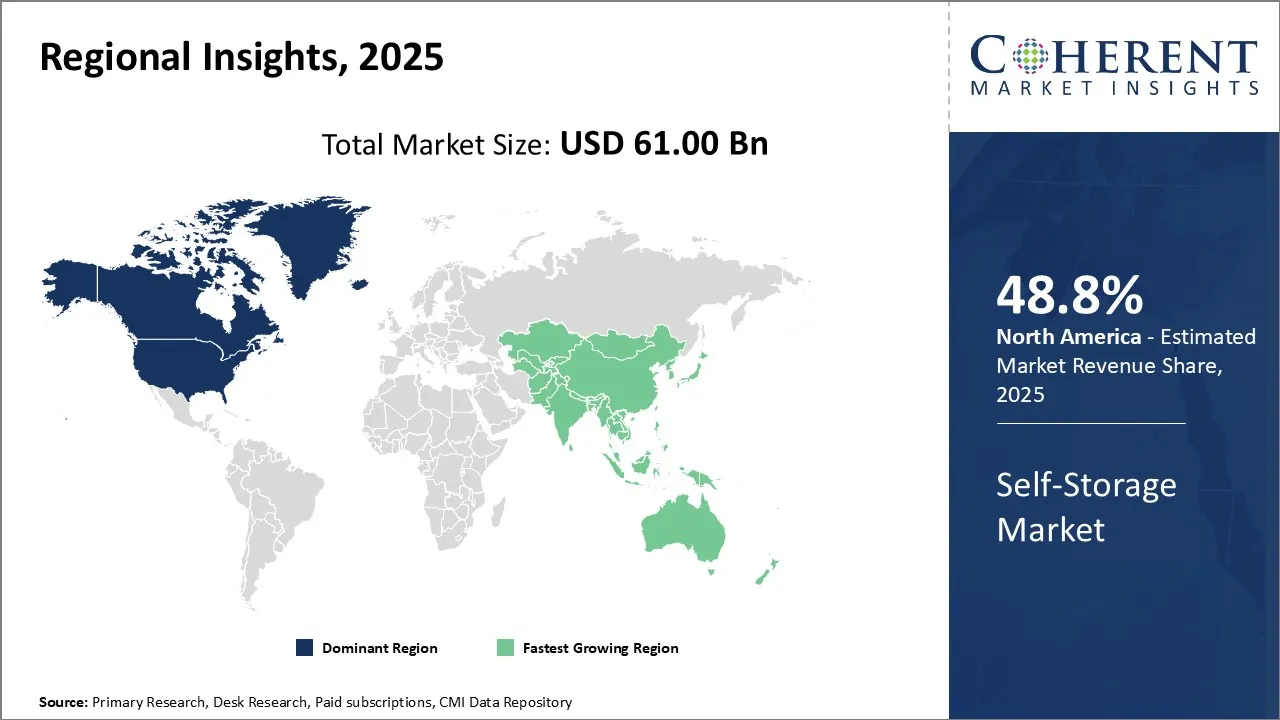
North America Self Storage Market Analysis & Trends
The North America’s self storage market has firmly established itself as the largest and most dominant in the world with 48.8% market share in 2026, due to urbanization, smaller living spaces, and rising residential mobility. Consumers increasingly seek extra space for household goods, seasonal items, and relocations. Strong e-commerce growth also drives commercial storage needs. Climate-controlled units further boost demand, offering protection against extreme weather and enhancing value.
For instance, in November 2026, Blue Vista Capital Management LLC announced a collaboration to establish a $600 million national self-storage platform in the United States. The initiative will focus on developing and acquiring modern facilities nationwide, addressing rising residential and commercial storage demand. This strategic move strengthens Blue Vista’s market presence and supports growth in the expanding self-storage industry.
Asia Pacific Self Storage Market Analysis & Trends
Asia Pacific is anticipated to be the fastest growing region in 2026, due to rapid urbanization, smaller living spaces, and rising middle-class incomes. Increased mobility, frequent relocations, and growing e-commerce activity drive residential and commercial storage needs. Climate-controlled units gain popularity as consumers seek secure solutions for valuables, fueling strong regional growth and expanding facility investments.
For instance, in October 2026, CapitaLand Investment and Extra Space Asia announced a $100 million investment in a flagship self-storage property in Singapore, alongside the acquisition of three facilities in Tokyo, Japan. The move strengthens their presence in Asia-Pacific’s growing self-storage market, driven by urbanization, rising residential demand, and increasing need for secure, flexible storage solutions.
Self Storage Market Outlook Country-Wise
The U.S. Self Storage Market Trends
The U.S. self-storage market is highly demanding in 2026 due to urbanization, smaller living spaces, and frequent relocations. Rising residential mobility, lifestyle changes, and downsizing trends drive households to seek extra space. Strong e-commerce growth adds commercial demand, while climate-controlled units protect valuables from extreme weather, making self-storage a secure and flexible solution nationwide.
For instance, in November 2026, VOC Partners launched a new self-storage investment platform focused on the Mid-Atlantic region of the United States. The initiative includes facilities in Pennsylvania and Delaware, partnering with Budget Store & Lock to expand operations. With a mix of value-add and core assets, the platform aims to meet rising demand for secure, flexible storage solutions.
China Self Storage Market Trends
The self-storage market in China is highly demanding in 2026 due to rapid urbanization, shrinking apartment sizes, and rising consumer mobility. With more people living in dense cities, households and businesses seek secure, flexible storage options. E-commerce growth adds further pressure, driving demand for modern, technology-enabled facilities that maximize convenience and efficient space use
For instance, in May 2026, RedBox Storage Hong Kong achieved major recognition at the Self Storage Awards Asia 2026, securing multiple honors for excellence in operations and customer service. The awards highlight Hong Kong’s growing role in Asia’s self-storage industry, where rising urban demand and limited living space continue to drive innovation and expansion across the region.
Market Report Scope
Self Storage Market Report Coverage
| Report Coverage | Details | ||
|---|---|---|---|
| Base Year: | 2025 | Market Size in 2026: | USD 64.54 Bn |
| Historical Data for: | 2020 To 2024 | Forecast Period: | 2026 To 2033 |
| Forecast Period 2026 to 2033 CAGR: | 5.8% | 2033 Value Projection: | USD 95.77 Bn |
| Geographies covered: |
| ||
| Segments covered: |
| ||
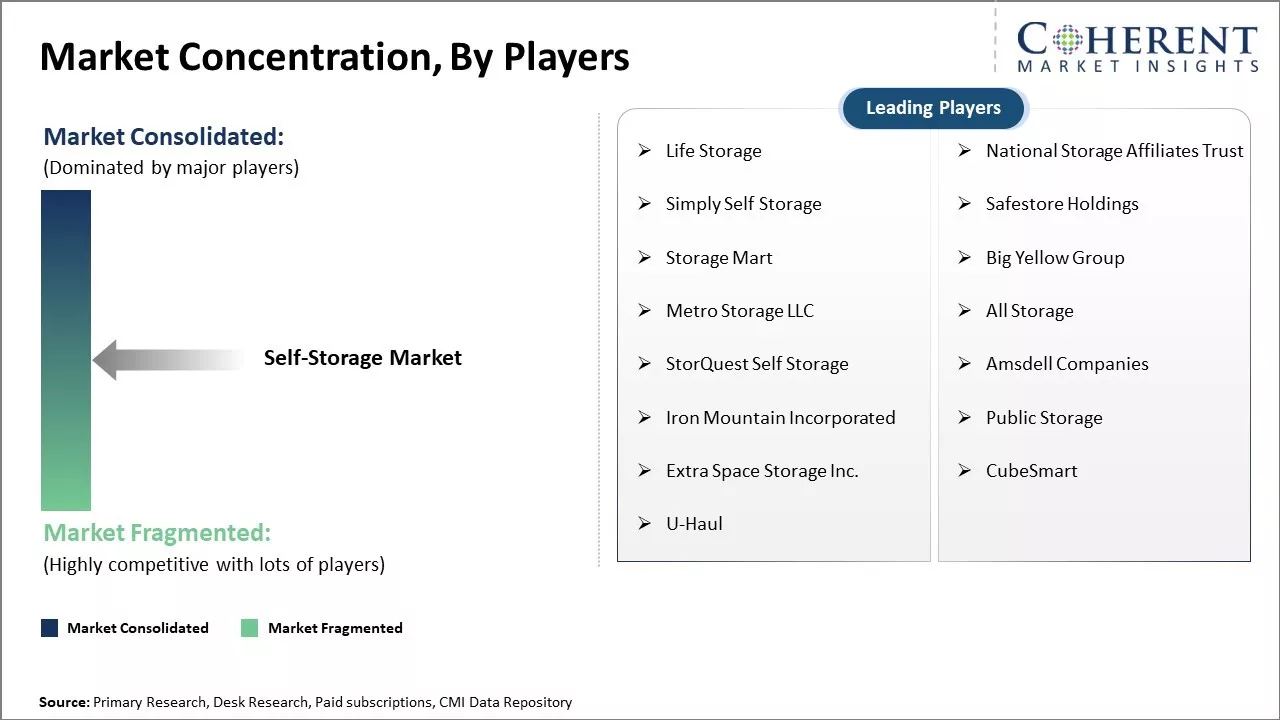
| Companies covered: | Life Storage, National Storage Affiliates Trust, Simply Self Storage, Safestore Holdings, Storage Mart, Big Yellow Group, Metro Storage LLC, All Storage, StorQuest Self Storage, Amsdell Companies, Iron Mountain Incorporated, Public Storage, Extra Space Storage Inc., CubeSmart, U-Haul | ||
| Growth Drivers: |
| ||
| Restraints & Challenges: |
| ||
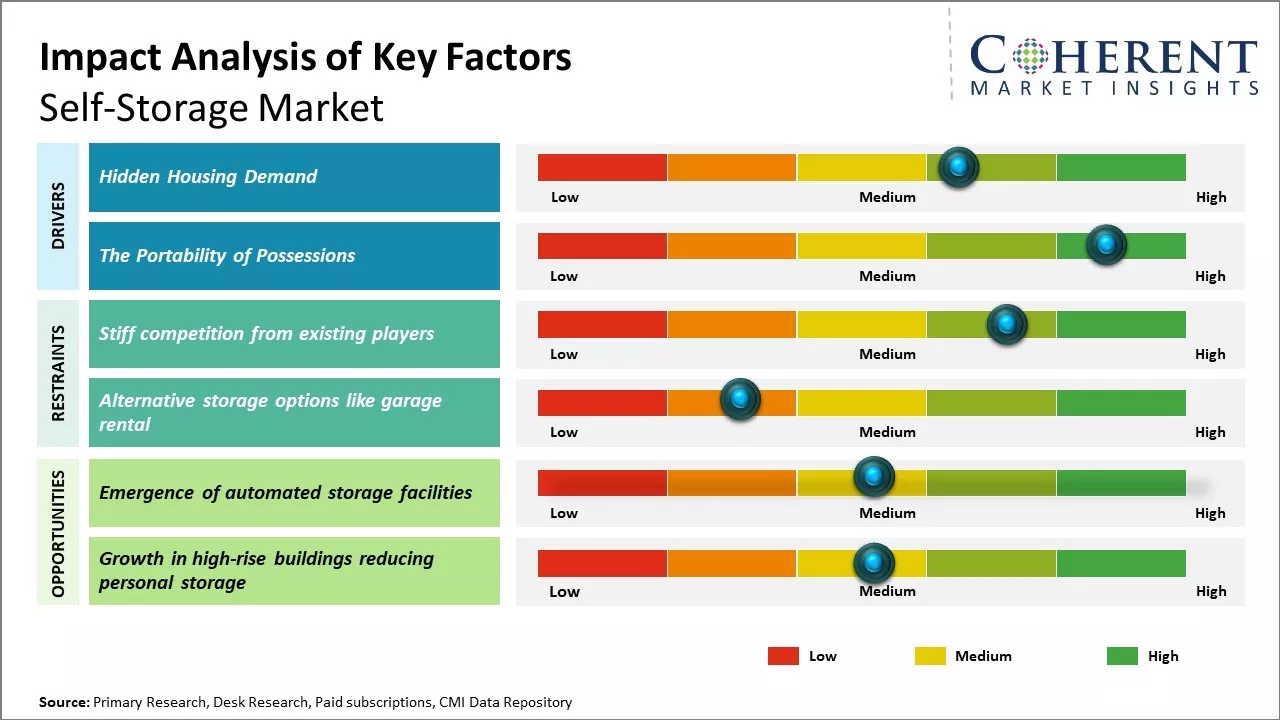
Self-Storage Market Driver
Hidden Housing Demand
Global self storage market has witnessed growth over the past decade due to underlying housing demand. While the housing market grew rapidly prior to the 2008 financial crisis, the ensuing recession left many homeowners 'underwater' on their mortgages as home values plunged. This prevented many people from moving as wanted, whether it be due to jobs, families, or simply wanting to size-up or down. The recovery in the housing market has been slow and uneven, with inventory of available Housing remains scarce in numerous big cities.
New household formation has also increased steadily as millennials become adults and move out on their own, placing further constraints on the supply of affordable housing. With migration patterns shifting many Americans to cities and job opportunities concentrated in major metro areas, the lack of available housing stock has forced many to look to alternative solutions. Self storage has become a popular option for those wanting to hold possessions long-term without carrying the financial burden of a full-sized new home.
The flexibility and affordability of self-storage units has allowed many to delay committing to their next permanent living arrangement. This pent-up housing demand acts as a sustained tailwind for the self-storage sector, as units are frequently used for long-term storage of entire households while transitions within the housing market are resolved. As housing inventory hopefully increases to meet demand and the economy remains strong enough to support household formation, this driver of self storage demand should moderate. However, the structural shift to smaller living quarters in urban areas suggests self storage will still play an important role in housing even after shortages are addressed.
Market Concentration and Competitive Landscape
The Portability of Possessions
A key aspect of modern lifestyle is the ability to be highly mobile and flexible with living and work arrangements. Globalization has opened opportunities abroad while technology has enabled remote work arrangements to spread. Younger generations in particular value experiences over possessions and want freedom unencumbered by physical items. However, modern life still requires conglomerations of belongings for different aspects of daily life - from professional wardrobes and electronics to hobby equipment and household goods. With housing sizes decreasing as living spaces become increasingly compact, primary residences often no longer have sufficient room for extensive possessions collections. Self storage has became a popular solution, allowing people to maintain control over larger accumulations of items without the responsibility of storing or transporting them.
Self-Storage Market Opportunity
Emergence of automated storage facilities
Steady population growth and smaller living quarters boosts need for supplemental storage. Operators can target specific customer niches like college students or businesses. New facilities offering high-tech amenities may appeal to young age customers. Partnerships with commercial real estate developers open possibilities to acquire prime lots. Consolidation of regional operators remains possible to achieve economies of scale.
Analyst Opinion (Expert Opinion)
The global self-storage market value projection is indicated to continue growing in the coming years. Demand is driven by urbanization, shrinking living spaces, and increasing e-commerce activity, which boosts both personal and commercial storage needs. Medium- and large-sized units are particularly popular, reflecting a preference for flexible storage solutions that accommodate household items, furniture, and business inventory.
Europe houses approximately 6,900 self-storage facilities, offering nearly 14 million sqm of rentable space. Despite growth, average space per capita remains lower than in mature markets, signaling untapped potential. Supply is expanding rapidly in urban areas, but secondary markets remain under-penetrated, presenting opportunities for new entrants and institutional investment.
Emerging trends include climate-controlled units, smart technology for bookings and access, and value-added services such as packaging, insurance, and logistics support. These innovations enhance customer experience and revenue per unit.
Challenges include the risk of oversupply in certain regions, rising operating costs for premium units, and regulatory constraints on urban facility development. Nevertheless, under-penetrated markets, tech adoption, and hybrid storage-logistics solutions present strong opportunities. Overall, the self-storage market offers sustainable growth potential, supported by evolving lifestyles, urban density, and commercial storage demands.
Speak to the analyst
Want personalized insights?
Take the findings above to one of our principal consultants, or have the report rebuilt around the segments, geographies and competitors you actually track.
Self-Storage Industry News
- In October 2025, PGIM Real Estate and Pithos Capital expanded their self-storage joint venture into Spain, targeting Catalonia, Andalusia, and Valencia. The seed portfolio includes 10 assets with seven more in the pipeline, operated under the Zebrabox brand. The initiative focuses on adaptive reuse and sustainability, aiming for BREEAM Very Good certification to meet rising urban storage demand.
- In May 2025, Pocket Storage and Forum Partners launched a technology-enabled self-storage platform targeting ultra-urban U.S. markets. Focused on adaptive reuse, the initiative repurposes existing properties into modern storage facilities, addressing rising demand in dense cities. The platform combines real estate innovation with digital solutions, offering secure, flexible storage options to meet growing residential and commercial needs.
- In June 2023, StorageMart, a company that is known for operating over 280 self-storage facilities across Canada, the K., and the U.S., purchased I-29/I-35 Self Storage in Kansas City, Missouri, along with Summit Self Storage in Missouri. These two properties together offer a total of 112,296 rentable square feet across 796 apartment buildings.
- In June 2023, SmartStop Self Storage REIT, Inc., a fully integrated self-storage company, announced that its affiliates, Strategic Storage Trust VI, Inc., and Strategic Growth Trust III, Inc., acquired an eight-facility portfolio in the Greater Toronto Area (GTA).
Market Segmentation
- Types Insights (Revenue, US$ Bn, 2021 - 2033)
- Climate-Controlled Units
- Portable Storage
- Traditional Storage Units
- End User Insights (Revenue, US$ Bn, 2021 - 2033)
- Commercial
- Industrial
- Residential
- Regional Insights (Revenue, US$ Bn, 2021 - 2033)
- North America
- U.S.
- Canada
- Latin America
- Brazil
- Argentina
- Mexico
- Rest of Latin America
- Europe
- Germany
- U.K.
- France
- Italy
- Russia
- Rest of Europe
- Asia Pacific
- China
- India
- Japan
- Australia
- South Korea
- ASEAN
- Rest of Asia Pacific
- Middle East & Africa
- GCC Countries
- South Africa
- Rest of Middle East & Africa
- Key Players
- Life Storage
- National Storage Affiliates Trust
- Simply Self Storage
- Safestore Holdings
- Storage Mart
- Big Yellow Group
- Metro Storage LLC
- All Storage
- StorQuest Self Storage
- Amsdell Companies
- Iron Mountain Incorporated
- Public Storage
- Extra Space Storage Inc.
- CubeSmart
- U-Haul
Sources
Primary Research Interviews
- Self-Storage Facility Operators
- Commercial Real Estate Developers
- Logistics and Warehousing Consultants
- Property Management Companies
- Others
Databases
- Bloomberg Terminal
- Thomson Reuters Eikon
- Euromonitor International
- Others
Magazines
- Self-Storage Magazine
- Storage Management Magazine
- Inside Self-Storage
- PropertyCasualty360
- Others
Journals
- Journal of Property Investment & Finance
- International Journal of Retail & Distribution Management
- Facilities
- Others
Newspapers
- Financial Times
- The Wall Street Journal
- Reuters
- Bloomberg News
- Others
Associations
- Self Storage Association (SSA)
- International Facility Management Association (IFMA)
- National Multifamily Housing Council (NMHC)
- Building Owners and Managers Association (BOMA)
- Others
Public Domain Sources
- U.S. Census Bureau
- U.S. Department of Housing and Urban Development (HUD)
- World Bank Open Data
- Government Statistical Offices
- Others
Proprietary Elements
- CMI Data Analytics Tool
- Proprietary CMI Existing Repository of information for the last 8 years
Definition: The self storage market provides affordable storage units in various sizes to both residential and commercial customers who need extra space to store their possessions. Self storage facilities offer fully enclosed and secure storage spaces along with 24/7 access so customers can store items ranging from household goods and furniture to business records and inventory. With flexible month-to-month rental terms and a variety of unit sizes to choose from, self storage is a low-cost solution for both short and long-term storage needs for individuals and companies alike.
Get access to 250+ pages report
Every segment, forecast, competitor profile and data table behind the analysis above — available for instant download.
- ESOMAR Member
- ISO 9001:2015 Certified
- D-U-N-S Registered
- GDPR & CCPA Compliant
Missing comfort of reading report in your local language? Find your preferred language:
Transform your Strategy with Exclusive Trending Reports
Frequently Asked Questions
The Self-Storage Market is estimated to be valued at USD 64.54 Bn in 2026, and is expected to reach USD 95.77 Bn by 2033.
The CAGR of the Self-Storage Market is projected to be 5.8% from 2026 to 2033.
Hidden housing demand and the portability of possessions are the major factors driving the growth of global self storage market.
Stiff competition from existing players and alternative storage options like garage rental are the major factors hampering the growth of global self storage market.
In terms of types, traditional storage units segment is estimated to dominate the market in 2026.
Life Storage, National Storage Affiliates Trust, Simply Self Storage, Safestore Holdings, Storage Mart, Big Yellow Group, Metro Storage LLC, All Storage, StorQuest Self Storage, Amsdell Companies, Iron Mountain Incorporated, Public Storage, Extra Space Storage Inc., CubeSmart, U-Haul are the major players.
North America is expected to lead the global self storage market in 2026.