

Global Cell Expansion Market Size and Share Analysis – Growth Trends and Forecasts (2026-2033)
Global cell expansion market is estimated to be valued at USD 22.15 Bn in 2026 and is expected to reach USD 49.58 Bn in 2033, at a CAGR of 12.2% during the forecast period (2026-2033).
Key Takeaways
- Based on Product, Consumables Product Segment leads the cell expansion market with a 43.8% share. This is due to their repeated use in every expansion cycle, driving consistent demand.
- North America cell expansion market is expected to hold a dominant position during the forecast period, with 43.2% market share. This is due to the increasing acquisition by market players of cell and gene therapy manufacturing facilities in the region.
Market Overview
The cell expansion market will witness high growth during the forecast period due to increasing demand for regenerative medicine, cell and gene therapies, and personalized treatment modalities. Cell expansion plays a pivotal role in generating adequate numbers of cells for therapeutic, research, and diagnostic purposes—especially in stem cell research, immunotherapy, and cancer therapy. Governments and venture capitalists are significantly investing in biotech and life sciences research, and regulatory bodies are increasingly simplifying routes for next-generation cell-based therapy.
Current Events and Its Impact on Cell Expansion Market
Current Events | Description and its impact |
Culture Biosciences Unveils Stratyx™ 250 – First Cloud ‑ Integrated Mobile Bioreactor |
|
Sartorius Launches Modular Cell Expansion Platform for GMP-Compatible Cell Therapy Production |
|
Pricing Analysis
The price of Cell expansion market is determined by a range of factors that include technology development, rate of production, and end-user requirements. Newer cell expansion equipment, for instance, bioreactors and automated systems, will most likely be pricier due to their precision, scalability, and capacity to generate cell quality. Small lab-scale bioreactors, for instance, may run from $20,000 to $100,000, whereas industrial systems with GMP certification may range from well over $500,000 to tens of millions of dollars, depending upon capacity and customization level.
Consumables like culture media, growth factors, and single-use components are the major contributors to repeated costs. Repeated costs are different for different cell types and applications, with the requirement for stem cells and CAR-T therapies being more advanced and expensive reagents, thereby becoming overall costlier.
Pricing is also varied by geography. Europe and North America generally fetch higher prices due to stringent regulatory regimes, technology adoption at a later stage, and greater labor costs. Emerging Asia-Pacific economies, however, have lower equipment and operational expenses, although the market is quickly evolving with increased demand for high-quality and scalable solutions.
Pricing is also driven by competitive forces between the key players. Companies attempt to offer cheap, automated, and scalable solutions in order to obtain market share, further leading to a decline in prices or offering flexible leasing terms. The pricing models also get impacted by alliances between pharmaceutical companies and equipment companies, usually resulting in bundled packages or long-term contracts.
- Current Industry Events of 2026
- Market Size Estimation
- Regional Breakdown
- Competitive Landscape
- Customer Intelligence
- Segmental Analysis
- Pricing Analysis
- Key Market Drivers, Challenges & Future Trends
- Customized Insights Section
Role of technologies like AI on the Market
Artificial Intelligence (AI) is rapidly transforming the Cell Expansion Industry through enhanced efficiency, precision, and scalability of cell culture processes. AI-based systems enable real-time tracking and regulation of such critical parameters as temperature, pH, oxygen, and nutrition supply, holding the optimal growth conditions and uniform cell quality. With the amount of data generated in cell cultivation, AI software can predict and dynamically adjust culture conditions, reducing variability and human error.
AI also accelerates process development through quickly optimizing growth protocols for specific cell types, like stem cells or immune cells used in therapy like CAR-T. Machine learning software scanned existing data to identify key factors influencing cell yield and viability and thus lower development lead times and expenses.
In addition, AI-powered automation is combined with bioreactors and closed system platforms for an optimal maximization of cell expansion processes and scalability for manufacturing within a commercial environment. AI-powered predictive maintenance provides zero equipment downtime, thus optimizing operational efficiency.
Furthermore, AI supports quality control and regulatory compliance with traceable data analytics and timely identification of contamination or deviations. This enhances reproducibility and safety required in clinical and industrial application. Combining AI with other emerging technologies like robotics, IoT, and big data analytics is propelling the creation of smart biomanufacturing environments.
These technologies can potentially reduce the cost, increase consistency, and accelerate the commercialization of cell-based therapies. Overall, AI is the driving force in closing gaps in cellular growth, driving personalized medicine, and driving the expansion of the market towards more efficient, scalable, and affordable solutions.
End user feedback
- Biopharmaceutical companies: Biopharmaceutical companies emphasize the need for scalable and reproducible cell growth technologies. They look for technologies that offer high cell viability and uniform quality under large-scale production. Closed-system and automation technologies are most valued to minimize contamination risks and maximize production efficiency. Companies also need flexible platforms capable of supporting different cell types and therapeutic applications to further develop their pipeline development and commercialization activities.
- Research and Academic Institutions: Research and Academic Institutions place the greatest emphasis on usability and versatility of cell expansion equipment. They require equipment that can handle a broad variety of cell lines and offer precise control of culture conditions to enable experimental reproducibility. Cost-effectiveness and simplicity, considering the ubiquity of small- to medium-scale projects, are key factors. These customers also value systems that enable rapid prototyping and feasibility testing for new cell therapies or scientific research.
- Hospitals and Clinics: Hospitals and Clinics using cell expansion for treatments designed for patients guarantee safety, sterility, and regulatory compliance. They need reliable and well-validated systems for culturing cells for therapies like CAR-T therapy or stem cell transplantation. Consistency and speed are essential as delays or contamination can have direct implications on patient outcomes. Simple-to-use interfaces and integration into clinical workflows make these technologies easier to adopt in healthcare.
- Contract Research and Manufacturing Organizations (CROs and CMOs) require high-throughput, flexible, and cost-effective cell expansion technology. CROs and CMOs handle more than one client and project at a time, thus flexibility and adherence to regulatory guidelines in Good Manufacturing Practices (GMP) facilities are required. Smooth workflow integration and scalability allow CROs and CMOs to complete projects on tight deadlines without any diminution in quality.
- Government and Regulatory Authorities: Government and Regulatory Authorities are concerned with standardized, validated procedures to ensure product safety and performance. Government and Regulatory Authorities must institute tools that support traceability, documentability, and conformity to regulatory guidelines. Their contributions typically emphasize the need for open quality control and risk management in cell expansion protocols to protect public health.
Market Driver
- Development of new technologies in cell expansion
Development of new technologies in cell expansion is expected to offer lucrative growth opportunities for players in the global cell expansion market. For instance, In March 2024, Getinge, in collaboration with CellRev, unveiled Livit ACE, a continuous adherent cell processing platform designed specifically for allogeneic cell therapy manufacturing. Livit ACE integrates activation, expansion, and harvest in a seamless, automated workflow—dramatically reducing cost of goods by over 50%, minimizing consumable use, and boosting process consistency and productivity.
- Key players are involved in launching of a new medium for the expansion and maintenance of cells
Key players are involved in launching of a new medium for the expansion and maintenance of cells is expected to drive the growth of global cell expansion market. For instance, in September 2021, Bio-Techne Corporation, which develops, manufactures, and sells life science reagents, instruments, and services for the research, diagnostic, and bioprocessing markets, announced the launch of a new medium for the expansion and maintenance of induced pluripotent stem cells (iPSCs), which can be used in both research and translational workflows. The ExCellerate iPSC Expansion Medium is the newest addition to Bio-Techne's regenerative medicine portfolio.
Global Cell Expansion Market – Restraints
Animal and human cells are also utilized to evaluate medicines for in vivo toxicity and pharmacokinetics in animals and humans. Furthermore, stem cell research uses human embryos for clinical purposes, which frequently results in the killing of human embryos. Stringent restrictions have been created by ethical authorities such as The Human Tissue Authority (HTA), the Human Fertilization and Embryology Authority (HFEA), etc. in numerous nations across the world to supervise these operations.
For instance, prohibitions under the 1990 Act on Human Embryo Research by the Human Fertilization and Embryology Authority includes, keeping or using an embryo after the appearance of the primitive streak, or after 14 days whichever is the earlier, placing an embryo in a non-human animal, placing non-human gametes or embryos in a woman, replacing a nucleus of a cell of an embryo with a nucleus taken from the cell of another person, another embryo, or a subsequent development of an embryo, altering the genetic structure of any cell while it forms part of an embryo.
Segmental Insights
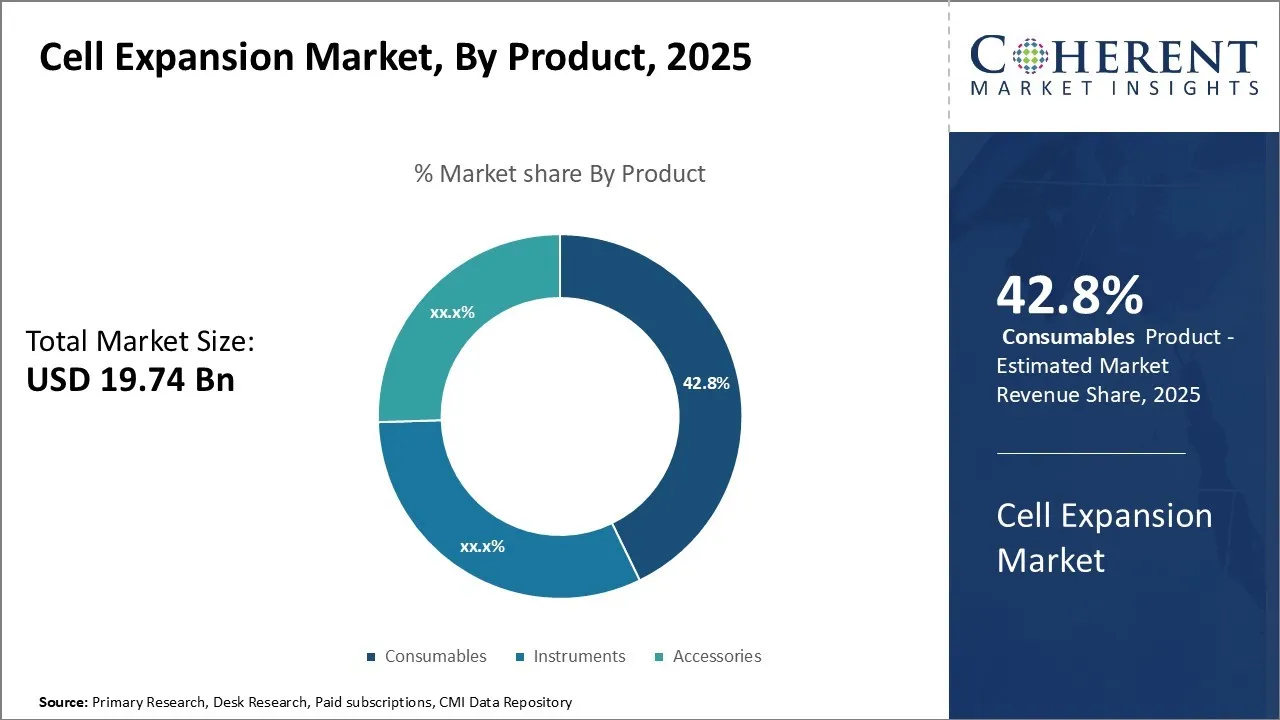
Cell Expansion Market Insights, By Product
Consumables lead the cell expansion market with a 43.8% share due to their repeated use in every expansion cycle, driving consistent demand. These include media, reagents, sera, and growth factors essential for cell culture and proliferation.
As regenerative medicine and cell expansion grow, the need for high-quality, scalable consumables has intensified. Unlike instruments, consumables require regular replenishment, making them a recurring revenue stream. Additionally, advancements in cell expansion methods, serum-free, and chemically defined media have boosted their adoption across clinical and research settings.
Global Cell Expansion Market – Regional Insights
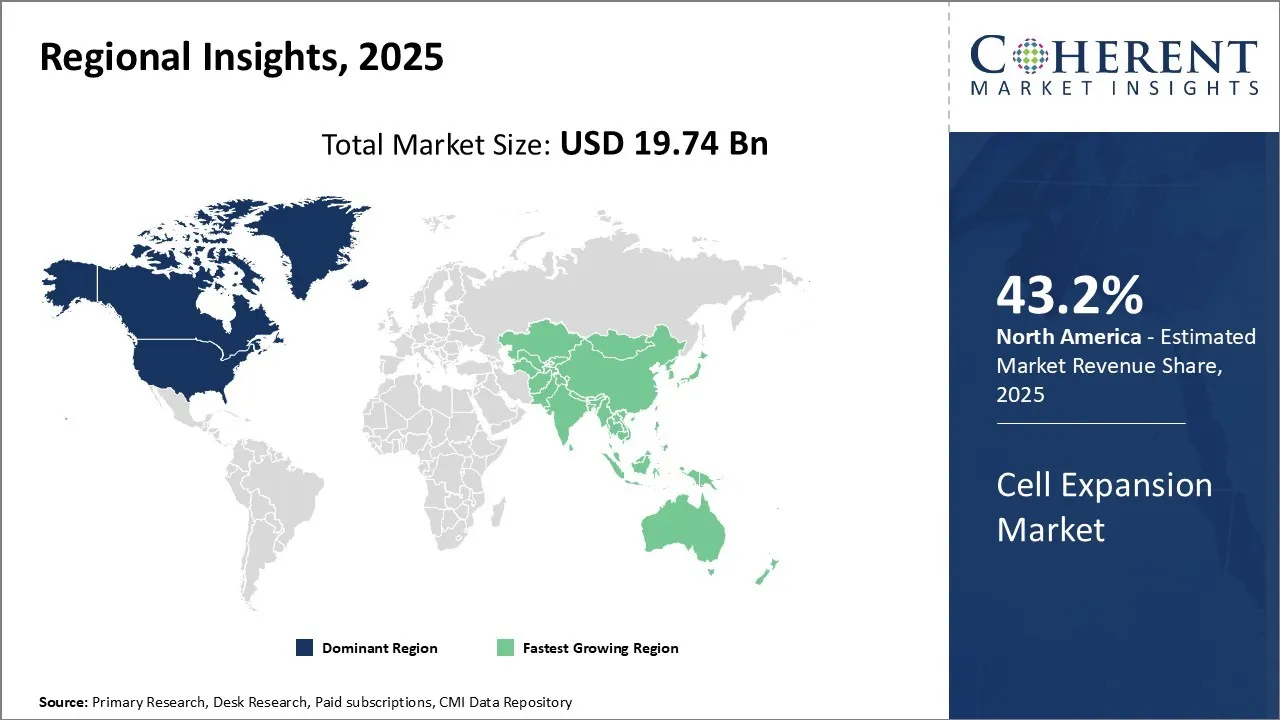
North America Cell Expansion Market Analysis and Trends
North America cell expansion market is expected to hold a dominant position during the forecast period, owing to the increasing acquisition by market players of cell and gene therapy manufacturing facilities in the region. For instance, in July 2021, AGC Biologics, signed a purchase agreement with Novartis Gene Therapies, a division of Novartis AG to acquire a state-of-the-art cell and gene therapy commercial manufacturing facility in Longmont, Colorado, U.S. The facility will provide AGC Biologics with significant extra capacity and space, pending full due diligence, to continue to develop its end-to-end Cell and Gene Therapy (C>) offering, assuring supply security for current and future C> clients.
Furthermore, Europe is expected to exhibit significant growth in the cell expansion market, owing to increasing facility expansion and investment in cell and gene therapy manufacturing by market players in this region. For instance, in March 2021, GSK, announced the agreement with Cell and Gene Therapy Catapult to the improvement of cell and gene therapies through creativity and technology, to expand its clinical trial manufacturing capacity for cell and gene therapy at the Cell and Gene Therapy Catapult facility in Stevenage, U.K.
Cell Expansion Market Dominating Countries
United States Cell Expansion Market Analysis and Trend
The US leads the global cell expansion industry with its developed biotech and pharma base. Highly sophisticated research facilities, significant investment in regenerative medicine, and a well-developed healthcare system are strong drivers of leadership. Early mover advantage in taking up new cell expansion technologies is another advantage for the US.
Germany Cell Expansion Market Analysis and Trend
Germany leads the European cell expansion market, driven by its strong manufacturing base and focus on cutting-edge biotechnologies. The country's existing pharmaceutical sector and favorable regulatory environment for the development and sale of cell therapies foster demand for cell expansion systems.
China Cell Expansion Market Analysis and Trend
China is growing its role in the cell expansion market rapidly as a result of increasing investments in biopharmaceutical research and robust demand for new therapies. The encouragement derived from government initiatives towards biotech innovation and a huge patient population are good conditions for growth within the market in the country.
Japan Cell Expansion Market Analysis and Trend
Japan is among the key markets for cell growth in Asia, driven by its elderly population and good healthcare. Cell therapy and regenerative medicine research interest in the country, combined with friendly government regulations, drive the adoption of cell growth technology.
South Korea Cell Expansion Market Analysis and Trend
South Korea is emerging as a key market in the cell expansion industry, supported by a robust government funding and support for biotechnology. Focus on R&D and collaboration between research institutes and industry drives innovation in cell expansion technology and applications.
Market Report Scope
Cell Expansion Market Report Coverage
| Report Coverage | Details | ||
|---|---|---|---|
| Base Year: | 2025 | Market Size in 2026: | USD 22.15 Bn |
| Historical Data for: | 2020 To 2024 | Forecast Period: | 2026 To 2033 |
| Forecast Period 2026 to 2033 CAGR: | 12.2% | 2033 Value Projection: | USD 49.58 Bn |
| Geographies covered: |
| ||
| Segments covered: |
| ||
| Companies covered: | Becton, Dickinson and Company, Sartorius AG, Merck KGaA, Corning, Inc., Eppendorf SE, Lonza Group AG, PromoCell, Danaher, Thermo Fisher Scientific, HiMedia Laboratories, STEMCELL Technologies Inc., REPROCELL Inc., Bio-Techne, Valiant Co., Ltd., Miltenyi Biotec, Biologos, Cyagen US Inc. | ||
| Growth Drivers: |
| ||
| Restraints & Challenges: |
| ||
Analyst View
- The cell expansion industry is witnessing strong momentum, led by the growing implementation of cell-based therapies and regenerative medicine uses across worldwide healthcare systems. The increased incidence of chronic ailments, combined with a rising population age, is generating high demand for sophisticated therapeutic options that depend on expanded cell populations in order to achieve effective treatment.
- Major market drivers for these technologies involve high investments in stem cell research, growing clinical trials of cell therapies, and supportive regulatory environments for novel treatment strategies. The biopharmaceutical industry's movement toward personalized therapy is also driving the need for scalable cell expansion technologies and automation systems.
- Yet, the industry is confronted by significant constraints such as the stringent capital needs for setting up cell expansion plants, complicated regulatory approval procedures, and the technical issues of cell viability and functionality being maintained during expansion processes. Also, issues of risks of contamination and standardization of expansion protocols still remain operational challenges.
- Future prospects are in the creation of cost-efficient automation solutions, artificial intelligence integration for process streamlining, and growth into novel therapeutic fields like immunotherapy and tissue engineering. Closed-system bioreactors and single-use technologies are major opportunities for growth.
- North America is the leading market now, backed by strong research facilities, huge healthcare investments, and the presence of top biotechnology firms. The Asia-Pacific region, though, is seen to be growing as the fastest-growing market because of growing healthcare spending, increased research capabilities, and initiatives by governments encouraging biotechnology growth among nations such as China, Japan, and South Korea.
Recent Developments
- In 2025, Thermo Fisher launched the latest HyPerforma single-use bioreactor series equipped with advanced real-time monitoring and analytics for cell expansion. This technology enhances process control by tracking critical parameters such as pH, dissolved oxygen, and metabolite levels, ensuring higher consistency and yield in cell cultures.
- In 2025, Cytiva announced the expansion of its Xcellerex X-platform portfolio with the addition of 500-L and 2000-L single-use bioreactors. This expansion enables researchers to scale up manufacturing of advanced therapeutics from 50 L to 2000 L, enhancing operational efficiencies and production capacity.
Market Segmentation
- Global Cell Expansion Market, By Product (Revenue, USD Bn, 2021 - 2033)
- Consumables
- Media
- Others
- Instruments
- Automated Cell
- Expansion Systems
- Cell Counters
- Centrifuges
- Bioreactors
- Others
- Accessories
- Consumables
- Global Cell Expansion Market, By Cell Type (Revenue, USD Bn, 2021 - 2033)
- Mammalian Cells
- Human Cells
- Stem Cells
- Adult Stem Cells
- Induced Pluripotent Stem Cells
- Embryonic Stem Cells
- Differentiated Cells
- Animal Cells
- Human Cells
- Microbial Cells
- Others (Plant-derived Cells)
- Mammalian Cells
- Global Cell Expansion Market, By Application (Revenue, USD Bn, 2021 - 2033)
- Biopharmaceuticals
- Tissue Culture & Engineering
- Vaccine Production
- Drug Development
- Cancer Research
- Stem Cell Research
- Other Applications
- Global Cell Expansion Market, By End User (Revenue, USD Bn, 2021 - 2033)
- Biotechnology Companies
- Biopharmaceutical Companies
- Others
- Global Cell Expansion Market, By Region (Revenue, USD Bn, 2021 - 2033)
- North America
- U.S.
- Canada
- Latin America
- Brazil
- Argentina
- Mexico
- Rest of Latin America
- Europe
- Germany
- U.K.
- Spain
- France
- Italy
- Russia
- Rest of Europe
- Asia Pacific
- China
- India
- Japan
- Australia
- South Korea
- ASEAN
- Rest of Asia Pacific
- Middle East
- GCC Countries
- Israel
- Rest of Middle East
- Africa
- South Africa
- North Africa
- Central Africa
- North America
- Company Profiles
- Becton, Dickinson and Company
- Sartorius AG
- Merck KGaA
- Corning, Inc.
- Eppendorf SE
- Lonza Group AG
- PromoCell
- Danaher
- Thermo Fisher Scientific
- HiMedia Laboratories
- STEMCELL Technologies Inc.
- REPROCELL Inc.
- Bio-Techne
- Valiant Co., Ltd.
- Miltenyi Biotec
- Biologos
- Cyagen US Inc.
Sources
Primary Research Interviews
- Cell therapy and regenerative medicine companies’ executives
- Biotechnology and pharmaceutical industry professionals
- Cell expansion technology providers and manufacturers
- Research institutes and academic researchers
- Others
Databases
- ClinicalTrials.gov
- Biotechnology Innovation Organization (BIO) Database
- FDA Approval Database
- Others
Magazines
- BioWorld Intelligence
- Nature Biotechnology
- Cell & Gene Therapy Insights
- Genetic Engineering & Biotechnology News
- Others
Journals
- Nature Methods
- Stem Cells Translational Medicine
- Cytotherapy Journal
- Others
Newspapers
- BioPharma Dive
- FierceBiotech
- The Wall Street Journal (Healthcare Section)
- Reuters Health News
- Others
Associations
- International Society for Cell & Gene Therapy (ISCT)
- Alliance for Regenerative Medicine (ARM)
- BioWorld Intelligence Database
- American Society of Gene & Cell Therapy (ASGCT)
- Others
Public Domain Sources
- World Health Organization (WHO) Publications
- National Institutes of Health (NIH) Reports
- FDA Guidance Documents
- European Medicines Agency (EMA) Publications
- Others
Proprietary Elements
- CMI Data Analytics Tool
- Proprietary CMI Existing Repository of information for last 8 years
Get access to 250+ pages report
Every segment, forecast, competitor profile and data table behind the analysis above — available for instant download.
- ESOMAR Member
- ISO 9001:2015 Certified
- D-U-N-S Registered
- GDPR & CCPA Compliant
Missing comfort of reading report in your local language? Find your preferred language:
Transform your Strategy with Exclusive Trending Reports
Frequently Asked Questions
The Cell Expansion Market size is estimated to be valued at USD 22.15 Bn in 2026, and is expected to reach USD 49.58 Bn by 2033.
The CAGR of the Market is projected to be 12.2% from 2026 to 2033.
The market is estimated to be valued at USD 19.69 Bn in 2026.
Becton, Dickinson and Company, Sartorius AG, Merck KGaA, Corning, Inc., Eppendorf SE, Lonza Group AG, PromoCell, Danaher, Thermo Fisher Scientific, HiMedia Laboratories, STEMCELL Technologies Inc., REPROCELL Inc., Bio-Techne, Valiant Co., Ltd., Miltenyi Biotec, Biologos, Cyagen US Inc. are some of the prominent players operating in the market.
The biopharmaceutical, regenerative medicine, and stem cell therapy industries rely heavily on cell expansion for drug development and therapeutic applications.
Cell expansion is critical in stem cell therapy as it enables the proliferation of stem cells to sufficient quantities for effective treatment.
Contract cell expansion services are typically structured as outsourced manufacturing solutions where specialized firms handle cell cultivation, scale-up, and quality control for clients.