

Global Centrifugal Pump Market Size and Share Analysis
The centrifugal pump market is estimated to be valued at USD 43.86 Bn in 2026 and is expected to reach USD 65.95 Bn by 2033, growing at a compound annual growth rate (CAGR) of 6.0% from 2026 to 2033.
Key Takeaways
- In terms of Product Type, Single-Stage Pump Segment is expected to contribute the highest share of 35.6% in 2026.
- In terms of Capacity (HP), Small Capacity Pumps Segment is expected to contribute the highest share of 44.50% in 2026.
- In terms of End-Use Industry, Industrial Segment is estimated to contribute to 49.81% of share in 2026.
- The Asia Pacific region currently dominates the global centrifugal pump market and is expected to have a largest market share of 39.2% in 2026.
Market Overview
The centrifugal pump market is expected to witness a positive trend over the forecast period. Pumps are increasingly being utilized across various end-use industries such as the chemical, oil & gas, power generation, and water & wastewater treatment industries. The rising energy demand along with growing industrialization in emerging economies across Asia Pacific and the Middle East & Africa is further augmenting the demand for centrifugal pumps. Additionally, increasing investments in process industries and technological advancements in product offerings are some of the factors expected to drive the market growth during the forecast period.
Current Events and Its Impact on Centrifugal Pump Market
Current Events | Description and its impact |
Reliability-X Supplies IoT-Enabled Centrifugal Pumps to Saudi Aramco
|
|
DESMI launches Magnetic ‑ Drive Pumps for Chemical Industry
|
|
Centrifugal Pump Market Pipeline Analysis
Centrifugal pump industry pricing is established by various factors, including type of pump, end-user sector, material composition, and technological incorporation. Prices fluctuate extensively across product ranges—spanning from $100 to over $5,000 per piece—depending on size, capacity, pressure rating, and specialty characteristics like corrosion resistance or energy-efficient designs. Typical farm or residential-type centrifugal pumps will be in the low-cost range, but industrial-grade pumps used in oil & gas, power generation, and chemical processing will be costly.
Material costs are a crucial aspect of pricing, especially for pumps made of stainless steel, bronze, or composite material for handling aggressive or hazardous fluids. Price movements of raw materials, especially steel, and other alloys, have a direct bearing on manufacturing costs and thus market prices.
In developed markets like North America and Europe, higher labor and regulatory compliance costs drive up the cost of pumps, but these are offset by demand for energy-efficient and smart pumping systems. Asia-Pacific offers lower-cost products with lower manufacturing costs and high local manufacturer density, including China and India.
Technological progress is also reshaping the cost scenario. Advanced features such as IoT integration, VFDs, and predictive maintenance can add 20–40% to the cost but deliver phenomenal lifecycle savings. Overall, while traditional centrifugal pump costs remain constant, customers' appreciation for intelligent, efficient, and durable systems is pushing average market prices marginally higher, especially in industry and infrastructure segments.
- Current Industry Events of 2026
- Market Size Estimation
- Regional Breakdown
- Competitive Landscape
- Customer Intelligence
- Segmental Analysis
- Pricing Analysis
- Key Market Drivers, Challenges & Future Trends
- Customized Insights Section
Role of Advanced technologies
Advanced technologies are taking a revolutionary role in the centrifugal pump market, making it more efficient, more reliable, and more operationally smarter. The single most significant innovation is probably utilizing smart technologies such as the Internet of Things (IoT), artificial intelligence (AI), and machine learning. These technologies enable real-time monitoring of pump performance, predictive maintenance, and remote diagnostics, which reduce downtime and enhance energy efficiency across industrial processes.
Variable Frequency Drives (VFDs) are another valuable innovation, allowing pumps to vary motor speed to match actual demand. This enhances energy efficiency and increases pump longevity by reducing mechanical stress. With escalating energy costs and increasing environmental regulations, VFDs are being incorporated into pump systems for commercial, municipal, and industrial applications increasingly.
Exotic materials such as corrosion-alloy, composites, and ceramics are also applied in order to increase the operational life and longevity of centrifugal pumps, especially in demanding applications like chemical processing or offshore oil and gas. These materials reduce maintenance frequency and increase performance under adverse conditions.
Also, 3D printing and other advanced manufacturing techniques are enabling more precise pump designs, reducing lead time and production costs. Computational Fluid Dynamics (CFD) modeling is also being used more to model and optimize flow performance before actual manufacturing.
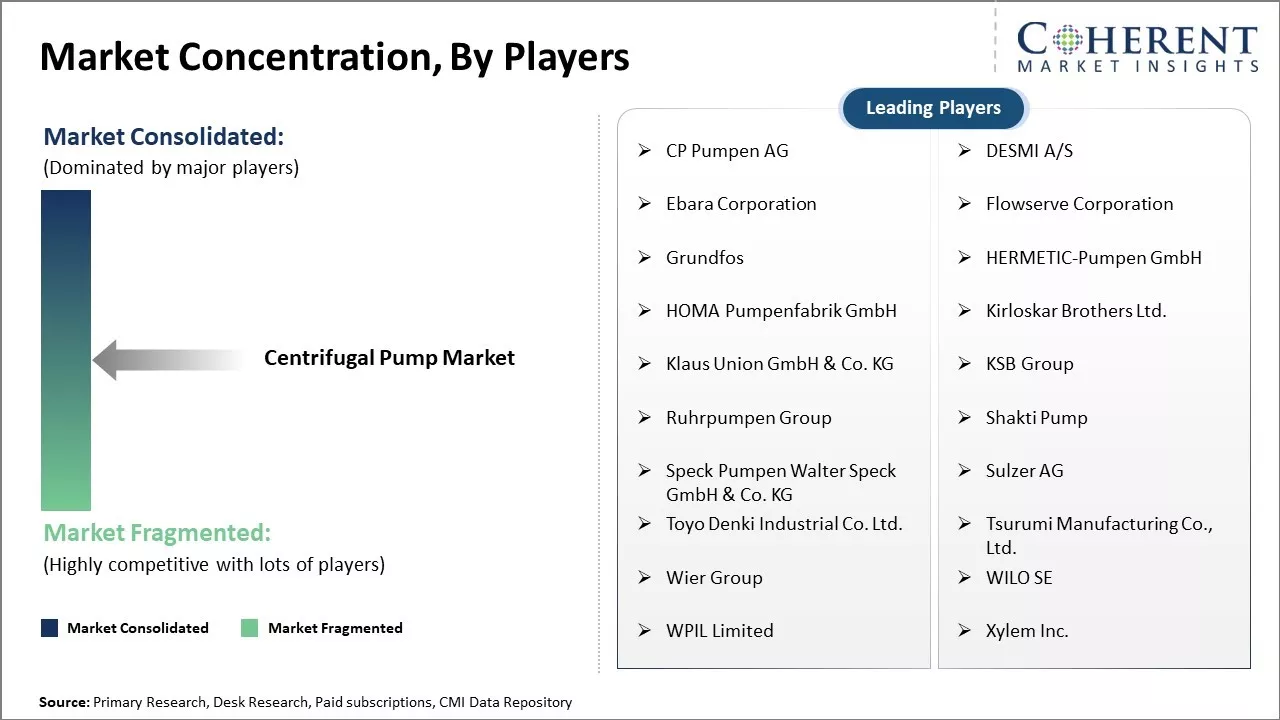
Market Concentration and Competitive Landscape
Market Driver
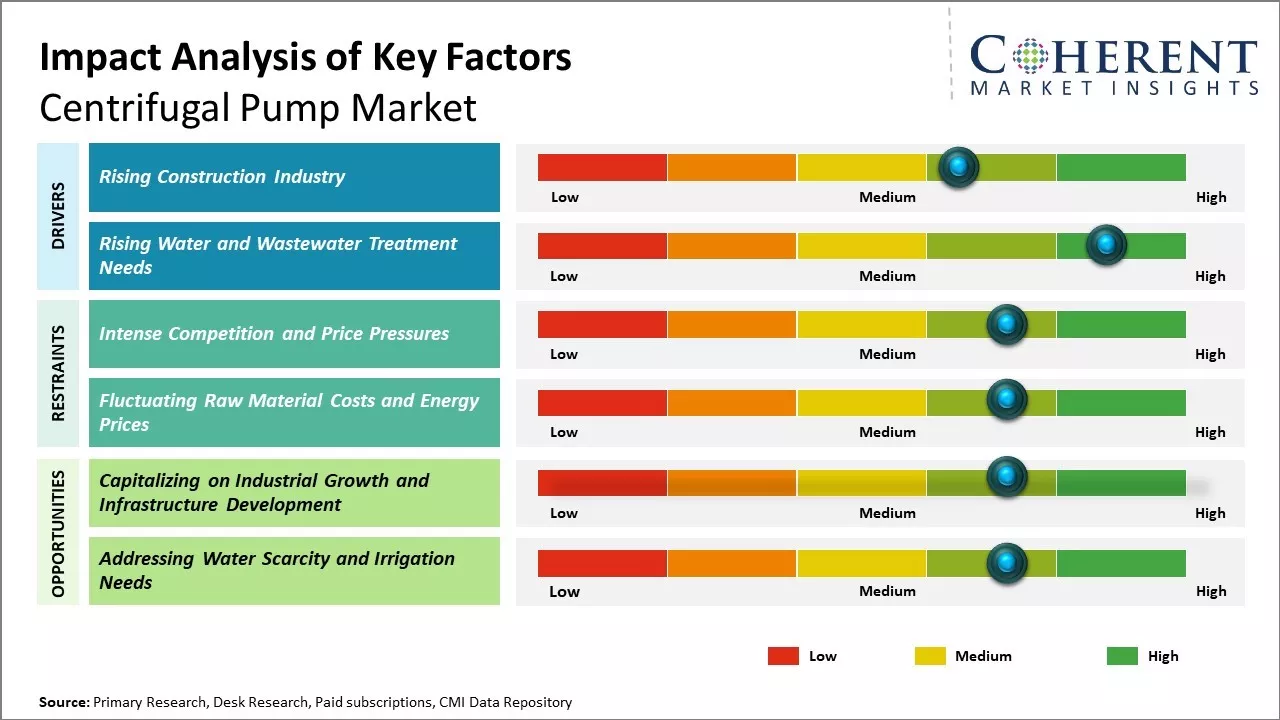
- Rising Construction Industry
The rising construction industry across the globe especially in emerging economies is fueling the demand for centrifugal pumps. As more construction projects are announced related to buildings, infrastructure development, etc., it creates a need for moving slurries, liquids, and transfer of various materials on construction sites.
Centrifugal pumps are ideal for such applications owing to their ability to handle large flows at moderate head conditions. Many economies in Asia Pacific, Latin America, Middle East, and Central Europe are undertaking massive housing construction as well as highways, metros, dams, and other civil engineering structures. This rise in construction activities provides steady opportunities for centrifugal pump manufacturers and distributors.
Countries like India, China, Indonesia, Brazil, Saudi Arabia, and Poland are spending billions of dollars in the construction of new urban infrastructure to accommodate rapid urbanization which boosts their infrastructure sector. New buildings, townships, ports require excavation, concrete casting, irrigation, sewage, and are core end-use areas for centrifugal pump consumption.
- Rising Water and Wastewater Treatment Needs
With growing populations worldwide, the demand for clean drinking water as well as the treatment of industrial and domestic wastewater has increased tremendously. Most cities and towns now require sophisticated water treatment and wastewater processing facilities to purify and recycle water. Centrifugal pumps play a critical role in moving water and wastewater through various treatment stages right from intake, screening, coagulation, and sedimentation to final disposal or recycling applications.
They are used for applications like raw water intake, sludge transfer, filtration, dosing of chemicals, and final effluent disposal. The need for reliable water management solutions has also grown due to acute water scarcity issues faced in many parts globally. Both developing and developed nations are investing heavily in construction of new water treatment plants as well as expanding and upgrading existing infrastructure.
This growing requirement for sustainable and efficient water treatment presents pumps manufacturers with significant opportunities. Centrifugal pumps, with their flexible design and high efficiency, address majority of the key requirements for water treatment projects.
Market Opportunities: Capitalizing on Industrial Growth and Infrastructure Development
The centrifugal pump market possesses several opportunities for growth. The industrial sector is steadily expanding in developing nations, driving the need for efficient pumping solutions across various process industries. The agriculture industry also offers prospects as sustainable irrigation becomes a priority. Furthermore, the integration of advanced technologies allows for smart pumps with remote monitoring.
Segmental Insights
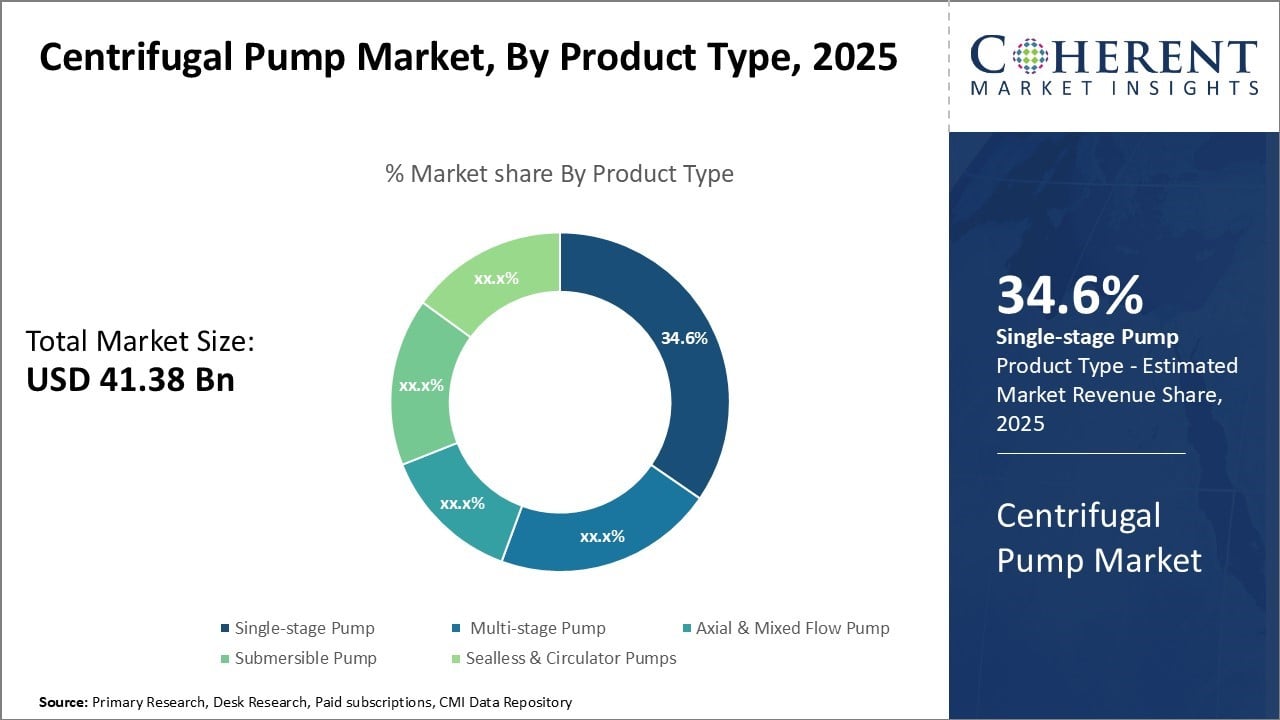
Centrifugal Pump Market Insights, By Product Type
In terms of product type, Single-stage pump is expected to contribute the highest share of 35.6% in 2026, owing to its cost effectiveness for various applications. Single-stage pumps provide a basic level of fluid movement for many residential, commercial and industrial purposes without complex multistage mechanisms. Their straightforward design with a single impeller chamber makes them extremely reliable and low maintenance.
Lack of stage barriers and seals helps reduce overall part counts, while large suction and discharge sizes streamline hydraulic characteristics. This simplistic and robust construction model allows single-stage pumps to achieve competitive price-points relative to their pumping functionality. Their cost effectiveness has made them a top choice for transferring water, raw materials, chemicals and various fluids where high heads or large flows are not critical operation parameters.
Affordable pricing also expands addressable markets and applications domains for single-stage pumps compared to other premium product lines. Their universality across a diverse range of industries like food & beverage, oil & gas, mining, power, water supply etc. has cemented single-stage pumps' leadership status in the overall centrifugal pump market.
.webp "Centrifugal Pump Market, By Capacity (Hp)")
Centrifugal Pump Market Insights, By Capacity (HP)
In terms of capacity (HP), small capacity pumps are expected to contribute the highest share of 44.50% in 2026, driven by increasing applications of small centrifugal pumps in commercial buildings. Pumps with horsepower ratings under 5 HP are widely used to circulate water for Heating, ventilation, and air conditioning (HVAC) systems, fountains, condensate removal, and other mechanical apparatus in facilities like malls, hotels, hospitals and office complexes. Their compact footprints and appreciable flow rates at lower energy consumption levels make small pumps highly suited for installations with limited space.
Additionally, precise variable speed control capabilities in modern small pumps help commercial building managers optimize energy efficiency of circulatory systems. Strict environmental regulations also favor the widespread deployment of low-power pumps. Their low initial and operational expenditures further boost the feasibility of water-related commercial applications. Therefore, steady growth of commercial real estate and building services industry acts as a macro driver for small capacity centrifugal pumps.
Centrifugal Pump Market, Insights, By End-use Industry
In terms of end-use industry, industrial segment is estimated to contribute the highest share of 49.81% in 2026, driven by the increasing reliance of process manufacturing on centrifugal pumps. Pumps are indispensable in many industrial verticals such as oil & gas, power generation, chemicals, pharmaceuticals, mining and pulp & paper for fluid transportation needs in manufacturing and ancillary processes.
Growth in the global manufacturing output, especially in emerging economies, has amplified the demand for centrifugal pumps suitable for corrosive, high-temperature, and abrasive applications in industries. Strict quality and performance standards for moving acids, bases, slurries, and viscous fluids within industrial facilities necessitate robust and durable industrial centrifugal pump designs. Their high efficiencies in bulk handling of fluids also ensure optimal resource usage.
Consequently, centrifugal pumps have emerged as lifelines for process industrialization worldwide. Sustained capital investments in plant expansions and new production facilities will continue stimulating the industrial centrifugal pumps market ahead relying on their process reliability.
Regional Insights
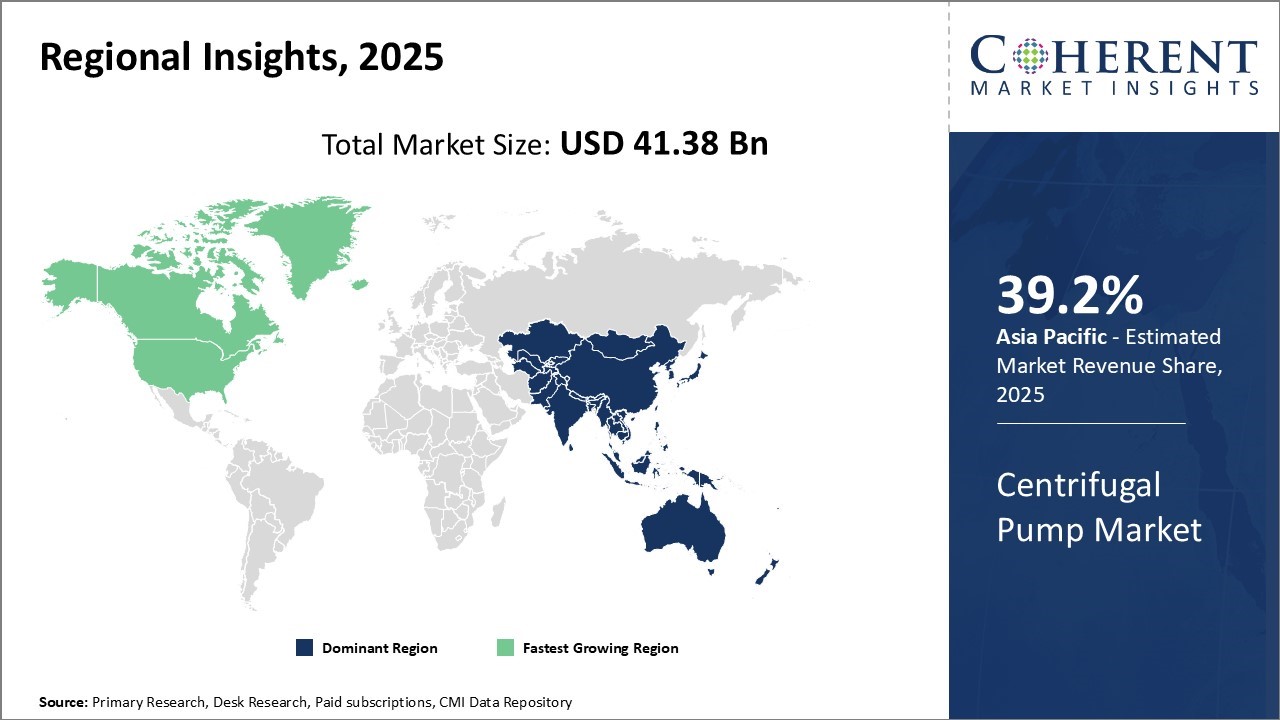
Asia Pacific Centrifugal Pump Market Analysis and Trends
Asia Pacific currently dominates the global centrifugal pump market and is expected to have a largest market share of 39.2% in 2026. Rapid industrialization and infrastructure development activities are driving the need for fluid transfer in major economies, such as China, India, Japan, and Southeast Asian, nations. China, in particular, has witnessed tremendous growth in the construction, energy and manufacturing space over the past decade.
This has greatly increased the consumption of centrifugal pumps for applications in thermal and hydro power plants, irrigation projects, sewage treatment facilities, and various process industries. At the same time, the availability of low-cost manufacturing options and expertise in pump assembly has enabled regional players to become formidable competitors in the export market as well.
However, the North American region is emerging as the fastest growing market for centrifugal pumps globally and is expected to grow with the CAGR of 8.21% in 2026. With a strong industrial manufacturing base across various sectors such as oil and gas, chemicals, power generation, mining, and construction, the demand for centrifugal pumps remains consistently high in the U.S. and Canada.
Major pump manufacturers have established their production and distribution facilities across the region to effectively cater to localized demand. Additionally, the presence of leading pump original equipment manufacturers Favors imports of high-end and customized pump models to complement domestic offerings.
Centrifugal Pump Market Dominating Countries
United States Centrifugal Pump Market Analysis and Trend
The United States leads the centrifugal pump market, fueled by high demand from the oil & gas, water treatment, and industrial sectors. Ongoing investments in infrastructure, shale gas development, and intelligent water management equipment provide the foundation for consistent market growth. American manufacturers are also at the forefront of adopting smart technologies and energy-efficient designs.
China Centrifugal Pump Market Analysis and Trend
China dominates the world centrifugal pump market in volume because of its huge industrial base, urbanization, and leadership in production. The expansion of the country's chemical processing, mining, and wastewater treatment keeps propelling demand higher. Efficient manufacturing and state-sponsored industrialization make China a centrifugal pump production hub.
Germany Centrifugal Pump Market Analysis and Trend
Germany possesses precision engineering as well as pump technology developments. It is a dominant player in the European centrifugal pumps market, exporting high-quality and energy-saving pumps to diverse industries such as automobiles, pharma, and wastewater. The German companies are also large R&D investors; hence they are at the vanguard of smart pump systems.
India Centrifugal Pump Market Analysis and Trend
India's centrifugal pump industry is growing at a high rate driven by expanding agricultural mechanization, rural electrification, and infrastructure development. The government initiative for irrigation development and modernization of water supply is also supporting demand growth. Local manufacturers are also becoming competitive with low-cost manufacturing and product customization.
Market Report Scope
Centrifugal Pump Market Report Coverage
| Report Coverage | Details | ||
|---|---|---|---|
| Base Year: | 2025 | Market Size in 2026: | USD 43.86 Bn |
| Historical Data for: | 2020 To 2024 | Forecast Period: | 2026 To 2033 |
| Forecast Period 2026 to 2033 CAGR: | 6.0% | 2033 Value Projection: | USD 65.95 Bn |
| Geographies covered: |
| ||
| Segments covered: |
| ||
| Companies covered: | CP Pumpen AG, DESMI A/S, Ebara Corporation, Flowserve Corporation, Grundfos, HERMETIC-Pumpen GmbH, HOMA Pumpenfabrik GmbH, Kirloskar Brothers Ltd., Klaus Union GmbH & Co. KG, KSB Group, Ruhrpumpen Group, Shakti Pump, Speck Pumpen Walter Speck GmbH & Co. KG, Sulzer AG, Toyo Denki Industrial Co. Ltd., Tsurumi Manufacturing Co., Ltd., Wier Group, WILO SE, WPIL Limited, and Xylem Inc. | ||
| Growth Drivers: |
| ||
| Restraints & Challenges: |
| ||
Centrifugal Pump Industry News
- In March 2025, Xi’an Keshang Pump Co., Ltd. received the Green Innovation Award at the China Chlor-Alkali Industry Innovation Conference for its high-efficiency centrifugal pumps used in chlor-alkali chemical processing. The pumps were recognized for reducing energy use and emissions.
- In February 2024, DESMI, a leading Danish pump manufacturer, launched a new range of magnetic-drive centrifugal pumps specifically designed for the chemical and pharmaceutical industries. These pumps are seal-less, minimizing leak risks and ensuring safe handling of corrosive or hazardous fluids.
Analyst View
- The centrifugal pump industry showcases strong fundamentals fueled by increased industrial activity and infrastructure growth in the emerging economies. Oil and gas exploration, chemical processing industries, and water treatment plants are major demand drivers, especially with the tightening environmental regulations worldwide. Increased focus on efficiency in energy utilization has spurred usage of newer pump technologies, such as variable frequency drives and intelligent monitoring systems.
- Industrial automation trends offer great opportunities, with IoT-equipped pumps providing predictive maintenance and optimized operations. The renewable energy sector, particularly solar-driven pumping systems for agriculture, is an up-and-coming growth opportunity. Also, the movement towards sustainable water management practices in developing countries offers great market opportunity.
- Nevertheless, the market is hindered by high initial capital outlays and maintenance charges, especially discouraging small-scale users. Unpredictability of raw material prices, notably steel and cast iron, still puts a squeeze on manufacturer margins. Technical sophistication in pump selection and installation frequently calls for specialized knowledge, thereby constraining market penetration in price-sensitive segments.
- Asia-Pacific is the leading regional market, fueled by industrial growth in China and India, combined with huge infrastructure schemes. It enjoys manufacturing cost benefits and increasing domestic demand from a range of sectors. North America and Europe experience sustained demand, led mainly by replacement cycles and technological improvement. The Middle East and Africa offer good prospects, especially in water infrastructure and oil drilling operations, setting these regions for sustained growth.
Market Segmentation
- Product Type Insights (Revenue, USD Bn, 2021 - 2033)
- Single-stage Pump
- Multi-stage Pump
- Axial & Mixed Flow Pump
- Submersible Pump
- Sealless & Circulator Pumps.
- Capacity (HP) Insights (Revenue, USD Bn, 2021 - 2033)
- Small
- Medium
- High
- End-use Industry Insights (Revenue, USD Bn, 2021 - 2033)
- Industrial
- Chemicals
- Water & Wastewater Treatment
- Power
- Oil & Gas
- Pharmaceuticals
- Food & Beverages
- Others
- Agricultural
- Domestic
- Regional Insights (Revenue, USD Bn, 2021 - 2033)
- North America
- U.S.
- Canada
- Latin America
- Brazil
- Argentina
- Mexico
- Rest of Latin America
- Europe
- Germany
- U.K.
- Spain
- France
- Italy
- Russia
- Rest of Europe
- Asia Pacific
- China
- India
- Japan
- Australia
- South Korea
- ASEAN
- Rest of Asia Pacific
- Middle East & Africa
- GCC Countries
- South Africa
- Israel
- Rest of Middle East & Africa
- Key Players Insights
- CP Pumpen AG
- DESMI A/S
- Ebara Corporation
- Flowserve Corporation
- Grundfos
- HERMETIC-Pumpen GmbH
- HOMA Pumpenfabrik GmbH
- Kirloskar Brothers Ltd.
- Klaus Union GmbH & Co. KG
- KSB Group
- Ruhrpumpen Group
- Shakti Pump
- Speck Pumpen Walter Speck GmbH & Co. KG
- Sulzer AG
- Toyo Denki Industrial Co. Ltd.
- Tsurumi Manufacturing Co., Ltd.
- Wier Group
- WILO SE
- WPIL Limited
- Xylem Inc.
Sources
Primary Research Interviews
- Centrifugal pump manufacturers and suppliers
- Industrial equipment distributors and dealers
- Enduser industries (oil & gas, water treatment, chemical processing)
- Engineering consultants and system integrators
- Others
Databases
- Global Trade Atlas
- Euromonitor International
- IBISWorld Industry Reports
- Others
Magazines
- Pumps & Systems Magazine
- World Pumps
- Flow Control Magazine
- Chemical Engineering Magazine
- Others
Journals
- Journal of Fluids Engineering
- International Journal of Rotating Machinery
- Proceedings of the Institution of Mechanical Engineers
- Others
Newspapers
- Financial Times
- The Wall Street Journal
- Reuters Business News
- Bloomberg Industrial News
- Others
Associations
- Hydraulic Institute (HI)
- American Society of Mechanical Engineers (ASME)
- International Pump Manufacturers Association (IPMA)
- European Association of Pump Manufacturers (Europump)
- Others
Public Domain Sources
- U.S. Census Bureau Manufacturing Statistics
- European Commission Industry Reports
- International Trade Centre (ITC) Market Analysis
- National Institute of Standards and Technology (NIST)
- Others
Proprietary Elements
- CMI Data Analytics Tool
- Proprietary CMI Existing Repository of information for last 8 years
*Definition: The centrifugal pump market consists of companies that manufacture and sell centrifugal pumps used to move liquids by means of centrifugal force. Centrifugal pumps work by using the rotational energy from an impeller to increase the velocity of a fluid and generate pressure through centrifugal force. They are commonly used for industrial purposes like transporting water, sewage, slurries, and particulate slurries. The centrifugal pump market sees demand from various end-use industries like oil & gas, chemical, and construction.
Get access to 250+ pages report
Every segment, forecast, competitor profile and data table behind the analysis above — available for instant download.
- ESOMAR Member
- ISO 9001:2015 Certified
- D-U-N-S Registered
- GDPR & CCPA Compliant
Missing comfort of reading report in your local language? Find your preferred language:
Transform your Strategy with Exclusive Trending Reports
Frequently Asked Questions
The Centrifugal Pump Market size is estimated to be valued at USD 43.86 Bn in 2026, and is expected to reach USD 65.95 Bn by 2033.
The CAGR of the global Market is projected to be 6.0% from 2026 to 2033.
Rising construction industry and rising water and wastewater treatment needs are the major factors driving the growth of the global market.
Intense competition and price pressures and fluctuating raw material costs and energy prices are the major factors hampering the growth of the centrifugal pump market.
In terms of product type, single-stage pump is estimated to dominate the market revenue share in 2026.
CP Pumpen AG, DESMI A/S, Ebara Corporation, Flowserve Corporation, Grundfos, HERMETIC-Pumpen GmbH, HOMA Pumpenfabrik GmbH, Kirloskar Brothers Ltd., Klaus Union GmbH & Co. KG, KSB Group, Ruhrpumpen Group, Shakti Pump, Speck Pumpen Walter Speck GmbH & Co. KG, are the major players operating in the market.
Asia Pacific is expected to lead the centrifugal pump industry.