

Chloroacetic Acid Market Analysis & Forecast 2026-2033
The global chloroacetic acid market was valued at USD 2,307 Mn in 2026 and is forecast to reach a value of USD 3,384.9 Mn by 2033 at a CAGR of 6.47% between 2026 and 2033.
Key Takeaways
- Based on Product Type, the monochloroacetic acid segment is expected to hold 77.3% share of the market in 2026.
- Based on Region, Asia Pacific is set to lead the chloroacetic acid market with 45% share in 2026. While, North America is anticipated to be the fastest growing region.
Market Overview
Chloroacetic acid is a specialty organochlorine compound and a building block in organic synthesis. Hence, it is used in the production of various chemical compounds, agrochemicals, dyes, and drugs. Chloroacetic acid is used to prepare or produce industrial chemicals and is used as a thickening agent or chemical intermediate in carboxymethylcellulose (CMC) and carboxymethyl starch. It also produces thioglycolic acid and glycine, which is a major precursor to the production of glyphosate.
Current Events and Its Impacts on the Chloroacetic Acid Market
Current Event | Description and its Impact |
Pharmaceutical and Agrochemical Sector Growth Dynamics |
|
European Green Deal and Chemical Strategy Implementation |
|
How is global chloroacetic acid production structured across processes, purity grades, applications, and regions?
Category | Latest Data | Notes |
By Manufacturing Process | Chlorination of acetic acid → ~82% of global output | Dominant, cost-efficient, scalable |
Hydrolysis of trichloroethylene → ~13% | Niche, used for specialty production | |
Other minor routes → ~5% | Limited industrial relevance | |
By Purity Grade | Technical grade → ~70% | Bulk use in herbicides and surfactants |
High-purity grade → ~25% | Growing demand in pharmaceuticals | |
Laboratory grade → ~5% | Small but steady demand for research | |
By Application Sector | Agrochemicals → ~60% | Glyphosate precursor is the largest driver |
Surfactants & detergents → ~20% | Used in cleansing and industrial formulations | |
Pharmaceuticals → ~15% | Intermediates for drugs and APIs | |
Miscellaneous → ~5% | Dyes, adhesives, cosmetics | |
By Regional Production | Asia-Pacific → ~65% | China and India lead global output |
Europe → ~20% | Specialty and high-purity production | |
North America → ~15% | Balanced demand across sectors |
- Current Industry Events of 2026
- Market Size Estimation
- Regional Breakdown
- Competitive Landscape
- Customer Intelligence
- Segmental Analysis
- Pricing Analysis
- Key Market Drivers, Challenges & Future Trends
- Customized Insights Section
Segmental Insights
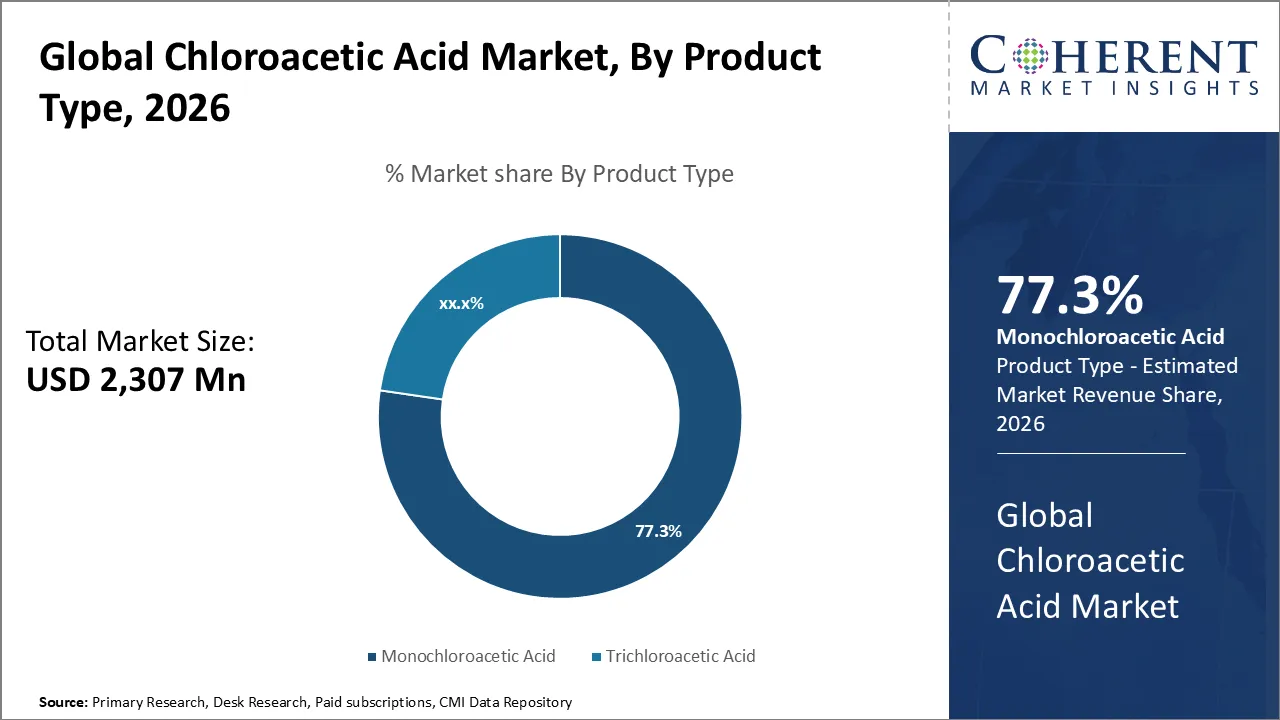
Chloroacetic Acid Market Insights, By Product Type: Monochloroacetic Acid dominates due to its vital agrochemical and industrial applications
In terms of product type, the monochloroacetic acid segment is expected to hold 77.3% share of the market in 2026. It is the most popular chemical in the world as it is widely used in agrochemicals like 2,4-D herbicides, as well as in thioglycolic acid, carboxymethylcellulose, and other intermediates.
For instance, in February 2026, Nouryon's use of bio-based biodegradable carboxymethylcellulose in laundry detergents is closely related to Monochloroacetic Acid, which is a key raw material for making it. This new idea shows the significance MCA is in the chloroacetic acid market. It shows that there is a growing need for environmentally friendly solutions and strengthens MCA's position as the leader in industrial and consumer applications around the world.
Regional Insights
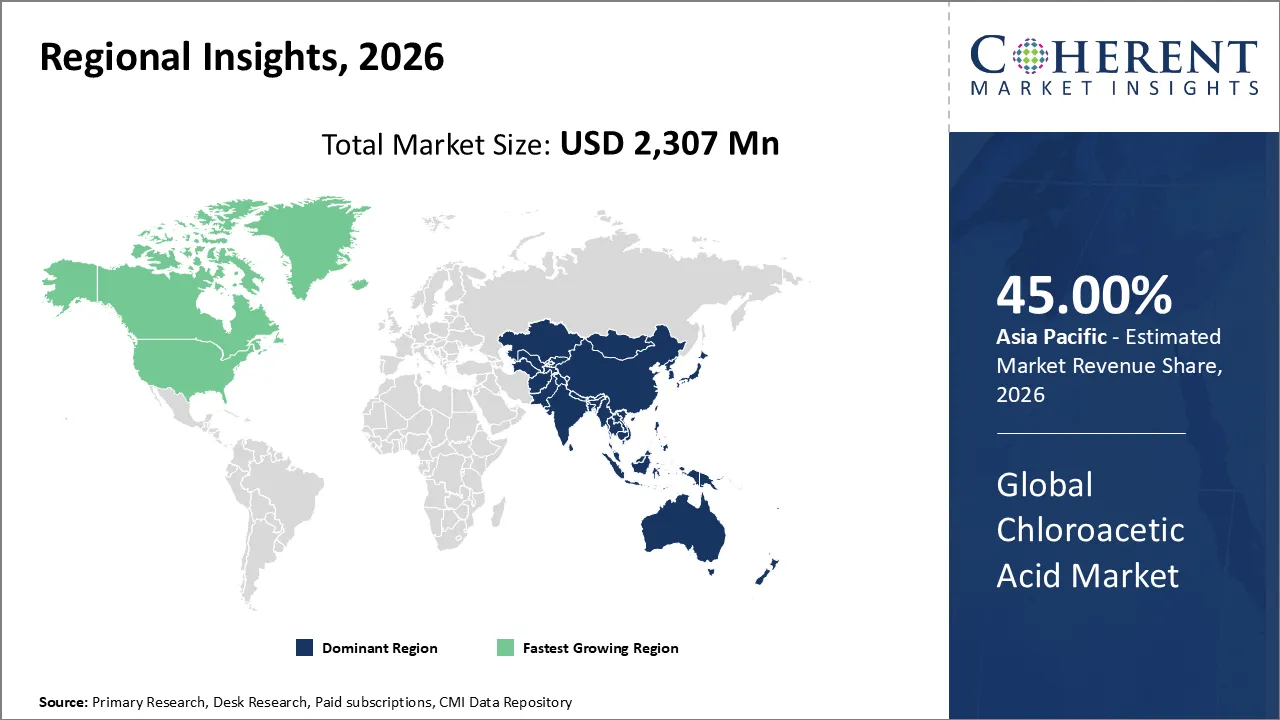
Asia Pacific Chloroacetic Acid Market Analysis & Trends
Asia Pacific is expected to dominate the chloroacetic acid market with 45% share in 2026, driven by China, India, and other emerging economies with significant chemical manufacturing capacity. Strong growth in agrochemicals, pharmaceuticals, textiles, and cosmetics ensures rising demand, making Asia-Pacific the hub of chloroacetic acid market expansion in 2026.
North America Chloroacetic Acid Market Analysis & Trends
North America is expected to exhibit the fastest growth, owing to there is strong demand for pharmaceuticals and specialty chemicals. Chloroacetic acid is needed by the region's advanced healthcare sector to make drug intermediates, and industrial uses in adhesives, surfactants, and CMC support its use. Regulatory focus on quality and innovation guarantees steady growth, which makes North America's market even more important.
For instance, in January 2026, the Canada Gazette notice exhibits new rules for drinking water that include monochloroacetic acid and other haloacetic acids (HAAs). It sets a maximum acceptable concentration of 0.08 mg/L for six HAAs combined. This is meant to lower the health risks from disinfection by-products and make public health protections stronger by making water quality standards stricter.
Chloroacetic Acid Market Outlook Country-Wise
China Chloroacetic Acid Market Trends
China's chloroacetic acid market remains highly competitive in 2026 because it has strong chemical manufacturing capacity and strong end-use sectors. The agrochemical, pharmaceutical, textile, and personal care industries are all growing quickly as the population growth and industrialization. Due to these things, China is the world's largest producer and consumer of chloroacetic acid.
The U.S. Chloroacetic Acid Market Trends
The U.S. chloroacetic acid market is strong in 2026 because there is strong of demand for it in pharmaceuticals, personal care, and specialty chemicals. It is a key ingredient in making drugs, cosmetics, and industrial products, and its high consumption levels across the country are supported by advanced research and development and a strong chemical industry.
Market Report Scope
Chloroacetic Acid Market Report Coverage
| Report Coverage | Details | ||
|---|---|---|---|
| Base Year: | 2025 | Market Size in 2026: | USD 2,307 Mn |
| Historical Data for: | 2020 To 2024 | Forecast Period: | 2026 To 2033 |
| Forecast Period 2026 to 2033 CAGR: | 6.47% | 2033 Value Projection: | USD 3,384.9 Mn |
| Geographies covered: |
| ||
| Segments covered: |
| ||
| Companies covered: | CABB GmbH, Arkema Group, Daicel Corporation, Niacet Corporation, and Akzo Nobel N.V. | ||
| Growth Drivers: |
| ||
| Restraints & Challenges: |
| ||
Chloroacetic Acid Market Driver
Growing demand in agrochemicals
Chloroacetic acid is a vital component of making herbicides, especially glyphosate, which is one of the most widely used chemicals for protecting crops in the world. As the world's population grows, the demand for food is rising, which puts pressure on farmers to get the most out of their crops and keep weeds away from them. This trend directly drives the Chloroacetic Acid Market growth, as agrochemical companies are using more and more chloroacetic acid to meet the growing needs of farmers around the world.
Expansion in pharmaceuticals
Chloroacetic acid has great significance to the pharmaceutical industry considering that it is used to make active pharmaceutical ingredients and intermediates that go into many medicines. The use of chloroacetic acid continues to progress up as healthcare costs are rising around the world and the need for new drugs grows. It is essential because it can make antibiotics, painkillers, and other medicines. The rise in pharmaceutical production is driving chloroacetic acid market demand, reinforcing its important as a key chemical in the healthcare supply chain.
Chloroacetic Acid Market Opportunity
Textiles & Personal Care
The textile and personal care industries are increasingly relying on chloroacetic acid derivatives for producing dyes, pigments, surfactants, and thickening agents. With the fashion boom in Asia-Pacific and the global expansion of the beauty industry, demand for high-quality fabrics and cosmetic formulations is surging. This trend creates significant opportunities for chemical manufacturers to scale production and innovate. As these sectors continue to grow, the Chloroacetic Acid Market forecast points to steady expansion driven by lifestyle changes and rising consumer spending.
Analyst Opinion (Expert Opinion)
The chloroacetic acid market continues to be an essential component of the specialty chemicals industry as it is used as a chemical intermediate in many different fields. The majority of the demand is for monochloroacetic acid (MCA), which is also important for making carboxymethyl cellulose (CMC), a thickener, stabilizer, and binder that is used in food processing, pharmaceuticals, oilfield fluids, detergents, and paper making. This wide range of uses supports steady demand for chemicals in both developed and developing markets.
Agrochemical production is a major area of consumption. Chloroacetic acid derivatives are used to make herbicides and pesticides that are essential for protecting crops and increasing agricultural productivity. Chloroacetic acid is also used in the pharmaceutical industry to make active pharmaceutical intermediates that are used in many drugs. This increases demand from the healthcare sector.
Sustainability and regulations are shifting production practices. Manufacturers are increasingly investing into greener processes and technologies that lower emissions as they are worried about the safety and environmental effects of handling chloroacetic acid.
Overall, the chloroacetic acid industry is characterized by a variety of factors that drive demand, new material technologies, and differences in regional markets. All of these things help the industry grow steadily over the long term.
Speak to the analyst
Want personalized insights?
Take the findings above to one of our principal consultants, or have the report rebuilt around the segments, geographies and competitors you actually track.
Recent Developments
- In April 2025, Feldbinder has introduced the BTAN 57 titanium tank car, which is made to carry molten monochloroacetic acid (MCA). Compared to enamel-coated cars, the lighter titanium construction makes the car 40% lighter and 30% expand. CABB testing went well, and by the end of the year, 15 units should be up and running.
Market Segmentation
- By Product Type
- Monochloroacetic Acid
- Thioglycolic Acid
- Carboxymethylcellulose
- 2-4 dichlorophenoxyacetic Acid & Salts
- Others
- Trichloroacetic Acid
- Cosmetics
- Pharmaceuticals
- Agriculture
- Others
- Monochloroacetic Acid
- By Region
- North America
- U.S.
- Canada
- Latin America
- Brazil
- Argentina
- Mexico
- Rest of Latin America
- Europe
- Germany
- U.K.
- Spain
- France
- Italy
- Russia
- Rest of Europe
- Asia Pacific
- China
- India
- Japan
- Australia
- South Korea
- ASEAN
- Rest of Asia Pacific
- Middle East & Africa
- GCC Countries
- Israel
- Rest of Middle East & Africa
- North America
- Key Players
- CABB GmbH
- Arkema Group
- Daicel Corporation
- Niacet Corporation
- Akzo Nobel N.V.
Sources
Primary Research Interviews
- Chloroacetic Acid Manufacturers
- Monochloroacetic Acid (MCA) Producers
- Agrochemical Formulation Companies
- Carboxymethyl Cellulose (CMC) Manufacturers
- Surfactant & Detergent Manufacturers
- Chemical Distributors & Traders
- Downstream Pharmaceutical & Personal Care Product Manufacturers
- Others
Databases
- Bloomberg Terminal
- Thomson Reuters Eiko
- Trade Map (ITC)
- Others
Magazines
- Chemical Week
- ICIS Chemical Business
- Chemical Engineering Magazine
- Agrochemicals & Fertilizers Magazine
- Speciality Chemicals Magazine
- Others
Journals
- Journal of Applied Polymer Science
- Industrial & Engineering Chemistry Research
- Journal of Surfactants and Detergents
- Journal of Agricultural and Food Chemistry
- Chemical Engineering Journal
- Others
Newspapers
- Financial Times
- The Wall Street Journal
- Reuters
- Bloomberg News
- The Economic Times
- Others
Associations
- American Chemistry Council (ACC)
- European Chemical Industry Council (Cefic)
- International Council of Chemical Associations (ICCA)
- Indian Chemical Council (ICC)
- China Petroleum and Chemical Industry Federation (CPCIF)
- Others
Public Domain Sources
- U.S. Environmental Protection Agency (EPA)
- European Chemicals Agency (ECHA)
- United Nations Comtrade Database
- World Bank Open Data
- Organisation for Economic Co-operation and Development (OECD)
- Others
Proprietary Elements
- CMI Data Analytics Tool
- Proprietary CMI Existing Repository of Information for the Last 8 Years
Get access to 250+ pages report
Every segment, forecast, competitor profile and data table behind the analysis above — available for instant download.
- ESOMAR Member
- ISO 9001:2015 Certified
- D-U-N-S Registered
- GDPR & CCPA Compliant
Missing comfort of reading report in your local language? Find your preferred language:
Transform your Strategy with Exclusive Trending Reports
Frequently Asked Questions
The global chloroacetic acid market size was valued at USD 2,307 Mn in 2026 and is expected to reach USD 3,384.9 Mn in 2033.
Growing demand in agrochemicals and expansion in pharmaceuticals are major factors that is expected to propel the growth of the market over the forecast period
Increasing use of chloroacetic acid in herbicides and laundry agents are two other significant application segments that are some of the main trends in the market.
Environmental & health regulations is a major factor restraining the growth of the market.
Major players operating in the market include CABB GmbH, Arkema Group, Daicel Corporation, Niacet Corporation, and Akzo Nobel N.V.
The market is estimated to grow at around 6.47% CAGR during the forecast period.