

Polyvinyl Chloride (PVC) Market Analysis & Forecast: 2026-2033
Polyvinyl Chloride (PVC) Market is estimated to be valued at USD 64.82 Bn in 2026 and is expected to reach USD 85.30 Bn in 2033, exhibiting a compound annual growth rate (CAGR) of 4.0% from 2026 to 2033.
Key Takeaways
- By Product Type, the Calcium-based Stabilizers (Ca-Zn Stabilizers) segment is projected to dominate the global PVC stabilizers market with 52% shares in 2026.
- By Region, Asia Pacific is expected to lead the global Polyvinyl Chloride (PVC) market in 2026, capturing a commanding 69% share.
- North America is projected to witness steady growth in the global PVC market over the forecast period, accounting for a 12% market share.
- Europe maintains a substantial 12% share in the global PVC market in 2026.
Market Overview
The PVC Market is anticipated to expand at a considerable CAGR. This is supported by the increasing construction and automobile industry. On the other hand, the environmental and health concerns associated with the production, use, and disposal of PVC may restrict the growth of the market. In any case, rising Production of healthcare goods as well as the electronics industry is expected to create some growth opportunities for the market. Medical grade PVC is increasingly in demand because of features such as abrasion resistance, low weight, and considerable durability.
Current Events and Its Impact on the PVC Market
Event | Description and Impact |
China’s Economic Slowdown and Real Estate Crisis |
|
European Energy Crisis and Natural Gas Supply Disruptions |
|
Global Supply Chain Disruptions and Raw Material Shortages |
|
Pricing Analysis
The global PVC market, valued at around $65 billion in 2023, features a tiered pricing structure shaped by raw material costs, application-specific requirements, and regional supply-demand dynamics. Prices vary significantly across rigid (RPVC) and flexible (FPVC) grades, with commodity-grade RPVC priced between $800–1,200/MT and high-performance RPVC reaching up to $2,500/MT. Flexible PVC used in medical and food-grade applications commands premium pricing, ranging from $1,500–3,500/MT.
In construction, PVC pipes from major brands like Charlotte Pipe and Wavin range from $3.50 to $12.30 per linear foot/meter, depending on size and pressure rating. Window and door profiles vary widely, with premium systems from VEKA and Rehau priced between $12.80–45.20 per linear meter/foot.
In automotive applications, interior-grade PVC ranges from $2.15–7.80 per square foot, while healthcare uses see prices above $2,000/MT for medical-grade formulations. Regional pricing reflects differences in energy costs, labor, and local market dynamics, with Asia-Pacific offering the most competitive prices due to high-volume production and lower input costs.
- Current Industry Events of 2026
- Market Size Estimation
- Regional Breakdown
- Competitive Landscape
- Customer Intelligence
- Segmental Analysis
- Pricing Analysis
- Key Market Drivers, Challenges & Future Trends
- Customized Insights Section
Role of Technologies like AI in the Polyvinyl Chloride (PVC) Market
Artificial Intelligence (AI) is becoming a transformative contributor to the polyvinyl chloride (PVC) industry, accelerating efficiency and innovation. Polyvinyl chloride (PVC) with its versatility, durability, and affordability is widely used across construction, automotive, medical, and consumer goods sectors. As demand rises, AI technologies are playing a critical role in optimizing operations and enhancing product quality.
AI-powered systems are now embedded in manufacturing facilities to monitor real-time production variables like temperature and pressure. For example, Westlake Chemical has deployed AI to streamline polymerization processes, improving yield and consistency while reducing waste. These efficiencies not only cut costs but also reduce environmental impact.
Computer vision and machine learning are also revolutionizing quality control. Shin-Etsu Chemical uses AI to detect micro-defects in resin particles—boosting quality assurance and minimizing customer complaints. Meanwhile, companies like Formosa Plastics have implemented AI-driven formulation tools that customize PVC compounds based on client needs, shortening development cycles and improving performance.
Overall, AI integration is positioning itself as a key driver of smarter manufacturing and innovation, reinforcing the market leadership of polyvinyl chloride (PVC) with its versatility, polyvinyl chloride (PVC) with its durability, and polyvinyl chloride (PVC) with its affordability in a data-driven world.
Segmental Insights
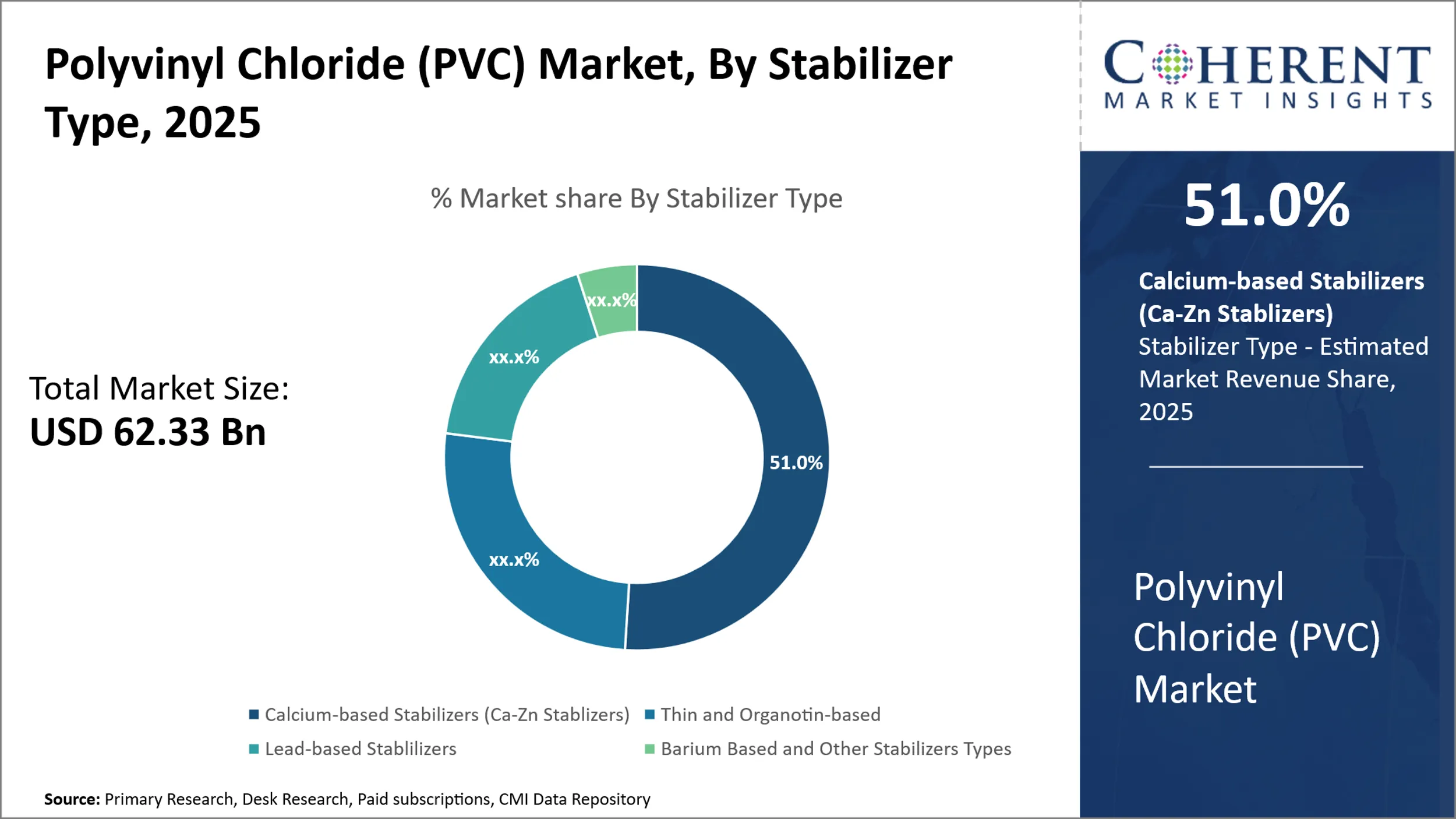
Global PVC Stabilizers Market Insights, By Stabilizer Type
By Stabilizer type, the Calcium-based Stabilizers (Ca-Zn Stabilizers) segment is anticipated to lead the global PVC stabilizers market, accounting for the largest share of 52%. This dominance is largely driven by the increasing shift toward environmentally friendly and non-toxic stabilizing solutions, especially in applications involving food packaging, medical devices, and children’s products.
Calcium-based stabilizers offer excellent thermal stability, processing performance, and weather resistance without the health and environmental risks associated with lead-based alternatives. As regulatory frameworks continue to tighten around heavy metal usage, the adoption of Ca-Zn stabilizers is expected to further accelerate.
The Tin and Organotin-based (Sn Stabilizers) segment holds the second-largest share at 26% and is widely used in rigid PVC applications, including pipes and profiles, due to its high transparency and excellent heat resistance. These stabilizers are particularly prevalent in regions with well-established industrial standards and manufacturing capabilities.
The Lead-based Stabilizers segment, despite its historical dominance, now represents 17% of the market and continues to decline in usage due to increasing environmental concerns and restrictions across various countries. However, it still finds application in some developing markets where cost considerations and legacy systems prevail.
The Barium-based and Other Stabilizer Types (Liquid Mixed Metals) segment accounts for the remaining 5% and is primarily used in flexible PVC products. Though niche, these stabilizers are valued for their unique performance characteristics in specialized applications and may see selective growth where alternative materials are less effective.
Regional Insights
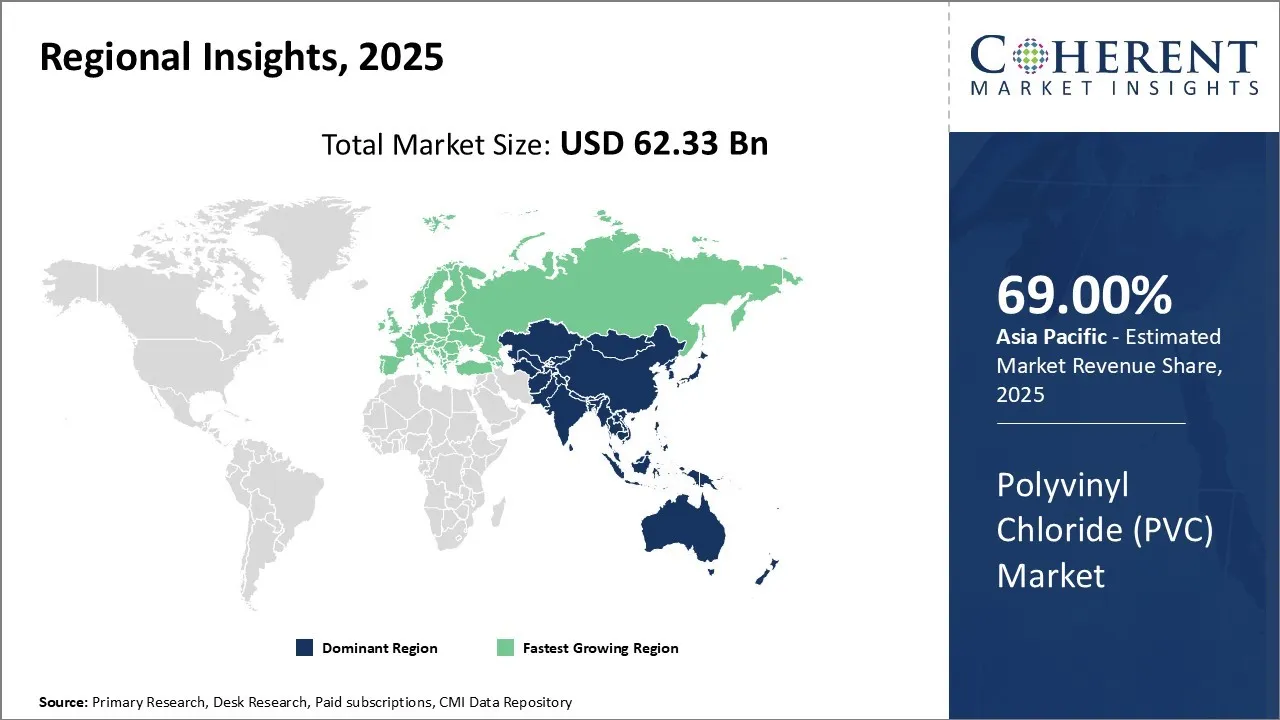
Asia Pacific PVC Market Analysis and Trends
Asia Pacific is expected to dominate the global polyvinyl chloride (PVC) market with 69.00% in 2026, backed by strong industrial output, rapid urbanization, and robust infrastructure development across the region. High demand for PVC from sectors such as construction, automotive, consumer electronics, and packaging continues to strengthen the market. China, in particular, is a major driver of regional dominance, with its expansive electronics manufacturing base and aggressive infrastructure rollout. The rise in demand for smartphones, OLED TVs, and smart devices has led to increased consumption of PVC in electronics and appliance applications.
Furthermore, favorable government policies, expanding urban populations, and increased foreign investment in industrial sectors are expected to accelerate PVC adoption. This strong growth outlook places Asia Pacific at the forefront of the global PVC landscape.
North America PVC Market Analysis and Trends
North America is projected to witness steady growth in the global PVC market over the forecast period with 12% market share, primarily driven by the recovery of the construction sector and increased consumer spending on durable goods. The region's well-established residential and commercial infrastructure sector is driving demand for PVC in applications such as piping systems, siding, window frames, and insulation materials.
Additionally, the electronics and automotive sectors are experiencing renewed activity, further supporting PVC usage in cable insulation, dashboards, and interior components. Innovation in sustainable and recycled PVC products, alongside strong regulatory support for green building materials, is expected to bolster market expansion across the U.S. and Canada.
Europe PVC Market Analysis and Trends
Europe maintains a substantial share of 12% in the global PVC market, with growth expected to remain moderate due to economic stabilization and regulatory challenges. The region's emphasis on sustainability and circular economy principles is influencing a shift toward bio-based and recycled PVC products. Key industries including automotive, packaging, and healthcare continue to use PVC due to its versatility and cost-efficiency.
Countries like Germany, France, and the UK are investing in renovation and energy-efficient construction projects, supporting stable PVC demand. Despite challenges such as rising energy costs and stricter environmental regulations, Europe’s focus on innovation in high-performance and eco-friendly PVC products positions the region for sustained long-term growth.
Dominating Countries in the Global PVC Market
China PVC Market Analysis and Trends
China leads the global PVC market, supported by massive demand across construction, electronics, and manufacturing industries. As the world’s largest electronics producer, China’s need for PVC in cables, connectors, and insulation materials remains high.
Its strong construction pipeline and government-led urban development projects further accelerate PVC consumption. In addition, China’s expanding export base and cost-effective production capabilities solidify its global leadership.
India PVC Market Analysis and Trends
India is emerging as a major player in the global PVC market, driven by rapid industrialization and infrastructure development. Government initiatives such as "Smart Cities Mission" and "Housing for All" are spurring demand for PVC pipes, doors, windows, and insulation materials. The country's increasing focus on domestic manufacturing and sanitation infrastructure also contributes to the growing PVC footprint, making India a key growth engine in Asia Pacific.
United States PVC Market Analysis and Trends
The United States commands a significant share of the North American PVC market, supported by widespread use in residential construction, infrastructure modernization, and consumer products. PVC’s low cost, durability, and energy efficiency make it a preferred material in water piping, window frames, and insulation. Additionally, advancements in PVC recycling and sustainable formulation technologies align with national energy goals, reinforcing long-term demand.
Market Report Scope
Polyvinyl Chloride (PVC) Market Report Coverage
| Report Coverage | Details | ||
|---|---|---|---|
| Base Year: | 2025 | Market Size in 2026: | USD 64.82 Bn |
| Historical Data for: | 2020 To 2024 | Forecast Period: | 2026 To 2033 |
| Forecast Period 2026 to 2033 CAGR: | 4.0% | 2033 Value Projection: | USD 85.30 Bn |
| Geographies covered: |
| ||
| Segments covered: |
| ||
| Companies covered: | ChemChina, Formosa Plastics Corporation, Ineos, Inner Mongolia Junzheng Energy & Chemical Group, Kem One, LG Chem, Occidental Petroleum Corporation, Orbia, SABIC, Shaanxi Coal and Chemical Industry Group Co. Ltd, Shin-Etsu Chemical Co. Ltd, Xinjiang Tianye (Group) Co. Ltd, Westlake Chemical Corporation, and Xinjiang Zhongtai Chemicals | ||
| Growth Drivers: |
| ||
| Restraints & Challenges: |
| ||
Global Polyvinyl Chloride (PVC) Market Drivers
- Growing demand from healthcare and medical devices industry to propel market growth
The demand for medical grade PVC is expected to grow globally. The increasing prevalence of chronic diseases is catalyzing the demand for healthcare products, including blood and plasma transfusion sets, catheters and cannula, and containers for intravenous solutions sets. Moreover, the global call for medical equipment and surgical instruments is propelling the demand for PVC.
- Growing demand from construction sector to fuel market growth
Demand for the construction industry is a significant driver factor for the PVC market growth. The material is a popular choice for building frames and sills due to its resistance to corrosion and high strength. It is a preferred material for roofing, as it can resist severe weather conditions, such as heavy rains and snowfall. Its low cost and durability make it a popular choice for construction.
It is a highly versatile material that can be used in an array of applications, from windows to flooring and outdoor pipes. It is also light-weight, making it easy to install and reducing labor costs. In addition, it is resistant to weather and chemicals. PVC is also easy to repair and maintain, ensuring that its use extends for a long time.
Global Polyvinyl Chloride (PVC) Market Opportunities
Emerging application in electronic industry is expected to provide lucrative growth opportunities. Increasing consumption of electronic devices and appliances is driving the demand for PVC in consumer applications. PVC is a popular plastic that is used in a variety of different industries. It has many advantages over other types of materials, including durability, affordability and versatility.
Growing application in electric vehicle is expected to present significant growth opportunities. The high demand for electric vehicles is driving the demand for PVC in the automotive industry. It is used in various applications such as dashboards, roof linings, door panels and pockets, sun visors, floor coverings, headlinings, seals, mud flaps, and anti-stone damage protection among others.
Global Polyvinyl Chloride (PVC) Market Trends
- Expanding application of PVC along with rapid urbanization
PVC plastic is used in a variety of products including pipes, windows, doors and fences, insulations, roofing, sidings, floorings, and more. It is an extremely durable material that can be molded into numerous shapes and sizes to meet the requirements of the end-use industry.
PVC is also highly resistant against chemical corrosion, abrasions, fire, and extreme temperatures. This is an important factor for ensuring the safety of human beings in harsh environments such as mining and industrial sites.
- Growing trend energy-efficient material
PVC is an efficient material for ducting. It is a better insulator than metals, which allows hot and cold air to travel longer distances in buildings. This can help to reduce energy costs in the long run. Moreover, the construction industry is thriving in emerging economies like India and China. This is resulting in the increased demand for construction materials, including pipes and fittings, which are being manufactured from PVC.
Analyst Viewpoint
- The global PVC market remains fundamentally strong, underpinned by infrastructure growth in emerging economies and consistent demand from the construction industry.
- Rapid urbanization in Asia-Pacific, particularly in China, India, and Southeast Asia, continues to drive PVC consumption in piping, fittings, and housing applications.
- Environmental pressures and regulatory crackdowns on traditional plastics present significant challenges, especially in developed markets.
- Volatility in raw material prices—primarily ethylene and chlorine—affects production costs and squeezes manufacturer margins.
- Growing consumer demand for sustainable materials is pushing the market toward bio-based and recyclable PVC alternatives.
- Technological advancements in chemical recycling and eco-friendly PVC formulations present long-term opportunities for market differentiation.
- Niche applications such as smart packaging and medical devices are emerging as high-growth areas due to PVC’s adaptability and regulatory approvals.
- Asia-Pacific leads global PVC demand, while North America and Europe are focusing on innovation, compliance, and sustainable product offerings.
Global Polyvinyl Chloride (PVC) Market: Key Developments
- In March 2025, Formosa Plastics Corporation launched a new line of bio-attributed PVC resins produced using renewable feedstocks, designed to help customers reduce their carbon footprint and comply with sustainability goals in Europe and North America.
- In November 2024, Westlake Corporation entered into a strategic collaboration with BASF to develop recyclable PVC compounds for use in consumer goods packaging, aligning with the circular economy initiatives gaining momentum in the plastics industry.
- In August 2024, INOVYN (an Ineos company) introduced its new range of low-carbon-footprint PVC branded as BIOVYN™, which utilizes bio-attributed ethylene derived from biomass, offering up to 90% CO₂ savings compared to conventional PVC.
Market Segmentation
- Global Polyvinyl Chloride (PVC) Market, By Product Type (Revenue, USD Bn, 2021 - 2033)
- Rigid PVC (Clear Rigid PVC and Non-clear Rigid PVC)
- Flexible PVC (Clear Flexible PVC and Non-clear Flexible PVC)
- Low-smoke PVC
- Chlorinated PVC
- Global Polyvinyl Chloride (PVC) Market, By Stabilizer Type (Revenue, USD Bn, 2021 - 2033)
- Calcium-based Stabilizers (Ca-Zn Stabilizers)
- Lead-based Stabilizers (Pb Stabilizers)
- Tin and Organotin-based (Sn Stabilizers)
- Barium-based and Other Stabilizer Types (Liquid Mixed Metals)
- Global Polyvinyl Chloride (PVC) Market, By Application (Revenue, USD Bn, 2021 - 2033)
- Pipes and Fittings
- Films and Sheets
- Wires and Cables
- Bottles
- Profiles, Hoses, and Tubing
- Other Applications
- Global Polyvinyl Chloride (PVC) Market, By End User Industry (Revenue, USD Bn, 2021 - 2033)
- Healthcare
- Automotive
- Electrical and Electronics
- Packaging
- Footwear
- Building and Construction
- Other End user Industries
- Global Polyvinyl Chloride (PVC) Market, By Geography (Revenue, USD Bn, 2021 - 2033)
- North America
- U.S.
- Canada
- Latin America
- Brazil
- Argentina
- Mexico
- Rest of Latin America
- Europe
- Germany
- U.K.
- Spain
- France
- Italy
- Russia
- Rest of Europe
- Asia Pacific
- China
- India
- Japan
- Australia
- South Korea
- ASEAN
- Rest of Asia Pacific
- Middle East
- GCC Countries
- Israel
- Rest of Middle East
- Africa
- South Africa
- North Africa
- Central Africa
- North America
- Company Profiles
- ChemChina
- Formosa Plastics Corporation
- Ineos
- Inner Mongolia Junzheng Energy & Chemical Group
- Kem One
- LG Chem
- Occidental Petroleum Corporation
- Orbia
- SABIC
- Shaanxi Coal and Chemical Industry Group Co. Ltd.
- Shin-Etsu Chemical Co. Ltd.
- Xinjiang Tianye (Group) Co. Ltd.
- Westlake Chemical Corporation
- Xinjiang Zhongtai Chemicals
Sources
Primary Research Interviews
- PVC manufacturers and producers
- Chemical industry suppliers and distributors
- Construction and building materials companies
- Packaging industry professionals
- Others
Databases
- Chemical Market Analytics International (CMAI)
- IHS Markit Chemical Economics Handbook
- ICIS Chemical Database
- Plastics Insight Database
- Others
Magazines
- Plastics News
- Chemical Engineering
- Modern Plastics Worldwide
- Plastics Technology
- Others
Journals
- Journal of Vinyl and Additive Technology
- Polymer Engineering & Science
- Materials & Design
- Others
Newspapers
- Chemical Week
- ICIS Chemical Business
- Plastics News Daily
- Chemical & Engineering News
- Others
Associations
- Vinyl Institute (VI)
- European Council of Vinyl Manufacturers (ECVM)
- PVC4Cables Association
- International Association of Plastics Distribution (IAPD)
- Others
Public Domain Sources
- U.S. Environmental Protection Agency (EPA)
- European Chemicals Agency (ECHA)
- United Nations Industrial Development Organization (UNIDO)
- World Health Organization (WHO)
- Others
Proprietary Elements
- CMI Data Analytics Tool
- Proprietary CMI Existing Repository of information for last 8 years
*Definition: PVC (Polyvinyl chloride) is a popular plastic material that’s used in numerous applications due to its durability, affordability, versatility, and low maintenance.
Get access to 250+ pages report
Every segment, forecast, competitor profile and data table behind the analysis above — available for instant download.
- ESOMAR Member
- ISO 9001:2015 Certified
- D-U-N-S Registered
- GDPR & CCPA Compliant
Missing comfort of reading report in your local language? Find your preferred language:
Transform your Strategy with Exclusive Trending Reports
Frequently Asked Questions
The Polyvinyl Chloride (PVC) Market size is estimated to be valued at USD 64.82 Bn in 2026, and is expected to reach USD 85.30 Bn by 2033.
The CAGR of the global Market is projected to be 4.0% from 2026 to 2033.
Growing demand from healthcare and medical devices industry and rising demand from construction sector are fuelling growth of the market.
The Calcium-based Stabilizers (Ca-Zn Stabilizers) segment is the leading Product segment in the market.
Negative environmental impact is the major factors restraining growth of the market.
ChemChina, Formosa Plastics Corporation, Ineos, Inner Mongolia Junzheng Energy & Chemical Group, Kem One, LG Chem, Occidental Petroleum Corporation, Orbia, SABIC, Shaanxi Coal and Chemical Industry Group Co. Ltd, Shin-Etsu Chemical Co. Ltd, Xinjiang Tianye (Group) Co. Ltd, Westlake Chemical Corporation, and Xinjiang Zhongtai Chemicals.
The polyvinyl chloride (PVC) industry involves the production and processing of a versatile synthetic plastic polymer used in construction, packaging, healthcare, and electrical applications.