

Coconut Milk Powder Market Size and Share Analysis: (2026 - 2033)
The coconut milk powder market is anticipated to grow at a CAGR of 13.85% with USD 1.26 Bn in 2026 and is expected to reach USD 3.13 Bn in 2033. The coconut milk powder market is experiencing high growth, driven by advancing consumer preferences toward plant-based, lactose-free, as well as clean-label alternatives (Globally, 30% of product launches carry clean label claims, with no additives or preservatives being the most common). The convenience of powdered formats for storage, transport, and portion control has broadened their appeal across both household as well as industrial applications. Manufacturers are investing heavily in sustainable sourcing as well as spray-drying technology to maintain product consistency while extending shelf life.
Key Takeaways
- Conventional segment is expected to account the largest share of 60% in 2026, it is cheaper, widely available, as well as used extensively in processed foods and beverages. Processed & Frozen Vegetables market amounts to US$ 284.55bn in 2025 and is expected to grow annually by 6.34%.
- Food will dominate with 65% in 2026, coconut milk powder is used as an ingredient in many processed foods, desserts, and baked goods. The export of baked goods from India experienced a remarkable surge between from US$ 346.7 million in FY19 to US$ 557.6 million in FY24, showcasing a CAGR of 10%, India is announcing its presence as a key player in the international bakery market. The baked goods trade constitutes 0.12% of the total world trade.
- Hypermarket/supermarket will dominate with 50% in 2026, high-volume consumer purchases of packaged food ingredients happen in large retail chains, though online sales are growing post-pandemic. According to Placer.ai, grocery store foot traffic rose to nearly 17.2 billion visits in 2024 – a 1.0% increase from 2023 and 10.9% from 2019.
- Asia Pacific is expected to acquire the dominant share of 50% in 2026, major coconut-producing countries (Philippines, Indonesia, Thailand) are in Asia Pacific. Total export volumes increased by about 17%, from 923,152 metric tons in 2024 to 1,082,916 metric tons in 2025.
Segmental Insights
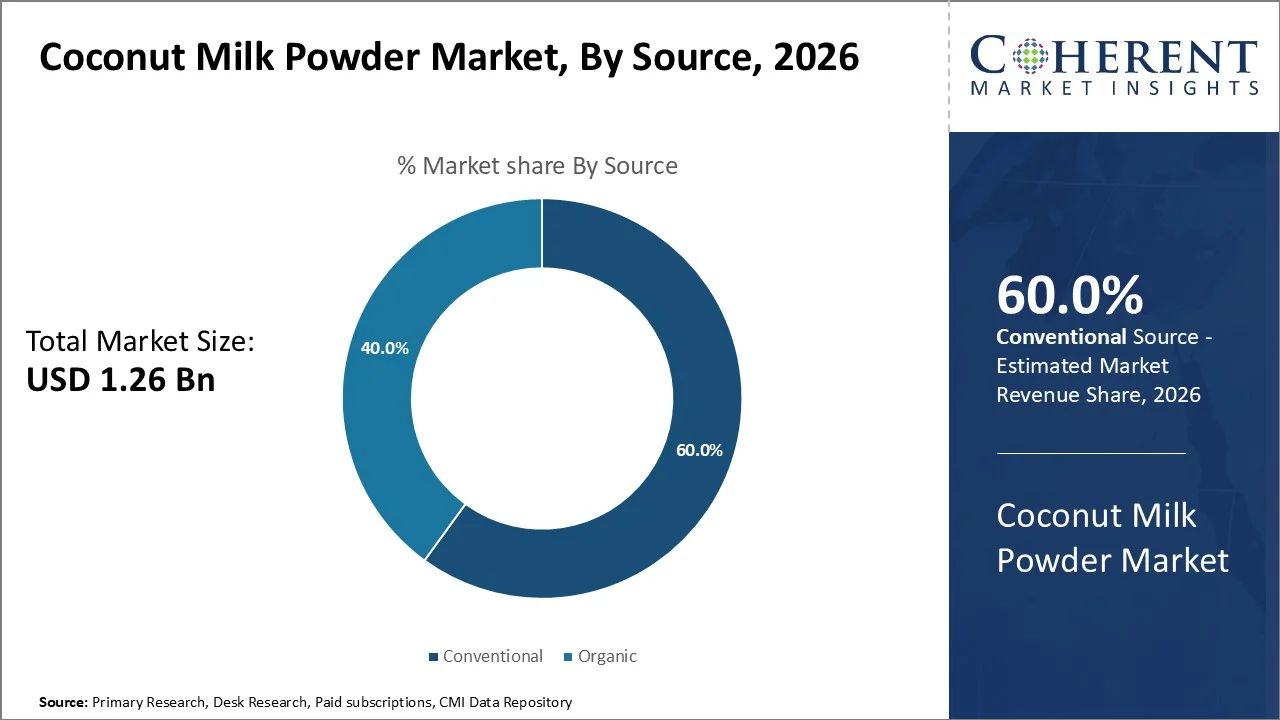
Why is Conventional Segment Acquiring the Largest Market Share?
Conventional segment is projected to account for the largest share of source in 2026, representing approximately 60% of the total volume. Its established production infrastructure, cost-effectiveness, as well as widespread availability across global supply chains are some of the growth-inducing factors.
The extensive cultivation practices that have been refined over decades in major coconut-producing regions such as the Philippines, Indonesia, Thailand, and Sri Lanka is further stimulating the market growth. According to the Coconut Development Board, the Philippines leads the world in coconut production with 3,647,000 metric tons, followed by Indonesia with 3,374,000 metric tons and India with 2,199,000 metric tons.
The Food and Agriculture Organization (FAO) says these countries produce most of the world’s coconuts. Most farms use traditional methods because they give more coconuts per hectare and cost less than organic farming.
- Current Industry Events of 2026
- Market Size Estimation
- Regional Breakdown
- Competitive Landscape
- Customer Intelligence
- Segmental Analysis
- Pricing Analysis
- Key Market Drivers, Challenges & Future Trends
- Customized Insights Section
Food holds the Largest Market Share
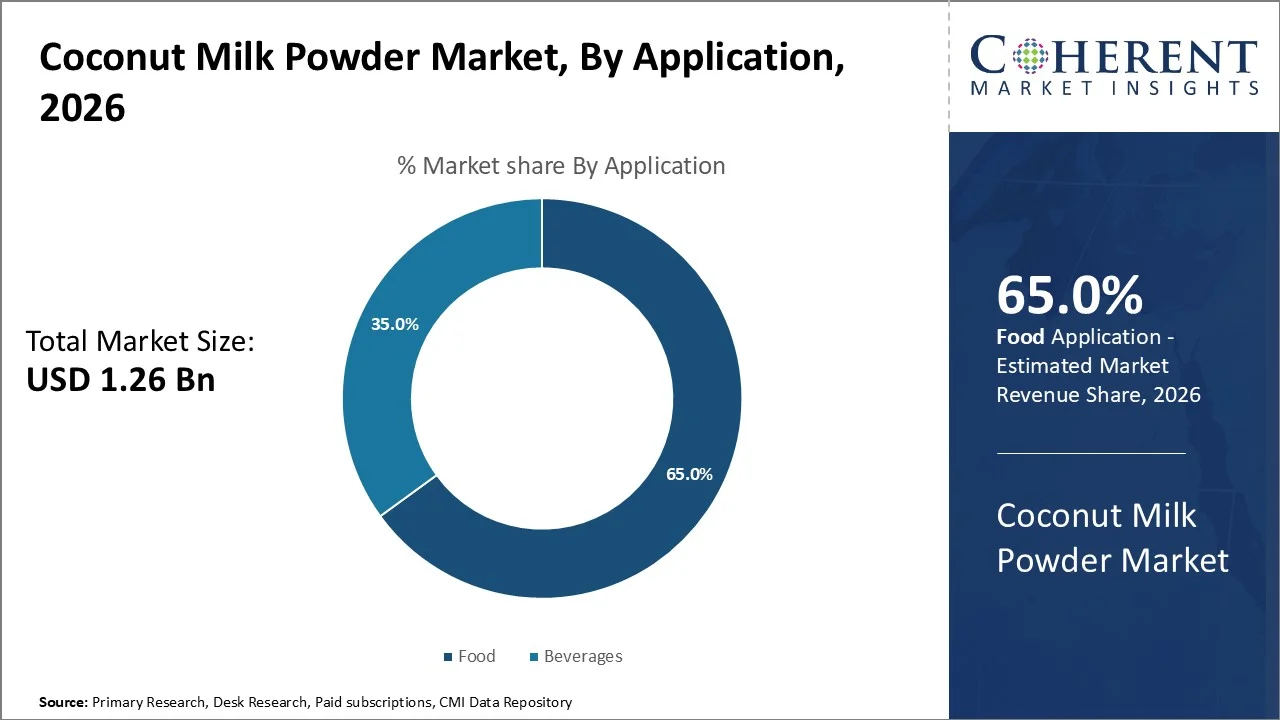
Based on application, food dominates the market, accounting for a significant 65% share in 2026, its extensive integration across multiple food manufacturing processes as well as the inherent functional properties that coconut milk powder provides to various food products are the factors propelling the growth of the market.
The exceptional versatility of ingredient as both a flavor enhancer along with a functional component is stimulating the market. The Food and Agriculture Organization (FAO) has documented the increasing adoption of coconut-derived ingredients in processed foods, particularly noting their role in meeting the growing demand for plant-based alternatives without compromising on taste or texture.
According to India Brand Equity Foundation, India is the third largest coconut-producing country in the world and accounted for about 31.45% of the world’s total production during FY22, with a production of 19,310 million nuts. During FY24, India produced 21,373.62 million nuts. The crop contributed around US$ 3.72 billion to the country’s gross domestic product (GDP) during FY23. The coconut palm provides food security and livelihood opportunities to more than 12 million people in India.
Big food companies like Nestlé use coconut milk powder in their sweets, and companies like Mondelez use it in bakery products for people who want dairy-free and healthier options.
Hypermarket/Supermarket holds the Largest Market Share
Based on distribution channel, hypermarket/supermarket dominates the market, accounting for a significant 50% share in 2026, their extensive reach, convenient accessibility, as well as established consumer shopping patterns that favor these large-format retail establishments for pantry staples and food ingredients are the factors propelling the market. IBISWorld's 2025 report counts 78,680 supermarkets as well as grocery store businesses (+2.2% from 2024)
Major hypermarket and supermarket chains like Walmart, Tesco, Carrefour, and regional players have strategically positioned coconut milk powder products in their health food sections, baking aisles, and international cuisine segments, making them easily discoverable for consumers during their regular grocery shopping trips.
People trust big stores to sell safe and good-quality food. This is very important for processed foods like coconut milk powder, where buyers want reliable brands and proper storage.
Spray Drying Technology is transforming the Coconut Milk Powder Industry
Spray drying is the main technology used to make coconut milk powder, covering about 85% of global production. Modern systems use multi-stage drying, control particle size, and optimize temperature to improve quality. Companies like Dabur India, Thai-Choice Foods, Maggi Corporation, etc., have adopted advanced spray drying methods, which aid retain coconut oil, cut production costs, as well as reduce batch variability.
The benefits of using advanced spray drying include longer shelf life (12 → 24 months), better powder solubility (95%), faster production (30–40% time savings), improved coconut flavor, as well as higher yield efficiency (15–20%). These changes make coconut milk powder more reliable, better in quality, and cheaper to make for manufacturers.
Freeze Drying (Lyophilization) Technology: A major breakthrough in Coconut Milk Powder
Freeze drying is the most method to make coconut milk powder. It holds the nutrients as well as taste by drying the powder at very cold temperatures below -40°C. Companies like Nutiva Inc., Wilderness Family Naturals, Healthy Traditions, etc., use this method to make top-quality, organic, or special coconut milk powders.
The benefits include 95% retention of healthy fats (MCTs), the ability to charge premium prices (300–400% higher), long shelf life up to 5 years, instant reconstitution, as well as preservation of probiotics and enzymes. This method targets health-conscious as well as premium consumers seeking superior quality products.
Current Events and Their Impact on the Coconut Milk Powder Market
Current Event | Description and its Impact |
Rising Food Safety Regulations in Europe and North America |
|
Sustainability along with Packaging Guidelines |
|
Coconut Milk Powder Market Trends
- High inclination toward dairy alternatives fueled by lactose intolerance awareness, veganism, as well as environmental consciousness. Lactose intolerance is generally most common in Asian countries, especially in East Asian, where about 70-100% of people show lactose intolerance.
- High preference for natural, minimally processed ingredients with recognizable components is coming as a potential trend.
- Growing incorporation of coconut milk powder in protein supplements, meal replacements, as well as fortified beverages
- Rapid growth in online retail channels, particularly post-pandemic, enabling direct-to-consumer sales. By 2025, online transactions will represent 16.6% of total retail sales.
- Rising demand for organic, fair-trade, as well as sustainably sourced coconut milk powder
Regional Insights
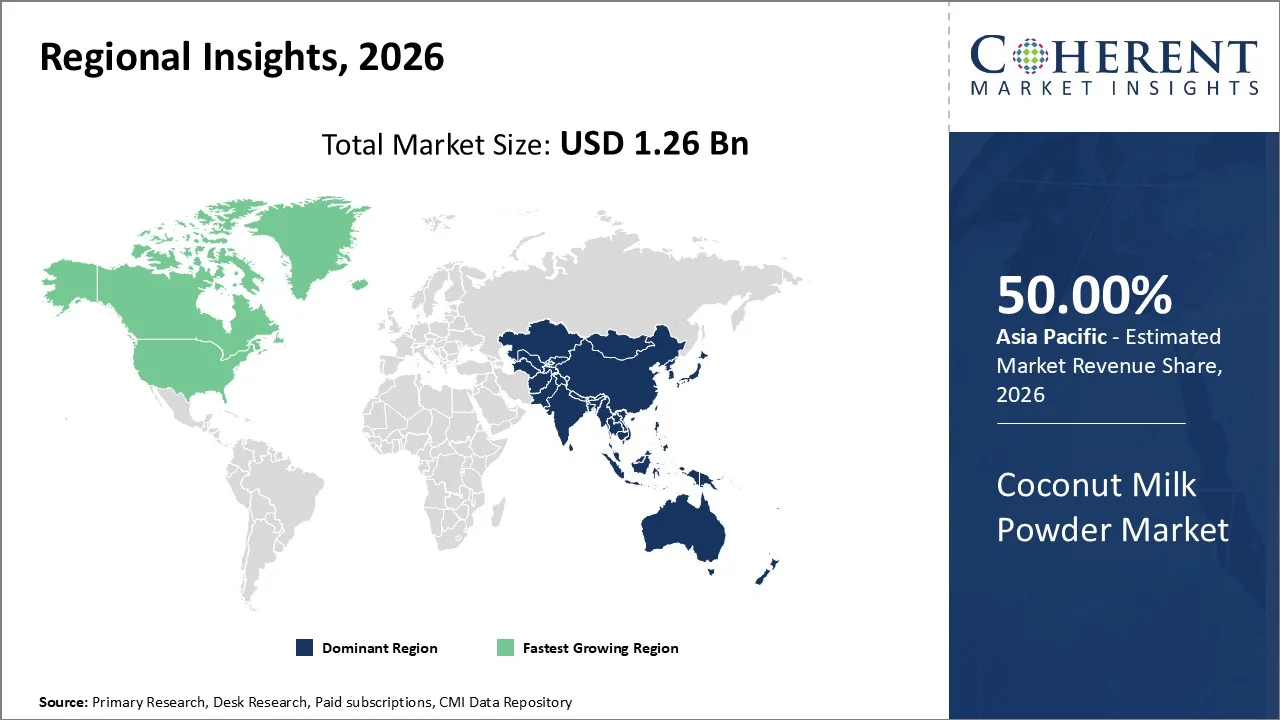
Asia Pacific dominates owing to its extensive domestic production capabilities
Asia Pacific account 50% market share in 2026, its deeply embedded cultural traditions of coconut utilization, extensive domestic production capabilities, and sophisticated supply chain infrastructure that has evolved over centuries. Countries like Thailand, Philippines, Indonesia, and Malaysia, which collectively represent the world's largest coconut-producing nations is one of the factors responsible for the growth of the market. Coconut production in Ilocos Region was estimated at 17,807 metric tons in the fourth quarter of 2025. This was higher by 5.9 percent from 16,812 metric tons in the previous year of the same period.
Thailand's Ministry of Agriculture and Cooperatives reported that the country produces over 1.8 million tons of coconuts annually, with a major portion being processed into value-added products including coconut milk powder.
The Thai Coconut Committee has supported coconut processing, and now there are over 200 coconut processing plants across Thailand.
Similarly, the Philippine Coconut Authority documented that the archipelago nation maintains approximately 3.5 million hectares of coconut plantations, supporting over 3.5 million farming families who contribute to the raw material supply for coconut milk powder production.
North America Coconut Milk Powder Market Trends
The North America region is poised to be the fastest-growing region through 2026-2033, expanding at a CAGR of approximately 6.2%. The substantial supply chain dominance and production capabilities that directly serve North American consumers are one of the factors responsible for the growth of the region.
The Philippines and Indonesia are the world’s biggest coconut producers, says the FAO. They have strong export systems that send good-quality coconut milk powder to North America. U.S. imports are expected to recover from 380,000 metric tons in 2025 to around 410,000 metric tons in 2026
Major Filipino cooperatives like the Philippine Coconut Authority have developed specialized processing facilities that cater specifically to North American food safety standards and consumer preferences.
Philippines being the Major coconut producer in the world is Accelerating the Coconut Milk Powder Market Demand in Philippines
Philippines contributes the highest share in the coconut milk powder market in APAC owing to its dominant position as one of the world's largest coconut producers and its well-established coconut processing infrastructure.
The Philippines produces about 19.5 million tons of coconuts each year, which is almost 15% of all coconuts in the world, according to the Philippine Statistics Authority.
The extensive archipelagic geography of the country provides ideal tropical conditions with over 3.5 million hectares dedicated to coconut cultivation across more than 68 provinces.
United States Coconut Milk Powder Market Trends
The U.S. contributes the highest share in the coconut milk powder market in North America due to its massive consumer base, well-established distribution networks, as well as high adoption of plant-based alternatives across diverse demographic segments.
The USDA says sales of plant-based foods have grown a lot, and coconut products make up a big part of this growth.
Who are the Major Companies in Coconut Milk Powder Industry
Some of the major key players in coconut milk powder market include, The Coconut Company (UK) Ltd., Tirumala Food Industries, Enature Organic Products, Ayam Sarl, Nestlé S.A., Renuka Foods PLC, S & P Industries Sdn Bhd, Shriram Coconut Products Limited, Star Heritage Products, and Pulau Sambu Singapore Pte Ltd.
Key News
- In 2026, MAGGI® Working Towards a More Sustainable Future, From Tomato Sauces to Coconut Milk Powder, across our portfolio MAGGI® is looking at ways to support a more sustainable foodservice industry. For us, farming is a key part of working sustainably. As part of this we're starting a journey with our tomato suppliers and farmers to work towards improving soil health and water management.
Market Report Scope
Coconut Milk Powder Market Report Coverage
| Report Coverage | Details | ||
|---|---|---|---|
| Base Year: | 2025 | Market Size in 2026: | USD 1.26 Bn |
| Historical Data for: | 2020 To 2024 | Forecast Period: | 2026 To 2033 |
| Forecast Period 2026 to 2033 CAGR: | 13.85% | 2033 Value Projection: | USD 3.13 Bn |
| Geographies covered: |
| ||
| Segments covered: |
| ||
| Companies covered: | The Coconut Company (UK) Ltd., Tirumala Food Industries, Enature Organic Products, Ayam Sarl, Nestlé S.A., Renuka Foods PLC, S & P Industries Sdn Bhd, Shriram Coconut Products Limited, Star Heritage Products, and Pulau Sambu Singapore Pte Ltd. | ||
| Growth Drivers: |
| ||
| Restraints & Challenges: |
| ||
Analyst Opinion
- The coconut milk powder market is growing as consumers are inclining towards plant-based and natural products. The number of people trying plant-based meat went up from 48% in 2024 to 51% in 2025.
- More people are thinking about their health, particularly if they want lactose free or are allergic to dairy. This is increasing demand for coconut milk powder in food, drinks, and stores. Cow’s milk protein is the third most common food allergen after nuts and peanuts. Studies show that up to 17% of people say they are allergic to cow’s milk.
- Its long shelf life and easy-to-use nature make it more popular for both businesses and home use.
- High adoption in the bakery as well as confectionery industry, coupled with expanding applications in infant formula and sports nutrition products, creates substantial growth opportunities. The market benefits significantly from the booming vegan food trend as well as high incorporation into ethnic cuisines globally.
- Asia-Pacific is the biggest market because it grows many coconuts, has good processing plants, and people know coconut products well. The Philippines, Indonesia, and India are the main producers and also use more coconut products at home.
- North America emerges as the fastest-growing region, stimulates by health-conscious millennials, expanding retail distribution, as well as increasing incorporation in specialty food products.
Speak to the analyst
Want personalized insights?
Take the findings above to one of our principal consultants, or have the report rebuilt around the segments, geographies and competitors you actually track.
Market Segmentation
- By Source (Revenue, USD Bn, 2021-2033)
- Conventional
- Organic
- By Application (Revenue, USD Bn, 2021-2033)
- Food
- Snacks
- Bakery & Confectionary
- Dairy & Frozen Products
- Beverages
- Food
- By Distribution Channel (Revenue, USD Bn, 2021-2033)
- Online Stores
- Hypermarkets/Supermarkets
- Specialty Stores
- Others
- By Region (Revenue, USD Bn, 2021-2033)
- North America
- U.S.
- Canada
- Latin America
- Brazil
- Mexico
- Argentina
- Rest of Latin America
- Europe
- Germany
- U.K.
- France
- Italy
- Spain
- Russia
- Rest of Europe
- Asia Pacific
- China
- India
- Japan
- Australia
- South Korea
- ASEAN
- Rest of Asia Pacific
- Middle East
- GCC
- Israel
- Rest of Middle East
- Africa
- South Africa
- Central Africa
- North Africa
- North America
- Key Players
- The Coconut Company (UK) Ltd.
- Tirumala Food Industries
- Enature Organic Products
- Ayam Sarl
- Nestle S.A.
- Renuka Foods PLC
- S & P Industries Sdn Bhd
- Shriram Coconut Products Limited
- Star Heritage Products
- Pulau Sambu Singapore Pte Ltd.
Sources
Primary Research Interviews
- Coconut milk powder manufacturers and processors
- Food ingredient suppliers and distributors
- Health food retailers and e-commerce platform managers
- Food technologists and product development specialists
- Others
Databases
- Euromonitor International
- Others
Magazines
- Food Processing Magazine
- Natural Products Insider
- Beverage Industry Magazine
- Nutraceuticals World
- Others
Journals
- Journal of Food Science and Technology
- Food Chemistry International
- International Journal of Food Properties
- Others
Newspapers
- Food Business Magazine
- The Wall Street Journal (Food & Agriculture section)
- Financial Times (Consumer Goods coverage)
- Reuters Business News
- Others
Associations
- International Coconut Community (ICC)
- Specialty Food Association (SFA)
- Natural Products Association (NPA)
- Food and Agriculture Organization (FAO)
- Others
Public Domain Sources
- U.S. Department of Agriculture (USDA) reports
- European Food Safety Authority (EFSA) publications
- Trade.gov market research reports
- World Trade Organization (WTO) trade statistics
- Others
Proprietary Elements
- CMI Data Analytics Tool
- Proprietary CMI Existing Repository of information for last 10 years
Get access to 250+ pages report
Every segment, forecast, competitor profile and data table behind the analysis above — available for instant download.
- ESOMAR Member
- ISO 9001:2015 Certified
- D-U-N-S Registered
- GDPR & CCPA Compliant
Missing comfort of reading report in your local language? Find your preferred language:
Transform your Strategy with Exclusive Trending Reports
Frequently Asked Questions
The coconut milk powder market is expected to reach USD 3.13 Bn in 2033.
Major players operating in the global coconut milk powder market include the Coconut Company (UK) Ltd., Tirumala Food Industries, Enature Organic Products, Ayam Sarl, Nestlé S.A., Renuka Foods PLC, S & P Industries Sdn Bhd, Shriram Coconut Products Limited, Star Heritage Products, and Pulau Sambu Singapore Pte Ltd.
Fluctuating prices of coconut is expected to restrain the coconut milk powder market growth over the forecast period
Growing prevalence of lactose intolerance in North America & Europe is the trends in the market are driving growth of the global Coconut Milk Powder market.
The coconut milk powder market is anticipated to grow at a CAGR of 13.85% between 2026 and 2033.
Among regions, Asia Pacific is expected to account for a largest market share in the global coconut milk powder market over the forecast period.