

Colombia Wound Care Biologics Market Size and Share Analysis - 2026 To 2033
The Colombia wound care biologics market size is anticipated to grow at a CAGR of 10.2% with USD 15 Mn in 2026 and is expected to reach USD 29.5 Mn in 2033. The growth is mainly owing to rising chronic wound cases, especially diabetic foot ulcers, and increasing use of biologic skin substitutes, enzyme-based formulations, and growth-factor therapies. For instance, Colombia reported 3,033,800 adults with diabetes in 2024, thus creating a larger at-risk patient pool and facilitating wider adoption of advanced wound-healing solutions.
Key Takeaways
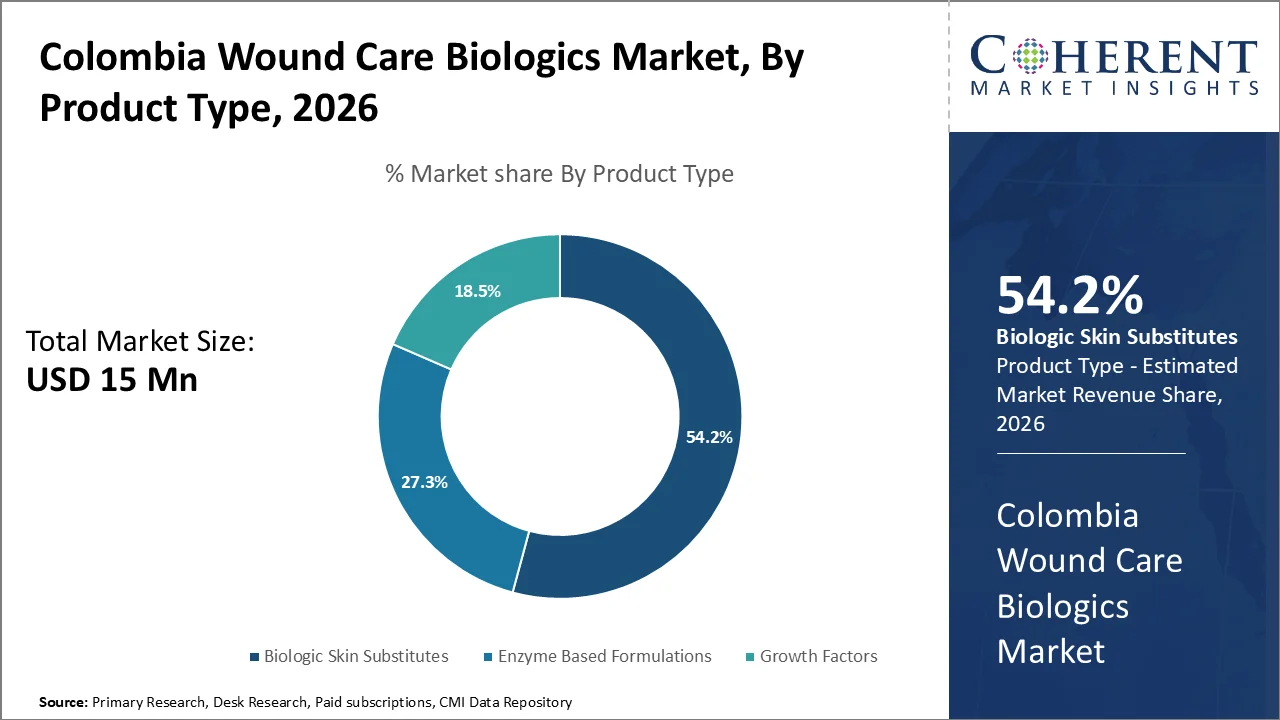
- The biologic skin substitutes segment is projected to account for the largest share of 54.20% in 2026. The segment growth is due to the rising use of advanced tissue-regeneration products for diabetic foot ulcers, pressure ulcers, and non-healing wounds. IDF reported 3.0 Mn adults with diabetes in Colombia in 2024.
- The chronic wounds segment is projected to account for the largest share of 68.40% in 2026. The segment’s growth is due to the increasing diabetes-related wound complications and the need for longer-duration wound care. IDF reported 8.4% adult diabetes prevalence in Colombia in 2024.
- The hospitals segment is projected to account for the largest share of 44.30% in 2026. The growth is owing to hospitals being the primary setting for severe wounds, burns, surgical wounds, and advanced biologic applications. OECD reported 1.9 hospital beds per 1,000 population in Colombia.
Segmental Insights
Which Product Type Segment Dominates the Market?
On the basis of product type, the biologic skin substitutes segment accounts for the largest Colombia wound care biologics market share of 54.20% in 2026. The growth of the segment is mainly driven by the Colombia’s expanding chronic wound treatment need, especially among patients with diabetes, vascular ulcers, pressure ulcers, and post-surgical wounds.
These products are preferred in difficult-to-heal wounds because they act as extracellular matrix scaffolds, support tissue regeneration, and help clinicians manage wounds that do not respond to conventional dressings. The segment also benefits from Colombia’s stronger focus on cardiometabolic disease management, as the Ministry of Health emphasizes continuity of care, diabetes control, risk monitoring, patient education, and early intervention for complications.
In July 2024, INVIMA granted sanitary registration for InnovaMatrix AC Placental ECM to ConvaTec Colombia for import and sale, supporting access to an advanced biologic matrix indicated for diabetic ulcers, venous ulcers, pressure ulcers, chronic vascular ulcers, surgical wounds, burns, and trauma wounds.
- Current Industry Events of 2026
- Market Size Estimation
- Regional Breakdown
- Competitive Landscape
- Customer Intelligence
- Segmental Analysis
- Pricing Analysis
- Key Market Drivers, Challenges & Future Trends
- Customized Insights Section
Chronic Wounds Segment to Secure the Largest Share
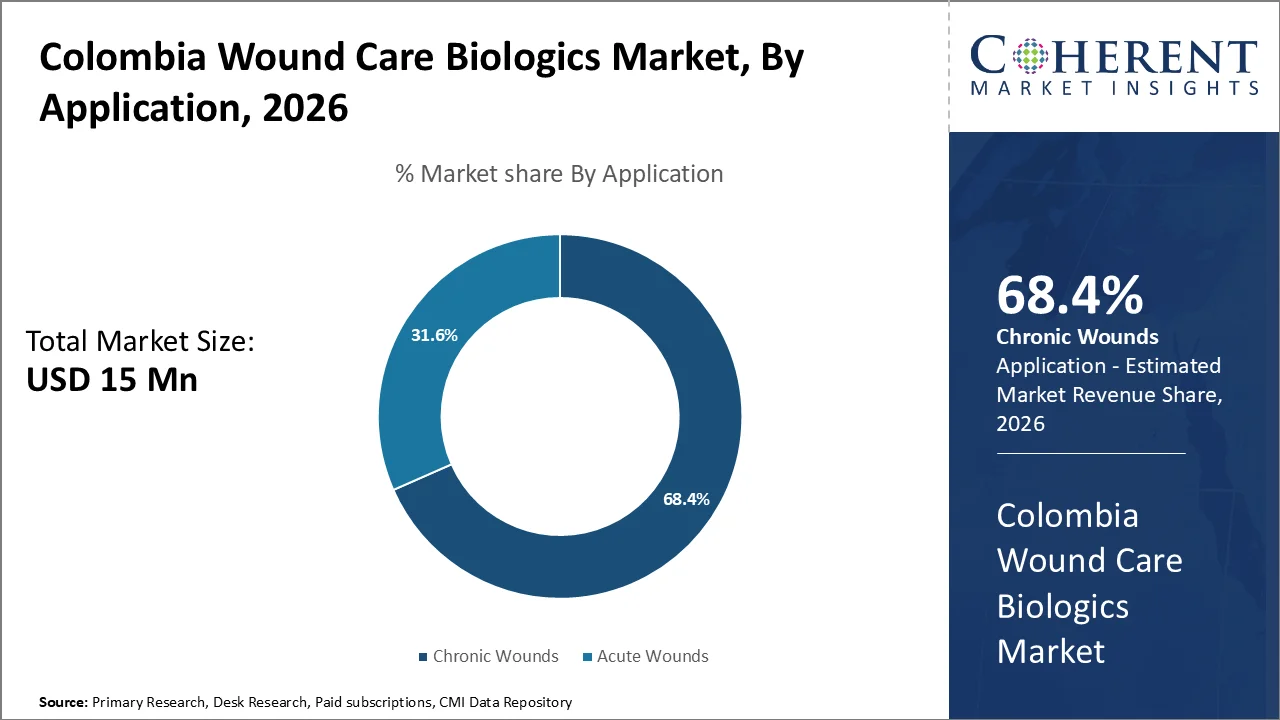
On the basis of application, the chronic wounds segment accounts for the largest Colombia wound care biologics market share of 68.40% in 2026, owing to the rising diabetic population and higher need for advanced treatment of slow-healing ulcers. The segment is further driven by increasing use of biologic skin substitutes and regenerative membranes for diabetic foot ulcers, pressure ulcers, venous leg ulcers, and other long-duration wounds.
Colombia’s Cuenta de Alto Costo reported 2,597,719 diabetes mellitus cases as of August 31, 2025, creating a large patient base vulnerable to chronic wound complications. It also reported that only 44.02% of diabetes patients had HbA1c measurement information in the previous six months, thereby indicating gaps in glycemic monitoring that may increase non-healing wound risk.
Hospitals Segment to Secure the Largest Share
On the basis of end user, the hospitals segment accounts for the largest share of 44.30% in 2026. The segment’s growth is owing to the strong role of hospitals and institutional health providers in treating complex wounds, including diabetic foot ulcers, pressure ulcers, burns, venous ulcers, and post-surgical wounds. These cases often need physician-led wound assessment, debridement, infection control, biologic dressing selection, and regular monitoring.
Colombia’s SISPRO reported 19,682 IPS provider sites, which shows a broad institutional base for advanced wound care delivery. The SISPRO also reported 3,641 public IPS sites and 15,977 private IPS sites, thus facilitating hospital and clinic-based access to specialized treatment.
A relevant 2026 development is Colombia’s implementation of interoperable electronic health records from April 15, 2026, which may improve continuity of wound care between hospitals, clinics, and follow-up providers.
Market Drivers
Rising Chronic Wound Burden is Transforming the Colombia Wound Care Biologics Market
Rising chronic wound burden is transforming the Colombia wound care biologics market because hospitals and wound care centers are increasingly treating diabetic foot ulcers, venous leg ulcers, pressure injuries, burns, and complex surgical wounds with advanced regenerative products.
According to Colombia’s Ministry of Health, 1,985,748 people were living with diabetes mellitus during July 2022 to June 2023, representing a crude prevalence of 3.82 per 100 inhabitants. This directly expands the patient pool at risk of non-healing wounds and diabetic foot complications. For example, the country’s National Nutrition Situation Survey reported that 56.4% of adults had excess weight. This included 37.7% who were overweight and 18.7% who had obesity, thereby increasing the risk of delayed wound healing.
A relevant development is RegenCol’s collagen membrane, developed with UNAL support and registered with INVIMA, which entered initial commercialization through 2023 sales and alliances, supporting local adoption of biologic wound coverage solutions in Colombia.
A Major Breakthrough in the Colombia Wound Care Biologics Market: Stem Cell–Derived Biologics for Diabetic Foot Ulcers
Stem cell–derived biologics are becoming important in the Colombia wound care biologics market because diabetic foot ulcers require therapies that support tissue repair, angiogenesis, and faster wound closure.
The country’s Cuenta de Alto Costo reported that 2,597,719 people had diabetes mellitus as of August 2025. This creates a large patient base at risk of diabetic foot ulcers as well as delayed wound healing. It also reported that only 44.02% of people with diabetes had HbA1c measurement information in the last six months, thereby showing a monitoring gap which can increase the risk of uncontrolled diabetes along with chronic wound complications. Such factors are driving the Colombia wound care biologics market growth.
A new medical update is the ClinicalTrials.gov study NCT07553468, posted in April 2026. The study looks at stromal vascular fraction cells for diabetic foot ulcers and shows the move toward patient’s own cell-based treatments for wounds that do not improve with usual treatment.
Current Events and Their Impact on the Colombia Wound Care Biologics Market
Current Event | Description and its Impact |
UDI-DI and Medical Device Traceability Requirements by INVIMA in Colombia (2026) |
|
Colombia’s 2026 Health Financing and UPC Adjustment for the National Health System |
|
Colombia Wound Care Biologics Market Trends
- The rising diabetes burden in Colombia is increasing demand for biologic skin substitutes, growth factors, and regenerative wound care products used for diabetic foot ulcers and delayed wound healing. IDF reported 3,033,800 adults with diabetes in Colombia in 2024, representing 8.4% adult prevalence.
- Hospitals and specialty clinics are increasingly adopting advanced wound-healing products because chronic wounds require longer treatment cycles, infection control, tissue regeneration, and faster closure support.
- Biologic wound care adoption is supported by regulatory recognition of tissue-based products. INVIMA classified EPIFAST as a biological dressing and allograft derived from human tissue, showing relevance for biologic wound treatment pathways in Colombia.
- Colombia’s medical device traceability rules are strengthening product monitoring. INVIMA states that UDI-DI coding under Resolution 1405 of 2022 improves identification, traceability, and safety of medical devices.
- Public health financing may improve access to advanced wound care products, as Colombia’s 2026 UPC policy finances health services and technologies under the contributory and subsidized regimes.
Who are the Major Companies in Colombia Wound Care Biologics Market
Some of the major key players in Colombia wound care biologics market are Smith & Nephew, Plc, Organogenesis, Inc., Integra Life Sciences Corporation, MiMedx Group, Inc., Skye Biologics, Inc., Amino Technology LLC, Osiris Therapeutics, Inc., Alphatec Holdings, Inc. Mallinckrodt Plc., Amniox Medical, Inc., Acelity L.P. Inc., ConvaTec Group Plc, Generex Biotechnology Corporation, and Olaregen Therapeutix Inc.
Key News
- In February 2026, Oneness announced that Bonvadis® topical cream received medical device marketing authorization from INVIMA Colombia. The approval covers all wound-related indications and allows the product to be marketed in Colombia as a wound dressing. The product was approved under the imported registration license number INVIMA2026DM-0032092.
- In September 2025, Smith+Nephew launched the CENTRIO Platelet-Rich-Plasma (PRP) System in the U.S. for chronic exuding wounds, including diabetic foot ulcers, venous leg ulcers, pressure ulcers, and tunneling wounds. The launch highlights growing adoption of biologic, autologous wound-healing solutions, which may influence advanced wound care practices in markets such as Colombia once local regulatory and commercial availability expands.
Market Report Scope
Colombia Wound Care Biologics Market Report Coverage
| Report Coverage | Details | ||
|---|---|---|---|
| Base Year: | 2025 | Market Size in 2026: | USD 15 Mn |
| Historical Data for: | 2020 To 2024 | Forecast Period: | 2026 To 2033 |
| Forecast Period 2026 to 2033 CAGR: | 10.2% | 2033 Value Projection: | USD 29.5 Mn |
| Segments covered: |
| ||
| Companies covered: | Smith & Nephew, Plc, Organogenesis, Inc., Integra Life Sciences Corporation, MiMedx Group, Inc., Skye Biologics, Inc., Amino Technology LLC, Osiris Therapeutics, Inc., Alphatec Holdings, Inc. Mallinckrodt Plc., Amniox Medical, Inc., Acelity L.P. Inc., ConvaTec Group Plc, Generex Biotechnology Corporation, and Olaregen Therapeutix Inc. | ||
| Growth Drivers: |
| ||
| Restraints & Challenges: |
| ||
Analyst Opinion
- The Colombia wound care biologics market is growing because chronic wound treatment is becoming a direct clinical need. Colombia reported 2,597,719 diabetes mellitus cases as of August 31, 2025, which increases the risk of diabetic foot ulcers, delayed wound healing, and infection-related complications.
- Chronic wound care demand is rising because diabetes monitoring remains limited among many patients. In 2025, only 44.02% of Colombian diabetes patients had an HbA1c measurement in the previous six months, which may increase the risk of uncontrolled diabetes and non-healing wounds.
- Biologic wound care products are gaining importance as hospitals look for faster tissue repair and wound closure options. INVIMA classified EPIFAST as a biological dressing and human-tissue allograft, showing formal regulatory relevance for tissue-based wound healing products in Colombia.
Speak to the analyst
Want personalized insights?
Take the findings above to one of our principal consultants, or have the report rebuilt around the segments, geographies and competitors you actually track.
Market Segmentation
- By Product Type (Revenue, USD Mn, 2021-2033)
- Biologic Skin Substitutes
- Enzyme Based Formulations
- By Application (Revenue, USD Mn, 2021-2033)
- Chronic Wounds
- Diabetic Foot Ulcer
- Venous Leg Ulcer
- Pressure Ulcer
- Acute Wounds
- Surgical Wounds
- Burns
- By End User (Revenue, USD Mn, 2021-2033)
- Hospitals
- Clinics
- Ambulatory Surgical Centers
- Home Care Settings
Sources
Primary Research Interviews
- Wound Care Biologics Manufacturers
- Biologic Skin Substitute Manufacturers
- Advanced Wound Care Product Manufacturers
- Collagen Dressing and Enzyme-Based Formulation Suppliers
- Growth Factor Therapy Providers
- Hospitals and Wound Care Clinics in Colombia
- Diabetic Foot Care Specialists
- Burn Care Specialists and Plastic Surgeons
- Dermatologists and Vascular Surgeons
- Medical Device Distributors and Importers in Colombia
- Tissue Banks and Regenerative Medicine Experts
- Hospital Procurement Managers
- Others
Databases
- Bloomberg Terminal
- Thomson Reuters Eikon / Refinitiv
- IQVIA
- GlobalData Medical Intelligence
- S&P Global Market Intelligence
- D&B Hoovers
- UN Comtrade Database
- World Bank Open Data
- OECD Health Statistics
- SISPRO – Integrated Social Protection Information System, Colombia
- INVIMA Product and Registration Databases
- Others
Magazines
- WoundSource
- Today’s Wound Clinic
- Wounds International
- Wound Care Learning Network
- Medical Device Network
- MedTech Dive
- Healthcare Global
- Latin America Healthcare Business
- Others
Journals
- Wound Repair and Regeneration
- International Wound Journal
- Journal of Wound Care
- Advances in Skin & Wound Care
- Diabetes Care
- International Journal of Lower Extremity Wounds
- Burns
- Journal of Tissue Engineering and Regenerative Medicine
- Stem Cells Translational Medicine
- Others
Newspapers
- Reuters
- Bloomberg News
- Financial Times
- The Wall Street Journal
- El Tiempo
- Portafolio
- La Republica
- Semana
- Others
Associations
- Asociacion Colombiana de Diabetes
- Asociacion Colombiana de Dermatologia y Cirugia Dermatologica
- Asociacion Colombiana de Cirugia
- Sociedad Colombiana de Cirugia Plastica Estetica y Reconstructiva
- Asociacion Colombiana de Hospitales y Clinicas
- International Working Group on the Diabetic Foot
- European Wound Management Association
- Wound Healing Society
- International Society for Burn Injuries
- Others
Public Domain Sources
- INVIMA – Instituto Nacional de Vigilancia de Medicamentos y Alimentos
- Ministerio de Salud y Proteccion Social, Colombia
- SISPRO – Sistema Integral de Informacion de la Proteccion Social
- DANE – Departamento Administrativo Nacional de Estadistica
- World Bank Open Data
- Pan American Health Organization
- World Health Organization
- International Diabetes Federation
- U.S. FDA Medical Devices Database
- European Medicines Agency
- ClinicalTrials.gov
- Others
Proprietary Elements
- CMI Data Analytics Tool
- Proprietary CMI Existing Repository of Information for the Last 10 Years
Get access to 250+ pages report
Every segment, forecast, competitor profile and data table behind the analysis above — available for instant download.
- ESOMAR Member
- ISO 9001:2015 Certified
- D-U-N-S Registered
- GDPR & CCPA Compliant
Missing comfort of reading report in your local language? Find your preferred language:
Transform your Strategy with Exclusive Trending Reports
Frequently Asked Questions
The Colombia Wound Care Biologics Market is expected to reach USD 29.5 Mn in 2033.
Major players operating in the global Colombia Wound Care Biologics Market include Smith & Nephew, Plc, Organogenesis, Inc., Integra Life Sciences Corporation, MiMedx Group, Inc., Skye Biologics, Inc., Amino Technology LLC, Osiris Therapeutics, Inc., Alphatec Holdings, Inc. Mallinckrodt Plc., Amniox Medical, Inc., Acelity L.P. Inc., ConvaTec Group Plc, Generex Biotechnology Corporation, and Olaregen Therapeutix Inc.
The high price of advanced skin substitutes, a preference for cheaper traditional dressings, and a shortage of specialized professionals for applying complex biologics are the key factors hampering growth of the market.
The rising diabetic foot ulcer cases, a rapidly aging population, increasing adoption of advanced skin substitutes, and improved access to healthcare, particularly for chronic wound management is boosting demand for wound care biologics.
The Colombia Wound Care Biologics Market is anticipated to grow at a CAGR of 10.2% between 2026 and 2033.
Among product type, the biologic skin substitutes segment is expected to account for a largest market share in the Colombia Wound Care Biologics Market over the forecast period.
Wound care biologics are advanced therapies derived from natural living organisms—such as human, animal, or microbial tissues—used to accelerate healing in complex, chronic, or non-healing wounds.