

Global End-Of-Line Packaging Market Size and Share Analysis – Growth Trends and Forecasts (2026-2033)
The end-of-line packaging market is estimated to be valued at USD 5.72 Bn in 2026 and is expected to reach USD 8.16 Bn by 2033, exhibiting a compound annual growth rate (CAGR) of 5.2% from 2026 to 2033.
Key Takeaways
- In terms of Product Type, Palletizers Segment is expected to contribute 30.8% share of the market in 2026. This is because Palletizers are highly versatile machines that allow for flexible packaging capabilities
- In terms of End-Use Industry, Food & Beverages Segment is expected to contribute 37.1% share of the market in 2026. This because end-of-Line Packaging Market for beverages ensure product safety, quality and extend shelf life.
- North America is expected to account for over 36.0% of the market share in 2026. This is due to highly developed packaging industry and the presence of major packaged food manufacturers in the region.
Market Overview
End-of-line (EOL) packaging market is fueled by rising demand for automation, efficiency, and accuracy in packaging processes in food & beverage, pharmaceuticals, consumer goods, and e-commerce industries. Rising consumer demands for quicker delivery, product safety, and sustainability are compelling manufacturers to implement advanced EOL solutions such as case packers, palletizers, stretch wrappers, and labeling systems. The growth of smart factories and Industry 4.0 projects further accelerates market growth by adopting IoT, robotics, and AI technologies onto packaging lines to improve real-time monitoring, predictive maintenance, and quality control. Moreover, more stringent regulations on packaging safety and hygiene, particularly for the pharmaceutical and food industries, require compliant and automated EOL devices.
Current Events and Its Impact on End-of-Line Packaging Market
Current Events | Description and its impact |
Tetra Pak Rolls Out AI-Powered End-of-Line Packaging System in Europe |
|
Amazon Advances End-of-Line Automation in U.S. Fulfillment Centers |
|
Pricing Analysis for End-of-Line Packaging Market
The cost dynamics of the End-of-Line (EOL) Packaging Market depend on a number of primary factors such as raw material prices, level of automation, system integration complexity, and customization. EOL packing systems most often consist of machinery like case packers, palletizers, stretch wrappers, and conveyors, and the cost varies greatly depending on whether the system is semi-automatic or automatic.
Price volatility in raw materials—especially for metals, electronics, and plastic parts—affects costs of manufacturing equipment directly. For example, rising steel and aluminum prices over the past few years have inflated the base cost of machinery. Additionally, the implementation of Industry 4.0 technologies like IoT-based sensors, AI-based inspection equipment, and robotics has caused a premium for high-end EOL systems that provide predictive maintenance, real-time data monitoring, and enhanced operational efficiency.
Geographical location also has an impact on prices. North American and European markets are likely to have higher equipment and labor costs with tighter safety requirements and demands for higher-level automation. Conversely, Asia-Pacific provides more competitive pricing owing to lower manufacturing costs and growing local manufacturing capability.
The average cost of a fully automated EOL packaging line is between $100,000 and $500,000 in 2025, based on complexity and required throughput, while semi-automatic machines can range from $20,000 to $80,000. As the need for workforce shortages and efficiency increases in industries such as food & beverage, pharmaceuticals, and e-commerce, the trend is likely to go in favor of high-efficiency systems, maintaining consistent price growth for premium solutions while propelling cost-optimization for mid-range systems.
- Current Industry Events of 2026
- Market Size Estimation
- Regional Breakdown
- Competitive Landscape
- Customer Intelligence
- Segmental Analysis
- Pricing Analysis
- Key Market Drivers, Challenges & Future Trends
- Customized Insights Section
Role of New Technologies in End-of-Line Packaging Market
The End-of-Line (EOL) packaging industry is transforming with lightning speed by incorporating new technologies in efforts to increase efficiency, precision, and flexibility. Digitalization and automation are at the forefront of this revolution, decreasing labor by a great extent, limiting errors, and increasing throughput in food & beverage, pharmaceutical, and consumer goods industries.
The most significant innovations include the coupling of cobots (collaborative robots) with robotics to handle tasks like palletizing, packing, and sorting. Such systems are more adaptable and can be readily reprogrammed for varied product types or packaging configurations, facilitating mass customization and flexible manufacturing.
Artificial Intelligence (AI) and machine vision are being used with greater frequency for real-time quality inspection and predictive maintenance. AI and End-of-Line Packaging by using machine vision assist in identifying product flaws, incorrect sealing, or misplaced labels, minimizing waste and providing consistent quality. AI-based systems also provide predictive analytics that avoid downtime through the anticipation of equipment failure before it happens.
Internet of Things (IoT) technologies enable EOL machines to be networked throughout the supply chain. This enables centralized monitoring, data gathering, and performance optimization, resulting in more intelligent decision-making and response to production problems at a faster rate.
Moreover, green technologies, including energy-efficient motors and environmentally friendly packaging automation, are on the rise due to international environmental regulations and customer pressure for cleaner solutions.
These advanced technologies are transforming EOL packaging with higher operational performance, higher scalability, and reduced total cost of ownership, hence dictating the future of smart and adaptive packaging systems.
Government Regulations
Government regulations are a key driver in determining the End-of-Line (EOL) Packaging Market across the world, maintaining safety, hygiene, and environmental regulations. In the EU, the Machinery Regulation (EU) 2023/1230, coming into force in 2024 and fully enforced by 2027, supersedes the previous Machinery Directive and subjecting packaging machinery to strict safety requirements.
Packaging materials employed in food and pharmaceutical industries also need to meet EU standards for food contact materials, restricting the use of harmful substances in packaging items. In the US, the Food and Drug Administration (FDA) controls packaging machinery through the Food Safety Modernization Act (FSMA), with a design sanitary requirement and prevention of contamination.
There is no federal machinery safety statute, yet voluntary standards such as ANSI/PMMI B155.1-2011 and ISO 12100 are generally used to control risk assessments and safety features. India has implemented the Omnibus Technical Regulation (OTR) Order 2024, requiring packaging machinery certification by 2025, imposing ISO-compliant safety standards such as functional safety controls and protection features. Industries worldwide such as the pharmaceutical and food industries also need to comply with systems such as cGMP, ISO 13485, and GxP to ensure validated processes and traceability.
Functional safety standards like ISO 13849 are responsible for control system design and validation. These overlapping regulations result in increased compliance costs, compelling manufacturers to incorporate advanced safety, hygiene, and traceability capabilities into their machines. Market access and liability management mandate certification like CE marking or FDA clearance. Thus, regulatory needs spur innovation and retrofitting in EOL packaging technologies, leading to adoption of IoT-integrated monitoring and data logging to meet strict global standards.
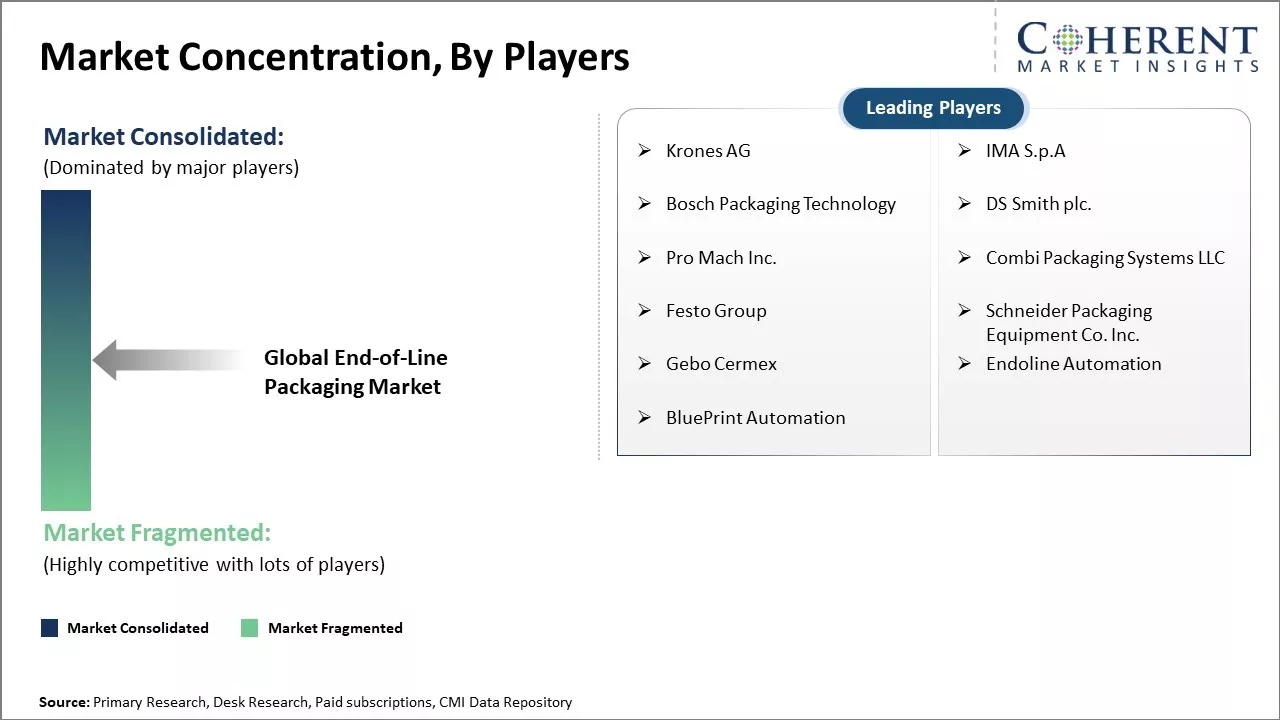
Market Concentration and Competitive Landscape
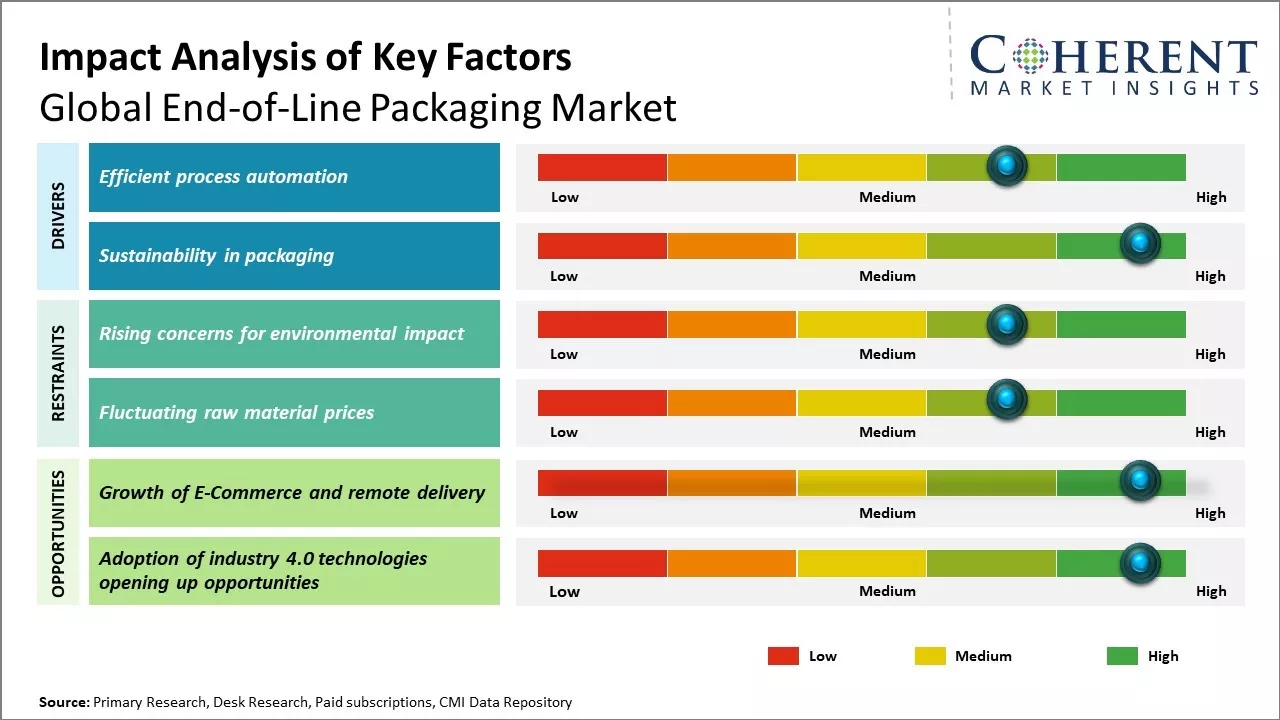
Market Driver
- Efficient process automation
One of the key drivers for growth in the end-of-line packaging market is the increasing demand for more efficient process automation across different industries. Manufacturers are under constant pressure to improve productivity while minimizing costs. At the same time, there is a need to handle greater output volumes with fewer workers on the production line. This is driving greater investments in automated end-of-line packaging solutions that can efficiently package large quantities of products at high speeds with minimal human intervention.
In 2024, Amazon significantly expanded its use of robotics and automated end-of-line packaging systems across several fulfillment centers in the U.S. to meet soaring e-commerce demand. According to a report by Logistics Management, the company implemented AI-powered robotic palletizers and automated case packers that increased packaging throughput by over 30% while reducing manual labor requirements by nearly 25%.
Fully automated end-of-line systems allow products to be transported through the entire packaging process seamlessly with little to no waste of time or materials during transition between different packaging stages such as filling, palletizing, etc. This leads to significant gains in line efficiency and throughput.
For example, a leading food manufacturer was able to increase production volume by over 15% simply by automating its end-of-line palletizing process with a robotic solution. Not only were they packaging more products in the same amount of time, but they also gained valuable production floor space that was previously occupied. The automation paid for itself within the first year through savings in labor costs and improved efficiency.
- Sustainability in packaging
With sustainability becoming an increasingly important consideration for both consumers and regulators, end-of-line packaging solutions that optimize material usage and facilitate recycling/reuse are gaining more attention. There is a definite push towards reducing excess material consumption and overall packaging waste generated throughout the supply chain.
Environmental protection agencies in different countries have enacted several norms pertaining to packaged product disposal and recyclability that companies must comply with. This application of policy pressure is motivating the use of smarter packaging designs and technologies within the industry.
Lightweighting of packaging through innovative material engineering as well as maximizing filling ratios during production are some examples of ongoing initiatives. Companies focused on sustainability are actively exploring the potential of automated packaging machinery to attain these goals. Advanced equipment such as multi-head weighers, volumetric/weight fillers ensure precise dosing of products and fewer unused cavities or fill spaces in cartons, pouches, and bottles.
Similarly, automated palletizers with layer pads and wrapping films apply just the necessary amount of wrapping to securely unitize pallets without any overuse. When implemented at scale across a nationwide or global manufacturing and distribution network, even small per unit savings in material usage can translate to huge overall reductions in carbon and waste footprint.
Market Opportunities: Growth of E-Commerce and remote delivery
The rapid growth of the e-commerce industry and demand for remote delivery of products is presenting massive opportunities for expansion in the end-of-line packaging market. As online shopping increases globally, vendors are looking at more effective packaging solutions to protect products through the online supply chain and moment of delivery. There is a focus on developing lightweight yet durable mailers, padded envelopes, boxes, and other forms of secure packaging.
Innovation is also happening in the area of smart and interactive packaging that can provide real-time status updates to customers during transit. This helps build confidence for the digital customer who does not get to physically check products before purchase. The packaging manufacturers are well-positioned to leverage the boom in the e-commerce industry by offering specialized solutions tailored for the complexities of remote business models and delivery logistics.
Segmental Insights
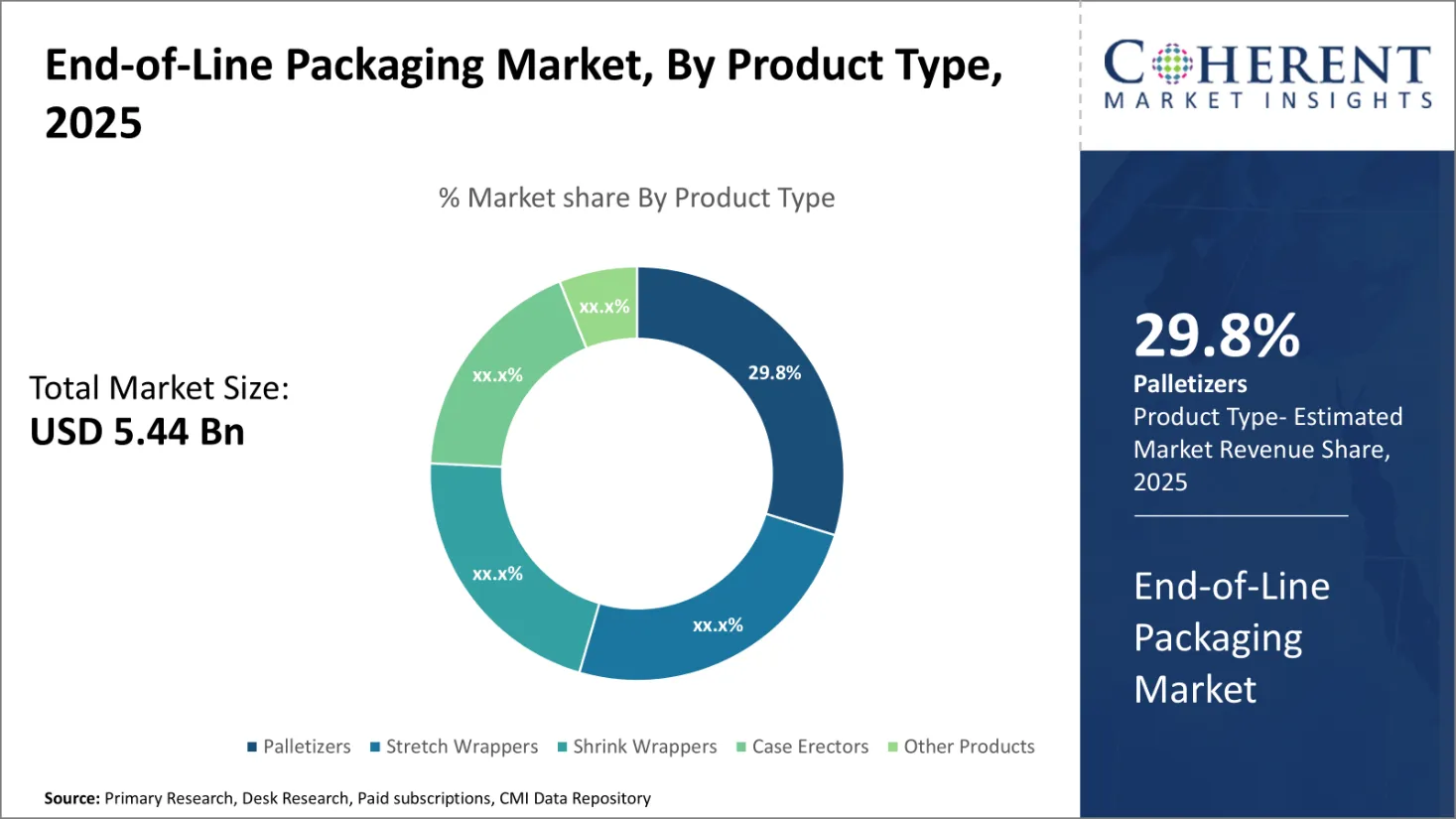
End-of-Line Packaging Market Insights, By Product Type
In terms of product type, palletizers are expected to contribute 30.8% share of the market in 2026. Palletizers are highly versatile machines that allow for flexible packaging capabilities. They efficiently load packaged goods onto pallets in order to prepare shipments for storage and transport. Given the diversity of products manufactured across industries, palletizers offer packaging flexibility that is crucial to meet varying product dimensions and weight requirements. Their ability to securely layer and stack products makes them well-suited for most packaging needs.
Palletizers also enable high output processing speeds through automation. Using robotics and conveyor integration, they can rapidly palletize goods coming off production lines. This high-throughput capability keeps pace with modern manufacturing demands of maximizing output while minimizing costs. As industries focus on lean production techniques, palletizers help achieve packaging efficiencies through their high-speed operation. Their automation requires minimal human involvement, further reducing labor expenses.
Consistency and accuracy are additional key advantages of palletizers. Robotic palletizing ensures a uniform build pattern is followed with each pallet loaded. This precise stacking creates stable loads that prevent shifting during transport. It also allows for optimized space utilization on pallets. The consistent arrangement of goods facilitates automated order fulfillment down the line. Overall, palletizers provide a versatile, high-speed, and accurate packaging solution highly valued across diverse manufacturing industries.

End-of-Line Packaging Market Insights, By End-Use Industry
In terms of end-use industry, food & beverages is expected to contribute 37.1% share of the market in 2026. End-of-Line Packaging Market for beverages ensure product safety, quality and extend shelf life. End-of-line packaging equipment plays a vital role in maintaining the integrity of food shipments from manufacturing to store shelves. Given the importance of proper packaging, food companies invest significantly in reliable, sophisticated machines.
Regulatory packaging compliance is also crucial within the industry. Equipment must meet food contact material and seal strength guidelines set by bodies like the FDA. Leakproof and tamper-evident seals created by equipment help guarantee compliance. Additionally, auto identification and traceability features allow accurate tracking of packaged goods in case of recalls.
Strict temperature control standards during shipping require reliable cooling or modified atmosphere packaging by equipment. Automated packaging lines efficiently overwrap food items while precisely regulating film permeation for optimum temperature control.
They create hermetically sealed packages that maintain freshness. Given these stringent standards, food producers rely on high-performance end-of-line packaging machines to consistently package products as per regulatory protocol and quality audit procedures. Robust, automated equipment forms a vital quality control measure for the industry.
Global End-of-Line Packaging Market - Regional Insights
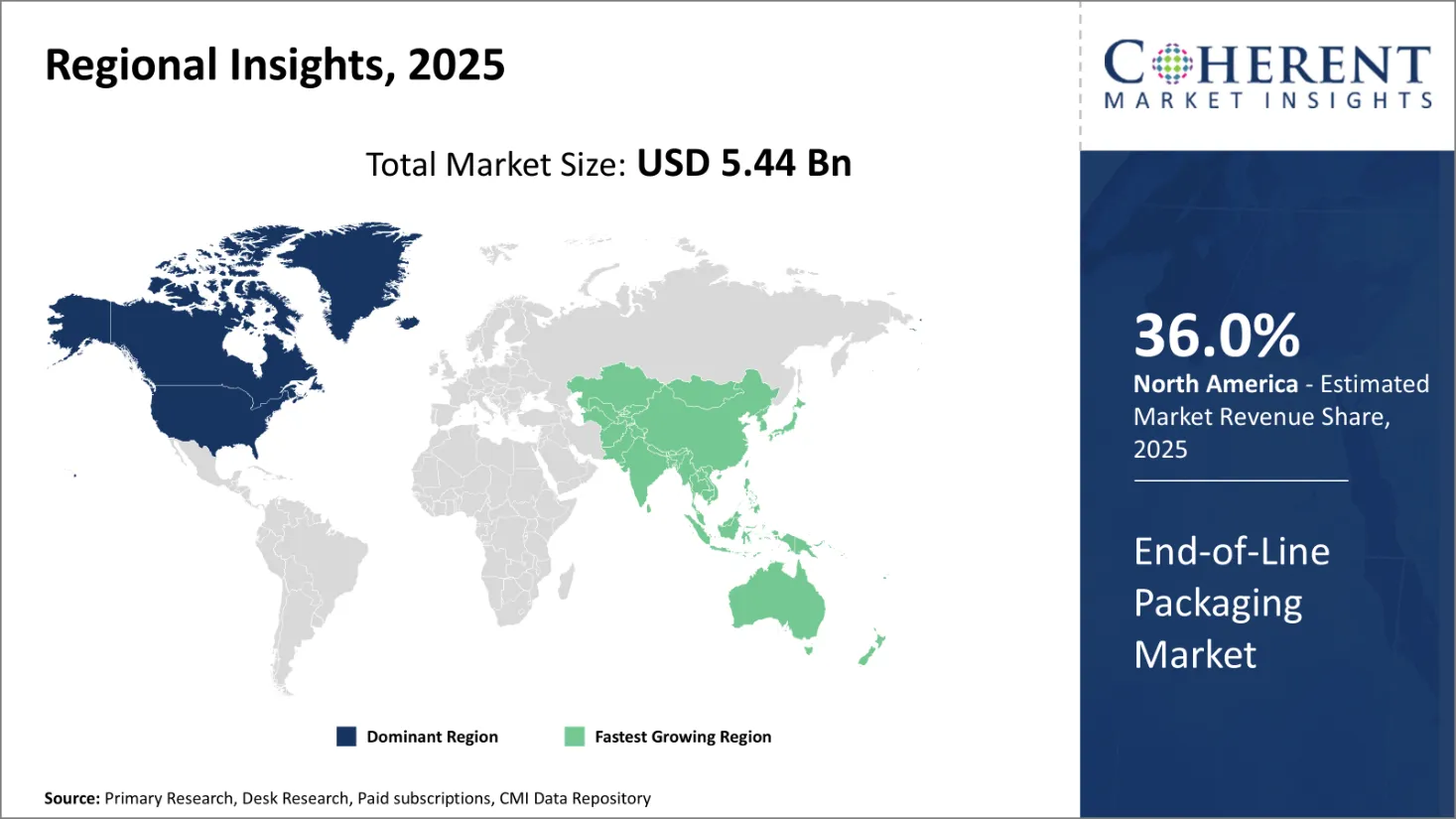
North America End-of-Line Packaging Market Analysis and Trends
North America has established itself as the dominant region in the global end-of-line packaging market. With a highly developed packaging industry and the presence of major packaged food manufacturers, the region is expected to account for over 36.0% of the market share in 2026.
The U.S. alone is estimated to be larger than any single country in Europe or Asia Pacific. The market dominance of North America can be attributed to multiple factors. Firstly, companies based in the U.S. and Canada have been pioneers and continue to be technology leaders in end-of-line packaging solutions. Stringent FDA regulations have propelled growth of automated packaging to ensure product safety and quality.
Thirdly, well-established distribution networks of consumer goods companies facilitate high-volume just-in-time deliveries, driving the adoption of integrated packaging lines. Lastly, product innovation is highly encouraged in the competitive retail environment, resulting in new packaging formats on a regular basis.
Asia Pacific End-of-Line Packaging Market Analysis and Trends
Asia Pacific is the fastest growing region over the forecast period. Countries like China, India, Indonesia, and Vietnam are emerging as manufacturing powerhouses and witnessing expansion of their domestic consumer markets. This twin growth driver has boosted investments in end-of-line packaging infrastructure across sectors such as food and beverage, pharmaceuticals, consumer product and retail, and e-commerce fulfillment.
The availability of low-cost skilled labor has also encouraged global machinery suppliers to establish local manufacturing plants or forge partnerships to capitalize on the opportunities. However, given differing demand patterns across Southeast Asian countries, industry players must tailor their value proposition accordingly to succeed in the diverse Asia Pacific landscape. Localization of product design and servicing networks will be critical to access this high-potential regional market.
End-of-Line Packaging Market Dominating Countries
United States End-of-Line Packaging Market Analysis and Trend
The United States is a major leader in the EOL packaging industry due to its deep manufacturing infrastructure, high-end automation adoption, and focus on smart factory technology. The nation's strong food and pharmaceutical sectors constantly require innovative packages that are safe and efficient. Moreover, increasing e-commerce growth is driving the demand for automated packaging solutions to fulfill high-volume orders.
Germany End-of-Line Packaging Market Analysis and Trend
Germany leads the European market for EOL packaging because it has world-class manufacturing capabilities, especially in the automotive, pharmaceutical, and consumer goods industries. German manufacturers have precision engineering and high-quality equipment as top priorities, leading to heavy investments in robotics and Industry 4.0-capable packaging lines. Stringent safety and sustainability regulations in Europe also spur uptake of innovative, compliant packaging equipment.
China End-of-Line Packaging Market Analysis and Trend
China ranks among the most rapidly growing markets for EOL packaging driven by industrialization at breakneck speed, growth in food & beverage production, and a thriving e-commerce industry. The country's emphasis on enhancing its production efficiency and lowering labor expenses speeds up automation adoption. Investments in domestic manufacturing capacity and government programs in favor of smart manufacturing further enhance China's dominance of the global packaging landscape.
Japan End-of-Line Packaging Market Analysis and Trend
Japan's end-of-line packaging industry is helped by its dominance in automation and robotics technology. Famous for high quality control standards and process refinement, Japanese companies implement advanced packaging systems in pharmaceuticals, electronics, and food packaging. The nation's aging labor force also necessitates demand for automated solutions to ensure productivity despite limited labor resources.
Market Report Scope
End-of-Line Packaging Market Report Coverage
| Report Coverage | Details | ||
|---|---|---|---|
| Base Year: | 2025 | Market Size in 2026: | USD 5.72 Bn |
| Historical Data for: | 2020 To 2024 | Forecast Period: | 2026 To 2033 |
| Forecast Period 2026 to 2033 CAGR: | 5.2% | 2033 Value Projection: | USD 8.16 Bn |
| Geographies covered: |
| ||
| Segments covered: |
| ||
| Companies covered: | Krones AG, IMA S.p.A, Bosch Packaging Technology, DS Smith plc., Pro Mach Inc., Combi Packaging Systems LLC, Festo Group, Schneider Packaging Equipment Co. Inc., Gebo Cermex, Endoline Automation, and BluePrint Automation | ||
| Growth Drivers: |
| ||
| Restraints & Challenges: |
| ||
End-Of-Line Packaging Market Recent Development
- In June 2025, Soontrue showcased its new automated Case Erecting & Sealing Collaborative Line at ProPak Asia in Bangkok, featuring integrated robotics, fast carton changeovers, and modular design for improved production efficiency and labor reduction.
- At Pack Expo International in September 2024, Pacteon Group made a joint EOL automation product line available by adding Descon Conveyor Systems to Schneider Packaging Equipment, ESS Technologies, and Phoenix Stretch Wrappers. As part of their exhibit, the team created an in‑union case erector–palletizer combining Anubis's 3D‑printed dual‑purpose EOAT with Schneider's FANUC CRX‑25iA robot, allowing tool‑less changeovers and streamlined processes.
Key Takeaways from Analyst
- The end-of-line packaging market is poised to grow steadily driven by the increasing demand for automated packaging solutions across industries. Growing need for faster throughput and rise of Industry 4.0 are prompting manufacturers to adopt automated end-of-line packaging systems. North America dominates currently due to strong presence of food and consumer goods companies.
- Restraints remain high initial investment and complexity involved in implementation of these systems. However, factors such as payback period of 1-2 years and opportunities for enhancing productivity are motivating companies to overcome these restraints. Increase in e-commerce is creating opportunities for growth as well with demand for customized smaller packs from this industry. The pharmaceutical industry also presents lucrative opportunities attributed to strict packaging guidelines.
- Robotics- and internet of things-based technologies are disrupting the market, enabling capabilities such as predictive maintenance, remote monitoring, and over the air updates in end-of-line packaging machines. Growing preference for flexible, modular systems to meet dynamic production demands will gain prominence. Growing demand for sustainable packaging presents an opportunity for system integrators to develop eco-friendly automated end-of-line solutions.
Market Segmentation
- Product Type Insights (Revenue, USD Bn, 2021 - 2033)
- Palletizers
- Stretch Wrappers
- Shrink Wrappers
- Case Erectors
- Other Products
- End-use Industry Insights (Revenue, USD Bn, 2021 - 2033)
- Food & Beverages
- Pharmaceuticals
- Consumer Goods
- Industrial Goods
- Other Industries
- Regional Insights (Revenue, USD Bn, 2021 - 2033)
- North America
- U.S.
- Canada
- Latin America
- Brazil
- Argentina
- Mexico
- Rest of Latin America
- Europe
- Germany
- U.K.
- Spain
- France
- Italy
- Russia
- Rest of Europe
- Asia Pacific
- China
- India
- Japan
- Australia
- South Korea
- ASEAN
- Rest of Asia Pacific
- Middle East & Africa
- GCC Countries
- Israel
- Rest of Middle East & Africa
- Key Players Insights
- Krones AG
- IMA S.p.A
- Bosch Packaging Technology
- DS Smith plc.
- Pro Mach Inc.
- Combi Packaging Systems LLC
- Festo Group
- Schneider Packaging Equipment Co. Inc.
- Gebo Cermex
- Endoline Automation
- BluePrint Automation
Sources
Primary Research Interviews
- Packaging Equipment Manufacturers
- E commerce Fulfillment Center Managers
- Packaging Automation Solution Providers
- Supply Chain Directors
- Others
Databases
- IBISWorld Industry Reports Database
- Euromonitor International Database
- Others
Magazines
- Packaging World Magazine
- Packaging Digest Magazine
- Modern Materials Handling Magazine
- Logistics Management Magazine
- Others
Journals
- Journal of Packaging Technology and Research
- International Journal of Production Research
- Packaging Technology and Science Journal
- Others
Newspapers
- Financial Times
- The Wall Street Journal
- Reuters Business News
- Bloomberg Business
- Others
Associations
- Packaging Machinery Manufacturers Institute (PMMI)
- International Association of Packaging Research Institutes (IAPRI)
- World Packaging Organisation (WPO)
- Material Handling Industry Association (MHIA)
- Others
Public Domain Sources
- U.S. Census Bureau Manufacturing Statistics
- European Commission Industry Reports
- World Trade Organization Trade Statistics
- National Institute of Standards and Technology (NIST)
- Others
Proprietary Elements
- CMI Data Analytics Tool
- Proprietary CMI Existing Repository of information for last 8 years
Get access to 250+ pages report
Every segment, forecast, competitor profile and data table behind the analysis above — available for instant download.
- ESOMAR Member
- ISO 9001:2015 Certified
- D-U-N-S Registered
- GDPR & CCPA Compliant
Missing comfort of reading report in your local language? Find your preferred language:
Transform your Strategy with Exclusive Trending Reports
Frequently Asked Questions
The End-of-Line Packaging Market size is estimated to be valued at USD 5.72 Bn in 2026, and is expected to reach USD 8.16 Bn by 2033.
The CAGR of the global Market is projected to be 5.2% from 2026 to 2033.
Efficient process automation and sustainability in packaging are the major factors driving the growth of the global market.
Rising concerns for environmental impact and fluctuating raw material prices are the major factors hampering the growth of the global market.
In terms of product type, palletizers is estimated to dominate the market revenue share in 2026.
Industry 4.0 enables smarter, data-driven end-of-line (EOL) packaging systems through IoT, AI, and automation, improving efficiency, flexibility, and predictive maintenance.
EOL packaging for the food and beverage industry focuses on hygiene, speed, and compliance with safety regulations, using wash-down designs and rapid changeover capabilities.