

Erythromycin Market Size and Forecast — 2026 - 2033
The Global Erythromycin Market size is estimated to be valued at USD 1.15 billion in 2026 and is expected to reach USD 1.87 billion by 2033, exhibiting a compound annual growth rate (CAGR) of 6.5% from 2026 to 2033.
Overview
The erythromycin market is driven by the rising prevalence of bacterial infections, particularly respiratory tract, skin, and sexually transmitted infections, which continue to demand effective macrolide antibiotics. Increasing antibiotic resistance has also supported the need for alternative or combination therapies where erythromycin remains relevant. Growing healthcare access in emerging economies and expanding pharmaceutical manufacturing capacity further boost market growth. In addition, erythromycin is widely used in patients allergic to penicillin, enhancing its clinical demand. Ongoing research, improved drug formulations, and its use in veterinary medicine also contribute to market expansion. Regulatory approvals and hospital procurement programs continue to support steady global adoption.
Key Takeaways
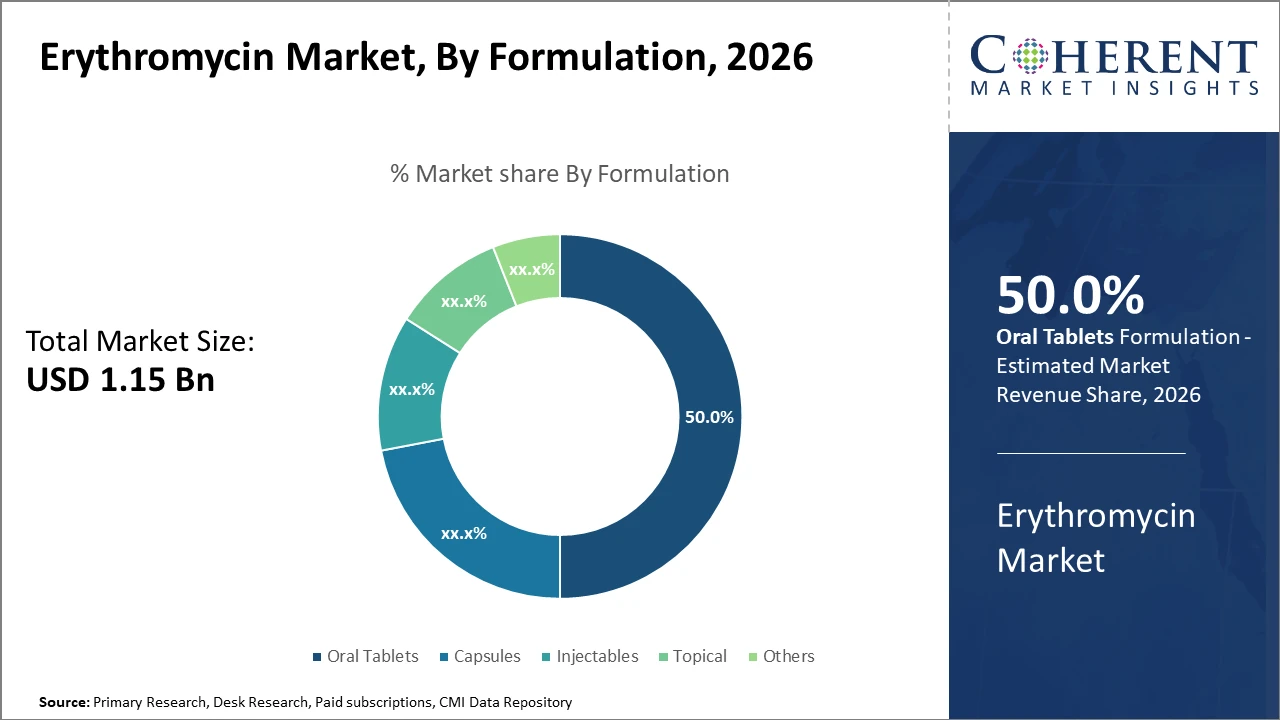
The oral tablets segment dominates the erythromycin market with nearly 50% share in 2026 due to ease of use, patient compliance, and cost-effectiveness in outpatient treatment settings.
Respiratory tract infections represent the largest application segment, contributing over one-third of total market revenue, driven by high global incidence and continued reliance on macrolide antibiotics.
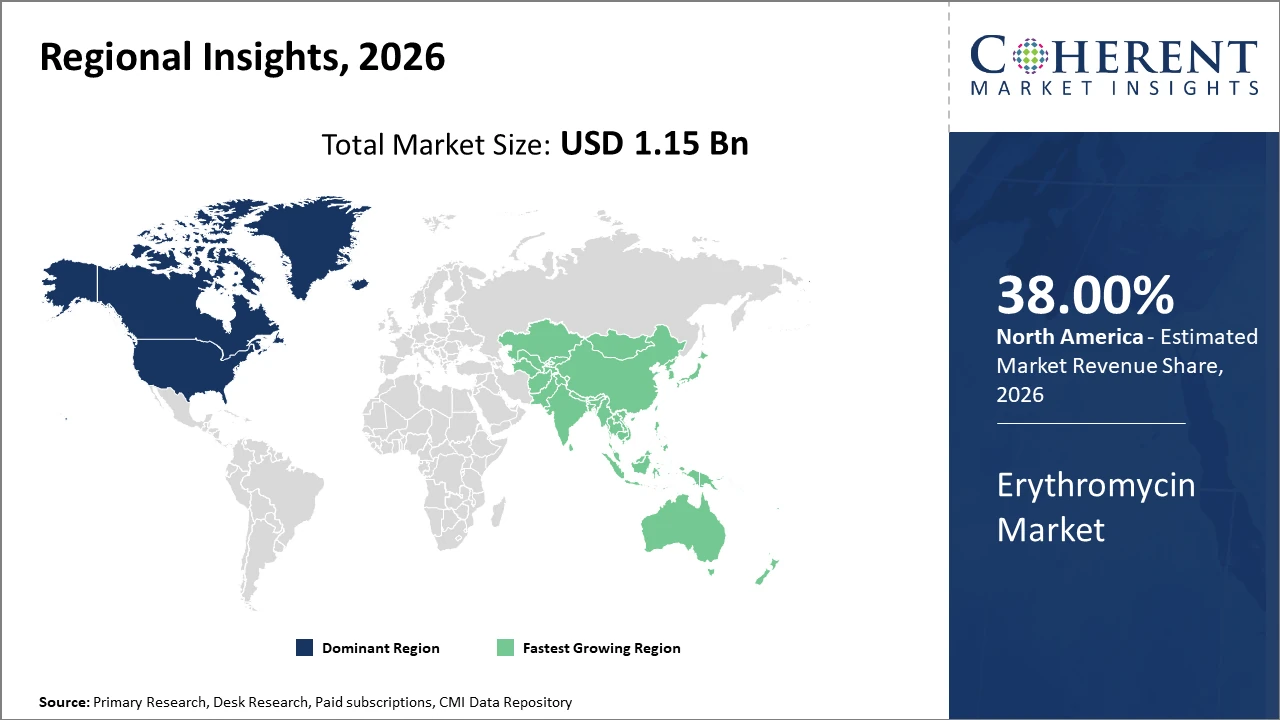
North America holds the leading regional market share at approximately 38%, supported by strong healthcare infrastructure, high antibiotic usage, and significant pharmaceutical R&D investments.
Asia Pacific is the fastest-growing region, registering a CAGR above 7%, fueled by rising infectious disease burden, expanding healthcare access, and strong generic drug manufacturing capabilities.
Growth is further supported by increasing demand for affordable antibiotic formulations and widespread use of erythromycin as an alternative therapy for penicillin-allergic patients.
Erythromycin Market Segmentation Analysis
Erythromycin Market Insights, By Formulation
Oral tablets dominate the erythromycin market with a share of 50% due to their ease of administration, cost-effectiveness, and strong patient adherence, accounting for nearly half of total market revenue. Their widespread use in treating respiratory and skin infections further strengthens demand across outpatient settings. Capsules are experiencing steady growth, supported by improved bioavailability and advanced release formulations that enhance therapeutic outcomes. Injectable erythromycin maintains a stable presence in hospital settings, primarily used for severe or acute infections requiring rapid action. Topical formulations are increasingly adopted in dermatology for localized skin conditions.
Erythromycin Market Insights, By Application
Respiratory tract infections dominate the erythromycin market due to their high global prevalence, including bacterial pneumonia and bronchitis, which continue to drive strong prescription rates. Erythromycin remains widely used as a first-line or alternative therapy in patients allergic to penicillin. Skin infections represent the second-largest segment, supported by increasing cases of acne and bacterial dermatological conditions treated with topical and oral formulations. Gastrointestinal disorders are an emerging growth area, driven by erythromycin’s role as a motilin receptor agonist in prokinetic therapy. Sexually transmitted diseases contribute steady demand, while the “others” segment includes niche applications such as ophthalmic infections and specialized clinical uses.
Erythromycin Market Insights, By Distribution Channel
Hospital pharmacies dominate the erythromycin market due to their critical role in supplying antibiotics for inpatient care and higher utilization of injectable formulations in severe infection cases. Retail pharmacies maintain steady growth, supported by outpatient prescriptions for respiratory and skin infections and strong accessibility across urban and semi-urban regions. Online pharmacies are emerging rapidly, driven by the expansion of telemedicine services and increasing consumer preference for convenient drug access and home delivery. Institutional sales, including government tenders and NGO-led procurement programs, play a key role in emerging and low-income markets by enabling large-scale distribution of erythromycin for public health and infectious disease management initiatives.
Erythromycin Market Trends
The erythromycin market is witnessing a shift toward advanced drug delivery systems, including liposomal and sustained-release formulations, aimed at improving bioavailability and patient compliance.
Combination therapies involving erythromycin are increasingly being developed to address antimicrobial resistance, with several clinical pipelines advancing during 2024–2025.
Growing concerns over antibiotic resistance are encouraging optimized prescribing practices and more targeted therapeutic applications of erythromycin.
Digital health platforms and prescription monitoring systems are improving antibiotic stewardship by reducing misuse and enhancing treatment effectiveness, supporting more stable market growth.
Erythromycin Market Insights, By Geography
North America Erythromycin Market Analysis and Trends
In North America, the erythromycin market with a share of 38% is driven by strong regulatory frameworks and advanced healthcare infrastructure. The United States leads demand due to respiratory infections and antibiotic stewardship programs. Hospitals and pharmacies maintain steady consumption through established distribution networks. Pharmaceutical companies invest in formulation improvements, generics, and resistance management. Growing antimicrobial resistance focus and clinical research strengthen market leadership. Favorable reimbursement and healthcare expenditure support sustained adoption across applications, reinforcing the region’s leadership in global antibiotic consumption and supporting ongoing clinical research and innovation in macrolide therapies while ensuring stable supply and improved patient access across hospitals and retail channels.
Asia Pacific Erythromycin Market Analysis and Trends
Asia Pacific is the fastest-growing region in the erythromycin market, registering a CAGR exceeding 7%, driven by expanding healthcare access, rising infectious disease prevalence, and the presence of cost-efficient pharmaceutical manufacturing hubs. Countries such as India and China play a pivotal role in large-scale production and export of erythromycin and its generics, supported by favorable government policies and strong industrial infrastructure. Increasing investments in pharmaceutical R&D and growing domestic demand further strengthen regional expansion. Additionally, rising healthcare awareness, improved hospital networks, and expanding antibiotic distribution channels are contributing to sustained market growth, positioning Asia Pacific as a key global growth engine.
Erythromycin Market Outlook for Key Countries
USA Erythromycin Market Analysis and Trends
The USA’s erythromycin market is supported by proactive public health initiatives focused on antimicrobial resistance management and a consistently high incidence of respiratory infections. In 2025, erythromycin prescriptions increased by approximately 15%, reflecting sustained clinical reliance on macrolide antibiotics. Major domestic and multinational pharmaceutical companies have strengthened market growth through investments in advanced formulations, including sustained-release and injectable erythromycin products that improve therapeutic efficiency and patient compliance. Regulatory approvals and its inclusion in essential medicines lists have further enhanced accessibility across healthcare settings. Strong hospital infrastructure, well-established outpatient care networks, and ongoing clinical research continue to reinforce steady market expansion in the United States.
Germany Erythromycin Market Analysis and Trends
Germany’s erythromycin market is driven by strong pharmaceutical manufacturing capabilities, high antibiotic consumption rates, and well-established healthcare infrastructure. The country’s demand is primarily supported by respiratory tract infections, dermatological conditions, and ophthalmic applications where erythromycin remains a widely prescribed macrolide antibiotic. Key market trends include a gradual shift toward combination therapies, increasing use of topical formulations in dermatology, and growing preference for targeted antibiotic treatments aligned with antimicrobial stewardship programs. Strict regulatory frameworks under EU guidelines are influencing prescribing patterns and encouraging rational antibiotic use. Additionally, ongoing R&D in formulation improvements and generic drug production continues to shape competitive dynamics and market accessibility in Germany.
Analyst Opinion
Rising production capacities, especially in Asia Pacific, improved supply-side strength, with continuous manufacturing systems boosting erythromycin output by about 12% in 2024.
Expanding therapeutic applications, including combination therapies for diabetic foot ulcers and gastrointestinal motility disorders, contributed nearly 18% of total market revenue in 2025.
Pricing remained relatively stable in 2026 despite inflation and raw material cost pressures, supported by strong supplier partnerships and efficient inventory management across key manufacturing hubs.
Export growth from India and China increased by around 9.4% in 2025, driven by rising demand in Africa and Latin America, strengthening global trade-driven market expansion.
- Current Industry Events of 2026
- Market Size Estimation
- Regional Breakdown
- Competitive Landscape
- Customer Intelligence
- Segmental Analysis
- Pricing Analysis
- Key Market Drivers, Challenges & Future Trends
- Customized Insights Section
Market Scope
| Report Coverage | Details | ||
|---|---|---|---|
| Base Year: | 2025 | Market Size in 2026: | USD 1.15 billion |
| Historical Data for: | 2020 To 2024 | Forecast Period: | 2026 To 2033 |
| Forecast Period 2026 to 2033 CAGR: | 6.5% | 2033 Value Projection: | USD 1.87 billion |
| Geographies covered: |
| ||
| Segments covered: |
| ||
| Companies covered: | Pfizer Inc., Mylan NV, Abbott Laboratories, Lupin Limited, Novartis AG, Sanofi SA, Cipla Limited, Zydus Cadila, Natco Pharma Ltd., Sandoz International GmbH | ||
| Growth Drivers: |
| ||
Erythromycin Market Growth Factors
Erythromycin market growth is primarily driven by the rising global incidence of infectious diseases, particularly lower respiratory tract infections, which remain a major cause of morbidity and mortality in low-income regions. Increasing antibiotic prescriptions, supported by government-led infectious disease control programs, continues to expand market demand and overall market size. Technological advancements in drug delivery, including sustained-release and improved formulation systems, enhance patient compliance and therapeutic effectiveness, further boosting usage. Additionally, growing healthcare expenditure in emerging economies, combined with heightened awareness of antimicrobial resistance, is encouraging physicians to rely on established antibiotics like erythromycin, thereby supporting sustained revenue growth and market expansion.
Erythromycin Market Development
In May 2026, LSL Pharma Group Inc. announced a multi-year agreement to supply erythromycin, produced by its subsidiary Steri-Med Pharma Inc., to hospitals outside Québec. Additionally, Steri-Med’s Sterisporin ophthalmic ointment has been listed by Canada’s two largest pharmacy chains outside Québec, expanding its retail reach nationwide. These developments are projected to add over $4 million in recurring annual revenue for the company.
Key Players
Leading Companies of the Market
Pfizer Inc.
Novartis AG
Abbott Laboratories
Lupin Limited
Mylan NV
Sanofi SA
Cipla Limited
Zydus Cadila
Natco Pharma Ltd
Sandoz International GmbH
Several leading pharmaceutical companies are pursuing aggressive expansion strategies in the erythromycin market through acquisitions, partnerships, and geographic diversification. For instance, companies such as Pfizer Inc. and Teva Pharmaceuticals have strengthened their macrolide antibiotic portfolios by acquiring niche manufacturers, contributing to a combined market share increase of over 4% in 2025. Additionally, Sun Pharmaceutical Industries expanded its distribution and supply chain networks across emerging economies, resulting in a notable 15% rise in erythromycin product revenues in 2024. These strategic initiatives highlight the growing focus on strengthening production capabilities, improving market penetration, and capturing rising demand in both developed and developing healthcare markets globally.
Erythromycin Market Future Outlook
The erythromycin market is expected to witness steady growth driven by persistent demand for macrolide antibiotics in treating respiratory, skin, and ophthalmic infections. Rising global incidence of bacterial infections, coupled with the continued need for effective alternatives in penicillin-allergic patients, will support long-term usage. Future market trends include increased adoption of combination therapies, improved topical and sustained-release formulations, and expanding generic drug penetration to enhance affordability. However, antimicrobial resistance concerns and strict regulatory policies on antibiotic usage may moderate growth. Ongoing R&D focused on optimized dosing, reduced side effects, and improved delivery systems is expected to sustain product relevance across both hospital and outpatient care settings.
Erythromycin Market Historical Analysis
The erythromycin market has evolved significantly over the past decades, beginning with its introduction as one of the first widely used macrolide antibiotics for bacterial infections. Historically, it gained strong adoption as an alternative for patients allergic to penicillin, particularly in treating respiratory tract and skin infections. Over time, widespread generic manufacturing increased accessibility and reduced costs, leading to expanded global usage. However, rising antimicrobial resistance has gradually influenced prescribing patterns, with a shift toward more targeted antibiotic therapies. Despite this, erythromycin has maintained a stable presence in dermatology, ophthalmology, and pediatric care, supported by its broad-spectrum efficacy and established clinical acceptance worldwide.
Sources
Primary Research Interviews:
Infectious disease specialists, clinical pharmacologists, hospital physicians, and microbiologists involved in antibiotic prescription and resistance management.
Procurement managers, hospital pharmacy heads, and R&D teams in pharmaceutical companies producing erythromycin and other macrolide antibiotics.
Regulatory affairs experts, formulation scientists, and product development teams working on antibiotic manufacturing, generic drug production, and controlled release formulations.
Magazines:
Pharmaceutical Executive – Insights into antibiotic commercialization, market access strategies, and pharmaceutical innovation.
Drug Discovery & Development – Coverage of antimicrobial research, drug pipeline developments, and regulatory updates.
Pharma Times – Trends in antibiotic usage, production, and healthcare policy impacts.
Journals:
International Journal of Antimicrobial Agents – Studies on antibiotic development, formulation improvements, and resistance mitigation.
The Lancet Infectious Diseases – Clinical research on infectious disease treatment and antibiotic stewardship.
Antimicrobial Agents and Chemotherapy – Scientific studies on macrolide antibiotics and bacterial resistance mechanisms.
Newspapers:
Financial Times – Coverage of pharmaceutical industry trends, antibiotic demand, and regulatory developments.
Reuters – Reporting on drug approvals, antimicrobial resistance concerns, and pharmaceutical supply updates.
Bloomberg – Market analysis, mergers, and strategic investments in antibiotic manufacturing companies.
Associations:
World Health Organization (WHO) – Global guidelines on antibiotic use, antimicrobial resistance, and infectious disease control.
Infectious Diseases Society of America (IDSA) – Clinical guidelines and research on antibiotic therapy and stewardship.
European Society of Clinical Microbiology and Infectious Diseases (ESCMID) – Research and standards in antimicrobial treatment.
Get access to 250+ pages report
Every segment, forecast, competitor profile and data table behind the analysis above — available for instant download.
- ESOMAR Member
- ISO 9001:2015 Certified
- D-U-N-S Registered
- GDPR & CCPA Compliant
Missing comfort of reading report in your local language? Find your preferred language:
Transform your Strategy with Exclusive Trending Reports
Frequently Asked Questions
The erythromycin market is led by major pharmaceutical companies such as Pfizer Inc., Novartis AG, Lupin Limited, and Cipla Limited. These players maintain strong global positions through extensive product portfolios, established manufacturing capabilities, and robust distribution networks across both developed and emerging markets.
The market is projected to grow from USD 1.15 billion in 2026 to USD 1.87 billion by 2033, registering a CAGR of 6.5%, supported by rising infectious disease incidence and improvements in antibiotic formulations.
Respiratory tract infections represent the largest growth opportunity due to high global prevalence, continued reliance on macrolide antibiotics, and increasing focus on effective outpatient treatment solutions.
Key trends include advancement in drug delivery systems, growing adoption of combination therapies to combat antibiotic resistance, and increased use of digital adherence tools to improve treatment outcomes.
The market is highly competitive, driven by innovation and widespread generic availability. Key challenges include pricing pressure, antimicrobial resistance concerns, and the need for balanced antibiotic stewardship.
Companies focus on mergers and acquisitions, expansion into emerging markets, product diversification, and strategic collaborations with healthcare providers to strengthen distribution and market reach.