

Europe Maternity Wear Market Size and Forecast — 2026-2033
Europe Maternity Wear Market is estimated to be valued at USD 490.9 Mn in 2026 and is expected to reach USD 767.9 Mn in 2033, exhibiting a compound annual growth rate (CAGR) of 6.6% from 2026 to 2033.
Market Drivers
- Growing number of pregnant working women: The increasing number of pregnant working women is driving the growth of the Europe maternity wear market. Expectant and nursing mothers need special protection to prevent harm against their or their infants' health. Pregnancy and maternity are vulnerable for working women. They need adequate time to give birth, recover, and nurse their children. In this condition, maternity wear provides comfort and flexibility to women during or after pregnancy.
- Business tactics are increasingly: The growing adoption of business strategies is projected to foster the market growth. For instance, in January 20, 2021, Isabella Oliver (a premium maternity brand) adopted the market penetration strategy and launched a new rental program to improve its reach and increase the longevity of maternity clothing. The brand offered its customers a new range of options to rent a dress, including party wear and fundamental pregnancy essentials, for two weeks, before returning them free of charge.
Market Restraints:
Fluctuating birth rate is expected to hinder the market growth. Due to lifestyle decisions made in economically prosperous areas where birth control is widely available, mortality rates are low, and raising children can be expensive due to housing, education, and other costs, developed countries tend to have lower fertility rates.
Lack of awareness regarding maternity wear among consumers is expected to hinder the market growth.
Market Opportunities:
- E-commerce industry growth: Expansion of the e-commerce industry due to internet penetration and growing digital literacy is expected to provide potential growth opportunities for the market players. For instance, the key players in the apparel industry, such as Seraphine, Mothercare, Isabella Oliver, and Gap, are focusing on product innovations and launching their products on various online retail platforms to serve the vast consumer base.
- Increasing number of players: Increasing number of players expanding their presence in the market is again projected to bring promising opportunities for the market. For instance, in October 2021, Seraphine opened a maternity store in New York and LA .
Market Trends:
The growing trend of buying cloths on rent is expected to uplift
The growing trend of buying cloths on rent is expected to uplift the market growth. For instance, in November 2021, Hyper and Boob Collaborates to provide clothes on rent. This will make it possible to rent smart and multifunctional clothes for pregnancy.
New product launches by key players will also favor the market growth. For instance, in March 2021, a U.K.-based premium maternity brand, Isabella Oliver launched its first 100 percent sustainable and ethical maternity capsule collection for Spring/Summer 2021, as part of its continuing commitment to “drive lasting positive change in the fashion industry with sustainable practices and an ethical supply chain.”
- Current Industry Events of 2026
- Market Size Estimation
- Regional Breakdown
- Competitive Landscape
- Customer Intelligence
- Segmental Analysis
- Pricing Analysis
- Key Market Drivers, Challenges & Future Trends
- Customized Insights Section
Europe Maternity Wear Market Report Coverage
| Report Coverage | Details | ||
|---|---|---|---|
| Base Year: | 2025 | Market Size in 2026: | USD 490.9 Mn |
| Historical Data for: | 2020 To 2024 | Forecast Period: | 2026 To 2033 |
| Forecast Period 2026 to 2033 CAGR: | 6.6% | 2033 Value Projection: | USD 767.9 Mn |
| Geographies covered: |
| ||
| Segments covered: |
| ||
| Companies covered: | Gap Inc., Seraphine, Isabella Oliver., H and M Hennes and Mauritz AB., Brunelli and co. S. R. L, Mothercare, Boob Design, Pink Blush Maternity, Organic & More, and Adidas America Inc | ||
| Growth Drivers: |
| ||
| Restraints & Challenges: |
| ||
Market Segmentation
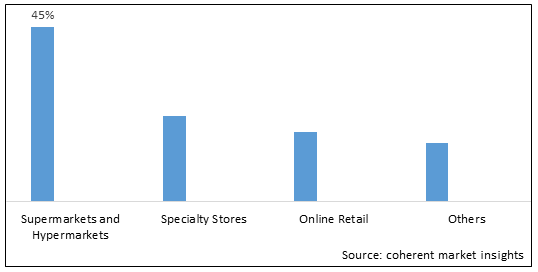
- Europe Maternity Wear Market by Distribution Channel in 2026: The supermarkets and hypermarkets segment held a dominant position in the Europe maternity wear market in 2026, accounting for 45% shares in terms of volume, followed by specialty stores, online retail, and others, respectively.
Figure 1. Europe Maternity Wear Market by Distribution Channel in 2026
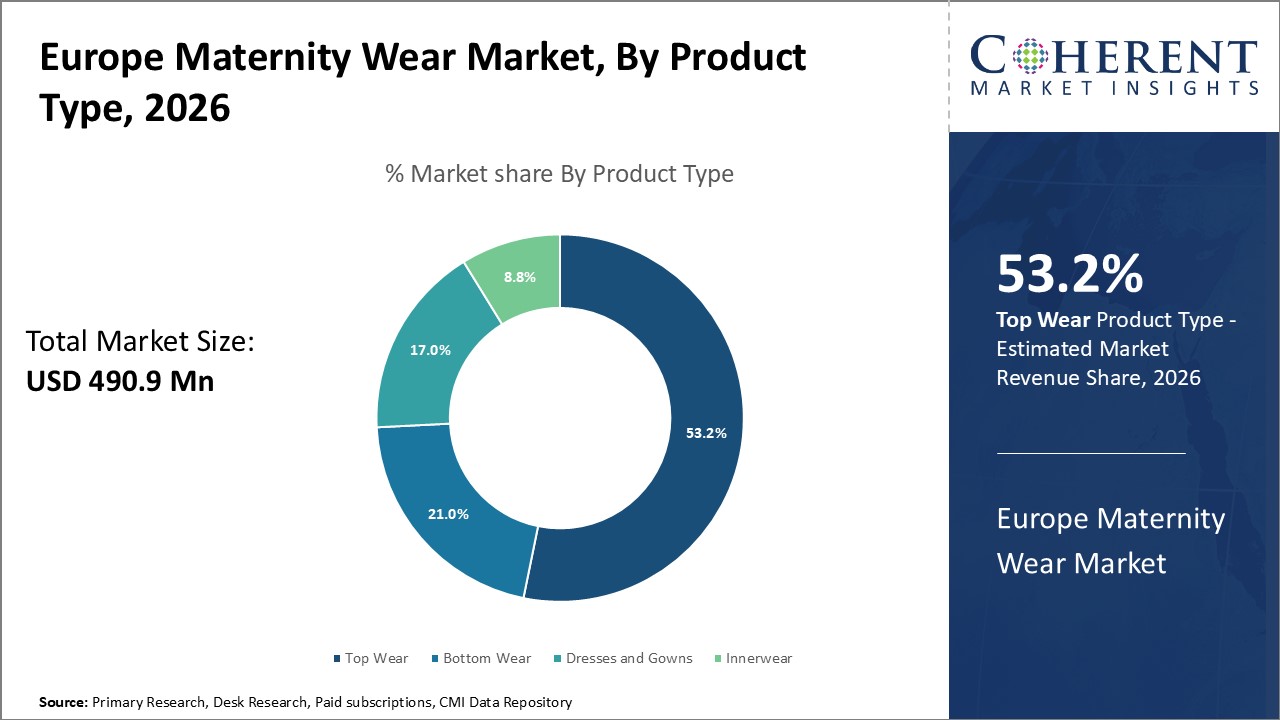
- Europe Maternity Wear Market, by Product Type, in 2022: The top wear product segment held a dominant position in the Europe maternity wear market in 2026, accounting for 53.2% shares in terms of volume, followed by bottom wear, dresses and gowns, and innerwear, respectively.
Figure 2. Europe Maternity Wear Market, by Product Type, in 2026
In comparison, imports of textile products in Europe increased by 154.2% over the same period last year (April-June ).
Key Development
- In September 2020, launched its first-ever maternity active wear into the market. The Nike (M) collection, which retailed for US 45 to $85 online, was released on September 17 2020. It consists of four products that are tailored to the changing needs of women's bodies before, during, and after pregnancy.
- In April 2021, launched a range of maternity lingerie. Manufacturers are increasingly incorporating stretchable materials, such as elastane and spandex, in maternity wear, as the demand for fashionable products has risen recently.
- In November 2021, Hyper + Boob designed collaborates to provide clothes on rent. The two pioneers of sustainability initiated a cooperation that will make it possible to rent smart and multifunctional clothes for pregnancy. The companies hope to establish a new consumer behavior where renting clothes becomes a natural alternative for expectant and new mothers.
Competitive Landscape:
Key players Gap Inc., Seraphine, Isabella Oliver., H and M Hennes and Mauritz AB., Brunelli and co. S. R. L, Mother care, Boob Design, Pink Blush Maternity, Organic & More, and Adidas America Inc.
Sources
Primary Research Interviews:
- Buyers at European maternity retailers (Mamas & Papas, Boobs & Bloom)
- European maternity brand founders and merchandising heads
- D2C maternity e-commerce platform managers
- Textile and fabric suppliers
Databases:
- Euromonitor International (Apparel and Footwear Europe)
- NielsenIQ Europe retail measurement
- Mintel UK/EU Mother and Baby
- Edited apparel retail analytics
Magazines:
- Drapers
- Vogue Business
- FashionUnited Europe
- The Industry.fashion
Journals:
- Journal of Fashion Marketing and Management
- International Journal of Clothing Science and Technology
- Maternal & Child Nutrition (related apparel/wearables)
- Journal of Consumer Behaviour
Newspapers:
- Financial Times
- The Guardian
- Le Monde
- Reuters
Associations:
- British Retail Consortium (BRC)
- EURATEX (European Apparel and Textile Confederation)
- Baby Products Association (UK)
- European Maternity & Infant Industry forums
Public Domain Sources:
- Eurostat retail and apparel trade data
- UK ONS retail statistics
- Company filings (H&M, Inditex/Zara, Mothercare/Boots)
- HMRC and EU customs data (HS 6104)
Proprietary Elements
- CMI Data Analytics Tool, Proprietary CMI Existing Repository of information for last 10 years.
*Definition: Maternity wear is clothing worn by women who are pregnant. The purpose of the clothing is to accommodate the change in body size during pregnancy. Maternity clothing originated during the middle ages and was only later made when women became more selective.
Get access to 250+ pages report
Every segment, forecast, competitor profile and data table behind the analysis above — available for instant download.
- ESOMAR Member
- ISO 9001:2015 Certified
- D-U-N-S Registered
- GDPR & CCPA Compliant
Missing comfort of reading report in your local language? Find your preferred language:
Transform your Strategy with Exclusive Trending Reports
Frequently Asked Questions
The Europe Maternity Wear Market is estimated to be valued at USD 490.9 Mn in 2026, and is expected to reach USD 767.9 Mn by 2033.
The CAGR of the Europe Maternity Wear Market is projected to be 6.6% from 2026 to 2033.
The growing number of pregnant working women is fuelling the market growth.
The supermarkets and hypermarkets segment is the leading component segment in the market.
Fluctuating birth rate is the major factor restraining the market growth.
The major players operating in the Europe maternity wear market are Gap Inc., Seraphine, Isabella Oliver., H and M Hennes and Mauritz AB., Brunelli and co. S. R. L, Mothercare, Boob Design, Pink Blush Maternity, Organic & More, and Adidas America Inc.