

Extracorporeal Shock Wave Lithotripsy Market Size and Forecast – 2026 to 2033
The Extracorporeal Shock Wave Lithotripsy Market is anticipated to grow at a CAGR of 3.9% with USD 5.1 Bn in 2026 and is expected to reach USD 6.2 Bn in 2033. Rising kidney stone prevalence drives the Extracorporeal Shock Wave Lithotripsy market as patients increasingly choose non-invasive procedures with shorter hospital stays.
Key Takeaways
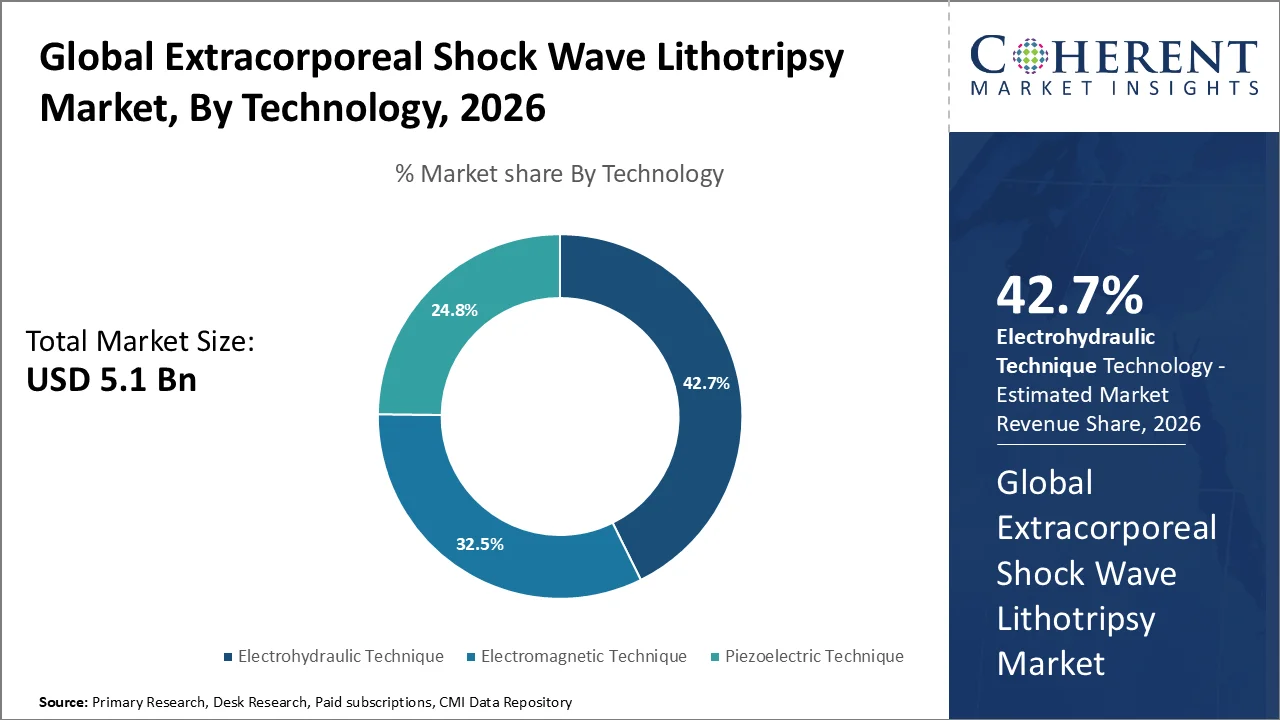
- Electrohydraulic Technique hold the largest market share of 42.7% in 2026 owing to the rising prevalence of kidney and urinary stones. Approximately 1 in 500 people in the United States develops kidney stone disease each year.
- Pancreatic Stones expected to hold largest market share of 38.9% in 2026 owing to its high occurrence of pancreatic duct stones in chronic pancreatitis. Pancreatic duct stones occur in up to 50% of patients with chronic pancreatitis, while 20–40% may develop pancreatic pseudocysts.
- Hospital acquired the prominent market share of 53.7% in 2026 owing to its availability of specialized urology departments.
- North America is expected to acquire the dominant share of 41.3% in 2026 owing to the increasing incidence and recurrence of urolithiasis. Urolithiasis has an estimated 50% recurrence rate within five years.
Current Events and Their Impact on the Extracorporeal Shock Wave Lithotripsy Market
Current Event | Description and its Impact |
FDA Clearance of a New Extracorporeal Shock Wave Lithotripter in January 2026 |
|
FDA Clearance of the U200 Extracorporeal Shock Wave Lithotripter in 2025 |
|
Segmental Insights
- Current Industry Events of 2026
- Market Size Estimation
- Regional Breakdown
- Competitive Landscape
- Customer Intelligence
- Segmental Analysis
- Pricing Analysis
- Key Market Drivers, Challenges & Future Trends
- Customized Insights Section
Why is Electrohydraulic Technique Acquiring the Largest Market Share?
Electrohydraulic Technique hold the largest market share of 42.7% in 2026. The electrohydraulic technique segment in the Extracorporeal Shock Wave Lithotripsy market benefits from its established clinical application, effective stone-fragmentation performance, and relatively broad treatment area. The technology uses an underwater electrical discharge to generate focused shock waves that efficiently break urinary stones. Its long clinical history has strengthened urologists’ familiarity and encouraged adoption in hospitals and specialized stone-treatment centers. Ongoing technological advances that extend electrode life and improve energy consistency further enhance the effectiveness and commercial relevance of electrohydraulic lithotripsy. For instance, Halliburton launched the Turing electro-hydraulic control system as the next generation of its SmartWell intelligent completion technology. The system supports a wide range of completion applications, enhances hydrocarbon recovery, and helps operators reduce the number of wells required.
Pancreatic Stones expected to hold largest market share
Pancreatic Stones expected to hold largest market share of 38.9% in 2026 owing to its limitations of conventional endoscopic stone extraction. Pancreatic stones support growth in the Extracorporeal Shock Wave Lithotripsy market because chronic pancreatitis can form obstructive stones in the main pancreatic duct, causing pain and disrupting pancreatic drainage. ESWL provides a non-surgical approach that fragments large, radiopaque stones that conventional endoscopic techniques may struggle to remove. By breaking stones into smaller fragments, ESWL facilitates subsequent extraction and helps relieve ductal obstruction. Clinical guidelines also identify ESWL as an important treatment option for appropriately selected patients with larger obstructive pancreatic duct stones. Olympus launched the StoneMasterV and VorticCatchV EndoTherapy devices to improve bile duct stone management and retrieval during ERCP procedures.
Which End User segment dominates the market?
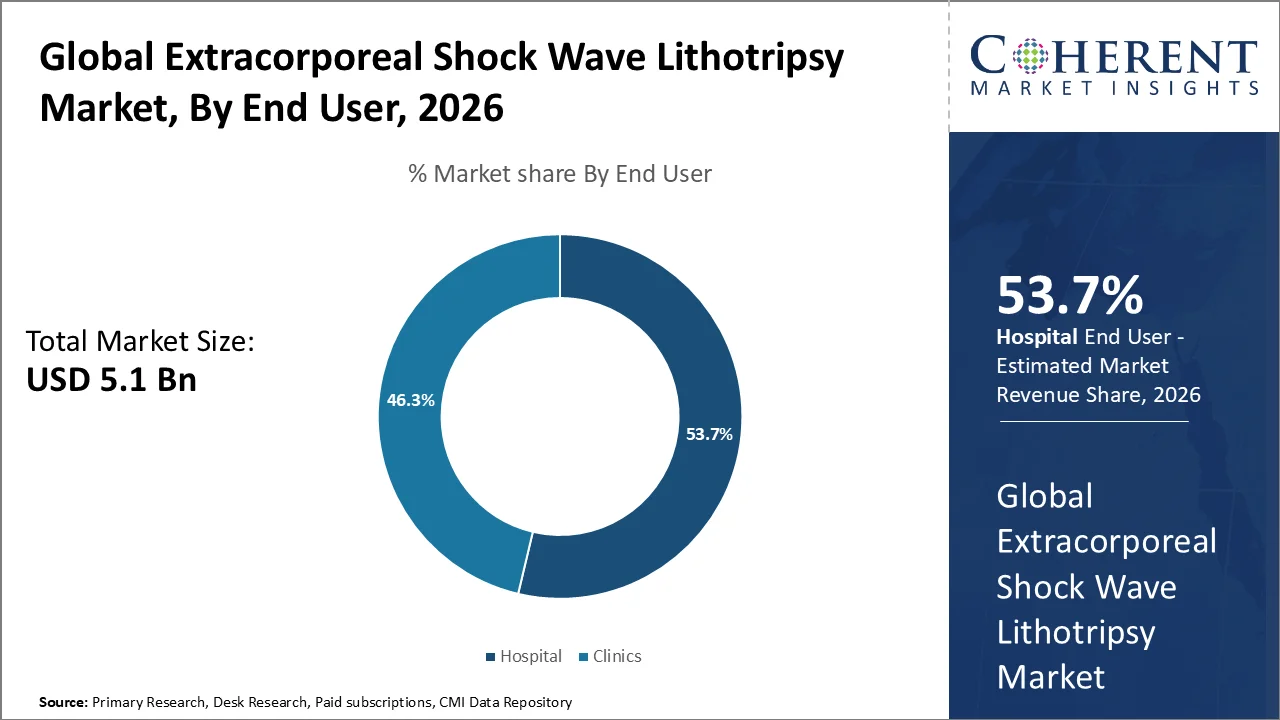
Hospital acquired the prominent market share of 53.7% in 2026. Hospitals support the growth of the Extracorporeal Shock Wave Lithotripsy market by providing specialized urology departments, advanced diagnostic imaging, anesthesia services, and multidisciplinary clinical teams. They manage high patient volumes and complex stone cases, which increases the use of ESWL systems. Hospitals also deliver comprehensive pre- and post-procedure care, allowing physicians to combine lithotripsy with alternative treatments when required. Expanding healthcare infrastructure, ongoing technology upgrades, and rising adoption of minimally invasive stone-treatment procedures further increase hospital demand for ESWL equipment and services.
Extracorporeal Shock Wave Lithotripsy Market Trends
- Rising use of minimally invasive stone-treatment approaches continues to support demand for ESWL, ureteroscopy, and other endourological procedures. NICE recommends SWL or ureteroscopy for adults with renal or ureteric stones depending on stone size and location. For renal stones larger than 10 mm but no larger than 20 mm, NICE recommends considering SWL or ureteroscopy, with PCNL considered when SWL or ureteroscopy is unsuitable.
- Advances in lithotripsy technology are reflected in continued FDA clearance of new ESWL systems. In January 2026, the FDA cleared Sonomotion's Break Wave extracorporeal shock wave lithotripter through the 510(k) pathway. The device is classified as a Class II urological extracorporeal shock-wave lithotripter under Product Code LNS. This demonstrates continued development and regulatory entry of new lithotripsy platforms.
- ESWL is also used in the management of pancreatic duct stones in appropriately selected patients. The American Gastroenterological Association recommends ESWL for larger pancreatic duct stones (>5 mm) that are radiopaque and located in the head or body of the pancreas, when endoscopic removal is appropriate.
Regional Insights
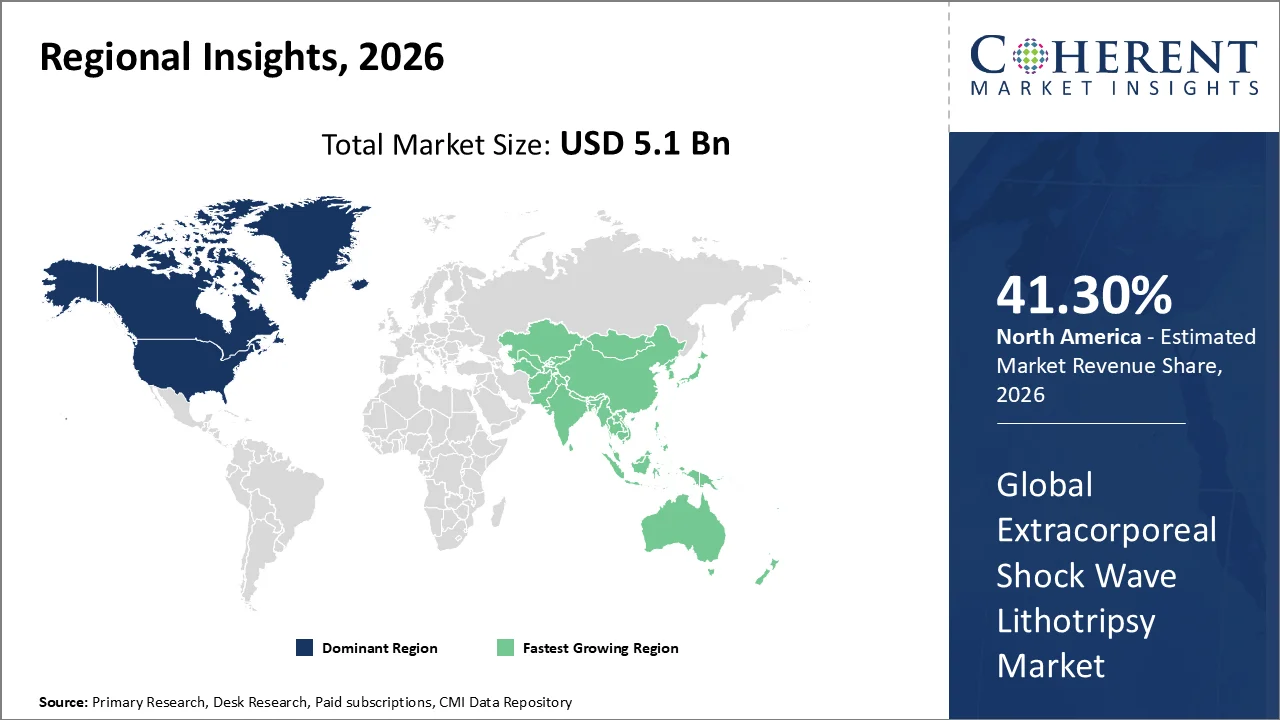
North America dominates owing to demand for repeated and follow-up treatments
North America is expected to acquire the dominant share of 41.30% in 2026. North America supports the growth of the Extracorporeal Shock Wave Lithotripsy market through its high kidney stone burden, advanced urology infrastructure, and strong preference for minimally invasive treatments. Hospitals and specialized centers employ skilled urologists, advanced imaging technologies, and modern lithotripsy systems to treat patients effectively. Favorable reimbursement policies, increasing healthcare spending, and innovations in shock-wave delivery further strengthen market demand. Moreover, growing preference for outpatient procedures and shorter recovery periods encourages healthcare providers to use ESWL for appropriately selected patients. In September 2025, Dornier MedTech America launched the Dornier Hoover FANS and Axis II Slim single-use ureteroscope nationwide in the U.S. following FDA clearance.
Asia Pacific Extracorporeal Shock Wave Lithotripsy Market Trends
The Asia Pacific extracorporeal shock wave lithotripsy market benefits from the growing prevalence of kidney and urinary stones, expanding healthcare infrastructure, and rising demand for minimally invasive procedures. Healthcare providers in China and India are investing in hospital modernization, improving access to advanced lithotripsy systems. Higher healthcare spending, the expansion of specialty clinics, and increasing awareness of noninvasive stone treatments are further boosting market demand. Additionally, affordable treatment options, medical tourism, and mobile lithotripsy services are helping providers extend treatment access and accelerate adoption across the region. JIPMER installed the advanced Dornier Delta III extracorporeal shock-wave lithotripsy system in its Urology Department, inaugurated by Medical Superintendent Dr. Ashok Shankar Rao Badhe.
United States Extracorporeal Shock Wave Lithotripsy Market Trends
The United States extracorporeal shock wave lithotripsy market benefits from the growing prevalence of kidney stones, rising demand for minimally invasive procedures, and greater awareness of non-surgical stone treatment. Manufacturers continue to advance lithotripsy systems with improved imaging, targeting, and shock-wave technologies, helping clinicians enhance treatment accuracy and patient outcomes. Robust healthcare infrastructure, well-established urology services, expanding outpatient facilities, and favorable reimbursement policies further drive adoption. Moreover, higher healthcare spending and broader access to advanced treatment centers continue to strengthen market development nationwide. In 2025, U.S. healthcare spending was estimated at USD 5.7 trillion, equivalent to approximately USD 15,500–USD 16,000 per person and 18.4% of GDP.
China Extracorporeal Shock Wave Lithotripsy Market Trends
China’s extracorporeal shock wave lithotripsy market grows as kidney and urinary stone cases increase, patients seek minimally invasive treatments, and healthcare infrastructure expands. Hospitals and specialty clinics increasingly adopt ESWL systems as awareness of non-invasive stone management rises. Manufacturers are improving imaging technologies, energy modulation, and portable lithotripsy devices to enhance treatment accuracy and accessibility. Government initiatives to strengthen healthcare services also support market growth, while an aging population and rising lifestyle-related metabolic disorders increase the need for advance lithotripsy solutions.
Who are the Major Companies in Extracorporeal Shock Wave Lithotripsy Industry
Some of the major key players in Extracorporeal Shock Wave Lithotripsy are Boston Scientific Corporation, C.R. Bard Inc., Lumenis LTD, GE Healthcare and Siemens AG.
Key News
- In May 2026, EDAP TMS S.A. rebranded as FocalTherics to focus exclusively on robotic focal therapy and plans to classify its ESWL and Distribution segments as discontinued operations from Q2 2026.
Market Report Scope
Extracorporeal Shock Wave Lithotripsy Market Report Coverage
| Report Coverage | Details | ||
|---|---|---|---|
| Base Year: | 2025 | Market Size in 2026: | USD 5.1 Bn |
| Historical Data for: | 2020 To 2024 | Forecast Period: | 2026 To 2033 |
| Forecast Period 2026 to 2033 CAGR: | 3.9% | 2033 Value Projection: | USD 6.2 Bn |
| Geographies covered: |
| ||
| Segments covered: |
| ||
| Companies covered: | Boston Scientific Corporation, C.R. Bard Inc., Lumenis LTD, GE Healthcare and Siemens AG. | ||
Analyst Opinion
- ESWL demand is fundamentally tied to the persistent burden of urinary stones, not discretionary healthcare spending. Global estimates indicate that kidney stones affect roughly 1 in 11 people, with lifetime risk continuing to rise across many populations. From an analyst perspective, this creates a durable procedural base for extracorporeal shock wave lithotripsy, particularly as clinicians favor non-invasive stone management before moving to more invasive interventions.
- The clinical value of ESWL remains strongest when patient selection is disciplined. Published clinical evidence generally reports stone-free rates of about 60–90% for appropriately selected renal and ureteral stones, although outcomes vary substantially with stone size, composition, location, and patient anatomy. This variability is not a weakness of the technology; it is the key reason imaging quality and treatment planning increasingly determine ESWL utilization.
- Technological refinement is shifting ESWL from a basic fragmentation procedure toward a precision-driven treatment. Modern systems combine improved fluoroscopic or ultrasound localization, real-time targeting, adjustable shock-wave energy, and more sophisticated patient positioning. Clinical studies have shown that lower-frequency shock-wave delivery can improve stone clearance while reducing tissue injury in selected cases. This will favor vendors that can demonstrate measurable improvements in targeting accuracy, retreatment rates, and patient tolerance rather than simply offering higher energy output.
- The strongest growth opportunity lies in expanding ESWL’s role within outpatient and day-care urology. ESWL can often avoid surgical incisions and, depending on the clinical setting and patient profile, reduce the need for prolonged hospitalization. That economic and operational advantage becomes particularly important as hospitals face pressure to increase procedural throughput while controlling resource utilization. Purchasing decisions to increasingly prioritize treatment efficiency, workflow integration, and patient turnover alongside clinical performance.
Speak to the analyst
Want personalized insights?
Take the findings above to one of our principal consultants, or have the report rebuilt around the segments, geographies and competitors you actually track.
Market Segmentation
- By Technology (Revenue, USD Bn, 2021-2033)
- Electrohydraulic Technique
- Electromagnetic Technique
- Piezoelectric Technique
- By Application (Revenue, USD Bn, 2021-2033)
- Kidney Stones
- Uretic Stones
- Pancreatic Stones
- Salivary Stones
- By End User (Revenue, USD Bn, 2021-2033)
- Hospital
- Clinics
- By Region (Revenue, USD Bn, 2021-2033)
- North America
- U.S.
- Canada
- Latin America
- Brazil
- Mexico
- Argentina
- Rest of Latin America
- Europe
- Germany
- U.K.
- France
- Italy
- Spain
- Russia
- Rest of Europe
- Asia Pacific
- China
- India
- Japan
- Australia
- South Korea
- ASEAN
- Rest of Asia Pacific
- Middle East
- GCC
- Israel
- Rest of Middle East
- Africa
- South Africa
- Central Africa
- North Africa
- North America
Sources
Primary Research interviews
- Urologists and endourology specialists
- Hospital procurement and medical equipment managers
- ESWL technicians and clinical engineers
- Hospital administrators and department heads
- Distributors and healthcare technology specialists
Databases
- PubMed/MEDLINE
- ClinicalTrials.gov
- Cochrane Library
- Scopus
- Web of Science
- WHO Global Health Observatory
- U.S. FDA medical device databases
Magazines
- Urology Times
- European Urology Today
- Urology News
- Medical Device Network
Journals
- European Urology
- Journal of Urology
- Urology
- Journal of Endourology
- World Journal of Urology
- Urological Research
- Journal of Clinical Urology
Newspapers
- The New York Times
- The Guardian
- The Times of India
- The Economic Times
- Reuters
Associations
- European Association of Urology (EAU)
- American Urological Association (AUA)
- Endourological Society
- American Society of Anesthesiologists
- Urological Society of India
Public Domain sources
- World Health Organization (WHO)
- U.S. Food and Drug Administration (FDA)
- National Institutes of Health (NIH)
- National Library of Medicine (NLM)
- Centers for Disease Control and Prevention (CDC)
- European Medicines Agency (EMA)
- European Association of Urology Guidelines
- National health ministry and government healthcare databases
Proprietary Elements
- CMI Data Analytics Tool
- Proprietary CMI Existing Repository of information for last 10 years
Get access to 250+ pages report
Every segment, forecast, competitor profile and data table behind the analysis above — available for instant download.
- ESOMAR Member
- ISO 9001:2015 Certified
- D-U-N-S Registered
- GDPR & CCPA Compliant
Missing comfort of reading report in your local language? Find your preferred language:
Transform your Strategy with Exclusive Trending Reports
Frequently Asked Questions
The Extracorporeal Shock Wave Lithotripsy Market is anticipated to grow at a CAGR of 3.9% with USD 5.1 Bn in 2026 and is expected to reach USD 6.2 Bn in 2033.
The market is primarily driven by the increasing burden of kidney and urinary stones, demand for non-invasive treatment, and the expansion of outpatient urology services.
ESWL remains attractive because it can fragment suitable stones without surgical incisions and can support faster recovery.
Key technologies include electrohydraulic, electromagnetic, and piezoelectric lithotripsy. Advances in targeting, imaging, and energy delivery are becoming increasingly important differentiators among systems.
Kidney and ureteral stones remain the principal applications. Clinical suitability depends on factors such as stone size, location, composition, anatomy, and the patient's overall condition.
Modern systems increasingly integrate improved imaging, precise stone localization, patient positioning, and controlled shock-wave delivery.