

Fall Detection Systems Market Size and Trends: 2026-2033
Fall detection systems market is estimated to be valued at USD 8,379 Mn in 2026 and is expected to reach USD 15,752 Mn by 2033, exhibiting a compound annual growth rate (CAGR) of 9.4% from 2026 to 2033.
Key Takeaways
- Based on Product Type, the Automated Detection Systems segment is expected to lead the market with 62% share in 2026.
- Based on Sensing Modalities, the Wearable segment is expected to lead the market with 68% share in 2026.
- Based on Technology, the Mobile Phones segment is expected to lead with 35% share in 2026.
- Based on Component, the Accelerometer & Gyroscope segment is projected to lead with 43% share in 2026.
- Based on End User, the Home Care Settings segment is expected to lead with 58% share in 2026.
- Based on Region, North America is set to lead the fall detection systems market with 45% share in 2026. While, Asia Pacific is anticipated to be the fastest growing region.
Market Overview
The increasing use of wearable health devices and IoT-based monitoring systems among the elderly is fueling the growth of the fall detection systems market. Rising awareness regarding senior safety, as well as the growing number of people suffering from chronic diseases and mobility disorders, is increasing the demand for automated fall detection solutions. Companies are also working on developing new products such as wearable watches, necklaces, and clip-on solutions with real-time alert notifications, GPS location tracking, and mobile app connectivity. Additionally, the development of home care services, assisted living facilities, and smart healthcare infrastructure is also having a positive impact on the market.
Current Events and their Impacts on the Fall Detection Systems Market
Current Events | and its impact |
Global Aging Population Demographics and Healthcare Policy Shifts |
|
AI and IoT Technological Breakthrough Convergence |
|
How is product innovation driving the growth in fall detection systems?
- AI and Multimodal Detection: Using artificial intelligence and multiple types of sensors (both wearable and environmental) to improve the accuracy of detecting and preventing falls.
- Small and Discreet Devices: Making and designing lightweight, stylish, and unobtrusive devices like watches, necklaces, and clip-on devices to encourage more seniors to use them.
- Mobile & Cloud Integration: Connecting to health management systems, apps, and smartphones for remote monitoring and analysis.
- Current Industry Events of 2026
- Market Size Estimation
- Regional Breakdown
- Competitive Landscape
- Customer Intelligence
- Segmental Analysis
- Pricing Analysis
- Key Market Drivers, Challenges & Future Trends
- Customized Insights Section
Segmental Insights
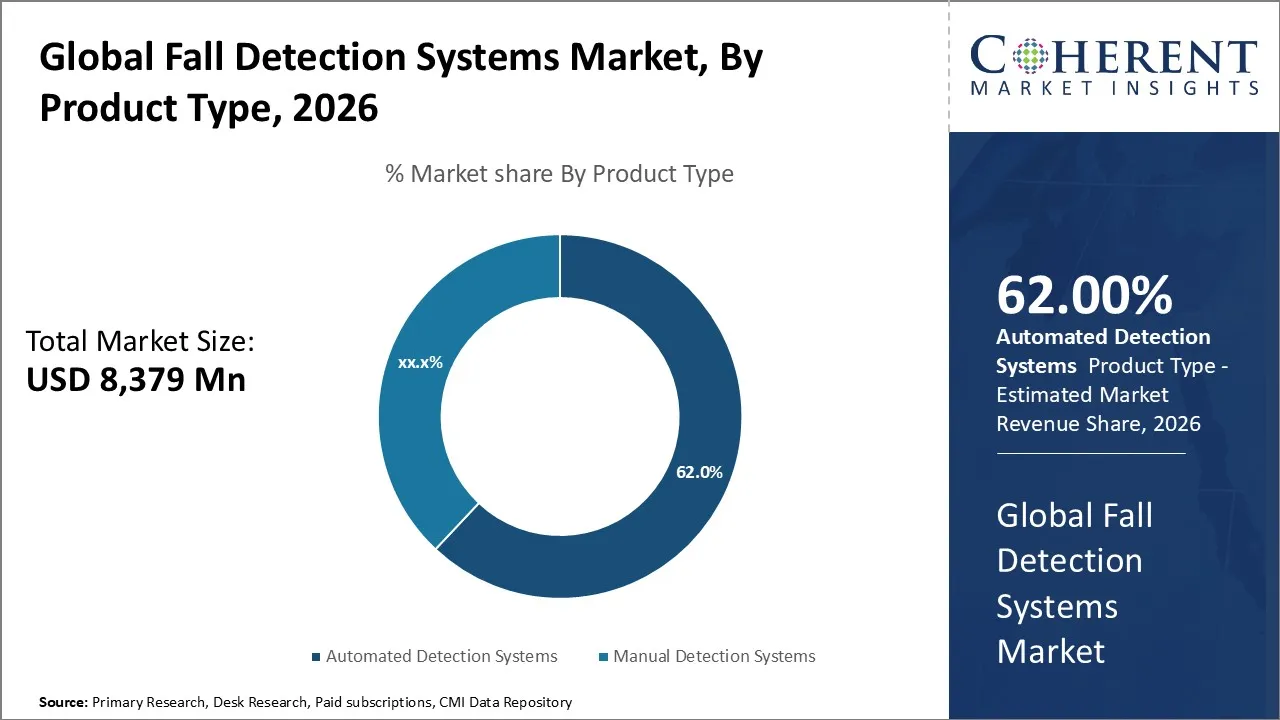
Fall Detection Systems Market Insights, By Product Type – Automated Detection Systems lead due to real-time IoT integration
On the basis of product type, the Automated Detection Systems segment is anticipated to provide the highest market share of 62% in 2026, owing to its ability to detect falls in real-time and the presence of IoT platforms. The system automatically alerts caregivers and medical professionals, ensuring a quicker response time and greater safety for seniors.
For instance, in January 2025, Kami Vision unveiled Kami Fall Detect Camera. The Kami Fall Detect Camera is an AI-powered fall detection solution for homeowners and caregivers that uses vision AI to detect falls and automatically send notifications through connected apps and services
Fall Detection Systems Market Insights, By Sensing Modalities – Wearables dominate due to convenience and portability
Based on the sensing modalities, the Wearable segment is expected to have the largest market share of 68% in 2026. Wearable devices such as watches, necklaces, and clip-on sensors are preferred by consumers because of their discreet nature, portability, and ability to continuously monitor. Wearables also provide seamless connectivity with mobile applications, which support notifications and activities remotely.
For instance, in November 2024, Brighton Solutions introduced the Stride Smartwatch, a wearable device that provides senior safety functionality such as fall detection, GPS, and wellness tracking, which improves senior independence and emergency response.
Fall Detection Systems Market Insights, By Technology – Mobile phones drive adoption through smart connectivity
Based on technology, the Mobile Phones segment is projected to have the largest market share of 35% in 2026. The fall detection solution for smartphones enables instant alerts, GPS location, and cloud storage of data, which helps caregivers monitor patients in real-time.
For instance, in April 2024, Binah.ai announced a fall detection functionality that will be available as of Q2 2024 in the Binah Connect mobile app and SDK, allowing phones to continuously monitor for falls and other health parameters.
Fall Detection Systems Market Insights, By Component – Accelerometer & Gyroscope lead due to high motion detection accuracy
On the basis of component, the Accelerometer & Gyroscope segment is anticipated to hold the largest market share of 43% in 2026. This is due to the sensor's accelerometer and gyroscope's high degree of accuracy in detecting motion, impact, and orientation changes,all of which are necessary for precise fall detection.
For instance, in July 2024, Samsung Electronics announced the Galaxy Watch Ultra and Watch7 line, which features an accelerometer and gyroscope sensor that supports fall detection among other health and safety features.
Fall Detection Systems Market Insights, By End User – Home care settings dominate as aging-in-place trends increase demand
Based on end user, the Home Care Settings segment is expected to account for the highest market share of 58% in 2026. The growing demand for aging in place and independent living among the elderly is fueling the demand for home-based fall detection systems.
For instance, in January 2025, Kami Vision Inc. announced the Kami Fall Detect Camera, an A.I.‑powered fall detection system designed for home use.
Regional Insights
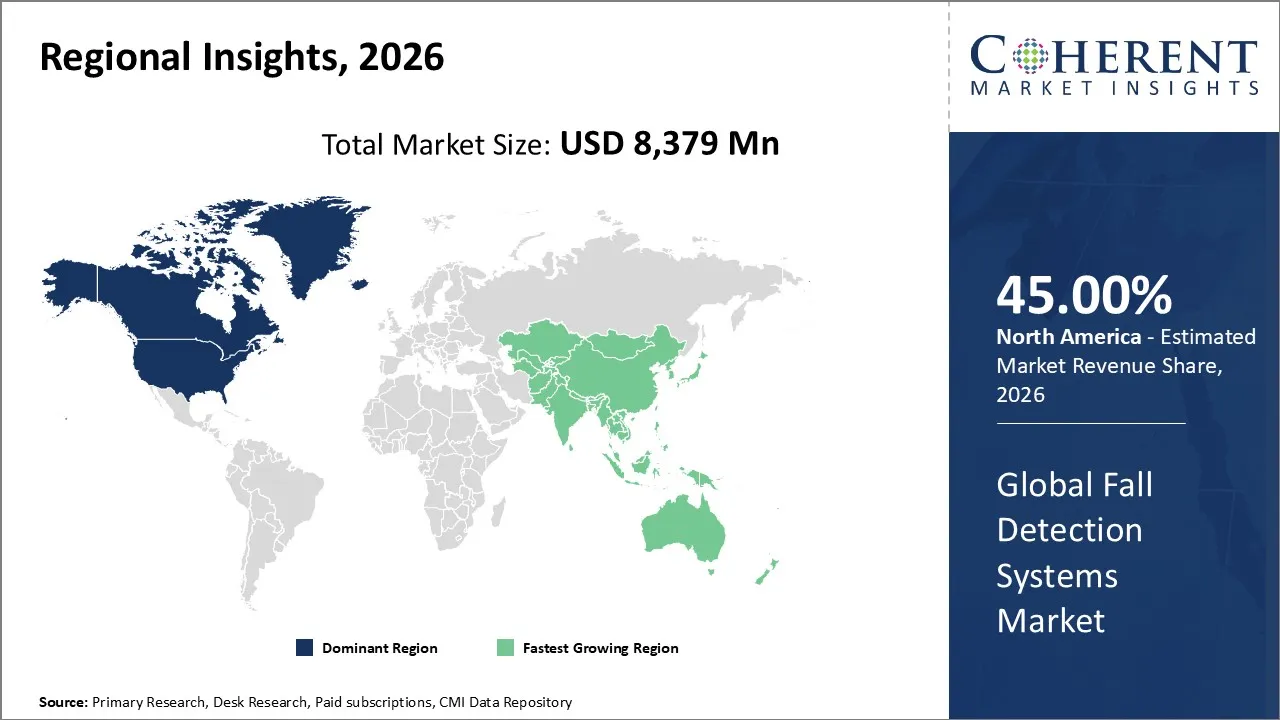
North America Fall Detection Systems Market Analysis & Trends
North America is projected to lead the fall detection systems market in 2026, with a forecasted market share of 45%. The fall detection systems market in North America is growing because of things like a well-developed healthcare system, a high rate of adoption of wearable and IoT-enabled fall detection solutions, key technology providers, and an aging people.
Asia Pacific Fall Detection Systems Market Analysis & Trends
The Asia Pacific market shows the most significant growth in the fall detection systems market, attributed to the growing awareness of health issues, rising disposable incomes, and the adoption of smart healthcare solutions in China, Japan, and India. New entrants in the market are offering cost-effective and technology-based fall detection solutions for home care and assisted living facilities.
For instance, in March 2025, FallCall Solutions partnered with RANiX Co., Ltd. to launch an AI-powered radar-based fall prevention system designed for hospital and home care applications. This innovation demonstrates how Asia Pacific is embracing advanced sensor technologies to improve elderly care and fall prevention.
Fall Detection Systems Market Outlook for Key Countries
Is the U.S. home care fall detection market expanding due to senior independence and smart healthcare adoption?
The U.S. home care fall detection systems market is growing at a rapid pace due to the increasing adoption of intelligent fall detection systems, wearable devices, and AI-enabled home solutions that enable the elderly to live independently while giving caregivers and families peace of mind. The use of fall detection systems in private homes and home healthcare initiatives has increased due to the aging population and the need for preventive safety measures.
Is China’s eldercare and smart health push boosting home care fall detection adoption?
In China, the factors of a rapidly aging population and the development of smart healthcare infrastructure are driving the adoption of fall detection solutions in a home environment. The development of elderly care technology, such as wearable fall detection and cloud-connected fall alerts, is in line with the country’s focus on promoting preventive eldercare.
For instance, in March 2025, China’s eldercare sector reported rapid integration of AI-powered robotics into elderly care services, driven by the country’s aging population and technological innovation in AI and robotics.
Market Report Scope
Fall Detection Systems Market Report Coverage
| Report Coverage | Details | ||
|---|---|---|---|
| Base Year: | 2025 | Market Size in 2026: | USD 8,379 Mn |
| Historical Data for: | 2020 To 2024 | Forecast Period: | 2026 To 2033 |
| Forecast Period 2026 to 2033 CAGR: | 9.4% | 2033 Value Projection: | USD 15,752 Mn |
| Geographies covered: |
| ||
| Segments covered: |
| ||
| Companies covered: | Koninklijke Philips N.V., LifeWatch USA, Tunstall, Apple Inc., ADT Security Services, Medical Guardian LLC, MobileHelp, Bay Alarm Company, MariCare Oy, Origin Wireless, The ADT Corporation, Singapore Technologies Electronics Limited, Semtech Corporation | ||
| Growth Drivers: |
| ||
| Restraints & Challenges: |
| ||
Fall Detection Systems Market Driver
Rising aging population and increasing demand for independent living solutions
The increasing aging population across the world, especially in North America, Europe, and Asia Pacific, is increasing the demand for fall detection solutions. Older people want to grow old at home, which means they want to be independent and safe at the same time. This is increasing the demand for both wearable and non-wearable fall detection solutions.
Fall Detection Systems Market Opportunity
Integration of AI, IoT, and smart home technologies
The market offers great opportunities for growth by integrating the latest technologies such as artificial intelligence, Internet of Things, and smart home automation. AI-powered cameras, IoT-enabled sensors, and mobile apps that offer real-time alerts and predictive fall analysis can improve senior safety. Those who offer innovative, non-intrusive, and highly accurate fall detection solutions have the potential to gain a larger market share in the growing home care and assisted living markets.
Analyst Opinion (Expert Opinion)
- The market for fall detection systems is undergoing a rapid transformation due to changes in demographics and technological developments. There is a definite trend towards the development of systems that integrate real-time monitoring with predictive analytics, allowing the elderly to live independently while being protected.
- Companies that focus on seamless integration with smart home systems and non-intrusive monitoring are finding themselves with a competitive edge. Those that focus on privacy, accuracy, and usability are gaining popularity, which shows a shift in consumer demand from reactive to proactive fall prevention.
- The market is shifting from basic alert solutions to comprehensive safety solutions that incorporate technology, design, and user experience. Those who fail to innovate in predictive technology, connectivity, and non-intrusive deployment may find it difficult to remain relevant in the market, despite the increasing demand for fall detection.
Speak to the analyst
Want personalized insights?
Take the findings above to one of our principal consultants, or have the report rebuilt around the segments, geographies and competitors you actually track.
Top Strategies Followed by Fall Detection Systems Market Players
- Established players are engaged in technological innovation and integration. The existing players in the market, including Philips, Honeywell, and Medtronic, are heavily investing in the development of AI-powered motion analytics, multi-sensor fusion, and IoT-based platforms.
- Mid-level players compete on price affordability while ensuring functionality. These firms use scalable manufacturing, local sensor sourcing, and collaborations with local distributors to provide affordable fall detection services. Their approaches target balancing functionality and affordability, making their offerings attractive to middle-class seniors and small care facilities.
- Small-scale or niche players specialize in customized and innovative solutions. Startups usually target non-intrusive monitoring solutions, wearable designs with highly advanced sensors, or privacy-respecting AI algorithms. Partnerships with hospitals, eldercare facilities, and tech incubators help them get noticed despite having limited budgets. Others incorporate mobile applications, cloud-based analytics, or remote monitoring solutions.
Emerging Startups in the Fall Detection Systems Market
- AI and intelligent sensor startups are changing the face of monitoring. Startups such as FallCall Solutions and SafelyYou use AI-enabled cameras and wearable technology that can identify falls and anticipate risky movements before they happen, thus improving preventive care. If implemented on a large scale, these technologies could revolutionize home and institutional eldercare.
- Stress non-intrusive and privacy-friendly approaches. Startups are developing radar-based, contact-free fall detection systems or creating devices that can be incorporated into everyday objects such as light fixtures or furniture. For example, Sansi Lighting introduced AI-enabled ceiling fixtures that can detect falls without video surveillance.
- Niche startups are based on unmet needs. Some niche startups may focus on community living, senior care in rural areas, or specialty facilities. Partnerships with local healthcare providers, technology incubators, and universities help in the implementation of innovative solutions, as well as the integration of IoT platforms for remote notifications.
Fall Detection Systems Industry News
- In April 2025, AltumView launched an upgraded version of its Sentinare smart sensor that includes a fall detection solution powered by large vision‑language AI models, significantly reducing false alarms, a major industry challenge, and enhancing caregiver alerting in senior care environments.
- In March 2024, Philips Lifeline launched a version of its medical alert solution that automatically detects falls and initiates help if the wearer is incapacitated, enhancing safety and reducing response times for seniors.
- In September 2024, Apple introduced the Apple Watch Series 10, highlighting features for Crash Detection and Fall Detection that automatically recognize hard falls and connect wearers to emergency services if needed, helping improve elderly and active user safety.
Market Segmentation
- Product Type Insights (Revenue, USD Mn, 2026 - 2033)
- Automated Detection Systems
- Manual Detection Systems
- Sensing Modalities Insights (Revenue, USD Mn, 2026 - 2033)
- Wearable
- Watches
- Necklace
- Clip to Garment
- Non Wearable
- Floor Sensors
- Wall Sensors
- Cameras
- Wearable
- Technology Insights (Revenue, USD Mn, 2026 - 2033)
- GPS System
- Mobile Phones
- Sensors
- Component Insights (Revenue, USD Mn, 2026 - 2033)
- Accelerometer & Gyroscope
- Unimodal Sensors
- Multimodal Sensors
- End User Insights (Revenue, USD Mn, 2026 - 2033)
- Home Care Settings
- Senior Assisted Living Facilities
- Regional Insights (Revenue, USD Mn, 2026 - 2033)
- North America
- U.S.
- Canada
- Latin America
- Brazil
- Argentina
- Mexico
- Rest of Latin America
- Europe
- Germany
- U.K.
- Spain
- France
- Italy
- Russia
- Rest of Europe
- Asia Pacific
- China
- India
- Japan
- Australia
- South Korea
- ASEAN
- Rest of Asia Pacific
- Middle East
- GCC Countries
- Israel
- Rest of Middle East
- Africa
- South Africa
- North Africa
- Central Africa
- North America
- Key Players Insights
- Koninklijke Philips N.V.
- LifeWatch USA
- Tunstall
- Apple Inc.
- ADT Security Services
- Medical Guardian LLC
- MobileHelp
- Bay Alarm Company
- MariCare Oy
- Origin Wireless
- The ADT Corporation
- Singapore Technologies Electronics Limited
- Semtech Corporation
Sources
Primary Research Interviews
- Fall Detection System Manufacturers & Product Managers
- Wearable Device & IoT Sensor Designers
- Home Care & Assisted Living Facility Administrators
- Healthcare Technology Consultants & Professionals
- Emergency Response & Monitoring Service Providers
- Senior Care Experts & Caregivers
- Others
Databases
- Bloomberg Terminal
- Thomson Reuters Eikon
- Company Annual Reports & SEC Filings
- Patent Databases (USPTO, WIPO)
- Others
Magazines
- Healthcare Design Magazine
- mHealth Intelligence
- MedTech Dive
- IoT for All
- Home Health Care News
- Others
Journals
- Journal of Geriatric Physical Therapy
- IEEE Internet of Things Journal
- Sensors Journal
- Journal of Medical Systems
- International Journal of Medical Informatics
- Others
Newspapers
- The Wall Street Journal
- Financial Times
- Reuters
- Bloomberg News
- USA Today (Health & Technology Section)
- Others
Associations
- American Telemedicine Association (ATA)
- International Association of Home Care & Hospice (IAHCH)
- World Health Organization (WHO) – Aging & Health Division
- National Institute on Aging (NIA)
- Others
Public Domain Sources
- U.S. Department of Health & Human Services (HHS) Reports
- Centers for Disease Control and Prevention (CDC) – Fall & Injury Reports
- World Health Organization (WHO) – Global Aging & Fall Statistics
- U.S. Census Bureau – Elderly Population Data
- Bureau of Labor Statistics (BLS) – Healthcare & Technology Data
- Others
Proprietary Elements
- CMI Data Analytics Tool
- Proprietary CMI Existing Repository of Information for the Last 8 Years
Get access to 250+ pages report
Every segment, forecast, competitor profile and data table behind the analysis above — available for instant download.
- ESOMAR Member
- ISO 9001:2015 Certified
- D-U-N-S Registered
- GDPR & CCPA Compliant
Missing comfort of reading report in your local language? Find your preferred language:
Transform your Strategy with Exclusive Trending Reports
Frequently Asked Questions
The Fall Detection Systems Market is estimated to be valued at USD 8,379 Mn in 2026, and is expected to reach USD 15,752 Mn by 2033.
The CAGR of the Fall Detection Systems Market is projected to be 9.4% from 2026 to 2033.
Rising aging population and preference for independent living, integration of wearable and IoT technologies, and increasing awareness of preventive healthcare and senior safety are the major factors driving market growth.
High device costs, lack of awareness in emerging markets, and concerns regarding privacy and data security in non-wearable monitoring systems are the primary factors restraining market growth.
In terms of product type, Automated Detection Systems segment is expected to lead the market due to real-time detection capabilities and IoT integration.
North America is expected to lead the market in 2026, owing to advanced healthcare infrastructure, higher adoption of wearable devices, and strong awareness of elderly safety solutions.
Key players include Koninklijke Philips N.V., LifeWatch USA, Tunstall Healthcare, Apple Inc., ADT Security Services, Medical Guardian LLC, MobileHelp, Bay Alarm Company, MariCare Oy, Origin Wireless, Singapore Technologies Electronics Limited, and Semtech Corporation.