

Flocculant and Coagulant Market Size and Trends- (2026-2033)
The Flocculant and Coagulant Market is estimated to be valued at USD 9,100 Mn in 2026 and is expected to reach USD 13,300 Mn by 2033, growing at a compound annual growth rate (CAGR) of 5% from 2026 to 2033.
Key Takeaways
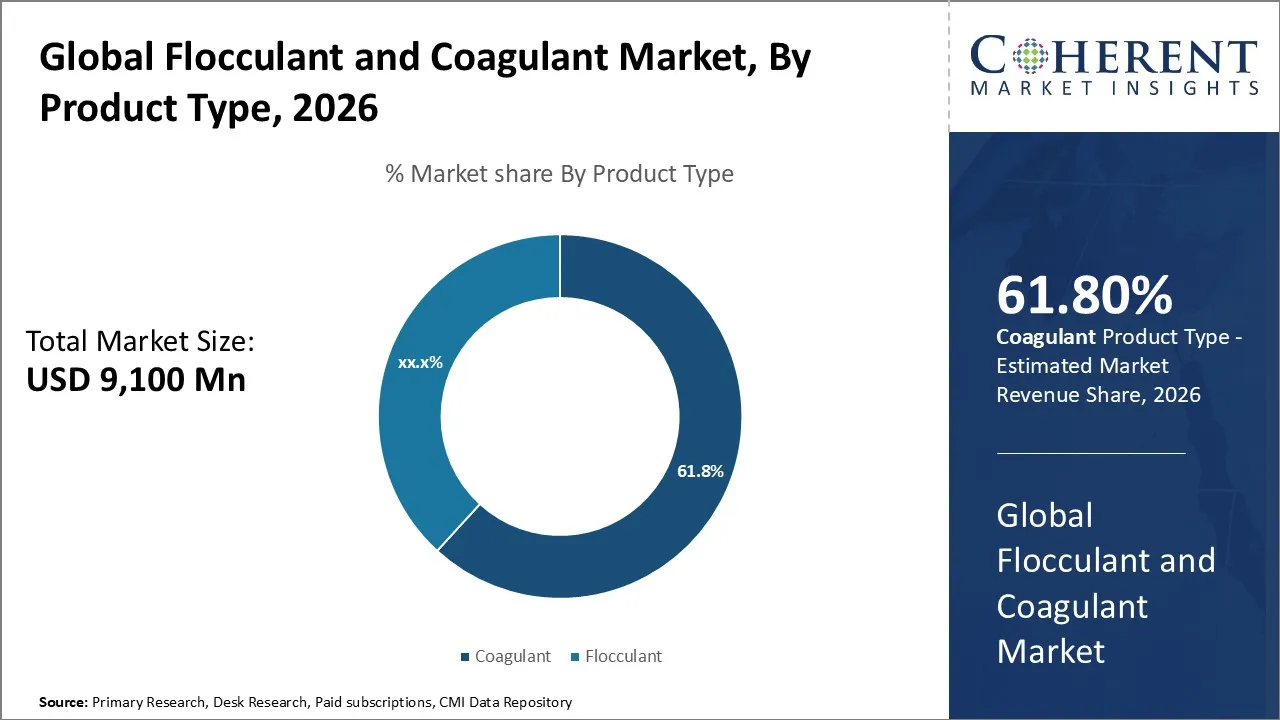
- Based on Product Type, the Coagulants segment is expected to lead the market with 61.80 % share in 2026, due to its dominant use in primary water treatment applications.
- Based on End-Use, the Municipal Water Treatment segment is expected to hold 43.20 % share of the market in 2026, driven by regulatory mandates and rising urban water infrastructure investment.
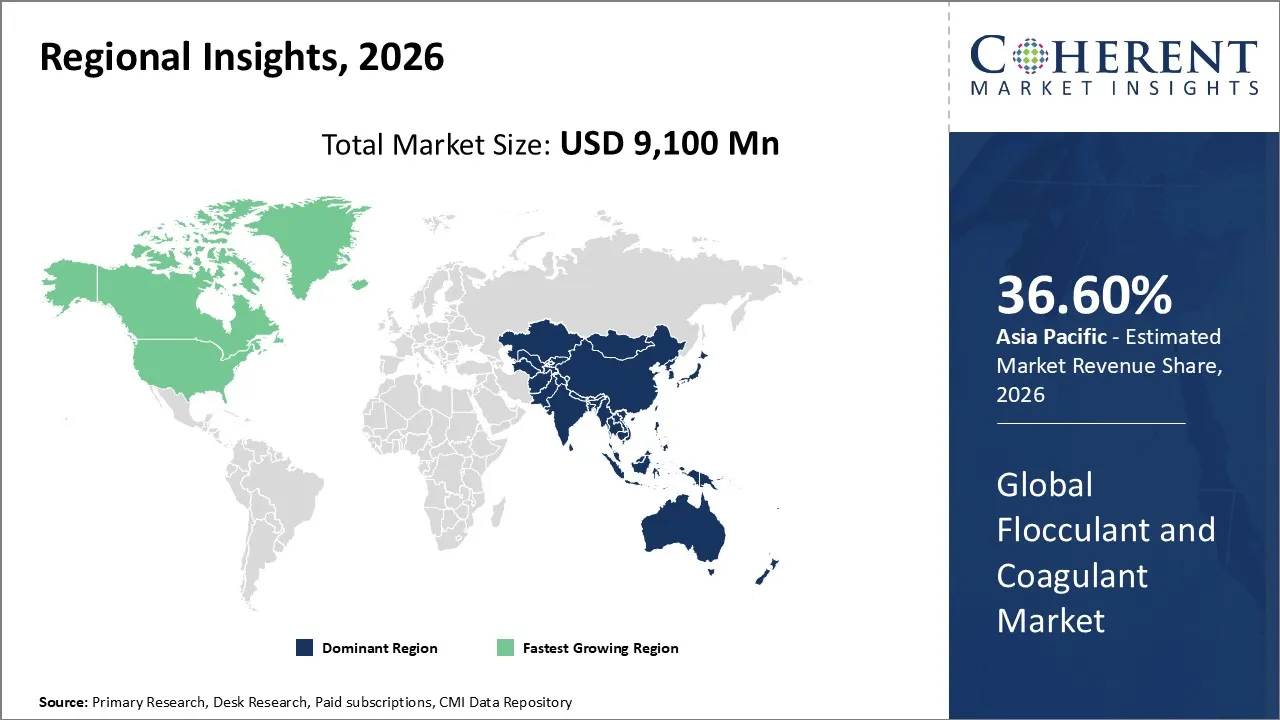
- Based on Region, Asia Pacific is set to lead the market with 36.60 % share in 2026. While, North America is anticipated to be the fastest growing region.
Market Overview
- The Flocculant and Coagulant Market provides advanced chemical treatment systems and purification technologies primarily for municipal wastewater and industrial process water. The market includes sophisticated organic polymers, inorganic metallic salts, and bio-based formulations, along with associated dosing equipment, real-time monitoring sensors, and long-term sludge management services.
- The global prevalence of water scarcity and industrial pollution is being identified more frequently each year, thus creating a greater demand for early purification systems among municipal treatment centers and specialized industrial facilities. Resource managers and industrial operators recognize the critical importance of effective solid separation for water reuse and long-term environmental health outcomes. Government environmental agencies now require universal effluent screening, making chemical sedimentation and advanced filtration a standard requirement in industrial healthcare operations.
- With the implementation of stringent environmental standards and water conservation policies, the market is growing steadily, mainly in the Asia Pacific region, where industrial production is high and rapid expansion of water infrastructure is taking place. The market is also significant in regions with advanced environmental research and high utility expenditure, including China, the US and Europe. Chemical manufacturers are developing next-generation products featuring artificial intelligence for automated dosing and green chemistry delivery systems that plant operators prefer for more precise and personalized operation.
Current Events and Its Impacts on the Flocculant and Coagulant Market
Current Event | Description and the Impact |
Environmental Regulations and Sustainability Initiatives |
|
Technological Advancements and Innovation
|
|
Economic and Industrial Development Trends |
|
Segmental Insights
- Current Industry Events of 2026
- Market Size Estimation
- Regional Breakdown
- Competitive Landscape
- Customer Intelligence
- Segmental Analysis
- Pricing Analysis
- Key Market Drivers, Challenges & Future Trends
- Customized Insights Section
Flocculant and Coagulant Market Insights By, Product Type - Dominant Use in Primary Water Treatment Applications Drives Preference for Coagulants
In terms of product type, the coagulants segment contributes the highest share of 61.80% in 2026 of the market due to their essential role as the primary step in liquid and solid separation. They neutralize the electrical charges of particles that create cloudiness in water, enabling them to group together into larger masses. The effectiveness of these substances in treating raw water from diverse sources contributes to their widespread use around the globe. Most wastewater treatment facilities require a coagulation phase before any other filtration can occur. These chemicals remain the most widely consumed product in the global water purification industry.
For instance, in July 2025, Kemira, a world leader in sustainable chemical solutions for water-intensive industries, announced a significant investment to enhance its production capacity in Tarragona, Spain. This investment of nearly USD 23.3 million will enable the construction of a new production line for aluminum chlorohydrate (ACH). It is a high-performance coagulant mainly utilized in drinking water treatment.
Flocculant and Coagulant Market Insights By, End-use- Municipal Water Treatment Leads with Regulatory Mandates
In terms of end-use, the municipal water treatment segment contributes the highest share of 43.20% in 2026 of the market owing to the rising need for clean drinking water and the expansion of urban sewage systems to support growing populations. City governments face constant pressure to meet strict health standards. This pressure requires the continual use of treatment chemicals in large public facilities. Municipal plants process a vast and massive volume of water every day. They represent a larger and more consistent portion of the market compared to specific industrial or commercial sectors.
Regional Insights
Asia Pacific Flocculant and Coagulant Market Analysis & Trends
Asia Pacific has remained the dominant region with 36.60% in 2026 of the global Flocculant and Coagulant Market over the past decade. This market acts as the global leader in both production and consumption due to rapid industrial growth and massive population expansion. In countries like China and India, the expansion of manufacturing sectors such as textiles, chemicals, and power generation creates vast amounts of wastewater that require intensive treatment. The government programs and strict discharge standards are compelling industries to adopt these chemicals in order to avoid heavy penalties. Moreover, the region experiences significant movement to cities, which forces local authorities to improve their water treatment plants to ensure a steady supply of clean drinking water. The high demand makes Asia Pacific the fastest-growing market for synthetic as well as natural treatment solutions, with countries continuing to invest in vital water systems.
For instance, in September 2024, Watson-Marlow Fluid Technology Solutions (WMFTS) has introduced the Qdos™ H-FLO chemical metering and dosing pump, designed for higher flow rates, along with WMArchitect™ single-use solutions. This initiative aims to provide a variety of biopharmaceutical fluid management innovations from a single, reliable supplier. The Qdos H-FLO will be beneficial for various applications, such as disinfectants, flocculants, coagulants, acids/alkalis, mining reagents, and surfactants.
North America Flocculant and Coagulant Market Analysis & Trends
The North American market is the fastest growing region, characterized by advanced systems and a highly regulated environmental landscape. In the countries of the US and Canada, firm mandates from federal agencies drive the continuous use of high-performance chemicals to meet drinking water and wastewater quality standards. The market has a strong industrial base with the oil and gas, mining, and food processing sectors, which produce complex wastewater streams. Moreover, there is a growing trend toward sustainability and the use of environmentally friendly chemistry, which results in the development of safe bio-based flocculants. Investments in aging public infrastructure and the integration of automated feeding systems ensure steady market growth and operational efficiency across the entire region.
For instance, in April 2024, Gradiant, a leader in advanced water and wastewater treatment chemical solutions, has released the CURE Chemicals. The CURE Chemicals are designed to set new standards for operational effectiveness and environmental sustainability across the world's vital industries. This product encompasses more than 300 proprietary formulations, featuring corrosion and scale inhibitors, process chemicals, biocides, antiscalants and cleaners, as well as coagulants and flocculants, among other products.
Flocculant and Coagulant Market Outlook Country-Wise
China Flocculant and Coagulant Market Trends
The rapid growth in the Chinese market is attributed to the government’s strict enforcement of water protection laws against pollution. The country is moving more people to cities, with municipal plants using large amounts of these chemicals to offer safe drinking water to millions of households. High demand is created by many industrial sectors, including textiles, electronics, and the generation of electricity, due to the treatment of wastewater from these industries to meet national quality standards. China is currently investing greatly in renovating its treatment facilities with the latest systems that use these chemicals in a more economical way. Thus, this attention to environmental health has made China a primary center of chemical production and consumption.
The U.S. Flocculant and Coagulant Market Trends
The U.S. market remains steady and highly advanced due to firm federal rules regarding public water safety and industrial waste. Many cities in the US currently focus on repairing aging water pipes and upgrading old treatment plants, which sustains the demand for high-performance chemicals. Industries like oil and gas, food processing, and mining also rely on these substances to clean the large volumes of water they use in their daily operations. There is a strong movement toward using safer bio-based chemicals that have less impact on nature. These modern solutions help the facilities in the country to comply with tough environmental standards while improving their overall efficiency.
For instance, in April 2024, Gradiant, a company that provides advanced water and wastewater treatment solutions around the world, has formed a partnership with Hydrotech Engineering, an Italian company that has been around for more than 20 years and specializes in process and wastewater treatment. This partnership is a major step forward for Hydrotech Engineering. It shows how committed the company is to advanced water treatment technologies by using Gradiant's wide range of cutting-edge technologies, knowledge, and global resources.
Market Report Scope
Flocculant and Coagulant Market Report Coverage
| Report Coverage | Details | ||
|---|---|---|---|
| Base Year: | 2025 | Market Size in 2026: | USD 9,100 Mn |
| Historical Data for: | 2020 To 2024 | Forecast Period: | 2026 To 2033 |
| Forecast Period 2026 to 2033 CAGR: | 5% | 2033 Value Projection: | USD 13,300 Mn |
| Geographies covered: |
| ||
| Segments covered: |
| ||
| Companies covered: | BASF SE, Ecolab Inc., Solvay SA, SNF Ltd, Cytec Industries Inc., Akferal, Kemira Oyj, Jayem Engineers, and TRIO Chemicals & Allied Products | ||
| Growth Drivers: |
| ||
| Restraints & Challenges: |
| ||
Flocculant and Coagulant Market Drivers
Rising global demand for clean water
The increasing demand for clean water around the globe is driving the growth of the flocculant and coagulant industry. As the population grows, more people move to cities, thereby creating a need for local administrations to provide fresh drinking water as well as a necessary way to dispose of huge amounts of sewage. One of the important functions of these chemical agents is thus being served in the treatment facilities as they remove dirt as well as harmful bacteria from the raw water supplies. The strict government laws and public health rules thus make it necessary for cities as well as manufacturing units to employ these agents to purify sewage before it is released. By helping facilities in recycling water and keeping the public safe, these chemicals play a key role in solving global water shortages and ensuring the long-term health of the planet.
For instance, in May 2024, for the second year in a row, Kuehne+Nagel has been named the logistics partner of Alumichem, a prominent Nordic provider of water treatment solutions, in Ghana. The goal of this collaboration is to provide Ghanaian communities with safe drinking water. The goal is to improve the effectiveness of water treatment procedures and offer cutting-edge technologies, such as flocculants and coagulants based on aluminum.
Analyst Opinion (Expert Opinion)
- The global flocculant and coagulant market is experiencing steady growth, driven by increasing demand for efficient water and wastewater treatment solutions in both municipal and industrial segments. Municipal water treatment remains the primary application, accounting for a significant portion of total consumption due to ongoing infrastructure upgrades and stricter effluent quality regulations. Industrial wastewater treatment, particularly in sectors such as paper, textiles, oil & gas, and mining, also contributes substantially to market demand.
- In terms of product segmentation, inorganic coagulants like aluminum sulfate, ferric chloride, and polyaluminum chloride dominate usage because of their cost-effectiveness and broad applicability. Organic flocculants, including polyacrylamides and bio-based polymers, are gaining adoption due to operational efficiency and sustainability considerations.
- Regionally, Asia-Pacific is the fastest-growing market, supported by rapid urbanization, industrial expansion, and investment in wastewater management infrastructure, while North America and Europe continue to drive demand through established treatment capacity and stringent regulatory frameworks.
- Technological innovations, such as high-efficiency flocculants, pre-polymerized coagulants, automated dosing systems, and digital monitoring, are improving treatment efficiency, reducing chemical usage, and enhancing operational outcomes. Market growth is influenced by raw material price volatility and regulatory compliance, which shape production and adoption strategies.
- Overall, the market is expected to expand steadily, underpinned by rising water quality infrastructure investments, evolving industrial needs, and a focus on sustainable and efficient water treatment solutions.
Speak to the analyst
Want personalized insights?
Take the findings above to one of our principal consultants, or have the report rebuilt around the segments, geographies and competitors you actually track.
Flocculant and Coagulant Industry News
- In March 2025, Kemira and IFF have declared their ultimate investment choice to move forward with the establishment of a joint venture manufacturing business with the goal of commercially producing renewable biobased products. The commercial production is expected to start in late 2027, with a total investment of about USD 151.7 million.
- In July 2024, BASF has agreed to sell its flocculants business for mining applications to Solenis, a multinational manufacturer of specialty chemicals with its headquarters located in Wilmington, Delaware. In an effort to concentrate on key strategic areas, BASF is optimizing its portfolio through the sale of its flocculants business to Solenis, , a multinational manufacturer of specialty chemicals with its headquarters located in Wilmington, Delaware. In an effort to concentrate on key strategic areas, BASF is optimizing its portfolio through the sale of its flocculants business to Solenis.
- In 2023, Evoqua has partnered with Xylem to collaborate on providing innovative and environmentally friendly solutions for water and wastewater treatment. Together, they aim to contribute to the development of a more resilient and water-secure future.
- In January 2021, Brenntag, a world leader in the distribution of chemicals and ingredients, acquired ICL Packed Ltd., a subsidiary of Industrial Chemical Ltd. The acquired company distributes packaged water treatment chemicals from England. Brenntag also signed a supply contract with ICL, a major UK manufacturer of Caustic Soda, Hydrochloric acid, Iron, Aluminium coagulants, and Sodium Hypochlorite.
Market Segmentation
- Product Type Insights (Revenue, USD Mn, 2026 - 2033)
- Flocculant
- Anionic Flocculant
- Amphoteric Flocculant
- Non-ionic Flocculant
- Cationic Flocculant
- Coagulant
- Organic Coagulant
- PolyDADMAC
- Polyamine
- Inorganic coagulant
- Aluminum Chloride
- Aluminum Sulfate
- Ferric Chloride
- Others
- Organic Coagulant
- Flocculant
- End-use Insights (Revenue, USD Mn, 2026 - 2033)
- Power Generation
- Chemical Processing
- Municipal Water Treatment
- Pulp and Paper
- Oil and Gas
- Others
- Regional Insights (Revenue, USD Mn, 2026 - 2033)
- North America
- U.S.
- Canada
- Latin America
- Brazil
- Argentina
- Mexico
- Rest of Latin America
- Europe
- U.K.
- Germany
- Italy
- France
- Russia
- Spain
- Rest of Europe
- Asia Pacific
- China
- India
- Japan
- ASEAN
- Australia
- South Korea
- Rest of Asia Pacific
- Middle East
- GCC
- Israel
- Rest of Middle East
- Africa
- North Africa
- Central Africa
- South Africa
- North America
- Key Players Insights
- BASF SE
- Ecolab Inc.
- Solvay SA
- SNF Ltd
- Cytec Industries Inc.
- Akferal
- Kemira Oyj
- Jayem Engineers
- TRIO Chemicals & Allied Products
Sources
Primary Research Interviews
- Flocculant & Coagulant Manufacturers
- Water Treatment Plant Operators
- Industrial Water & Wastewater Solution Providers
- Chemical Process Engineers
- Environmental & Water Treatment Consultants
- Others
Databases
- Bloomberg Terminal
- Thomson Reuters Eikon
- Others
Magazines
- Water & Wastewater International
- Chemical Engineering Magazine
- Water Technology Magazine
- WaterWorld
- Filtration + Separation
- Others
Journals
- Journal of Water Process Engineering
- Water Research
- Environmental Science & Technology
- Desalination
- Journal of Environmental Chemical Engineering
- Others
Newspapers
- Financial Times
- The Wall Street Journal
- Reuters
- Bloomberg News
- The Economic Times
- Others
Associations
- Water Environment Federation (WEF)
- International Water Association (IWA)
- American Water Works Association (AWWA)
- European Water Association (EWA)
- Water Research Foundation (WRF)
- Others
Public Domain Sources
- U.S. Environmental Protection Agency (EPA)
- European Environment Agency (EEA)
- Ministry of Jal Shakti, India
- World Bank Open Data
- United Nations Environment Programme (UNEP)
- Others
Proprietary Elements
- CMI Data Analytics Tool
- Proprietary CMI Existing Repository of Information for the Last 8 Years
Definition: The Flocculant and Coagulant Market focuses on providing chemical systems and industrial solutions that help treat water contaminated by suspended particles and organic matter. These chemical treatment systems are widely used in municipal water plants and industrial facilities, where water purification is now a standard part of environmental and public health protection. Targeted coagulants and advanced polymer flocculants assist in limiting the impact of water pollution and reduce the long-term environmental challenges linked to industrial waste by restoring water clarity before it reaches public distribution lines or natural ecosystems. The demand for these solutions comes from mining operations, oil and gas refineries, and paper manufacturing companies, all of which must adhere to strict environmental and regulatory mandates.
Get access to 250+ pages report
Every segment, forecast, competitor profile and data table behind the analysis above — available for instant download.
- ESOMAR Member
- ISO 9001:2015 Certified
- D-U-N-S Registered
- GDPR & CCPA Compliant
Missing comfort of reading report in your local language? Find your preferred language:
Transform your Strategy with Exclusive Trending Reports
Frequently Asked Questions
The Flocculant and Coagulant Market is estimated to be valued at USD 9,100 Mn in 2026, and is expected to reach USD 13,300 Mn by 2033.
The CAGR of the Flocculant and Coagulant Market is projected to be 5% from 2026 to 2033.
The rising global demand for clean water and stricter environmental regulations for wastewater treatment are the major factors driving the growth of the Flocculant and Coagulant Market
The high operational costs and competition from alternative treatment technologies are the major factors hampering the growth of the Flocculant and Coagulant Market.
In terms of product type, the coagulants segment is estimated to dominate the market revenue share in 2026.
BASF SE, Ecolab Inc., Solvay SA, SNF Ltd, Cytec Industries Inc., Akferal, Kemira Oyj, Jayem Engineers, and TRIO Chemicals & Allied Products are the major players.
Asia Pacific is expected to lead the Flocculant and Coagulant Market in 2026.