

Food Irradiation Market Size and Trends: 2026-2033
Food irradiation market is estimated to be valued at USD 254.5 Bn in 2026 and is expected to reach USD 358.1 Bn by 2033, exhibiting a compound annual growth rate (CAGR) of 5% from 2026 to 2033.
Key Takeaways
- Based on Source of Radiation, the Gamma Ray Radiation segment is expected to lead the market with 48% share in 2026.
- Based on Technology, the Ozone Treatment segment is expected to lead the market with 33% share in 2026.
- Based on Region, North America is set to lead the food irradiation market with 40% share in 2026. While, Asia Pacific is anticipated to be the fastest growing region.
Market Overview
The global food irradiation market is growing significantly globally owing to increased demand for durable and safe food items along with increased awareness among consumers regarding food pathogens and contaminants. Various foods such as spices, meat, fruits, and vegetables are irradiated using gamma rays, electron beams, and X-rays to improve longevity as well as safety. Manufacturers are adopting new technologies such as ozone treatment, ultra-high pressure treatment, and food coating to prevent nutritional loss while reducing contaminants.
Current Events and Its Impacts on the Food Irradiation Market
Current Events | and its impact |
Global Food Safety Crisis and Consumer Awareness |
|
Technological Advancements in Nuclear and E-beam Technology |
|
How is product innovation driving growth in the food irradiation market?
- Advanced Irradiation Technologies: Use of electron beam, X-ray, and gamma-ray technologies to speed up and enhance precision in treating various foodstuffs.
- Ozone Treatment Solutions: Ozone treatment for microbial decontamination with the retention of nutrient value due to the demand for health-conscious individuals.
- Ultra-High Pressure (UHP) Technology: Novel non-thermal processing technique that increases the shelf life of food products without compromising texture and flavor.
- Food Coating & Protective Packaging: The development of new food coating and packaging technologies to improve the efficiency of irradiation and minimize spoilage.
- Current Industry Events of 2026
- Market Size Estimation
- Regional Breakdown
- Competitive Landscape
- Customer Intelligence
- Segmental Analysis
- Pricing Analysis
- Key Market Drivers, Challenges & Future Trends
- Customized Insights Section
Segmental Insights
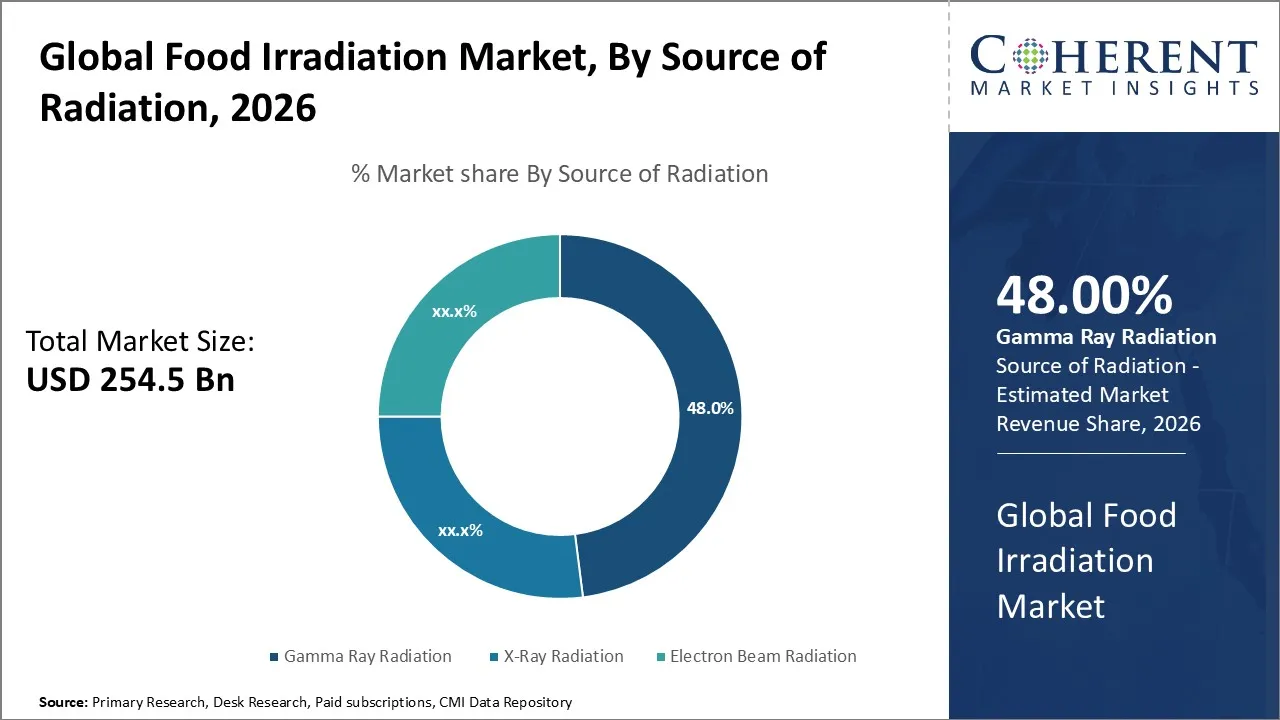
Food Irradiation Market Insights, By Source of Radiation – Gamma Ray Radiation dominates due to widespread adoption
By source of radiation, the Gamma Ray Radiation segment is estimated to share the highest market portion of 48% by 2026, due to its efficiency in bulk and dense food product treatments. Gamma radiation deeply penetrates spices, meats, and vegetables to assure microbial decontamination and extended shelf life. Its long-established use, cost-effectiveness, and regulatory acceptance make it the preferred choice among food processors worldwide.
For instance, in August 2024, India's Ministry of Food Processing Industries invited Expression of Interest to set up 50 new multi-product food irradiation units all over the country under the Pradhan Mantri Kisan SAMPADA Yojana cold chain/infra scheme, signaling governmental support to expand irradiation infrastructure, including gamma ray applications.
Food Irradiation Market Insights, By Technology – Ozone Treatment leads due to effective microbial decontamination
Based on technology, the Ozone Treatment segment is anticipated to have the maximum share of 33% in 2026, as this technique provides effective disinfection without any interference with nutritional quality. Ozone is an efficient oxidizing agent that reduces microbial contamination on fruits, vegetables, and ready-to-consume food. This non-thermal method maintains taste, texture, and color while keeping the food safe and in compliance with regulations.
For instance, in January 2025, Flavour Shield B.V. introduced version 2 of its ozone treatment system for fresh produce, intended primarily for the reduction of microbial contamination of fruits and vegetables during processing and transportation.
Regional Insights
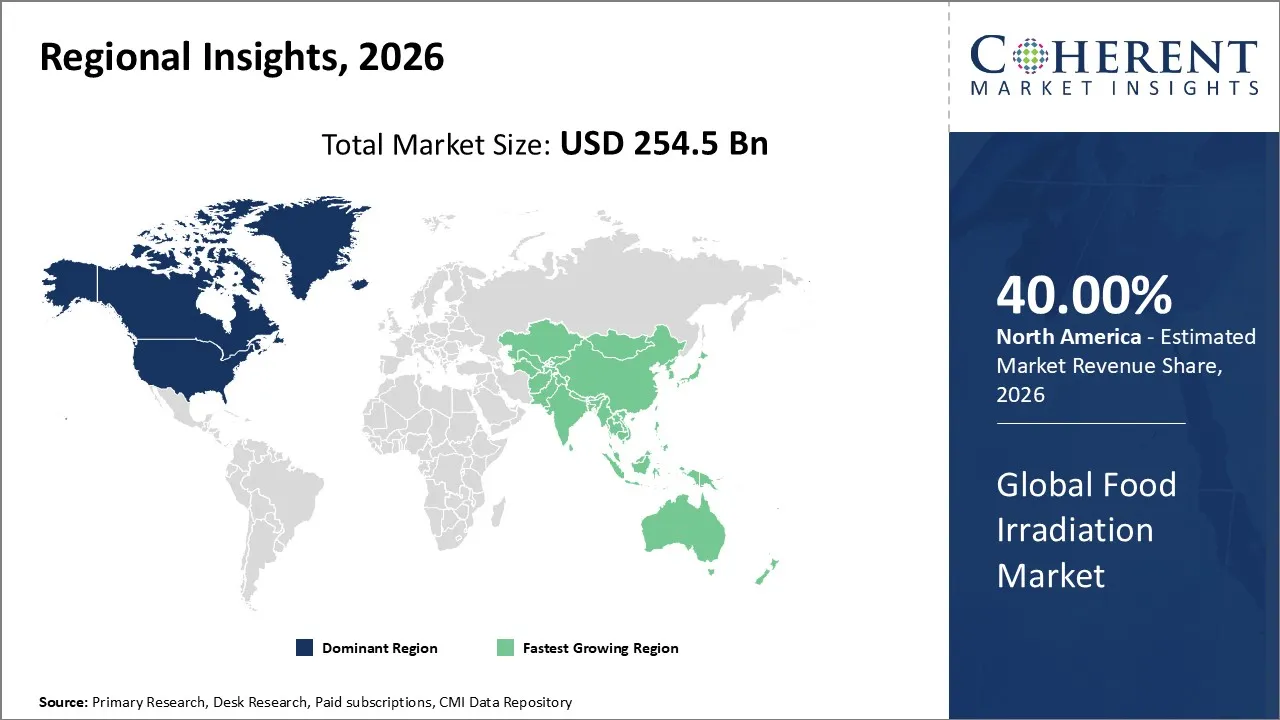
North America Food Irradiation Market Analysis & Trends
North America is likely to gain the highest share in the market by 2026, with an estimated market share of 40%. The growth rate of the market in North America can be attributed to the presence of robust food safety regulations, widespread adoption of irradiation technologies by food processing facilities, and favorable infrastructure.
For instance, in May 2024, Sterigenics expanded its food irradiation processing capacity in the U.S. by adding a high throughput electron beam line for the sterilization of spice products, which would help in faster processing of bulk food products.
Asia Pacific Food Irradiation Market Analysis & Trends
Asia Pacific is expected to be the fastest-growing market due to the increasing awareness of food safety, increase in demand for exports, and rapid growth in irradiation facilities in countries such as India, China, and Japan. Investments in cold chain infrastructure and government initiatives to upgrade modern food processing technologies are acting as growth drivers.
For instance, in November 2024, Vishwesh Agromed started operations at a gamma irradiation center in Nagpur, India, designed to treat fruits, vegetables, and spices for both domestic use and export.
Food Irradiation Market Outlook for Key Countries
Is the U.S. food irradiation market expanding due to safety regulations and technological adoption?
The U.S. food irradiation market is growing, due to the rising stringency of food safety regulations, increased consumer awareness of foodborne pathogens, and more significant use of advanced forms of irradiation, including gamma rays, electron beams, and X-rays. Food processors are increasingly dependent on the irradiation process to extend the shelf life, quality, and compliance of their products with USDA and FDA standards to facilitate exports.
For instance, in May 2025, Sterigenics, a Sotera Health company, announced the expansion of its Haw River, North Carolina campus to include a new X‑ray irradiation facility adjacent to its existing gamma facility.
Is Canada’s food irradiation market growing to support exports and domestic food safety?
The food irradiation market in Canada is growing steadily as the country strengthens its food safety measures and tries to meet export standards regarding meat, seafood, and spices. Government initiatives for safer and longer-lasting food products encourage processors to use irradiation technologies.
For instance, in October 2025, Bionuclear Canada announced a partnership with local food processors to deliver gamma irradiation services for spices and dried food products, thus extending their shelf life as well as ensuring regulatory compliance with food safety regulations in Canada.
Market Report Scope
Food Irradiation Market Report Coverage
| Report Coverage | Details | ||
|---|---|---|---|
| Base Year: | 2025 | Market Size in 2026: | USD 254.5 Bn |
| Historical Data for: | 2020 To 2024 | Forecast Period: | 2026 To 2033 |
| Forecast Period 2026 to 2033 CAGR: | 5% | 2033 Value Projection: | USD 358.1 Bn |
| Geographies covered: |
| ||
| Segments covered: |
| ||
| Companies covered: | Sterigenics International, Inc., Ionisos SA., Gray Star, Inc., Reviss Services Ltd., Nordion Inc., Sadex Corporation, Steris Isomedix Services, Scantech Sciences Inc., Steri-Tek, and Symec Engineers (India) Pvt. Ltd. Etc. | ||
| Growth Drivers: |
| ||
| Restraints & Challenges: |
| ||
Food Irradiation Market Driver
Rising demand for safer and longer-lasting food products
The growing demand for safe, high-quality, and long-lasting food products is positively impacting the growth of the food irradiation market. People are becoming aware of foodborne pathogens and contamination, making food processors use food irradiation techniques such as gamma rays, electron beams, and X-rays to enhance the shelf life and safety of food products.
Food Irradiation Market Opportunity
Introduction of new irradiation technologies
Technological improvements have occurred in techniques such as food irradiation using methods such as ozone treatment, ultra high pressure, and combined irradiation techniques, offering opportunities to the food industry to preserve nutritional value and improve microbial safety. This may result in more efficient, cost-effective, and environmentally friendly technologies to the food industry.
Analyst Opinion (Expert Opinion)
- The food irradiation market is undergoing significant transformation as concerns about food safety, shelf life, and global supply chain efficiency drive adoption. Leading companies such as Sterigenics and Nordion are making significant investments in cutting-edge irradiation technologies, such as gamma and high-throughput electron beam facilities, indicating a strong belief in the increasing significance of food irradiation for processors.
- In North America, stringent regulations and high consumer awareness of foodborne pathogens are accelerating approval, with processors integrating irradiation as a key step in ensuring product safety and quality. In Asia-Pacific, emerging markets are rapidly developing irradiation facilities to meet both domestic and export standards, reflecting the technology’s critical role in maintaining food safety across complex supply chains.
- The market is moving beyond niche applications for specialty foods and becoming a standard practice in food processing. Innovations such as ozone treatment, ultra-high pressure processing, and hybrid approaches are enabling processors to maintain nutritional quality while reducing microbial contamination. Companies offering efficient, sustainable, and scalable solutions are increasingly being recognized as strategic partners in food safety.
Speak to the analyst
Want personalized insights?
Take the findings above to one of our principal consultants, or have the report rebuilt around the segments, geographies and competitors you actually track.
Top Strategies Followed by Food Irradiation Market Players
- Established players focus heavily on technology and process innovation. Leading companies like Sterigenics, Nordion, and Ionisos invest in advanced irradiation technologies such as high-throughput electron beam lines, gamma irradiation facilities, and X-ray systems. These companies continually test and optimize equipment to enhance efficiency, reduce energy consumption, and improve food safety outcomes across diverse product categories.
- Mid-level players compete on operational efficiency and cost-effectiveness. These companies adopt flexible production models and leverage regional facilities to provide scalable irradiation solutions at competitive prices. They often focus on regional foods, spices, and dried products where demand for extended shelf life is high.
- Small-scale operators specialize in niche or regional segments. Some focus on specialty products, including organic or export-specific food items, and target underserved markets. They adopt innovative technologies such as ozone treatment or small-scale electron beam systems to maintain quality while addressing microbial safety. Partnerships with local food processors help expand reach and credibility in the market.
Emerging Startups in the Food Irradiation Market
- Technology-driven startups are at the forefront of innovative irradiation technologies. Startups are developing hybrid irradiation techniques that use the combination of ozone, gamma, and electron beam irradiation for effective microbial destruction with the retention of nutrients. Startups dealing with compact irradiation devices are likely game-changers for the food industry.
- Sustainability is a growing focus. Several startups are working to develop irradiation technologies that will be more energy-efficient and environment-friendly. The purpose is either to reduce power consumption or make sure that chemical consumption decreases while keeping the standard of food safety intact.
- Niche applications are creating new opportunities. Some startups specialize in exporting irradiated spices, herbs, and perishable foods to meet high international standards. Others develop mobile or containerized irradiation units for localized food safety solutions, enabling safer distribution in remote or developing regions.
Food Irradiation Industry News
- In May 2025, Sterigenics International, Inc. announced the expansion of its Haw River, North Carolina campus includes a new X‑ray sterilization facility adjacent to its gamma irradiation operations.
- in October 2025, Bionuclear Canada announced a partnership with local food processors to provide gamma irradiation services for spices and dried foods, enhancing product shelf life and export readiness while ensuring compliance with Canadian food safety regulations.
Market Segmentation
- Source of Radiation Insights (Revenue, USD Bn, 2026 - 2033)
- Gamma Ray Radiation
- X-Ray Radiation
- Electron Beam Radiation
- Technology Insights (Revenue, USD Bn, 2026 - 2033)
- Ultra-High Pressure Technology
- Steam Pasteurization
- Ozone Treatment
- Food Coating Technology
- Others (Fumigation and others)
- Regional Insights (Revenue, USD Bn, 2026 - 2033)
- North America
- U.S.
- Canada
- Latin America
- Brazil
- Argentina
- Mexico
- Rest of Latin America
- Europe
- Germany
- U.K.
- Spain
- France
- Italy
- Russia
- Rest of Europe
- Asia Pacific
- China
- India
- Japan
- Australia
- South Korea
- ASEAN
- Rest of Asia Pacific
- Middle East
- GCC Countries
- Israel
- Rest of Middle East
- Africa
- South Africa
- North Africa
- Central Africa
- North America
- Key Players Insights
- Sterigenics International, Inc.
- Ionisos SA.
- Gray Star, Inc.
- Reviss Services Ltd.
- Nordion Inc
- Sadex Corporation
- Steris Isomedix Services
- Scantech Sciences Inc.
- Steri-Tek
- Symec Engineers (India) Pvt. Ltd. Etc.
Sources
Primary Research Interviews
- Food Irradiation Technology Providers & Equipment Manufacturers
- Food Processors & Packagers using Irradiation
- Quality Assurance & Food Safety Managers
- Regulatory & Compliance Experts in Food Safety
- Cold Chain & Logistics Managers
- Research Scientists & Microbiologists in Food Safety
- Others
Databases
- Bloomberg Terminal
- Thomson Reuters Eikon
- FAOSTAT – Food & Agriculture Data
- USDA National Agricultural Statistics Service (NASS)
- Food and Agriculture Organization (FAO) Databases
- Others
Magazines
- Food Processing Magazine
- Food Safety Magazine
- Dairy Foods Magazine
- Food Engineering Magazine
- Food Technology Magazine
- Others
Journals
- International Journal of Food Science & Technology
- Food Control Journal
- Journal of Food Protection
- Trends in Food Science & Technology
- Journal of Food Safety
- Others
Newspapers
- The Wall Street Journal – Food & Agriculture Section
- Financial Times – Food Industry Section
- Reuters – Food & Commodities News
- Bloomberg News – Agribusiness & Food Safety
- The New York Times – Food Section
- Others
Associations
- International Atomic Energy Agency (IAEA) – Food & Agriculture Division
- World Health Organization (WHO) – Food Safety Initiatives
- Food and Agriculture Organization (FAO)
- Institute of Food Technologists (IFT)
- International Food Irradiation Association
- Others
Public Domain Sources
- USDA – Food Safety & Inspection Service Publications
- FDA – Food Irradiation Guidelines & Reports
- U.S. Census Bureau – Food Manufacturing & Distribution Data
- FAO & WHO Food Safety Reports
- Public Government Reports on Food Processing & Exports
- Others
Proprietary Elements
- CMI Data Analytics Tool
- Proprietary CMI Existing Repository of Information for the Last 8 Years
Get access to 250+ pages report
Every segment, forecast, competitor profile and data table behind the analysis above — available for instant download.
- ESOMAR Member
- ISO 9001:2015 Certified
- D-U-N-S Registered
- GDPR & CCPA Compliant
Missing comfort of reading report in your local language? Find your preferred language:
Transform your Strategy with Exclusive Trending Reports
Frequently Asked Questions
The Food Irradiation Market is estimated to be valued at USD 254.5 Bn in 2026, and is expected to reach USD 358.1 Bn by 2033.
The CAGR of the Food Irradiation Market is projected to be 5% from 2026 to 2033.
Increasing consumer awareness of foodborne pathogens, stringent food safety regulations, expansion of cold chain infrastructure, and adoption of advanced irradiation technologies such as gamma rays, electron beams, and X-rays are major factors driving market growth.
High initial investment costs, limited consumer awareness in certain regions, and regulatory complexities in some countries are key factors restraining market growth.
In terms of source of radiation, the Gamma Ray Radiation segment is expected to dominate the market in 2026 due to its effectiveness and widespread adoption.
North America is expected to lead the Food Irradiation Market in 2026, supported by strong regulatory frameworks and high consumer awareness of food safety.
Key players include Sterigenics International, Inc., Ionisos SA., Gray Star, Inc., Reviss Services Ltd., Nordion Inc., Sadex Corporation, Steris Isomedix Services, Scantech Sciences Inc., Steri-Tek, and Symec Engineers (India) Pvt. Ltd.