

GCC Lubricant Packaging Market Size and Share Analysis- 2026 To 2033
The GCC Lubricant Packaging Market size is anticipated to grow at a CAGR of 3.5% with USD 220 Mn in 2026 and is expected to reach USD 280 Mn in 2033. The market is growing with the rising vehicle ownership, expanding automotive maintenance, increasing industrial activity, higher lubricant consumption, growing e-commerce distribution, and demand for durable, leak-resistant packaging. According to GASTAT, Saudi Arabia had 15.8 Mn registered vehicles in use by the end of 2024, increasing 6.9% from 2023, thereby supporting the robust demand for automotive lubricant packaging across the GCC.
Key Takeaways
- The bottles segment is projected to account for the largest share of 38.6% in 2026. The segment growth is due to the convenient handling, controlled lubricant dispensing, product visibility, and widespread use in retail automotive lubricant sales.
- The engine oil segment is projected to account for the largest share of 58.4% in 2026. The segment’s growth is attributable to the high vehicle ownership, frequent oil replacement cycles, and rising demand for passenger and commercial vehicle maintenance across GCC countries. India's private vehicle fleet is projected to grow from 32 Mn in 2023 to 90 Mn by 2050.
- The plastic segment is projected to account for the largest share of 48.2% in 2026. The segment growth is due to the lightweight structure, durability, cost-effectiveness, design flexibility, corrosion resistance, and suitability for bottles, pails, and other lubricant packaging formats.
- The automotive segment is projected to account for the largest share of 36.7% in 2026. The segment’s growth is attributable to the expanding vehicle fleets, increasing aftermarket servicing activities, harsh climatic conditions, and sustained consumption of engine oils and automotive lubricants.
Segmental Insights
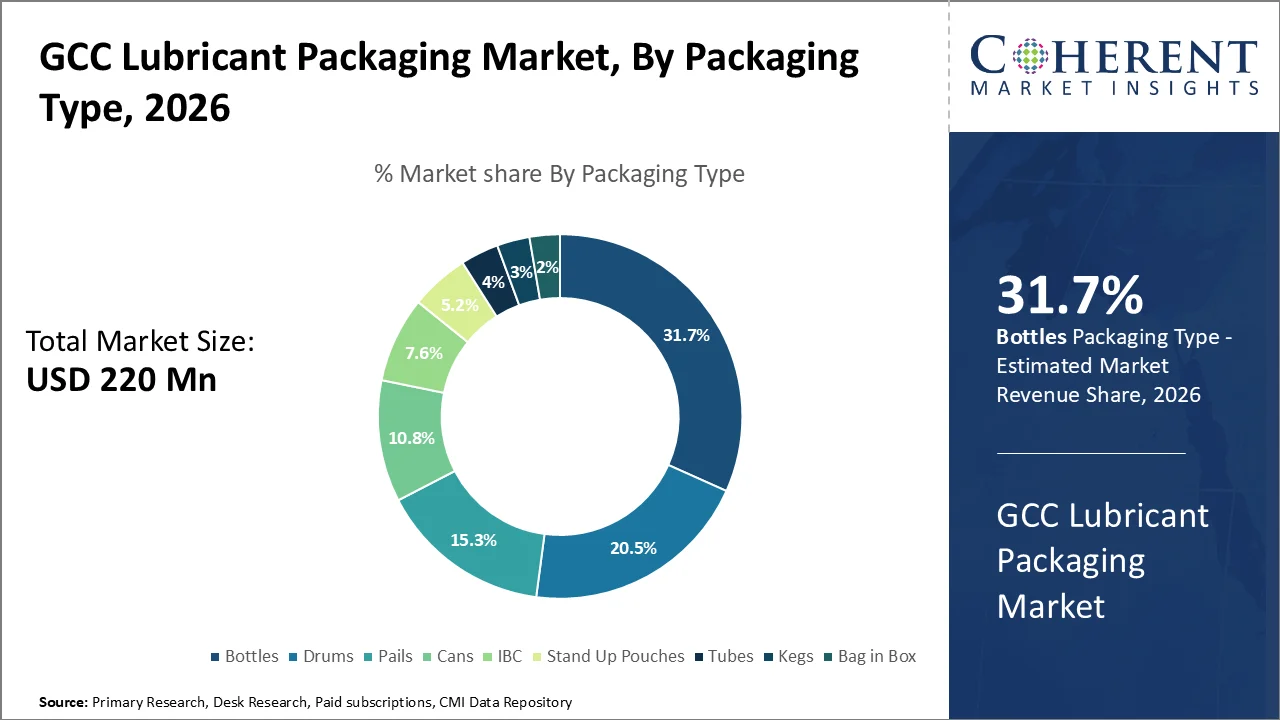
Which Bottles Segment Dominates the Market?
On the basis of packaging type, the bottles segment accounts for the largest GCC Lubricant Packaging Market share of 31.7% in 2026. The growth of the segment is mainly driven by the retail sale of engine oils and transmission fluids in convenient, tamper-evident packs suitable for workshops, service stations, and vehicle owners. Bottles remain preferred because they enable controlled pouring, branding, multiple pack sizes, and easier shelf handling than drums or pails.
Supporting product development, ADNOC Distribution’s official reporting highlighted expansion of its Voyager lubricant business, while its bottle design uses a tamper-proof, non-refillable shroud closure, strengthening product integrity and consumer confidence across GCC retail channels.
- Current Industry Events of 2026
- Market Size Estimation
- Regional Breakdown
- Competitive Landscape
- Customer Intelligence
- Segmental Analysis
- Pricing Analysis
- Key Market Drivers, Challenges & Future Trends
- Customized Insights Section
Engine Oil Segment to Secure the Largest Share
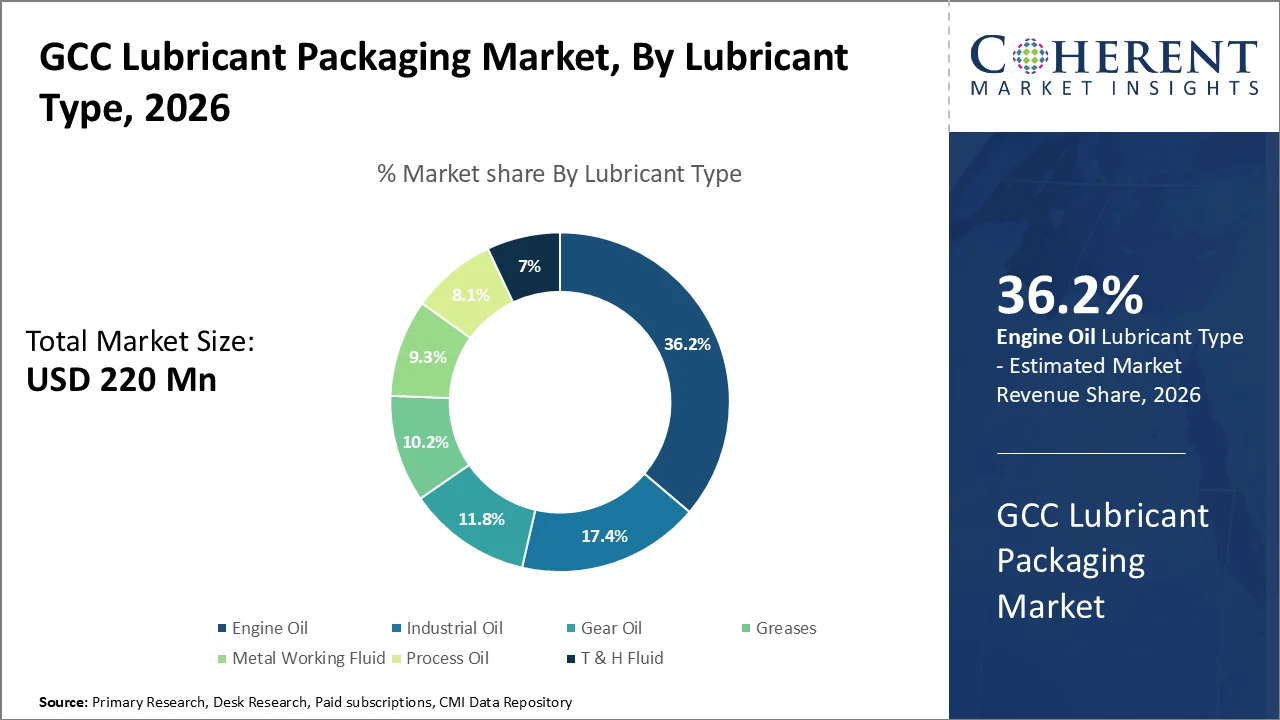
On the basis of lubricant type, the engine oil segment accounts for the largest GCC Lubricant Packaging Market share of 36.2% in 2026. The growth of the segment is mainly driven by the frequent oil-change requirements across the GCC’s large passenger-car, commercial-vehicle, construction, and logistics fleets. Engine oils are commonly distributed in bottles, cans, pails, and drums, enabling suppliers to serve individual motorists, workshops, dealerships, and fleet operators.
Which Plastic Segment Dominates the Market?
On the basis of material type, the plastic segment accounts for the largest GCC Lubricant Packaging Market share of 67.6% in 2026. The segment’s growth is owing to the use of high-density polyethylene bottles, pails, and jerry cans, which provide chemical resistance, low weight, impact strength, leak prevention, and economical production. Plastic packs also reduce transportation weight and handling risks across the GCC’s long-distance lubricant distribution network compared with metal alternatives.
Automotive Segment to Secure the Largest Share
On the basis of end-use, the automotive segment accounts for the largest GCC Lubricant Packaging Market share of 41.5% in 2026. The segment’s growth is owing to the recurring lubricant replacement across passenger cars, taxis, rental vehicles, commercial fleets, and off-road vehicles operating under the GCC’s high-temperature and dusty conditions.
In June 2026, Saudi Aramco’s affiliate Sinopec SenMei Petroleum partnered with Valvoline to expand lubricant sales through its service-station and retail network. The partnership strengthens the automotive lubricant operations of a GCC-based producer and supports greater circulation of branded, packaged products through workshops, fuel stations, distributors, and vehicle-maintenance channels.
Market Drivers
Circular Polyethylene and Polypropylene: A Major Breakthrough in the GCC Lubricant Packaging Market
Circular polyethylene and polypropylene represent an important technological breakthrough for lubricant packaging. This is because these materials can potentially reduce dependence on virgin fossil-based resins while maintaining the chemical resistance, impact performance, moldability, and sealing characteristics required for oil containers. High-density polyethylene is widely suitable for lubricant bottles, jerry cans, pails, closures, and certain drum components. Polypropylene is used in caps, handles, dispensing components, and rigid containers.
The cutting edge recycling processes convert difficult-to-recycle plastic waste into feedstock that can be used to manufacture polymers with performance characteristics comparable to conventional virgin material. This approach is relevant for lubricant packaging because direct mechanical recycling can present challenges involving color consistency, odor, contamination, and chemical compatibility. Certified circular materials based on mass-balance systems provide manufacturers with an alternative route for incorporating circular feedstock while retaining high technical performance.
Current Events and Their Impact on the GCC Lubricant Packaging Market
Current Event | Description and its Impact |
Implementation of the GCC Integrated Customs Tariff in 2025
|
|
Saudi Arabia’s Updated Technical Regulation for Packaging |
|
GCC Lubricant Packaging Market Trends
- The rising demand for lightweight bottles, pails, and stand-up pouches assist in reducing the transportation costs, improving handling, and supporting efficient lubricant distribution across the GCC markets.
- Manufacturers are adopting high-density polyethylene packaging, tamper-evident closures, anti-counterfeit labels, and ergonomic designs to improve product safety, durability, and brand differentiation.
- The expanding automotive servicing, industrial manufacturing, construction, and oil and gas activities are strengthening the demand for engine oil, hydraulic fluid, and industrial lubricant packaging.
- Economic diversification is increasing lubricant consumption across industrial facilities and commercial fleets. Manufacturing activities excluding oil refining accounted for 11.1% of Saudi Arabia’s GDP in 2025, thereby indicating a growing addressable market for packaged hydraulic oils, gear oils, and industrial lubricants.
- Sustainability regulations and circular-economy programs are encouraging recyclable plastic, metal containers, refill systems, and reduced-material packaging. The UAE’s recyclable-materials policy includes plastic waste among materials directed to domestic recycling facilities. Saudi Arabia’s non-oil activities grew 4.9% in 2025. This is supporting manufacturing, logistics, and industrial diversification while increasing the pressure on packaging suppliers to improve recyclability, material efficiency, and waste recovery.
Regional Insights
Kingdom of Saudi Arabia (K.S.A) Dominates Owing to Its Vehicle Base, Lubricant Industry, and Packaging Capacity
Kingdom of Saudi Arabia (K.S.A) is expected to lead with a share of 41.5% in the GCC lubricant packaging market in 2026. The country’s growth is owing to the largest vehicle population, substantial base-oil and lubricant production, extensive construction and logistics activity, and a broad domestic packaging-conversion industry.
The General Authority for Statistics reported approximately 1.026 million new vehicles were registered during 2024. This supports recurrent consumption of engine oils, transmission fluids, greases, coolants, hydraulic fluids, and other maintenance products.
The country possesses a diversified packaging supply base. Greif manufactures steel drums in Riyadh for industries like oil and gas and chemicals. ALPLA operates plants in Dammam and Jeddah and supplies packaging for engine oil and lubricant applications. Al Sharq Plastic Industries manufactures HDPE bottles, jerry cans, pails, and drums, while National Plastic Factory Company supplies plastic drums and jerry cans.
United Arab Emirates (U.A.E) Lubricant Packaging Market Trends
The UAE is projected to be the fastest-growing GCC country market. The country’s growth is owing to the role as a lubricant trading and re-export centre, concentration of international lubricant brands, extensive port infrastructure, industrial free zones, and expanding automotive service networks.
The country accommodates lubricant blending, packaging, storage, distribution, and export activities serving the Middle East, Africa, and Asia. This generates demand for both retail bottles and export-oriented drums, pails, jerry cans, and IBCs.
ADNOC Distribution illustrates the expansion of lubricant-related distribution. In May 2026, the firm reported that its VOYAGER lubricant export network had increased to 53 markets, compared with 47 markets in the first quarter of 2025. Its UAE retail network reached 568 stations, while the Saudi network expanded to 219 stations. Such expansion strengthens the requirements for consistent branded packaging across multiple geographies.
Who are the Major Companies in GCC Lubricant Packaging Market
Some of the major key players in GCC Lubricant Packaging Market are Pampa Industries International (Corp), Siddco Plastics Industries Ltd, Neelkamal Plastics Factory LLC, Eterna Plastics, First Press Plastic Moulders, Mold-Tek Packaging Ltd, Rising Plastics Industry LLC, National Plastic Factory, and DUPLAS AL SHARQ L.L.C, Saudi Can Manufacturing Company Ltd, Saudi Plastic Factory, Zamil Plastics Industries Ltd, Al Watania Plastics, and Arabian Gulf Manufacturers Ltd.
Key News
- In January 2025, SCHÜTZ and National Plastic Factory Company advanced their licensing partnership to manufacture 1,000-liter ECOBULK IBCs near Dammam, Saudi Arabia. The initiative strengthens industrial packaging supply, shortens delivery times, and serves chemical, oil, lubricant, food, and GCC markets.
- In December 2023, Oman Oil Marketing Company introduced the redesigned eco-friendly lubricant packaging across its global markets, thereby improving product visibility and customer experience. The initiative supports the sustainability, preserves lubricant quality, and strengthens its presence in MENA, Asia, Saudi Arabia, and Tanzania.
Market Report Scope
GCC Lubricant Packaging Market Report Coverage
| Report Coverage | Details | ||
|---|---|---|---|
| Base Year: | 2025 | Market Size in 2026: | USD 220 Mn |
| Historical Data for: | 2020 To 2024 | Forecast Period: | 2026 To 2033 |
| Forecast Period 2026 to 2033 CAGR: | 3.5% | 2033 Value Projection: | USD 280 Mn |
| Geographies covered: |
| ||
| Segments covered: |
| ||
| Companies covered: | Pampa Industries International (Corp), Siddco Plastics Industries Ltd, Neelkamal Plastics Factory LLC, Eterna Plastics, First Press Plastic Moulders, Mold-Tek Packaging Ltd, Rising Plastics Industry LLC, National Plastic Factory, and DUPLAS AL SHARQ L.L.C, Saudi Can Manufacturing Company Ltd, Saudi Plastic Factory, Zamil Plastics Industries Ltd, Al Watania Plastics, and Arabian Gulf Manufacturers Ltd. | ||
| Growth Drivers: |
| ||
| Restraints & Challenges: |
| ||
Analyst Opinion
- GCC lubricant packaging demand is primarily driven by sustained lubricant consumption across the automotive, construction, industrial, marine, logistics, and oil and gas sectors. Frequent maintenance and lubricant replacement requirements support recurring demand for bottles, cans, pails, drums, and intermediate bulk containers.
- Commercial transportation and logistics activities are generating considerable demand for lubricant packaging. Saudi Arabia’s General Authority for Statistics reported that road freight exports through land ports exceeded 13.4 million tons in 2024, while road freight imports surpassed 12.2 million tons. This is supporting lubricant use across heavy trucks, logistics fleets, as well as cargo-handling equipment.
- Sustainability policies will influence lubricant packaging design. Under the Saudi Green Initiative, the government aims to divert 94% of waste generated in Riyadh away from landfills by 2035. This initiative is expected to encourage the lubricant suppliers to adopt recyclable plastics, lightweight containers, reusable drums, and improved packaging collection and recovery systems.
Speak to the analyst
Want personalized insights?
Take the findings above to one of our principal consultants, or have the report rebuilt around the segments, geographies and competitors you actually track.
Market Segmentation
- By Packaging Type (Revenue, USD Mn, 2021-2033)
- Stand UP Pouches
- Bottles
- Drums
- Pails
- Cans
- Tubes
- Kegs
- Bag in Box
- IBC
- By Lubricant Type (Revenue, USD Mn, 2021-2033)
- Engine Oil
- T&H Fluid
- Process Oil
- Metal Working Fluid
- Industrial Oil
- Gear Oil
- Greases
- By Material Type (Revenue, USD Mn, 2021-2033)
- Metal
- Steel
- Tin
- Plastic
- Polyethylene
- LDPE
- HDPE
- Polyethylene
- PET
- PVC
- PA
- PP
- PS
- Metal
- By End-use (Revenue, USD Mn, 2021-2033)
- Automotive
- Metalworking
- Oil & Gas
- Power Generation
- Machine industry
- Chemicals
- Other Manufacturing
- By Region (Revenue, USD Mn, 2021-2033)
- Kingdom of Saudi Arabia (K.S.A)
- United Arab Emirates (U.A.E)
- Kuwait
- Qatar
- Bahrain
- Oman
Sources
Primary Research Interviews
- Lubricant manufacturers and blending companies
- Lubricant packaging manufacturers
- Plastic bottle, metal can, drum, pail, and intermediate bulk container manufacturers
- Packaging material suppliers and converters
- Automotive and industrial lubricant distributors
- Packaging procurement and supply chain managers
- Filling, labeling, sealing, and packaging machinery suppliers
- Recycling and waste management companies
- Automotive workshops, service centers, and industrial lubricant users
- Key opinion leaders in lubricant packaging and sustainable packaging
Databases
- World Bank
- United Nations Industrial Development Organization (UNIDO)
- United Nations Comtrade Database
- International Trade Centre Trade Map
- Organisation for Economic Co-operation and Development (OECD)
- Gulf Cooperation Council Statistical Center
- Saudi General Authority for Statistics
- Federal Competitiveness and Statistics Centre, United Arab Emirates
Magazines
- Lubes’n’Greases
- Packaging Middle East and Africa
- Packaging Gateway
- Oil Review Middle East
- Gulf Industry
- Hydrocarbon Processing
Journals
- Journal of Packaging Technology and Research
- Packaging Technology and Science
- Resources, Conservation and Recycling
- Journal of Cleaner Production
- Industrial Lubrication and Tribology
- Waste Management
Newspapers
- Arab News
- Gulf News
- Khaleej Times
- The National
- Saudi Gazette
- Gulf Times
- Oman Observer
Associations
- Gulf Petrochemicals and Chemicals Association
- Gulf Standardization Organization
- Petroleum Packaging Council
- Society of Tribologists and Lubrication Engineers
- European Lubricating Grease Institute
- Independent Lubricant Manufacturers Association
- Flexible Packaging Association
- World Packaging Organisation
Public Domain Sources
- Company annual reports and investor presentations
- Government industrial, trade, customs, and environmental publications
- GCC packaging and product-standard regulations
- Saudi Standards, Metrology and Quality Organization publications
- United Arab Emirates Ministry of Industry and Advanced Technology publications
- Import-export databases and customs statistics
- Sustainability and plastic waste management regulations
- Company product catalogs, technical data sheets, and press releases
Proprietary Elements
- CMI Data Analytics Tool
- Proprietary CMI Existing Repository of Information for the Last 10 Years
Get access to 250+ pages report
Every segment, forecast, competitor profile and data table behind the analysis above — available for instant download.
- ESOMAR Member
- ISO 9001:2015 Certified
- D-U-N-S Registered
- GDPR & CCPA Compliant
Missing comfort of reading report in your local language? Find your preferred language:
Transform your Strategy with Exclusive Trending Reports
Frequently Asked Questions
The GCC Lubricant Packaging Market is expected to reach USD 280 Mn in 2033.
Major players operating in the global GCC Lubricant Packaging Market include Pampa Industries International (Corp), Siddco Plastics Industries Ltd, Neelkamal Plastics Factory LLC, Eterna Plastics, First Press Plastic Moulders, Mold-Tek Packaging Ltd, Rising Plastics Industry LLC, National Plastic Factory, and DUPLAS AL SHARQ L.L.C, Saudi Can Manufacturing Company Ltd, Saudi Plastic Factory, Zamil Plastics Industries Ltd, Al Watania Plastics, and Arabian Gulf Manufacturers Ltd.
The petrochemical feedstock price volatility, stringent single-use plastic bans, high production costs from administrative testing compliance, and a strong consumer shift toward sustainable and eco-friendly packaging alternatives are the key factors hampering growth of the market.
The rapid industrialization, massive automotive fleet expansion, and infrastructure development is boosting demand for Lubricant Packaging.
The GCC Lubricant Packaging Market is anticipated to grow at a CAGR of 3.5% between 2026 and 2033.
The bottles segment is expected to account for a largest market share in the GCC Lubricant Packaging Market over the forecast period.
The market outlook is positive owing to the automotive fleet expansion, heavy industrial maintenance, and a regional shift toward sustainable packaging.