

Gm1 Gangliosidosis Treatment Market Size and Share Analysis: 2026 - 2033
The Gm1 Gangliosidosis Treatment Market is anticipated to grow at a CAGR of 36.7% with USD 194.2 Mn in 2026 and is expected to reach USD 1,658.9 Mn in 2033. The Global GM1 Gangliosidosis Treatment Market is gaining momentum due to high unmet clinical need, rare disease policy support, and progress in gene therapy and substrate-reduction therapies. GM1 gangliosidosis is a rare inherited lysosomal storage disorder caused by GLB1 gene mutations, leading to progressive nervous system damage. NIH MedlinePlus data published in 2023 estimates GM1 gangliosidosis frequency at 1 in 100,000 to 200,000 newborns, with Type I reported more frequently than other forms. The market is also supported by broader rare disease attention, as the WHO World Health Assembly update published in 2025 recognized that over 300 million people globally live with more than 7,000 rare diseases, most beginning in childhood. Current treatment remains largely supportive, creating demand for disease-modifying options. Clinical activity is advancing through gene therapy candidates such as PBGM01, which received FDA orphan, rare pediatric disease, and fast track designations, as reported in 2023 SEC filings. In addition, clinical-stage programs such as LYS-GM101, approved for adaptive clinical trial initiation in 2021, further indicate a developing treatment pipeline.
Key Takeaways
- PBGM01 is expected to account the largest share of 45.0% in 2026, driven by strong clinical efficacy signals and advanced clinical development leadership. For instance, according to ClinicalTrials.gov, in 2021, PBGM01 was registered under the Phase 1/2 Imagine-1 study for pediatric GM1 gangliosidosis, supporting its advanced clinical-stage position. According to Passage Bio, Inc., biotech company, in 2023, updated interim data showed Dose 2 achieved healthy-control CSF β-Gal activity and reduced GM1 gangliosides with durability up to 12 months. According to Passage Bio, Inc., in 2024, PBGM01 rights were out-licensed to GEMMABio Therapeutics, Inc.
Source: ClinicalTrial.gov; Passage Bio
- Based on disease type, Type 1 GM1 gangliosidosis will dominate with 55.0% in 2026, because it is the most severe infantile form, with symptoms usually developing by 6 months and affected children often showing developmental regression, seizures, hepatosplenomegaly, and profound intellectual disability, as published by MedlinePlus Genetics in 2023. This creates higher urgency for diagnosis and therapy adoption. Company pipelines also support this focus: Passage Bio reported PBGM01 development for infantile GM1 in 2023, while Sio’s AXO-AAV-GM1 trial included Type I and Type II GM1 in 2021.
- North America is expected to acquire the dominant share of 40.0% in 2026, attributed to advanced rare disease research infrastructure, strong clinical trial ecosystem, and favorable orphan drug regulations. North America dominates due to strong rare-disease regulation, U.S.-based gene-therapy research, and active clinical infrastructure. FDA orphan designations cover GM1 therapies such as AAV beta-galactosidase programs, while ClinicalTrials.gov lists PBGM01 studies in U.S. pediatric sites. In 2026, a Phase 1–2 AAV9 gene-therapy study for Type II GM1 was published, reinforcing regional innovation leadership.
Segmental Insights
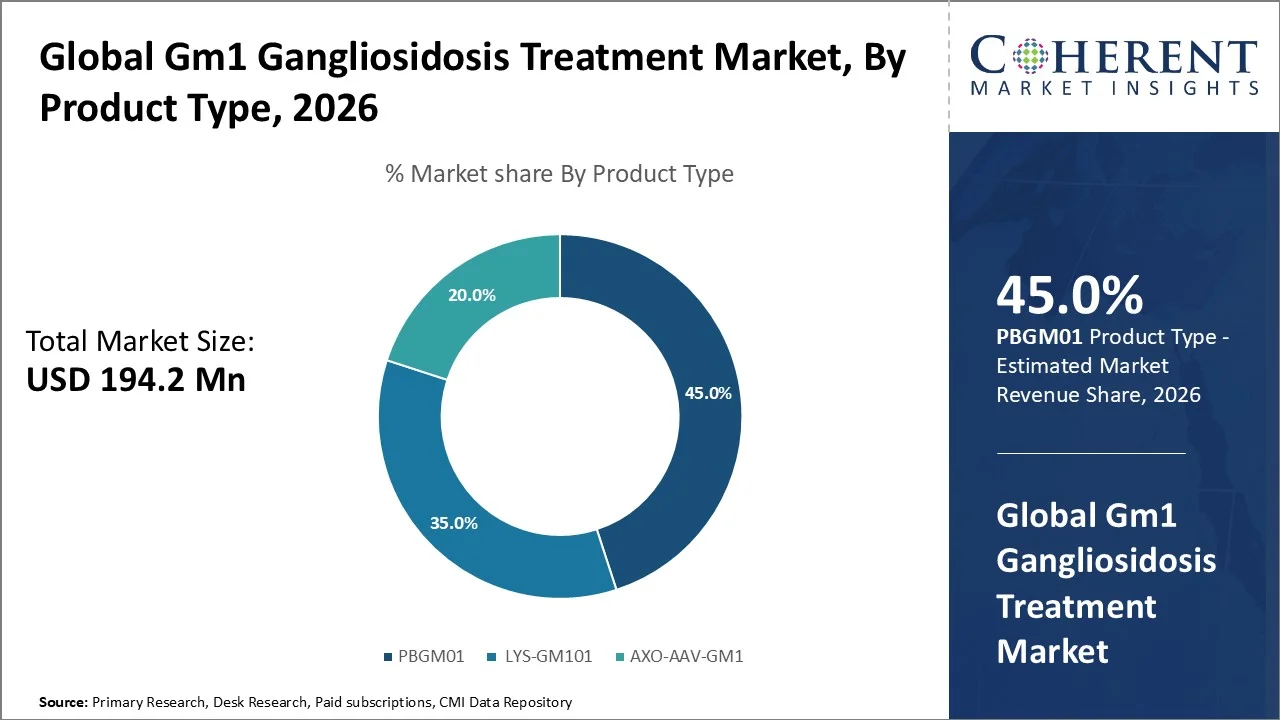
Why is PBGM01 Acquiring the Largest Market Share?
PBGM01 is projected to account for the largest share of cognitive systems spending in 2026, representing approximately 45.0% of the total volume. PBGM01 appears to be the dominant product type in the GM1 Gangliosidosis Treatment Market because it has the clearest late-stage clinical visibility among named candidates. According to ClinicalTrials.gov, the Imagine-1 Phase 1/2 study was listed as active, not recruiting, with 2026-02 shown as the estimated primary completion timing and 2029-02 as estimated study completion; the study evaluates a single intracisterna magna dose of PBGM01 for Type 1 and Type 2a pediatric GM1. Futhermmore, according to MedlinePlus Genetics, published in 2023, GM1 occurs in 1 in 100,000–200,000 newborns, and Type I is reported more frequently, supporting strong demand for infantile-focused therapies. Moreover, according to Passage Bio, Inc., in 2024, GEMMABio, a new therapeutics company, received exclusive worldwide PBGM01 development and commercialization rights, strengthening its 2026 pipeline continuity.
Source: ClinicalTrials.gov; MedlinePlus; Passagebio.com
- Current Industry Events of 2026
- Market Size Estimation
- Regional Breakdown
- Competitive Landscape
- Customer Intelligence
- Segmental Analysis
- Pricing Analysis
- Key Market Drivers, Challenges & Future Trends
- Customized Insights Section
Type 1 GM1 Gangliosidosis holds the Largest Market Share
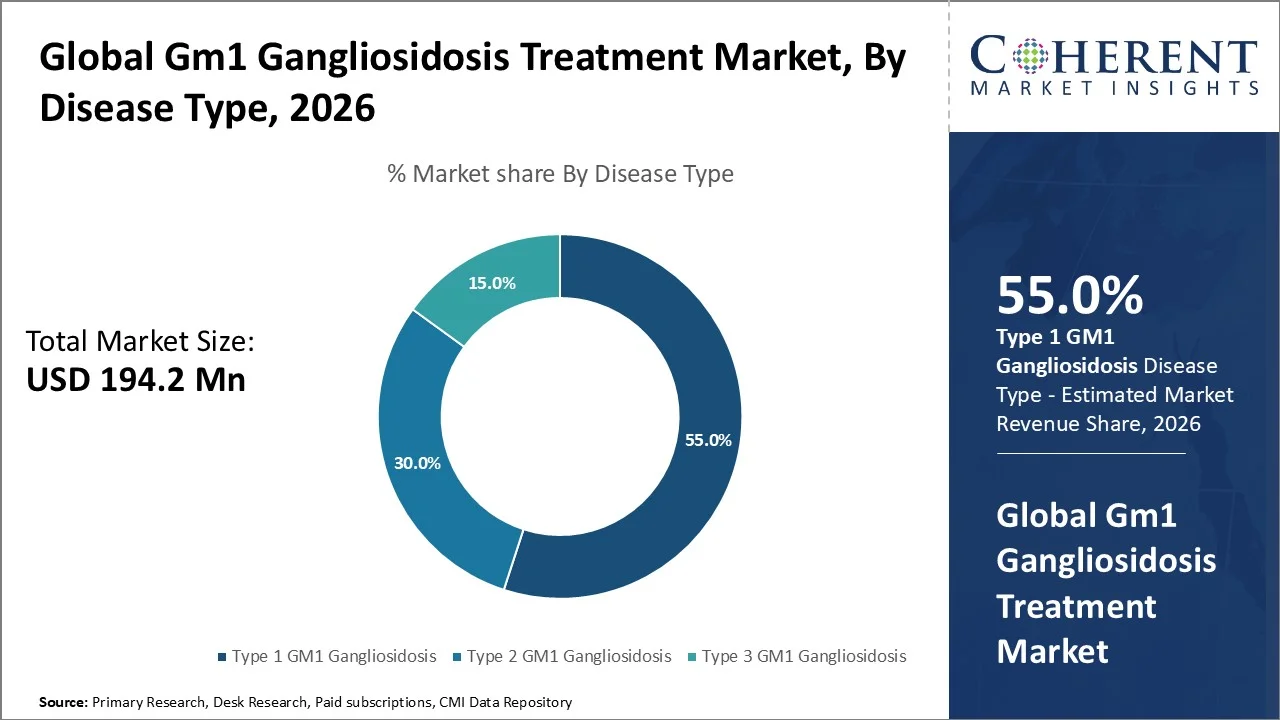
Based on disease type, type 1 GM1 Gangliosidosis dominate the market, accounting for a significant 55.0% share in 2026, Type 1 GM1 Gangliosidosis holds the largest share in the GM1 gangliosidosis treatment market due to its severe infantile onset, high clinical urgency, and stronger focus in gene therapy development. A 2026 NIH-indexed publication states that Type I is the most aggressive GM1 form, typically emerging before 6–12 months with hypotonia, neurodevelopmental regression, organ involvement, and rapid disease progression. This creates higher diagnostic attention, faster treatment-seeking, and stronger eligibility for early-intervention trials. ClinicalTrials.gov lists PBGM01 as a GM1 gene therapy designed to deliver a functional GLB1 gene copy to the brain and peripheral tissues, with evaluation in pediatric participants including early-onset infantile GM1. Type 1 therefore dominates because it represents the highest unmet need, greatest mortality risk, and clearest target population for disease-modifying therapies, encouraging companies and regulators to prioritize infantile GM1 programs. Moreover, in 2026, Azafaros B.V., biotechnology company also reported Phase 3 development activity for nizubaglustat in GM1/GM2 gangliosidoses. These factors make Type 1 the priority segment for diagnosis, trial enrollment, and disease-modifying therapy development.
Market Drivers
Increasing Research & Development for Treatment of GM1 gangliosidosis
Increasing research and development is driving the GM1 gangliosidosis treatment market size by shifting the field from supportive care toward disease-modifying therapies, especially gene therapy and oral substrate-reduction approaches. For instance, in 2026, FDA’s Rare Disease Innovation Hub agenda prioritized rare-disease regulatory science, novel endpoints, and biomarker development, supporting faster evaluation of ultra-rare genetic therapies. ClinicalTrials.gov also lists active GM1 programs, including PBGM01 gene therapy, designed to deliver a functional GLB1 gene to the brain and peripheral tissues. Moreover, in January 2026, Azafaros B.V., biotechnology company reported that two pivotal Phase 3 studies of nizubaglustat for GM1/GM2 gangliosidoses and NPC were enrolling, with data expected in 2027. These developments expand pipeline visibility, attract rare-disease investment, and strengthen future commercialization potential.
Rising Adoption of Inorganic Strategies Such as Collaborations for Development of Gene Therapy Treatment for Gm1 Gangliosidosis
Rising inorganic strategies such as licensing and collaborations are strengthening the GM1 gangliosidosis treatment market by helping small biotech innovators share clinical, regulatory, and commercialization risk. For instance, in 2026, the New England Journal Medicines-published Phase 1–2 study on AAV9 gene therapy for Type II GM1 gangliosidosis showed the value of collaboration-led development. The program involved academic and government-linked research groups, including NHGRI/NIH, UMass Chan Medical School, and Auburn University, after earlier commercial sponsorship challenges. This supports the trend that partnerships and licensing models help sustain ultra-rare gene therapy programs where small patient pools create high development risk. Furthermore, in August 2024, Passage Bio, biotech company out-licensed PBGM01 for GM1 gangliosidosis to GEMMA Biotherapeutics with exclusive worldwide development and commercialization rights, showing how licensing helps continue rare pediatric gene therapy programs. Moreover, in 2026, the AAV9/GLB1 gene therapy study for Type II GM1 showed clinical progress from a long academic-government collaboration involving NHGRI/NIH, UMass Chan Medical School, and Auburn University.
Growing Early Diagnosis Through Newborn Screening and Increasing Investment in Rare Disease R&D
Growing early diagnosis through newborn screening and increasing investment in rare disease research and development has created significant opportunity for the Gm1 gangliosidosis treatment market growth over forecast period. Growing early diagnosis through newborn screening and higher rare-disease R&D investment can drive the GM1 gangliosidosis treatment market by expanding the identifiable patient pool before irreversible neurological damage occurs. For instance, in March 2026, HRSA: Health Resources and Services Administration stated that U.S. newborn screening is state-based and most states screen for some or all RUSP conditions, while RUSP inclusion depends on screening benefit, state feasibility, and effective treatment availability. This supports future GM1 screening readiness as therapies advance. Furthermore, in 2026, NIH/NCATS (NCATS- National Center for Advancing Translational Sciences – NIH) reported that more than 10,000 rare diseases affect millions in the U.S., and around 30% of children with rare diseases die before age five, strengthening urgency for early diagnosis and R&D. Azafaros B.V. company’s 2026 Phase 3 nizubaglustat program for GM1/GM2 further validates commercial and clinical momentum.
Current Events and Their Impact on the Gm1 Gangliosidosis Treatment Market
Current Event | Description and its Impact |
FDA Rare Disease Innovation Hub Strategic Agenda 2026 |
|
FDA Plausible Mechanism Framework for Ultra-Rare Genetic Diseases |
|
NIH/NCATS Rare Disease Research and Gene Therapy Collaboration Push |
|
Gm1 Gangliosidosis Treatment Market Trends
- Gene therapy remains the core innovation trend: ClinicalTrials.gov shows PBGM01 is being studied as a one-time gene therapy designed to deliver a functional GLB1 gene through intracisterna magna administration. The Imagine-1 Phase 1/2 trial has an estimated primary completion date of February 2026, making it one of the most visible late-stage clinical programs for GM1 gangliosidosis. This trend is important because GM1 is caused by GLB1 gene mutations, so gene replacement may directly target the disease mechanism rather than only managing symptoms.
- Ultra-rare disease regulatory flexibility is improving: In February 2026, the FDA launched a framework to accelerate individualized therapies for ultra-rare diseases. This supports the GM1 gangliosidosis treatment market because the patient population is extremely small, making conventional large-scale trials difficult. Faster and more flexible regulatory pathways may help sponsors design development programs using limited patient data, natural history evidence, biomarkers, and individualized treatment approaches. This trend may improve the feasibility of bringing therapies for very rare pediatric neurological diseases into clinical and commercial use.
- Rare pediatric disease focus is rising: FDA’s rare disease programs continue to support orphan drug and rare pediatric disease development, which is highly relevant for GM1 gangliosidosis because severe Type I GM1 begins in infancy and progresses rapidly. These programs provide regulatory incentives that can encourage companies to invest in therapies for very small patient populations. As more sponsors target pediatric genetic disorders, GM1 treatment development may benefit from stronger regulatory engagement, priority review opportunities, and structured guidance for clinical evidence generation in children with life-threatening rare diseases.
- Evidence-based clinical development is gaining importance: FDA’s rare disease drug development guidance resources are helping sponsors plan trials where patient numbers are limited and disease progression is severe. For GM1 gangliosidosis, this is important because studies may need to rely on carefully selected endpoints, natural history comparisons, biomarkers, and long-term follow-up instead of large randomized trials. This trend supports more structured evidence generation for gene therapies and other disease-modifying treatments, helping companies show safety, durability, and clinical benefit in a rare pediatric population.
Regional Insights
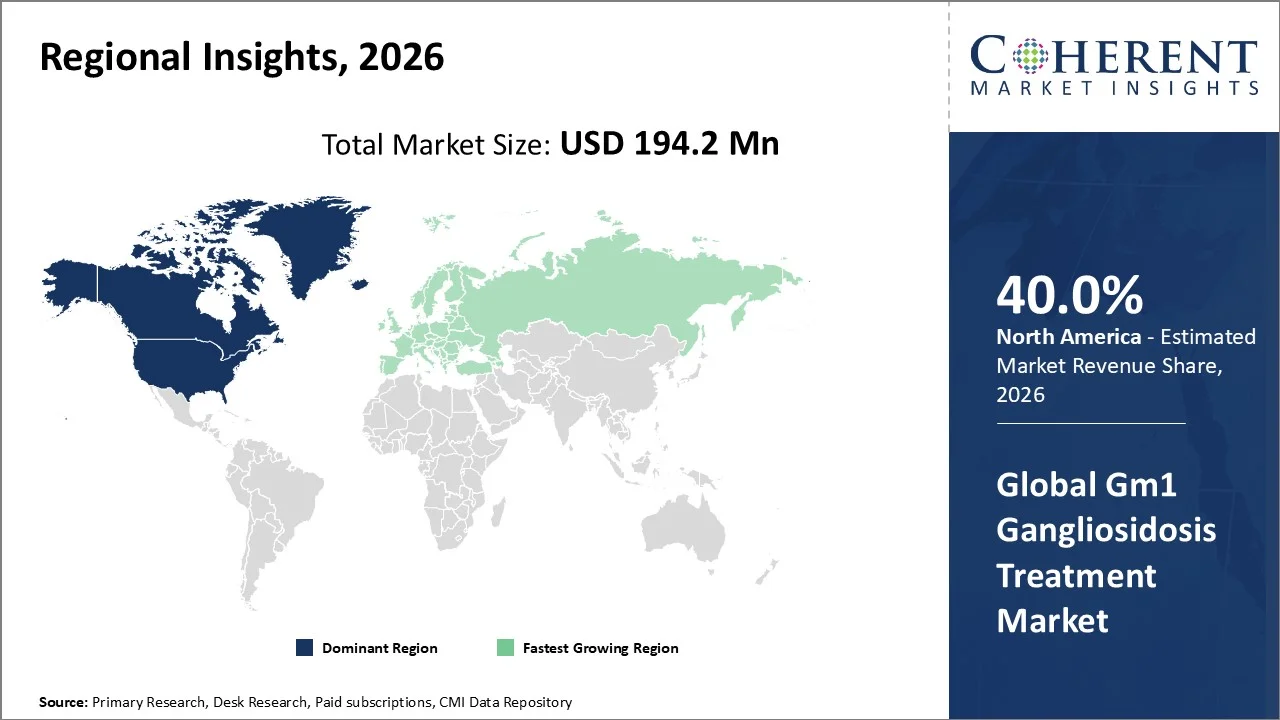
North America dominates owing to Strong Research Infrastructure
North America account 40.0% market share in 2026, supported by advanced infrastructure for rare disease research, strong U.S. regulations, and increasing government initiatives. North America dominates the GM1 gangliosidosis treatment market due to strong U.S. rare-disease regulation, clinical trial infrastructure, newborn screening systems, and gene therapy R&D. For instance, in 2026, U.S.FDA’s Rare Disease Innovation Hub released a strategic agenda to advance rare-disease regulatory science and improve coordination across drug, biologic, and device centers, supporting therapies for small patient groups such as GM1. Furthermore, in 2026, NIH/NCATS reported that more than 10,000 rare diseases affect millions of Americans and around 30% of children with rare diseases die before age five, strengthening funding urgency. The U.S. also has broad early-diagnosis capacity, as Health Resources and Services Administration (HRSA) states newborn screening reaches nearly 4 million babies each year. ClinicalTrials.gov lists U.S.-linked PBGM01 gene therapy for GM1, designed to deliver a functional GLB1 gene copy to brain and peripheral tissues. These factors support faster diagnosis, trial recruitment, and therapy commercialization.
Asia Pacific Gm1 Gangliosidosis Treatment Market Trends
The Asia-Pacific region is poised to be as the fastest-growing region through 2026-2033. Asia Pacific is the fastest-growing region in the GM1 gangliosidosis treatment market due to expanding rare-disease diagnosis, newborn screening, and government-backed genetic medicine infrastructure. According to India’s PIB, in 2026, the government highlighted early detection, affordability, genomics, biotechnology, and preventive healthcare as priorities for genetic and rare diseases. This directly supports diagnosis-led demand for GM1 therapies. According to Lok Sabha data published in 2026, India provides financial support of up to Rs. 50 lakhs per rare-disease patient under NPRD 2021, improving treatment access. Clinical readiness is also rising, as ClinicalTrials.gov lists PBGM01’s Phase 1/2 study with February 2026 as the estimated primary completion date. MedlinePlus Genetics reports GM1 occurs in 1 in 100,000–200,000 newborns, and Type I is reported more frequently, supporting strong pediatric treatment need.
Supportive Regulatory Laws and Strong Research is Accelerating the Gm1 Gangliosidosis Treatment Market Demand in United States
The U.S. dominates the North America GM1 gangliosidosis treatment market due to its stronger rare-disease regulatory ecosystem, clinical-trial infrastructure, and active gene-therapy pipeline. For instance, in April 2026, U.S.FDA’s Rare Disease Innovation Hub released its Strategic Agenda to improve rare-disease regulatory science and coordination across FDA centers, especially for small patient populations with high unmet need. Furthermore, in 2026, NIH/NCATS reported that over 10,000 rare diseases affect millions of Americans, and nearly 30% of children with rare diseases die before age five, supporting urgent R&D funding. ClinicalTrials.gov lists PBGM01, a GM1 gene therapy designed to deliver a functional GLB1 gene copy to the brain and peripheral tissues. In addition, in 2026, Azafaros B.V. reported Phase 3 nizubaglustat studies for GM1/GM2 gangliosidoses, further strengthening U.S.-linked rare-disease development momentum.
China Gm1 Gangliosidosis Treatment Market Trends
China dominates Asia Pacific due to its stronger rare-disease policy, large diagnosed pool, and faster drug-access reforms. According to China’s State Council, in 2025, China expanded its rare-disease catalog to 207 conditions, built a national network of 419 medical institutions, and registered 1.64 million rare-disease cases across a reporting system covering 1.15 billion people. In 2026, China revised drug regulations to give market exclusivity to eligible pediatric and rare-disease drugs, supporting GM1 therapy development and faster market entry.
Who are the Major Companies in Gm1 Gangliosidosis Treatment Market
Some of the major key players in Global Gm1 Gangliosidosis Treatment Market are Axovant Gene Therapies Ltd, Passage Bio and Lysogene.
Key News
- In January 2026, Azafaros B.V., biotech company announced that nizubaglustat was being evaluated in two global Phase 3 studies, including one for GM1/GM2 gangliosidoses, with the studies actively recruiting. The company also highlighted that nizubaglustat has FDA Rare Pediatric Disease, Orphan Drug, Fast Track, and IND clearance status for GM1/GM2 gangliosidoses. This development supports the GM1 gangliosidosis treatment market by advancing an oral, brain-penetrant therapy toward potential disease modification and improving clinical momentum for patients with limited treatment options.
- In January 2026, Cure GM1 Foundation announced a ~US$1.4 million investment into its enzyme replacement therapy (ERT) project, marking its largest-ever single research commitment to accelerate investigational development. The initiative aims to de-risk early-stage therapy development and attract future partnerships and funding. This reflects increasing nonprofit-led funding support in ultra-rare diseases, helping bridge early R&D gaps and advancing potential disease-modifying treatments for GM1 gangliosidosis.
Market Report Scope
Gm1 Gangliosidosis Treatment Report Coverage
| Report Coverage | Details | ||
|---|---|---|---|
| Base Year: | 2025 | Market Size in 2026: | USD 194.2 Mn |
| Historical Data for: | 2020 To 2024 | Forecast Period: | 2026 To 2033 |
| Forecast Period 2026 to 2033 CAGR: | 36.7% | 2033 Value Projection: | USD 1,658.9 Mn |
| Geographies covered: |
| ||
| Segments covered: |
| ||
| Companies covered: | Axovant Gene Therapies Ltd, Passage Bio and Lysogene. | ||
Analyst Opinion
- The GM1 gangliosidosis treatment market is moving from supportive care toward disease-modifying therapies, mainly because rare-disease regulators are creating more flexible development pathways for small patient populations. In February 2026, the FDA Rare Disease Innovation Hub released its 2026 Strategic Agenda to advance rare-disease regulatory science and improve coordination across FDA centers. This is important for GM1 gangliosidosis, where limited patients, severe disease progression, and difficulty in running large trials make regulatory flexibility essential for gene therapy and substrate-reduction therapy development.
Source: U.S.FDA
- Active late-stage clinical development is becoming a key growth signal for the GM1 gangliosidosis treatment market. In January 2026, Azafaros stated that two pivotal Phase 3 studies of nizubaglustat were enrolling, including a study for GM1/GM2 gangliosidoses, with data expected in 2027. In February 2026, the company also reported that nizubaglustat had FDA Rare Pediatric Disease, Orphan Drug, Fast Track, and IND clearance status for GM1/GM2 gangliosidoses, showing strong regulatory support for advanced development.
Source: Azafaros
- Gene therapy remains a major innovation pillar, although the market is becoming more selective after earlier pipeline setbacks. ClinicalTrials.gov lists PBGM01 as a gene therapy for GM1 gangliosidosis intended to deliver a functional GLB1 gene copy to the brain and peripheral tissues. This supports long-term market potential because GM1 is caused by GLB1 deficiency, making gene replacement a directly targeted treatment approach. Continued clinical tracking of PBGM01 in 2026 shows that advanced biologic therapies remain central to future market development.
- Early diagnosis and government-backed rare-disease research infrastructure will be critical for market expansion. In 2026, NIH/NCATS highlighted that more than 10,000 rare diseases affect millions of Americans, while around 30% of children with rare diseases die before age five. This strengthens the case for faster diagnosis, patient registries, natural-history studies, and rare-disease R&D funding. For GM1 gangliosidosis, earlier identification may improve trial enrollment and increase future demand for therapies designed for infantile and juvenile patients.
Speak to the analyst
Want personalized insights?
Take the findings above to one of our principal consultants, or have the report rebuilt around the segments, geographies and competitors you actually track.
Gm1 Gangliosidosis Treatment Market Segmentation
- By Product Type
- LYS-GM101
- PBGM01
- AXO-AAV-GM1
- By Disease Type
- Type 1 GM1 Gangliosidosis
- Type 2 GM1 Gangliosidosis
- Type 3 GM1 Gangliosidosis
- Global Gm1 Gangliosidosis Treatment Market, By Region
- North America
- U.S.
- Canada
- Latin America
- Brazil
- Mexico
- Argentina
- Rest of Latin America
- Europe
- Germany
- U.K.
- France
- Italy
- Spain
- Russia
- Rest of Europe
- Asia Pacific
- China
- India
- Japan
- Australia
- South Korea
- ASEAN
- Rest of Asia Pacific
- Middle East
- GCC
- Israel
- Rest of Middle East
- Africa
- South Africa
- Central Africa
- North Africa
- North America
Sources
Primary Research Interviews
- Interviews with pediatric neurologists and geneticists to understand GM1 diagnosis, disease progression, and treatment gaps.
- Insights from gene therapy developers and trial investigators on pipeline progress, safety, and adoption potential.
- Discussions with orphan drug experts and analysts to assess approvals, competition, and commercialization challenges.
- Conversations with advocacy groups and screening experts to evaluate early diagnosis, access, and treatment readiness.
Databases
- FDA Orphan Drug Designations Database
- NIH Genetic and Rare Diseases Information Center
- ClinicalTrials.gov
- PubMed
- Orphanet
- GlobalData Healthcare Database
- Others
Magazines
- GEN – Genetic Engineering & Biotechnology News
- BioPharma Dive
- Fierce Biotech
- Pharmaceutical Technology
- Rare Disease Advisor
Journals
- Molecular Genetics and Metabolism
- Orphanet Journal of Rare Diseases
- Human Gene Therapy
- Journal of Inherited Metabolic Disease
- Molecular Therapy
Newspapers
- Reuters
- Financial Times
- BioCentury
- Bloomberg News
- The Wall Street Journal
Associations
- EveryLife Foundation for Rare Diseases
- Cure GM1 Foundation
- National Organization for Rare Disorders
- Global Genes
- Society for Inherited Metabolic Disorders
Public Domain Sources
- U.S. Food and Drug Administration
- National Institutes of Health
- National Center for Advancing Translational Sciences
- Centers for Disease Control and Prevention
- Health Resources and Services Administration
- European Medicines Agency
Proprietary Elements
- CMI Data Analytics Tool
- Proprietary CMI Existing Repository of information for last 10 years
Get access to 250+ pages report
Every segment, forecast, competitor profile and data table behind the analysis above — available for instant download.
- ESOMAR Member
- ISO 9001:2015 Certified
- D-U-N-S Registered
- GDPR & CCPA Compliant
Missing comfort of reading report in your local language? Find your preferred language:
Transform your Strategy with Exclusive Trending Reports
Frequently Asked Questions
The Gm1 Gangliosidosis Treatment Market is expected to reach USD 57,140.0 Million in 2033.
Major players operating in the global Gm1 Gangliosidosis Treatment Market include Axovant Gene Therapies Ltd, Passage Bio and Lysogene.
Low awareness about GM1 gangliosidosis in emerging countries is the major factors hampering the growth of the Gm1 gangliosidosis treatment market.
Increasing Research and Development for Treatment of GM1 gangliosidosis and rising adoption of inorganic strategies such as collaborations for development of gene therapy treatment for GM1 gangliosidosis
The Gm1 Gangliosidosis Treatment Market is anticipated to grow at a CAGR of 36.7% between 2026 and 2033.
Among regions, North America is expected to account for a largest market share in the global Gm1 Gangliosidosis Treatment Market over the forecast period.