

Healthcare Asset Management Market Size And Share Analysis - Growth Trends And Forecasts (2026-2033)
Healthcare Asset Management Market is estimated to be valued at USD 24.12 Bn in 2026 and is expected to reach USD 77.28 Bn in 2033, exhibiting a compound annual growth rate (CAGR) of 18.1% from 2026 to 2033.
Key Takeaways
- Based on Technology, the Radio Frequency Identification (RFID) Systems segment is projected to account for 75.4% of the market share in 2026, owing to its ability to provide real-time tracking, reduce equipment loss, and improve operational efficiency.
- Based on Component, the Hardware segment is projected to account for the largest share of the global healthcare asset management market in 2026, due to its critical role in enabling real-time tracking, automation, and accuracy in hospital operations.
- Based on Application, the Equipment Tracking segment is expected to account for the largest share of the global healthcare asset management market in 2026, as it directly improves operational efficiency, patient care, and cost control.
- Based on End User, Hospitals/Clinics segment is expected to lead the global healthcare asset management market in 2026, holding highest share, due to their need for real-time tracking of medical equipment, better inventory management, and enhanced patient safety.
- Based on Region, North America is expected to dominate the healthcare asset management market in 2026, holding a 52. 4% share. While, Europe is projected to contribute significant share to the healthcare asset management market.
Market Overview
The global healthcare asset management market is experiencing strong growth due to the growing focus on asset management and rising concerns about drug counterfeiting. Moreover, a rise in the adoption of asset management solutions and a rise in the implementation of RFID technology are expected to boost the healthcare asset management market demand.
Current Events and their Impact on the Healthcare Asset Management Market
Current Event | Description and Its Impact |
Geopolitical and Regulatory Developments |
|
Economic Trends and Funding Dynamics |
|
Adoption of Artificial Intelligence in Healthcare Asset Management
Artificial intelligence is revolutionizing healthcare asset management by improving efficiency, reducing costs, and enhancing patient care. AI-powered systems enable real-time tracking of medical equipment, ensuring critical assets are always available when needed. Through predictive analytics, AI can forecast maintenance needs, minimizing downtime and extending asset lifespan. It also optimizes inventory levels, preventing overstocking or shortages. By automating compliance tracking and audits, AI reduces manual errors and ensures regulatory adherence.
In May 2025, Smarter Technologies, a leading automation and insights platform focused on healthcare efficiency, unveiled the industry's first AI-driven revenue management solution designed to enhance administrative workflows and improve the financial performance of hospitals and health systems.
- Current Industry Events of 2026
- Market Size Estimation
- Regional Breakdown
- Competitive Landscape
- Customer Intelligence
- Segmental Analysis
- Pricing Analysis
- Key Market Drivers, Challenges & Future Trends
- Customized Insights Section
Segmental Insights
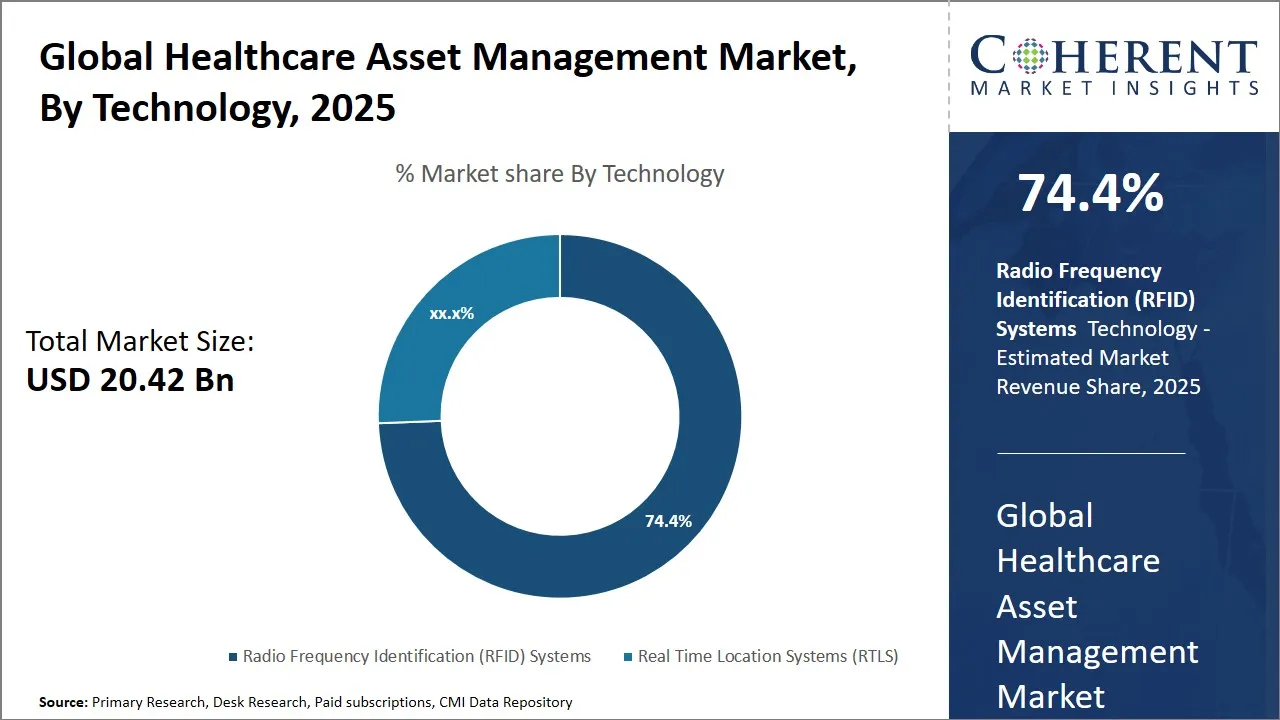
Healthcare Asset Management Market Insights, By Technology: Radio Frequency Identification (RFID) Systems Acquires the dominant share owing to the Rising Demand to Provide Real-Time Tracking
In terms of technology, the radio frequency identification (RFID) systems segment is expected to hold 75.4% share of the market in 2026, primarily driven by its ability to provide real-time tracking, reduce equipment loss, and improve operational efficiency. Hospitals and healthcare facilities often face challenges like misplaced medical devices, inefficient inventory management, and delays in locating critical assets. RFID helps overcome these issues by enabling automatic identification and location tracking of medical equipment, pharmaceuticals, and even patients.
For instance, in August 2024, Avery Dennison introduced its AD Minidose U9XM UHF RFID inlays and tags, tailored for identifying compact medical and pharmaceutical items like syringes and vials. These high‑memory tags are approved by Auburn University’s RFID Lab and compliant with ARC Category S—support storage of expiry dates and batch/lot data, enhancing traceability and authenticity without relying on cloud lookups.
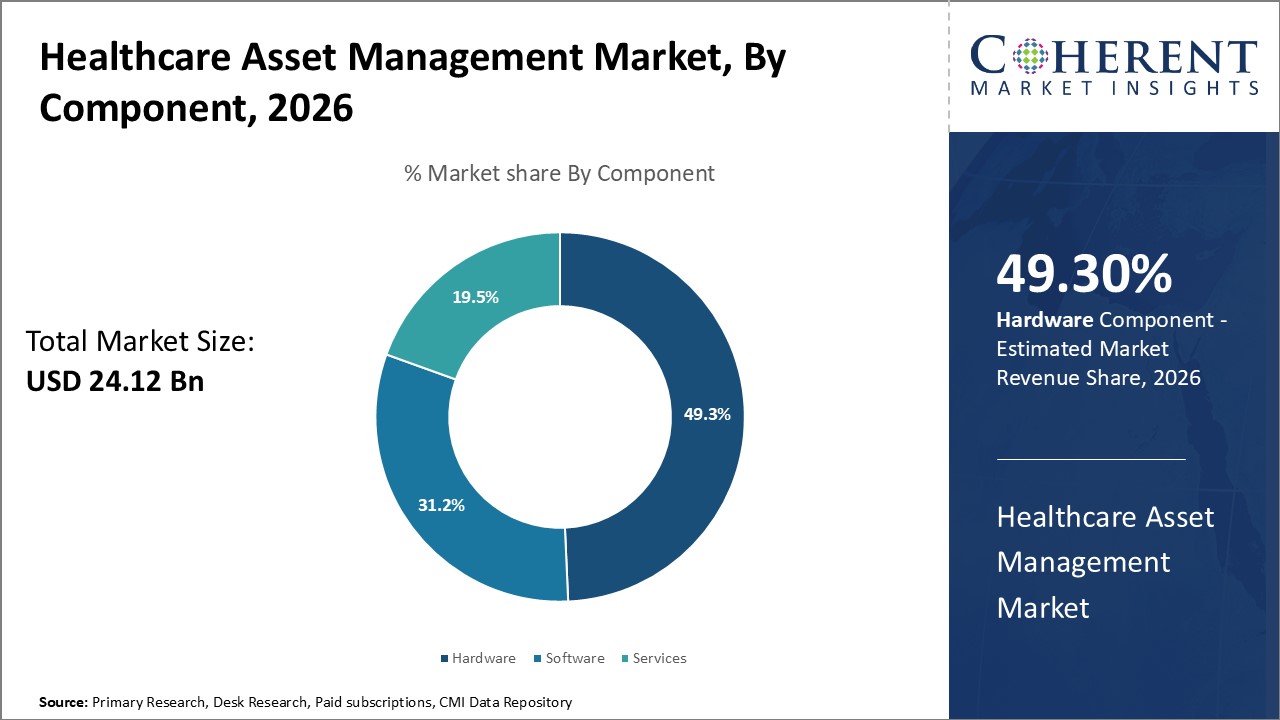
Healthcare Asset Management Market Insights, By Component: Hardware Holds the largest share
In terms of component, the hardware segment is projected to hold the largest share of the market in 2026, due to its critical role in enabling real-time tracking, automation, and accuracy in hospital operations. Hardware such as RFID tags, sensors, readers, and beacons form the foundation for locating and monitoring high-value assets, medical equipment, pharmaceutical inventories, and even patients and staff. As hospitals aim to reduce equipment loss, improve utilization, and enhance patient safety, the need for robust physical infrastructure increases. Additionally, hardware enables seamless integration with software systems, ensuring data accuracy and operational efficiency, making it a vital component in the expanding healthcare asset management ecosystem.
For instance, in November 2024, Advantech launched the AIM‑68H, a rugged 10.1‑inch WUXGA medical‑grade tablet, offering high visibility with its 800‑nit display and clear audio via an 80 dB speaker to support emergency alerting. Powered by a 12th‑Gen Intel® processor and equipped with Wi‑Fi 6E, Bluetooth 5.3, NFC and barcode scanning capabilities, it integrates seamlessly into mobile patient monitoring, imaging, equipment control, and emergency care workflows.
Healthcare Asset Management Market Insights, By Application: Equipment Tracking Acquires the most prominent share on account of the growing Need for Improved Operation Efficiency and Patient Care
In terms of application, the equipment tracking segment is expected to dominate the market with highest share in 2026, as it directly improves operational efficiency, patient care, and cost control. Hospitals and clinics manage thousands of medical devices, ranging from infusion pumps to surgical tools and misplacement or underutilization of such equipment can lead to delays in treatment, increased operational costs, and patient safety risks.
For instance, in March 2025, Singapore’s Khoo Teck Puat Hospital (KTPH) boosts efficiency by deploying a real‑time location system (RTLS) to track both patients and medical assets. The active RTLS monitors approximately 1,500 pieces of equipment and has slashed staff search time, saving an estimated 20,000 work‑hours annually.
Healthcare Asset Management Market Insights, By End User: Hospitals/Clinics Acquires the dominant share owing to the Rising need to Real-Time Tracking of Medical Equipment and Better Inventory
In terms of end user, hospitals/clinics segment is expected to capture the greatest share of the market in 2026, due to their need for real-time tracking of medical equipment, better inventory management, and enhanced patient safety. With thousands of assets like infusion pumps, wheelchairs, and surgical instruments moving throughout facilities daily, hospitals face significant challenges in locating and maintaining equipment efficiently. Asset management solutions, especially those using RFID and IoT, help reduce equipment loss, improve utilization rates, and cut down on unnecessary purchases.
Additionally, hospitals are under pressure to improve operational efficiency and regulatory compliance while minimizing costs. These systems assist in automating maintenance schedules, tracking high-value assets, and managing pharmaceuticals, including preventing drug counterfeiting. As patient volumes increase, especially in urban hospitals, asset visibility becomes even more critical for reducing delays in care delivery and improving the overall quality of service.
For instance, in February 2025, Falcon ICU, a division of Critical Care Unified (CCU), inaugurated its second Smart ICU unit in Mumbai in collaboration with Mahajan Hospital. The initiative targets mid‑sized hospitals struggling with critical‑care infrastructure by leveraging advanced monitoring systems, real‑time patient tracking, and international protocols to deliver precise, timely interventions.
Regional Insights
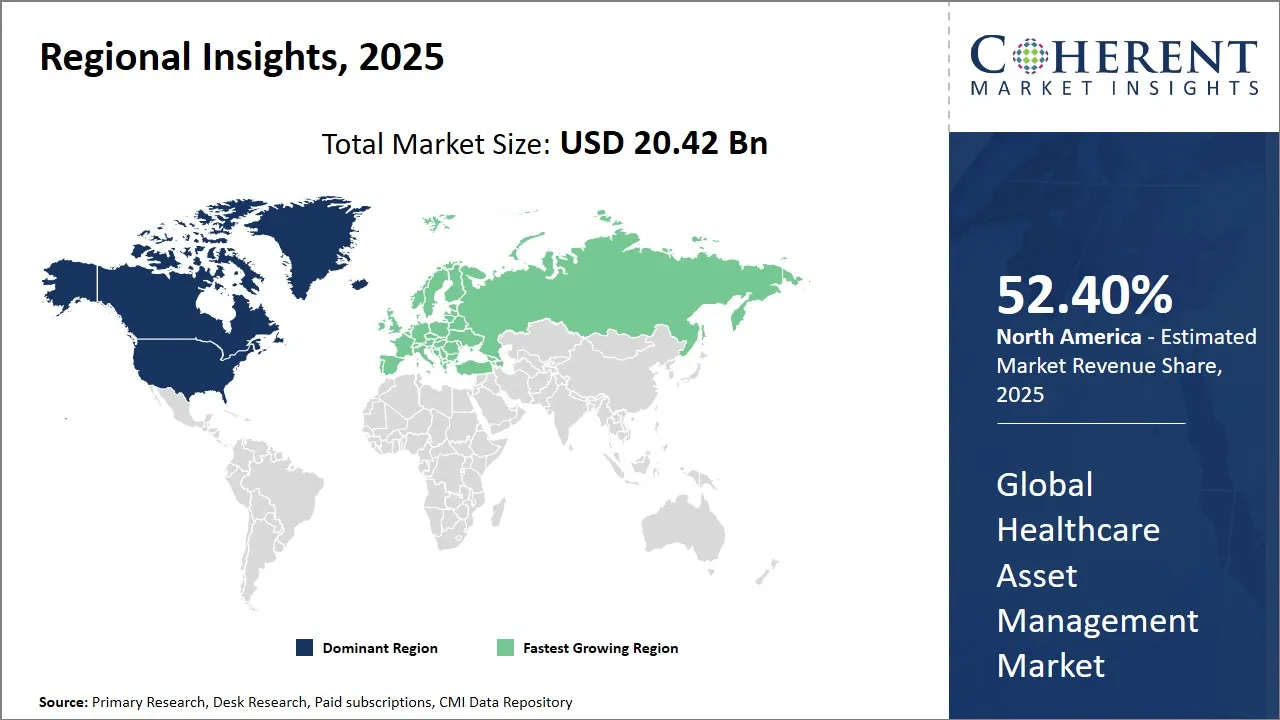
North America Healthcare Asset Management Market Analysis & Trends
North America is projected to lead the market with a 52.40% share in 2026, driven by rising drug counterfeiting, data privacy concerns, and supply chain inefficiencies. The region’s strong digital infrastructure and regulatory support are boosting adoption of asset tracking technologies like RFID in hospitals, clinics, and pharmaceutical networks, ensuring better inventory control, equipment utilization, and compliance.
For instance, Identiv, Inc. and Novanta Inc., announced a strategic partnership to streamline adoption of RFID solutions for healthcare OEMs. The collaboration combines Identiv’s RFID inlays, tags, and labels with Novanta’s ThingMagic reader modules and APIs to deliver end‑to‑end solutions enabling access, identification, and traceability with improved cost and performance. The focus is on smart medical devices, diagnostics, and wearables that enhance product performance and assembly integrity while boosting patient safety.
Europe Healthcare Asset Management Market Analysis & Trends
Europe is witnessing strong demand in the healthcare asset management market due to rising adoption RTLS technologies to improve equipment tracking, reduce asset loss, and boost operational efficiency. Regulatory mandates, growing digital health infrastructure, and the need to enhance patient safety and staff productivity are further driving adoption across hospitals and clinics.
For instance, GS1 Healthcare is commemorating two decades of transforming patient safety and healthcare efficiency through barcode technology. Since its introduction to the healthcare sector 20 years ago, the GS1 DataMatrix barcode has become vital to global healthcare supply chains, standardizing identification of medicines, devices, patients, assets, and locations across over 70 countries. By streamlining inventory management and enabling precise tracking, these barcodes have allowed clinicians to devote more time to direct patient care.
Healthcare Asset Management Market Outlook Country-Wise
The U.S. Healthcare Asset Management Market Trends
The United States leads the healthcare asset management market due to its advanced healthcare infrastructure, widespread adoption of RFID/RTLS, and strong emphasis on patient safety. Rising concerns over drug counterfeiting and growing hospital digitization are key drivers, pushing the demand for real-time tracking of equipment, pharmaceuticals, and patients. Hospitals increasingly invest in asset management to reduce costs, prevent equipment loss, and ensure regulatory compliance, making the U.S. a major growth hub in this market.
For instance, in January 2026, Bluesight is piloting its KitCheck Anywhere solution, a retrofit involving RFID‑enabled shelf liners and cloud‑connected readers—at a U.S. hospital to monitor refrigerated medications in remote locations, such as cardiac operating rooms, instead of only within the central pharmacy. Operational since June 2024 at a 450‑bed, 20‑OR hospital in a 12‑facility network, the pilot aims to enhance real‑time visibility of inventory, reduce out‑of‑stocks, and prevent expiration by extending drug‑tracking into care areas.
U.K. Healthcare Asset Management Market Trends
The United Kingdom is a key market for Healthcare Asset Management due to NHS efforts to improve efficiency, safety, and compliance. Growing adoption of RFID and RTLS helps public hospitals track assets, reduce equipment loss, and improve utilization. Rising e-health investments and digital transformation initiatives are further driving demand for integrated asset management solutions across the UK healthcare system.
For instance, in March 2023, Ingenica Solutions launched a pioneering inventory and asset management app aimed at transforming supply chain workflows in UK Community Health Centres. The user‑friendly system, piloted across five centres, achieved between £200,000–£250,000 in savings over six months, and delivered a 30% average reduction in inventory. Over one-third of product lines decreased by more than 50%, creating an immediate £5,000 “stock holiday,” while annual inventory savings are estimated at £14,000–£22,000. The app also streamlined operations by reducing inventory-related workloads by a full day per week, freeing up administrative time for patient care.
Market Report Scope
Healthcare Asset Management Market Report Coverage
| Report Coverage | Details | ||
|---|---|---|---|
| Base Year: | 2025 | Market Size in 2026: | USD 24.12 Bn |
| Historical Data for: | 2020 To 2024 | Forecast Period: | 2026 To 2033 |
| Forecast Period 2026 to 2033 CAGR: | 18.1% | 2033 Value Projection: | USD 77.28 Bn |
| Geographies covered: |
| ||
| Segments covered: |
| ||
| Companies covered: | Aeroscout, Inc, Radianse, Motorola Solutions, Infor, Inc., IBM Corporation, GE Healthcare, Airista Flow, Sonitor Technologies, Siemens Healthineers, and Awarepoint Corporation, among others | ||
| Growth Drivers: |
| ||
| Restraints & Challenges: |
| ||
Global Healthcare Asset Management Market Drivers
- Growing Focus on Assets Management to Drive Market Growth
One of the key factors expected to augment the growth of the global healthcare asset management market during the forecast period is the growing focus on assets management. For instance, Asset management is a systematic approach to the governance of medical assets. It involves tracking and managing medical equipment, supplies, and other assets within a healthcare facility.
For instance, October 2024, Cognosos acquired hospital RTLS software specialist Cox Prosight, merging its AI‑native LocationAI® platform with Cox Prosight’s award‑winning, vendor‑agnostic software. The integration delivers a unified “single‑pane‑of‑glass” system covering asset tracking, staff duress, patient monitoring, hand‑hygiene compliance, environmental monitoring and more—enhancing operational efficiency and safety in hospitals.
- Drug Counterfeiting to Underpin Market Growth
Another key factor driving the growth of the global healthcare asset management market is the increasing concern over drug counterfeiting worldwide. Counterfeit drugs—those produced and sold to deceptively represent their origin, authenticity, or effectiveness, pose a significant threat to patient safety and pharmaceutical supply chains. As highlighted in recent healthcare asset management market research, the need for advanced tracking systems has become critical.
For instance, in August 2025, Delhi Police’s Anti‑Gang Squad dismantled a major counterfeit medicine syndicate, arresting six individuals including kingpin Rajesh Mishra. The operation uncovered illicit manufacturing units in Jind and Baddi, spanning across Uttar Pradesh, Haryana, and Himachal Pradesh. Authorities seized over 100,000 counterfeit tablets, along with raw materials, packaging, and machinery mimicking major pharmaceutical brands.
Such incidents underscore the urgent demand for robust asset tracking and authentication technologies, further boosting the adoption of healthcare asset management solutions globally.
Global Healthcare Asset Management Market Opportunities
A rise in the implementation of RFID (Radio Frequency Identification) technology is expected to offer significant growth opportunities for players in the global healthcare asset management market. For instance, RFID technology is an extremely attractive, versatile anti-counterfeiting, anti-tampering solution. It adapts easily to the most diverse IT environments, making it ideal even for SMEs. The World Health Organization and the Food and Drug Administration (FDA) suggested the use of RFID to enhance the quality of the supply chain to eliminate counterfeit or fake drugs in the global market. Moreover, RFID tags allow medical facilities or healthcare organizations to effectively manage equipment, inventory and reduce human error. Furthermore, the growing adoption of asset management solutions is likely to create lucrative opportunities, supporting the healthcare asset management market forecast over the coming years.
For instance, in September 2024, Impinj, together with UK-based RFID Discovery Solutions, has deployed RAIN RFID asset‑tracking systems across more than 200 hospitals worldwide, significantly improving safety, efficiency, and cost control. The battery‑free tags, affixed to vital equipment like surgical tools, wheelchairs, laptops, PPE, and implant.
Global Healthcare Asset Management Market Trends
- Rise In Focus on Patient Care Is a Recent Trend
Healthcare asset management helps healthcare organizations worldwide improve the way they care for their patients. These solutions help clinicians to provide their patients with a more personalized and precisely targeted experience, ultimately improving the outcomes. Moreover, these combined benefits of asset management can enhance the level of care that healthcare organizations can give to their patients. Asset management help reduce costs and enhance patient outcomes. This trend is expected to continue over the forecast period.
- Growing Awareness Is Another Trend
Asset management in hospitals is simply a highly organized and economical method of organising, purchasing, maintaining, using, and disposing of healthcare organization’s equipment and physical assets. Adoption of asset management solutions is increasing due to rising requirement for efficient and precise tracking of medical equipment. Thus, with the growing awareness about the benefits of asset management, the adoption or use of healthcare asset management is also increasing. This trend is also expected to continue over the forecast period.
Analyst Opinion (Expert Opinion)
The healthcare asset management market value is on the cusp of a decisive transformation, driven not by conventional efficiency metrics, but by the critical need for real-time, location-aware, and secure infrastructure within increasingly complex clinical environments. In my view, this is no longer a ‘nice-to-have’ system, it’s a non-negotiable pillar of operational sustainability and clinical safety in modern healthcare.
Leading institutions are no longer investing in asset tracking simply to locate infusion pumps or wheelchairs; they are leveraging asset management as a central nervous system to mitigate clinical risk, reduce equipment hoarding, and prevent capital loss. The deployment of Real-Time Location Systems (RTLS) is a prime example. According to Zebra Technologies, hospitals lose nearly 15%–20% of mobile medical equipment annually due to misplacement, delays, or theft. RTLS platforms can reduce equipment shrinkage by over 60%, while also ensuring asset availability and uptime—a clear ROI case for C-suite decision-makers.
Moreover, the industry is seeing a surge in RFID-enabled solutions—not just for tracking but also for compliance, sterilization logging, and lifecycle analytics. For example, University of California San Diego Health reported that its RFID system improved asset utilization by over 35% and saved more than $1 million annually in redundant equipment purchases. This is not anecdotal—it’s a pattern.
The value is especially evident in pharmaceutical inventory and surgical instrument management. A single misplaced or unsterilized surgical tool can trigger an adverse event, potentially costing a hospital millions in litigation. Asset management software that integrates with electronic health records (EHRs) and sterilization workflows is now being viewed not as an IT investment, but as a patient safety imperative.
Another underappreciated but emerging segment is environmental monitoring, where asset management platforms are extending into cold-chain tracking of vaccines and temperature-sensitive biologics. In this context, the market is naturally aligning with broader digital health initiatives and hospital digital twins, especially in the U.S., U.K., and parts of the GCC.
Speak to the analyst
Want personalized insights?
Take the findings above to one of our principal consultants, or have the report rebuilt around the segments, geographies and competitors you actually track.
Key Developments
- In July 2025, PeriOptimization, a pioneering hospital management software developed under the leadership of VA‑affiliated Dr. Robert C. Villare, is poised to revolutionize VA surgical and dental services by enhancing both patient and staff management. Built collaboratively with clinicians, the web‑based platform consolidates outdated scheduling systems into a unified, real‑time solution.
- In June 2025, LookDeep Health unveiled new AI-powered features designed to proactively curb workplace violence in healthcare settings. Enhancements include voice-activated help words, AI-driven situational awareness via tele‑ICU and virtual nursing video feeds, and seamless integration with Real-Time Location Systems (RTLS), enabling wearable badges for discreet distress signaling. Healthcare workers, though only 10 percent of the U.S. labor force, endure nearly half of all non‑fatal occupational injuries, with two nurses assaulted every hour.
- In February 2025, Medisafe, a leading digital health and patient engagement platform, introduced PATHWAYS, a complimentary, web‑based tool designed to streamline patient tracking and care coordination, particularly for Alzheimer’s disease treatment involving FDA‑approved monoclonal antibody therapies.
- In September 2024, RFiD Discovery unveiled its new Patient Discharge Management system, designed to streamline patient exits and automate bed availability updates in hospitals. This system uses RFID-enabled wristbands issued at admission and a Smart Drop Reader to instantly mark beds as ready for cleaning upon discharge, sending alerts to cleaning staff via SMS or email.
Market Segmentation
- Healthcare Asset Management Market, By Technology (Revenue, USD Bn, 2021 - 2033)
- Real Time Location Systems (RTLS)
- Radio Frequency Identification (RFID) Systems
- Active RFID
- Passive RFID
- Healthcare Asset Management Market, By Component (Revenue, USD Bn, 2021 - 2033)
- Hardware
- Software
- Services
- Healthcare Asset Management Market, By Application (Revenue, USD Bn, 2021 - 2033)
- Staff Management
- Equipment Tracking
- Patient Tracking
- Supply Chain Management
- Healthcare Asset Management Market, By End Users (Revenue, USD Bn, 2021 - 2033)
- Hospitals/Clinics
- Laboratories
- Pharmaceuticals
- Bio-Technology
- Healthcare Asset Management Market, By Geography (Revenue, USD Bn, 2021 - 2033)
- North America
- U.S.
- Canada
- Latin America
- Brazil
- Argentina
- Mexico
- Rest of Latin America
- Europe
- Germany
- U.K.
- Spain
- France
- Italy
- Russia
- Rest of Europe
- Asia Pacific
- China
- India
- Japan
- Australia
- South Korea
- ASEAN
- Rest of Asia Pacific
- Middle East
- GCC Countries
- Israel
- Rest of Middle East
- Africa
- South Africa
- North Africa
- Central Africa
- North America
- Healthcare Asset Management Market Companies
- Aeroscout, Inc.
- Radianse
- Motorola Solutions
- Infor, Inc.
- IBM Corporation
- GE Healthcare
- Airista Flow
- Sonitor Technologies
- Siemens Healthineers
- Awarepoint Corporation
Sources
Primary Research Interviews from the following stakeholders
Stakeholders
- Interviews with hospital administrators, biomedical engineers, IT heads, procurement managers, and healthcare infrastructure planners across key regional markets.
Specific Stakeholders
- Operations managers at multi-specialty hospitals and healthcare networks
- Asset tracking heads at logistics and pharmaceutical cold chain companies
- CIOs and digital transformation lead at private hospital chains
- Inventory and supply chain managers in large pathology labs and diagnostic centers
- Biomedical engineers at medical device service companies
- Nursing staff and clinical managers responsible for portable equipment and critical care infrastructure
Databases
- World Health Organization (WHO) Global Health Observatory
- World Bank Health Statistics
- National Health Systems Resource Centre (India)
- U.S. Centers for Medicare & Medicaid Services (CMS)
- European Centre for Disease Prevention and Control (ECDC)
- Ministry of Health and Family Welfare (India)
- OECD Health Statistics
- National Center for Biotechnology Information (NCBI)
- U.S. Food and Drug Administration (FDA) Unique Device Identification (UDI) Database
Magazines
- Healthcare IT News
- MedTech Innovation News
- Health Management Technology
- BioSpectrum Asia
- Medical Device & Diagnostic Industry (MD+DI)
- Express Healthcare
- Healthcare Facilities Today
- Hospital Management Magazine
Journals
- Journal of Biomedical Informatics
- International Journal of Medical Informatics
- Journal of Healthcare Engineering
- IEEE Journal of Translational Engineering in Health and Medicine
- Journal of Hospital Administration
- Journal of Healthcare Management
- International Journal of Health Planning and Management
Newspapers
- The Wall Street Journal – Healthcare Section
- The Economic Times – Health & Pharma
- The Hindu Business Line – Healthcare Focus
- Financial Times – Life Sciences and Tech
- Business Standard – Healthcare & Hospital Management
- Nikkei Asia – Medical Device and Technology Insights
Associations
- Healthcare Information and Management Systems Society (HIMSS)
- International Society for Quality in Health Care (ISQua)
- Institute of Healthcare Engineering and Estate Management (IHEEM)
- Association for the Advancement of Medical Instrumentation (AAMI)
- Asia-Pacific Medical Technology Association (APACMed)
- Indian Biomedical Skill Consortium (IBSC)
- European Association of Healthcare IT Managers (HITM)
Public Domain Sources
- National Health Mission (NHM), India
- Health Resources and Services Administration (HRSA), U.S.
- Department of Health and Social Care (UK)
- Ministry of Health, Labour and Welfare (Japan)
- Australian Digital Health Agency
- India Brand Equity Foundation (IBEF) – Healthcare Reports
- Directorate General of Health Services (DGHS), India
- National Institute of Health and Family Welfare (NIHFW)
Proprietary Elements
- CMI Data Analytics Tool, and Proprietary CMI Existing Repository of information for last 8 years
*Definition: Asset management in hospitals is a systematic approach to governance over medical assets that a department or group is responsible for, throughout the entire medical asset lifecycle from procurement and operations to disposal.
Get access to 250+ pages report
Every segment, forecast, competitor profile and data table behind the analysis above — available for instant download.
- ESOMAR Member
- ISO 9001:2015 Certified
- D-U-N-S Registered
- GDPR & CCPA Compliant
Missing comfort of reading report in your local language? Find your preferred language:
Transform your Strategy with Exclusive Trending Reports
Frequently Asked Questions
The Healthcare Asset Management Market is estimated to be valued at USD 24.12 Bn in 2026, and is expected to reach USD 77.28 Bn by 2033.
The CAGR of the Healthcare Asset Management Market is projected to be 18.1% from 2026 to 2033.
Growing focus on assets management and increasing concerns about drug counterfeiting is fueling the growth of the global healthcare asset management market.
The Radio Frequency Identification (RFID) Systems segment is the leading technology segment in the market.
Concerns regarding data privacy and low awareness in low & middle-income countries are major factors restraining growth of the market.
Major players operating in the market are Aeroscout, Inc, Radianse, Motorola Solutions, Infor, Inc., IBM Corporation, GE Healthcare, Airista Flow, Sonitor Technologies, Siemens Healthineers, and Awarepoint Corporation, among others.
Healthcare asset management involves tracking, maintaining, and optimizing medical equipment, tools, and facilities to improve efficiency and reduce costs.