

Veterinary Infusion Pump Market Size and Share Analysis - 2026 To 2033
The Veterinary Infusion Pump Market is anticipated to grow at a CAGR of 5.6% with USD 125.6 Mn in 2026 and is expected to reach USD 183.9 Mn in 2033. The Veterinary Infusion Pump Market is growing as veterinary hospitals and clinics shift toward controlled fluid, drug, anesthesia, and nutrition delivery for companion and large animals. For instance, the APPA’s 2026 State of the Industry Report cited 95 Mn U.S. households owning a pet, supporting higher veterinary treatment volumes. Furthermore, U.S.FDA’s 2026 Animal Medical Devices page notes that human medical device recalls and alerts are shared when devices may be used in veterinary settings, strengthening safety awareness. AAHA’s 2024 fluid therapy guidelines highlight use across anesthesia, resuscitation, and sick-patient care, while B. Braun and Eitan Medical offer advanced veterinary infusion systems with precision, training, and smart-control features.
Source: American Pets Product Association; U.S. FDA; American Animal Hospital Association
Key Takeaways:
- Large-Volume Infusion Pump is expected to account the largest share of 61.4% in 2026, driven by because veterinary hospitals use them for continuous IV fluid delivery in dehydration, shock, anesthesia, surgery, and post-operative recovery. For instance, APPA’s 2026 industry data projects USD 165 billion in U.S. pet industry sales, including US$42.4 billion for vet care and product sales, while 95 Mn U.S. households own pets. This supports higher treatment volumes and demand for reliable large-volume systems. AAHA’s 2024 guidelines also emphasize individualized fluid rates and maintenance care.
Source: APPA-American Pet Product Association; American Animal Hospital Association
- Veterinary hospitals will dominate with 62.0% in 2026, because they handle higher volumes of emergency cases, surgeries, anesthesia procedures, dehydration management, trauma care, and post-operative recovery compared with small clinics. Hospitals have better budgets, trained staff, ICU facilities, and continuous monitoring systems, making infusion pumps essential for accurate fluid and drug delivery. APPA’s 2026 data shows 95 Mn U.S. households own pets, supporting higher hospital treatment demand. AAHA’s 2024 guidelines highlight fluid therapy use in anesthesia, resuscitation, and sick-patient care, further supporting hospital adoption.
- North America is expected to acquire the dominant share of 39.3% in 2026, owing to high pet ownership, strong veterinary spending, advanced hospital infrastructure, and faster adoption of smart fluid-delivery devices. APPA’s 2026 State of the Industry Report states that 95 Mn U.S. households own pets, supporting higher veterinary treatment volumes. AVMA also reported in 2026 that U.S. pet-owning households reached 77.5 Mn in 2025. Moreover, AAHA’s 2024 fluid therapy guidelines emphasize fluid use in anesthesia, resuscitation, and sick-patient care, increasing infusion pump demand in veterinary hospitals.
Rising Pet Ownership and Pet Healthcare Spending
Increasing pet ownership and pet healthcare spending has driven the global veterinary infusion pump market growth over the forecast period. Rising pet ownership and pet healthcare spending drive the Global Veterinary Infusion Pump Market by increasing the number of animals receiving advanced clinical treatment, including IV fluid therapy, anesthesia support, emergency care, surgery, and post-operative recovery. For instance, APPA’s 2026 data shows 95 million U.S. households own pets, while U.S. pet industry sales are projected at USD 165 billion, including USD 42.4 billion for veterinary care and product sales. This higher spending enables hospitals and clinics to invest in precision devices. AAHA’s 2024 guidelines also highlight fluid therapy use in anesthesia, resuscitation, and sick-patient care, supporting infusion pump adoption.
Growth In Veterinary Surgeries and Critical Care Procedures
Growth in veterinary surgeries and critical care procedures drive the veterinary infusion pump market growth over the forecast period because these procedures require controlled IV fluid delivery, anesthesia support, pain medication, antibiotics, nutrition, and emergency resuscitation. During surgery, infusion pumps help maintain blood pressure, hydration, and organ perfusion, while in ICU cases they support animals with shock, dehydration, trauma, kidney disease, or post-operative complications. For instance, AAHA’s 2024 fluid therapy guidelines state that fluids are used in anesthesia, resuscitation, and sick-patient treatment, and recommend IV catheter placement for patients undergoing anesthesia. Rising pet treatment spending also supports adoption, as APPA projects US$42.4 billion in U.S. vet care and product sales in 2026.
- Current Industry Events of 2026
- Market Size Estimation
- Regional Breakdown
- Competitive Landscape
- Customer Intelligence
- Segmental Analysis
- Pricing Analysis
- Key Market Drivers, Challenges & Future Trends
- Customized Insights Section
Growing adoption of advanced veterinary infusion pumps with smart monitoring features is driving the Global Veterinary Infusion Pump Market
Growing adoption of advanced veterinary infusion pumps with smart monitoring features is driving the Global Veterinary Infusion Pump Market by improving treatment accuracy, patient safety, and workflow efficiency in veterinary hospitals and clinics. Modern pumps offer programmable flow rates, dynamic pressure monitoring, air-bubble detection, anti-bolus protection, audio-visual alarms, and multi-mode infusion support, helping veterinarians deliver fluids, drugs, anesthesia support, and nutrition more precisely.
For instance, in April 2026, U.S.FDA’s Animal Medical Devices page, current as of April 02, 2026, states that FDA’s Center for Veterinary Medicine shares human medical device recalls because such devices may be used in veterinary settings. The page lists infusion pump-related recalls such as false alarm issues, thermal damage, intermittent connection issues, and battery corrections. This highlights the need for safer infusion pumps with smart alarms, monitoring, battery reliability, and device-error prevention in veterinary settings.
Additionally, Narang Medical lists its veterinary infusion pump with a 3.5-inch high-resolution touch screen, rate/time/weight/sequential modes, ±5% accuracy, infusion rate range of 0.1–2,000 mL/h, dual CPU control, IP34 dustproof/waterproof design, and battery operation of about 10 hours. The same page lists 2026 event participation such as WHX Miami 2026, Meditech 2026, and Medica 2026. This supports the trend toward portable, accurate, multi-mode veterinary infusion systems suitable for surgery, ICU, and emergency care.
Source: USFDA; Narang Medical Limited
Current Events and Their Impact on the Veterinary Infusion Pump Market
Current Event | Description and its Impact |
FDA Strengthens Visibility of Medical Device Recalls Used in Veterinary Settings |
|
FDA Class I Recall Classification for Large-Volume Infusion Pumps |
|
USDA Veterinary Services Grant Program Supports Rural Veterinary Capacity |
|
EMA Promotes Veterinary Medicine Safety and Pharmacovigilance in 2026 |
|
UK VMD Updates Guidance on Veterinary Product Claims |
|
Segmental Insights
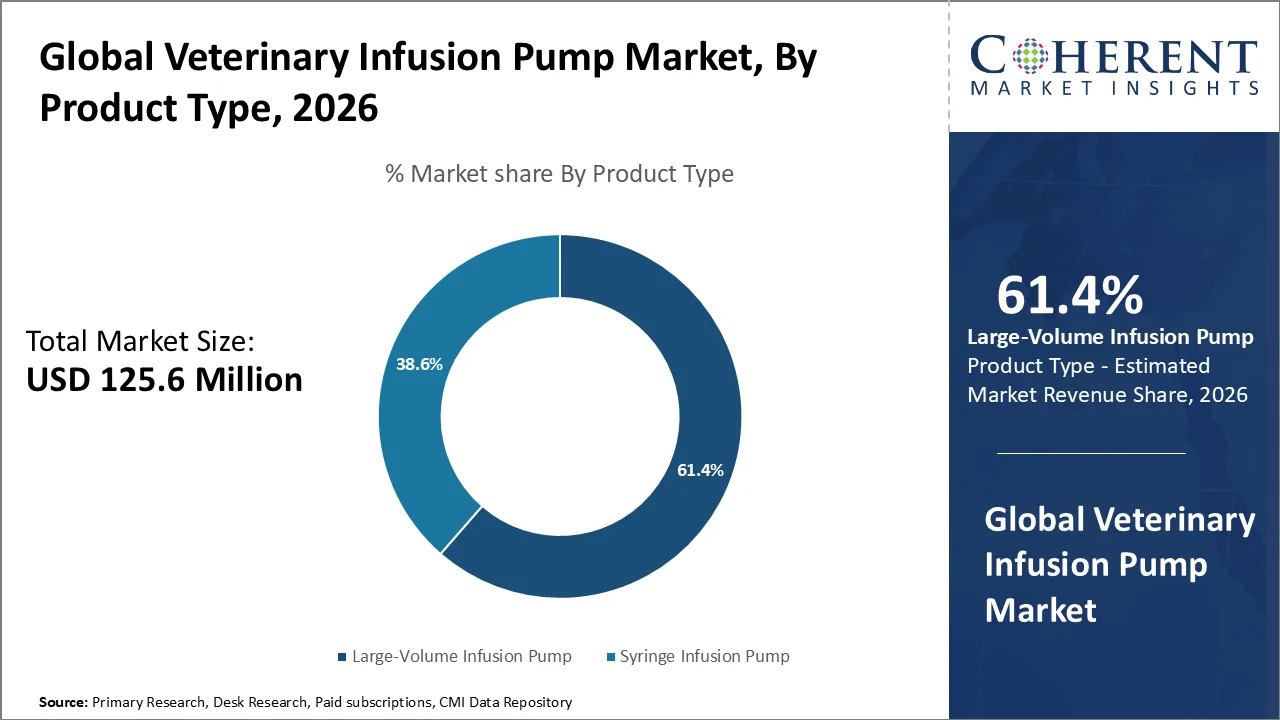
Why is Large-Volume Infusion Pump Acquiring the Largest Market Share?
Large-Volume Infusion Pump is projected to account for the largest share of cognitive systems spending in 2026, representing approximately 61.4% of the total volume. The Large-Volume Infusion Pump segment dominates the Veterinary Infusion Pump Market because it is widely used for continuous IV fluid delivery during dehydration, shock, anesthesia, surgery, blood transfusion, and post-operative care, where higher fluid volumes and controlled flow are required. In 2026, Infusion Concepts’ product guide listed the BeneFusion eVP Vet Infusion Pump with ±5% accuracy, 10+ infusion modes, dynamic pressure monitoring, anti-bolus protection, and air-bubble detection, supporting critical-care use. In January 2026, the U.S. FDA classified an Ivenix Large Volume Pump recall as Class I, highlighting the importance of safe and advanced LVP systems in clinical settings.
Source: National Veterinary Services; Shenzhen Mindray Animal Medical Technology Co., LTD.; U.S.FDA; Infusion Concepts
Veterinary Hospitals holds the Largest Market Share
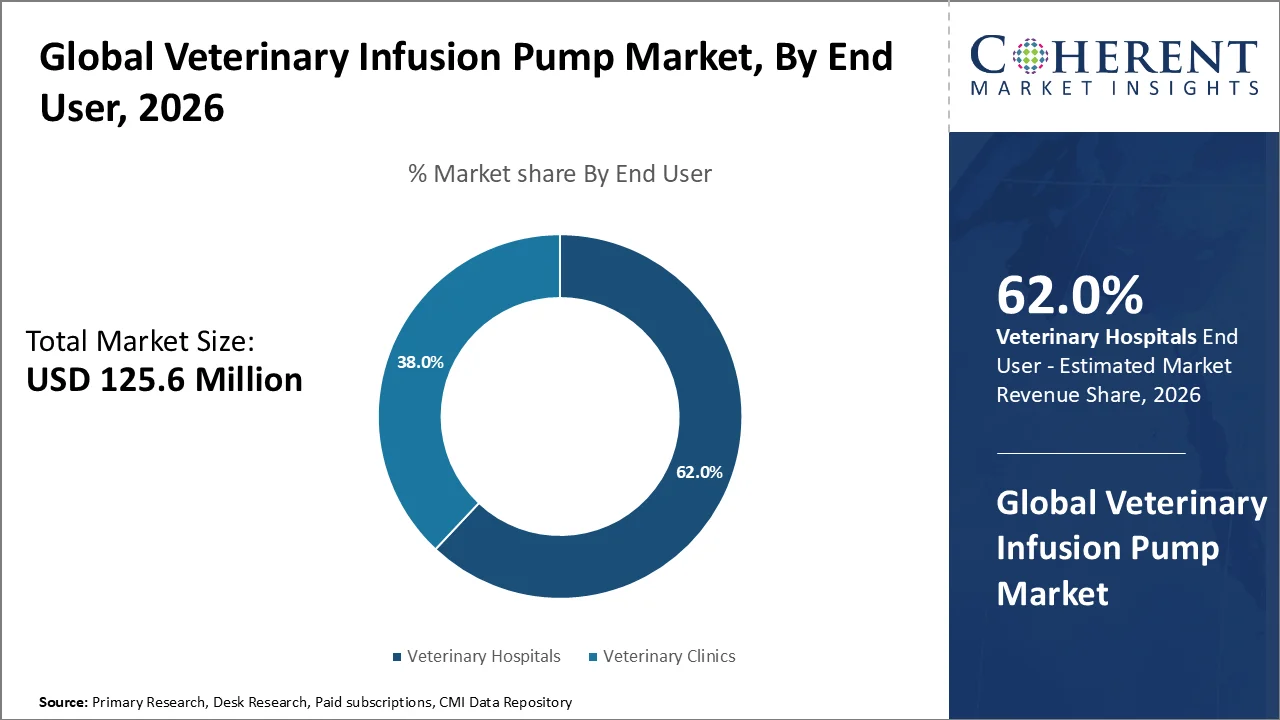
Veterinary hospitals dominate the market, accounting for a significant 62.0% share in 2026, because hospitals handle more critical cases, surgeries, anesthesia procedures, trauma, dehydration, shock, and post-operative recovery cases than small clinics. These treatments require continuous IV fluid delivery, accurate drug administration, and close monitoring. AAHA’s 2024 fluid therapy guidelines state that fluids are used in anesthesia, resuscitation, and sick-patient treatment, and that ongoing monitoring is necessary to avoid complications. APPA’s 2026 data also shows 95 million U.S. households own pets, while USD 42.4 billion is projected for U.S. vet care and product sales in 2026, supporting higher hospital visits and advanced equipment adoption. FDA’s 2026 animal medical device page also highlights infusion pump recalls used in veterinary settings, increasing preference for safer hospital-grade pumps.
Veterinary Infusion Pump Market Trends
- Shift toward smart safety monitoring and alarm-enabled pumps – Veterinary hospitals are increasingly preferring infusion pumps with pressure monitoring, air-bubble detection, battery alerts, and audio-visual alarms to reduce therapy interruption and dosing risks. In 2026, the U.S. FDA Animal Medical Devices page listed infusion pump recall alerts, including false alarm, thermal damage, and intermittent connection issues, showing stronger safety focus for devices also used in veterinary settings.
- Growing preference for large-volume and software-controlled infusion systems – Large-volume infusion pumps are gaining importance for fluid therapy, anesthesia support, shock management, and post-surgical recovery because they deliver fluids in controlled amounts. In 2026, the U.S. FDA reported a Fresenius Kabi Ivenix Large Volume Pump software correction due to anomalies that could cause serious patient harm, highlighting the need for safer software-driven infusion systems.
- Rising focus on veterinary medicine safety and adverse-event reporting – Treatment safety is becoming a major trend, encouraging veterinary facilities to adopt devices that support accurate fluid and drug delivery. In April 2026, the European Medicines Agency launched Veterinary Medicine Safety Day to encourage reporting of suspected adverse events after veterinary medicine use, including side effects, lack of efficacy, environmental impact, and unexpected reactions.
- Government support for rural and food-animal veterinary services – Public funding for veterinary service capacity is supporting equipment adoption in underserved and large-animal care settings. In 2026, USDA-NIFA stated that approximately USD 3.8 million would be available through the Veterinary Services Grant Program to mitigate food-animal veterinary service shortages in the U.S., supporting better clinical infrastructure and demand for infusion devices.
- Increasing emphasis on routine veterinary visits and preventive care – Regular veterinary care is increasing clinical touchpoints, which supports demand for infusion pumps used in illness management, dehydration, surgery, and emergency care. In May 2026, CDC’s Healthy Pets guidance stated that regular veterinary visits are essential for keeping pets and families healthy, including vaccines, deworming, flea and tick control, and veterinarian consultation.
- Adoption of precision therapy pumps with advanced technical features – Manufacturers are introducing veterinary pumps with higher accuracy, multiple infusion modes, anti-bolus protection, and dynamic monitoring. In 2026, Infusion Concepts’ product guide listed the BeneFusion eVP Vet Infusion Pump with ±5% infusion accuracy, dynamic pressure monitoring, air-bubble detection, anti-bolus safety protection, and dynamic audio-visual alarms, supporting advanced critical-care workflows.
Regional Insights
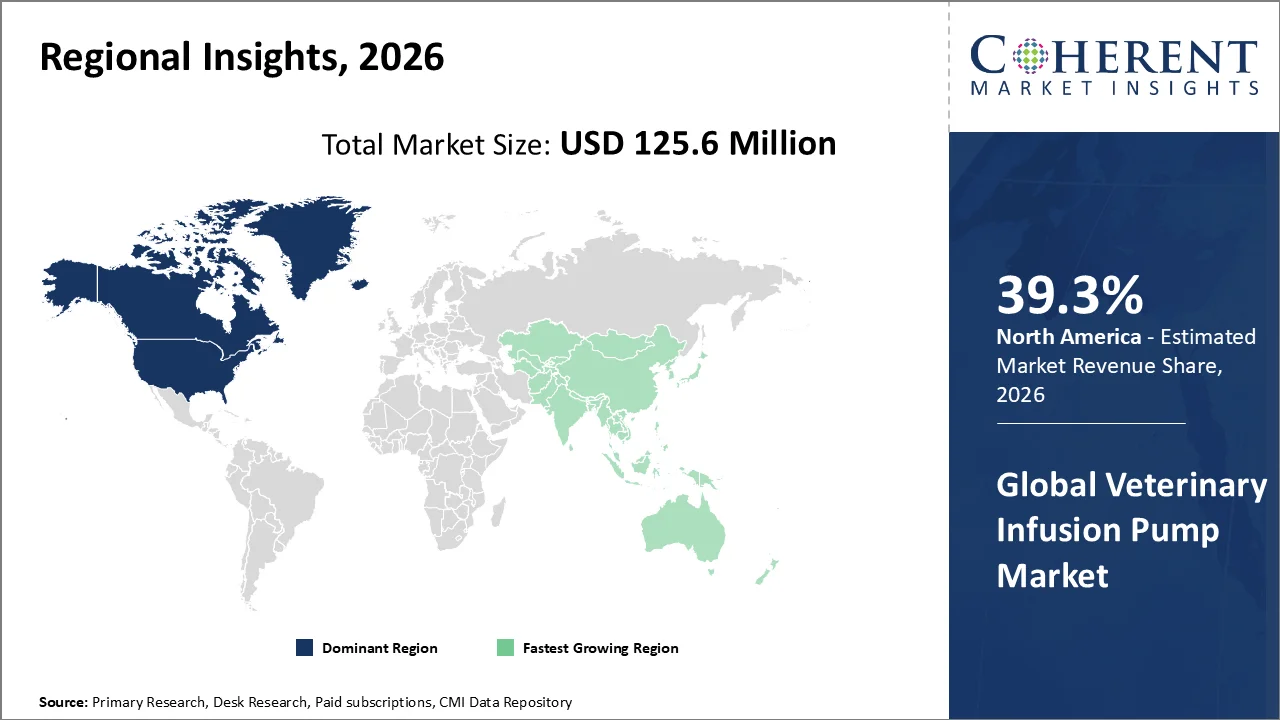
North America dominates owing to Strong Veterinary Spending
North America account 39.3% market share in 2026, due to high pet ownership, strong veterinary spending, advanced hospital infrastructure, and faster adoption of smart monitoring devices. For instance, APPA’s 2026 State of the Industry Report states that 95 million U.S. households own pets, while AVMA reported in 2026 that pet-owning households reached 77.5 million in 2025, creating a large treatment base for veterinary hospitals. AAHA’s 2024 fluid therapy guidelines highlight fluid use in anesthesia, resuscitation, and sick-patient treatment, supporting frequent use of infusion pumps in advanced care settings. In addition, the U.S. FDA’s 2026 Animal Medical Devices page shares infusion pump recall alerts for devices that may be used in veterinary settings, increasing preference for safer, alarm-enabled, hospital-grade pumps.
Asia Pacific Veterinary Infusion Pump Market Trends
The Asia-Pacific region is poised to be as the fastest-growing region through 2026-2033, owing to expansion of veterinary infrastructure and mobile care services, higher adoption of advanced treatment protocols, and rising pet population and veterinary spending in developed APAC markets. For instance, companion animal care is growing strongly in Australia, Japan, South Korea, China, and urban India. Animal Medicines Australia’s 2025 report stated that Australia had 31.6 million pets, with 73% of households owning pets, and pet owners spent US$1.9 billion on veterinary services. This supports higher use of advanced devices in veterinary hospitals and clinics.
Furthermore, large livestock base and rural animal healthcare modernization has driven the veterinary infusion pump market growth in the Asia Pacific region over the forecast period. The region has strong demand from dairy, livestock, poultry, and food-animal care. In 2026, PIB reported that India had 4,019 mobile veterinary units operational across 29 States/UTs, with veterinarians and para-veterinarians supporting animal treatment through the 1962 helpline. Such mobile and rural animal healthcare expansion supports demand for portable and reliable veterinary infusion pumps.
Growing Investment & High Pet Ownership is Accelerating the Veterinary Infusion Pump Market Demand in United States
The U.S. veterinary infusion pump market dominates North America due to its large pet treatment base, high veterinary spending, advanced veterinary hospitals, strong regulatory oversight, and government support for animal healthcare services. APPA’s 2026 data states that 95 million U.S. households own pets, while U.S. pet industry sales are projected at US$165 billion in 2026, including US$42.4 billion for vet care and product sales, supporting adoption of advanced infusion pumps in hospitals and clinics. AVMA reported in May 2026 that pet-owning households reached 77.5 million in 2025, expanding the patient pool for surgeries, dehydration care, anesthesia support, and emergency treatment. AAHA’s 2024 fluid therapy guidelines also emphasize fluid use in anesthesia, resuscitation, and sick-patient treatment, while FDA’s 2026 Animal Medical Devices page shares infusion pump recall alerts for devices that may be used in veterinary settings, increasing demand for safer, hospital-grade pumps.
India Veterinary Infusion Pump Market Trends
India has become the biggest player in the Asia Pacific veterinary infusion pump market in 2026. India dominates the Asia Pacific Veterinary Infusion Pump Market due to its large livestock base, expanding veterinary infrastructure, strong dairy and food-animal healthcare demand, and government support for veterinary capacity building. PIB reported in 2025 that India is the world’s largest livestock owner with 536.76 million livestock, including 303.76 million bovines, creating a large treatment base for fluid therapy, surgery, dehydration, and emergency care. In 2026, PIB stated that 4,019 mobile veterinary units were treating animals through the 1962 toll-free service, while veterinary colleges increased to 84, strengthening access to animal healthcare. The Union Budget 2026–27 also proposed adding more than 20,000 veterinary professionals and supporting veterinary colleges, hospitals, diagnostic laboratories, and breeding facilities, which will increase adoption of clinical devices such as infusion pumps.
Who are the Major Companies in Veterinary Infusion Pump Market
Some of the major key players in Veterinary Infusion Pump Market are B. Braun Melsungen AG, Heska Corporation, Q Core Medical Ltd., Burtons Medical Equipment Ltd., DRE Medical, Inc., Grady Medical, Promed Group Co., Ltd., and SAI Infusion Technologies.
Key News
- In 2026, Infusion Concepts, a specialist supplier of veterinary infusion solutions, featured the Mindray BeneFusion eVP Vet Infusion Pump in its Product & Service Guide 2026. The pump is designed for advanced veterinary therapy and critical care, offering multiple infusion modes, fast start-up, dynamic pressure monitoring, ±5% infusion accuracy, anti-bolus safety protection, air-bubble detection, dynamic audio-visual alarms, and compatibility with multiple giving sets. Mindray Animal Medical also highlights SmartAIR, dual ultrasound air-bubble detection, color-coded drug names, dynamic pressure system, and integrated central monitoring, supporting safer and more precise fluid delivery in veterinary hospitals and clinics.
- In April 2025, Auxilab, laboratory equipment supplier company launched the AXAVET EN-V5H VET Infusion Pump with integrated heating technology. The pump is designed for veterinary clinics and hospitals and combines fluid infusion accuracy, patient thermal comfort, and treatment safety. It offers a 0.1–2,000 mL/h flow range, six infusion modes, ±5% accuracy, six-level air-bubble detection, up to 10 hours battery autonomy, and 5,000 data records, supporting safer long-duration fluid and medication delivery in animals.
- In February 2025, Promed Technology released the IP-200D VET Veterinary Infusion Pump for veterinary hospitals. The product uses a vertical design, double CPU safety architecture, numeric keypad, adjustable occlusion pressure release, and a 3.2-inch high-brightness LCD for improved usability. It also includes occlusion detection, air-in-line alarms, eight-level audio-visual alarm adjustment, and a rechargeable lithium battery with ≥10 hours backup life.
Market Report Scope
Veterinary Infusion Pump Market Report Coverage
| Report Coverage | Details | ||
|---|---|---|---|
| Base Year: | 2025 | Market Size in 2026: | USD 125.6 Mn |
| Historical Data for: | 2020 To 2024 | Forecast Period: | 2026 To 2033 |
| Forecast Period 2026 to 2033 CAGR: | 5.6% | 2033 Value Projection: | USD 183.9 Mn |
| Geographies covered: |
| ||
| Segments covered: |
| ||
| Companies covered: | B. Braun Melsungen AG, Heska Corporation, Q Core Medical Ltd., Burtons Medical Equipment Ltd., DRE Medical, Inc., Grady Medical, Promed Group Co., Ltd., and SAI Infusion Technologies. | ||
Analyst Opinion
- The Veterinary Infusion Pump Market is moving from basic equipment adoption to essential hospital infrastructure as more pets receive clinical treatment, surgery, and emergency care. APPA’s 2026 State of the Industry Report cites 95 million U.S. households owning pets, while AVMA reported in May 2026 that pet-owning households reached 77.5 million in 2025. This larger patient base supports higher pump utilization.
- Veterinary hospitals are expected to remain the primary demand center because infusion pumps are required across anesthesia, resuscitation, dehydration, kidney disease, shock, and sick-patient management. AAHA’s 2024 Fluid Therapy Guidelines state that fluid therapy is used from anesthesia to resuscitation and sick-patient treatment, and ongoing monitoring is required. This supports adoption of accurate, alarm-enabled, hospital-grade infusion systems.
- Regulatory visibility around device performance is becoming a market catalyst, not only a compliance issue. FDA’s Animal Medical Devices page, published/updated in April 2026, says human medical device recalls and early alerts are shared because those devices may be used in veterinary settings, including infusion pump alerts. EMA’s 2026 Veterinary Medicine Safety Day also reinforces safer treatment monitoring and adverse-event reporting.
- Technology innovation is shifting purchasing decisions toward smart pumps rather than basic gravity infusion. Infusion Concepts’ 2026 guide lists the BeneFusion eVP Vet Infusion Pump with ±5% accuracy, 10+ infusion modes, dynamic pressure monitoring, anti-bolus protection, air-bubble detection, audio-visual alarms, and central workflow compatibility. These features improve precision therapy, critical-care reliability, and staff efficiency in modern veterinary hospitals.
- Government support for veterinary service expansion is widening the addressable base, especially in rural and food-animal care. USDA-NIFA stated in 2026 that about US$3.8 million would be available through the Veterinary Services Grant Program to mitigate food-animal veterinary shortages. Better-supported practices are more likely to invest in equipment for dehydration treatment, emergency stabilization, surgery, and large-animal fluid therapy.
- North America is expected to remain the leading regional market because the U.S. has a large pet-owning base, higher veterinary spending, advanced hospital infrastructure, and stronger regulatory visibility around infusion pump safety. APPA’s 2026 State of the Industry Report states that 95 million U.S. households own pets, while FDA’s 2026 animal medical device page monitors recalls for devices used in veterinary settings.
Speak to the analyst
Want personalized insights?
Take the findings above to one of our principal consultants, or have the report rebuilt around the segments, geographies and competitors you actually track.
Market Segmentation
- By Product Type (Revenue, USD Mn, 2021-2033)
- Large-Volume Infusion Pump
- Syringe Infusion Pump
- By End User (Revenue, USD Mn, 2021-2033)
- Veterinary Hospitals
- Veterinary Clinics
- By Region (Revenue, USD Mn, 2021-2033)
- North America
- U.S.
- Canada
- Latin America
- Brazil
- Mexico
- Argentina
- Rest of Latin America
- Europe
- Germany
- U.K.
- France
- Italy
- Spain
- Russia
- Rest of Europe
- Asia Pacific
- China
- India
- Japan
- Australia
- South Korea
- ASEAN
- Rest of Asia Pacific
- Middle East
- GCC
- Israel
- Rest of Middle East
- Africa
- South Africa
- Central Africa
- North Africa
- North America
Sources
Primary Research Interviews
- Interviews with veterinary hospital directors, clinic owners, and veterinary surgeons to understand adoption of infusion pumps in fluid therapy, anesthesia support, surgery, post-operative recovery, dehydration treatment, and emergency care.
- Insights from veterinary equipment manufacturers, infusion pump suppliers, and distributors on product innovation, pricing, pump accuracy, safety alarms, battery backup, service support, calibration needs, and demand for smart monitoring features.
- Discussions with veterinary anesthesiologists, critical care specialists, and ICU veterinarians to assess clinical usage patterns, preferred pump types, large-volume versus syringe pump demand, dosing accuracy requirements, and treatment safety concerns.
- Conversations with procurement managers and biomedical equipment technicians in veterinary hospitals to evaluate purchase criteria, maintenance challenges, training requirements, replacement cycles, after-sales service, and compatibility with existing hospital workflows.
- Interviews with animal healthcare consultants, industry experts, and veterinary market analysts to understand regional demand trends, competitive landscape, regulatory influence, technology adoption, and future growth opportunities in the Veterinary Infusion Pump Market.
Databases
- U.S. FDA Center for Veterinary Medicine (CVM) – Animal Medical Devices and device safety updates
- U.S. FDA Medical Device Recalls and Early Alerts Database
- FDA MAUDE Database – Medical Device Adverse Event Reports
- PubMed / National Library of Medicine (NLM)
- USDA-NIFA Veterinary Services Grant Program and Veterinary Medicine Loan Repayment Program Data
- USDA-APHIS Animal Health and Veterinary Services Database
- AVMA Pet Ownership and Veterinary Care Statistics
- APPA State of the Industry / Pet Industry Statistics
Magazines
- DVM360
- Today’s Veterinary Practice
- Veterinary Practice News
- Vet Times
- Veterinary Economics
- American Veterinarian
- Veterinary Business Journal
- Vet Practice Magazine
Journals
- Journal of Veterinary Emergency and Critical Care
- Journal of the American Veterinary Medical Association (JAVMA)
- Journal of Veterinary Internal Medicine
- Veterinary Anaesthesia and Analgesia
- Frontiers in Veterinary Science
- The Veterinary Journal
- Veterinary Record
- Journal of Small Animal Practice
Newspapers
- Reuters – Healthcare and Animal Health News
- Financial Times – Healthcare / Animal Health Business Section
- The Wall Street Journal – Healthcare and Pet Care Business Section
- The New York Times – Science / Health / Pet Care Coverage
- The Guardian – Veterinary and Animal Welfare News
- Associated Press – Healthcare and Veterinary Sector News
Associations
- American Veterinary Medical Association (AVMA)
- American Animal Hospital Association (AAHA)
- Veterinary Emergency and Critical Care Society (VECCS)
- American College of Veterinary Emergency and Critical Care (ACVECC)
- American College of Veterinary Anesthesia and Analgesia (ACVAA)
- World Small Animal Veterinary Association (WSAVA)
- British Veterinary Association (BVA)
- Federation of Veterinarians of Europe (FVE)
Public Domain Sources
- U.S. FDA – Animal Medical Devices
- U.S. FDA – Medical Device Recalls and Early Alerts
- CDC – Healthy Pets, Healthy People
- USDA-NIFA – Veterinary Services Grant Program
- USDA-NIFA – Veterinary Medicine Loan Repayment Program
- USDA-APHIS – Animal Health and Veterinary Services
- European Medicines Agency (EMA) – Veterinary Medicines and Safety Updates
- World Organisation for Animal Health (WOAH) – Animal Health Data and Reports
- AAHA Fluid Therapy Guidelines for Dogs and Cats
- Company product brochures and technical documents from Mindray Animal Medical, Infusion Concepts, B. Braun Vet Care, Eitan Medical, and Promed Technology.
Proprietary Elements
- CMI Data Analytics Tool
- Proprietary CMI Existing Repository of information for last 10 years
Get access to 250+ pages report
Every segment, forecast, competitor profile and data table behind the analysis above — available for instant download.
- ESOMAR Member
- ISO 9001:2015 Certified
- D-U-N-S Registered
- GDPR & CCPA Compliant
Missing comfort of reading report in your local language? Find your preferred language:
Transform your Strategy with Exclusive Trending Reports
Frequently Asked Questions
The Veterinary Infusion Pump Market is expected to reach USD 125.6 Mn in 2033.
Major players operating in the global Veterinary Infusion Pump Market include B. Braun Melsungen AG, Heska Corporation, Q Core Medical Ltd., Burtons Medical Equipment Ltd., DRE Medical, Inc., Grady Medical, Promed Group Co., Ltd., and SAI Infusion Technologies.
Lack of trained veterinary staff and regulatory and service complexity are the major factors hampering the growth of the veterinary infusion pump market.
Rising pet ownership and pet healthcare spending and growth in veterinary surgeries and critical care procedures are the factors driving the growth of the global veterinary infusion pump market.
The Veterinary Infusion Pump Market is anticipated to grow at a CAGR of 5.6% between 2026 and 2033.
Among regions, North America is expected to account for a largest market share in the global Veterinary Infusion Pump Market over the forecast period.
Veterinary infusion pump is used to deliver fluids, drugs, anesthesia support, nutrition, and blood products at controlled flow rates. It is commonly used during surgery, dehydration treatment, shock management, critical care, and post-operative recovery in companion animals, livestock, and exotic pets.